Effective Leadership in Healthcare Management and Clinical Outcomes

Verified

Added on  2023/04/21

|5
|559
|199
Essay
AI Summary
This essay examines the critical role of leadership in the medical profession, based on research from Health Workforce Australia (2012) and Nelsey and Brownie (2012). It highlights that effective leadership, not just formal roles, is essential for driving healthcare improvements and achieving common goals. Research indicates that well-managed healthcare facilities with efficient leadership result in fewer patient complaints. The essay emphasizes the importance of individual initiative and prompt decision-making by clinicians, which positively influences colleagues and fosters innovation. Furthermore, it discusses how leadership qualities are vital for managing healthcare units cost-effectively, resolving conflicts, and ensuring staff retention, ultimately improving the delivery of healthcare services.

Document Page
Running head: PARAPHRASE
PARAPHRASE
Name of the Student
Name of the University
Author Note
tabler-icon-diamond-filled.svg

Paraphrase This Document

Need a fresh take? Get an instant paraphrase of this document with our AI Paraphraser
Document Page
1PARAPHRASE
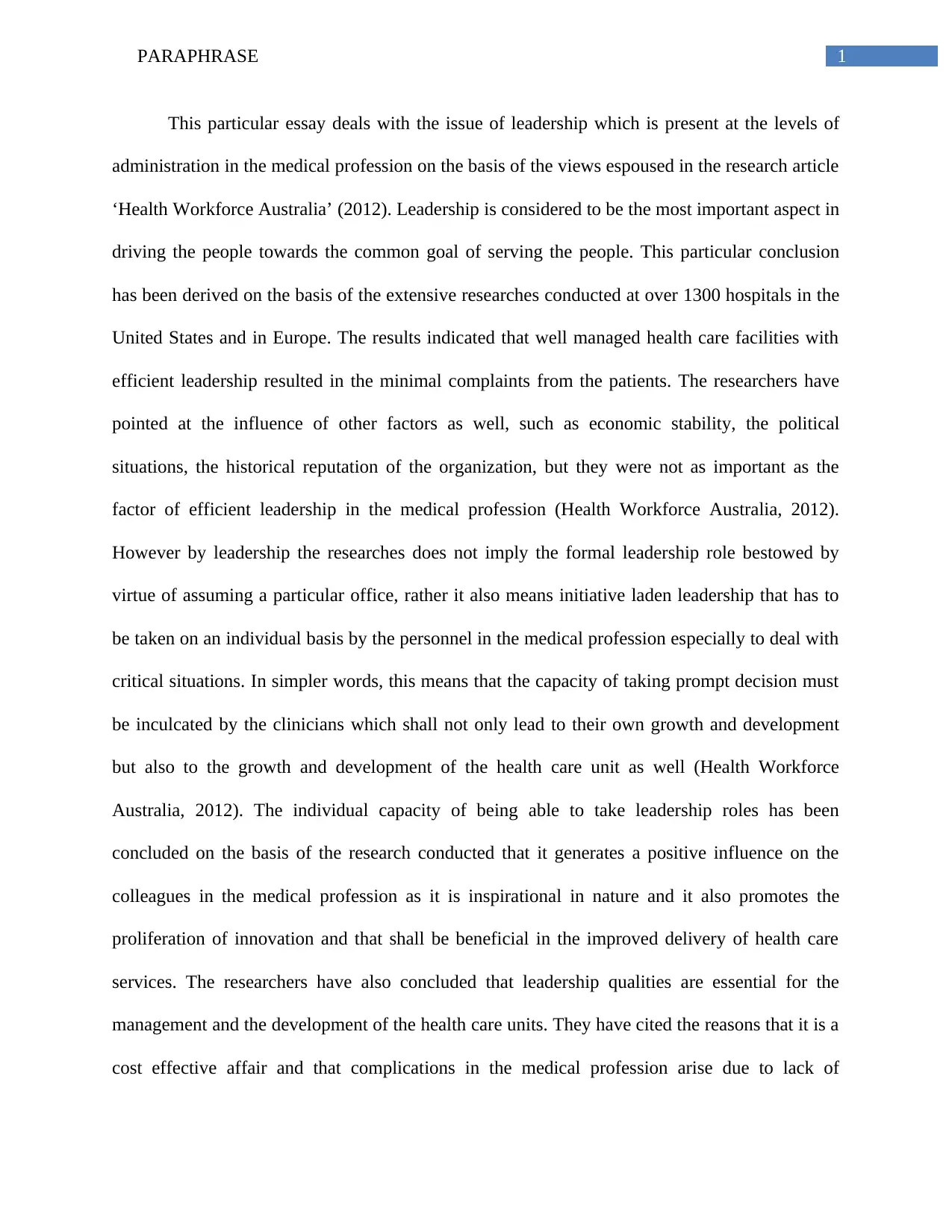
This particular essay deals with the issue of leadership which is present at the levels of
administration in the medical profession on the basis of the views espoused in the research article
‘Health Workforce Australia’ (2012). Leadership is considered to be the most important aspect in
driving the people towards the common goal of serving the people. This particular conclusion
has been derived on the basis of the extensive researches conducted at over 1300 hospitals in the
United States and in Europe. The results indicated that well managed health care facilities with
efficient leadership resulted in the minimal complaints from the patients. The researchers have
pointed at the influence of other factors as well, such as economic stability, the political
situations, the historical reputation of the organization, but they were not as important as the
factor of efficient leadership in the medical profession (Health Workforce Australia, 2012).
However by leadership the researches does not imply the formal leadership role bestowed by
virtue of assuming a particular office, rather it also means initiative laden leadership that has to
be taken on an individual basis by the personnel in the medical profession especially to deal with
critical situations. In simpler words, this means that the capacity of taking prompt decision must
be inculcated by the clinicians which shall not only lead to their own growth and development
but also to the growth and development of the health care unit as well (Health Workforce
Australia, 2012). The individual capacity of being able to take leadership roles has been
concluded on the basis of the research conducted that it generates a positive influence on the
colleagues in the medical profession as it is inspirational in nature and it also promotes the
proliferation of innovation and that shall be beneficial in the improved delivery of health care
services. The researchers have also concluded that leadership qualities are essential for the
management and the development of the health care units. They have cited the reasons that it is a
cost effective affair and that complications in the medical profession arise due to lack of
Document Page
2PARAPHRASE
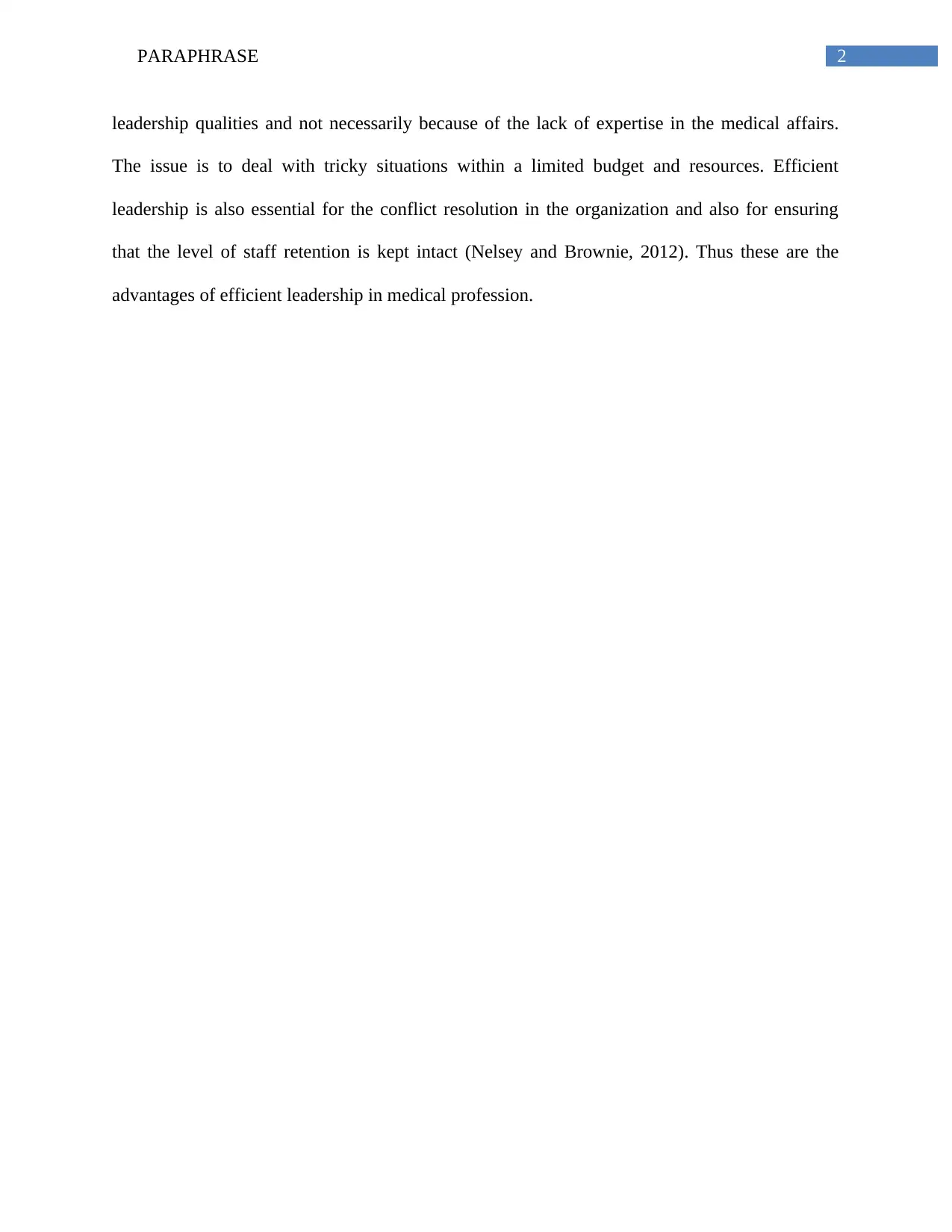
leadership qualities and not necessarily because of the lack of expertise in the medical affairs.
The issue is to deal with tricky situations within a limited budget and resources. Efficient
leadership is also essential for the conflict resolution in the organization and also for ensuring
that the level of staff retention is kept intact (Nelsey and Brownie, 2012). Thus these are the
advantages of efficient leadership in medical profession.
Document Page
3PARAPHRASE
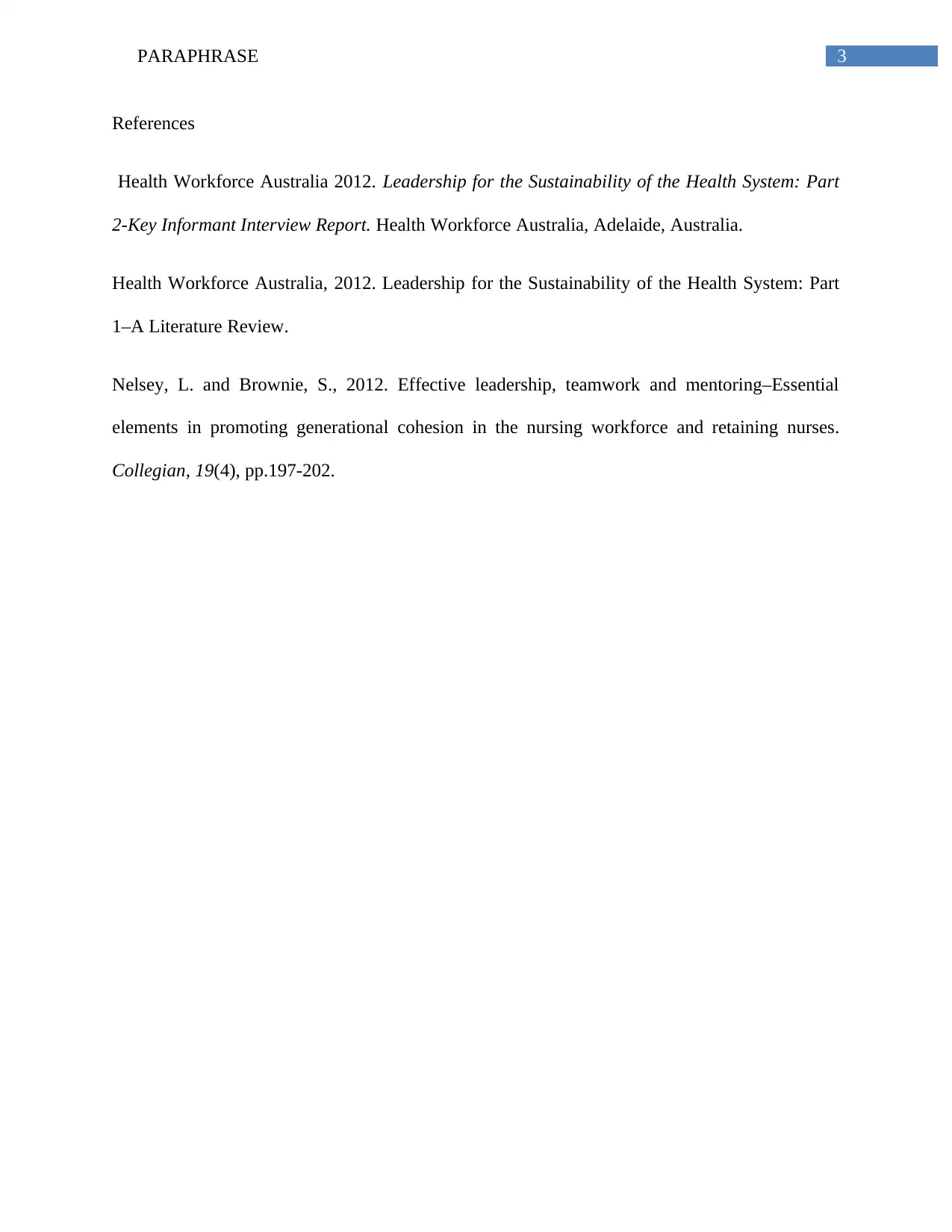
References
Health Workforce Australia 2012. Leadership for the Sustainability of the Health System: Part
2-Key Informant Interview Report. Health Workforce Australia, Adelaide, Australia.
Health Workforce Australia, 2012. Leadership for the Sustainability of the Health System: Part
1–A Literature Review.
Nelsey, L. and Brownie, S., 2012. Effective leadership, teamwork and mentoring–Essential
elements in promoting generational cohesion in the nursing workforce and retaining nurses.
Collegian, 19(4), pp.197-202.
tabler-icon-diamond-filled.svg

Paraphrase This Document

Need a fresh take? Get an instant paraphrase of this document with our AI Paraphraser
Document Page
4PARAPHRASE
chevron_up_icon
1 out of 5
circle_padding
hide_on_mobile
zoom_out_icon
[object Object]