Comprehensive Analysis: Key Characteristics of Literature Review
VerifiedAdded on 2023/01/16
|10
|3062
|54
Report
AI Summary
This report provides an in-depth analysis of the key characteristics of an effective literature review. It begins by defining literature review and its importance in research, followed by an examination of its essential components. The report emphasizes the importance of clearly stated objectives, an explicit and reproducible methodology, and a systematic search for relevant information. It also discusses the assessment of the validity of findings and the systematic presentation and synthesis of the data. The report highlights the need for an organized and structured approach to literature review, ensuring that all relevant aspects are addressed to provide a comprehensive overview of the topic. It emphasizes the importance of proper referencing and the inclusion of diverse perspectives to create a well-rounded and credible research foundation. Overall, the report provides a detailed guide for researchers, offering valuable insights into conducting and presenting an effective literature review.

Research
Methodology
Methodology

Paraphrase This Document
Need a fresh take? Get an instant paraphrase of this document with our AI Paraphraser
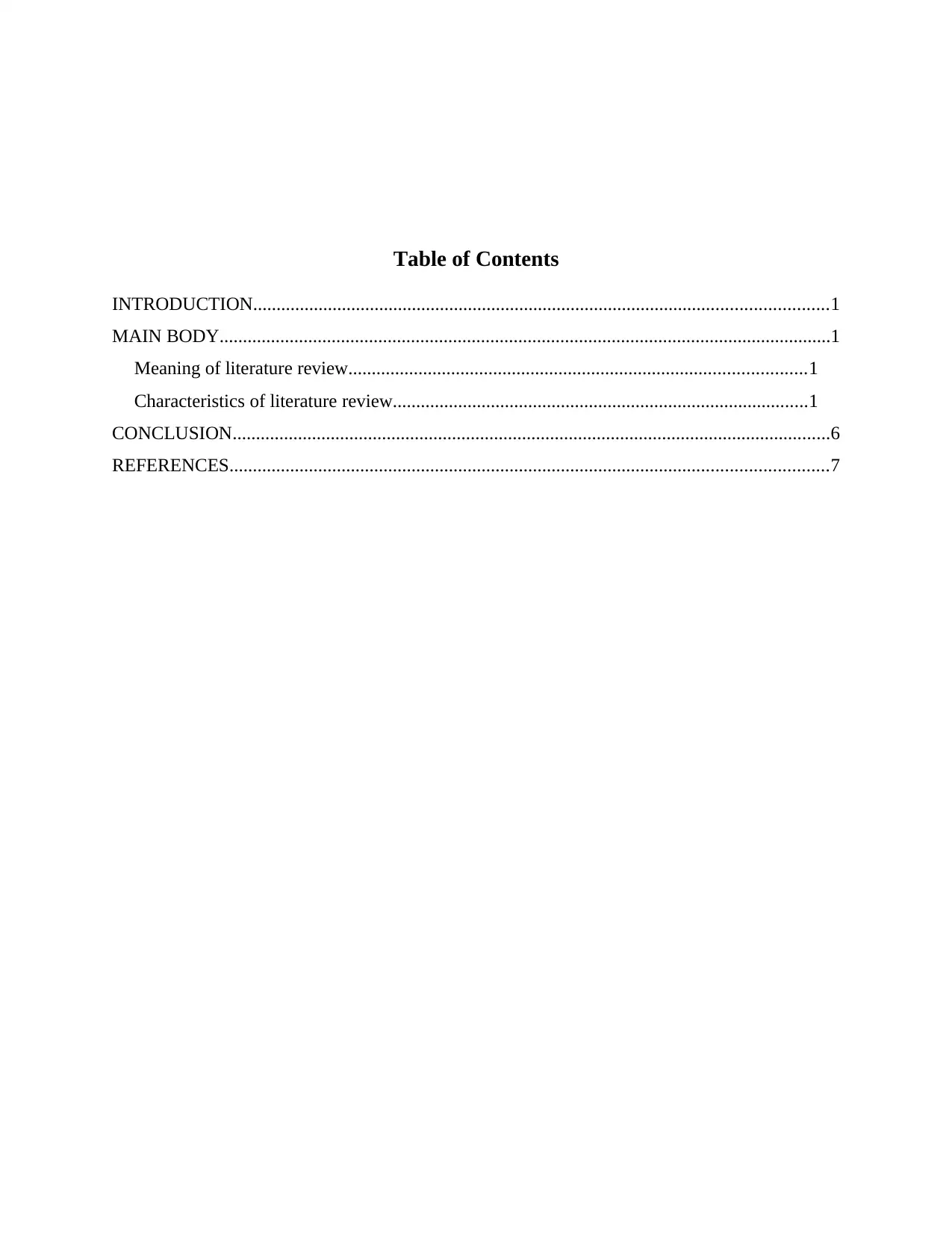
Table of Contents
INTRODUCTION...........................................................................................................................1
MAIN BODY...................................................................................................................................1
Meaning of literature review..................................................................................................1
Characteristics of literature review.........................................................................................1
CONCLUSION................................................................................................................................6
REFERENCES................................................................................................................................7
INTRODUCTION...........................................................................................................................1
MAIN BODY...................................................................................................................................1
Meaning of literature review..................................................................................................1
Characteristics of literature review.........................................................................................1
CONCLUSION................................................................................................................................6
REFERENCES................................................................................................................................7
INTRODUCTION
Literature review can be defined as the summary of the whole research to enable the
reader or user to have an idea about the matter in a concise form. In other words, it is a
systematic, explicit and reproducible method for assessing, evaluating and arrange the all the
facts which have been defined by the researchers, scholars and practitioners (Wu and et. Al.,
2018). There are many objectives of an effective literature review which should be kept in mind
while framing literature review. In this report, main characteristics to conduct an effective
systematic literature review has been elaborated with lots of details.
MAIN BODY
Meaning of literature review
Literature in literal sense, refers to the material which is published and available on a
specific subject. This comprises of advices which is an art having some value. It can be in
different forms and languages. On the other hand, review means comprehensive and thorough
analysis of the a particular topic. This is useful for both novice and experiences researchers. On
using these two different words, the meaning generated is that number of documents are
containing information, ideas and evidence are chosen which describe aims or views of the
researcher on the particular topic.
According to Lawerence & McEvoy, literature review has been defined as “an evidence
based review of relevant reference material.” This definition has particularly focused on the
matter included in literature review which is the evidence about the written matter (Alter and
Haydon, 2017). In the words of Paula, literature review is “the selection of available documents
(both published and unpublished) on the topic, which contain information, ideas, data and
evidence written form a particular standpoint to fulfil certain aims or express certain views on
the nature of the topic and how it is to be investigated, and the effective evaluation of these
documents in relation to the research being proposed.”
Characteristics of literature review
Literature review is the landscape about the all the details in the report therefore, it should
be in a sorted manner. There are variety of key characteristics which should be taken into mind
while conducting effective literature review. These are as follows:
1
Literature review can be defined as the summary of the whole research to enable the
reader or user to have an idea about the matter in a concise form. In other words, it is a
systematic, explicit and reproducible method for assessing, evaluating and arrange the all the
facts which have been defined by the researchers, scholars and practitioners (Wu and et. Al.,
2018). There are many objectives of an effective literature review which should be kept in mind
while framing literature review. In this report, main characteristics to conduct an effective
systematic literature review has been elaborated with lots of details.
MAIN BODY
Meaning of literature review
Literature in literal sense, refers to the material which is published and available on a
specific subject. This comprises of advices which is an art having some value. It can be in
different forms and languages. On the other hand, review means comprehensive and thorough
analysis of the a particular topic. This is useful for both novice and experiences researchers. On
using these two different words, the meaning generated is that number of documents are
containing information, ideas and evidence are chosen which describe aims or views of the
researcher on the particular topic.
According to Lawerence & McEvoy, literature review has been defined as “an evidence
based review of relevant reference material.” This definition has particularly focused on the
matter included in literature review which is the evidence about the written matter (Alter and
Haydon, 2017). In the words of Paula, literature review is “the selection of available documents
(both published and unpublished) on the topic, which contain information, ideas, data and
evidence written form a particular standpoint to fulfil certain aims or express certain views on
the nature of the topic and how it is to be investigated, and the effective evaluation of these
documents in relation to the research being proposed.”
Characteristics of literature review
Literature review is the landscape about the all the details in the report therefore, it should
be in a sorted manner. There are variety of key characteristics which should be taken into mind
while conducting effective literature review. These are as follows:
1
⊘ This is a preview!⊘
Do you want full access?
Subscribe today to unlock all pages.

Trusted by 1+ million students worldwide
Clearly stated set of objectives - Objectives are the base on which the whole research is
to be carried for determining the results. This shows the invention of the researcher based on the
defined criteria. This is the main element which the researcher is trying to achieve through the
research. Clearly defined objectives mean it should be intelligible together with all the
knowledge of the areas which are to be covered in the literature review. Literature review is
conducted on the basis of well defined objectives by giving different perceptions and definitions
of the authors related to the particular topic (Herjanto and Franklin, 2019).
If the objectives are vague then there are high chances that literature review may not
reflect the exact and true meaning of the data which is related to the main objectives. These
should define the time within which the whole task has to be completed. Furthermore, this
should comprise of the main points only without any irrelevant information so that only precise
information can be obtained for the objectives.
Together with this, there should be a well designed research protocol defining the
background, objectives, purpose and all other details which the researcher should include in the
literature review. In nutshell, the objectives should be simple, direct, specific and it should be
mentioned before the researcher is done (Pautasso, 2019).
An explicit, reproducible methodology- Methodology is the techniques which are used
in obtained the information from different sources. This include the details which can be copied
by some other individuals in future. The methods are based on scientific evidence to be used in
providing clear information. There are primary sources as well as secondary sources which can
be used in obtaining the direct data. There should not be any confusion or doubt in the sections
included in literature review.
The methods in a systematic literature review can be used in a repetitive mode which can
further be copied. There are different methods which can be used for extracting explicit data.
However, the most appropriate method must be opted for conducting effective literature review
which can provide authentic data without any bias.
Every information is based on the certain determinations which should be stable and
number of measurements should be taken into account. Along with this, there should be
standardisation about the techniques. In other words, there should be some common base for
using the chosen method (Jahan and et. al., 2016). There are number of methods such as
experiments which comprise of number of variables to be used for conducting the tests.
2
to be carried for determining the results. This shows the invention of the researcher based on the
defined criteria. This is the main element which the researcher is trying to achieve through the
research. Clearly defined objectives mean it should be intelligible together with all the
knowledge of the areas which are to be covered in the literature review. Literature review is
conducted on the basis of well defined objectives by giving different perceptions and definitions
of the authors related to the particular topic (Herjanto and Franklin, 2019).
If the objectives are vague then there are high chances that literature review may not
reflect the exact and true meaning of the data which is related to the main objectives. These
should define the time within which the whole task has to be completed. Furthermore, this
should comprise of the main points only without any irrelevant information so that only precise
information can be obtained for the objectives.
Together with this, there should be a well designed research protocol defining the
background, objectives, purpose and all other details which the researcher should include in the
literature review. In nutshell, the objectives should be simple, direct, specific and it should be
mentioned before the researcher is done (Pautasso, 2019).
An explicit, reproducible methodology- Methodology is the techniques which are used
in obtained the information from different sources. This include the details which can be copied
by some other individuals in future. The methods are based on scientific evidence to be used in
providing clear information. There are primary sources as well as secondary sources which can
be used in obtaining the direct data. There should not be any confusion or doubt in the sections
included in literature review.
The methods in a systematic literature review can be used in a repetitive mode which can
further be copied. There are different methods which can be used for extracting explicit data.
However, the most appropriate method must be opted for conducting effective literature review
which can provide authentic data without any bias.
Every information is based on the certain determinations which should be stable and
number of measurements should be taken into account. Along with this, there should be
standardisation about the techniques. In other words, there should be some common base for
using the chosen method (Jahan and et. al., 2016). There are number of methods such as
experiments which comprise of number of variables to be used for conducting the tests.
2
Paraphrase This Document
Need a fresh take? Get an instant paraphrase of this document with our AI Paraphraser
Surveys are another form of method which allows the researcher collect information from
a large number of people. For this purpose, questionnaire can be used. This contains number of
questions that can be asked to the participants through interviews. Case studies is that method in
which one specific case is studied in detail. This is completely based on the observation which
takes into account some criteria which can be considered for the analysis.
Observation trials study the issues in large groups of people. This method of research is
generally used in analysing the health of the people have participated in the research. In other
words, it can be said that the behaviour of the people is being monitored regularly for obtaining
results which can be used (de Guinea and Paré, 2017).
Systematic search for the identification of all areas in meet the eligibility criteria:
Every literature review is conducted for one specific area of a particular topic in order to deliver
the stated objectives. There are number of ways through which the data can be gathered so that
the main aims can be met. One of the main components for the same is that there should be a
sample size of population who are going to be questioned about the topic in order to gather the
data. This can be as many as the researcher thinks fit.
Furthermore, the information obtained from the participants are raw as they have to
interpret for converting them into something meaningful which can be used by the researchers.
There should be different interventions of various authors. This is possible by including the
arguments of different researchers, scholars etc. A topic can have both positive as well as
negative points which should be consider for ascertaining the overall meaning of all the
objectives (Booth, Sutton and Papaioannou, 2016).
A research is divided into different segments in which literature review being the most
important part as it gives a glimpse of the overall research material. Furthermore, the use of one
specific methods such as primary research can be one of the criteria of the research. In other
terms, it can be said that literature search can be useful for meeting all the criteria which can be
different in every research.
Literature review should include the matters which comprise of the definitions given by
different authors. These may be published content based on number of factors. However, no such
information or statements should be included which may be ambiguous or not appropriate. In
other words, the matters covered in the literature review should contain all the necessary data
which can be interpreted later on. Every paragraph of literature review has to be based on the
3
a large number of people. For this purpose, questionnaire can be used. This contains number of
questions that can be asked to the participants through interviews. Case studies is that method in
which one specific case is studied in detail. This is completely based on the observation which
takes into account some criteria which can be considered for the analysis.
Observation trials study the issues in large groups of people. This method of research is
generally used in analysing the health of the people have participated in the research. In other
words, it can be said that the behaviour of the people is being monitored regularly for obtaining
results which can be used (de Guinea and Paré, 2017).
Systematic search for the identification of all areas in meet the eligibility criteria:
Every literature review is conducted for one specific area of a particular topic in order to deliver
the stated objectives. There are number of ways through which the data can be gathered so that
the main aims can be met. One of the main components for the same is that there should be a
sample size of population who are going to be questioned about the topic in order to gather the
data. This can be as many as the researcher thinks fit.
Furthermore, the information obtained from the participants are raw as they have to
interpret for converting them into something meaningful which can be used by the researchers.
There should be different interventions of various authors. This is possible by including the
arguments of different researchers, scholars etc. A topic can have both positive as well as
negative points which should be consider for ascertaining the overall meaning of all the
objectives (Booth, Sutton and Papaioannou, 2016).
A research is divided into different segments in which literature review being the most
important part as it gives a glimpse of the overall research material. Furthermore, the use of one
specific methods such as primary research can be one of the criteria of the research. In other
terms, it can be said that literature search can be useful for meeting all the criteria which can be
different in every research.
Literature review should include the matters which comprise of the definitions given by
different authors. These may be published content based on number of factors. However, no such
information or statements should be included which may be ambiguous or not appropriate. In
other words, the matters covered in the literature review should contain all the necessary data
which can be interpreted later on. Every paragraph of literature review has to be based on the
3
objectives mentioned for the research. There should not be a single thing which is to be left
behind otherwise it will not make the researcher to meet the eligibility criteria.
There should be a conclusions of more than two publications in order to prove the point.
However, every such review should be authentic and based on the evidence in order to give a
support to the literature review. This helps in getting new insights to the same topic showing the
significant impacts on the intervention. This can be done by designing a research protocol for
meeting all the criteria (Machi and McEvoy, 2016).
A research protocol defines all the basic details which should be considered as they work
guidelines for the whole research. This provides the way in which literature reviews are to be
written so that the reader can understand about the research. Furthermore, there should not be
any duplication in the work otherwise this can affect the authenticity of the information
contained in the literature review.
An assessment of the validity of the findings- The literature review is all about the
findings that can be extracted through the research material. Every part of LR is based on certain
presumptions defining the risks involved. There should be some validity and authenticity in order
to include in the literature review. The data should be interpreted in an effective way so as to
reduce the amount of risk involved.
Every article should be properly referenced in order to support the objectives on the basis
of which systematic literature review is conducted. This can be attained through number of
techniques and tools which have minimum factor of risk. There can be biasses in the argument of
authors which may be based on certain amount of risk. Therefore, it should be the practice to
reduce it to an extent which can provide desirable data (Singh, 2017).
The risk of bias can be categorised into different categories such as selection bias,
performance bias, detection bias, attrition bias and many more. There can be different types of
risk which can hamper the validity of the information obtained by the researcher. This can be
done with the application of sensitivity analysis which ensures the correct reporting of the
findings. The evaluation risk should be done which helps in enhancing the transparency and
reproducibility.
In the absence of strong empirical evidence, methodological decisions in this guidance
document rely on epidemiological principles. Thus, this guidance document presents a
conservative path forward. Systematic reviewers have the responsibility to evaluate potential
4
behind otherwise it will not make the researcher to meet the eligibility criteria.
There should be a conclusions of more than two publications in order to prove the point.
However, every such review should be authentic and based on the evidence in order to give a
support to the literature review. This helps in getting new insights to the same topic showing the
significant impacts on the intervention. This can be done by designing a research protocol for
meeting all the criteria (Machi and McEvoy, 2016).
A research protocol defines all the basic details which should be considered as they work
guidelines for the whole research. This provides the way in which literature reviews are to be
written so that the reader can understand about the research. Furthermore, there should not be
any duplication in the work otherwise this can affect the authenticity of the information
contained in the literature review.
An assessment of the validity of the findings- The literature review is all about the
findings that can be extracted through the research material. Every part of LR is based on certain
presumptions defining the risks involved. There should be some validity and authenticity in order
to include in the literature review. The data should be interpreted in an effective way so as to
reduce the amount of risk involved.
Every article should be properly referenced in order to support the objectives on the basis
of which systematic literature review is conducted. This can be attained through number of
techniques and tools which have minimum factor of risk. There can be biasses in the argument of
authors which may be based on certain amount of risk. Therefore, it should be the practice to
reduce it to an extent which can provide desirable data (Singh, 2017).
The risk of bias can be categorised into different categories such as selection bias,
performance bias, detection bias, attrition bias and many more. There can be different types of
risk which can hamper the validity of the information obtained by the researcher. This can be
done with the application of sensitivity analysis which ensures the correct reporting of the
findings. The evaluation risk should be done which helps in enhancing the transparency and
reproducibility.
In the absence of strong empirical evidence, methodological decisions in this guidance
document rely on epidemiological principles. Thus, this guidance document presents a
conservative path forward. Systematic reviewers have the responsibility to evaluate potential
4
⊘ This is a preview!⊘
Do you want full access?
Subscribe today to unlock all pages.
Trusted by 1+ million students worldwide
sources of bias and error if these concerns could plausibly influence study results; we include
these concerns even if no empirical evidence exists that they influence study results.
Systematic presentation and synthesis of the characteristics and findings- This is
about the classification of all the data in suitable categories for finding extracting a meaning.
Literature review can have different contents and definitions which should be presented
systematically. There are number of ways in which the information can be presented so that
reader can understand the whole thing. Furthermore, it is necessary to define all the main
features of the outcomes and then sync them together to give a whole picture of the research
material (Fink, 2019).
This is about the analysis of the data so gathered. A literature review is incomplete and
meaningless without proper analysis. This can be done through the interpretation on the basis of
the answers received by the respondents. A piece of literature review comprise of different
paragraphs giving basic to in depth details. Therefore, it becomes imperative to put them under
the right headings for knowing the whole scenario. If the pieces of work is not combined then
there will not be any meaning about the research.
This part includes the data gathered from different sources which are further analysed to
sort them out. The information can be combined in a narrative form as well as statistically based
on the requirement of the researcher (Aburn, Gott and Hoare, 2016). This is known as meta
analysis which refers to the inclusion of the independent articles from various sources.
Furthermore, if the studies are heterogeneous the it is appropriate to frame them in a narrative
manner and vice versa.
There may be some literature review which is required to be presented in a summary
form. The statistical presentation of the data should include tables, graphs, numerical and
graphical presentations. This is easy to understand and read as well as the results can be
expressed in a numerical form that makes is less complexed for the researcher to determine the
estimation. (Thomé, Scavarda and Scavarda, 2016)
There are number of strengths and weaknesses based on the methods. Also, there can be
number of inconsistencies which should be removed from the overall literature review to make it
effective. There are are number of steps which should be followed for presenting the whole
literature review, this may include flow chart of studies to be made the part of literature reviews.
5
these concerns even if no empirical evidence exists that they influence study results.
Systematic presentation and synthesis of the characteristics and findings- This is
about the classification of all the data in suitable categories for finding extracting a meaning.
Literature review can have different contents and definitions which should be presented
systematically. There are number of ways in which the information can be presented so that
reader can understand the whole thing. Furthermore, it is necessary to define all the main
features of the outcomes and then sync them together to give a whole picture of the research
material (Fink, 2019).
This is about the analysis of the data so gathered. A literature review is incomplete and
meaningless without proper analysis. This can be done through the interpretation on the basis of
the answers received by the respondents. A piece of literature review comprise of different
paragraphs giving basic to in depth details. Therefore, it becomes imperative to put them under
the right headings for knowing the whole scenario. If the pieces of work is not combined then
there will not be any meaning about the research.
This part includes the data gathered from different sources which are further analysed to
sort them out. The information can be combined in a narrative form as well as statistically based
on the requirement of the researcher (Aburn, Gott and Hoare, 2016). This is known as meta
analysis which refers to the inclusion of the independent articles from various sources.
Furthermore, if the studies are heterogeneous the it is appropriate to frame them in a narrative
manner and vice versa.
There may be some literature review which is required to be presented in a summary
form. The statistical presentation of the data should include tables, graphs, numerical and
graphical presentations. This is easy to understand and read as well as the results can be
expressed in a numerical form that makes is less complexed for the researcher to determine the
estimation. (Thomé, Scavarda and Scavarda, 2016)
There are number of strengths and weaknesses based on the methods. Also, there can be
number of inconsistencies which should be removed from the overall literature review to make it
effective. There are are number of steps which should be followed for presenting the whole
literature review, this may include flow chart of studies to be made the part of literature reviews.
5
Paraphrase This Document
Need a fresh take? Get an instant paraphrase of this document with our AI Paraphraser
Apart from this, there are number of tools which can be used for producing the best result
which is of good quality. All the outcomes should be gathered together in order to make them
meaningful. This can be presented in different sections or tasks depending on the choice of the
researcher. Hence, it can be said that past data can be covered in this for making the literature
review effective and intelligible for the reader.
There are three common mistakes that researchers make when including literature
reviews in the discussion section. First, they mention all sorts of studies, some of which are not
even relevant to the topic under investigation. Second, instead of citing the original article, they
cite a related article that mentions the original article (Mortenson and Vidgen, 2016). Lastly,
some authors cite previous work solely based on the abstract, without even going through the
entire paper. These mistakes should be avoided in order to maintain the quality of the literature
review.
CONCLUSION
It can be concluded from the report that there are certain objectives which have been set
in the initial stages of this research work. There is a systematic research which has been carried
out and is related with the assessment of the criteria which has been decided by the researcher.
There have been a detailed risk assessment which has helped in reduction of risk up to a great
extent and also understand the validity of findings. There has been a systematic presentation and
synthesis which has lead to successful completion of the research work in the specified time
period. Research protocol is also a tool which has been used for minimization of any errors.
There has been also usage of many different types of methods such as experiment, questionnaire
which has lead to collection of authentic information by the researcher and then further analysing
it in completion of whole research.
6
which is of good quality. All the outcomes should be gathered together in order to make them
meaningful. This can be presented in different sections or tasks depending on the choice of the
researcher. Hence, it can be said that past data can be covered in this for making the literature
review effective and intelligible for the reader.
There are three common mistakes that researchers make when including literature
reviews in the discussion section. First, they mention all sorts of studies, some of which are not
even relevant to the topic under investigation. Second, instead of citing the original article, they
cite a related article that mentions the original article (Mortenson and Vidgen, 2016). Lastly,
some authors cite previous work solely based on the abstract, without even going through the
entire paper. These mistakes should be avoided in order to maintain the quality of the literature
review.
CONCLUSION
It can be concluded from the report that there are certain objectives which have been set
in the initial stages of this research work. There is a systematic research which has been carried
out and is related with the assessment of the criteria which has been decided by the researcher.
There have been a detailed risk assessment which has helped in reduction of risk up to a great
extent and also understand the validity of findings. There has been a systematic presentation and
synthesis which has lead to successful completion of the research work in the specified time
period. Research protocol is also a tool which has been used for minimization of any errors.
There has been also usage of many different types of methods such as experiment, questionnaire
which has lead to collection of authentic information by the researcher and then further analysing
it in completion of whole research.
6
REFERENCES
Books & Journals:
Aburn, G., Gott, M. and Hoare, K., 2016. What is resilience? An integrative review of the
empirical literature. Journal of advanced nursing. 72(5). pp.980-1000.
Alter, P. and Haydon, T., 2017. Characteristics of effective classroom rules: A review of the
literature. Teacher Education and Special Education. 40(2). pp.114-127.
Booth, A., Sutton, A. and Papaioannou, D., 2016. Systematic approaches to a successful
literature review. Sage.
de Guinea, A.O. and Paré, G., 2017. What literature review type should I conduct? 1. In The
Routledge Companion to Management Information Systems (pp. 73-82). Routledge.
Fink, A., 2019. Conducting research literature reviews: From the internet to paper. Sage
publications.
Herjanto, H. and Franklin, D., 2019. Investigating salesperson performance factors: A systematic
review of the literature on the characteristics of effective salespersons. Australasian
Marketing Journal (AMJ). 27(2). pp.104-112.
Jahan, N., and et. al., 2016. How to conduct a systematic review: a narrative literature
review. Cureus. 8(11).
Machi, L.A. and McEvoy, B.T., 2016. The literature review: Six steps to success. Corwin Press.
Mortenson, M.J. and Vidgen, R., 2016. A computational literature review of the technology
acceptance model. International Journal of Information Management. 36(6). pp.1248-
1259.
Pautasso, M., 2019. The Structure and Conduct of a Narrative Literature Review. A Guide to the
Scientific Career: Virtues, Communication, Research and Academic Writing, pp.299-
310.
Singh, S., 2017. How to conduct and interpret systematic reviews and meta-analyses. Clinical
and translational gastroenterology. 8(5). p.e93.
Thomé, A.M.T., Scavarda, L.F. and Scavarda, A.J., 2016. Conducting systematic literature
review in operations management. Production Planning & Control. 27(5). pp.408-420.
Wu, C.H., and et. Al., 2018. Identifying characteristics of an effective fracture liaison service:
systematic literature review. Osteoporosis International. 29(5). pp.1023-1047.
7
Books & Journals:
Aburn, G., Gott, M. and Hoare, K., 2016. What is resilience? An integrative review of the
empirical literature. Journal of advanced nursing. 72(5). pp.980-1000.
Alter, P. and Haydon, T., 2017. Characteristics of effective classroom rules: A review of the
literature. Teacher Education and Special Education. 40(2). pp.114-127.
Booth, A., Sutton, A. and Papaioannou, D., 2016. Systematic approaches to a successful
literature review. Sage.
de Guinea, A.O. and Paré, G., 2017. What literature review type should I conduct? 1. In The
Routledge Companion to Management Information Systems (pp. 73-82). Routledge.
Fink, A., 2019. Conducting research literature reviews: From the internet to paper. Sage
publications.
Herjanto, H. and Franklin, D., 2019. Investigating salesperson performance factors: A systematic
review of the literature on the characteristics of effective salespersons. Australasian
Marketing Journal (AMJ). 27(2). pp.104-112.
Jahan, N., and et. al., 2016. How to conduct a systematic review: a narrative literature
review. Cureus. 8(11).
Machi, L.A. and McEvoy, B.T., 2016. The literature review: Six steps to success. Corwin Press.
Mortenson, M.J. and Vidgen, R., 2016. A computational literature review of the technology
acceptance model. International Journal of Information Management. 36(6). pp.1248-
1259.
Pautasso, M., 2019. The Structure and Conduct of a Narrative Literature Review. A Guide to the
Scientific Career: Virtues, Communication, Research and Academic Writing, pp.299-
310.
Singh, S., 2017. How to conduct and interpret systematic reviews and meta-analyses. Clinical
and translational gastroenterology. 8(5). p.e93.
Thomé, A.M.T., Scavarda, L.F. and Scavarda, A.J., 2016. Conducting systematic literature
review in operations management. Production Planning & Control. 27(5). pp.408-420.
Wu, C.H., and et. Al., 2018. Identifying characteristics of an effective fracture liaison service:
systematic literature review. Osteoporosis International. 29(5). pp.1023-1047.
7
⊘ This is a preview!⊘
Do you want full access?
Subscribe today to unlock all pages.
Trusted by 1+ million students worldwide

8

1 out of 10


Related Documents


Your All-in-One AI-Powered Toolkit for Academic Success.
+13062052269
info@desklib.com
Available 24*7 on WhatsApp / Email
![[object Object]](/_next/static/media/star-bottom.7253800d.svg)
Unlock your academic potential
Copyright © 2020–2026 A2Z Services. All Rights Reserved. Developed and managed by ZUCOL.