Case Study: Impact of Talent Management Strategy on UNILEVER's Growth
VerifiedAdded on 2023/06/14
|19
|4092
|140
Case Study
AI Summary
This case study examines Unilever's talent management strategies and their impact on the firm's productivity. It begins with an introduction to talent management, its importance, and the research objectives, which include understanding Unilever's talent management policies, analyzing their effectiveness, and determining their impact on productivity. The study acknowledges limitations such as high compensation demands and talent market competition. It presents hypotheses related to employee retention and turnover. A literature review covers talent retention strategies, intrinsic and extrinsic incentives, and steps for implementing talent management. The talent management model, including planning, attracting, selecting, developing, and retaining, is detailed. The methodology involves a case study approach with inductive reasoning, thematic analysis, and data collection through interviews and archival research. The findings are based on questionnaires and interviews with Unilever's top executives and general employees, focusing on the significance, advantages, and disadvantages of talent management.
Effective Talent Management Strategy &Its impact on
firm’s productivity
A case study on UNILEVER (2021)
firm’s productivity
A case study on UNILEVER (2021)

Paraphrase This Document
Need a fresh take? Get an instant paraphrase of this document with our AI Paraphraser
Executive Summary.........................................................................................................................3
INTRODUCTION...........................................................................................................................4
Limitations of the Report.................................................................................................................4
Hypotheses.......................................................................................................................................5
Literature Review.............................................................................................................................5
Talent Management Model..............................................................................................................7
Project management plan.................................................................................................................9
Case Study Methodology:......................................................................................................9
Research Strategy:..................................................................................................................9
Case Study 9
Methodology..................................................................................................................................10
Questionnaire techniques...................................................................................................11
Data Analysis.................................................................................................................................12
Thematic Analysis of collected data......................................................................................13
Recognizing Importance................................................................................................13
Unfamiliar Concept........................................................................................................13
Traditionalist Tendency.................................................................................................13
Positive Outcome...........................................................................................................13
CONCLUSION..............................................................................................................................15
Recommendations..........................................................................................................................15
Reflective Statement......................................................................................................................16
Alternative research methodologies...............................................................................................17
REFERENCES..............................................................................................................................18
INTRODUCTION...........................................................................................................................4
Limitations of the Report.................................................................................................................4
Hypotheses.......................................................................................................................................5
Literature Review.............................................................................................................................5
Talent Management Model..............................................................................................................7
Project management plan.................................................................................................................9
Case Study Methodology:......................................................................................................9
Research Strategy:..................................................................................................................9
Case Study 9
Methodology..................................................................................................................................10
Questionnaire techniques...................................................................................................11
Data Analysis.................................................................................................................................12
Thematic Analysis of collected data......................................................................................13
Recognizing Importance................................................................................................13
Unfamiliar Concept........................................................................................................13
Traditionalist Tendency.................................................................................................13
Positive Outcome...........................................................................................................13
CONCLUSION..............................................................................................................................15
Recommendations..........................................................................................................................15
Reflective Statement......................................................................................................................16
Alternative research methodologies...............................................................................................17
REFERENCES..............................................................................................................................18
Executive Summary
The project highlights about Effective Talent Management Strategy & its impact on
firm’s productivity. Different strategies of talent management helps ion improving the
performance & growth of business due to which company can gain competitive advantage in
market. The chosen organization for accomplishing this project is Unilever which is one of the
recognized brands in world. Through formal &informal processes, I surveyed this corporation to
obtain primary data to back that up of my paper, which would be Talent Management Approach
&Its Consequences on Firm Efficiency. The corporation employs 155,000 people worldwide
&operates 400 brands in far more than 190 countries. This company, in both the business
&service sectors, is implementing new ideas to boost efficiency. One of them is responsible for
this activity. This document was compiled using primary data that I gathered on the topic. At the
conclusion of this report, I've included my observations &even some ideas that I believe might
help enhance the management even further.
The project highlights about Effective Talent Management Strategy & its impact on
firm’s productivity. Different strategies of talent management helps ion improving the
performance & growth of business due to which company can gain competitive advantage in
market. The chosen organization for accomplishing this project is Unilever which is one of the
recognized brands in world. Through formal &informal processes, I surveyed this corporation to
obtain primary data to back that up of my paper, which would be Talent Management Approach
&Its Consequences on Firm Efficiency. The corporation employs 155,000 people worldwide
&operates 400 brands in far more than 190 countries. This company, in both the business
&service sectors, is implementing new ideas to boost efficiency. One of them is responsible for
this activity. This document was compiled using primary data that I gathered on the topic. At the
conclusion of this report, I've included my observations &even some ideas that I believe might
help enhance the management even further.
⊘ This is a preview!⊘
Do you want full access?
Subscribe today to unlock all pages.

Trusted by 1+ million students worldwide
INTRODUCTION
The HND BUSINESS Degree includes a group project as a requirement. Every learner is
expected to produce such a report after completing all semesters, depending on a topic provided
by the recognized supervisor & focused on an organization pertaining to the student's discipline.
For the purpose of writing this report, my valued manager, Raziur Chowdhury, has assigned me
to work on the subject "Integrated Talent Management Strategy & Its Consequences on
Company Efficiency."
In compiling this research, I have chosen UNILEVER UK & IRL as my primary emphasis.
This organization was picked since it comes strongly advisable &has a good reputation.
This paper is based on the recognized organization UNILEVER's Integrated Talent
Management Strategy practices. To create this study, I gathered information from the renowned
corporation's top management & perhaps some general employees, as well as material from the
internet. The goal of an Integrated Talent Management Policy is to maximize the performance of
the company.
Research Aims
The study was conducted to highlight the role of talent management in HR general
purpose strategies to retain talent, start reducing UNILEVER profit margin, but also accomplish
perceptions HR consequences of an organization by effective &efficient manner instituting long
term planning, corporate branding, encouragement, &development strategies.
Research Objective:
To know about the Talent Management Policies of the UNILEVER.
To analyze the UNILEVER Effective Talent Management Strategy to improve firm’s
productivity.
To determine the affects of Talent Management Strategy practices on a firm’s
productivity.
The HND BUSINESS Degree includes a group project as a requirement. Every learner is
expected to produce such a report after completing all semesters, depending on a topic provided
by the recognized supervisor & focused on an organization pertaining to the student's discipline.
For the purpose of writing this report, my valued manager, Raziur Chowdhury, has assigned me
to work on the subject "Integrated Talent Management Strategy & Its Consequences on
Company Efficiency."
In compiling this research, I have chosen UNILEVER UK & IRL as my primary emphasis.
This organization was picked since it comes strongly advisable &has a good reputation.
This paper is based on the recognized organization UNILEVER's Integrated Talent
Management Strategy practices. To create this study, I gathered information from the renowned
corporation's top management & perhaps some general employees, as well as material from the
internet. The goal of an Integrated Talent Management Policy is to maximize the performance of
the company.
Research Aims
The study was conducted to highlight the role of talent management in HR general
purpose strategies to retain talent, start reducing UNILEVER profit margin, but also accomplish
perceptions HR consequences of an organization by effective &efficient manner instituting long
term planning, corporate branding, encouragement, &development strategies.
Research Objective:
To know about the Talent Management Policies of the UNILEVER.
To analyze the UNILEVER Effective Talent Management Strategy to improve firm’s
productivity.
To determine the affects of Talent Management Strategy practices on a firm’s
productivity.
Paraphrase This Document
Need a fresh take? Get an instant paraphrase of this document with our AI Paraphraser
Limitations of the Report
Human resource management plays a vital role in improving the performance &productivity of
business by identifying the right candidate &managing the overall life cycle of staff. They
generally play various types of activities within workplace but also face various challenges such
as:
High Compensation Demands
Tightening Talent Markets
Unappealing company culture
High Employee Turnover
Lack of Leadership
There is huge competition for expertise &skilled employees, it is important for organisations to
attract &retain top talents in order to increase the profitability &gain competitive advantage over
its competitors. Through the high demand of skilled labors, it becomes difficult for companies to
attract & fulfill their demand accordingly.
Hypotheses
The following hypotheses will help for future research work.
H1: Implementation of talent management strategies along with HR practices helps in retaining
employees
H2: Talent management strategies decreases employee turnover
Literature Review
Talent retention is one of the important aspects of organization, it is essential for business
to retain their highly skilled employees by fulfilling their needs &expectation within workplace.
Organisation must ensure that their staff may not face any difficulty while working. Through
talent retention strategies, firm can encourage people to stay with business for long term. There
are mainly two ways through which company can retain their employees such as intrinsic
incentives &extrinsic incentives. Intrinsic incentive mainly includes non-monetary rewards for
fulfilling the needs of staff whereas extrinsic incentive includes monetary rewards for meeting
the requirement of employees such as bonus. The right pool of talents can surely be the prime
factor in distinguishing any business; this paper will detail these aspects of talent management.
Human resource management plays a vital role in improving the performance &productivity of
business by identifying the right candidate &managing the overall life cycle of staff. They
generally play various types of activities within workplace but also face various challenges such
as:
High Compensation Demands
Tightening Talent Markets
Unappealing company culture
High Employee Turnover
Lack of Leadership
There is huge competition for expertise &skilled employees, it is important for organisations to
attract &retain top talents in order to increase the profitability &gain competitive advantage over
its competitors. Through the high demand of skilled labors, it becomes difficult for companies to
attract & fulfill their demand accordingly.
Hypotheses
The following hypotheses will help for future research work.
H1: Implementation of talent management strategies along with HR practices helps in retaining
employees
H2: Talent management strategies decreases employee turnover
Literature Review
Talent retention is one of the important aspects of organization, it is essential for business
to retain their highly skilled employees by fulfilling their needs &expectation within workplace.
Organisation must ensure that their staff may not face any difficulty while working. Through
talent retention strategies, firm can encourage people to stay with business for long term. There
are mainly two ways through which company can retain their employees such as intrinsic
incentives &extrinsic incentives. Intrinsic incentive mainly includes non-monetary rewards for
fulfilling the needs of staff whereas extrinsic incentive includes monetary rewards for meeting
the requirement of employees such as bonus. The right pool of talents can surely be the prime
factor in distinguishing any business; this paper will detail these aspects of talent management.
Although Talent management enhances the makeup &function of a company, the concept of
human capital management as a major consideration is still in the process of being fully
appreciated &developed. On the other hand, major companies &some national governments have
already progressed to the level of undertaking &innovating talent management to the
technological &global levels. (Talent management - Wikipedia Feb. 2013). Researchers have
found out some basic steps to count while implying Talent Management strategies. They are-
Hiring suitable candidate: Companies need to be careful while hiring people. Through
hiring suitable candidate for the vacant job position, company can increase their
performance &also achieve competitive advantage over its competitors. The right
employee can give their productive outcomes in achieving the goals &objective of
business.
Keep commitments: Organizations should instill a sense of duty in your personnel by
following through on promises that were made throughout the hiring process. Unmet
assumptions can result in physical unhappiness and, as a result, worse work performance.
Protecting against severe workplace stress: Organizations need to understand that a
concerned thinking could never offer its all to its task. As a result, rather of adding job
stress on people, companies should consider lowering tension in their heads. HRM must
devise methods that allow personnel to unwind, keep energized, &pleasant while
performing their duties (Freidberg &Kao 2008).
Merit recognition: Everyone demands respect for their abilities. As a result, businesses
should review their employees' progress regularly &recognize those who have
exceptional abilities.
Pleasant working atmosphere: The company must recognize that exceptionally
accomplished individuals like to work according to their own set of standards. As a
result, employees will be provided sufficient freedom to act in a flexible manner.
Employment rules should really be created in such a way that workers have a comfortable
work environment.
human capital management as a major consideration is still in the process of being fully
appreciated &developed. On the other hand, major companies &some national governments have
already progressed to the level of undertaking &innovating talent management to the
technological &global levels. (Talent management - Wikipedia Feb. 2013). Researchers have
found out some basic steps to count while implying Talent Management strategies. They are-
Hiring suitable candidate: Companies need to be careful while hiring people. Through
hiring suitable candidate for the vacant job position, company can increase their
performance &also achieve competitive advantage over its competitors. The right
employee can give their productive outcomes in achieving the goals &objective of
business.
Keep commitments: Organizations should instill a sense of duty in your personnel by
following through on promises that were made throughout the hiring process. Unmet
assumptions can result in physical unhappiness and, as a result, worse work performance.
Protecting against severe workplace stress: Organizations need to understand that a
concerned thinking could never offer its all to its task. As a result, rather of adding job
stress on people, companies should consider lowering tension in their heads. HRM must
devise methods that allow personnel to unwind, keep energized, &pleasant while
performing their duties (Freidberg &Kao 2008).
Merit recognition: Everyone demands respect for their abilities. As a result, businesses
should review their employees' progress regularly &recognize those who have
exceptional abilities.
Pleasant working atmosphere: The company must recognize that exceptionally
accomplished individuals like to work according to their own set of standards. As a
result, employees will be provided sufficient freedom to act in a flexible manner.
Employment rules should really be created in such a way that workers have a comfortable
work environment.
⊘ This is a preview!⊘
Do you want full access?
Subscribe today to unlock all pages.
Trusted by 1+ million students worldwide
Providing learning experiences: Every individual should really have opportunities for
all learners in order to further enhance their skills. Employees that are emboldened have a
greater sense of confidence in their job &hence attempt to offer more to the firm. HR
should set up a variety of training programmers to provide workers with opportunity to
learn.
Talent Management Model
Talent Management procedures vary per organization & are connected with
organizational needs &objectives. The majority of them are custom-made to fit the needs of the
business. As an outcome, there is really no one-size-fits-all method regarding Talent
Management. However, there are also several characteristics that are included in each Talent
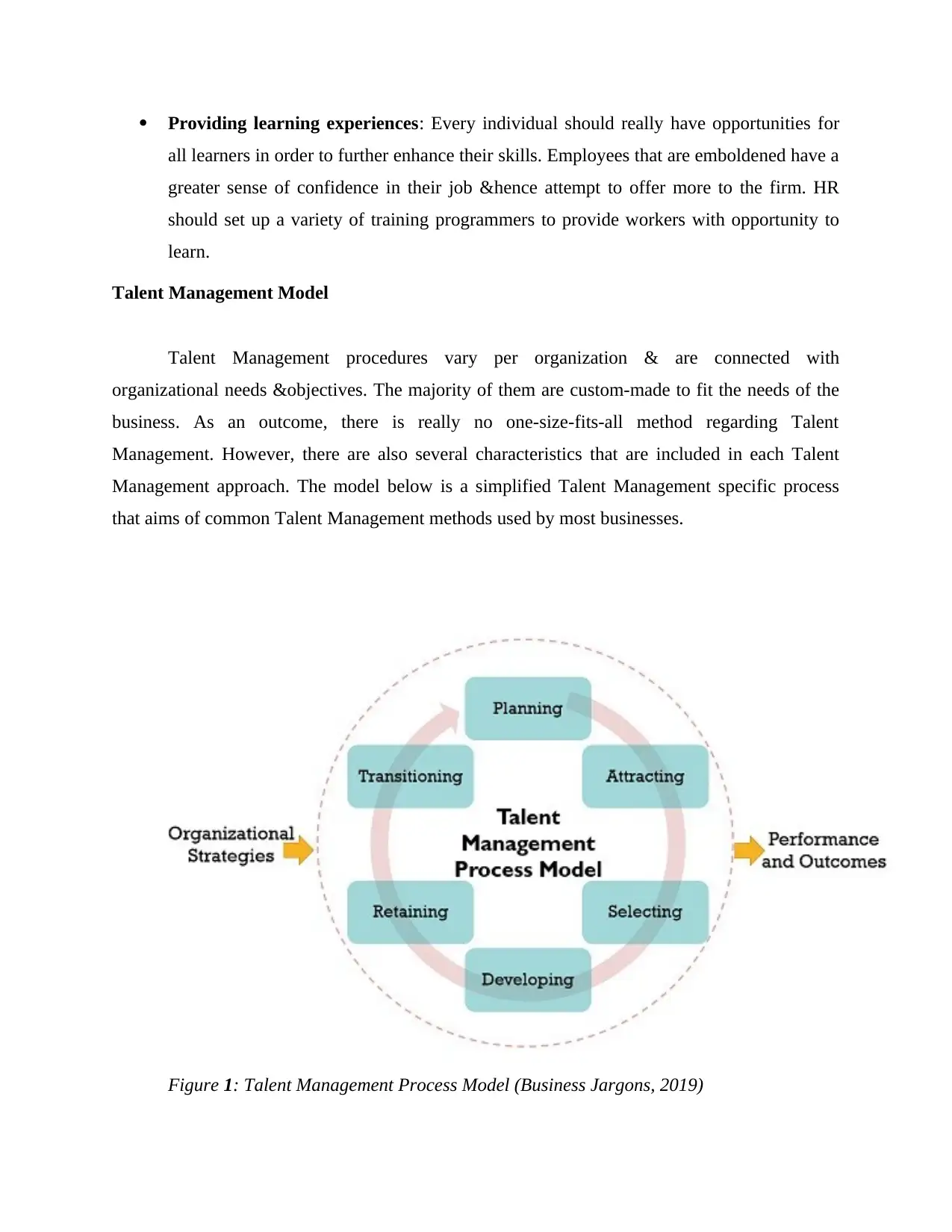
Management approach. The model below is a simplified Talent Management specific process
that aims of common Talent Management methods used by most businesses.
Figure 1: Talent Management Process Model (Business Jargons, 2019)
all learners in order to further enhance their skills. Employees that are emboldened have a
greater sense of confidence in their job &hence attempt to offer more to the firm. HR
should set up a variety of training programmers to provide workers with opportunity to
learn.
Talent Management Model
Talent Management procedures vary per organization & are connected with
organizational needs &objectives. The majority of them are custom-made to fit the needs of the
business. As an outcome, there is really no one-size-fits-all method regarding Talent
Management. However, there are also several characteristics that are included in each Talent
Management approach. The model below is a simplified Talent Management specific process
that aims of common Talent Management methods used by most businesses.
Figure 1: Talent Management Process Model (Business Jargons, 2019)
Paraphrase This Document
Need a fresh take? Get an instant paraphrase of this document with our AI Paraphraser
There are five factors are involved in the Talent management model which are discussed below-
1. Planning
2. Attracting
3. Selecting
4. Developing
5. Retaining
These five stages are followed by human resource departments when it comes to
controlling talent in their businesses. The methodology begins with the design phase, in which
HR calculates the expertise standards &criteria for specific available jobs, as well as appropriate
compensation packages, &so on. The second step, going to attract, follows. Organizations use
this method to recruit people for specific job openings. This may be accomplished by providing
appealing perks to workers, such as a competitive wage, a pleasant work conditions, a positive
corporate image, paid time off, additional benefits, &so on.
The third stage is the selection stage. HR works through with a range of internal activities
at this point to choose acceptable individuals for those roles, taking into account its skill,
qualities, temperament, enthusiasm, &desire, among other factors. The fourth step is the
Development phase, during which HR attempts to establish recently recruited staff. HR organises
a variety of training &development opportunities for workers to assist them improve their
abilities &skills while also ensuring that they are properly suited to their given duties. When
executing their tasks, such employees feel powerful &competent. Individuals develop a sense of
loyalty as a result of this.
Retaining is the last &last stage. This is, without a doubt, the most essential period. HR
develops rules &tactics to help employees stay with the company for as long as feasible. This
involves establishing a pleasant job atmosphere, paying them competitive wages, offering added
benefits, &maintaining paid time off, among other things (HRMS 28/03/2019).
An Integrative Talent Management model that is more complicated than a simple Talent
Management model & more successful, is another type of Talent Development model. The
1. Planning
2. Attracting
3. Selecting
4. Developing
5. Retaining
These five stages are followed by human resource departments when it comes to
controlling talent in their businesses. The methodology begins with the design phase, in which
HR calculates the expertise standards &criteria for specific available jobs, as well as appropriate
compensation packages, &so on. The second step, going to attract, follows. Organizations use
this method to recruit people for specific job openings. This may be accomplished by providing
appealing perks to workers, such as a competitive wage, a pleasant work conditions, a positive
corporate image, paid time off, additional benefits, &so on.
The third stage is the selection stage. HR works through with a range of internal activities
at this point to choose acceptable individuals for those roles, taking into account its skill,
qualities, temperament, enthusiasm, &desire, among other factors. The fourth step is the
Development phase, during which HR attempts to establish recently recruited staff. HR organises
a variety of training &development opportunities for workers to assist them improve their
abilities &skills while also ensuring that they are properly suited to their given duties. When
executing their tasks, such employees feel powerful &competent. Individuals develop a sense of
loyalty as a result of this.
Retaining is the last &last stage. This is, without a doubt, the most essential period. HR
develops rules &tactics to help employees stay with the company for as long as feasible. This
involves establishing a pleasant job atmosphere, paying them competitive wages, offering added
benefits, &maintaining paid time off, among other things (HRMS 28/03/2019).
An Integrative Talent Management model that is more complicated than a simple Talent
Management model & more successful, is another type of Talent Development model. The
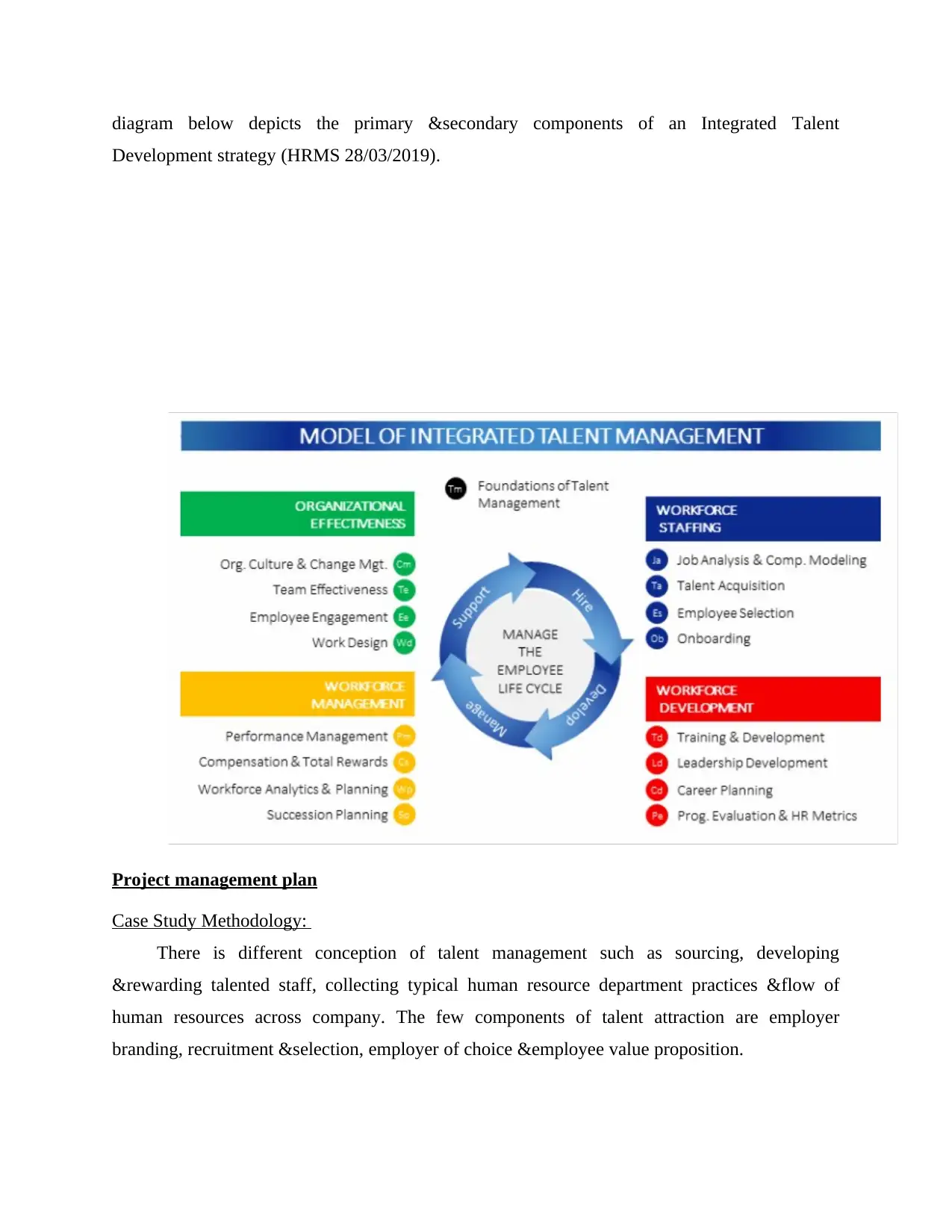
diagram below depicts the primary &secondary components of an Integrated Talent
Development strategy (HRMS 28/03/2019).
Project management plan
Case Study Methodology:
There is different conception of talent management such as sourcing, developing
&rewarding talented staff, collecting typical human resource department practices &flow of
human resources across company. The few components of talent attraction are employer
branding, recruitment &selection, employer of choice &employee value proposition.
Development strategy (HRMS 28/03/2019).
Project management plan
Case Study Methodology:
There is different conception of talent management such as sourcing, developing
&rewarding talented staff, collecting typical human resource department practices &flow of
human resources across company. The few components of talent attraction are employer
branding, recruitment &selection, employer of choice &employee value proposition.
⊘ This is a preview!⊘
Do you want full access?
Subscribe today to unlock all pages.
Trusted by 1+ million students worldwide
Research Strategy:
Case Study
Research Approach- Induction: Inductive approach, also known as inductive reasoning
begins with theories &observations which are anticipated towards the end of the research
process as a result of observations . This research “involves the search for pattern from
observation &the development of explanations – theories – for those patterns through
series of hypotheses”.
Research Process &Exploration: Research process mainly includes the steps which are
required for accomplishing or conducting the research work. Exploration research is an
activity of investigating the issues that has not been thoroughly investigated in past. It
generally helps researcher to get familiarize with the topic.
Data Analysis-Thematic Analysis: Through thematic analysis, company can analyse
qualitative data but it also includes interpretation in the processes of selecting codes
&constructing themes .
Data Collection: Data collection refers to collecting necessary data for research
completion through various sources. Here I have collected data through the following
sources-
1. Top Management Interview: Interviewing the senior executives of the
organizations.
2. Archival Research: Going through archived data gathered by primary
&secondary sources.
3. Policy Paper Analysis: Analyzing the Human Resource policies of the
organizations.
Methodology
To conduct this research, I have chosen the Interview method, to specify Non-standardized,
one to one interview (senior executives). I have also interviewed a focus group (general
employees).
Case Study
Research Approach- Induction: Inductive approach, also known as inductive reasoning
begins with theories &observations which are anticipated towards the end of the research
process as a result of observations . This research “involves the search for pattern from
observation &the development of explanations – theories – for those patterns through
series of hypotheses”.
Research Process &Exploration: Research process mainly includes the steps which are
required for accomplishing or conducting the research work. Exploration research is an
activity of investigating the issues that has not been thoroughly investigated in past. It
generally helps researcher to get familiarize with the topic.
Data Analysis-Thematic Analysis: Through thematic analysis, company can analyse
qualitative data but it also includes interpretation in the processes of selecting codes
&constructing themes .
Data Collection: Data collection refers to collecting necessary data for research
completion through various sources. Here I have collected data through the following
sources-
1. Top Management Interview: Interviewing the senior executives of the
organizations.
2. Archival Research: Going through archived data gathered by primary
&secondary sources.
3. Policy Paper Analysis: Analyzing the Human Resource policies of the
organizations.
Methodology
To conduct this research, I have chosen the Interview method, to specify Non-standardized,
one to one interview (senior executives). I have also interviewed a focus group (general
employees).
Paraphrase This Document
Need a fresh take? Get an instant paraphrase of this document with our AI Paraphraser
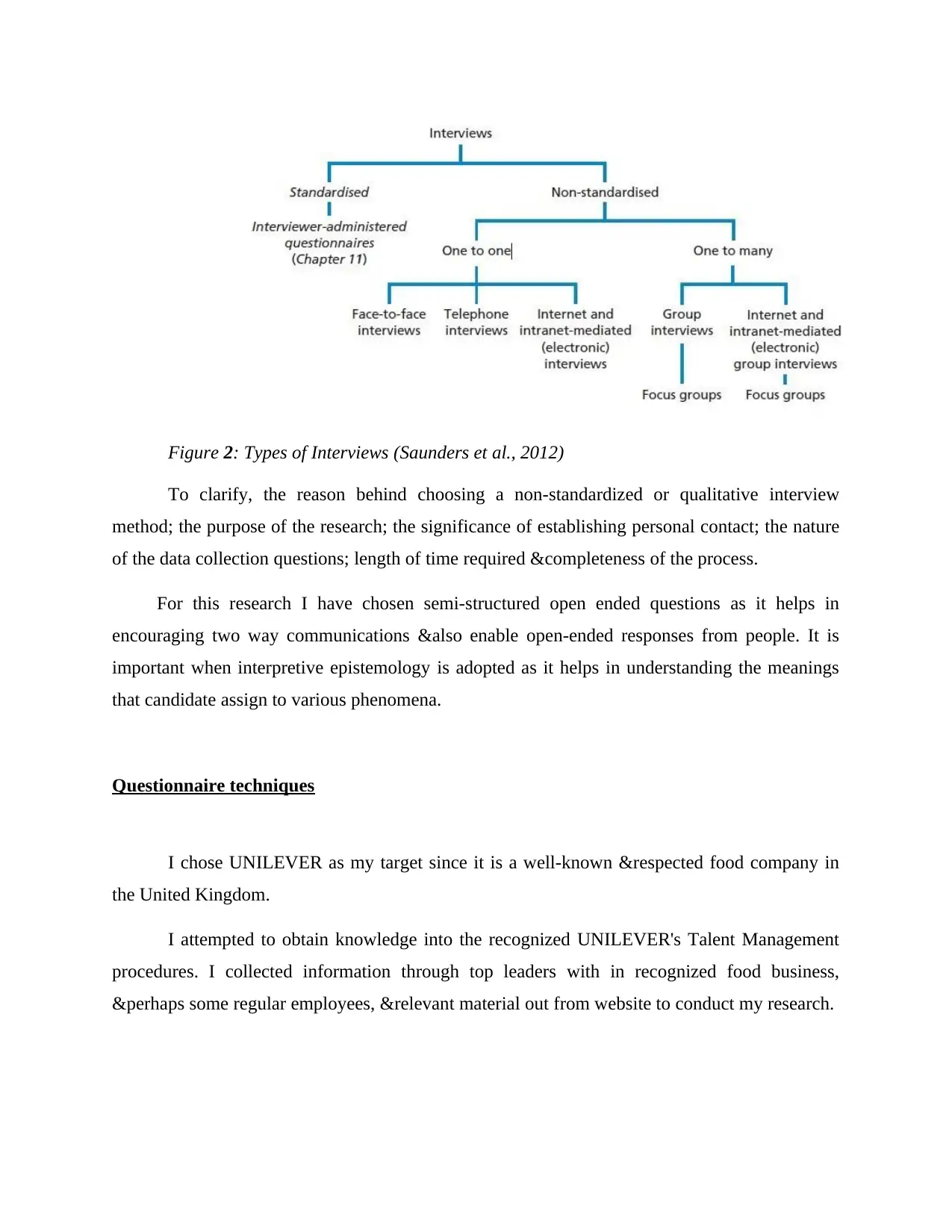
Figure 2: Types of Interviews (Saunders et al., 2012)
To clarify, the reason behind choosing a non-standardized or qualitative interview
method; the purpose of the research; the significance of establishing personal contact; the nature
of the data collection questions; length of time required &completeness of the process.
For this research I have chosen semi-structured open ended questions as it helps in
encouraging two way communications &also enable open-ended responses from people. It is
important when interpretive epistemology is adopted as it helps in understanding the meanings
that candidate assign to various phenomena.
Questionnaire techniques
I chose UNILEVER as my target since it is a well-known &respected food company in
the United Kingdom.
I attempted to obtain knowledge into the recognized UNILEVER's Talent Management
procedures. I collected information through top leaders with in recognized food business,
&perhaps some regular employees, &relevant material out from website to conduct my research.
To clarify, the reason behind choosing a non-standardized or qualitative interview
method; the purpose of the research; the significance of establishing personal contact; the nature
of the data collection questions; length of time required &completeness of the process.
For this research I have chosen semi-structured open ended questions as it helps in
encouraging two way communications &also enable open-ended responses from people. It is
important when interpretive epistemology is adopted as it helps in understanding the meanings
that candidate assign to various phenomena.
Questionnaire techniques
I chose UNILEVER as my target since it is a well-known &respected food company in
the United Kingdom.
I attempted to obtain knowledge into the recognized UNILEVER's Talent Management
procedures. I collected information through top leaders with in recognized food business,
&perhaps some regular employees, &relevant material out from website to conduct my research.
I designed a questionnaire with five tractor trailer outstanding questions that I used to
examine top executives as well as a controlled group of normal workers. As stated in the
"Restrictions" section.
The questionnaire consisted of the following questions:
1. Do you think that Talent Management is significant to improve a firm’s productivity?
2. According to you, what are the advantages of using Talent Management?
3. According to you, what are the disadvantages of using Talent Management?
4. What is the Talent Management procedure in your company?
5. How did Talent Management affect your firm’s productivity?
I gathered the information through a face-to-face interview. To mention, the replies were
quite consistent, with minor differences.
First &foremost, they all acknowledged the importance of Talent Management in
increasing a company's efficiency when answering that question. Second, they've found a
number of benefits to using Talent Management techniques in their company. Increased worker
production &competence, a greater relationship amongst individual performances &corporate
goals, dedication of valuable personnel, decreased churn, &so on are some of the benefits.
Finally, they addressed several frequent drawbacks of employing Talent Management
techniques. They are—such methods are frequently expensive, & top management is generally
hesitant to engage in anything that does not yield instant results. Because Talent Development
expenditures are long-term, the advantages might be realized over time rather than
instantaneously. Many people have also been seen to move careers after learning &developing
themselves at their current employment. Employees believe that changing jobs will result in a
better position &greater income. This is also an issue that discourages senior executives from
investment in talent management. Finally, when questioned about their respective firms' Talent
Management methods, their responses differed slightly.
Then there is a viva, which is mostly focused on academics. They do not however care if
their personnel learn different abilities or improve themselves more; alternatively, they prefer
that they keep doing their regular jobs &be advanced based on seniority. Candidates are
screening using various procedures, such as discussion groups, case studies, &so on, in order to
examine top executives as well as a controlled group of normal workers. As stated in the
"Restrictions" section.
The questionnaire consisted of the following questions:
1. Do you think that Talent Management is significant to improve a firm’s productivity?
2. According to you, what are the advantages of using Talent Management?
3. According to you, what are the disadvantages of using Talent Management?
4. What is the Talent Management procedure in your company?
5. How did Talent Management affect your firm’s productivity?
I gathered the information through a face-to-face interview. To mention, the replies were
quite consistent, with minor differences.
First &foremost, they all acknowledged the importance of Talent Management in
increasing a company's efficiency when answering that question. Second, they've found a
number of benefits to using Talent Management techniques in their company. Increased worker
production &competence, a greater relationship amongst individual performances &corporate
goals, dedication of valuable personnel, decreased churn, &so on are some of the benefits.
Finally, they addressed several frequent drawbacks of employing Talent Management
techniques. They are—such methods are frequently expensive, & top management is generally
hesitant to engage in anything that does not yield instant results. Because Talent Development
expenditures are long-term, the advantages might be realized over time rather than
instantaneously. Many people have also been seen to move careers after learning &developing
themselves at their current employment. Employees believe that changing jobs will result in a
better position &greater income. This is also an issue that discourages senior executives from
investment in talent management. Finally, when questioned about their respective firms' Talent
Management methods, their responses differed slightly.
Then there is a viva, which is mostly focused on academics. They do not however care if
their personnel learn different abilities or improve themselves more; alternatively, they prefer
that they keep doing their regular jobs &be advanced based on seniority. Candidates are
screening using various procedures, such as discussion groups, case studies, &so on, in order to
⊘ This is a preview!⊘
Do you want full access?
Subscribe today to unlock all pages.
Trusted by 1+ million students worldwide

1 out of 19


Related Documents


Your All-in-One AI-Powered Toolkit for Academic Success.
+13062052269
info@desklib.com
Available 24*7 on WhatsApp / Email
![[object Object]](/_next/static/media/star-bottom.7253800d.svg)
Unlock your academic potential
Copyright © 2020–2026 A2Z Services. All Rights Reserved. Developed and managed by ZUCOL.