Analysis of Design Methods Effectiveness Essay - Bournemouth Uni
VerifiedAdded on 2023/04/21
|7
|1731
|68
Essay
AI Summary
This essay evaluates the effectiveness of various design methods used in business and process design, including ID Click and Mood Setting, Brainstorming, Objective Tree, Morphological analysis, and Evaluation Matrix. The analysis considers these methods as decision-making tools within the design process. The essay explores each method's strengths and weaknesses, supported by secondary resources and academic literature, such as journal articles and textbooks. It examines the application of each method, providing both supportive and argumentative evidence to determine their suitability in different design scenarios. The paper highlights the importance of systematic problem-solving and the role of design methods in addressing complex issues. The essay also considers the advantages and disadvantages of each approach, offering a comprehensive overview of their practical implications.

Running head: TASK B
Effectiveness of various Design Methods
Name of the Student
Name of the University
Author note
Effectiveness of various Design Methods
Name of the Student
Name of the University
Author note
Paraphrase This Document
Need a fresh take? Get an instant paraphrase of this document with our AI Paraphraser

1TASK B
Abstract
The purpose of this essay is to explore and evaluate all the design approaches used in
business and process designing including Id Click and Mood Setting, Brainstorming,
Objective Tree Generating Alternatives or Morphological analysis and Evaluation Matrix.
Trough this essay, the effectiveness of the effectiveness of the various Design Methods have
been analysed as a means of decision making within the Design Process while presenting
both supportive and argumentative evidences from secondary resources.
Key words- Morphology, Evaluation Matrix, Design Approach, Problem Solving,
Brainstorming
INTRODUCTION
Design method or conceptual designing is a very basic problem solving approach of human
mind. With the advancement of the social structure, human needs and complex working
procedure, the complexity of design method is also increasing (Horvath, Kovacs and Denes
2013). Currently there are many design methods that are used in various practical fields and
study based academic fields. The purpose of any design tool is to find the most
comprehensive solution of a complex problem through systematic way while considering all
the independent variables and internal attributes of the subject. This essay will explore and
evaluate all the design approaches used in business and process designing including Id Click
and Mood Setting, Brainstorming, Objective Tree Generating Alternatives or Morphological
analysis and Evaluation Matrix. The purpose of this essay is to analyse the effectiveness of
the various Design Methods as a means of decision making within the Design Process while
presenting both supportive and argumentative evidences from secondary resources.
Id Click and Mood Setting
Abstract
The purpose of this essay is to explore and evaluate all the design approaches used in
business and process designing including Id Click and Mood Setting, Brainstorming,
Objective Tree Generating Alternatives or Morphological analysis and Evaluation Matrix.
Trough this essay, the effectiveness of the effectiveness of the various Design Methods have
been analysed as a means of decision making within the Design Process while presenting
both supportive and argumentative evidences from secondary resources.
Key words- Morphology, Evaluation Matrix, Design Approach, Problem Solving,
Brainstorming
INTRODUCTION
Design method or conceptual designing is a very basic problem solving approach of human
mind. With the advancement of the social structure, human needs and complex working
procedure, the complexity of design method is also increasing (Horvath, Kovacs and Denes
2013). Currently there are many design methods that are used in various practical fields and
study based academic fields. The purpose of any design tool is to find the most
comprehensive solution of a complex problem through systematic way while considering all
the independent variables and internal attributes of the subject. This essay will explore and
evaluate all the design approaches used in business and process designing including Id Click
and Mood Setting, Brainstorming, Objective Tree Generating Alternatives or Morphological
analysis and Evaluation Matrix. The purpose of this essay is to analyse the effectiveness of
the various Design Methods as a means of decision making within the Design Process while
presenting both supportive and argumentative evidences from secondary resources.
Id Click and Mood Setting

2TASK B
ID Click is approach of get rid of conventional ideas to find the interconnected attributes by
thinking “out of the box” (Cross 2018). The sketching and mapping techniques are used in
the Id Click phase. The purpose of this phase is to visualise the problem with conceptual
presentation. The mood setting is a next phase of the designing, where the problem has to be
developed by changing the distribution of apparent attributes of any factors. It is a problem
development method rather than being a problem solving method. In this process, the
designing approach is used to design the problem. According to Victor and Sebastian (2013),
Id Click and Mood Setting does not have any significant viability in business management.
Arguably this method can be used to develop lesson plan for learners to improve their
problem solving ability.
Brainstorming
Brainstorming is a problem solving approach, where a group of people participate in a
discussion to convey their concepts and problem solving ideas for a particular issue. The
brainstorming techniques enables a group of problem solver to collect a huge number of ideas
from which the significant one can be chosen. According to Buede and Miller (2016),
Brainstorming approach of problem solving does not always come to a productive result. To
found the effective idea for solving a problem the active operation of a leader is essential. In
the brainstorming process the leader has the responsibility to control team systematically and
lead the team to a effective problem solving idea. One of the major advantage of this design
approach is it allows information staring and huge information gathering because of group
discussion. To select the most optimum solving idea the leader can have a larger pool of ideas
and concepts. According to Stanton et al. (2017), the major disadvantage of brainstorming is
its requirement of time. It is a very time consuming process. Therefore, to quick problem
solving situation the brainstorming approach is not beneficial. Beside the problem solving
ID Click is approach of get rid of conventional ideas to find the interconnected attributes by
thinking “out of the box” (Cross 2018). The sketching and mapping techniques are used in
the Id Click phase. The purpose of this phase is to visualise the problem with conceptual
presentation. The mood setting is a next phase of the designing, where the problem has to be
developed by changing the distribution of apparent attributes of any factors. It is a problem
development method rather than being a problem solving method. In this process, the
designing approach is used to design the problem. According to Victor and Sebastian (2013),
Id Click and Mood Setting does not have any significant viability in business management.
Arguably this method can be used to develop lesson plan for learners to improve their
problem solving ability.
Brainstorming
Brainstorming is a problem solving approach, where a group of people participate in a
discussion to convey their concepts and problem solving ideas for a particular issue. The
brainstorming techniques enables a group of problem solver to collect a huge number of ideas
from which the significant one can be chosen. According to Buede and Miller (2016),
Brainstorming approach of problem solving does not always come to a productive result. To
found the effective idea for solving a problem the active operation of a leader is essential. In
the brainstorming process the leader has the responsibility to control team systematically and
lead the team to a effective problem solving idea. One of the major advantage of this design
approach is it allows information staring and huge information gathering because of group
discussion. To select the most optimum solving idea the leader can have a larger pool of ideas
and concepts. According to Stanton et al. (2017), the major disadvantage of brainstorming is
its requirement of time. It is a very time consuming process. Therefore, to quick problem
solving situation the brainstorming approach is not beneficial. Beside the problem solving
⊘ This is a preview!⊘
Do you want full access?
Subscribe today to unlock all pages.

Trusted by 1+ million students worldwide

3TASK B
part the brainstorming is very helpful to make the participant socialise while enabling them to
sharing their knowledge.
Objective Tree
Objectives tree is a type of design approach to solve any particular problem through
information mapping. In objective tree, major objectives to find the solution have to be sorted
out. After that the secondary objectives of the problem solving process have to be sorted. The
lower degree objectives are then connected to the major objective depending on their
interrelations. Through this process, the major objectives and sub objectives are mapped in a
tree like structure. According to Hubka (2015), the objective tree helps to find the solution by
sorting out the objectives by their hierarchy. Apart from that visual mapping also allows
visualising the conceptual map of the problems while considering their mutual dependency.
The major advantages of objective tree are it is systematic and less time consuming.
However, a major disadvantage of this process is the viability of the solution developed for
this designing approach is extremely dependent on the selection of the objectives that framing
their hierarchies (Stanton et al. 2017). Hence, to solve the problem through this design
approach, all the primary, secondary and tertiary objectives have to be identified along with
the proper values for their hierarchical position.
Generating Alternatives or Morphological analysis
The Morphological Analysis, which is also known as the process of generating alternatives
can be used to develop design knowledge while creating an abstract design space. By using
this space, the morphological analysis can randomly generate all possible design or scenario
solutions (Victor and Sebastian 2013). Morphological analysis is an inventive process as
well, that is feasible for pretending any unknown or alternative path. This morphological
problem solving is an essential part of innovative engineering that focuses on engineering
part the brainstorming is very helpful to make the participant socialise while enabling them to
sharing their knowledge.
Objective Tree
Objectives tree is a type of design approach to solve any particular problem through
information mapping. In objective tree, major objectives to find the solution have to be sorted
out. After that the secondary objectives of the problem solving process have to be sorted. The
lower degree objectives are then connected to the major objective depending on their
interrelations. Through this process, the major objectives and sub objectives are mapped in a
tree like structure. According to Hubka (2015), the objective tree helps to find the solution by
sorting out the objectives by their hierarchy. Apart from that visual mapping also allows
visualising the conceptual map of the problems while considering their mutual dependency.
The major advantages of objective tree are it is systematic and less time consuming.
However, a major disadvantage of this process is the viability of the solution developed for
this designing approach is extremely dependent on the selection of the objectives that framing
their hierarchies (Stanton et al. 2017). Hence, to solve the problem through this design
approach, all the primary, secondary and tertiary objectives have to be identified along with
the proper values for their hierarchical position.
Generating Alternatives or Morphological analysis
The Morphological Analysis, which is also known as the process of generating alternatives
can be used to develop design knowledge while creating an abstract design space. By using
this space, the morphological analysis can randomly generate all possible design or scenario
solutions (Victor and Sebastian 2013). Morphological analysis is an inventive process as
well, that is feasible for pretending any unknown or alternative path. This morphological
problem solving is an essential part of innovative engineering that focuses on engineering
Paraphrase This Document
Need a fresh take? Get an instant paraphrase of this document with our AI Paraphraser

4TASK B
concept design leading to the development of innovative concept. According to many
scholars, morphological analysis can also be sued to develop non-quantified parameters as
well. The major advantage of using the Morphological Analysis as design based problem
solving approach is that it is very applicable in the segmentation and enhancement of a
complex scenario where there could be multiple possible future directions (Horvath, Kovacs
and Denes 2013). Hence, Morphological analysis is a combination of precision and logical
reasoning associated with engineering plus creativities driven by design concept generation.
It is an excellent methods use for teaching engineers how to approach innovative and
inventive problems from the knowledge point of view.
Evaluation Matrix
Evaluation matrix is a very strategic design approach of problem solving that allows using
systematic reasoning and mathematical calculation to find the optimum solution for a
particular problem (Buede and Miller 2016). This process is a widely used in operational
management and engineering decision making where designers have to face with multiple
optional design options with various interrelated attributes. This situation requires evaluating
the design solution from the correlating concept that meets the demands. The evaluation
matrix can also help a designer to choose the most beneficial set of options from a bunch of
implemented attributes or criteria. In most of the cases, the evaluation matrix has two
dimensions correlated in matrix format. The designer has to identify the interrelation and
prioritise the weight of the connected attributes to find the solution (Cross 2018). The
evaluation matrix is commonly used in Quality Function Deployment process of quality
management, where the business operation has to choose the most profitable combination of
criteria for a particular product. The evaluation matrix representation of quality management
is also known as House of Quality or HOQ, which have several interconnected evolution
matrix segregated by wall, roof and base section.
concept design leading to the development of innovative concept. According to many
scholars, morphological analysis can also be sued to develop non-quantified parameters as
well. The major advantage of using the Morphological Analysis as design based problem
solving approach is that it is very applicable in the segmentation and enhancement of a
complex scenario where there could be multiple possible future directions (Horvath, Kovacs
and Denes 2013). Hence, Morphological analysis is a combination of precision and logical
reasoning associated with engineering plus creativities driven by design concept generation.
It is an excellent methods use for teaching engineers how to approach innovative and
inventive problems from the knowledge point of view.
Evaluation Matrix
Evaluation matrix is a very strategic design approach of problem solving that allows using
systematic reasoning and mathematical calculation to find the optimum solution for a
particular problem (Buede and Miller 2016). This process is a widely used in operational
management and engineering decision making where designers have to face with multiple
optional design options with various interrelated attributes. This situation requires evaluating
the design solution from the correlating concept that meets the demands. The evaluation
matrix can also help a designer to choose the most beneficial set of options from a bunch of
implemented attributes or criteria. In most of the cases, the evaluation matrix has two
dimensions correlated in matrix format. The designer has to identify the interrelation and
prioritise the weight of the connected attributes to find the solution (Cross 2018). The
evaluation matrix is commonly used in Quality Function Deployment process of quality
management, where the business operation has to choose the most profitable combination of
criteria for a particular product. The evaluation matrix representation of quality management
is also known as House of Quality or HOQ, which have several interconnected evolution
matrix segregated by wall, roof and base section.

5TASK B
CONCLUSION
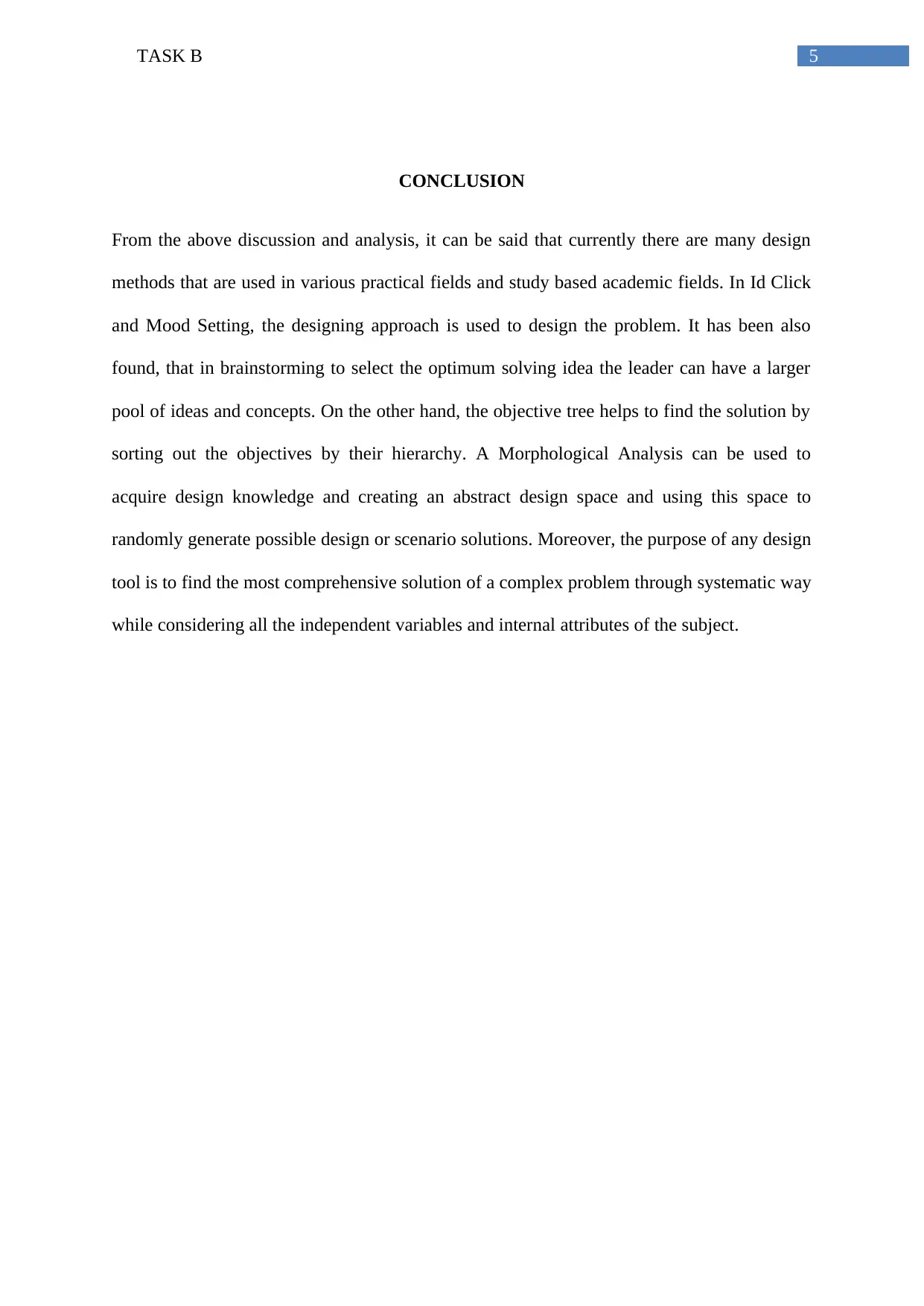
From the above discussion and analysis, it can be said that currently there are many design
methods that are used in various practical fields and study based academic fields. In Id Click
and Mood Setting, the designing approach is used to design the problem. It has been also
found, that in brainstorming to select the optimum solving idea the leader can have a larger
pool of ideas and concepts. On the other hand, the objective tree helps to find the solution by
sorting out the objectives by their hierarchy. A Morphological Analysis can be used to
acquire design knowledge and creating an abstract design space and using this space to
randomly generate possible design or scenario solutions. Moreover, the purpose of any design
tool is to find the most comprehensive solution of a complex problem through systematic way
while considering all the independent variables and internal attributes of the subject.
CONCLUSION
From the above discussion and analysis, it can be said that currently there are many design
methods that are used in various practical fields and study based academic fields. In Id Click
and Mood Setting, the designing approach is used to design the problem. It has been also
found, that in brainstorming to select the optimum solving idea the leader can have a larger
pool of ideas and concepts. On the other hand, the objective tree helps to find the solution by
sorting out the objectives by their hierarchy. A Morphological Analysis can be used to
acquire design knowledge and creating an abstract design space and using this space to
randomly generate possible design or scenario solutions. Moreover, the purpose of any design
tool is to find the most comprehensive solution of a complex problem through systematic way
while considering all the independent variables and internal attributes of the subject.
⊘ This is a preview!⊘
Do you want full access?
Subscribe today to unlock all pages.

Trusted by 1+ million students worldwide

6TASK B
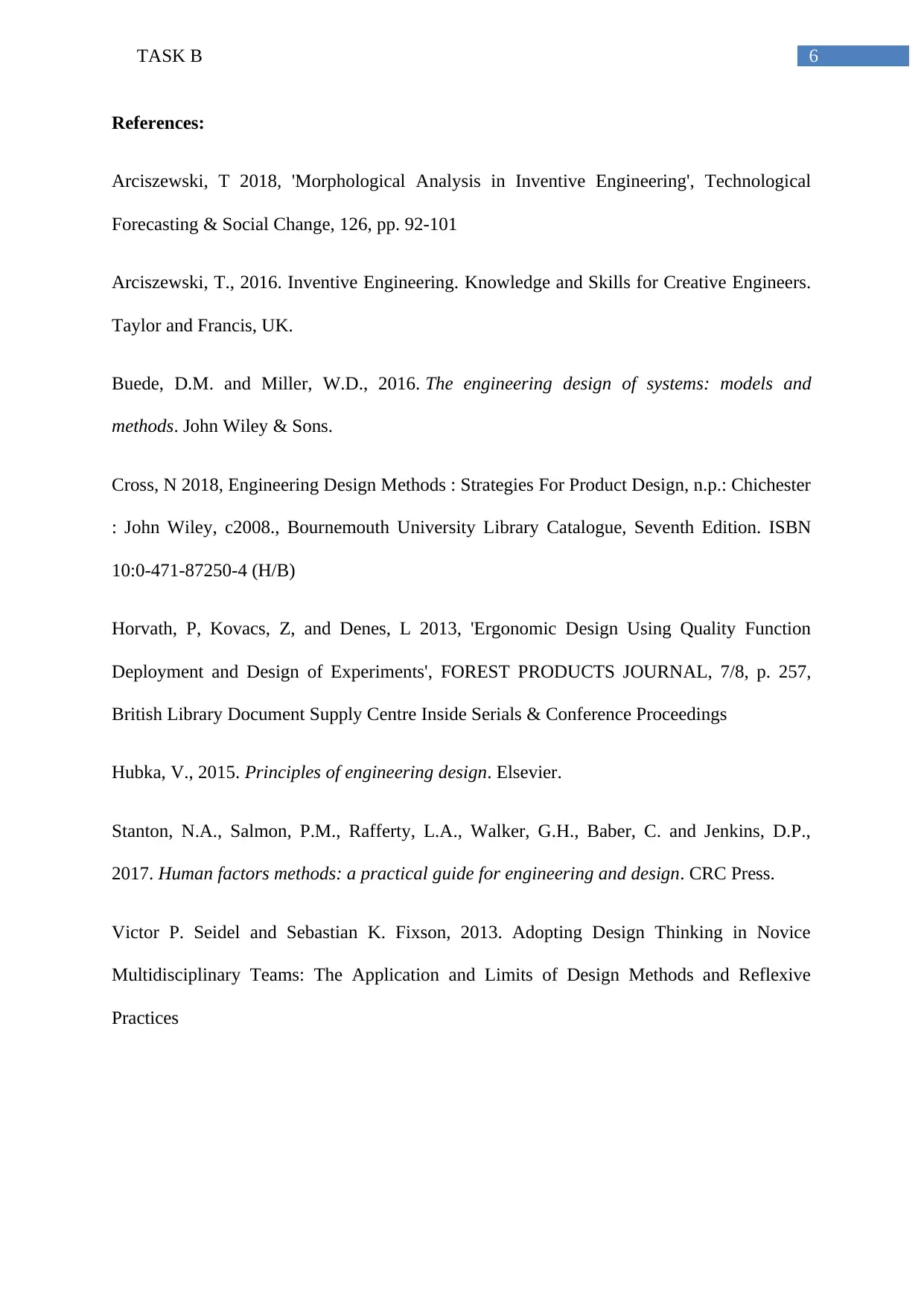
References:
Arciszewski, T 2018, 'Morphological Analysis in Inventive Engineering', Technological
Forecasting & Social Change, 126, pp. 92-101
Arciszewski, T., 2016. Inventive Engineering. Knowledge and Skills for Creative Engineers.
Taylor and Francis, UK.
Buede, D.M. and Miller, W.D., 2016. The engineering design of systems: models and
methods. John Wiley & Sons.
Cross, N 2018, Engineering Design Methods : Strategies For Product Design, n.p.: Chichester
: John Wiley, c2008., Bournemouth University Library Catalogue, Seventh Edition. ISBN
10:0-471-87250-4 (H/B)
Horvath, P, Kovacs, Z, and Denes, L 2013, 'Ergonomic Design Using Quality Function
Deployment and Design of Experiments', FOREST PRODUCTS JOURNAL, 7/8, p. 257,
British Library Document Supply Centre Inside Serials & Conference Proceedings
Hubka, V., 2015. Principles of engineering design. Elsevier.
Stanton, N.A., Salmon, P.M., Rafferty, L.A., Walker, G.H., Baber, C. and Jenkins, D.P.,
2017. Human factors methods: a practical guide for engineering and design. CRC Press.
Victor P. Seidel and Sebastian K. Fixson, 2013. Adopting Design Thinking in Novice
Multidisciplinary Teams: The Application and Limits of Design Methods and Reflexive
Practices
References:
Arciszewski, T 2018, 'Morphological Analysis in Inventive Engineering', Technological
Forecasting & Social Change, 126, pp. 92-101
Arciszewski, T., 2016. Inventive Engineering. Knowledge and Skills for Creative Engineers.
Taylor and Francis, UK.
Buede, D.M. and Miller, W.D., 2016. The engineering design of systems: models and
methods. John Wiley & Sons.
Cross, N 2018, Engineering Design Methods : Strategies For Product Design, n.p.: Chichester
: John Wiley, c2008., Bournemouth University Library Catalogue, Seventh Edition. ISBN
10:0-471-87250-4 (H/B)
Horvath, P, Kovacs, Z, and Denes, L 2013, 'Ergonomic Design Using Quality Function
Deployment and Design of Experiments', FOREST PRODUCTS JOURNAL, 7/8, p. 257,
British Library Document Supply Centre Inside Serials & Conference Proceedings
Hubka, V., 2015. Principles of engineering design. Elsevier.
Stanton, N.A., Salmon, P.M., Rafferty, L.A., Walker, G.H., Baber, C. and Jenkins, D.P.,
2017. Human factors methods: a practical guide for engineering and design. CRC Press.
Victor P. Seidel and Sebastian K. Fixson, 2013. Adopting Design Thinking in Novice
Multidisciplinary Teams: The Application and Limits of Design Methods and Reflexive
Practices
1 out of 7
Related Documents
Your All-in-One AI-Powered Toolkit for Academic Success.
+13062052269
info@desklib.com
Available 24*7 on WhatsApp / Email
Unlock your academic potential
Copyright © 2020–2025 A2Z Services. All Rights Reserved. Developed and managed by ZUCOL.