Effectiveness of Self-Testing: Psychological Research and Analysis

Verified

Added on  2023/05/27

|7
|1702
|122
Report
AI Summary
This report investigates the effectiveness of self-testing as a study technique, drawing on psychological research to analyze its impact on memory and long-term retention. It begins by defining self-testing and its benefits, citing studies that demonstrate its superiority over passive study methods. The report emphasizes the role of retrieval practice in enhancing memory, even in the absence of immediate feedback, though feedback is shown to further improve learning. It also discusses the importance of organizing study time and utilizing active learning strategies, such as taking notes by hand, to maximize learning outcomes. The report concludes that self-testing is a powerful tool for improving memory and academic performance, despite the challenges students may face in adopting this method. It suggests that students should organize their time, create a quiet study environment, and actively engage with the material to optimize their learning.
Document Page
Running Head: EFFECTIVENESS OF SELF-TESTING
1
Effectiveness of Self-Testing
[Author Name(s), First M. Last, Omit Titles and Degrees]
[Institutional Affiliation(s)]
Author Note
[Include any grant/funding information and a complete correspondence address.]
tabler-icon-diamond-filled.svg

Paraphrase This Document

Need a fresh take? Get an instant paraphrase of this document with our AI Paraphraser
Document Page
EFFECTIVENESS OF SELF-TESTING 2
Table of Contents
Introduction......................................................................................................................................3
Effectiveness of self-testing.............................................................................................................3
Conclusion.......................................................................................................................................6
References........................................................................................................................................7
Document Page
EFFECTIVENESS OF SELF-TESTING 3
Introduction
Self-testing is basically a test that can be completed without the help of any trained
professionals. Researchers have devoted a lot of time of theirs in studying how to study (Burton,
2010). The researchers have found out several techniques that may help the students in
remembering their studies. The two of the techniques that helped the students most in
remembering their studies is the practice testing and the distributed practice (Zawadzka &
Hanczakowski, 2018). The researchers have shown that self-test can help in improving the long-
term memory and the capability of the students to recover significant data when people need it. It
has already been proved that self-testing can help the students a lot and students practicing self-
testing can outperform the other students who are not practicing self-testing. Though self-testing
is so much effective in enlightening the long-term ability of recalling the evidences but still
people do not use this technique often. This is because of the fact that students feel that the
standard study methods are quite comfortable than the tests. As the brain is firm wired to follow
the path of the least struggle so the learners are more tending to opt for the relaxed options.
Effectiveness of self-testing
It is the peculiarity of our mind that memory of the people is better impressed by the
active than by the passive repetition. The retrieval practices often produce greater learning and
help in retaining the long-term studying. It has been found out by the researchers that the
retrieval of the information from the memory may help in producing a better retention that
studying the similar data for same quantity of time has been termed as the result of testing. In the
recent years several researches have shown strong mnemonic benefits of the retrieval benefits
(Roediger III & Butler, 2011). The retrieval practice can prove to be an effective enhancer of
memory but evidently the situations of the matter of retrieval. It has also been seen that the
Document Page
EFFECTIVENESS OF SELF-TESTING 4
retrievals in the easy condition or situation does not produce the required long-term effect but
retrievals under the difficult conditions can produce a much better long-term retrieval. The
benefits from these retrievals can persist over very long delays.
The researchers who perform the analysis of the behavior or remediation of the memory
among the neuro psychological population of patients believe that the attempts of the retrieval
should be arranged in a proper way so that they do not produce any errors (Hartwig & Dunlosky,
2012). There is always a fear that exist that if there is an error then it will be learned which can
make the learning of the accurate replies much harder. It has also been said that if the retrieval
happens under the easy circumstances in which the errors are to made in a smaller amount then
the impact of those retrievals on the long-term withholding may be damaged (Roediger III &
Butler, 2011). Although it has been found that the retrieval practices help in the promotion of the
long-term retaining in the absenteeism of the feedback but providing the accurate answers after
an effort of the retrieval may increase the reminder benefits of the testing.
The feedbacks that may contain the correct answers may help in the increase in the
learning because it can help in enabling the takers of the test to correct the errors and also helps
in maintaining the correct responses. Thus, providing the response after a retrieval effort in spite
of whether the effort will be productive or unproductive can help to confirm that the retrieval
will be fruitful in the future. The need for the feedback is quite serious after any kind of test but
it is mostly vital for the recognition tests because the takers of the tests are exposed to the false
data. The conventional knowledge and the trainings in the behavioral psychology always
indicates that providing the feedback instantly after a test is always a best but the experimental
results has already shown that the delayed feedbacks might be even more influential (Roediger
III & Butler, 2011). The retrieval practices always help in the production of the better long-term
tabler-icon-diamond-filled.svg

Paraphrase This Document

Need a fresh take? Get an instant paraphrase of this document with our AI Paraphraser
Document Page
EFFECTIVENESS OF SELF-TESTING 5
retention than studying alone. This finding clearly proposes that the testing which is normally
theorized as a tool of evaluation can also be used as a learning tool (Tran Rohrer & Pashler,
2015).
Many students while starting their semester even after studying hard may flounder.
Students who may struggle in the school during the start of their semester in managing the time
can use some of the time management techniques to head start their semester learning. There are
some of the habits that can help the students in their semester (Putnam, Sungkhasettee &
Roediger III, 2016).
Organization of the time
The students at the starting of the semester will get a hand out of the syllabus of the
semester from the professor. After getting the syllabus the students need to read the syllabus and
make table of studying. They can even mark on the calendar the exam date of every month and
also the project submission date. If the student studies 1 week prior the exam or starts preparing
for the project 1 week prior the submission then the student will not face any problem during the
semester (Putnam, Sungkhasettee & Roediger III, 2016).
Buying or renting the book before the starting of the course
Some of the students prefer to have used books because the used books come at a cheaper
rate than the new books. But it should be kept in mind that the previous owner may have
highlighted the unimportant part so the students must check all these possibilities (Karpicke &
Roediger, III. 2008).
Finding a quiet place to study
Document Page
EFFECTIVENESS OF SELF-TESTING 6
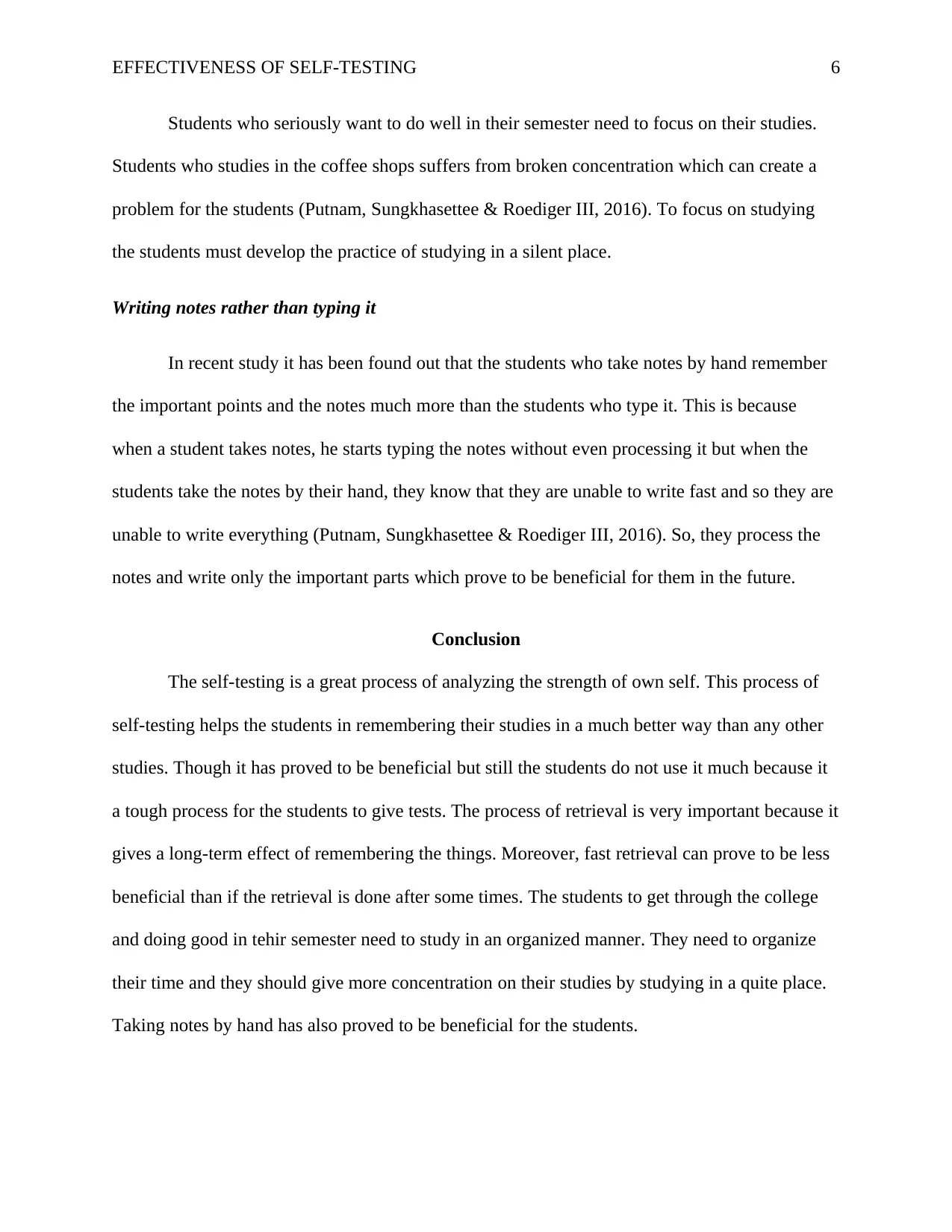
Students who seriously want to do well in their semester need to focus on their studies.
Students who studies in the coffee shops suffers from broken concentration which can create a
problem for the students (Putnam, Sungkhasettee & Roediger III, 2016). To focus on studying
the students must develop the practice of studying in a silent place.
Writing notes rather than typing it
In recent study it has been found out that the students who take notes by hand remember
the important points and the notes much more than the students who type it. This is because
when a student takes notes, he starts typing the notes without even processing it but when the
students take the notes by their hand, they know that they are unable to write fast and so they are
unable to write everything (Putnam, Sungkhasettee & Roediger III, 2016). So, they process the
notes and write only the important parts which prove to be beneficial for them in the future.
Conclusion
The self-testing is a great process of analyzing the strength of own self. This process of
self-testing helps the students in remembering their studies in a much better way than any other
studies. Though it has proved to be beneficial but still the students do not use it much because it
a tough process for the students to give tests. The process of retrieval is very important because it
gives a long-term effect of remembering the things. Moreover, fast retrieval can prove to be less
beneficial than if the retrieval is done after some times. The students to get through the college
and doing good in tehir semester need to study in an organized manner. They need to organize
their time and they should give more concentration on their studies by studying in a quite place.
Taking notes by hand has also proved to be beneficial for the students.
Document Page
EFFECTIVENESS OF SELF-TESTING 7
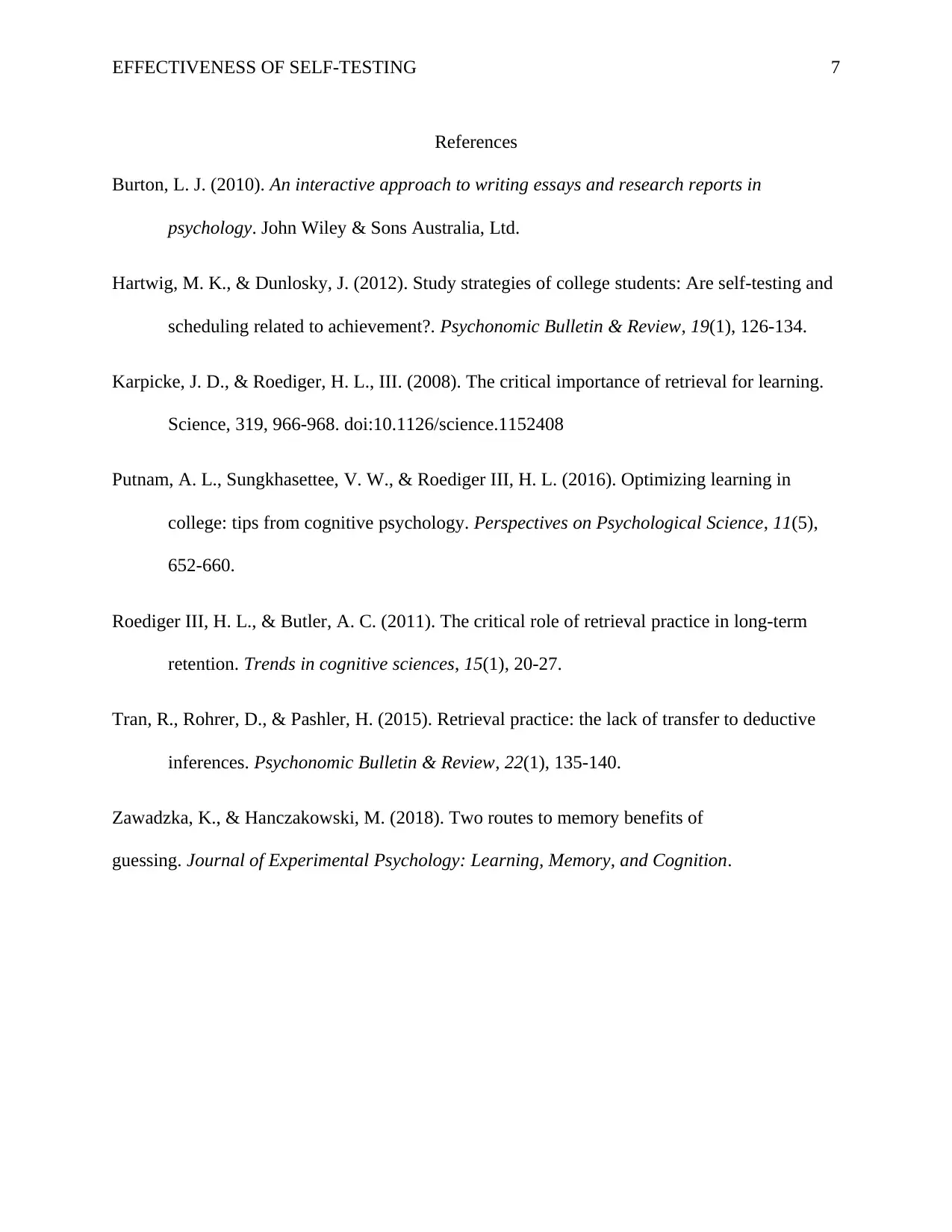
References
Burton, L. J. (2010). An interactive approach to writing essays and research reports in
psychology. John Wiley & Sons Australia, Ltd.
Hartwig, M. K., & Dunlosky, J. (2012). Study strategies of college students: Are self-testing and
scheduling related to achievement?. Psychonomic Bulletin & Review, 19(1), 126-134.
Karpicke, J. D., & Roediger, H. L., III. (2008). The critical importance of retrieval for learning.
Science, 319, 966-968. doi:10.1126/science.1152408
Putnam, A. L., Sungkhasettee, V. W., & Roediger III, H. L. (2016). Optimizing learning in
college: tips from cognitive psychology. Perspectives on Psychological Science, 11(5),
652-660.
Roediger III, H. L., & Butler, A. C. (2011). The critical role of retrieval practice in long-term
retention. Trends in cognitive sciences, 15(1), 20-27.
Tran, R., Rohrer, D., & Pashler, H. (2015). Retrieval practice: the lack of transfer to deductive
inferences. Psychonomic Bulletin & Review, 22(1), 135-140.
Zawadzka, K., & Hanczakowski, M. (2018). Two routes to memory benefits of
guessing. Journal of Experimental Psychology: Learning, Memory, and Cognition.
chevron_up_icon
1 out of 7
circle_padding
hide_on_mobile
zoom_out_icon
[object Object]