Understanding the Effects of Human Activities on Ecosystems
VerifiedAdded on 2023/01/17
|10
|2362
|97
Report
AI Summary
This report examines the profound impacts of human activities on ecosystems, highlighting the crucial role of ecosystem services in human well-being. It explores the historical context of environmental stability and the increasing pressures from population growth, leading to changes in climate patterns, biodiversity loss, and pollution. The report delves into specific effects such as climate change, biodiversity decline, ocean acidification, deforestation, ozone layer depletion, and environmental pollution. It also presents potential remedies, including increased tree planting, public awareness campaigns, waste recycling, and reduced consumption. The conclusion emphasizes the need for global cooperation, stricter environmental regulations, and continuous intervention to protect ecosystems from further degradation. The report utilizes figures and references to support its findings.
GEOGRAPHY
[Author Name(s), First M. Last, Omit Titles and Degrees]
[Institutional Affiliation(s)]
1 | P a g e
[Author Name(s), First M. Last, Omit Titles and Degrees]
[Institutional Affiliation(s)]
1 | P a g e

Paraphrase This Document
Need a fresh take? Get an instant paraphrase of this document with our AI Paraphraser
TOPIC: UNDERSTANDING OF EFFECTS OF HUMAN-ACTIVITIES TO ECOSYSTEMS
AND EFFECTIVE MEASURES
Introduction
Ecosystem-services are very essential to human’s lives worldwide since it promotes healthy
living standards. Provision of fresh-water, food, firewood, fresh-air, aesthetic-beauty and
recreational centers, as well as the eighty percent of human primary-production, depend on these
ecosystem services. The dependence has led to a considerable change in ecosystem-services due
to the increased need of human-population. An increased human-population has been witnessed
worldwide over and this has caused a lot of pressure on the limited economic-resources in the
environment (Chen, et al., 2014)
Since ecosystem-services are considered to be very important and essential to human-population,
there have been a lot of negative impacts due to human activities. Human-activities like cutting
down of trees for settlement establishment, charcoal burning and fire-wood for domestic,
emission of greenhouse gases into the atmosphere are some of the factors among many factors
that have led to degradation of ecosystems (D’agata, et al 2014). The problem of global warming
and increased temperatures across many nations in the world is due to human activities on the
environment. This has prompted a lot of environmental debate across the world between
environmentalists and political leaders of the world. Many conferences have been held in the
past to come up with amicable solutions that will ensure reduced negative effects on the
ecosystem (Crook, et al., 2015).
2 | P a g e
AND EFFECTIVE MEASURES
Introduction
Ecosystem-services are very essential to human’s lives worldwide since it promotes healthy
living standards. Provision of fresh-water, food, firewood, fresh-air, aesthetic-beauty and
recreational centers, as well as the eighty percent of human primary-production, depend on these
ecosystem services. The dependence has led to a considerable change in ecosystem-services due
to the increased need of human-population. An increased human-population has been witnessed
worldwide over and this has caused a lot of pressure on the limited economic-resources in the
environment (Chen, et al., 2014)
Since ecosystem-services are considered to be very important and essential to human-population,
there have been a lot of negative impacts due to human activities. Human-activities like cutting
down of trees for settlement establishment, charcoal burning and fire-wood for domestic,
emission of greenhouse gases into the atmosphere are some of the factors among many factors
that have led to degradation of ecosystems (D’agata, et al 2014). The problem of global warming
and increased temperatures across many nations in the world is due to human activities on the
environment. This has prompted a lot of environmental debate across the world between
environmentalists and political leaders of the world. Many conferences have been held in the
past to come up with amicable solutions that will ensure reduced negative effects on the
ecosystem (Crook, et al., 2015).
2 | P a g e
History of human-dependence on ecosystem-services
Many years ago, the global environmental condition was appealing and very stable. There were
no extreme temperatures that have been witnessed in present situations. To put in another way,
the ecosystem was remarkably-stable due to low temperatures and warm climatic environment
(Boumans, et al., 2015)
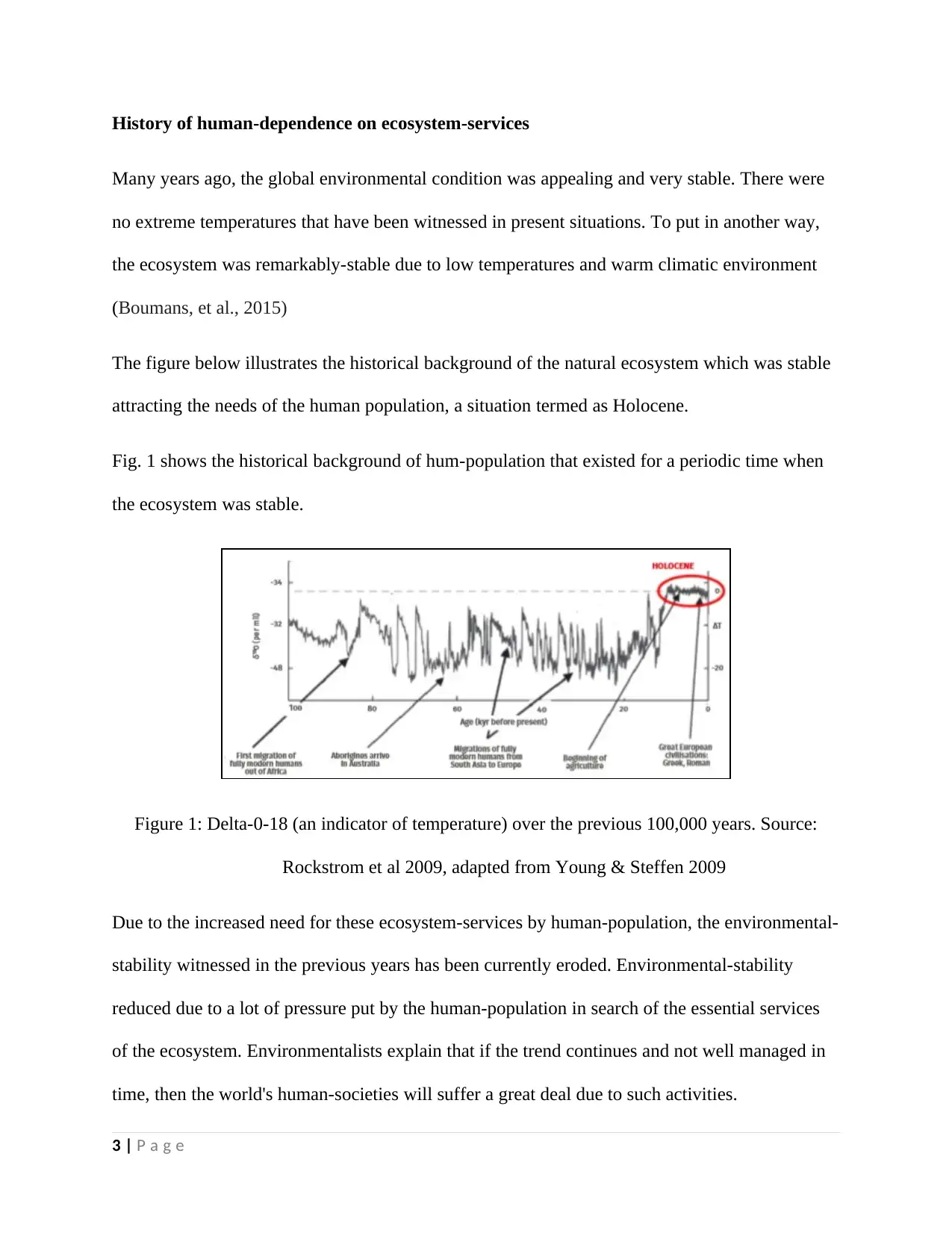
The figure below illustrates the historical background of the natural ecosystem which was stable
attracting the needs of the human population, a situation termed as Holocene.
Fig. 1 shows the historical background of hum-population that existed for a periodic time when
the ecosystem was stable.
Figure 1: Delta-0-18 (an indicator of temperature) over the previous 100,000 years. Source:
Rockstrom et al 2009, adapted from Young & Steffen 2009
Due to the increased need for these ecosystem-services by human-population, the environmental-
stability witnessed in the previous years has been currently eroded. Environmental-stability
reduced due to a lot of pressure put by the human-population in search of the essential services
of the ecosystem. Environmentalists explain that if the trend continues and not well managed in
time, then the world's human-societies will suffer a great deal due to such activities.
3 | P a g e
Many years ago, the global environmental condition was appealing and very stable. There were
no extreme temperatures that have been witnessed in present situations. To put in another way,
the ecosystem was remarkably-stable due to low temperatures and warm climatic environment
(Boumans, et al., 2015)
The figure below illustrates the historical background of the natural ecosystem which was stable
attracting the needs of the human population, a situation termed as Holocene.
Fig. 1 shows the historical background of hum-population that existed for a periodic time when
the ecosystem was stable.
Figure 1: Delta-0-18 (an indicator of temperature) over the previous 100,000 years. Source:
Rockstrom et al 2009, adapted from Young & Steffen 2009
Due to the increased need for these ecosystem-services by human-population, the environmental-
stability witnessed in the previous years has been currently eroded. Environmental-stability
reduced due to a lot of pressure put by the human-population in search of the essential services
of the ecosystem. Environmentalists explain that if the trend continues and not well managed in
time, then the world's human-societies will suffer a great deal due to such activities.
3 | P a g e
⊘ This is a preview!⊘
Do you want full access?
Subscribe today to unlock all pages.

Trusted by 1+ million students worldwide
For a further understanding of the planetary-boundary system, a Stockholm-Resilience-Center
(SRC) is a vital mechanism for a deeper understanding of ecosystem interference. This system
spells out a secure space within which human-population operations can be well demonstrated as
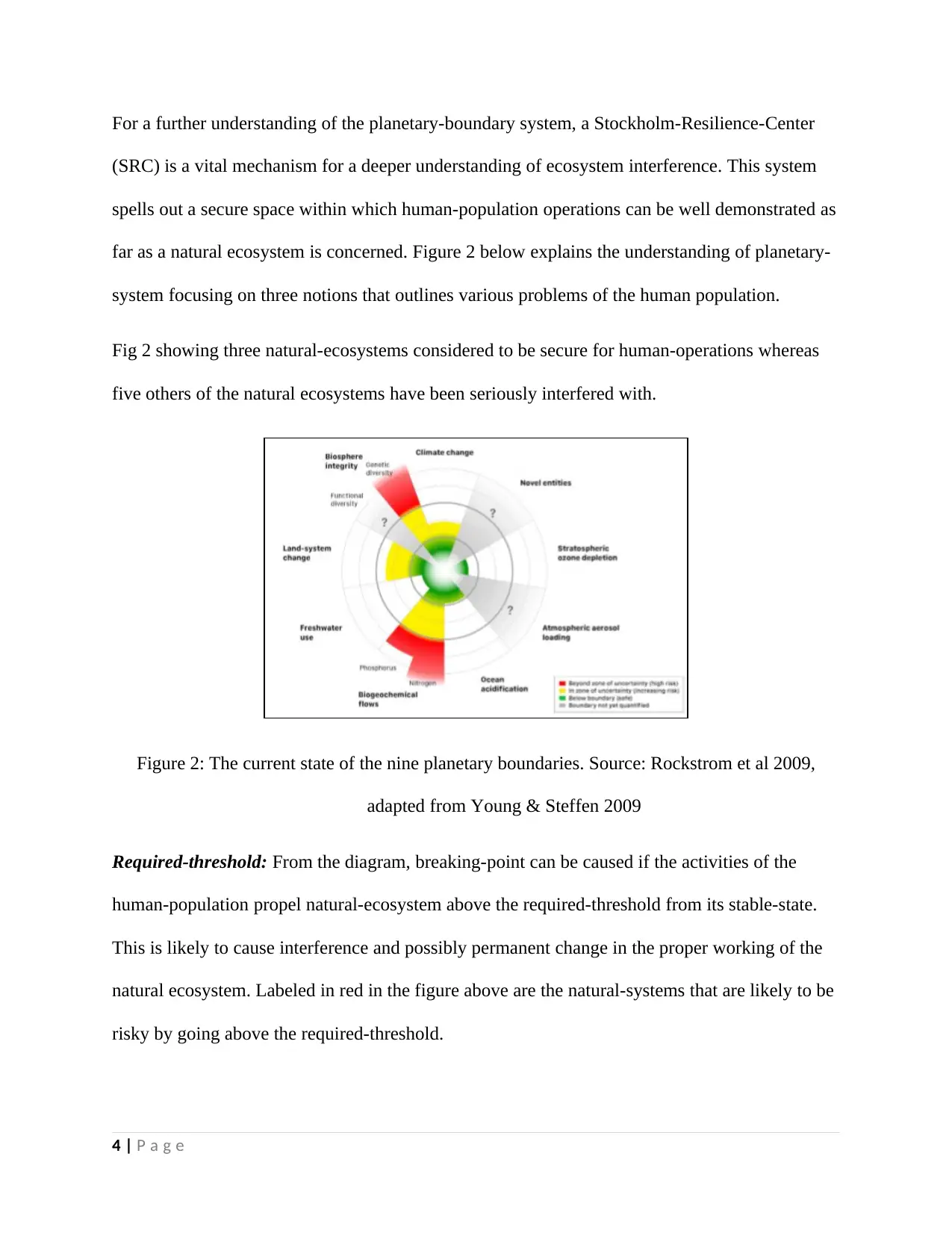
far as a natural ecosystem is concerned. Figure 2 below explains the understanding of planetary-
system focusing on three notions that outlines various problems of the human population.
Fig 2 showing three natural-ecosystems considered to be secure for human-operations whereas
five others of the natural ecosystems have been seriously interfered with.
Figure 2: The current state of the nine planetary boundaries. Source: Rockstrom et al 2009,
adapted from Young & Steffen 2009
Required-threshold: From the diagram, breaking-point can be caused if the activities of the
human-population propel natural-ecosystem above the required-threshold from its stable-state.
This is likely to cause interference and possibly permanent change in the proper working of the
natural ecosystem. Labeled in red in the figure above are the natural-systems that are likely to be
risky by going above the required-threshold.
4 | P a g e
(SRC) is a vital mechanism for a deeper understanding of ecosystem interference. This system
spells out a secure space within which human-population operations can be well demonstrated as
far as a natural ecosystem is concerned. Figure 2 below explains the understanding of planetary-
system focusing on three notions that outlines various problems of the human population.
Fig 2 showing three natural-ecosystems considered to be secure for human-operations whereas
five others of the natural ecosystems have been seriously interfered with.
Figure 2: The current state of the nine planetary boundaries. Source: Rockstrom et al 2009,
adapted from Young & Steffen 2009
Required-threshold: From the diagram, breaking-point can be caused if the activities of the
human-population propel natural-ecosystem above the required-threshold from its stable-state.
This is likely to cause interference and possibly permanent change in the proper working of the
natural ecosystem. Labeled in red in the figure above are the natural-systems that are likely to be
risky by going above the required-threshold.
4 | P a g e
Paraphrase This Document
Need a fresh take? Get an instant paraphrase of this document with our AI Paraphraser
Borderline: This is considered to be the approximated distance that is believed to be secure from
the required-threshold. Those natural-systems that surpass the borderline and probably fall into
unsafe-space are labeled in red whereas those that are intending to break the safe-borderline are
labeled in green.
Unpredictability: It can be noted that the conduct of natural-systems is too complicated and
greatly unpredictable. Further, it is very difficult to measure and predict the minimum mark
which a natural-system is likely to go beyond the breaking point. From the above diagram, three
zonal platforms have been set within which the natural-systems operates, that is, safe-zone, risk-
growth zone, and a high level-risk zone.
There exists a reciprocal relationship in natural systems. To put in other words, natural systems
are greatly interdependent (Renard, Rhemtulla & Bennett, 2015). Any human-activities that can
lead to the destruction of the natural-systems like practicing agricultural farming and search for
human settlement may results to the encroachment of land thus leading to the formation of
deserts, cutting of trees and rise in temperatures.
An increased trend in the destruction of natural-systems has brought a lot of worldwide
environmental-change. Other-ecosystems which also depend on the natural-systems have been
greatly affected. For example, the rise in temperature levels due global warming has made the
lives of many ecosystems (that is plants populations, insect-populations, and animal populations)
be in danger (Civitello, et al., 2015) The growth of the human population is a key issue that has
been witnessed in the recent past prompting a number of activities carried out to ensure the
chances of survival. As a result of such activities, a number of effects have been into play. To
understand these effects, it important to consider the following aspects of ecosystems:
5 | P a g e
the required-threshold. Those natural-systems that surpass the borderline and probably fall into
unsafe-space are labeled in red whereas those that are intending to break the safe-borderline are
labeled in green.
Unpredictability: It can be noted that the conduct of natural-systems is too complicated and
greatly unpredictable. Further, it is very difficult to measure and predict the minimum mark
which a natural-system is likely to go beyond the breaking point. From the above diagram, three
zonal platforms have been set within which the natural-systems operates, that is, safe-zone, risk-
growth zone, and a high level-risk zone.
There exists a reciprocal relationship in natural systems. To put in other words, natural systems
are greatly interdependent (Renard, Rhemtulla & Bennett, 2015). Any human-activities that can
lead to the destruction of the natural-systems like practicing agricultural farming and search for
human settlement may results to the encroachment of land thus leading to the formation of
deserts, cutting of trees and rise in temperatures.
An increased trend in the destruction of natural-systems has brought a lot of worldwide
environmental-change. Other-ecosystems which also depend on the natural-systems have been
greatly affected. For example, the rise in temperature levels due global warming has made the
lives of many ecosystems (that is plants populations, insect-populations, and animal populations)
be in danger (Civitello, et al., 2015) The growth of the human population is a key issue that has
been witnessed in the recent past prompting a number of activities carried out to ensure the
chances of survival. As a result of such activities, a number of effects have been into play. To
understand these effects, it important to consider the following aspects of ecosystems:
5 | P a g e
I. Change in climatic-condition
There has been a changed pattern of weather-condition in the current situation due to human
population actions. Activities carried out by human beings like emission of greenhouse gases
into the atmosphere have led to an increased level of global warming. A lot of carbon that is
released into the atmosphere has contributed to the continued rise in temperature levels. In the
end, such emitted gases into the atmosphere have led to the formation of acidic rain. When acidic
falls on top of building roofs, it leads to corrosion and rusting of metallic surfaces (Romero, et
al., 2015). It is predicted that if these activities are not regulated and conservation of ecosystem
become a key issue and an apparent concern world over, then the situation will even come the
year 2030.
II. Biodiversity-effects
Plants and animals constitute a greater percentage of natural ecosystems worldwide. Their lives
have been endangered. It is believed that there has been a general decline in the population of
vertebrates which is above 85% in some countries. Poor treatments of industrial effluents which
are channeled to the rivers, lakes, and seas in some countries have endangered aquatic lives.
Further, the use of insecticide pollutants in some countries like Germany has negatively impacted
on the environment. There has been poor disposal method of wastes across the world (Wang, et
al 2016). For instance, the use of plastic which is non-biodegradable poses a lot of health
problems to human, plant and animal populations.
III. Human activity effects on oceans
It is notable that carbon dioxide emitted into the atmosphere is from industries across the world.
When this emitted carbon dioxide reaches the ocean-waters, about 25% of it is dissolved. In turn,
6 | P a g e
There has been a changed pattern of weather-condition in the current situation due to human
population actions. Activities carried out by human beings like emission of greenhouse gases
into the atmosphere have led to an increased level of global warming. A lot of carbon that is
released into the atmosphere has contributed to the continued rise in temperature levels. In the
end, such emitted gases into the atmosphere have led to the formation of acidic rain. When acidic
falls on top of building roofs, it leads to corrosion and rusting of metallic surfaces (Romero, et
al., 2015). It is predicted that if these activities are not regulated and conservation of ecosystem
become a key issue and an apparent concern world over, then the situation will even come the
year 2030.
II. Biodiversity-effects
Plants and animals constitute a greater percentage of natural ecosystems worldwide. Their lives
have been endangered. It is believed that there has been a general decline in the population of
vertebrates which is above 85% in some countries. Poor treatments of industrial effluents which
are channeled to the rivers, lakes, and seas in some countries have endangered aquatic lives.
Further, the use of insecticide pollutants in some countries like Germany has negatively impacted
on the environment. There has been poor disposal method of wastes across the world (Wang, et
al 2016). For instance, the use of plastic which is non-biodegradable poses a lot of health
problems to human, plant and animal populations.
III. Human activity effects on oceans
It is notable that carbon dioxide emitted into the atmosphere is from industries across the world.
When this emitted carbon dioxide reaches the ocean-waters, about 25% of it is dissolved. In turn,
6 | P a g e
⊘ This is a preview!⊘
Do you want full access?
Subscribe today to unlock all pages.
Trusted by 1+ million students worldwide
ocean-water becomes acidic this is unfit for aquatic life. This is the ocean-acidification and is the
key issue to climate change. These acts have immensely increased to about 26% from the time of
industrial-revolution to date. This is a result of too much emission of carbon dioxide in the
atmosphere.
IV. Deforestation
This the act of cutting down trees covers for land-use by the human population. Trees cover acts
as an absorbing agent of carbon dioxide. The absorbed carbon dioxide is also depended upon by
another ecosystem to survive. Equally, this has contributed to famine due to the barren status of
agricultural land with no tree-cover and desert-like conditions in some countries in the world
(Wardle, 2016). From past statistics, fifteen billion trees are cut annually and the number of
forest cover has significantly reduced by half. Therefore, by the year twenty thousand and fifty,
land deterioration is forecasted to reduce agricultural-crop yield by half increasing malnutrition
rate and starvation-levels.
V. Ozone-layer effects
A chemical compound substance made by human-population has facilitated the emission of
Chlorofluorocarbons into the atmosphere creating holes in the ozone layer. Through this hole,
the filtered ultra-violet radiations are emitted which harmful to living organism's lives as well as
the human population's lives.
VI. Environmental pollution
The use of machinery and vehicles which are human-made have contributed a lot to air pollution.
A lot of smoke produced from these moving substances as well as huge-dusts from the use of
land has led to air pollution hence poor health of human populations. Further, pollutants like
7 | P a g e
key issue to climate change. These acts have immensely increased to about 26% from the time of
industrial-revolution to date. This is a result of too much emission of carbon dioxide in the
atmosphere.
IV. Deforestation
This the act of cutting down trees covers for land-use by the human population. Trees cover acts
as an absorbing agent of carbon dioxide. The absorbed carbon dioxide is also depended upon by
another ecosystem to survive. Equally, this has contributed to famine due to the barren status of
agricultural land with no tree-cover and desert-like conditions in some countries in the world
(Wardle, 2016). From past statistics, fifteen billion trees are cut annually and the number of
forest cover has significantly reduced by half. Therefore, by the year twenty thousand and fifty,
land deterioration is forecasted to reduce agricultural-crop yield by half increasing malnutrition
rate and starvation-levels.
V. Ozone-layer effects
A chemical compound substance made by human-population has facilitated the emission of
Chlorofluorocarbons into the atmosphere creating holes in the ozone layer. Through this hole,
the filtered ultra-violet radiations are emitted which harmful to living organism's lives as well as
the human population's lives.
VI. Environmental pollution
The use of machinery and vehicles which are human-made have contributed a lot to air pollution.
A lot of smoke produced from these moving substances as well as huge-dusts from the use of
land has led to air pollution hence poor health of human populations. Further, pollutants like
7 | P a g e
Paraphrase This Document
Need a fresh take? Get an instant paraphrase of this document with our AI Paraphraser
pesticides, chemical sprays, and radioactive-substances have equally led to the destruction of the
environment.
Remedies to human activities for better protection of ecosystems
There is a need for an increased campaign for tree planting to ensure better forest cover
(Suter, 2016).
Creation of public awareness and education. The general public across the world should
be sensitized and educated on the importance of protecting our endangered-ecosystems
Establishment of recycling areas for plastic wastes as well as proper treatment of
industrial waste products (Suter II, 2016).
Coming up with alternative measures to the use of pesticides and chemical sprays
Better methods to reduce human consumption
Conclusion
Human-activities have contributed to the destruction of ecosystems across many countries
worldwide. This is due to population explosion and overconsumption for both economic and
social needs. Further, emission of greenhouse gases has contributed to global warming in equal
measure thus causing climate-change. It is predicted that if the trend continues, then by 2030 the
world will be worst hit and the current situation will even deteriorate further. There is a need for
constant and serious interventions by political leaders and environmental-scientists across the
world to protect our ecosystems. The protection of the environment should be a general concern
that entails everybody across the globe (Suter, 2016). The environmental laws and regulations
should be seriously implemented to the letter.
8 | P a g e
environment.
Remedies to human activities for better protection of ecosystems
There is a need for an increased campaign for tree planting to ensure better forest cover
(Suter, 2016).
Creation of public awareness and education. The general public across the world should
be sensitized and educated on the importance of protecting our endangered-ecosystems
Establishment of recycling areas for plastic wastes as well as proper treatment of
industrial waste products (Suter II, 2016).
Coming up with alternative measures to the use of pesticides and chemical sprays
Better methods to reduce human consumption
Conclusion
Human-activities have contributed to the destruction of ecosystems across many countries
worldwide. This is due to population explosion and overconsumption for both economic and
social needs. Further, emission of greenhouse gases has contributed to global warming in equal
measure thus causing climate-change. It is predicted that if the trend continues, then by 2030 the
world will be worst hit and the current situation will even deteriorate further. There is a need for
constant and serious interventions by political leaders and environmental-scientists across the
world to protect our ecosystems. The protection of the environment should be a general concern
that entails everybody across the globe (Suter, 2016). The environmental laws and regulations
should be seriously implemented to the letter.
8 | P a g e
References
Boumans, R., Roman, J., Altman, I., & Kaufman, L. (2015). The Multiscale Integrated Model of
Ecosystem Services (MIMES): Simulating the interactions of coupled human and natural
systems. Ecosystem Services, 12, 30-41.
Chen, B., Zhang, X., Tao, J., Wu, J., Wang, J., Shi, P., ... & Yu, C. (2014). The impact of climate
change and anthropogenic activities on alpine grassland over the Qinghai-Tibet
Plateau. Agricultural and Forest Meteorology, 189, 11-18.
Civitello, D. J., Cohen, J., Fatima, H., Halstead, N. T., Liriano, J., McMahon, T. A., ... & Rohr, J.
R. (2015). Biodiversity inhibits parasites: broad evidence for the dilution
effect. Proceedings of the National Academy of Sciences, 112(28), 8667-8671.
Crook, D. A., Lowe, W. H., Allendorf, F. W., Erős, T., Finn, D. S., Gillanders, B. M., ... &
Kilada, R. W. (2015). Human effects on ecological connectivity in aquatic ecosystems:
integrating scientific approaches to support management and mitigation. The science of
the Total Environment, 534, 52-64.
D’agata, S., Mouillot, D., Kulbicki, M., Andréfouët, S., Bellwood, D. R., Cinner, J. E., ... &
Vigliola, L. (2014). Human-mediated loss of phylogenetic and functional diversity in
coral reef fishes. Current Biology, 24(5), 555-560.
Renard, D., Rhemtulla, J. M., & Bennett, E. M. (2015). Historical dynamics in ecosystem service
bundles. Proceedings of the National Academy of Sciences, 112(43), 13411-13416.
9 | P a g e
Boumans, R., Roman, J., Altman, I., & Kaufman, L. (2015). The Multiscale Integrated Model of
Ecosystem Services (MIMES): Simulating the interactions of coupled human and natural
systems. Ecosystem Services, 12, 30-41.
Chen, B., Zhang, X., Tao, J., Wu, J., Wang, J., Shi, P., ... & Yu, C. (2014). The impact of climate
change and anthropogenic activities on alpine grassland over the Qinghai-Tibet
Plateau. Agricultural and Forest Meteorology, 189, 11-18.
Civitello, D. J., Cohen, J., Fatima, H., Halstead, N. T., Liriano, J., McMahon, T. A., ... & Rohr, J.
R. (2015). Biodiversity inhibits parasites: broad evidence for the dilution
effect. Proceedings of the National Academy of Sciences, 112(28), 8667-8671.
Crook, D. A., Lowe, W. H., Allendorf, F. W., Erős, T., Finn, D. S., Gillanders, B. M., ... &
Kilada, R. W. (2015). Human effects on ecological connectivity in aquatic ecosystems:
integrating scientific approaches to support management and mitigation. The science of
the Total Environment, 534, 52-64.
D’agata, S., Mouillot, D., Kulbicki, M., Andréfouët, S., Bellwood, D. R., Cinner, J. E., ... &
Vigliola, L. (2014). Human-mediated loss of phylogenetic and functional diversity in
coral reef fishes. Current Biology, 24(5), 555-560.
Renard, D., Rhemtulla, J. M., & Bennett, E. M. (2015). Historical dynamics in ecosystem service
bundles. Proceedings of the National Academy of Sciences, 112(43), 13411-13416.
9 | P a g e
⊘ This is a preview!⊘
Do you want full access?
Subscribe today to unlock all pages.
Trusted by 1+ million students worldwide
Romero, G. Q., Gonçalves‐Souza, T., Vieira, C., & Koricheva, J. (2015). Ecosystem engineering
effects on species diversity across ecosystems: a meta‐analysis. Biological
Reviews, 90(3), 877-890
Suter II, G. W. (2016). Ecological risk assessment. CRC Press
Wang, H., Zhou, S., Li, X., Liu, H., Chi, D., & Xu, K. (2016). The influence of climate change
and human activities on ecosystem service value. Ecological engineering, 87, 224-239
Wardle, D. A. (2016). Do experiments exploring plant diversity-ecosystem functioning
relationships inform how biodiversity loss impacts natural ecosystems?. Journal of
Vegetation Science, 27(3), 646-653.
10 | P a g e
effects on species diversity across ecosystems: a meta‐analysis. Biological
Reviews, 90(3), 877-890
Suter II, G. W. (2016). Ecological risk assessment. CRC Press
Wang, H., Zhou, S., Li, X., Liu, H., Chi, D., & Xu, K. (2016). The influence of climate change
and human activities on ecosystem service value. Ecological engineering, 87, 224-239
Wardle, D. A. (2016). Do experiments exploring plant diversity-ecosystem functioning
relationships inform how biodiversity loss impacts natural ecosystems?. Journal of
Vegetation Science, 27(3), 646-653.
10 | P a g e

1 out of 10


Related Documents


Your All-in-One AI-Powered Toolkit for Academic Success.
+13062052269
info@desklib.com
Available 24*7 on WhatsApp / Email
![[object Object]](/_next/static/media/star-bottom.7253800d.svg)
Unlock your academic potential
Copyright © 2020–2026 A2Z Services. All Rights Reserved. Developed and managed by ZUCOL.