Report: Analyzing the Effects of Myopia on Physical Activity Levels

Verified

Added on  2020/05/04

|4
|579
|200
Report
AI Summary
This report provides an appraisal of a study investigating the effects of myopia on later physical activity, focusing on the methodology and findings. The study, conducted using data from the Avon Longitudinal Study of Parents and Children, examines the relationship between myopia and physical activity levels in a cohort of children. The report highlights the strengths of the study, including the detailed documentation of sample size achievement and the use of multivariable regression techniques to analyze the data and control for confounders. The report also acknowledges limitations, such as the lack of discussion on potential loss of follow-up and the absence of a flow diagram to represent sample size changes. The analysis of the report includes a description of how the sample size was achieved, the statistical methods used, and a comparison of the minimally and maximally confounder estimated results. The conclusion indicates that the report effectively describes the key aspects of the study. The report also includes a reference to the original research paper published in the British Journal of Sports Medicine.
Document Page
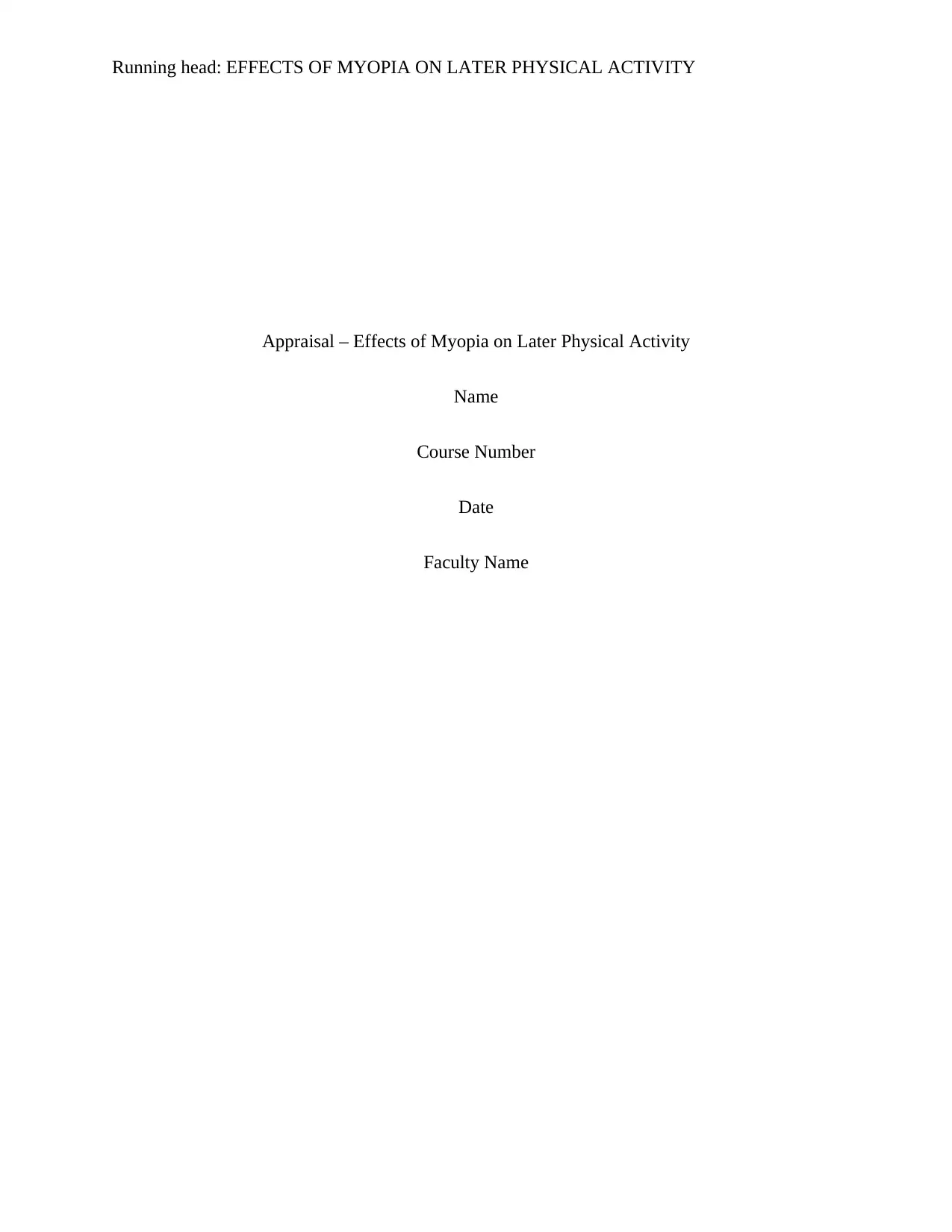
Running head: EFFECTS OF MYOPIA ON LATER PHYSICAL ACTIVITY
Appraisal – Effects of Myopia on Later Physical Activity
Name
Course Number
Date
Faculty Name
tabler-icon-diamond-filled.svg

Paraphrase This Document

Need a fresh take? Get an instant paraphrase of this document with our AI Paraphraser
Document Page
Running head: EFFECTS OF MYOPIA ON LATER PHYSICAL ACTIVITY
Appraisal – Effects of Myopia on Later Physical Activity
Strengths
The Avon Longitudinal Study of Parents and Children recruited pregnant women who
were expected to give birth between 1st April 1991 and 31st December 1992. This recruitment
process achieved a sample size of 7159 children. Therefore, this is how the researchers achieved
the initial sample size for the study. At the age of 12, the researcher approached the children as a
continuity of the study and requested them to wear an Anti-graph that was aimed at collecting
information on physical activity. Out of the total sample size, only 6622 of them accepted to
wear the gear. Data cleaning on the activity and autorefractor data led to a reduction of the
sample size into 4880 children. Therefore, we can affirm that documentation on how the sample
size was achieved was effectively done.
The description of how statistical methods were used to achieve the reported results was
documented. Multivariable regression method was used to describe the relationship between the
physical activity characteristics and myopic status. The models were categorized into two
showing different levels of controlling for the confounders. This shows how effective the
researchers were able to standardize the effect sizes in the model. The multivariable regression
technique was also used to describe the difference in effect sizes of the physical characteristics
between the myopic groups. There does not seem to be cases of loss of follow-up, hence no
documentation.
The changes in sample sizes experienced in every stage of the study have been described
by giving valid reasons for non-participation. The reasons include failure to consent and data
validity. Demographic statistics was clearly provided in the report. Describe the numbers and
percentages of myopes in the two groups; ‘best eye’ and ‘worst eye’. In the main results section,
Document Page
EFFECTS OF MYOPIA ON LATER PHYSICAL ACTIVITY 3
a table was provided showing the minimally and maximally confounder estimated results. The
results can be compared, hence showing the level of attenuation by the controlled confounders
on the predictors.
Limitations
The issue of loss of follow-up was not discussed in the report. With such a huge study,
there is a high chance of loss of follow-up. A flow diagram was not used to represent the changes
in sample size from the time of recruitment. There was no specific analysis of the follow-up time
spent on the participants. There were no reports on counts of participants who were on different
categories of exposures such as ethnic categories’ summaries.
Conclusion
We can conclude that the reports performed well based on the description of how the
sample size was achieved and reporting the results. All the key points that should be noted on
these sections were described on the reports.
Document Page
Running head: EFFECTS OF MYOPIA ON LATER PHYSICAL ACTIVITY
Referees
Deere, K., Williams, C., Leary, S., Mattocks, C., Ness, A., Blair, S., & Riddoch, C. (2009).
Myopia and later physical activity in adolescence: a prospective study. British Journal of
Sports Medicine, 43(7), 542-544. http://dx.doi.org/10.1136/bjsm.2008.049288
chevron_up_icon
1 out of 4
circle_padding
hide_on_mobile
zoom_out_icon
[object Object]