Critical Review of Elder Abuse, Risk Factors, and Pain Management

Verified

Added on  2023/04/24

|4
|804
|490
Essay
AI Summary
This essay provides a comprehensive review of elder abuse and pain management in older adults. It identifies individual, relationship, socio-cultural, and community risk factors contributing to elder abuse, referencing WHO statistics and relevant studies. The essay also discusses pain assessment methods, including communication with patients and observation of non-verbal cues, alongside pain management strategies. It highlights the use of pharmacological interventions, such as opioids, and non-pharmacological approaches, including creating a quiet environment and providing breathing exercises. The author emphasizes the importance of early intervention and regular physical record maintenance for effective pain management in elderly patients. Desklib offers a wealth of resources for students seeking to deepen their understanding of these critical healthcare topics.
Document Page
Running head: ARTICLE REVIEW ON ELDER ABUSE AND PAIN MANAGEMENT
ARTICLE REVIEW ON ELDER ABUSE AND PAIN MANAGEMENT
Name of Student:
Name of University:
Author’s Note:
tabler-icon-diamond-filled.svg

Paraphrase This Document

Need a fresh take? Get an instant paraphrase of this document with our AI Paraphraser
Document Page
1ARTICLE REVIEW ON ELDER ABUSE AND PAIN MANAGEMENT
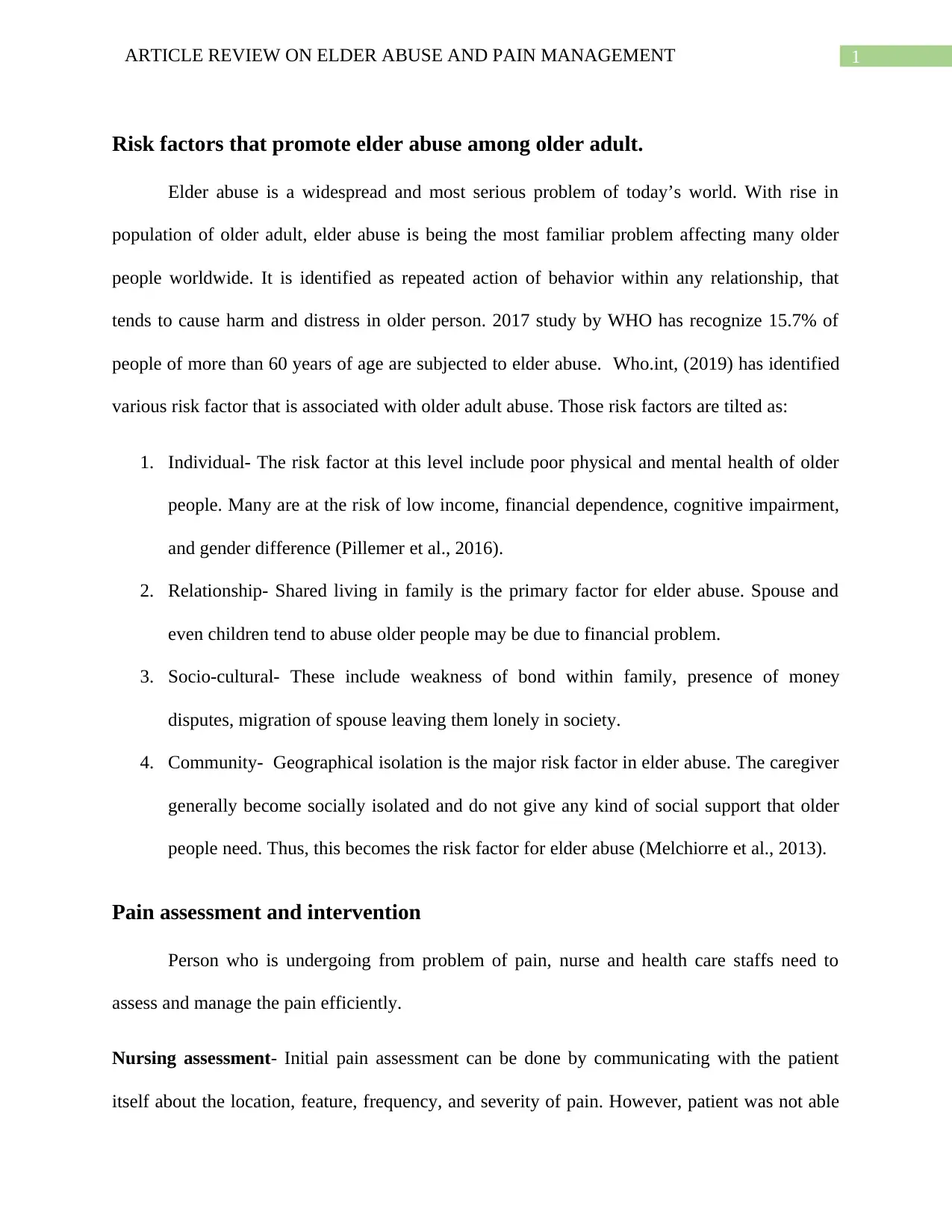
Risk factors that promote elder abuse among older adult.
Elder abuse is a widespread and most serious problem of today’s world. With rise in
population of older adult, elder abuse is being the most familiar problem affecting many older
people worldwide. It is identified as repeated action of behavior within any relationship, that
tends to cause harm and distress in older person. 2017 study by WHO has recognize 15.7% of
people of more than 60 years of age are subjected to elder abuse. Who.int, (2019) has identified
various risk factor that is associated with older adult abuse. Those risk factors are tilted as:
1. Individual- The risk factor at this level include poor physical and mental health of older
people. Many are at the risk of low income, financial dependence, cognitive impairment,
and gender difference (Pillemer et al., 2016).
2. Relationship- Shared living in family is the primary factor for elder abuse. Spouse and
even children tend to abuse older people may be due to financial problem.
3. Socio-cultural- These include weakness of bond within family, presence of money
disputes, migration of spouse leaving them lonely in society.
4. Community- Geographical isolation is the major risk factor in elder abuse. The caregiver
generally become socially isolated and do not give any kind of social support that older
people need. Thus, this becomes the risk factor for elder abuse (Melchiorre et al., 2013).
Pain assessment and intervention
Person who is undergoing from problem of pain, nurse and health care staffs need to
assess and manage the pain efficiently.
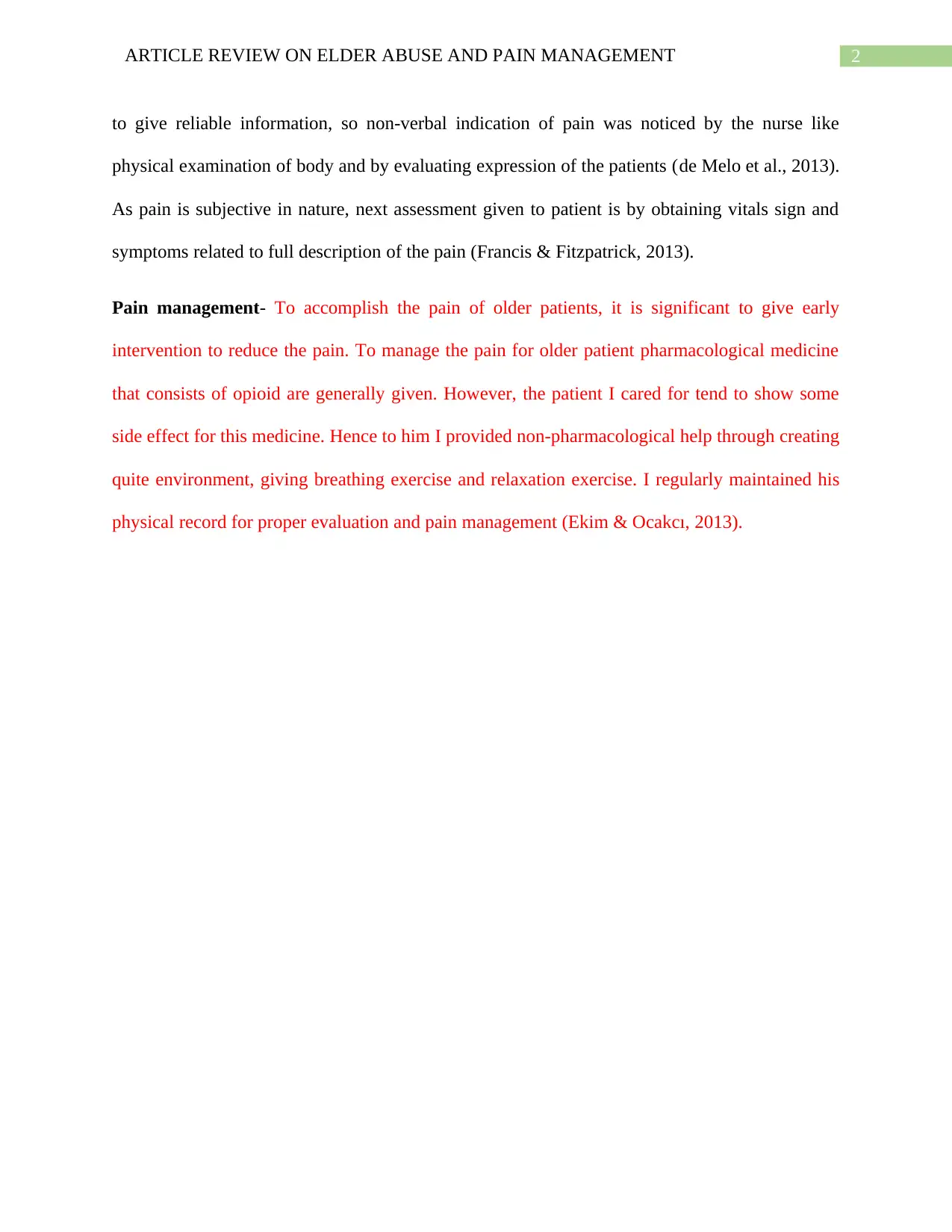
Nursing assessment- Initial pain assessment can be done by communicating with the patient
itself about the location, feature, frequency, and severity of pain. However, patient was not able
Document Page
2ARTICLE REVIEW ON ELDER ABUSE AND PAIN MANAGEMENT
to give reliable information, so non-verbal indication of pain was noticed by the nurse like
physical examination of body and by evaluating expression of the patients (de Melo et al., 2013).
As pain is subjective in nature, next assessment given to patient is by obtaining vitals sign and
symptoms related to full description of the pain (Francis & Fitzpatrick, 2013).
Pain management- To accomplish the pain of older patients, it is significant to give early
intervention to reduce the pain. To manage the pain for older patient pharmacological medicine
that consists of opioid are generally given. However, the patient I cared for tend to show some
side effect for this medicine. Hence to him I provided non-pharmacological help through creating
quite environment, giving breathing exercise and relaxation exercise. I regularly maintained his
physical record for proper evaluation and pain management (Ekim & Ocakcı, 2013).
Document Page
3ARTICLE REVIEW ON ELDER ABUSE AND PAIN MANAGEMENT
Reference
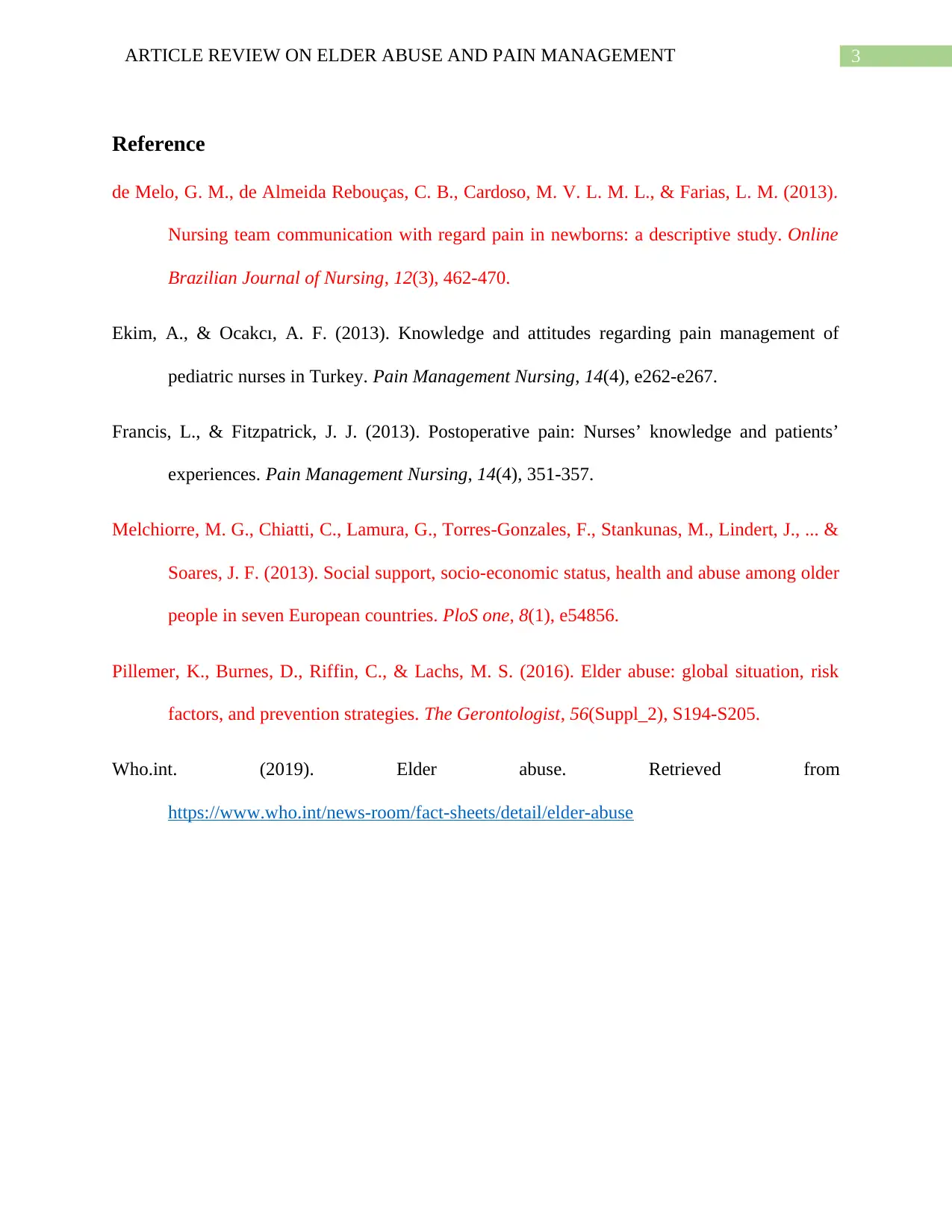
de Melo, G. M., de Almeida Rebouças, C. B., Cardoso, M. V. L. M. L., & Farias, L. M. (2013).
Nursing team communication with regard pain in newborns: a descriptive study. Online
Brazilian Journal of Nursing, 12(3), 462-470.
Ekim, A., & Ocakcı, A. F. (2013). Knowledge and attitudes regarding pain management of
pediatric nurses in Turkey. Pain Management Nursing, 14(4), e262-e267.
Francis, L., & Fitzpatrick, J. J. (2013). Postoperative pain: Nurses’ knowledge and patients’
experiences. Pain Management Nursing, 14(4), 351-357.
Melchiorre, M. G., Chiatti, C., Lamura, G., Torres-Gonzales, F., Stankunas, M., Lindert, J., ... &
Soares, J. F. (2013). Social support, socio-economic status, health and abuse among older
people in seven European countries. PloS one, 8(1), e54856.
Pillemer, K., Burnes, D., Riffin, C., & Lachs, M. S. (2016). Elder abuse: global situation, risk
factors, and prevention strategies. The Gerontologist, 56(Suppl_2), S194-S205.
Who.int. (2019). Elder abuse. Retrieved from
https://www.who.int/news-room/fact-sheets/detail/elder-abuse
chevron_up_icon
1 out of 4
circle_padding
hide_on_mobile
zoom_out_icon
[object Object]