Annotated Bibliography: Elderly Physical Functioning and Interventions
VerifiedAdded on 2022/08/31
|6
|1416
|27
Annotated Bibliography
AI Summary
This annotated bibliography examines the effectiveness of physical activity interventions for elderly individuals, focusing on enhancing their physical functioning. The study employs a PICOT framework to investigate the impact of physical activity programs. The paper analyzes three research articles retrieved from PubMed, including studies by Daher et al. (2018), Nielsen et al. (2018), and Thomas et al. (2019). The analysis includes the study designs, critical appraisals, and relevance of each study to the research question. Two studies support the use of physical activity interventions to improve physical functioning, while one study presents contradictory findings. The bibliography highlights the role of nurses in promoting elderly health and the significance of evidence-based research in addressing clinical questions, particularly in light of the physical, psychological, and emotional declines associated with aging. The goal is to assess the impact of interventions on the elderly population.
Running Head: ANNOTATED BIBLIOGRAPHY
Topic: Annotated Bibliography
Name:
Institution Affiliation:
Topic: Annotated Bibliography
Name:
Institution Affiliation:
Paraphrase This Document
Need a fresh take? Get an instant paraphrase of this document with our AI Paraphraser

ANNOTATED BIBLIOGRAPHY 2
Annotated Bibliography
The significance of the research question in evidence-based practice is very crucial.
The research question provides statically proved information to avoid the chances of
malpractices (Correa-de-Araujo, 2016). The lives of the human being are very crucial;
therefore, the research question and its scientifically proved answer through primary and
secondary sources are significant. In particular, the elderly age is very sensitive, and due to
the ageing sign, the physical, psychological, and emotional decline occurs. Most specifically,
the elderly population experience physical weakness; as a result, their physical activity
reduced to some extent. Robust studies suggested that in a hospital setting, the most
concerned issue of elderly people is restrained physical functioning (Rodrigues, 2014).
Therefore to enhanced elderly people's physical functioning, their health status can be
enhanced. The role of the nurse also plays a significant role in maintaining and promoting the
health functions among the elderly (Rodrigues, 2014). According to evidence-based studies,
they take care of nurses in health care centers can enhance the quality of life and health status
of the elderly. Therefore, the significance of evidence-based research and identifying the
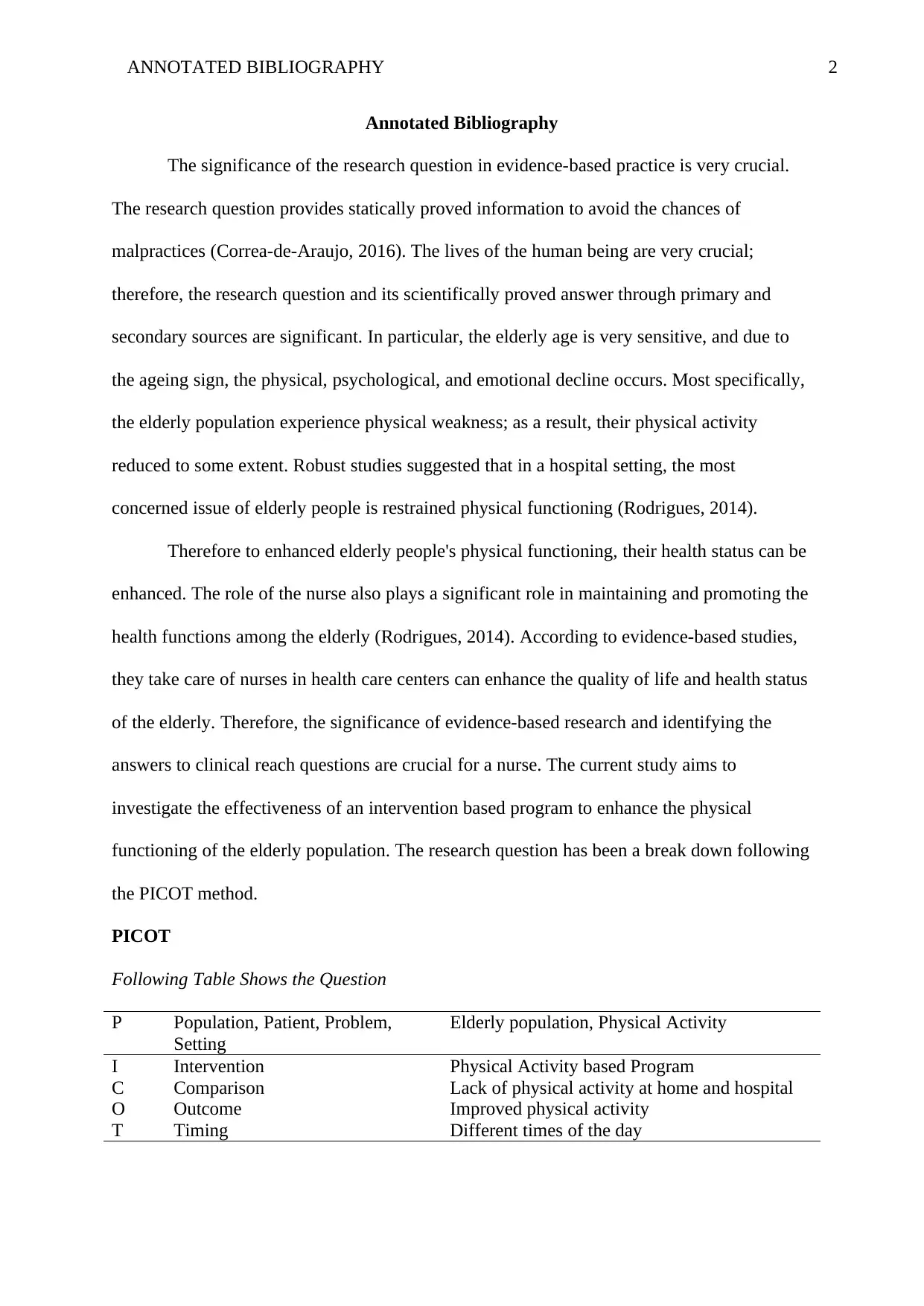
answers to clinical reach questions are crucial for a nurse. The current study aims to
investigate the effectiveness of an intervention based program to enhance the physical
functioning of the elderly population. The research question has been a break down following
the PICOT method.
PICOT
Following Table Shows the Question
P Population, Patient, Problem,
Setting
Elderly population, Physical Activity
I Intervention Physical Activity based Program
C Comparison Lack of physical activity at home and hospital
O Outcome Improved physical activity
T Timing Different times of the day
Annotated Bibliography
The significance of the research question in evidence-based practice is very crucial.
The research question provides statically proved information to avoid the chances of
malpractices (Correa-de-Araujo, 2016). The lives of the human being are very crucial;
therefore, the research question and its scientifically proved answer through primary and
secondary sources are significant. In particular, the elderly age is very sensitive, and due to
the ageing sign, the physical, psychological, and emotional decline occurs. Most specifically,
the elderly population experience physical weakness; as a result, their physical activity
reduced to some extent. Robust studies suggested that in a hospital setting, the most
concerned issue of elderly people is restrained physical functioning (Rodrigues, 2014).
Therefore to enhanced elderly people's physical functioning, their health status can be
enhanced. The role of the nurse also plays a significant role in maintaining and promoting the
health functions among the elderly (Rodrigues, 2014). According to evidence-based studies,
they take care of nurses in health care centers can enhance the quality of life and health status
of the elderly. Therefore, the significance of evidence-based research and identifying the
answers to clinical reach questions are crucial for a nurse. The current study aims to
investigate the effectiveness of an intervention based program to enhance the physical
functioning of the elderly population. The research question has been a break down following
the PICOT method.
PICOT
Following Table Shows the Question
P Population, Patient, Problem,
Setting
Elderly population, Physical Activity
I Intervention Physical Activity based Program
C Comparison Lack of physical activity at home and hospital
O Outcome Improved physical activity
T Timing Different times of the day

ANNOTATED BIBLIOGRAPHY 3
The above table shows the breakdown of the research question in the PICOT method.
The breakdown of the research question makes the investigation process easier (Lobiondo-
wood, & Haber, Cermon and Sing, 2018).
Article 1
Daher, S. S., Nogueira, M. P., Ferreira, M., Tedeschi, M., Martinez, L., & Shirassu,
M. M. (2018). Physical activity program for elderly and economy for the health system. Acta
Ortopedica Brasileira, 26(4), 271–274. https://doi.org/10.1590/1413-785220182604194374
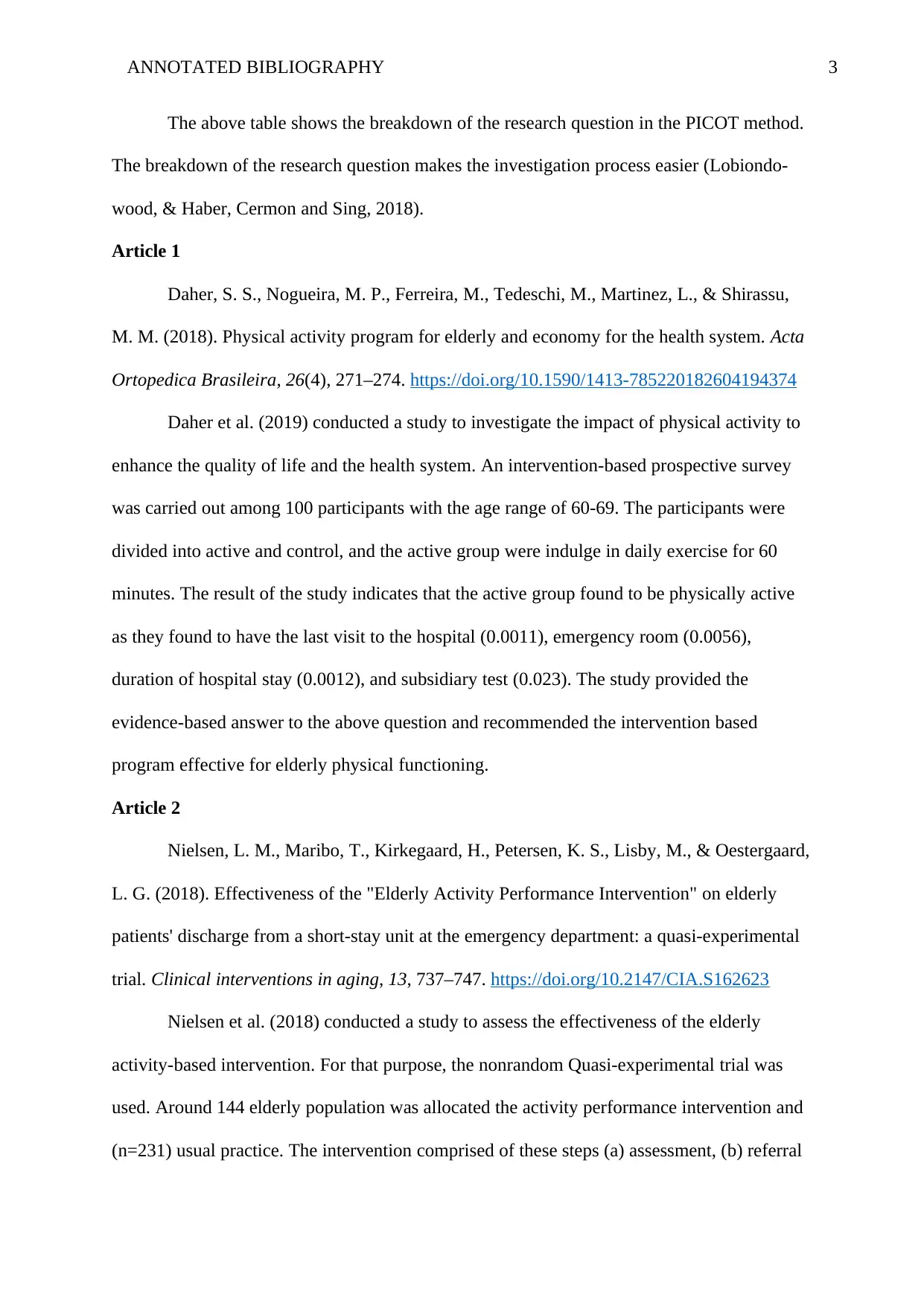
Daher et al. (2019) conducted a study to investigate the impact of physical activity to
enhance the quality of life and the health system. An intervention-based prospective survey
was carried out among 100 participants with the age range of 60-69. The participants were
divided into active and control, and the active group were indulge in daily exercise for 60
minutes. The result of the study indicates that the active group found to be physically active
as they found to have the last visit to the hospital (0.0011), emergency room (0.0056),
duration of hospital stay (0.0012), and subsidiary test (0.023). The study provided the
evidence-based answer to the above question and recommended the intervention based
program effective for elderly physical functioning.
Article 2
Nielsen, L. M., Maribo, T., Kirkegaard, H., Petersen, K. S., Lisby, M., & Oestergaard,
L. G. (2018). Effectiveness of the "Elderly Activity Performance Intervention" on elderly
patients' discharge from a short-stay unit at the emergency department: a quasi-experimental
trial. Clinical interventions in aging, 13, 737–747. https://doi.org/10.2147/CIA.S162623
Nielsen et al. (2018) conducted a study to assess the effectiveness of the elderly
activity-based intervention. For that purpose, the nonrandom Quasi-experimental trial was
used. Around 144 elderly population was allocated the activity performance intervention and
(n=231) usual practice. The intervention comprised of these steps (a) assessment, (b) referral
The above table shows the breakdown of the research question in the PICOT method.
The breakdown of the research question makes the investigation process easier (Lobiondo-
wood, & Haber, Cermon and Sing, 2018).
Article 1
Daher, S. S., Nogueira, M. P., Ferreira, M., Tedeschi, M., Martinez, L., & Shirassu,
M. M. (2018). Physical activity program for elderly and economy for the health system. Acta
Ortopedica Brasileira, 26(4), 271–274. https://doi.org/10.1590/1413-785220182604194374
Daher et al. (2019) conducted a study to investigate the impact of physical activity to
enhance the quality of life and the health system. An intervention-based prospective survey
was carried out among 100 participants with the age range of 60-69. The participants were
divided into active and control, and the active group were indulge in daily exercise for 60
minutes. The result of the study indicates that the active group found to be physically active
as they found to have the last visit to the hospital (0.0011), emergency room (0.0056),
duration of hospital stay (0.0012), and subsidiary test (0.023). The study provided the
evidence-based answer to the above question and recommended the intervention based
program effective for elderly physical functioning.
Article 2
Nielsen, L. M., Maribo, T., Kirkegaard, H., Petersen, K. S., Lisby, M., & Oestergaard,
L. G. (2018). Effectiveness of the "Elderly Activity Performance Intervention" on elderly
patients' discharge from a short-stay unit at the emergency department: a quasi-experimental
trial. Clinical interventions in aging, 13, 737–747. https://doi.org/10.2147/CIA.S162623
Nielsen et al. (2018) conducted a study to assess the effectiveness of the elderly
activity-based intervention. For that purpose, the nonrandom Quasi-experimental trial was
used. Around 144 elderly population was allocated the activity performance intervention and
(n=231) usual practice. The intervention comprised of these steps (a) assessment, (b) referral
⊘ This is a preview!⊘
Do you want full access?
Subscribe today to unlock all pages.

Trusted by 1+ million students worldwide

ANNOTATED BIBLIOGRAPHY 4
to further rehabilitation and (c) follow up visits. The results of the study suggested that no
significant difference in activity performance was observed between both groups. In other
words, the study proposed that physical activity-based intervention does not reduce the risk of
readmission in the hospital. This study contradicts the findings of the study mentioned above,
but still provides the answer for our study.
Article 3
Thomas, E., Battaglia, G., Patti, A., Brusa, J., Leonardi, V., Palma, A., & Bellafiore,
M. (2019). Physical activity programs for balance and fall prevention in elderly: A systematic
review. Medicine, 98(27), e16218. https://doi.org/10.1097/MD.0000000000016218
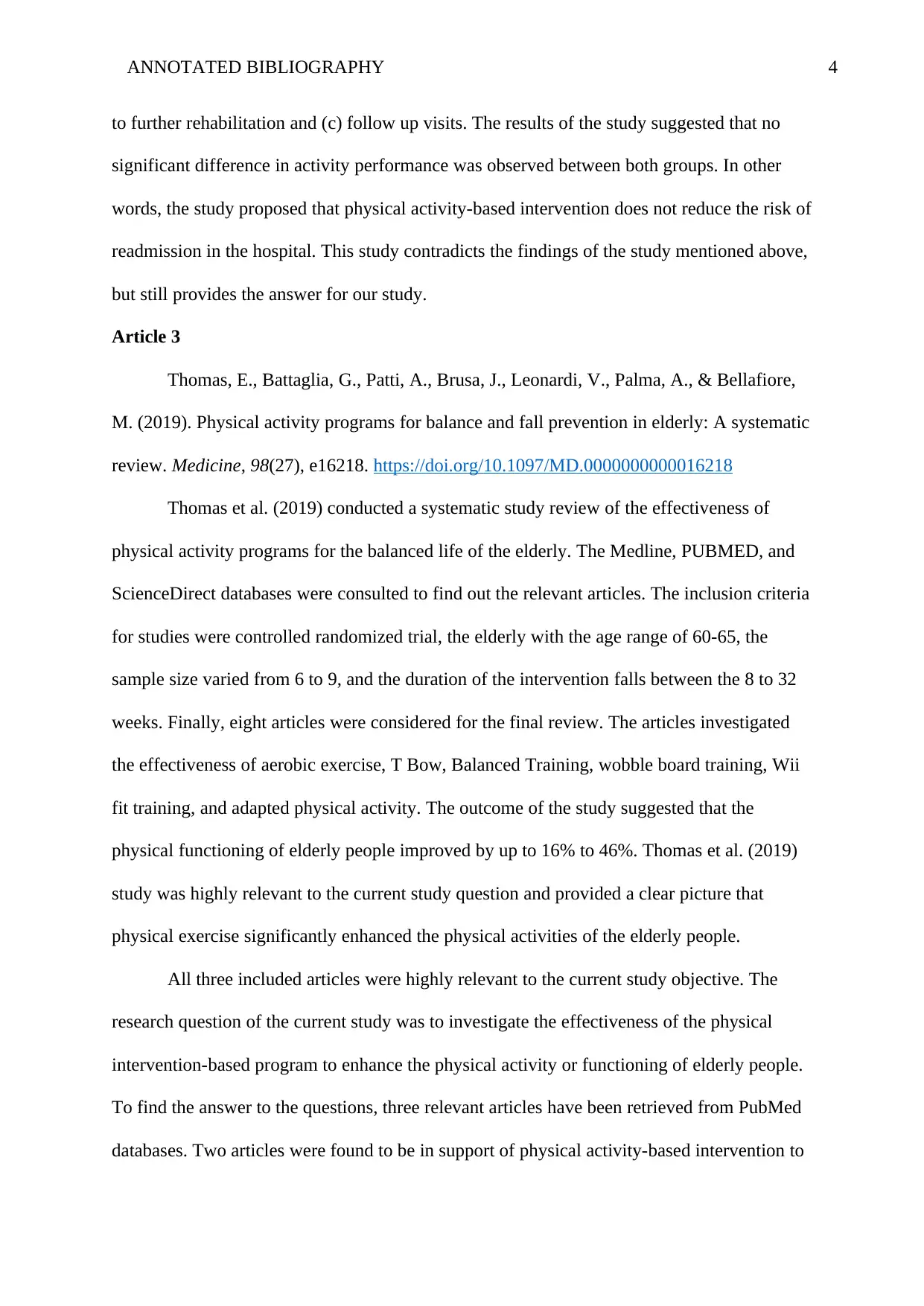
Thomas et al. (2019) conducted a systematic study review of the effectiveness of
physical activity programs for the balanced life of the elderly. The Medline, PUBMED, and
ScienceDirect databases were consulted to find out the relevant articles. The inclusion criteria
for studies were controlled randomized trial, the elderly with the age range of 60-65, the
sample size varied from 6 to 9, and the duration of the intervention falls between the 8 to 32
weeks. Finally, eight articles were considered for the final review. The articles investigated
the effectiveness of aerobic exercise, T Bow, Balanced Training, wobble board training, Wii
fit training, and adapted physical activity. The outcome of the study suggested that the
physical functioning of elderly people improved by up to 16% to 46%. Thomas et al. (2019)
study was highly relevant to the current study question and provided a clear picture that
physical exercise significantly enhanced the physical activities of the elderly people.
All three included articles were highly relevant to the current study objective. The
research question of the current study was to investigate the effectiveness of the physical
intervention-based program to enhance the physical activity or functioning of elderly people.
To find the answer to the questions, three relevant articles have been retrieved from PubMed
databases. Two articles were found to be in support of physical activity-based intervention to
to further rehabilitation and (c) follow up visits. The results of the study suggested that no
significant difference in activity performance was observed between both groups. In other
words, the study proposed that physical activity-based intervention does not reduce the risk of
readmission in the hospital. This study contradicts the findings of the study mentioned above,
but still provides the answer for our study.
Article 3
Thomas, E., Battaglia, G., Patti, A., Brusa, J., Leonardi, V., Palma, A., & Bellafiore,
M. (2019). Physical activity programs for balance and fall prevention in elderly: A systematic
review. Medicine, 98(27), e16218. https://doi.org/10.1097/MD.0000000000016218
Thomas et al. (2019) conducted a systematic study review of the effectiveness of
physical activity programs for the balanced life of the elderly. The Medline, PUBMED, and
ScienceDirect databases were consulted to find out the relevant articles. The inclusion criteria
for studies were controlled randomized trial, the elderly with the age range of 60-65, the
sample size varied from 6 to 9, and the duration of the intervention falls between the 8 to 32
weeks. Finally, eight articles were considered for the final review. The articles investigated
the effectiveness of aerobic exercise, T Bow, Balanced Training, wobble board training, Wii
fit training, and adapted physical activity. The outcome of the study suggested that the
physical functioning of elderly people improved by up to 16% to 46%. Thomas et al. (2019)
study was highly relevant to the current study question and provided a clear picture that
physical exercise significantly enhanced the physical activities of the elderly people.
All three included articles were highly relevant to the current study objective. The
research question of the current study was to investigate the effectiveness of the physical
intervention-based program to enhance the physical activity or functioning of elderly people.
To find the answer to the questions, three relevant articles have been retrieved from PubMed
databases. Two articles were found to be in support of physical activity-based intervention to
Paraphrase This Document
Need a fresh take? Get an instant paraphrase of this document with our AI Paraphraser

ANNOTATED BIBLIOGRAPHY 5
enhance the physical functioning of elderly people. In contrast, one study contradicted the
above two articles and suggested that physical activity-based interventions don’t enhance the
physical functioning of elderly people.
enhance the physical functioning of elderly people. In contrast, one study contradicted the
above two articles and suggested that physical activity-based interventions don’t enhance the
physical functioning of elderly people.

ANNOTATED BIBLIOGRAPHY 6
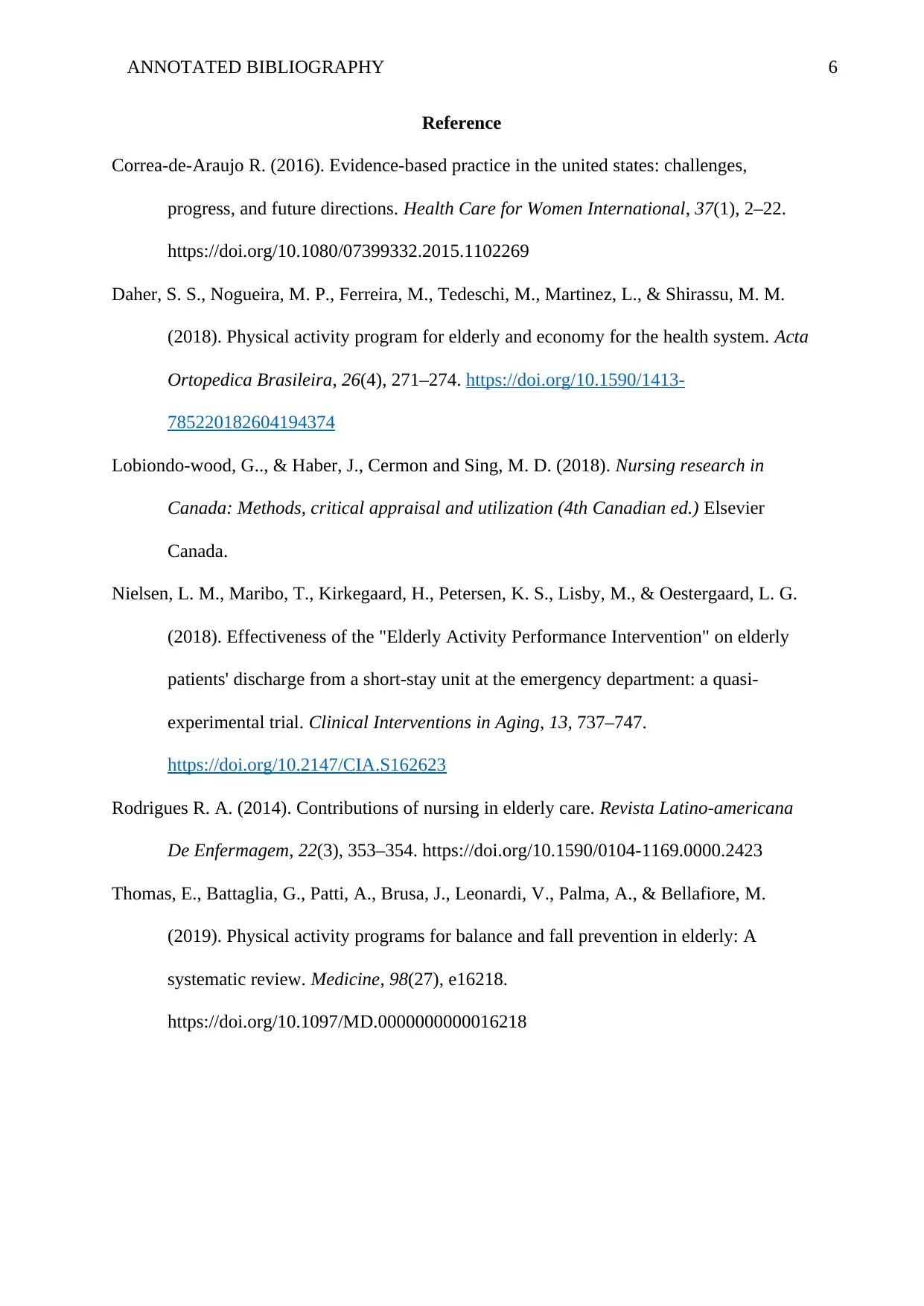
Reference
Correa-de-Araujo R. (2016). Evidence-based practice in the united states: challenges,
progress, and future directions. Health Care for Women International, 37(1), 2–22.
https://doi.org/10.1080/07399332.2015.1102269
Daher, S. S., Nogueira, M. P., Ferreira, M., Tedeschi, M., Martinez, L., & Shirassu, M. M.
(2018). Physical activity program for elderly and economy for the health system. Acta
Ortopedica Brasileira, 26(4), 271–274. https://doi.org/10.1590/1413-
785220182604194374
Lobiondo-wood, G.., & Haber, J., Cermon and Sing, M. D. (2018). Nursing research in
Canada: Methods, critical appraisal and utilization (4th Canadian ed.) Elsevier
Canada.
Nielsen, L. M., Maribo, T., Kirkegaard, H., Petersen, K. S., Lisby, M., & Oestergaard, L. G.
(2018). Effectiveness of the "Elderly Activity Performance Intervention" on elderly
patients' discharge from a short-stay unit at the emergency department: a quasi-
experimental trial. Clinical Interventions in Aging, 13, 737–747.
https://doi.org/10.2147/CIA.S162623
Rodrigues R. A. (2014). Contributions of nursing in elderly care. Revista Latino-americana
De Enfermagem, 22(3), 353–354. https://doi.org/10.1590/0104-1169.0000.2423
Thomas, E., Battaglia, G., Patti, A., Brusa, J., Leonardi, V., Palma, A., & Bellafiore, M.
(2019). Physical activity programs for balance and fall prevention in elderly: A
systematic review. Medicine, 98(27), e16218.
https://doi.org/10.1097/MD.0000000000016218
Reference
Correa-de-Araujo R. (2016). Evidence-based practice in the united states: challenges,
progress, and future directions. Health Care for Women International, 37(1), 2–22.
https://doi.org/10.1080/07399332.2015.1102269
Daher, S. S., Nogueira, M. P., Ferreira, M., Tedeschi, M., Martinez, L., & Shirassu, M. M.
(2018). Physical activity program for elderly and economy for the health system. Acta
Ortopedica Brasileira, 26(4), 271–274. https://doi.org/10.1590/1413-
785220182604194374
Lobiondo-wood, G.., & Haber, J., Cermon and Sing, M. D. (2018). Nursing research in
Canada: Methods, critical appraisal and utilization (4th Canadian ed.) Elsevier
Canada.
Nielsen, L. M., Maribo, T., Kirkegaard, H., Petersen, K. S., Lisby, M., & Oestergaard, L. G.
(2018). Effectiveness of the "Elderly Activity Performance Intervention" on elderly
patients' discharge from a short-stay unit at the emergency department: a quasi-
experimental trial. Clinical Interventions in Aging, 13, 737–747.
https://doi.org/10.2147/CIA.S162623
Rodrigues R. A. (2014). Contributions of nursing in elderly care. Revista Latino-americana
De Enfermagem, 22(3), 353–354. https://doi.org/10.1590/0104-1169.0000.2423
Thomas, E., Battaglia, G., Patti, A., Brusa, J., Leonardi, V., Palma, A., & Bellafiore, M.
(2019). Physical activity programs for balance and fall prevention in elderly: A
systematic review. Medicine, 98(27), e16218.
https://doi.org/10.1097/MD.0000000000016218
⊘ This is a preview!⊘
Do you want full access?
Subscribe today to unlock all pages.

Trusted by 1+ million students worldwide
1 out of 6
Related Documents
Your All-in-One AI-Powered Toolkit for Academic Success.
+13062052269
info@desklib.com
Available 24*7 on WhatsApp / Email
Unlock your academic potential
Copyright © 2020–2026 A2Z Services. All Rights Reserved. Developed and managed by ZUCOL.