Project Proposal: Improving Pressure Ulcer Care for Elderly Patients
VerifiedAdded on 2023/06/03
|26
|4592
|143
Project
AI Summary
This project proposal focuses on service improvements for the prevention and management of pressure ulcers in elderly patients, particularly within nursing home settings. The proposal identifies the increasing prevalence of pressure ulcers due to an aging population and associated comorbidities. It aims to frame an effective service improvement strategy to develop quality and safe service provision, utilizing secondary data collection. The proposed research incorporates DMAIC and PDSA models from Six Sigma, alongside principles of lean management to maximize patient value through waste and waiting time reduction. The proposal recommends holistic nursing care that caters to the diverse needs of elderly patients. The research anticipates demonstrating the positive effects of lean management and Six Sigma strategies on the quality of care, emphasizing the importance of preventive measures and appropriate interventions to manage and reduce pressure ulcer rates among elderly patients.

Nursing Research 1
Nursing Research
Nursing Research

Paraphrase This Document
Need a fresh take? Get an instant paraphrase of this document with our AI Paraphraser
Nursing Research 2
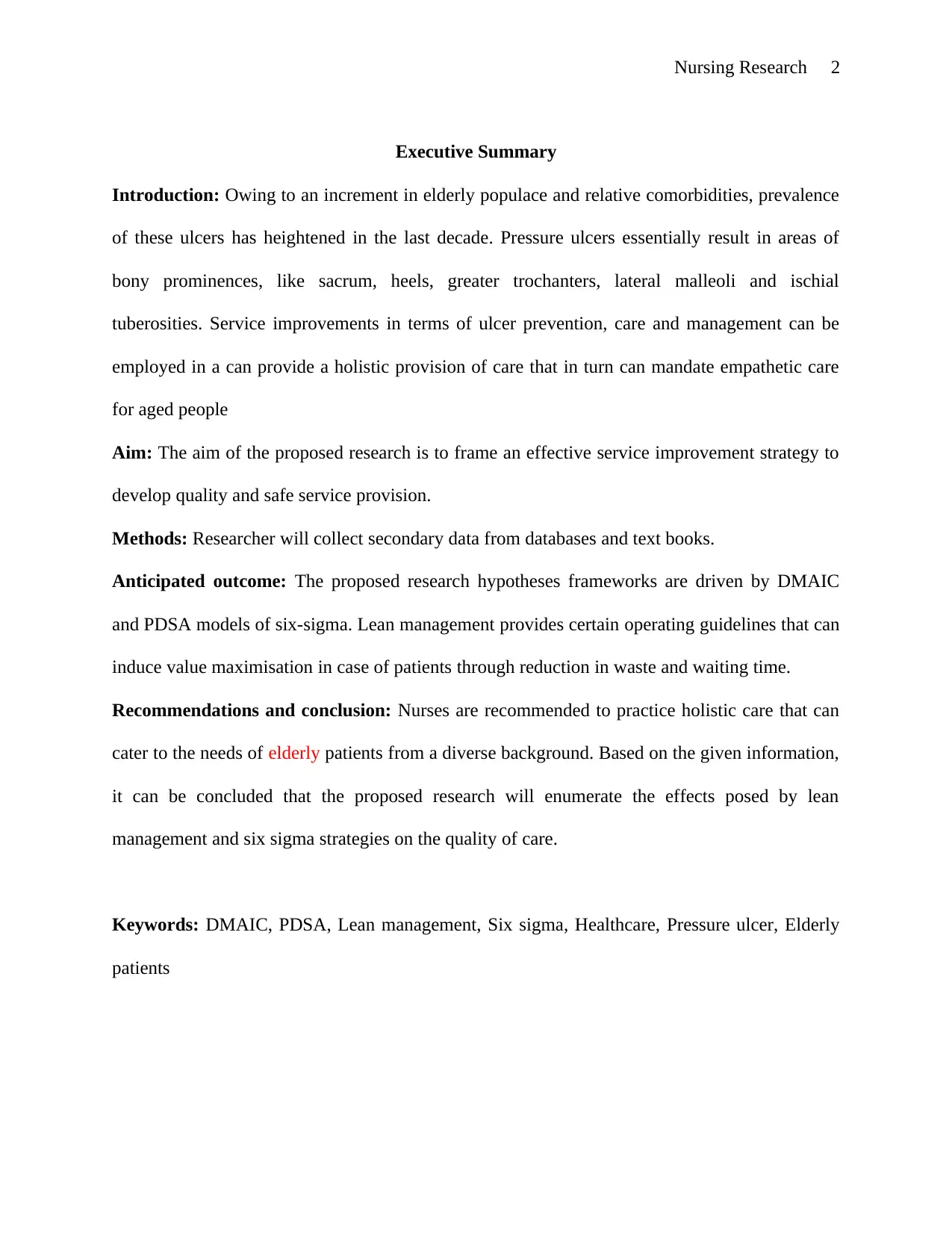
Executive Summary
Introduction: Owing to an increment in elderly populace and relative comorbidities, prevalence
of these ulcers has heightened in the last decade. Pressure ulcers essentially result in areas of
bony prominences, like sacrum, heels, greater trochanters, lateral malleoli and ischial
tuberosities. Service improvements in terms of ulcer prevention, care and management can be
employed in a can provide a holistic provision of care that in turn can mandate empathetic care
for aged people
Aim: The aim of the proposed research is to frame an effective service improvement strategy to
develop quality and safe service provision.
Methods: Researcher will collect secondary data from databases and text books.
Anticipated outcome: The proposed research hypotheses frameworks are driven by DMAIC
and PDSA models of six-sigma. Lean management provides certain operating guidelines that can
induce value maximisation in case of patients through reduction in waste and waiting time.
Recommendations and conclusion: Nurses are recommended to practice holistic care that can
cater to the needs of elderly patients from a diverse background. Based on the given information,
it can be concluded that the proposed research will enumerate the effects posed by lean
management and six sigma strategies on the quality of care.
Keywords: DMAIC, PDSA, Lean management, Six sigma, Healthcare, Pressure ulcer, Elderly
patients
Executive Summary
Introduction: Owing to an increment in elderly populace and relative comorbidities, prevalence
of these ulcers has heightened in the last decade. Pressure ulcers essentially result in areas of
bony prominences, like sacrum, heels, greater trochanters, lateral malleoli and ischial
tuberosities. Service improvements in terms of ulcer prevention, care and management can be
employed in a can provide a holistic provision of care that in turn can mandate empathetic care
for aged people
Aim: The aim of the proposed research is to frame an effective service improvement strategy to
develop quality and safe service provision.
Methods: Researcher will collect secondary data from databases and text books.
Anticipated outcome: The proposed research hypotheses frameworks are driven by DMAIC
and PDSA models of six-sigma. Lean management provides certain operating guidelines that can
induce value maximisation in case of patients through reduction in waste and waiting time.
Recommendations and conclusion: Nurses are recommended to practice holistic care that can
cater to the needs of elderly patients from a diverse background. Based on the given information,
it can be concluded that the proposed research will enumerate the effects posed by lean
management and six sigma strategies on the quality of care.
Keywords: DMAIC, PDSA, Lean management, Six sigma, Healthcare, Pressure ulcer, Elderly
patients
Nursing Research 3
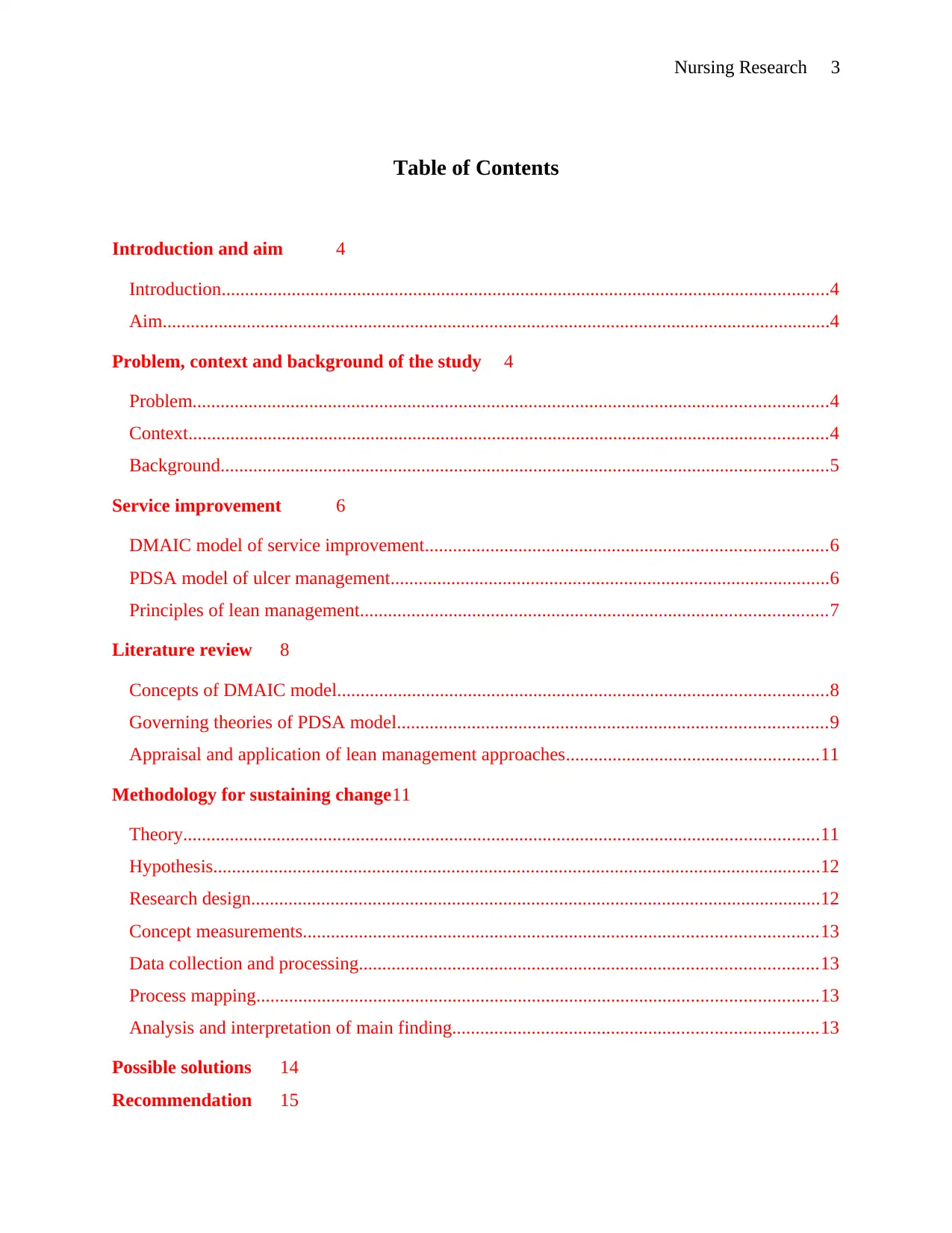
Table of Contents
Introduction and aim 4
Introduction..................................................................................................................................4
Aim...............................................................................................................................................4
Problem, context and background of the study 4
Problem........................................................................................................................................4
Context.........................................................................................................................................4
Background..................................................................................................................................5
Service improvement 6
DMAIC model of service improvement......................................................................................6
PDSA model of ulcer management..............................................................................................6
Principles of lean management....................................................................................................7
Literature review 8
Concepts of DMAIC model.........................................................................................................8
Governing theories of PDSA model............................................................................................9
Appraisal and application of lean management approaches......................................................11
Methodology for sustaining change11
Theory........................................................................................................................................11
Hypothesis..................................................................................................................................12
Research design..........................................................................................................................12
Concept measurements..............................................................................................................13
Data collection and processing..................................................................................................13
Process mapping........................................................................................................................13
Analysis and interpretation of main finding..............................................................................13
Possible solutions 14
Recommendation 15
Table of Contents
Introduction and aim 4
Introduction..................................................................................................................................4
Aim...............................................................................................................................................4
Problem, context and background of the study 4
Problem........................................................................................................................................4
Context.........................................................................................................................................4
Background..................................................................................................................................5
Service improvement 6
DMAIC model of service improvement......................................................................................6
PDSA model of ulcer management..............................................................................................6
Principles of lean management....................................................................................................7
Literature review 8
Concepts of DMAIC model.........................................................................................................8
Governing theories of PDSA model............................................................................................9
Appraisal and application of lean management approaches......................................................11
Methodology for sustaining change11
Theory........................................................................................................................................11
Hypothesis..................................................................................................................................12
Research design..........................................................................................................................12
Concept measurements..............................................................................................................13
Data collection and processing..................................................................................................13
Process mapping........................................................................................................................13
Analysis and interpretation of main finding..............................................................................13
Possible solutions 14
Recommendation 15
⊘ This is a preview!⊘
Do you want full access?
Subscribe today to unlock all pages.

Trusted by 1+ million students worldwide
Nursing Research 4
Conclusion 15
Reference List 17
Appendices 19
Appendix A: DMAIC model......................................................................................................19
Appendix B: PDSA Cycle..........................................................................................................20
Appendix C: Pre and post test patient design............................................................................21
Conclusion 15
Reference List 17
Appendices 19
Appendix A: DMAIC model......................................................................................................19
Appendix B: PDSA Cycle..........................................................................................................20
Appendix C: Pre and post test patient design............................................................................21
Paraphrase This Document
Need a fresh take? Get an instant paraphrase of this document with our AI Paraphraser
Nursing Research 5
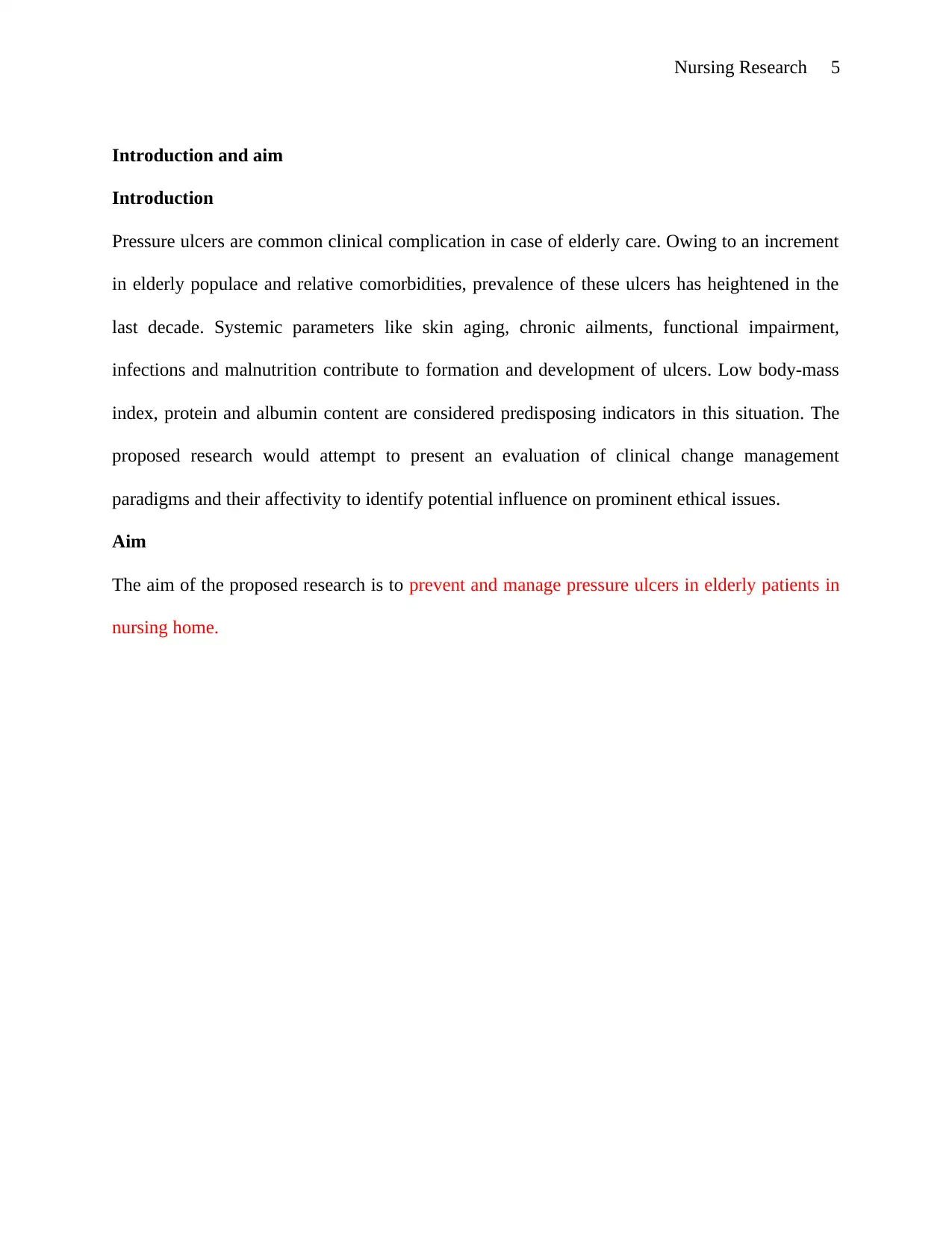
Introduction and aim
Introduction
Pressure ulcers are common clinical complication in case of elderly care. Owing to an increment
in elderly populace and relative comorbidities, prevalence of these ulcers has heightened in the
last decade. Systemic parameters like skin aging, chronic ailments, functional impairment,
infections and malnutrition contribute to formation and development of ulcers. Low body-mass
index, protein and albumin content are considered predisposing indicators in this situation. The
proposed research would attempt to present an evaluation of clinical change management
paradigms and their affectivity to identify potential influence on prominent ethical issues.
Aim
The aim of the proposed research is to prevent and manage pressure ulcers in elderly patients in
nursing home.
Introduction and aim
Introduction
Pressure ulcers are common clinical complication in case of elderly care. Owing to an increment
in elderly populace and relative comorbidities, prevalence of these ulcers has heightened in the
last decade. Systemic parameters like skin aging, chronic ailments, functional impairment,
infections and malnutrition contribute to formation and development of ulcers. Low body-mass
index, protein and albumin content are considered predisposing indicators in this situation. The
proposed research would attempt to present an evaluation of clinical change management
paradigms and their affectivity to identify potential influence on prominent ethical issues.
Aim
The aim of the proposed research is to prevent and manage pressure ulcers in elderly patients in
nursing home.
Nursing Research 6
Problem, context and background of the study
Problem
The problem caused by this issue is the formation of pressure ulcers in elderly patients during
their stay in the hospitals. Pressure ulcers are considered localised injuries, which occur due to
unrelieved pressures on the underlying skin and tissues. Despite effective preventive approaches,
pressure ulcers can be unavoidable in some cases. Even it has been observed that pressure ulcer
rate among elderly people has increased over time. Hence it is necessary to propose a specific
guideline to analyse effective service provision in consideration of patient safety and care
quality.
Context
Pressure ulcers essentially result in areas of bony prominences, like sacrum, heels, greater
trochanters, lateral malleoli and ischial tuberosities. As reported by Wang, Walker and Gillespie
(2018), 70% of the people who suffer from these ulcers belong to the age range of 65 years or
above. This result is prevalent in approximately 21% of patients in the nursing homes and 28%
of residents in hospitals in the United Kingdom. Bryant and Nix (2015) denote external as well
as internal risk indicators for checking the formation of pressure ulcers. External risk parameters
involve constant pressure that can give rise to immobility. In addition to this, excessive moisture
or shear forces on patients can be the causes of ulcers. Internal risk parameters malnutrition and
involve reduced sensory perception.
Background
Prognosis for effective treatment of pressure ulcers are further hindered by a drop in the service
provisions rendered by service providers. However, note at least 70% of secondary stage ulcers
are seen to heal after applying appropriate intervention for 6 months (Qaseem et al. 2015).
Problem, context and background of the study
Problem
The problem caused by this issue is the formation of pressure ulcers in elderly patients during
their stay in the hospitals. Pressure ulcers are considered localised injuries, which occur due to
unrelieved pressures on the underlying skin and tissues. Despite effective preventive approaches,
pressure ulcers can be unavoidable in some cases. Even it has been observed that pressure ulcer
rate among elderly people has increased over time. Hence it is necessary to propose a specific
guideline to analyse effective service provision in consideration of patient safety and care
quality.
Context
Pressure ulcers essentially result in areas of bony prominences, like sacrum, heels, greater
trochanters, lateral malleoli and ischial tuberosities. As reported by Wang, Walker and Gillespie
(2018), 70% of the people who suffer from these ulcers belong to the age range of 65 years or
above. This result is prevalent in approximately 21% of patients in the nursing homes and 28%
of residents in hospitals in the United Kingdom. Bryant and Nix (2015) denote external as well
as internal risk indicators for checking the formation of pressure ulcers. External risk parameters
involve constant pressure that can give rise to immobility. In addition to this, excessive moisture
or shear forces on patients can be the causes of ulcers. Internal risk parameters malnutrition and
involve reduced sensory perception.
Background
Prognosis for effective treatment of pressure ulcers are further hindered by a drop in the service
provisions rendered by service providers. However, note at least 70% of secondary stage ulcers
are seen to heal after applying appropriate intervention for 6 months (Qaseem et al. 2015).
⊘ This is a preview!⊘
Do you want full access?
Subscribe today to unlock all pages.
Trusted by 1+ million students worldwide
Nursing Research 7
Similarly, 50% of tertiary stage ulcers as well as 30% of final stage ulcers can also heal within
approximately a similar period as given above. As mentioned in the problem statement formation
of ulcers in elderly patients can cause a series of secondary comorbidities. As stated by Ackley,
Ladwig and Makic (2016), Braden scale is a prominent checklist that adjuncts risk assessment in
case of bed-bound patients. Skin infections, scabies or further laceration can occur from
continual wear and tear and inappropriate wound management (Mir et al. 2015). Service
providing organisations should therefore target prevention and treatment of pressure ulcers.
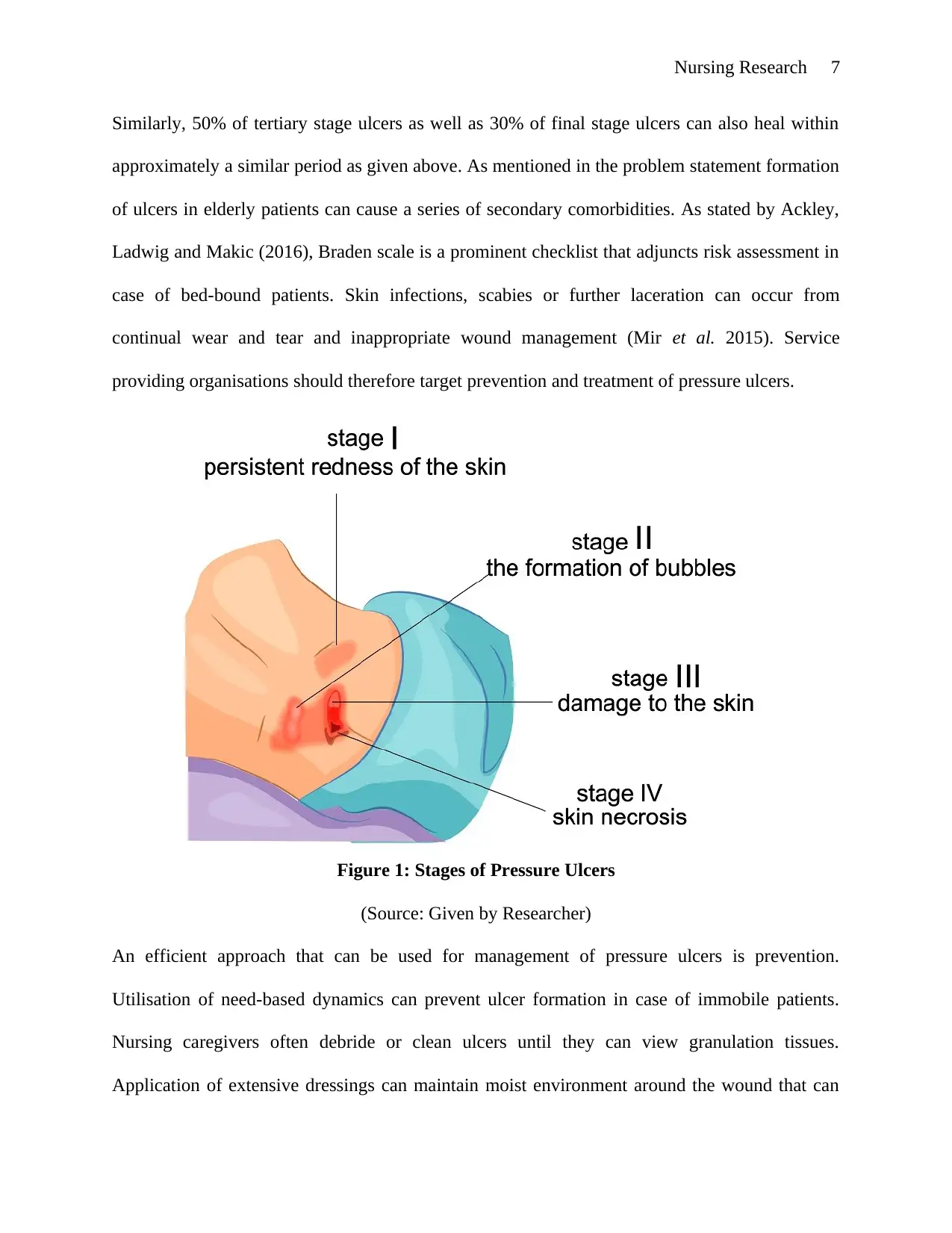
Figure 1: Stages of Pressure Ulcers
(Source: Given by Researcher)
An efficient approach that can be used for management of pressure ulcers is prevention.
Utilisation of need-based dynamics can prevent ulcer formation in case of immobile patients.
Nursing caregivers often debride or clean ulcers until they can view granulation tissues.
Application of extensive dressings can maintain moist environment around the wound that can
Similarly, 50% of tertiary stage ulcers as well as 30% of final stage ulcers can also heal within
approximately a similar period as given above. As mentioned in the problem statement formation
of ulcers in elderly patients can cause a series of secondary comorbidities. As stated by Ackley,
Ladwig and Makic (2016), Braden scale is a prominent checklist that adjuncts risk assessment in
case of bed-bound patients. Skin infections, scabies or further laceration can occur from
continual wear and tear and inappropriate wound management (Mir et al. 2015). Service
providing organisations should therefore target prevention and treatment of pressure ulcers.
Figure 1: Stages of Pressure Ulcers
(Source: Given by Researcher)
An efficient approach that can be used for management of pressure ulcers is prevention.
Utilisation of need-based dynamics can prevent ulcer formation in case of immobile patients.
Nursing caregivers often debride or clean ulcers until they can view granulation tissues.
Application of extensive dressings can maintain moist environment around the wound that can
Paraphrase This Document
Need a fresh take? Get an instant paraphrase of this document with our AI Paraphraser
Nursing Research 8
pace ulcer formation (Sheehan et al. 2016). Fluid, protein and calorie intake are also responsible
for influencing the formation rates. Preventive measures for these ulcers involve reducing
pressure through frequent repositioning, avoiding shear forces, and utilising pressure-reducing
static devices. According to Cereda et al. (2015), the aforementioned static devices involve
water, foam, air or gel mattresses for its construction. In other cases mattress overlays, heels and
joints pads, and foam wedges are also used. In some cases dynamic devices can be sought to help
if the patient is unable to reposition themselves.
Service improvement and prevalent policies
Service improvements in terms of ulcer prevention, care and management can be employed in a
patient-centred approach. This can provide a holistic provision of care that in turn can mandate
empathetic care for aged people, considering their prevalent needs and preferences. A prominent
threat in the management of pressure ulcers is that they are likely to occur in a very fast rate,
essentially within 6 hours after heavy loading. As per Health and Social Care Act (2012),
Pressure Ulcer Prevention Policy has been designed by NHS. Similarly, NICE guidelines also
designate an ECT2550 Pressure Ulcer Prevention and Treatment Policy.
DMAIC model of service improvement
DMAIC methodology offers efficiently governed methodical process that can deliver complete
measurable outcomes. The present protocol is thereby segregated in the following phases. [Refer
to Appendix A]
Define: The definition phase involves brainstorming to successfully enumerate the threats that
can be posed by an issue (Beeckman et al. 2014). In this case, ulcer formation in bedridden
elderly patients is defined as the threat.
pace ulcer formation (Sheehan et al. 2016). Fluid, protein and calorie intake are also responsible
for influencing the formation rates. Preventive measures for these ulcers involve reducing
pressure through frequent repositioning, avoiding shear forces, and utilising pressure-reducing
static devices. According to Cereda et al. (2015), the aforementioned static devices involve
water, foam, air or gel mattresses for its construction. In other cases mattress overlays, heels and
joints pads, and foam wedges are also used. In some cases dynamic devices can be sought to help
if the patient is unable to reposition themselves.
Service improvement and prevalent policies
Service improvements in terms of ulcer prevention, care and management can be employed in a
patient-centred approach. This can provide a holistic provision of care that in turn can mandate
empathetic care for aged people, considering their prevalent needs and preferences. A prominent
threat in the management of pressure ulcers is that they are likely to occur in a very fast rate,
essentially within 6 hours after heavy loading. As per Health and Social Care Act (2012),
Pressure Ulcer Prevention Policy has been designed by NHS. Similarly, NICE guidelines also
designate an ECT2550 Pressure Ulcer Prevention and Treatment Policy.
DMAIC model of service improvement
DMAIC methodology offers efficiently governed methodical process that can deliver complete
measurable outcomes. The present protocol is thereby segregated in the following phases. [Refer
to Appendix A]
Define: The definition phase involves brainstorming to successfully enumerate the threats that
can be posed by an issue (Beeckman et al. 2014). In this case, ulcer formation in bedridden
elderly patients is defined as the threat.
Nursing Research 9
Measure: The measurement of ulcer formation rates is done through Braden Scale to identify
risk exposure of patients in consideration of pressure ulcer development.
Analyse: One-Way data analysis of revealed critical factors of ulcer formation are heel
protectors and compliance to incontinence protocols. Braden score of 23 to 18 can identify lower
risk, while 12 or less resembles high risk exposure.
Improve: 60% reduction in cognitive nosocomial rate of pressure ulcer can result in
approximately £80,000 cost avoidance per annum.
Control: Nosocomial rates must be monitored each month to focus on patient-based care
indicators to maintain performance.
PDSA model of ulcer management
Plan: The plan conforms to manage pressure ulcers by applying therapeutic intervention after its
occurrence. This plan is based on timely washing and documentation of ulcer development in
elderly patients. [Refer to Appendix B]
Do: Bryant and Nix (2015) state appropriate washing techniques must be utilised for each stage
of pressure ulcer (soap wash for stage 1, saline wash for stage 2 ulcers). Stage 3 and 4 ulcers can
rarely be treated permanently; hence nurses should maintain effective protocols to prevent
further infections.
Study: During the treatment, frequent observations should be made and documented to analyse
the reduction rate pressure ulcers (Qaseem et al. 2015). The documentation charts can be aided
with weekly photographs to measure the diameter, depth and tenderness of the ulcers.
Act: Further modifications can be implemented in the prevalent cycle by utilisation of
therapeutic drugs for stage 1 and stage 2 pressure sores. Amoxicillin-potassium clavulanate can
be used to induce a faster healing process in case of infected ulcers in elderly patients.
Measure: The measurement of ulcer formation rates is done through Braden Scale to identify
risk exposure of patients in consideration of pressure ulcer development.
Analyse: One-Way data analysis of revealed critical factors of ulcer formation are heel
protectors and compliance to incontinence protocols. Braden score of 23 to 18 can identify lower
risk, while 12 or less resembles high risk exposure.
Improve: 60% reduction in cognitive nosocomial rate of pressure ulcer can result in
approximately £80,000 cost avoidance per annum.
Control: Nosocomial rates must be monitored each month to focus on patient-based care
indicators to maintain performance.
PDSA model of ulcer management
Plan: The plan conforms to manage pressure ulcers by applying therapeutic intervention after its
occurrence. This plan is based on timely washing and documentation of ulcer development in
elderly patients. [Refer to Appendix B]
Do: Bryant and Nix (2015) state appropriate washing techniques must be utilised for each stage
of pressure ulcer (soap wash for stage 1, saline wash for stage 2 ulcers). Stage 3 and 4 ulcers can
rarely be treated permanently; hence nurses should maintain effective protocols to prevent
further infections.
Study: During the treatment, frequent observations should be made and documented to analyse
the reduction rate pressure ulcers (Qaseem et al. 2015). The documentation charts can be aided
with weekly photographs to measure the diameter, depth and tenderness of the ulcers.
Act: Further modifications can be implemented in the prevalent cycle by utilisation of
therapeutic drugs for stage 1 and stage 2 pressure sores. Amoxicillin-potassium clavulanate can
be used to induce a faster healing process in case of infected ulcers in elderly patients.
⊘ This is a preview!⊘
Do you want full access?
Subscribe today to unlock all pages.
Trusted by 1+ million students worldwide
Nursing Research 10
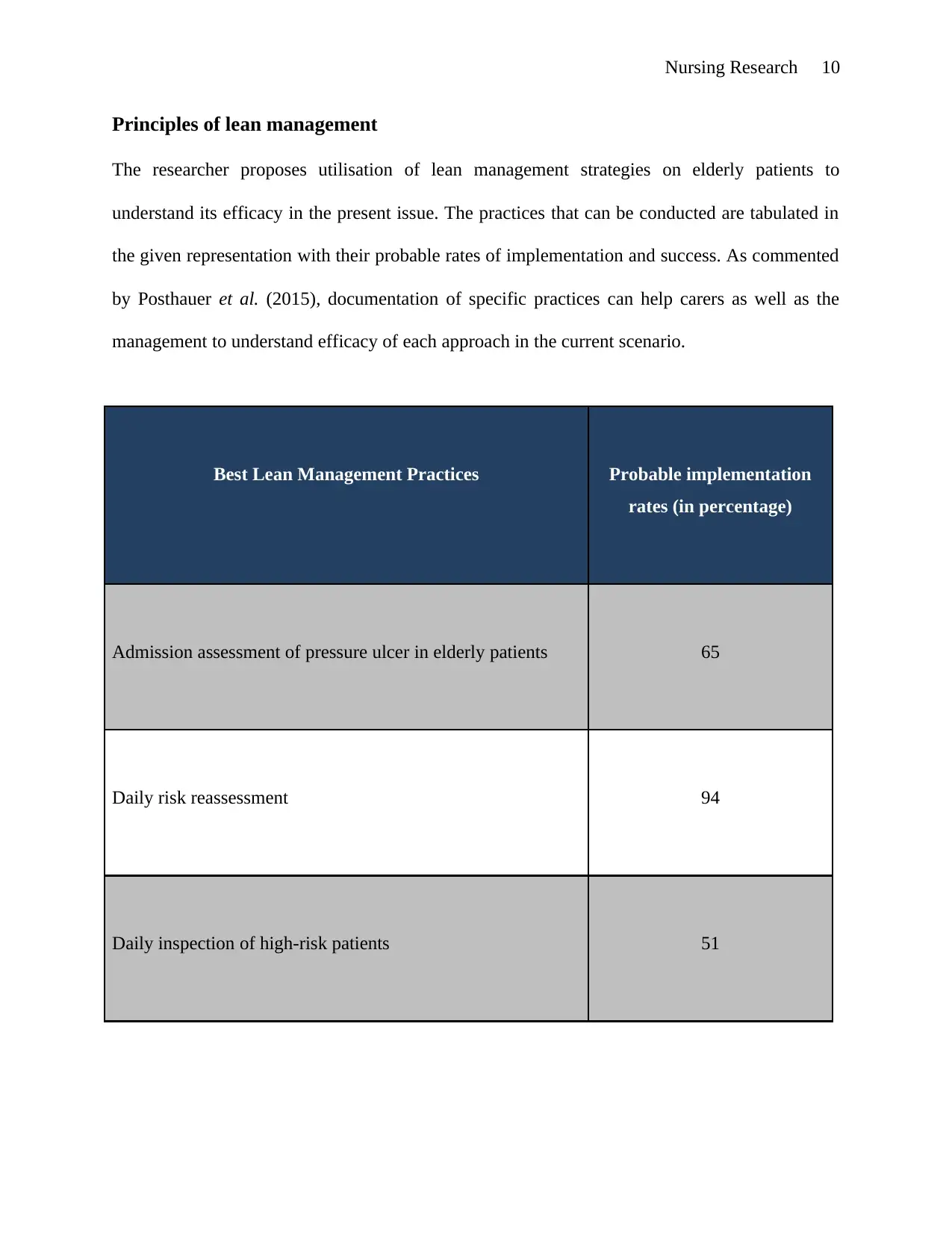
Principles of lean management
The researcher proposes utilisation of lean management strategies on elderly patients to
understand its efficacy in the present issue. The practices that can be conducted are tabulated in
the given representation with their probable rates of implementation and success. As commented
by Posthauer et al. (2015), documentation of specific practices can help carers as well as the
management to understand efficacy of each approach in the current scenario.
Best Lean Management Practices Probable implementation
rates (in percentage)
Admission assessment of pressure ulcer in elderly patients 65
Daily risk reassessment 94
Daily inspection of high-risk patients 51
Principles of lean management
The researcher proposes utilisation of lean management strategies on elderly patients to
understand its efficacy in the present issue. The practices that can be conducted are tabulated in
the given representation with their probable rates of implementation and success. As commented
by Posthauer et al. (2015), documentation of specific practices can help carers as well as the
management to understand efficacy of each approach in the current scenario.
Best Lean Management Practices Probable implementation
rates (in percentage)
Admission assessment of pressure ulcer in elderly patients 65
Daily risk reassessment 94
Daily inspection of high-risk patients 51
Paraphrase This Document
Need a fresh take? Get an instant paraphrase of this document with our AI Paraphraser
Nursing Research 11
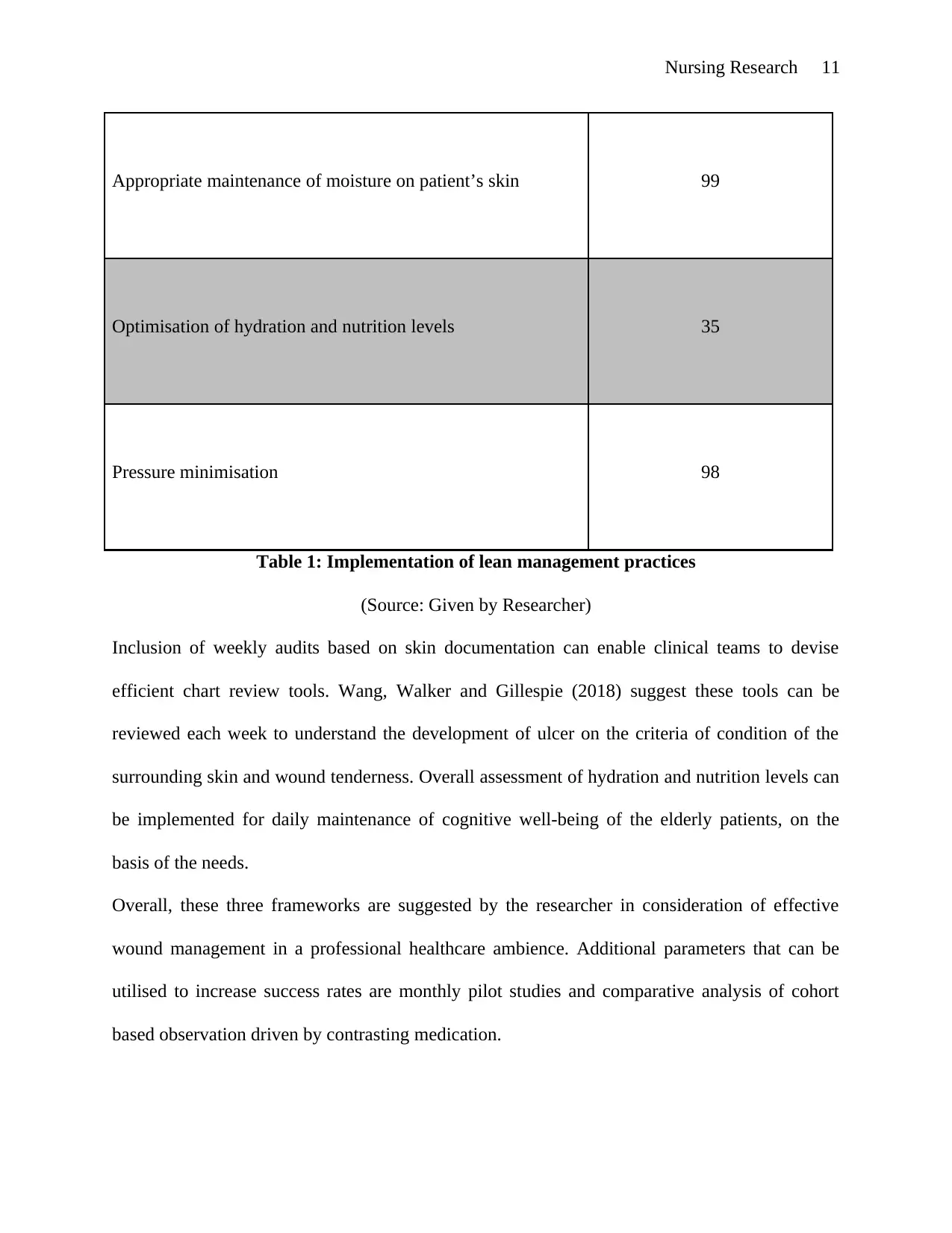
Appropriate maintenance of moisture on patient’s skin 99
Optimisation of hydration and nutrition levels 35
Pressure minimisation 98
Table 1: Implementation of lean management practices
(Source: Given by Researcher)
Inclusion of weekly audits based on skin documentation can enable clinical teams to devise
efficient chart review tools. Wang, Walker and Gillespie (2018) suggest these tools can be
reviewed each week to understand the development of ulcer on the criteria of condition of the
surrounding skin and wound tenderness. Overall assessment of hydration and nutrition levels can
be implemented for daily maintenance of cognitive well-being of the elderly patients, on the
basis of the needs.
Overall, these three frameworks are suggested by the researcher in consideration of effective
wound management in a professional healthcare ambience. Additional parameters that can be
utilised to increase success rates are monthly pilot studies and comparative analysis of cohort
based observation driven by contrasting medication.
Appropriate maintenance of moisture on patient’s skin 99
Optimisation of hydration and nutrition levels 35
Pressure minimisation 98
Table 1: Implementation of lean management practices
(Source: Given by Researcher)
Inclusion of weekly audits based on skin documentation can enable clinical teams to devise
efficient chart review tools. Wang, Walker and Gillespie (2018) suggest these tools can be
reviewed each week to understand the development of ulcer on the criteria of condition of the
surrounding skin and wound tenderness. Overall assessment of hydration and nutrition levels can
be implemented for daily maintenance of cognitive well-being of the elderly patients, on the
basis of the needs.
Overall, these three frameworks are suggested by the researcher in consideration of effective
wound management in a professional healthcare ambience. Additional parameters that can be
utilised to increase success rates are monthly pilot studies and comparative analysis of cohort
based observation driven by contrasting medication.
Nursing Research 12
Literature review
Concepts of DMAIC model
Application of six sigma strategies and relevant DMAIC model have facilitated healthcare over
the last decades. According to Thomas and Compton (2014), extrapolation of above-mentioned
outcomes can extend the application of DMAIC approach in the healthcare sector. As stated by
Cereda et al. (2015), clinicians are more prone to embrace DMAIC model due to its utilisation of
familiar paradigms and in the presence of sustainability and scientific rigor. The ability to clearly
outline and manage healthcare ambience presents a massive organisational benefit. Beeckman et
al. (2014) opine DMAIC improves the measurable outcomes of an activity through response
variables. This is in consideration of a common issue in aged residents of nursing home, which
contribute to care mortality and morbidity. Rates of pressure ulcers can thus be controlled
through implementation of six sigma DMAIC practices.
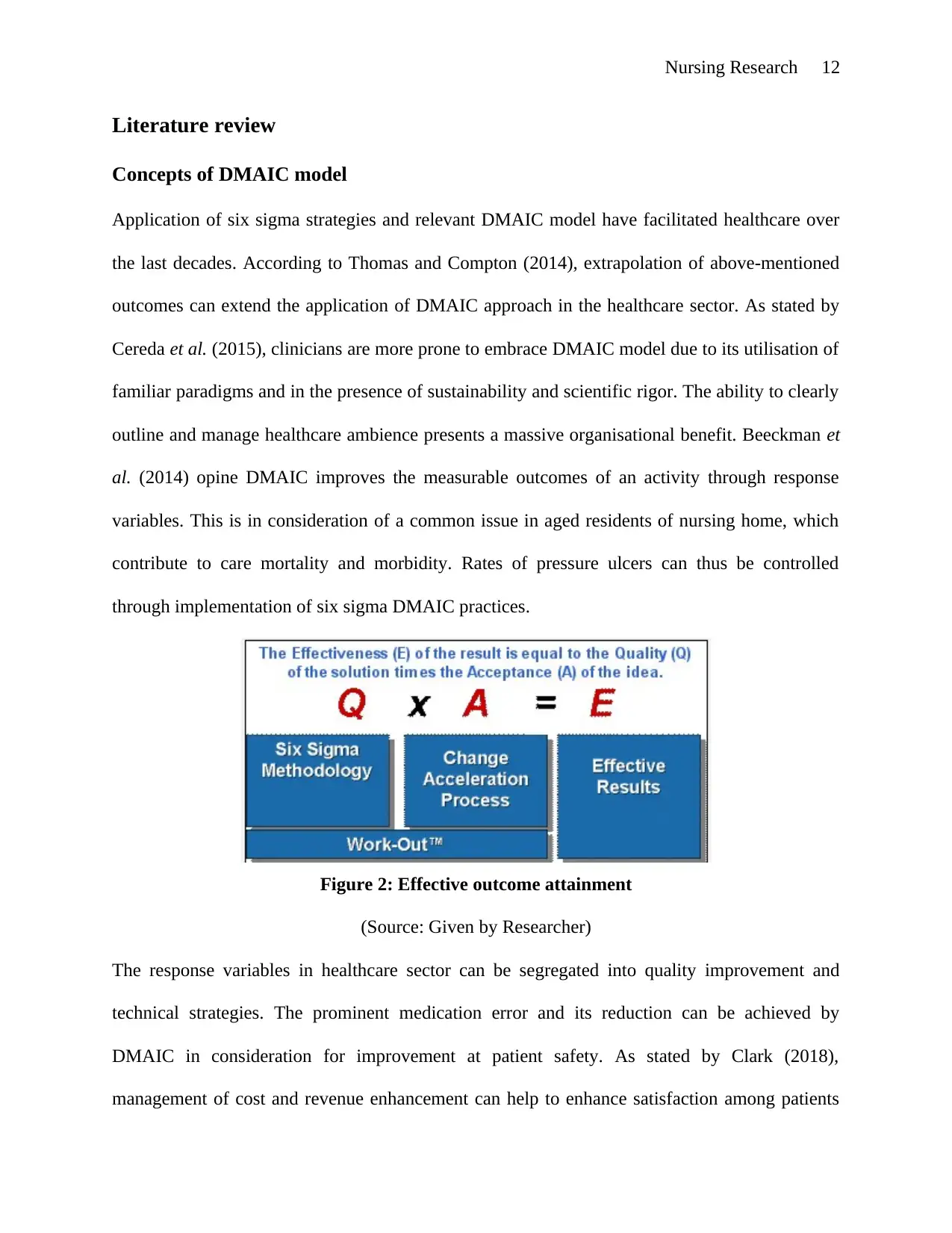
Figure 2: Effective outcome attainment
(Source: Given by Researcher)
The response variables in healthcare sector can be segregated into quality improvement and
technical strategies. The prominent medication error and its reduction can be achieved by
DMAIC in consideration for improvement at patient safety. As stated by Clark (2018),
management of cost and revenue enhancement can help to enhance satisfaction among patients
Literature review
Concepts of DMAIC model
Application of six sigma strategies and relevant DMAIC model have facilitated healthcare over
the last decades. According to Thomas and Compton (2014), extrapolation of above-mentioned
outcomes can extend the application of DMAIC approach in the healthcare sector. As stated by
Cereda et al. (2015), clinicians are more prone to embrace DMAIC model due to its utilisation of
familiar paradigms and in the presence of sustainability and scientific rigor. The ability to clearly
outline and manage healthcare ambience presents a massive organisational benefit. Beeckman et
al. (2014) opine DMAIC improves the measurable outcomes of an activity through response
variables. This is in consideration of a common issue in aged residents of nursing home, which
contribute to care mortality and morbidity. Rates of pressure ulcers can thus be controlled
through implementation of six sigma DMAIC practices.
Figure 2: Effective outcome attainment
(Source: Given by Researcher)
The response variables in healthcare sector can be segregated into quality improvement and
technical strategies. The prominent medication error and its reduction can be achieved by
DMAIC in consideration for improvement at patient safety. As stated by Clark (2018),
management of cost and revenue enhancement can help to enhance satisfaction among patients
⊘ This is a preview!⊘
Do you want full access?
Subscribe today to unlock all pages.
Trusted by 1+ million students worldwide

1 out of 26


Related Documents


Your All-in-One AI-Powered Toolkit for Academic Success.
+13062052269
info@desklib.com
Available 24*7 on WhatsApp / Email
![[object Object]](/_next/static/media/star-bottom.7253800d.svg)
Unlock your academic potential
Copyright © 2020–2026 A2Z Services. All Rights Reserved. Developed and managed by ZUCOL.