University of Central Lancashire: Crane LMI System Report, MP4706

Verified

Added on  2022/09/24

|8
|1428
|35
Report
AI Summary
This report delves into the Crane Load Moment Indicator (LMI) system, crucial for the safe operation of cranes. It begins with an introduction to the LMI system and its components, emphasizing the role of sensors in measuring parameters like pressure and temperature to prevent overloading. The report explores the principles of instrumentation and measurement systems, highlighting the use of LabVIEW software for design and simulation. It discusses virtual instrumentation, parameter measurement calculations, and the LabVIEW model for the Crane LMI system. Experimental results and analysis are presented, focusing on strain gauges and signal conditioning. Furthermore, it outlines potential future development phases, including low-cost controllers and data transmission methods like IoT, to improve the system's efficiency and reliability. The report concludes with a list of references used in the analysis and design of the system.

Document Page
Electrical Engg.
MP4706
Student Name –
Student ID –
tabler-icon-diamond-filled.svg

Paraphrase This Document

Need a fresh take? Get an instant paraphrase of this document with our AI Paraphraser
Document Page
Contents
Introduction...........................................................................................................................................3
Principles - Instrumentation and measurement systems.........................................................................3
Virtual Instrumentation and simulation.............................................................................................3
Parameter Measurement........................................................................................................................4
Calculation........................................................................................................................................4
LABVIEW Model - Crane LMI system............................................................................................4
Experimental Results and Analysis.......................................................................................................5
Strain gauges.........................................................................................................................................6
Future development phases....................................................................................................................6
a) Low cost controller........................................................................................................................6
b) Data transmission methods............................................................................................................6
References:............................................................................................................................................8
Document Page
Introduction
The cranes are used to lift heavy objects. When a crane lifts an object, then it can do so with
some limitation. It has some carrying capacity above which the crane may be damaged by the
load. To prevent this and make the system safe, the LMI system is used. Here, the various
types of LMI systems and their parts have been discussed. An LMI system helps to determine
the various physical parameters related to the crane and help to make the system safe. The
parameters are like the pressure and temperature. If the values exceed a limit which is set
initially, then a warning can be given to the operator. The threshold values are determined by
the help of calculations.
A disadvantage of using the LMI system is that it requires adjusting the values in 2 conditions
– one with no boom weight and one with charged boom weight. Another drawback is that if
any repair or replacement is required, it may be very expensive. The various parts needed are
the cable reel, angle sensor, load cells etc. All these parts are required for the measurement of
the parameters associated with the crane and the LMI system ( Levine, 2012 ).
Principles - Instrumentation and measurement systems
The LMI ( Load Moment Indicator ) system can be designed using various sub parts. The
software used for the design as well as the development of the measurement system is the
Labview software. For measuring the values of the various parameters of the crane, the LMI
system can be used which employs the sensors for measurement. The parameters are – the
boom length, boom angle, load value , position of the outrigger and temperature of the
driver’s cabinet. The DAQ controller by NI has been used here to implement the controlling
action ( Lijuan, 2012 ).
Virtual Instrumentation and simulation
Document Page
The simulation of a system in the virtual manner helps to evaluate the system performance
without actually designing it physically. This helps to save time and effort. A system
designed can be tested and improved while simulation is done. The LMI system can be
employed in the heavy – duty crane systems. It can help to increase the overall safety of the
system by preventing any accidents caused by overloading. A drawback of the LMI system is
that it cannot avoid any accidents related to the crane’s operation ( Precup, 2016 ).
Parameter Measurement
Calculation
If the base dimensions are represented as follows :
P be the crane centre – pivot point main boom , Q be the height of crane pivot point ( around
100 mm ) and R be the distance of sheaves.
Hence , the minimum radius needed = Outrigger base / 2
The maximum radius needed = Maximum main boom length * cos ( 30° ) + R * sin ( 30° ) –
P
Crane lift height = √ ( main boom length ^ 2 + R ^ 2 – ( radius + P ) ^ 2 + Q )
Crane loading capacity = Average of ( Max ( lifting height * capacity ) * Radius ) / 100
LABVIEW Model - Crane LMI system
tabler-icon-diamond-filled.svg

Paraphrase This Document

Need a fresh take? Get an instant paraphrase of this document with our AI Paraphraser
Document Page
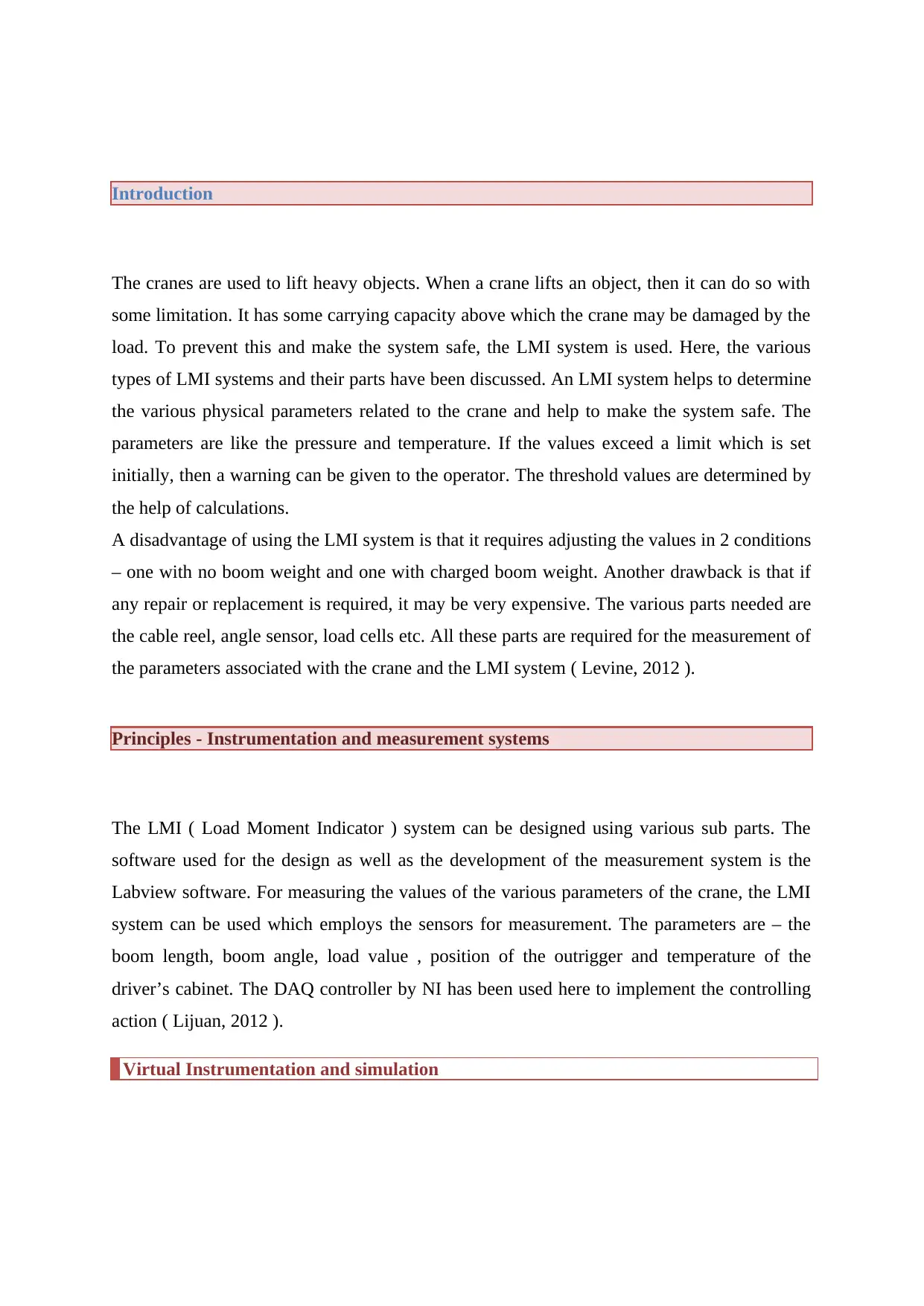
Figure 1: Block diagram - LMI model ( Labview )
The Figure 1 shows the various parts used to design the LMI system in Labview software.
Experimental Results and Analysis
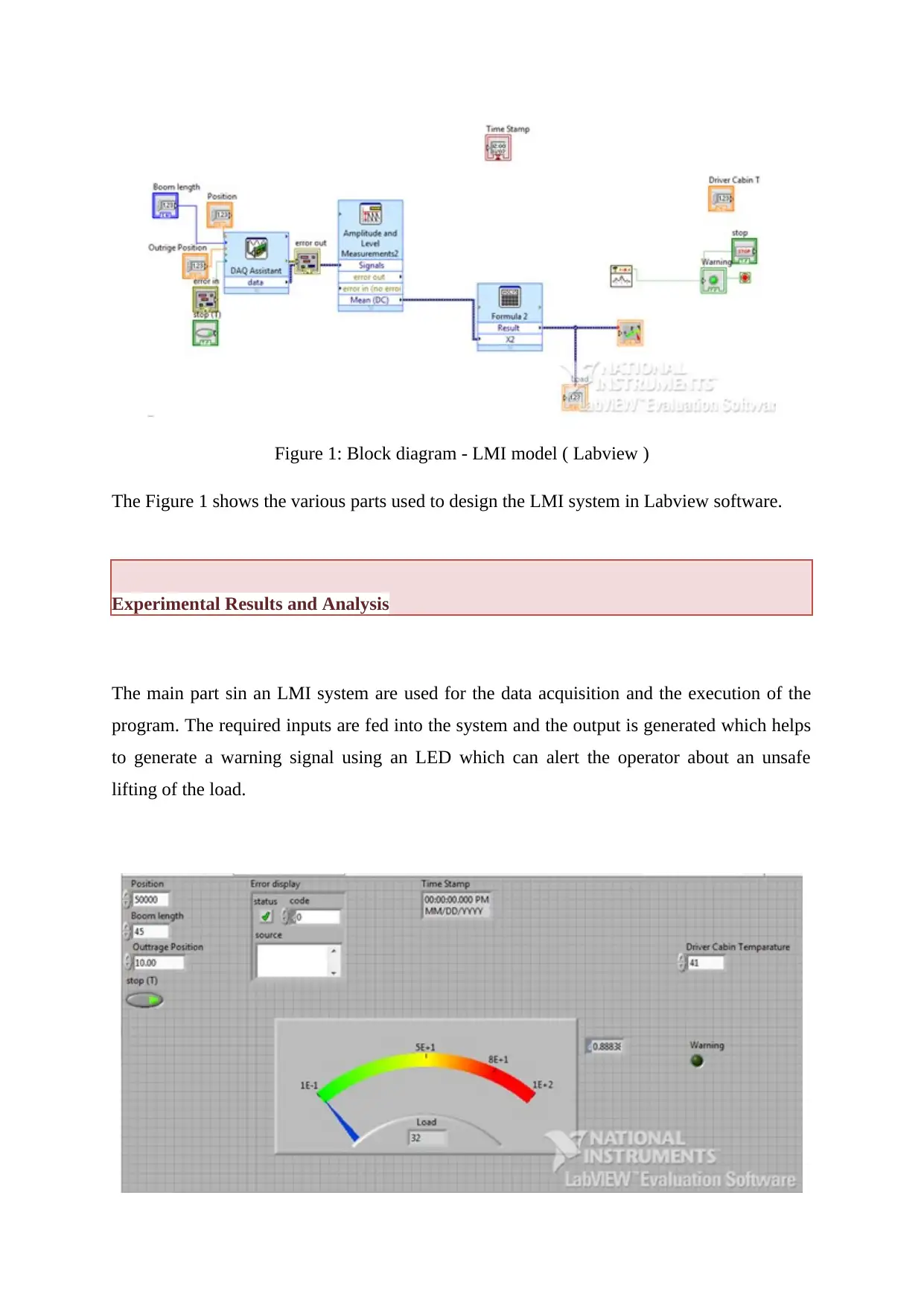
The main part sin an LMI system are used for the data acquisition and the execution of the
program. The required inputs are fed into the system and the output is generated which helps
to generate a warning signal using an LED which can alert the operator about an unsafe
lifting of the load.
Document Page
Figure 2: Front panel - LMI model (Labview)
The Figure 2 shows the front panel of the LMI system designed using the Matlab software.
Strain gauges
Here, the strain gauge sensor is used for the measurement of the pressure levels. The output
generated is in the form of a voltage signal which has very low levels in the range of milli
volts. To interface this low voltage signal to a computer is very tough. The signal level needs
to be increase before processing the signal. The load cell is used to measure the pressure
value. The signal generated by the load cell is very weak as it has a low level. Hence, proper
signal conditioning is required which can be done using amplifiers and output correction.
This helps to enhance the accuracy levels of the system. The output signal must be free of
any noise signals. The signal to noise ratio must be as high as possible ( Guimarães, 2013 ).
Future development phases
In future, the system can be improved in a variety of ways. Here, 2 methods have been
described.
a) Low cost controller
The major components in the design of the LMI system are : the sensors and the controller.
If low cost sensors are used, then they will be of low quality. This can affect the results of
measurement and can make the system inaccurate. Hence, the sensors need to be of high
quality ( Kumar, 2013 ). Hence, the controller having a low cost can be used ( Aslam, 2020 ).
Today, many low cost controllers are available in the market which have good performance
and are good in interfacing the sensors.
b) Data transmission methods
Document Page
The data transmission methods are of 2 types. They are: wired and wireless. The wireless
system is more effective. The IoT ( Internet of Things ) is the latest technique in which the
various devices which are connected using the internet. This makes the system easy to design
and operate ( Sabih, 2013 ).
.
tabler-icon-diamond-filled.svg

Paraphrase This Document

Need a fresh take? Get an instant paraphrase of this document with our AI Paraphraser
Document Page
References:
Aslam, M.S., Dai, X., Hou, J., Li, Q., Ullah, R., Ni, Z. and Liu, Y., 2020. Reliable control
design for composite‐driven scheme based on delay networked T‐S fuzzy
system. International Journal of Robust and Nonlinear Control, 30(4), pp.1622-1642.
Guimarães, M.P., 2013. Controle semiativo de vibrações por força de controle não linear.
Kumar, R., 2013. Efficient active vibration control of smart structures with modified positive
position feedback control using pattern search methods in the presence of instrumentation
phase lead and lag. Journal of Dynamic Systems, Measurement, and Control, 135(6).
Levine, S.E., Bida, T.A., Chylek, T., Collins, P.L., DeGroff, W.T., Dunham, E.W., Lotz, P.J.,
Venetiou, A.J. and Kermani, S.Z., 2012, September. Status and performance of the Discovery
Channel Telescope during commissioning. In Ground-based and Airborne Telescopes
IV (Vol. 8444, p. 844419). International Society for Optics and Photonics.
Lijuan, X.X.L.H.X. and Lianhui, Y., 2012. High precision periodic control method of control
moment gyro gimbal system. Journal of Beijing University of Aeronautics and Astronautics,
(8), p.8.
Precup, R.E., Preitl, S., Bojan-Dragos, C.A., Radac, M.B., Szedlak-Stinean, A.I., Hedrea,
E.L. and Roman, R.C., 2016. Evolving Takagi-Sugeno fuzzy modeling applications of
incremental online identification algorithms. In Proc. XIII InternationalSA UM Conference
on Systems, Automatic Control and Measurements (pp. 3-10).
Sabih, M., 2013. Control algorithms for distributed networked industrial systems (Doctoral
dissertation, King Fahd University of Petroleum and Minerals (Saudi Arabia)).
chevron_up_icon
1 out of 8
circle_padding
hide_on_mobile
zoom_out_icon
[object Object]