Analysis of Antennas and Multiplexing Techniques: EE Assignment

Verified

Added on  2020/03/02

|10
|1499
|175
Homework Assignment
AI Summary
This assignment delves into the classification and characteristics of antennas, exploring various types such as frequency-based (VLF, LF, MF, HF, SHF, EHF), aperture, radiation pattern, and polarization-based antennas. It provides detailed descriptions of directional, omnidirectional, horn, V-antennas, lens, and parabolic reflector antennas, highlighting their applications and advantages. The assignment also compares and contrasts CDMA and FDMA multiplexing techniques, outlining their concepts, applications, advantages, and disadvantages. CDMA is explained as a code-based multiplexing method utilized in cellular systems, while FDMA is presented as a frequency-based technique commonly used in fiber optic communication. The document includes a comprehensive list of references supporting the analysis and conclusions presented. The assignment aims to provide a clear understanding of these fundamental concepts in electrical engineering.

Document Page
Q & A 1
Name:
Subject:
Professor’s Name:
Unit Name:
Date:
tabler-icon-diamond-filled.svg

Paraphrase This Document

Need a fresh take? Get an instant paraphrase of this document with our AI Paraphraser
Document Page
Q & A 2
Contents
Answer 1......................................................................................................................................................3
Answer 2......................................................................................................................................................6
References...................................................................................................................................................9
Document Page
Q & A 3
Answer 1
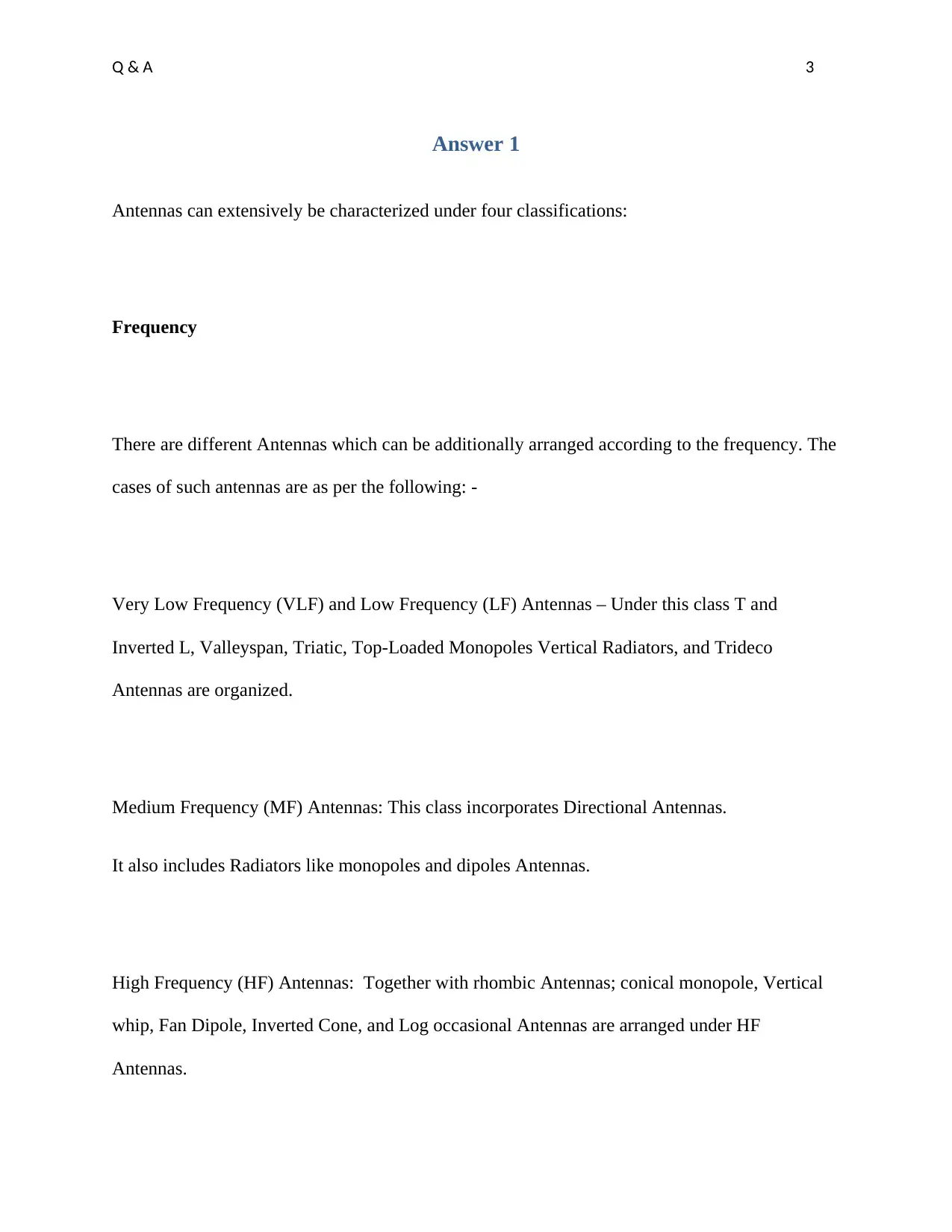
Antennas can extensively be characterized under four classifications:
Frequency
There are different Antennas which can be additionally arranged according to the frequency. The
cases of such antennas are as per the following: -
Very Low Frequency (VLF) and Low Frequency (LF) Antennas – Under this class T and
Inverted L, Valleyspan, Triatic, Top-Loaded Monopoles Vertical Radiators, and Trideco
Antennas are organized.
Medium Frequency (MF) Antennas: This class incorporates Directional Antennas.
It also includes Radiators like monopoles and dipoles Antennas.
High Frequency (HF) Antennas: Together with rhombic Antennas; conical monopole, Vertical
whip, Fan Dipole, Inverted Cone, and Log occasional Antennas are arranged under HF
Antennas.
Document Page
Q & A 4
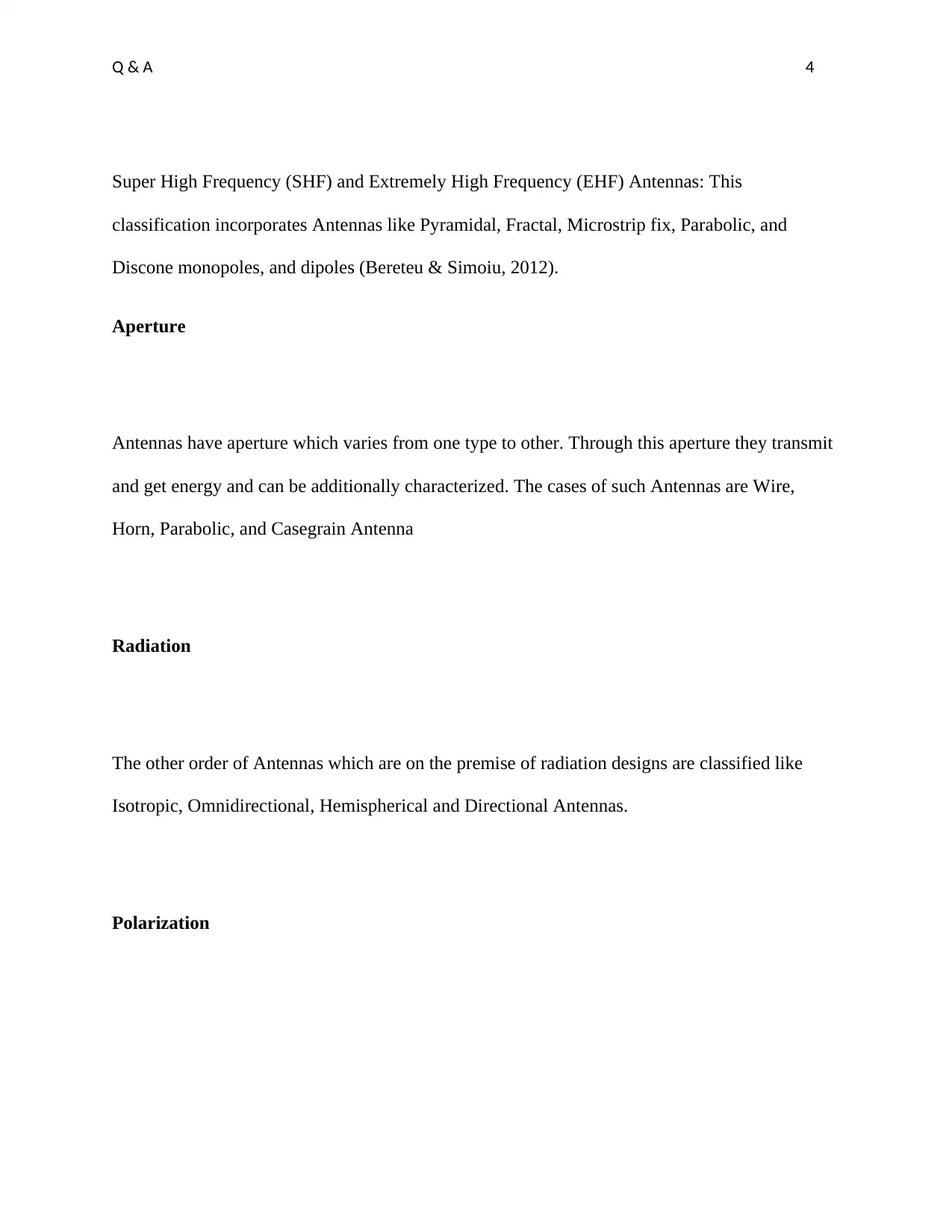
Super High Frequency (SHF) and Extremely High Frequency (EHF) Antennas: This
classification incorporates Antennas like Pyramidal, Fractal, Microstrip fix, Parabolic, and
Discone monopoles, and dipoles (Bereteu & Simoiu, 2012).
Aperture
Antennas have aperture which varies from one type to other. Through this aperture they transmit
and get energy and can be additionally characterized. The cases of such Antennas are Wire,
Horn, Parabolic, and Casegrain Antenna
Radiation
The other order of Antennas which are on the premise of radiation designs are classified like
Isotropic, Omnidirectional, Hemispherical and Directional Antennas.
Polarization
tabler-icon-diamond-filled.svg

Paraphrase This Document

Need a fresh take? Get an instant paraphrase of this document with our AI Paraphraser
Document Page
Q & A 5
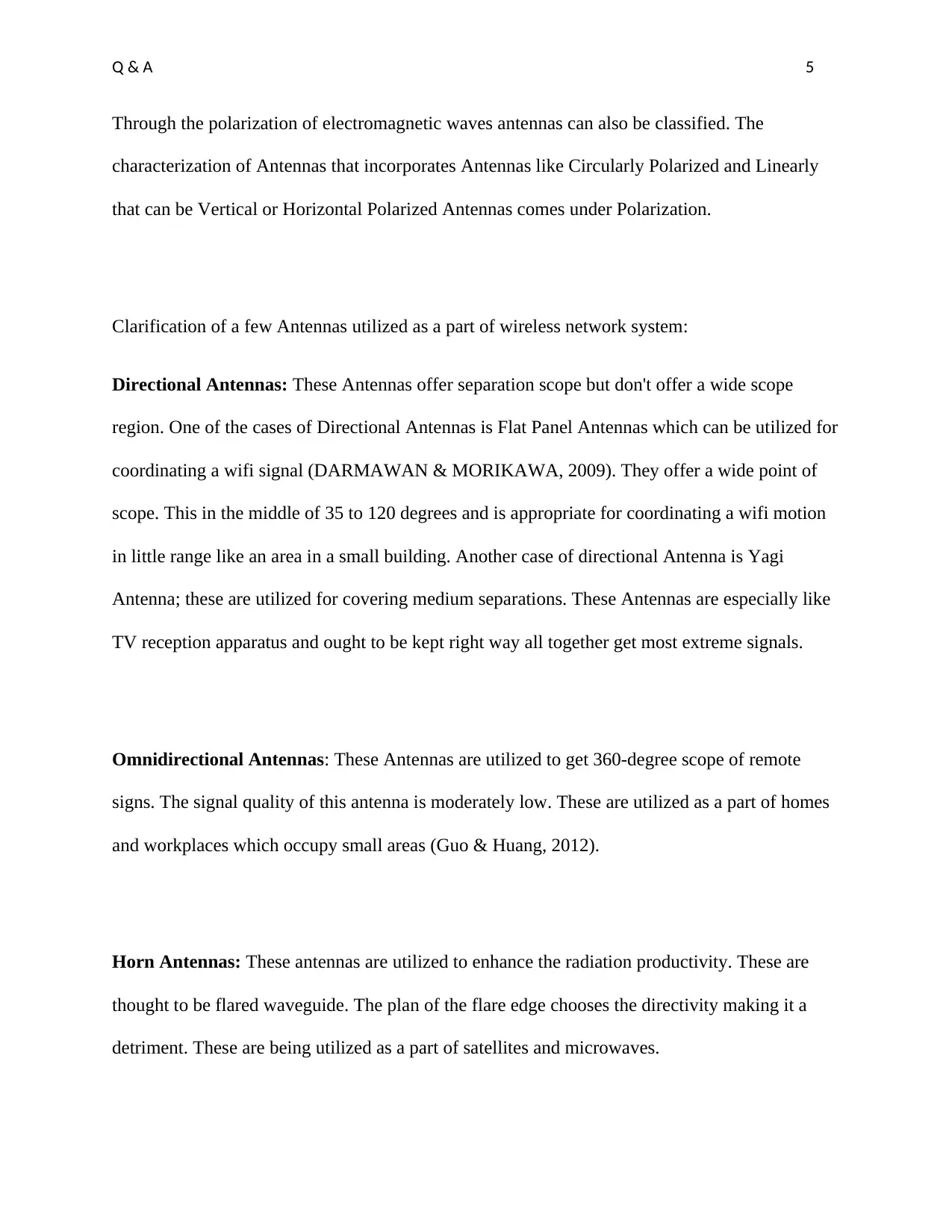
Through the polarization of electromagnetic waves antennas can also be classified. The
characterization of Antennas that incorporates Antennas like Circularly Polarized and Linearly
that can be Vertical or Horizontal Polarized Antennas comes under Polarization.
Clarification of a few Antennas utilized as a part of wireless network system:
Directional Antennas: These Antennas offer separation scope but don't offer a wide scope
region. One of the cases of Directional Antennas is Flat Panel Antennas which can be utilized for
coordinating a wifi signal (DARMAWAN & MORIKAWA, 2009). They offer a wide point of
scope. This in the middle of 35 to 120 degrees and is appropriate for coordinating a wifi motion
in little range like an area in a small building. Another case of directional Antenna is Yagi
Antenna; these are utilized for covering medium separations. These Antennas are especially like
TV reception apparatus and ought to be kept right way all together get most extreme signals.
Omnidirectional Antennas: These Antennas are utilized to get 360-degree scope of remote
signs. The signal quality of this antenna is moderately low. These are utilized as a part of homes
and workplaces which occupy small areas (Guo & Huang, 2012).
Horn Antennas: These antennas are utilized to enhance the radiation productivity. These are
thought to be flared waveguide. The plan of the flare edge chooses the directivity making it a
detriment. These are being utilized as a part of satellites and microwaves.
Document Page
Q & A 6
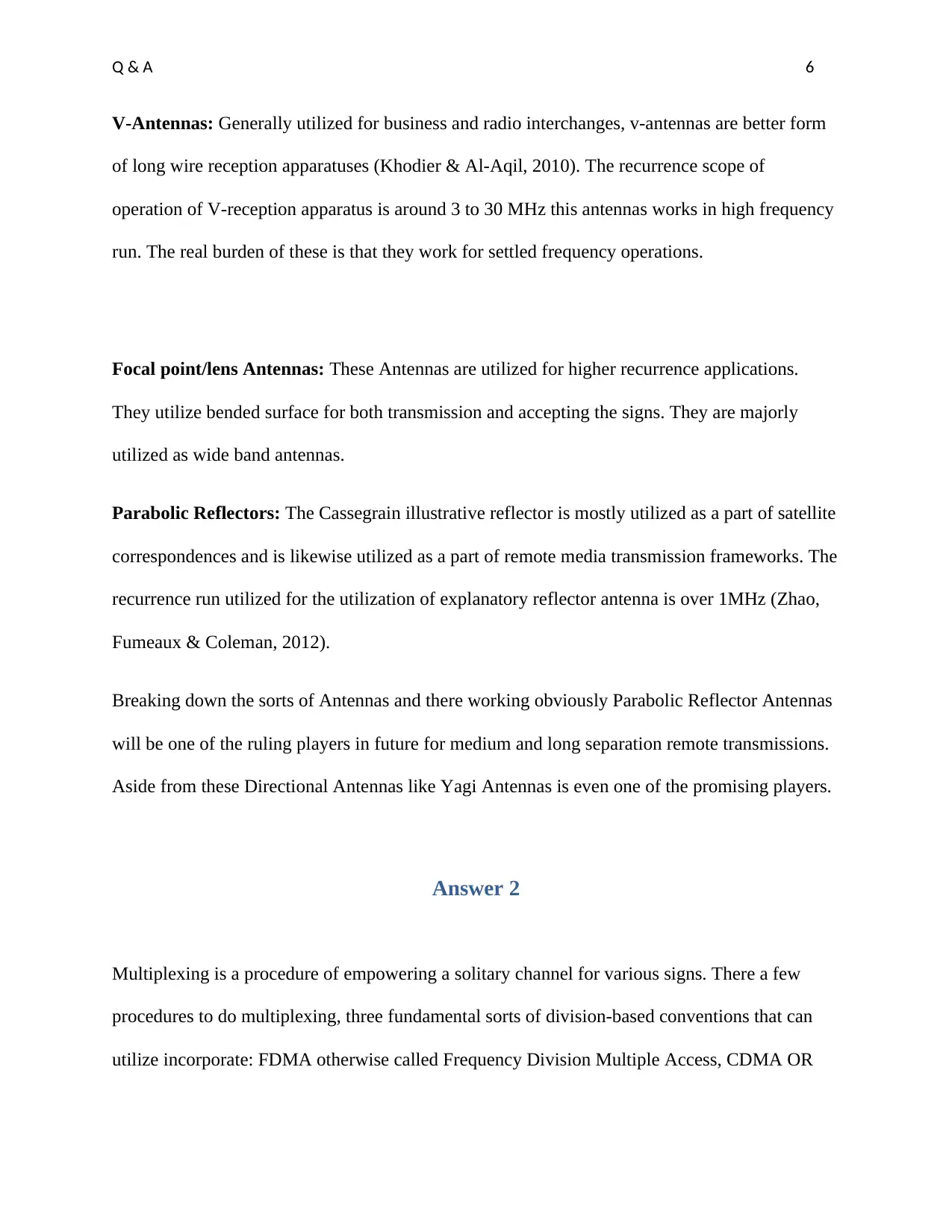
V-Antennas: Generally utilized for business and radio interchanges, v-antennas are better form
of long wire reception apparatuses (Khodier & Al-Aqil, 2010). The recurrence scope of
operation of V-reception apparatus is around 3 to 30 MHz this antennas works in high frequency
run. The real burden of these is that they work for settled frequency operations.
Focal point/lens Antennas: These Antennas are utilized for higher recurrence applications.
They utilize bended surface for both transmission and accepting the signs. They are majorly
utilized as wide band antennas.
Parabolic Reflectors: The Cassegrain illustrative reflector is mostly utilized as a part of satellite
correspondences and is likewise utilized as a part of remote media transmission frameworks. The
recurrence run utilized for the utilization of explanatory reflector antenna is over 1MHz (Zhao,
Fumeaux & Coleman, 2012).
Breaking down the sorts of Antennas and there working obviously Parabolic Reflector Antennas
will be one of the ruling players in future for medium and long separation remote transmissions.
Aside from these Directional Antennas like Yagi Antennas is even one of the promising players.
Answer 2
Multiplexing is a procedure of empowering a solitary channel for various signs. There a few
procedures to do multiplexing, three fundamental sorts of division-based conventions that can
utilize incorporate: FDMA otherwise called Frequency Division Multiple Access, CDMA OR
Document Page
Q & A 7
Code Division Multiple Access and TDMA that can likewise be called as Time Division
Multiple Access. Given underneath is the examination amongst CDMA and FDMA system:
Idea
CDMA is the acronym of Code Division Multiple Access, in this kind of multiplexing different
pseudorandom parallel arrangement is designated to each individual utilizing it and the
transporter is regulated, framing the range's waveform. An exceptional code design is given to
each of the client (M.Sabbar & Mohsen Taher, 2014). In FDMA one channel or data transfer
capacity is partitioned into a few individual groups. There is a need to oblige the transmission's
signal spectra that are should have been spread. Along these lines, the individual channels and
groups shaped are sufficiently wide. Each subcarrier is regulated with the transmitted
information and after that these subcarriers are straightly blended.
Utilization
CDMA is being utilized as a part of phone frameworks with Ultra high frequency. CDMA works
by utilizing the blend of spread range innovation together with simple analog to digital
conversion (ADC) system. The First step is to digitize the sound contribution to parallel frame
and the following stage will be the transmission of the frequency of the signal which is clarified
into unique codes (Trivedi & Kumar, 2017). In fiber optic correspondence frameworks FDMA is
tabler-icon-diamond-filled.svg

Paraphrase This Document

Need a fresh take? Get an instant paraphrase of this document with our AI Paraphraser
Document Page
Q & A 8
utilized, because of the gigantic data transfer capacity of every fiber optic it can be partitioned
into a few littler transmission capacities. An alternate light recurrence is allocated to various
information or data hotspots with the end goal of the transmission.
Advantages
The advantage CDMA procedure is that exclusive the customized beneficiary with a similar
frequency reaction and same unique code can block the transmitted signal consequently making
it secure. The channel for CDMA is ordinarily 1.23 MHz wide. The signs per unit data
transmission limit are significantly bigger in CDMA method because of the mix of advanced and
spread range than the strategies which utilize simple. CDMA permits roaming nationally because
of its similarity with other cellular advances. The advantages of FDMA when not being used it
sits sit; the channel data transfer capacity is additionally moderately low. It utilizes an extremely
basic calculation (Weng & Zhong, 2013).
Weaknesses
As the quantity of client's increments in CDMA the general nature of the administration quality
diminishes. It likewise confronts the issue of self-jamming. In FDMA the issue is that it doesn't
essentially vary from simple analog framework.
Document Page
Q & A 9
References
Bereteu, L., & Simoiu, D. (2012). Simulations Of Air Flow Over A Parabolic Antenna. Annals
Of West University Of Timisoara - Physics, 56(1).
DARMAWAN, A., & MORIKAWA, H. (2009). Downlink Cooperative Wireless Spatial
Multiplexing System. IEICE Transactions On Communications, E92-B(11), 3439-3447.
Guo, W., & Huang, X. (2012). Multicast communications in cognitive radio networks using
directional antennas. Wireless Communications And Mobile Computing, n/a-n/a.
Khodier, M., & Al-Aqil, M. (2010). Design and optimisation of Yagi-Uda antenna arrays. IET
Microwaves, Antennas & Propagation, 4(4), 426.
M.Sabbar, B., & Mohsen Taher, U. (2014). Increase Security in DS/CDMA UWB using Hybrid
Method of CDMA. International Journal Of Computer Applications, 90(5), 29-35.
Document Page
Q & A 10
Trivedi, V., & Kumar, P. (2017). Carrier Interferometry Coded Single Carrier FDMA (CI/SC-
FDMA) for Next Generation Underwater Acoustic Communication. Wireless Personal
Communications, 95(4), 4747-4762.
Weng, J., & Zhong, J. (2013). Angular multiplexing and de-multiplexing by Gabor wavelet
transform in digital holography. Optics Communications, 291, 124-132.
Zhao, S., Fumeaux, C., & Coleman, C. (2012). Miniaturised high-frequency and very-high-
frequency antennas based on optimised non-uniform helical structures. IET Microwaves,
Antennas & Propagation, 6(6), 603.
chevron_up_icon
1 out of 10
circle_padding
hide_on_mobile
zoom_out_icon
[object Object]