Electrical Engineering: Networking Assignment Solution - Analysis

Verified

Added on  2020/05/04

|5
|534
|64
Homework Assignment
AI Summary
This document presents a comprehensive solution to a networking assignment, addressing several key problems related to network communication and performance. The solution begins by analyzing packet loss rates and frame sizes, establishing relationships between various parameters such as propagation velocity, transmission speed, and frame generation rate. The assignment then delves into the calculation of bit error rates and normalized errors in data transmission. Furthermore, it explores the functionality of the Stop-and-Wait ARQ protocol, including the role of acknowledgements and negative acknowledgements in ensuring reliable data transfer. The solution also includes the analysis of polling stations, propagation delays, and signal strength in a network with multiple stations. Finally, the assignment discusses bit error rates and the probability of correct and incorrect bit transmission. The document concludes with a list of relevant references for further study.
Document Page
ASSIGNMENT 1
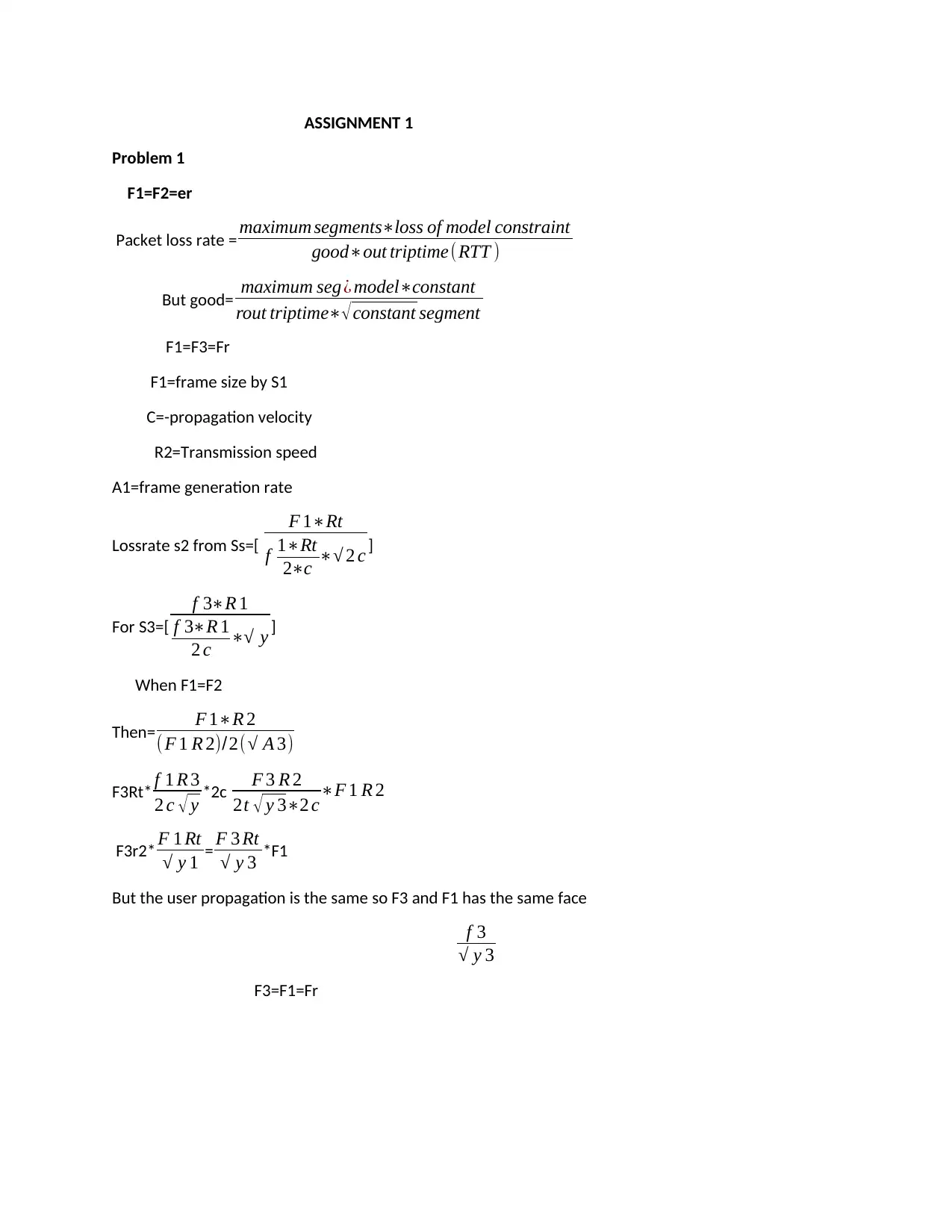
Problem 1
F1=F2=er
Packet loss rate = maximum segmentsloss of model constraint
goodout triptime(RTT )
But good= maximum seg ¿ modelconstant
rout triptimeconstant segment
F1=F3=Fr
F1=frame size by S1
C=-propagation velocity
R2=Transmission speed
A1=frame generation rate
Lossrate s2 from Ss=[
F 1Rt
f 1Rt
2c 2 c ]
For S3=[
f 3R 1
f 3R 1
2 c y ]
When F1=F2
Then= F 1R 2
( F 1 R 2)/2( A 3)
F3Rt* f 1 R 3
2 c y *2c F 3 R 2
2t y 32 cF 1 R 2
F3r2* F 1 Rt
y 1 = F 3 Rt
y 3 *F1
But the user propagation is the same so F3 and F1 has the same face
f 3
y 3
F3=F1=Fr
tabler-icon-diamond-filled.svg

Paraphrase This Document

Need a fresh take? Get an instant paraphrase of this document with our AI Paraphraser
Document Page
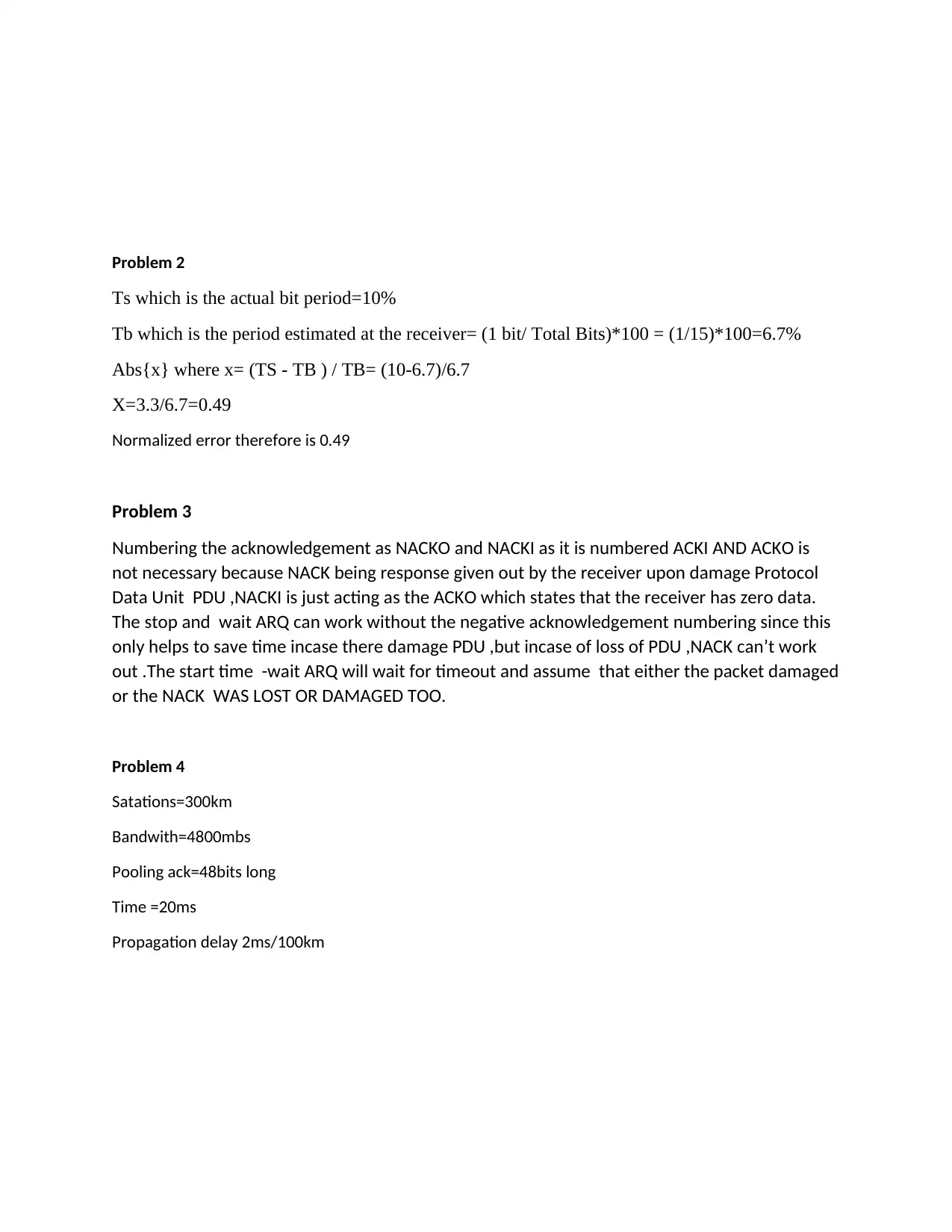
Problem 2
Ts which is the actual bit period=10%
Tb which is the period estimated at the receiver= (1 bit/ Total Bits)*100 = (1/15)*100=6.7%
Abs{x} where x= (TS - TB ) / TB= (10-6.7)/6.7
X=3.3/6.7=0.49
Normalized error therefore is 0.49
Problem 3
Numbering the acknowledgement as NACKO and NACKI as it is numbered ACKI AND ACKO is
not necessary because NACK being response given out by the receiver upon damage Protocol
Data Unit PDU ,NACKI is just acting as the ACKO which states that the receiver has zero data.
The stop and wait ARQ can work without the negative acknowledgement numbering since this
only helps to save time incase there damage PDU ,but incase of loss of PDU ,NACK can’t work
out .The start time -wait ARQ will wait for timeout and assume that either the packet damaged
or the NACK WAS LOST OR DAMAGED TOO.
Problem 4
Satations=300km
Bandwith=4800mbs
Pooling ack=48bits long
Time =20ms
Propagation delay 2ms/100km
Document Page
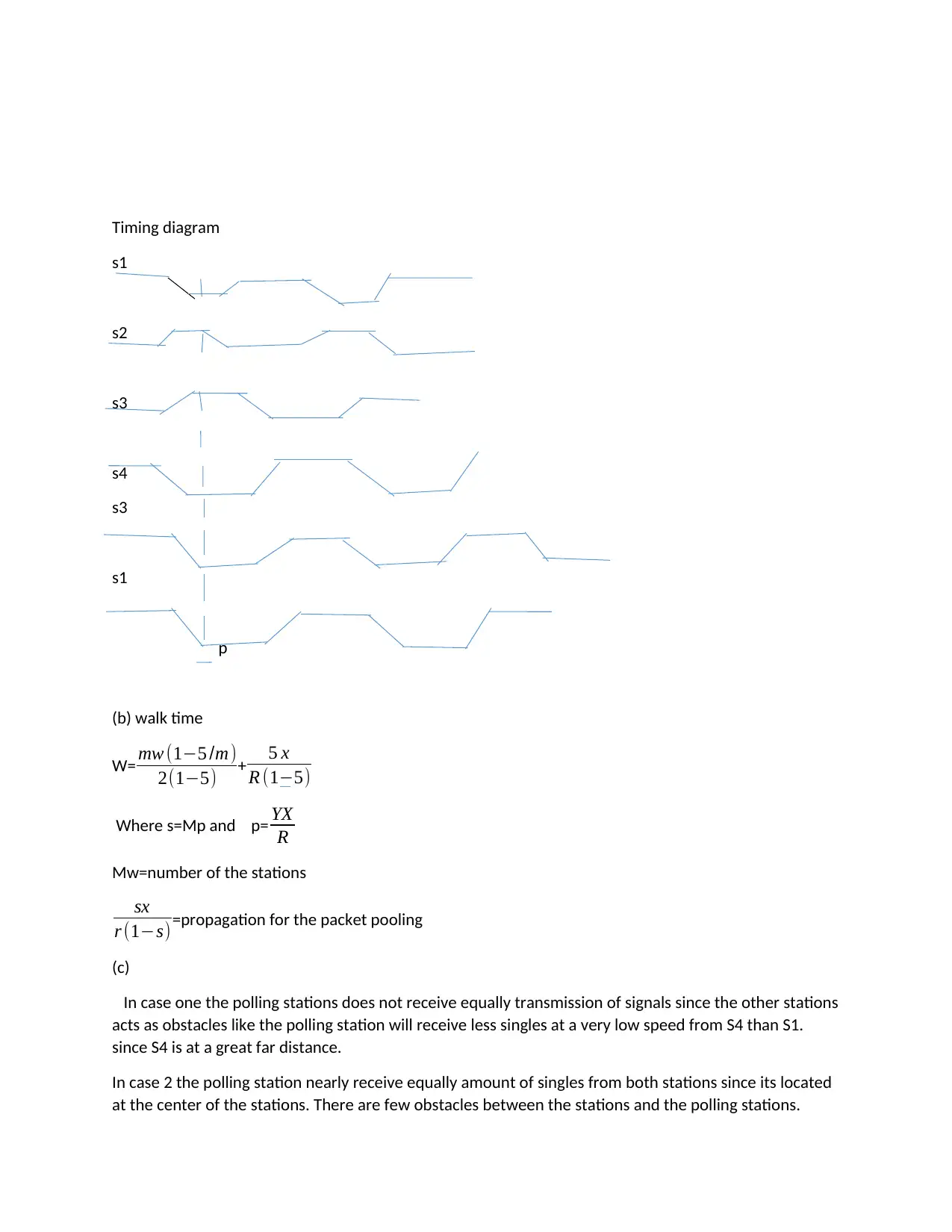
Timing diagram
s1
s2
s3
s4
s3
s1
p
(b) walk time
W= mw (15 /m)
2(15) + 5 x
R (15)
Where s=Mp and p= YX
R
Mw=number of the stations
sx
r (1s)=propagation for the packet pooling
(c)
In case one the polling stations does not receive equally transmission of signals since the other stations
acts as obstacles like the polling station will receive less singles at a very low speed from S4 than S1.
since S4 is at a great far distance.
In case 2 the polling station nearly receive equally amount of singles from both stations since its located
at the center of the stations. There are few obstacles between the stations and the polling stations.
Document Page
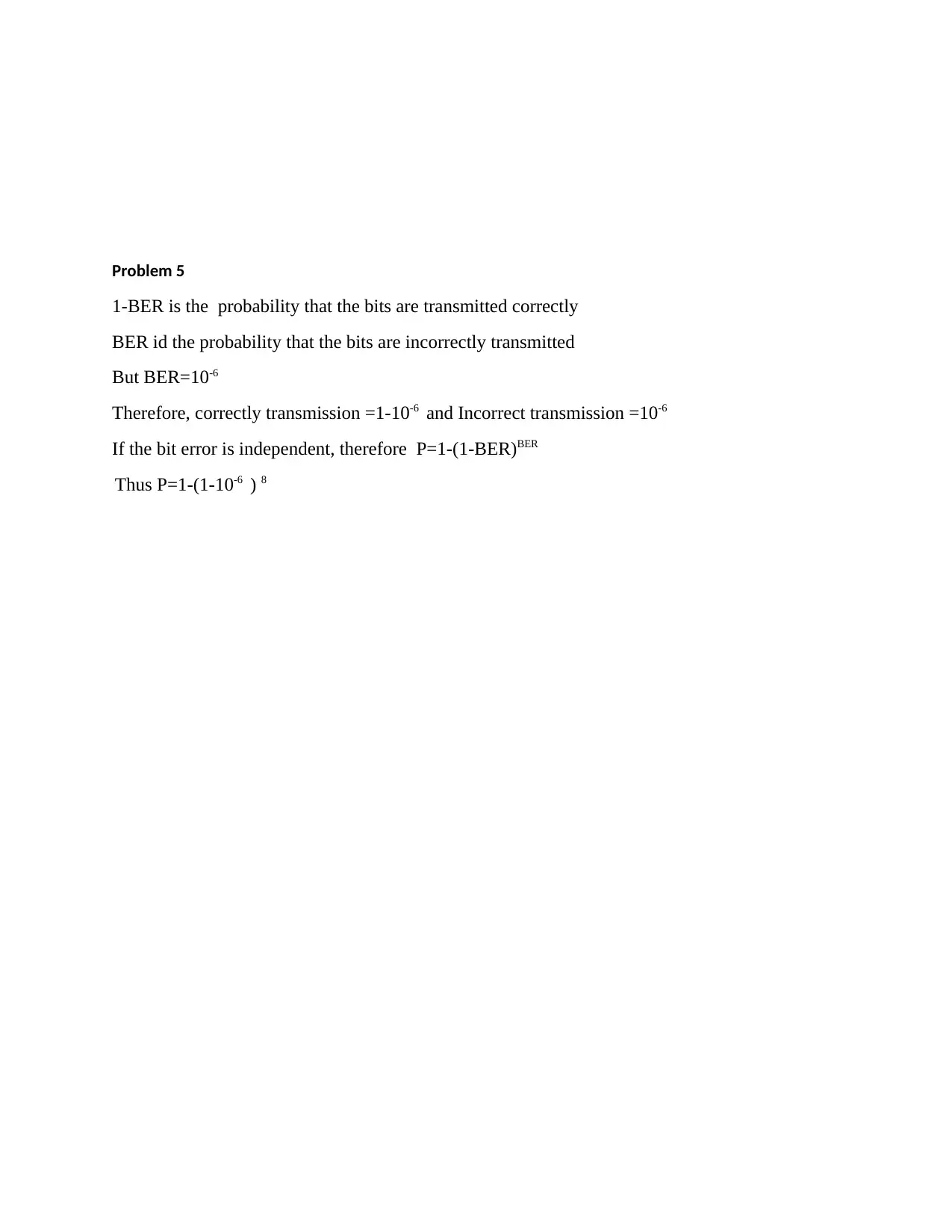
Problem 5
1-BER is the probability that the bits are transmitted correctly
BER id the probability that the bits are incorrectly transmitted
But BER=10-6
Therefore, correctly transmission =1-10-6 and Incorrect transmission =10-6
If the bit error is independent, therefore P=1-(1-BER)BER
Thus P=1-(1-10-6 ) 8
tabler-icon-diamond-filled.svg

Paraphrase This Document

Need a fresh take? Get an instant paraphrase of this document with our AI Paraphraser
Document Page
References
Mosco, Vincent, and Brenda Dervin. Pay-Per-Society: Computers and Communication in the Information
Age. Greenwood Publishing Group Inc., 2010
Hsu, John, et al. "Health information technology and physician-patient interactions: impact of computers
on communication during outpatient primary care visits." Journal of the American Medical Informatics
Association 12.4 (2005): 474-480.
Forte, Andrea, and Mark Guzdial. "Computers for communication, not calculation: Media as a
motivation and context for learning." System Sciences, 2004. Proceedings of the 37th Annual Hawaii
International Conference on. IEEE, 2013
Beniger, James. The control revolution: Technological and economic origins of the information society.
Harvard university press, 2009.
chevron_up_icon
1 out of 5
circle_padding
hide_on_mobile
zoom_out_icon
[object Object]