Foundation of Network Assignment: Network and Communication

Verified

Added on  2022/10/02

|12
|1155
|380
Homework Assignment
AI Summary
This document presents a detailed solution to a Foundation of Network assignment. The solution covers a range of topics, starting with calculations related to data transmission rates, frame sizes, and throughput. It then delves into bit error rate analysis, exploring the probability of error-free frames. The assignment also examines different persistence protocols in network communication, including P-persistence, 1-persistence, and non-persistence. Further, the document includes solutions to questions on bandwidth utilization, frame transmission, and the application of the 5-4-3 rule in Ethernet networks. The solution also provides a comparative analysis of IEEE 802.3, 802.4, and 802.5 network standards, highlighting their merits and demerits. Additionally, it includes calculations related to signal propagation and bit durations. The assignment concludes with the conversion of hexadecimal to decimal and binary formats, and a discussion of network management functions, specifically fault management and accounting management. This assignment is a great resource for students studying electrical engineering and network fundamentals.
Document Page
Foundation of Network 1
Foundation of Network
Your Name
School Affiliated
tabler-icon-diamond-filled.svg

Paraphrase This Document

Need a fresh take? Get an instant paraphrase of this document with our AI Paraphraser
Document Page
Foundation of Network 2
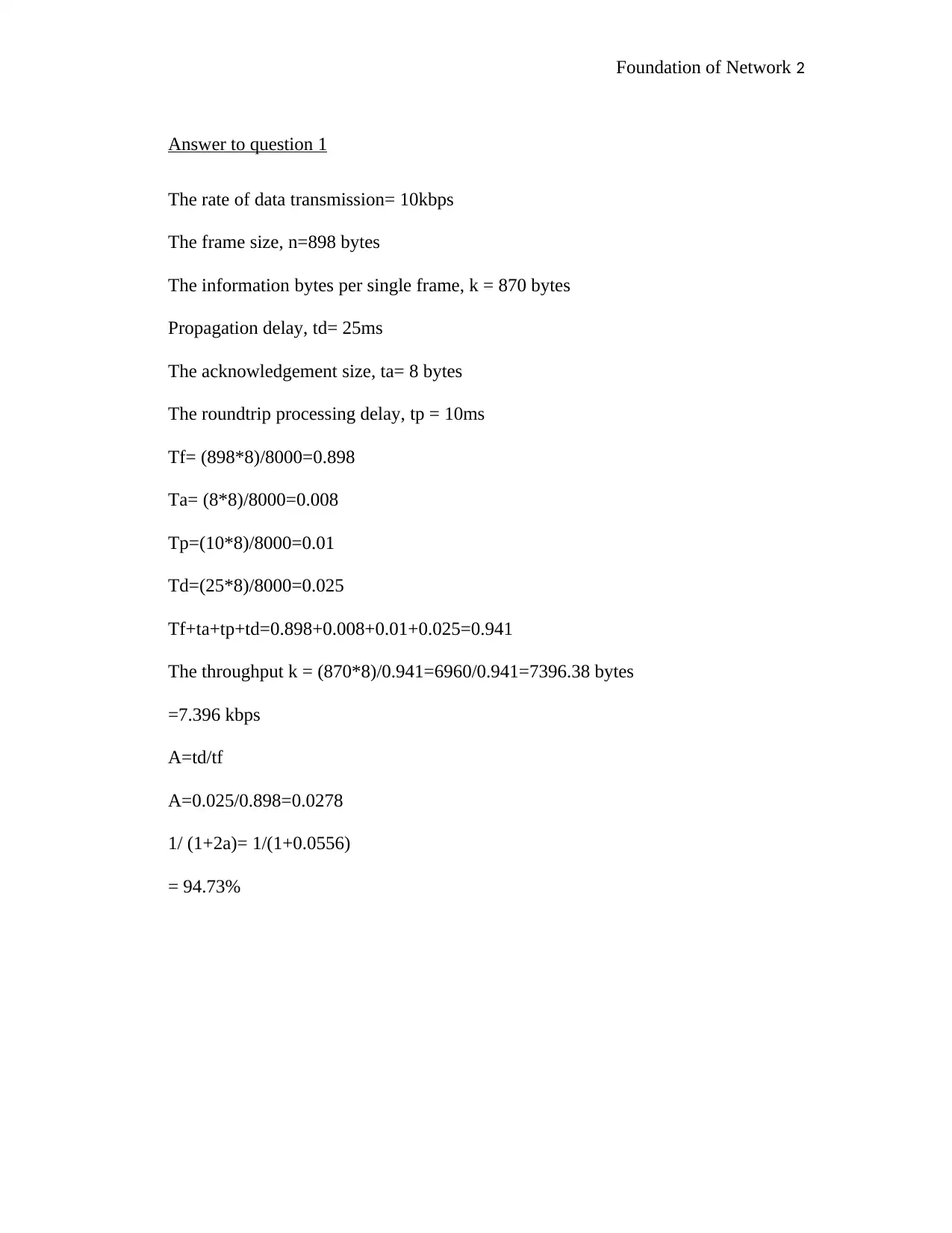
Answer to question 1
The rate of data transmission= 10kbps
The frame size, n=898 bytes
The information bytes per single frame, k = 870 bytes
Propagation delay, td= 25ms
The acknowledgement size, ta= 8 bytes
The roundtrip processing delay, tp = 10ms
Tf= (898*8)/8000=0.898
Ta= (8*8)/8000=0.008
Tp=(10*8)/8000=0.01
Td=(25*8)/8000=0.025
Tf+ta+tp+td=0.898+0.008+0.01+0.025=0.941
The throughput k = (870*8)/0.941=6960/0.941=7396.38 bytes
=7.396 kbps
A=td/tf
A=0.025/0.898=0.0278
1/ (1+2a)= 1/(1+0.0556)
= 94.73%
Document Page
Foundation of Network 3
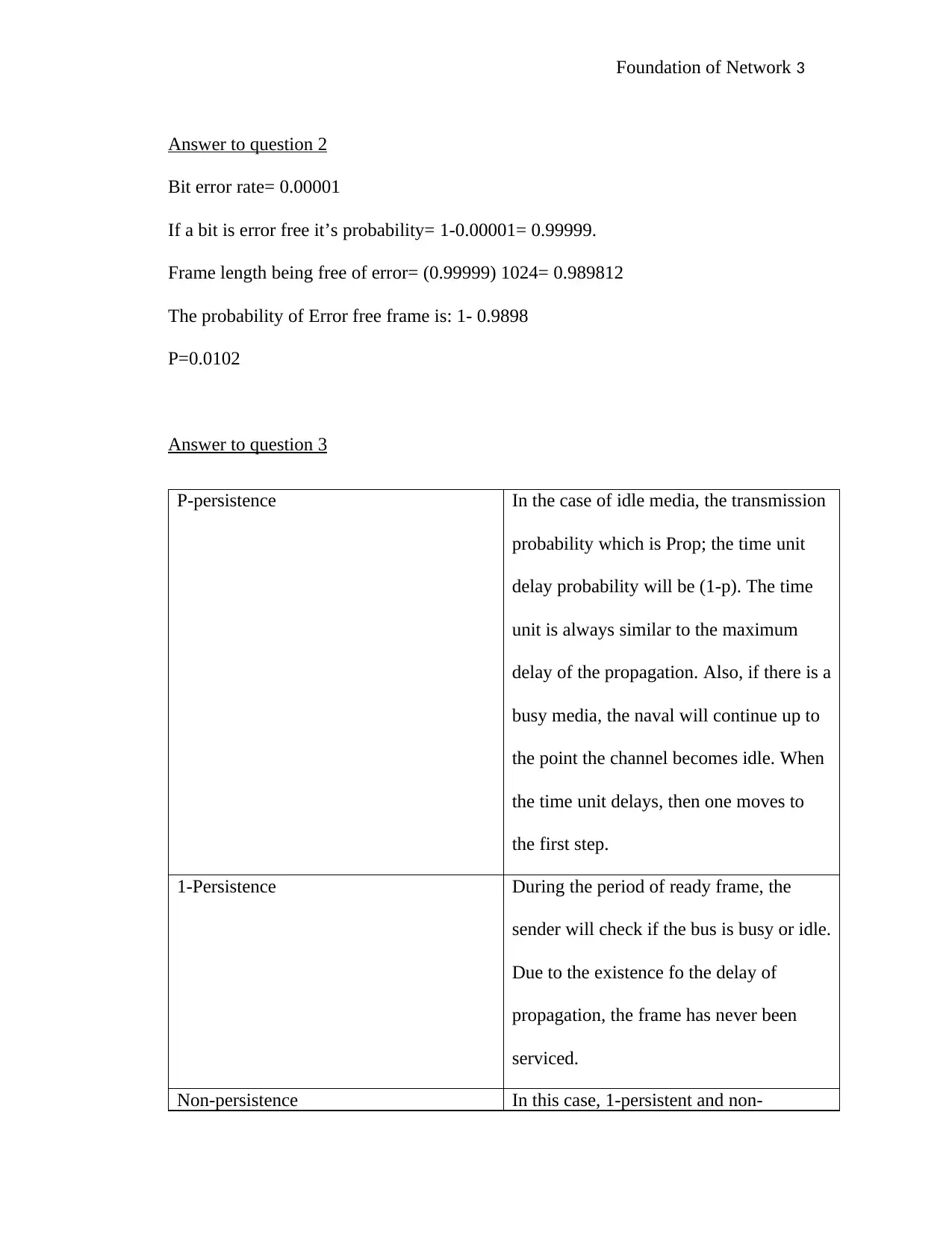
Answer to question 2
Bit error rate= 0.00001
If a bit is error free it’s probability= 1-0.00001= 0.99999.
Frame length being free of error= (0.99999) 1024= 0.989812
The probability of Error free frame is: 1- 0.9898
P=0.0102
Answer to question 3
P-persistence In the case of idle media, the transmission
probability which is Prop; the time unit
delay probability will be (1-p). The time
unit is always similar to the maximum
delay of the propagation. Also, if there is a
busy media, the naval will continue up to
the point the channel becomes idle. When
the time unit delays, then one moves to
the first step.
1-Persistence During the period of ready frame, the
sender will check if the bus is busy or idle.
Due to the existence fo the delay of
propagation, the frame has never been
serviced.
Non-persistence In this case, 1-persistent and non-
Document Page
Foundation of Network 4
persistent is combined as they try to
minimize the collisions which happen in
these two algorithms. Here, the station has
the time managing slots for the
transmitted messages. These messages
have to pick the random number still and
be transmitted only when the number is
less than the probability.
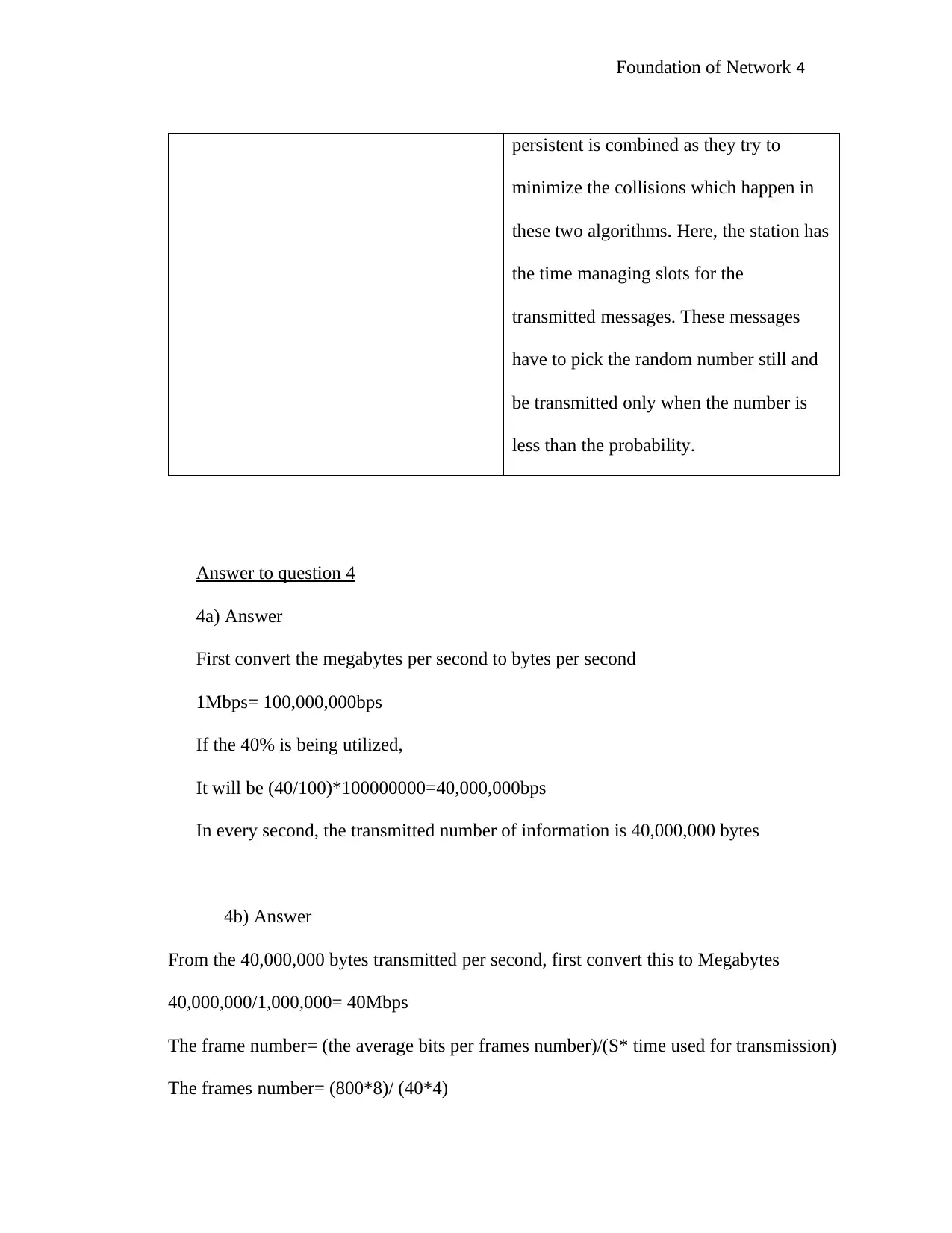
Answer to question 4
4a) Answer
First convert the megabytes per second to bytes per second
1Mbps= 100,000,000bps
If the 40% is being utilized,
It will be (40/100)*100000000=40,000,000bps
In every second, the transmitted number of information is 40,000,000 bytes
4b) Answer
From the 40,000,000 bytes transmitted per second, first convert this to Megabytes
40,000,000/1,000,000= 40Mbps
The frame number= (the average bits per frames number)/(S* time used for transmission)
The frames number= (800*8)/ (40*4)
tabler-icon-diamond-filled.svg

Paraphrase This Document

Need a fresh take? Get an instant paraphrase of this document with our AI Paraphraser
Document Page
Foundation of Network 5
=6400/160
=40
The frames transmitted in 2 secs is 40
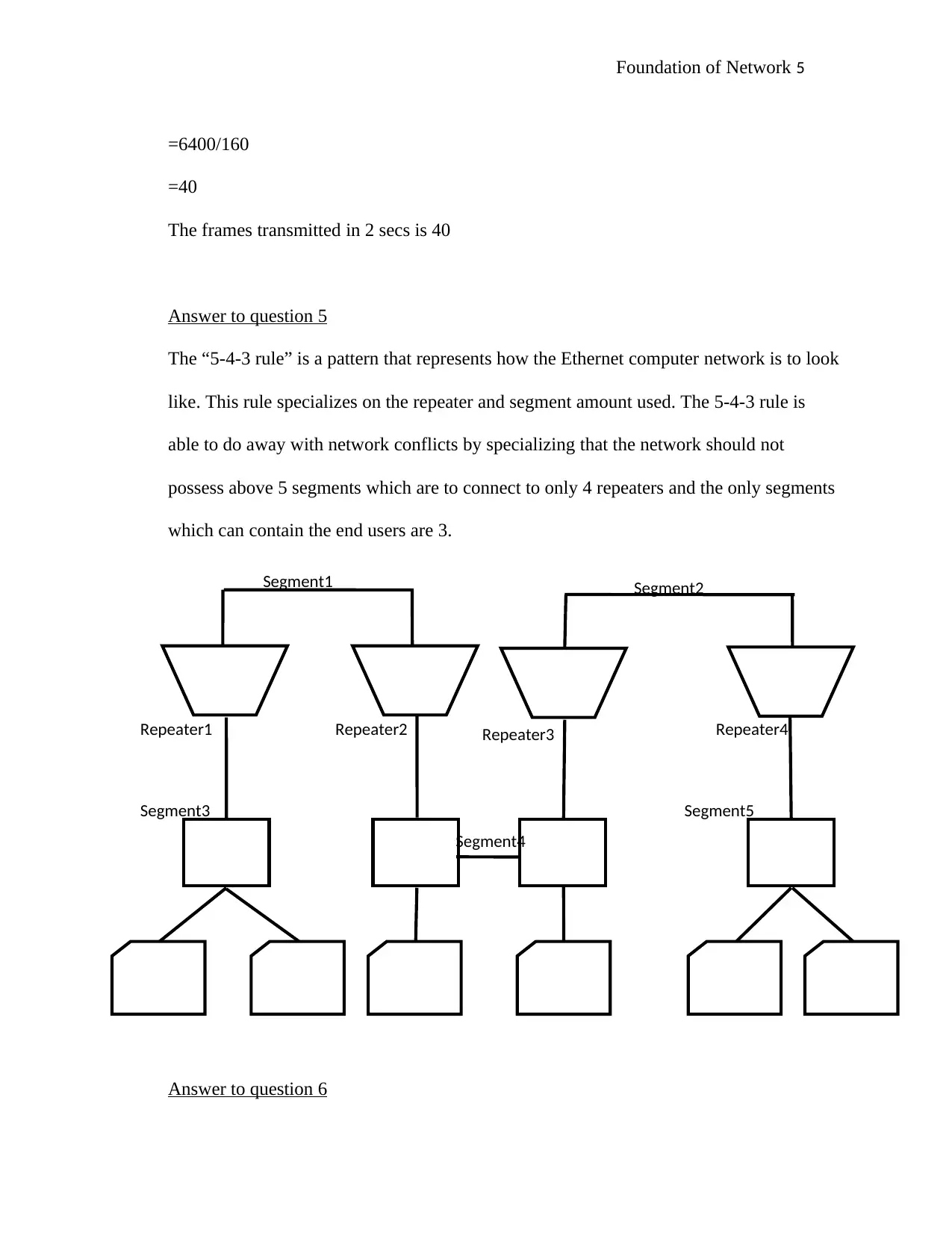
Answer to question 5
The “5-4-3 rule” is a pattern that represents how the Ethernet computer network is to look
like. This rule specializes on the repeater and segment amount used. The 5-4-3 rule is
able to do away with network conflicts by specializing that the network should not
possess above 5 segments which are to connect to only 4 repeaters and the only segments
which can contain the end users are 3.
Answer to question 6
Segment1 Segment2
Repeater1 Repeater2 Repeater3 Repeater4
Segment4
Segment3 Segment5
Document Page
Foundation of Network 6
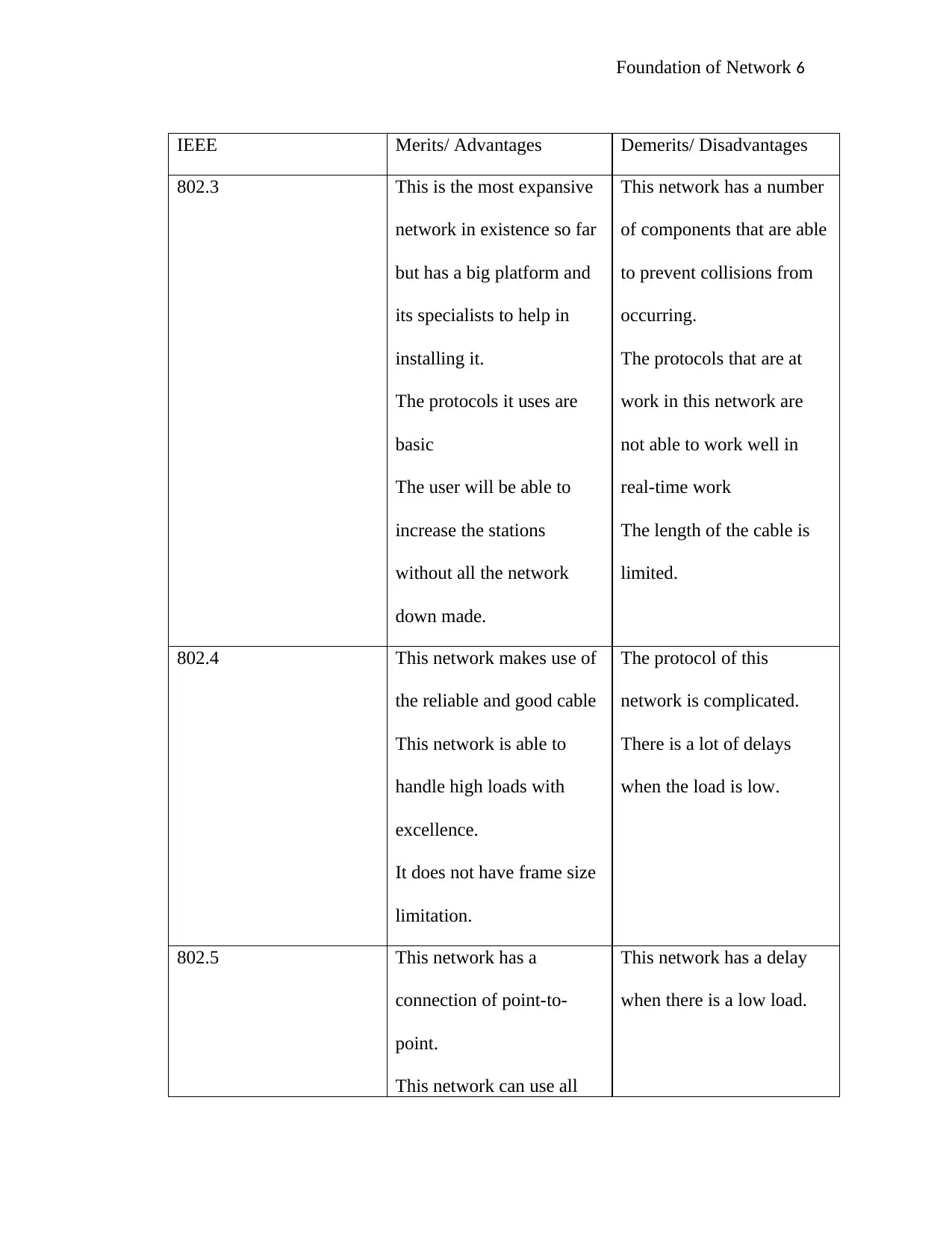
IEEE Merits/ Advantages Demerits/ Disadvantages
802.3 This is the most expansive
network in existence so far
but has a big platform and
its specialists to help in
installing it.
The protocols it uses are
basic
The user will be able to
increase the stations
without all the network
down made.
This network has a number
of components that are able
to prevent collisions from
occurring.
The protocols that are at
work in this network are
not able to work well in
real-time work
The length of the cable is
limited.
802.4 This network makes use of
the reliable and good cable
This network is able to
handle high loads with
excellence.
It does not have frame size
limitation.
The protocol of this
network is complicated.
There is a lot of delays
when the load is low.
802.5 This network has a
connection of point-to-
point.
This network can use all
This network has a delay
when there is a low load.
Document Page
Foundation of Network 7
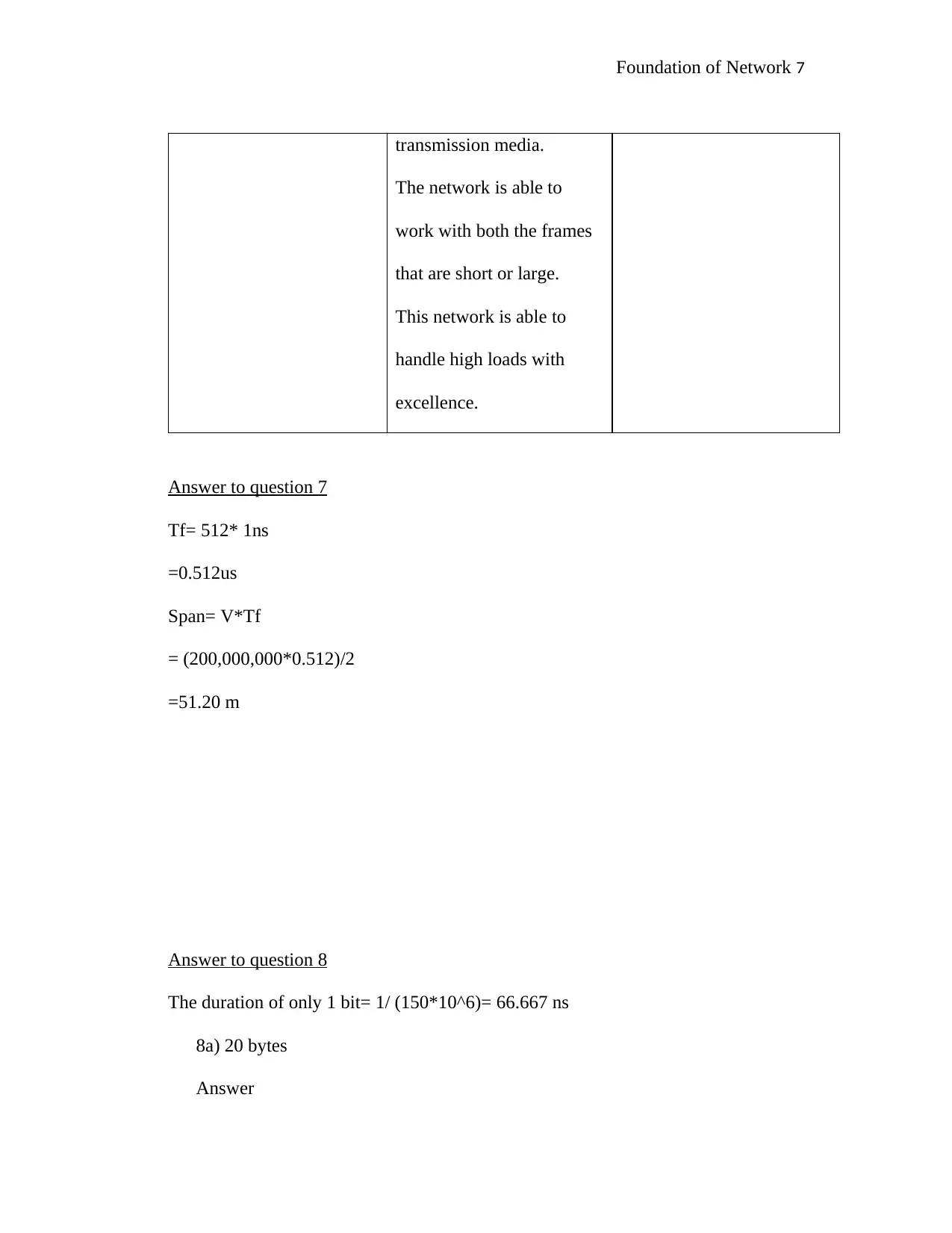
transmission media.
The network is able to
work with both the frames
that are short or large.
This network is able to
handle high loads with
excellence.
Answer to question 7
Tf= 512* 1ns
=0.512us
Span= V*Tf
= (200,000,000*0.512)/2
=51.20 m
Answer to question 8
The duration of only 1 bit= 1/ (150*10^6)= 66.667 ns
8a) 20 bytes
Answer
tabler-icon-diamond-filled.svg

Paraphrase This Document

Need a fresh take? Get an instant paraphrase of this document with our AI Paraphraser
Document Page
Foundation of Network 8
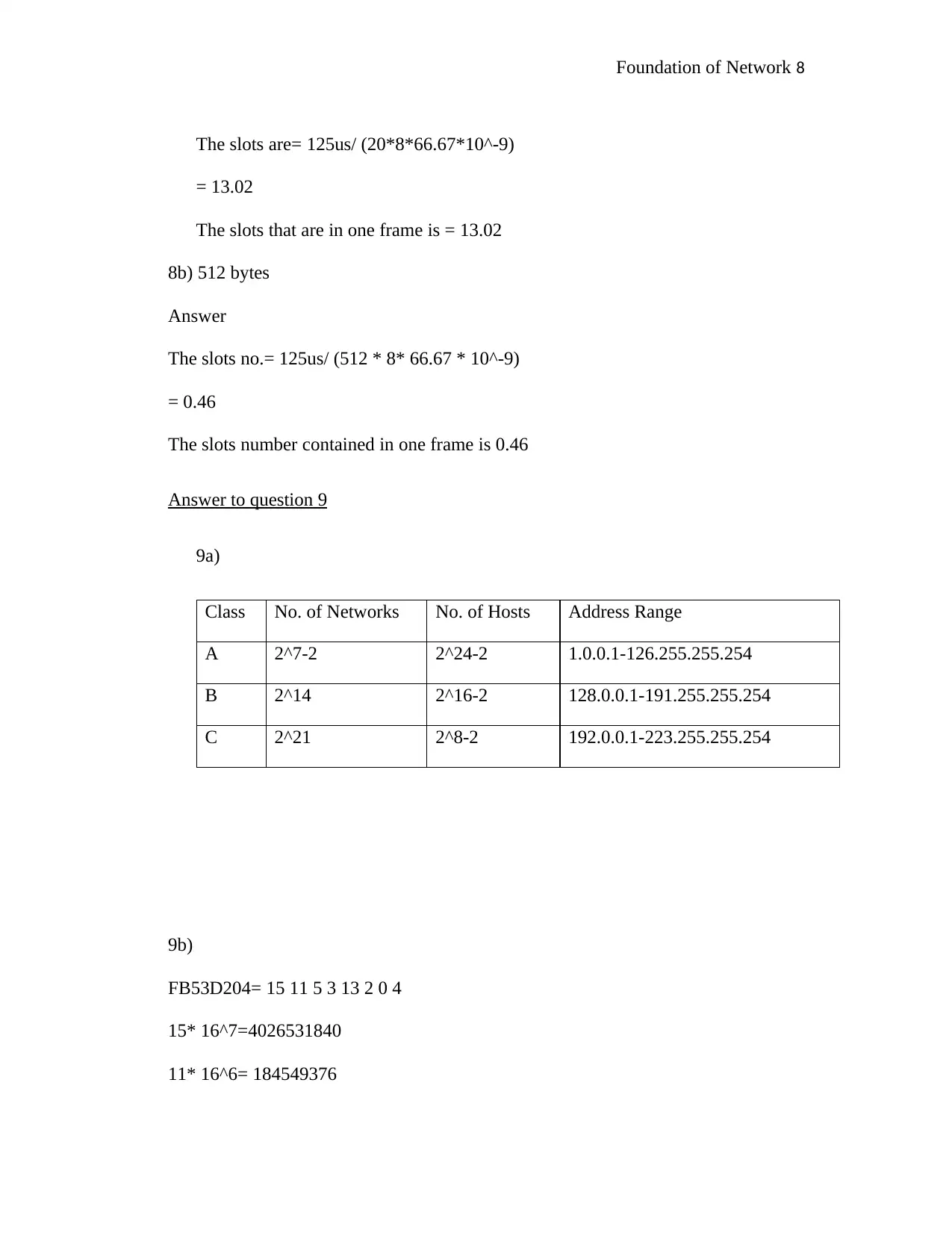
The slots are= 125us/ (20*8*66.67*10^-9)
= 13.02
The slots that are in one frame is = 13.02
8b) 512 bytes
Answer
The slots no.= 125us/ (512 * 8* 66.67 * 10^-9)
= 0.46
The slots number contained in one frame is 0.46
Answer to question 9
9a)
Class No. of Networks No. of Hosts Address Range
A 2^7-2 2^24-2 1.0.0.1-126.255.255.254
B 2^14 2^16-2 128.0.0.1-191.255.255.254
C 2^21 2^8-2 192.0.0.1-223.255.255.254
9b)
FB53D204= 15 11 5 3 13 2 0 4
15* 16^7=4026531840
11* 16^6= 184549376
Document Page
Foundation of Network 9
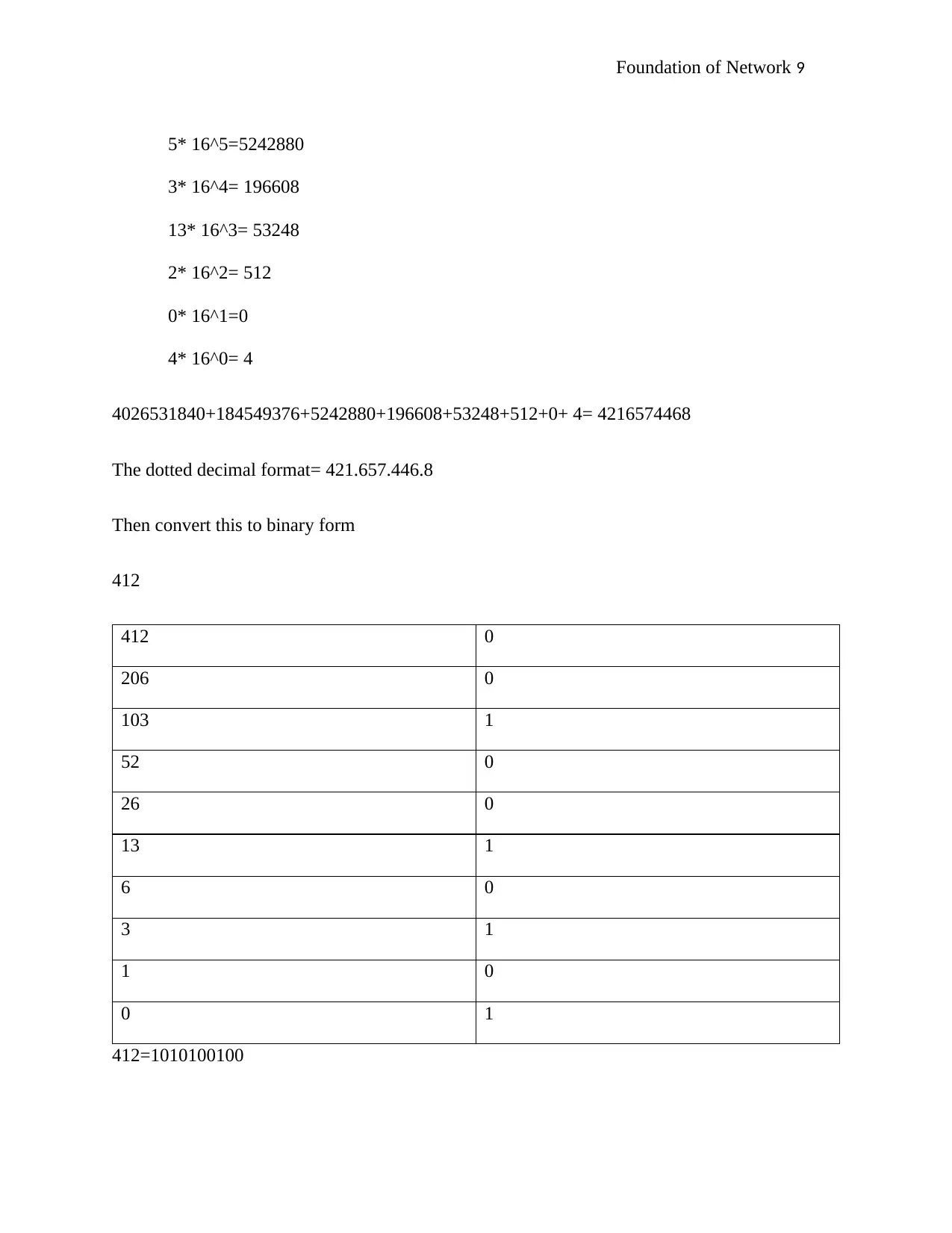
5* 16^5=5242880
3* 16^4= 196608
13* 16^3= 53248
2* 16^2= 512
0* 16^1=0
4* 16^0= 4
4026531840+184549376+5242880+196608+53248+512+0+ 4= 4216574468
The dotted decimal format= 421.657.446.8
Then convert this to binary form
412
412 0
206 0
103 1
52 0
26 0
13 1
6 0
3 1
1 0
0 1
412=1010100100
Document Page
Foundation of Network 10
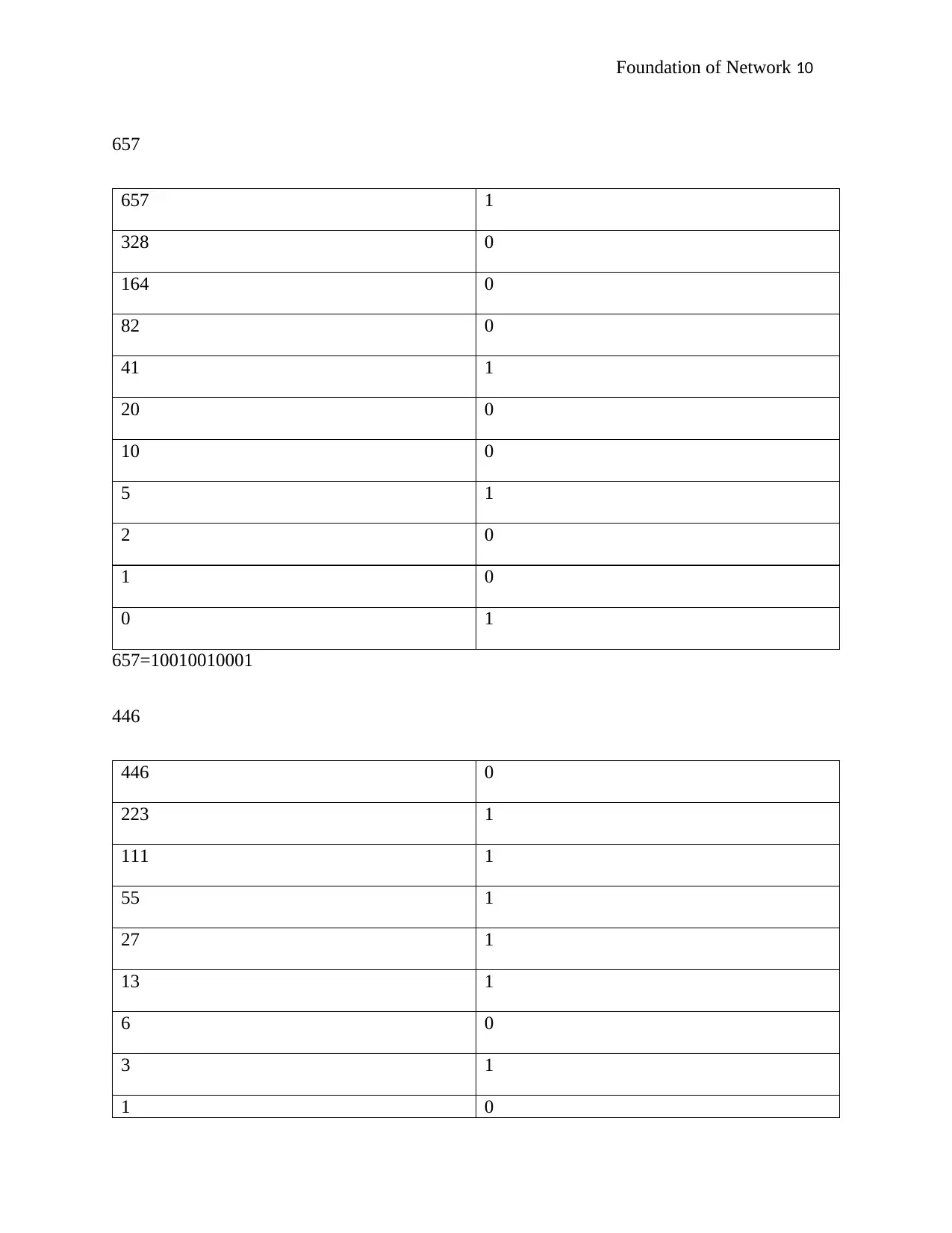
657
657 1
328 0
164 0
82 0
41 1
20 0
10 0
5 1
2 0
1 0
0 1
657=10010010001
446
446 0
223 1
111 1
55 1
27 1
13 1
6 0
3 1
1 0
tabler-icon-diamond-filled.svg

Paraphrase This Document

Need a fresh take? Get an instant paraphrase of this document with our AI Paraphraser
Document Page
Foundation of Network 11
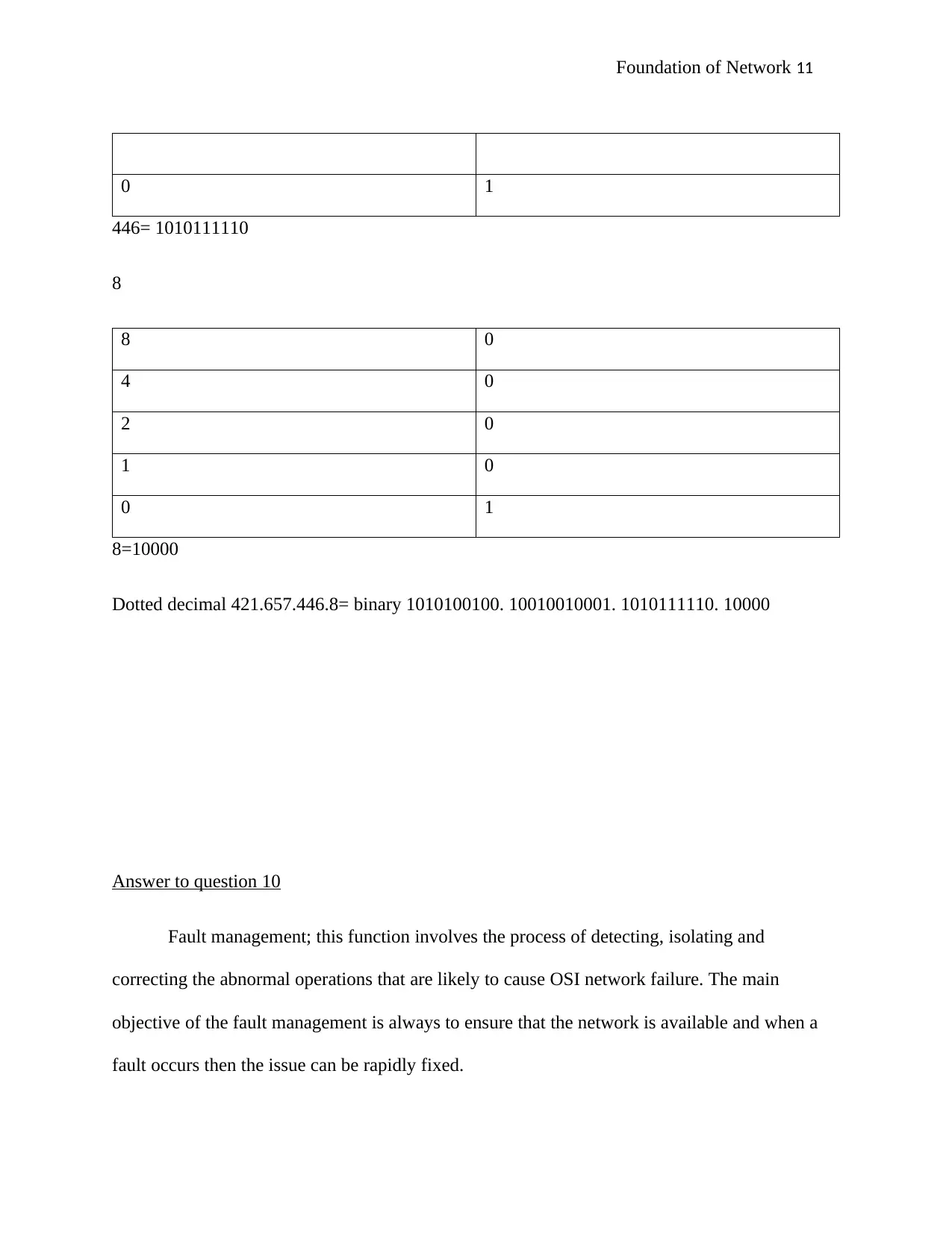
0 1
446= 1010111110
8
8 0
4 0
2 0
1 0
0 1
8=10000
Dotted decimal 421.657.446.8= binary 1010100100. 10010010001. 1010111110. 10000
Answer to question 10
Fault management; this function involves the process of detecting, isolating and
correcting the abnormal operations that are likely to cause OSI network failure. The main
objective of the fault management is always to ensure that the network is available and when a
fault occurs then the issue can be rapidly fixed.
Document Page
Foundation of Network 12
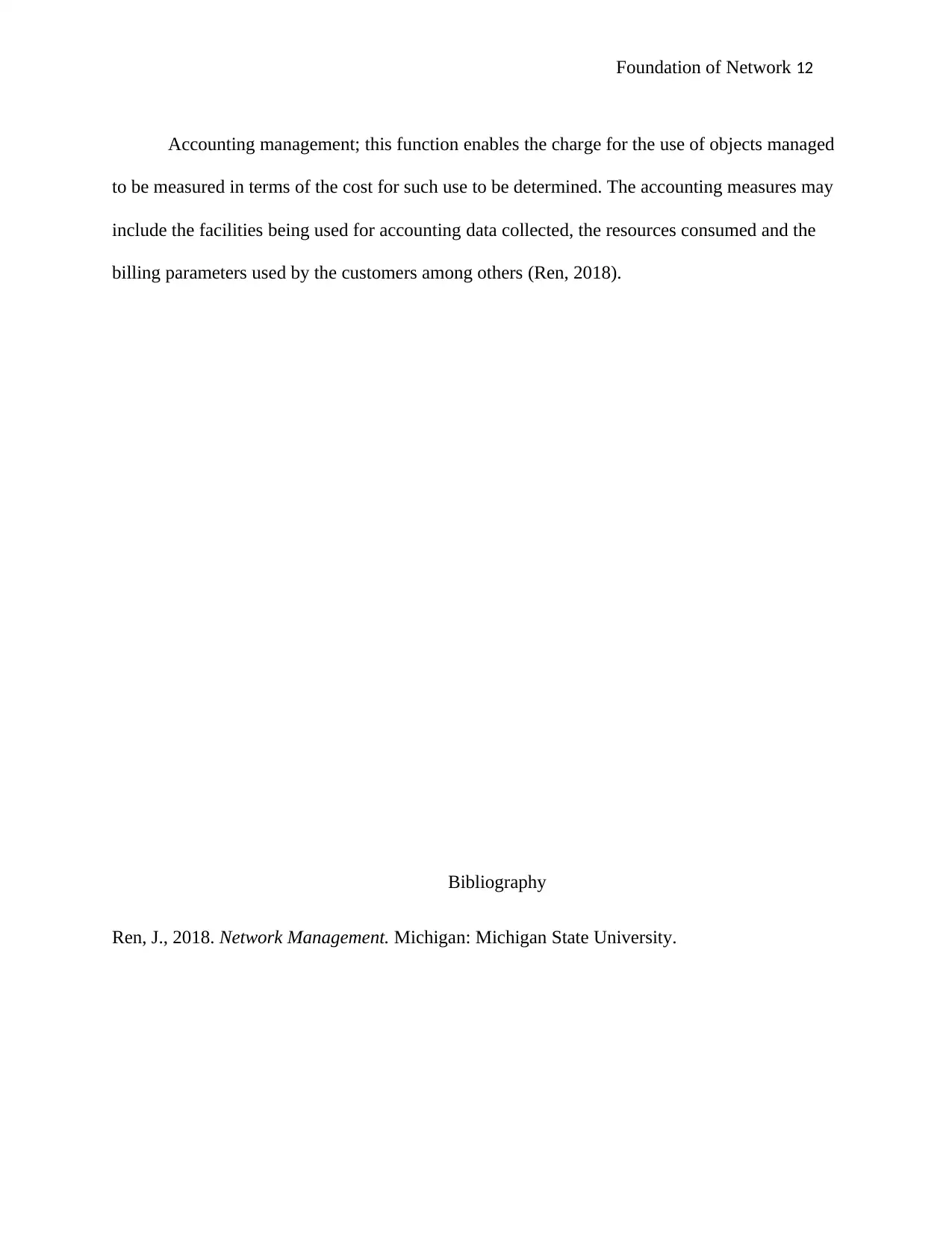
Accounting management; this function enables the charge for the use of objects managed
to be measured in terms of the cost for such use to be determined. The accounting measures may
include the facilities being used for accounting data collected, the resources consumed and the
billing parameters used by the customers among others (Ren, 2018).
Bibliography
Ren, J., 2018. Network Management. Michigan: Michigan State University.
chevron_up_icon
1 out of 12
circle_padding
hide_on_mobile
zoom_out_icon
[object Object]