Electromagnetism 2: Complete Homework Assignment Solution
VerifiedAdded on 2022/12/03
|5
|916
|147
Homework Assignment
AI Summary
This document provides a detailed solution to an Electromagnetism 2 assignment. The solution addresses three key questions: the phenomenon of magnetic flux fringing, the calculation of magnetic flux through a sample, and the relationship between inductance and various parameters in a coil. The solution explores factors affecting fringing, including reluctance and sample geometry, and provides calculations based on Ampere's law and relative permeability. It also examines how inductance is affected by coil area and current, presenting a graph illustrating the inverse relationship between inductance and current. The document includes relevant formulas, assumptions, and references to support the analysis, offering a comprehensive understanding of the concepts involved.
Running head: Electromagnetism 1
Paraphrase This Document
Need a fresh take? Get an instant paraphrase of this document with our AI Paraphraser

Electromagnetism 2
QUESTION ONE
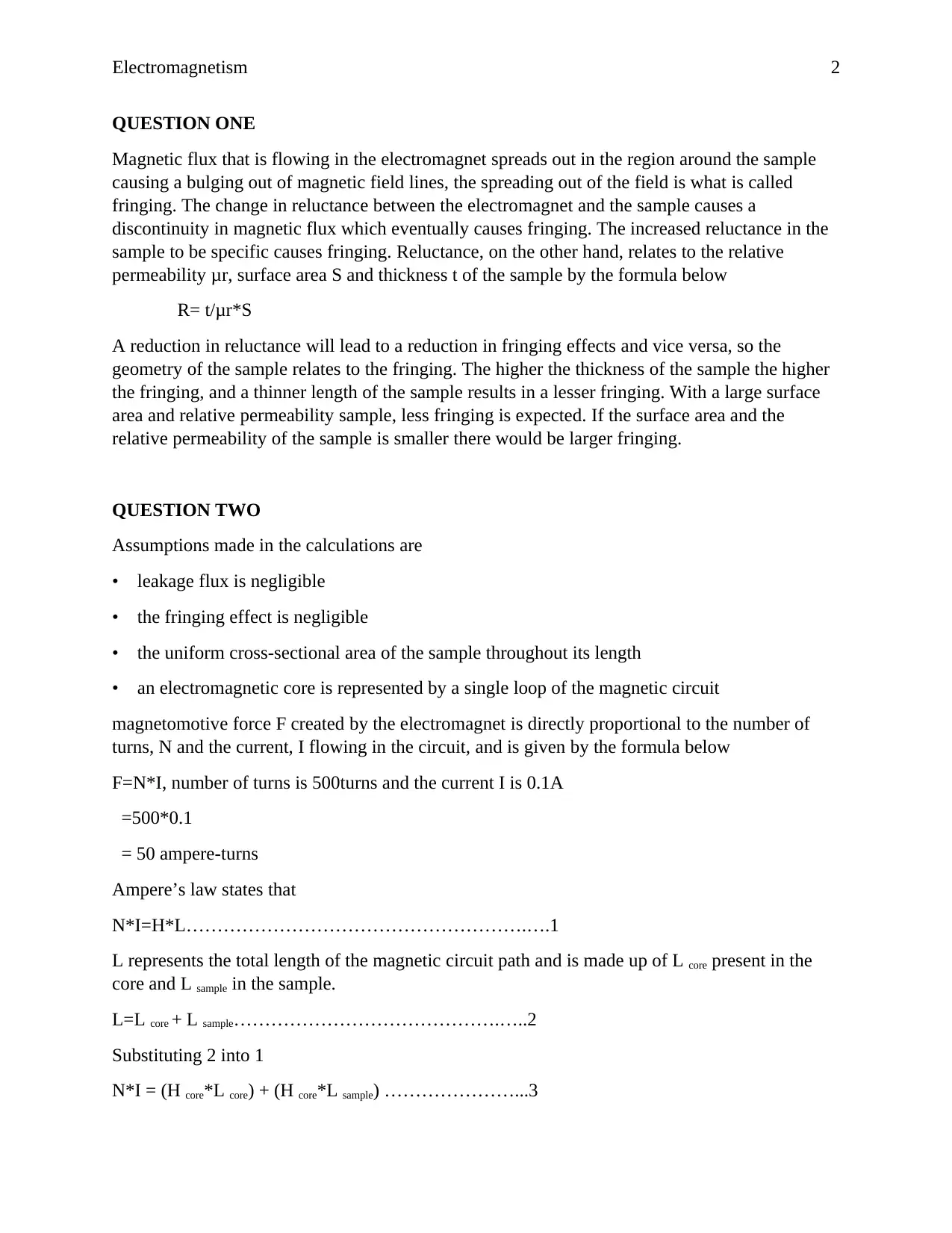
Magnetic flux that is flowing in the electromagnet spreads out in the region around the sample
causing a bulging out of magnetic field lines, the spreading out of the field is what is called
fringing. The change in reluctance between the electromagnet and the sample causes a
discontinuity in magnetic flux which eventually causes fringing. The increased reluctance in the
sample to be specific causes fringing. Reluctance, on the other hand, relates to the relative
permeability μr, surface area S and thickness t of the sample by the formula below
R= t/μr*S
A reduction in reluctance will lead to a reduction in fringing effects and vice versa, so the
geometry of the sample relates to the fringing. The higher the thickness of the sample the higher
the fringing, and a thinner length of the sample results in a lesser fringing. With a large surface
area and relative permeability sample, less fringing is expected. If the surface area and the
relative permeability of the sample is smaller there would be larger fringing.
QUESTION TWO
Assumptions made in the calculations are
• leakage flux is negligible
• the fringing effect is negligible
• the uniform cross-sectional area of the sample throughout its length
• an electromagnetic core is represented by a single loop of the magnetic circuit
magnetomotive force F created by the electromagnet is directly proportional to the number of
turns, N and the current, I flowing in the circuit, and is given by the formula below
F=N*I, number of turns is 500turns and the current I is 0.1A
=500*0.1
= 50 ampere-turns
Ampere’s law states that
N*I=H*L……………………………………………….….1
L represents the total length of the magnetic circuit path and is made up of L core present in the
core and L sample in the sample.
L=L core + L sample…………………………………….…..2
Substituting 2 into 1
N*I = (H core*L core) + (H core*L sample) …………………...3
QUESTION ONE
Magnetic flux that is flowing in the electromagnet spreads out in the region around the sample
causing a bulging out of magnetic field lines, the spreading out of the field is what is called
fringing. The change in reluctance between the electromagnet and the sample causes a
discontinuity in magnetic flux which eventually causes fringing. The increased reluctance in the
sample to be specific causes fringing. Reluctance, on the other hand, relates to the relative
permeability μr, surface area S and thickness t of the sample by the formula below
R= t/μr*S
A reduction in reluctance will lead to a reduction in fringing effects and vice versa, so the
geometry of the sample relates to the fringing. The higher the thickness of the sample the higher
the fringing, and a thinner length of the sample results in a lesser fringing. With a large surface
area and relative permeability sample, less fringing is expected. If the surface area and the
relative permeability of the sample is smaller there would be larger fringing.
QUESTION TWO
Assumptions made in the calculations are
• leakage flux is negligible
• the fringing effect is negligible
• the uniform cross-sectional area of the sample throughout its length
• an electromagnetic core is represented by a single loop of the magnetic circuit
magnetomotive force F created by the electromagnet is directly proportional to the number of
turns, N and the current, I flowing in the circuit, and is given by the formula below
F=N*I, number of turns is 500turns and the current I is 0.1A
=500*0.1
= 50 ampere-turns
Ampere’s law states that
N*I=H*L……………………………………………….….1
L represents the total length of the magnetic circuit path and is made up of L core present in the
core and L sample in the sample.
L=L core + L sample…………………………………….…..2
Substituting 2 into 1
N*I = (H core*L core) + (H core*L sample) …………………...3

Electromagnetism 3
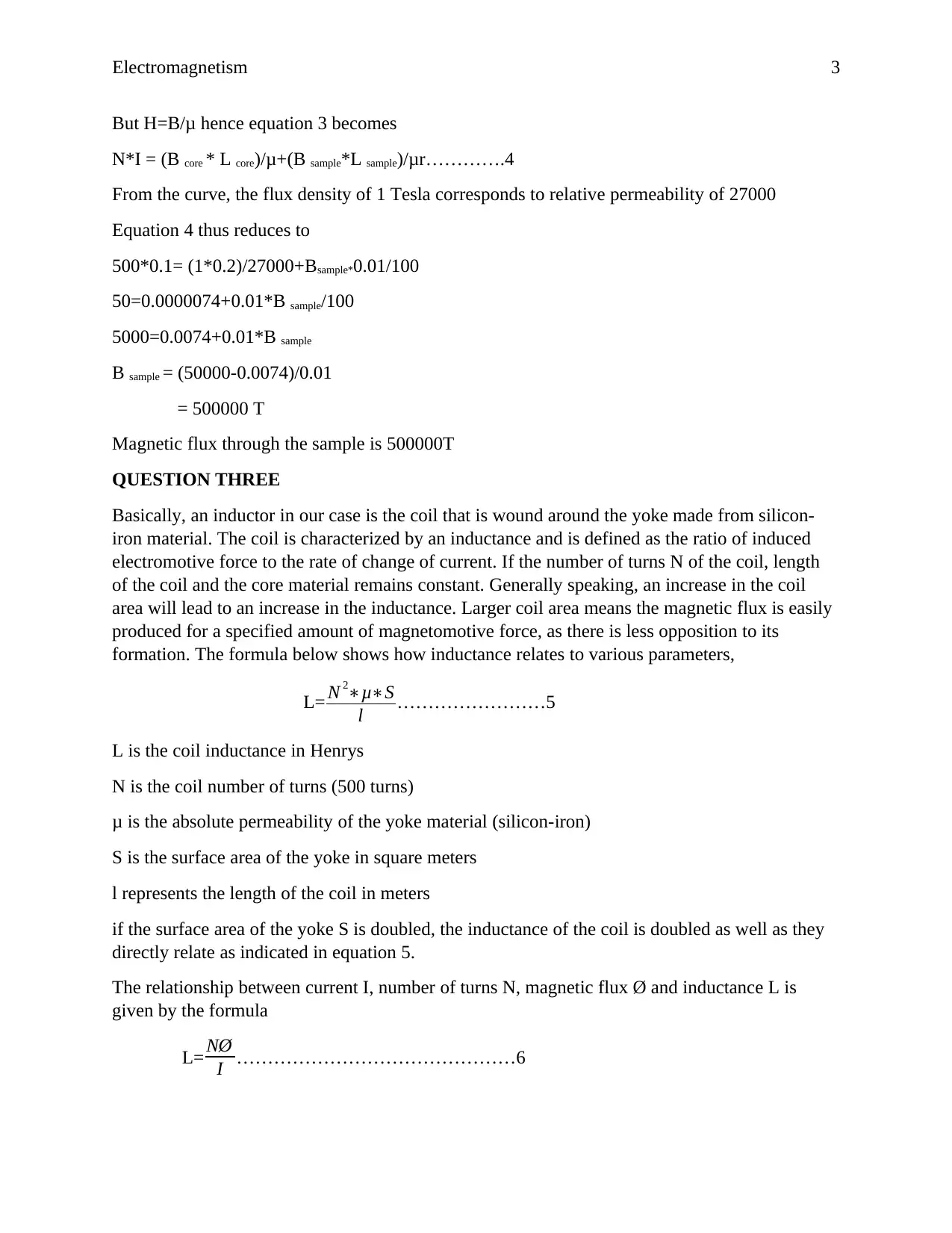
But H=B/μ hence equation 3 becomes
N*I = (B core * L core)/μ+(B sample*L sample)/μr………….4
From the curve, the flux density of 1 Tesla corresponds to relative permeability of 27000
Equation 4 thus reduces to
500*0.1= (1*0.2)/27000+Bsample*0.01/100
50=0.0000074+0.01*B sample/100
5000=0.0074+0.01*B sample
B sample = (50000-0.0074)/0.01
= 500000 T
Magnetic flux through the sample is 500000T
QUESTION THREE
Basically, an inductor in our case is the coil that is wound around the yoke made from silicon-
iron material. The coil is characterized by an inductance and is defined as the ratio of induced
electromotive force to the rate of change of current. If the number of turns N of the coil, length
of the coil and the core material remains constant. Generally speaking, an increase in the coil
area will lead to an increase in the inductance. Larger coil area means the magnetic flux is easily
produced for a specified amount of magnetomotive force, as there is less opposition to its
formation. The formula below shows how inductance relates to various parameters,
L= N 2∗μ∗S
l ……………………5
L is the coil inductance in Henrys
N is the coil number of turns (500 turns)
μ is the absolute permeability of the yoke material (silicon-iron)
S is the surface area of the yoke in square meters
l represents the length of the coil in meters
if the surface area of the yoke S is doubled, the inductance of the coil is doubled as well as they
directly relate as indicated in equation 5.
The relationship between current I, number of turns N, magnetic flux Ø and inductance L is
given by the formula
L= NØ
I ………………………………………6
But H=B/μ hence equation 3 becomes
N*I = (B core * L core)/μ+(B sample*L sample)/μr………….4
From the curve, the flux density of 1 Tesla corresponds to relative permeability of 27000
Equation 4 thus reduces to
500*0.1= (1*0.2)/27000+Bsample*0.01/100
50=0.0000074+0.01*B sample/100
5000=0.0074+0.01*B sample
B sample = (50000-0.0074)/0.01
= 500000 T
Magnetic flux through the sample is 500000T
QUESTION THREE
Basically, an inductor in our case is the coil that is wound around the yoke made from silicon-
iron material. The coil is characterized by an inductance and is defined as the ratio of induced
electromotive force to the rate of change of current. If the number of turns N of the coil, length
of the coil and the core material remains constant. Generally speaking, an increase in the coil
area will lead to an increase in the inductance. Larger coil area means the magnetic flux is easily
produced for a specified amount of magnetomotive force, as there is less opposition to its
formation. The formula below shows how inductance relates to various parameters,
L= N 2∗μ∗S
l ……………………5
L is the coil inductance in Henrys
N is the coil number of turns (500 turns)
μ is the absolute permeability of the yoke material (silicon-iron)
S is the surface area of the yoke in square meters
l represents the length of the coil in meters
if the surface area of the yoke S is doubled, the inductance of the coil is doubled as well as they
directly relate as indicated in equation 5.
The relationship between current I, number of turns N, magnetic flux Ø and inductance L is
given by the formula
L= NØ
I ………………………………………6
⊘ This is a preview!⊘
Do you want full access?
Subscribe today to unlock all pages.

Trusted by 1+ million students worldwide

Electromagnetism 4
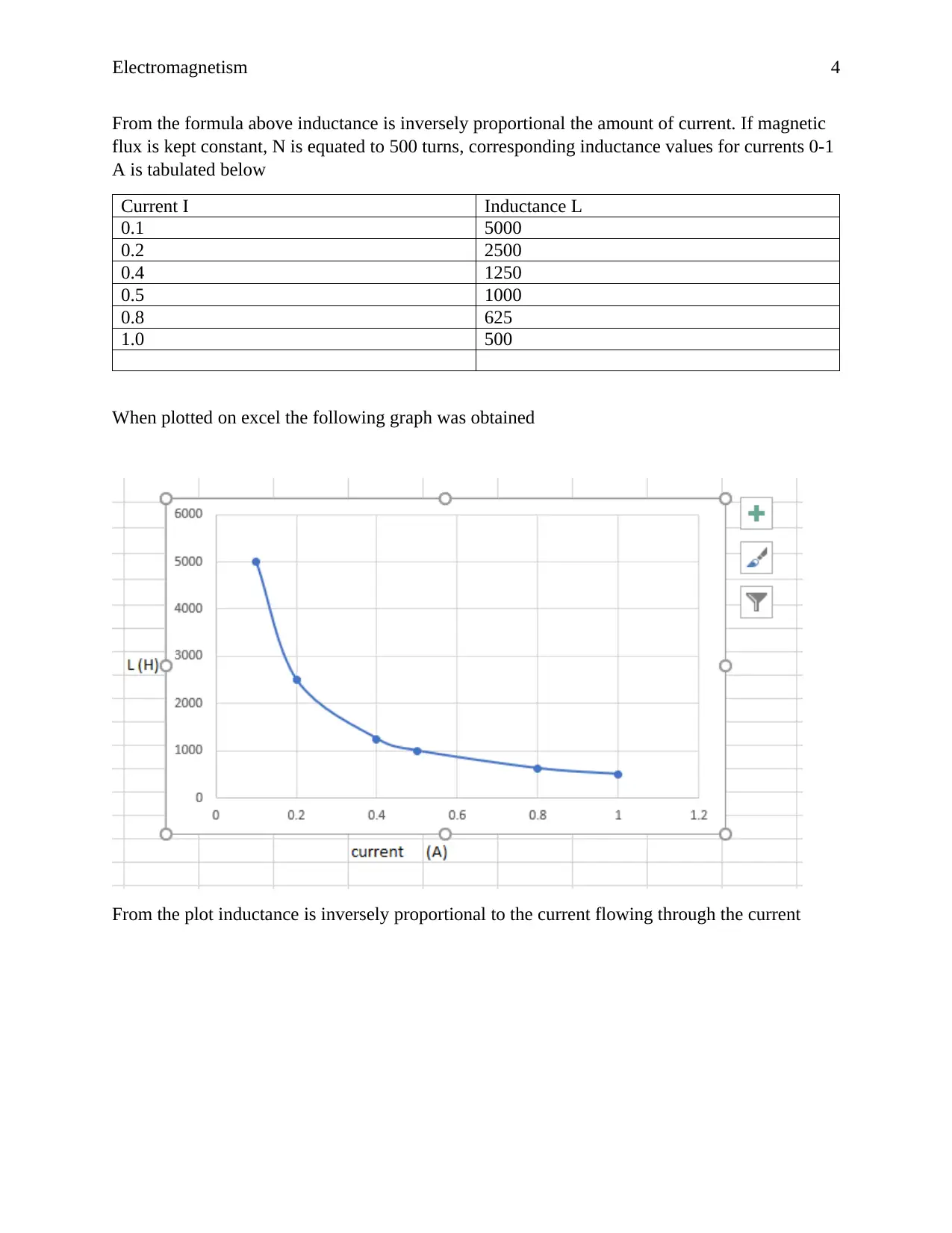
From the formula above inductance is inversely proportional the amount of current. If magnetic
flux is kept constant, N is equated to 500 turns, corresponding inductance values for currents 0-1
A is tabulated below
Current I Inductance L
0.1 5000
0.2 2500
0.4 1250
0.5 1000
0.8 625
1.0 500
When plotted on excel the following graph was obtained
From the plot inductance is inversely proportional to the current flowing through the current
From the formula above inductance is inversely proportional the amount of current. If magnetic
flux is kept constant, N is equated to 500 turns, corresponding inductance values for currents 0-1
A is tabulated below
Current I Inductance L
0.1 5000
0.2 2500
0.4 1250
0.5 1000
0.8 625
1.0 500
When plotted on excel the following graph was obtained
From the plot inductance is inversely proportional to the current flowing through the current
Paraphrase This Document
Need a fresh take? Get an instant paraphrase of this document with our AI Paraphraser

Electromagnetism 5
References
All about circuits. (n.d). factors affecting inductance. Retrieved from
https://www.allaboutcircuits.com/textbook/direct-current/chpt-15/factors-affecting-
inductance/
Encyclopedia Magnetica.(n,d). Flux fringing. Retrieved from http://www.encyclopedia-
magnetica.com/doku.php/flux_fringing
Faiz, J., Ebrahimi, B. M., & Noori, T. (2015). Three-and two-dimensional finite-element
computation of inrush current and short-circuit electromagnetic forces on windings of a
three-phase core-type power transformer. IEEE Transactions on Magnetics, 44(5), 590-
597.
Jung, J. W., Lee, B. H., Kim, D. J., Hong, J. P., Kim, J. Y., Jeon, S. M., & Song, D. H. (2012).
Mechanical stress reduction of rotor core of interior permanent magnet synchronous
motor. IEEE Transactions on Magnetics, 48(2), 911-914.
Wikipedia.(n,d). Electromagnet. Retrieved from https://en.wikipedia.org/wiki/Electromagnet
References
All about circuits. (n.d). factors affecting inductance. Retrieved from
https://www.allaboutcircuits.com/textbook/direct-current/chpt-15/factors-affecting-
inductance/
Encyclopedia Magnetica.(n,d). Flux fringing. Retrieved from http://www.encyclopedia-
magnetica.com/doku.php/flux_fringing
Faiz, J., Ebrahimi, B. M., & Noori, T. (2015). Three-and two-dimensional finite-element
computation of inrush current and short-circuit electromagnetic forces on windings of a
three-phase core-type power transformer. IEEE Transactions on Magnetics, 44(5), 590-
597.
Jung, J. W., Lee, B. H., Kim, D. J., Hong, J. P., Kim, J. Y., Jeon, S. M., & Song, D. H. (2012).
Mechanical stress reduction of rotor core of interior permanent magnet synchronous
motor. IEEE Transactions on Magnetics, 48(2), 911-914.
Wikipedia.(n,d). Electromagnet. Retrieved from https://en.wikipedia.org/wiki/Electromagnet
1 out of 5
Your All-in-One AI-Powered Toolkit for Academic Success.
+13062052269
info@desklib.com
Available 24*7 on WhatsApp / Email
Unlock your academic potential
Copyright © 2020–2025 A2Z Services. All Rights Reserved. Developed and managed by ZUCOL.