Literature Review: Benefits and Challenges of Electronic Prescribing

Verified

Added on  2020/03/04

|6
|1158
|54
Report
AI Summary
This report is a literature review focusing on electronic prescribing (e-prescribing) within a healthcare context, specifically examining its application in a hospital in Harrisburg, PA. The review explores the benefits of e-prescribing, such as improved efficiency, patient safety, and reduced medication errors, while also addressing the challenges, including implementation costs, system-related errors, and privacy concerns. The literature review synthesizes findings from various research studies, including Porterfield, Engelbert, & Coustasse (2014), Lander et al. (2013), Gagnon et al. (2014), Hogan-Murphy et al. (2015), and Farre & Cummins (2016). These studies highlight the importance of interoperability, user perceptions, equipment reliability, and organizational structures in the successful implementation of e-prescribing systems. The review also identifies the need for further research to address barriers and facilitators to fully understand the impact of e-prescribing in different settings. This review provides valuable insights for planning the implementation of e-prescribing strategies.
Document Page
Running head: ELECTRONIC PRESCRIBING
Electronic prescribing
Name of the student:
Name of the University:
Author’s note
tabler-icon-diamond-filled.svg

Paraphrase This Document

Need a fresh take? Get an instant paraphrase of this document with our AI Paraphraser
Document Page
1ELECTRONIC PRESCRIBING
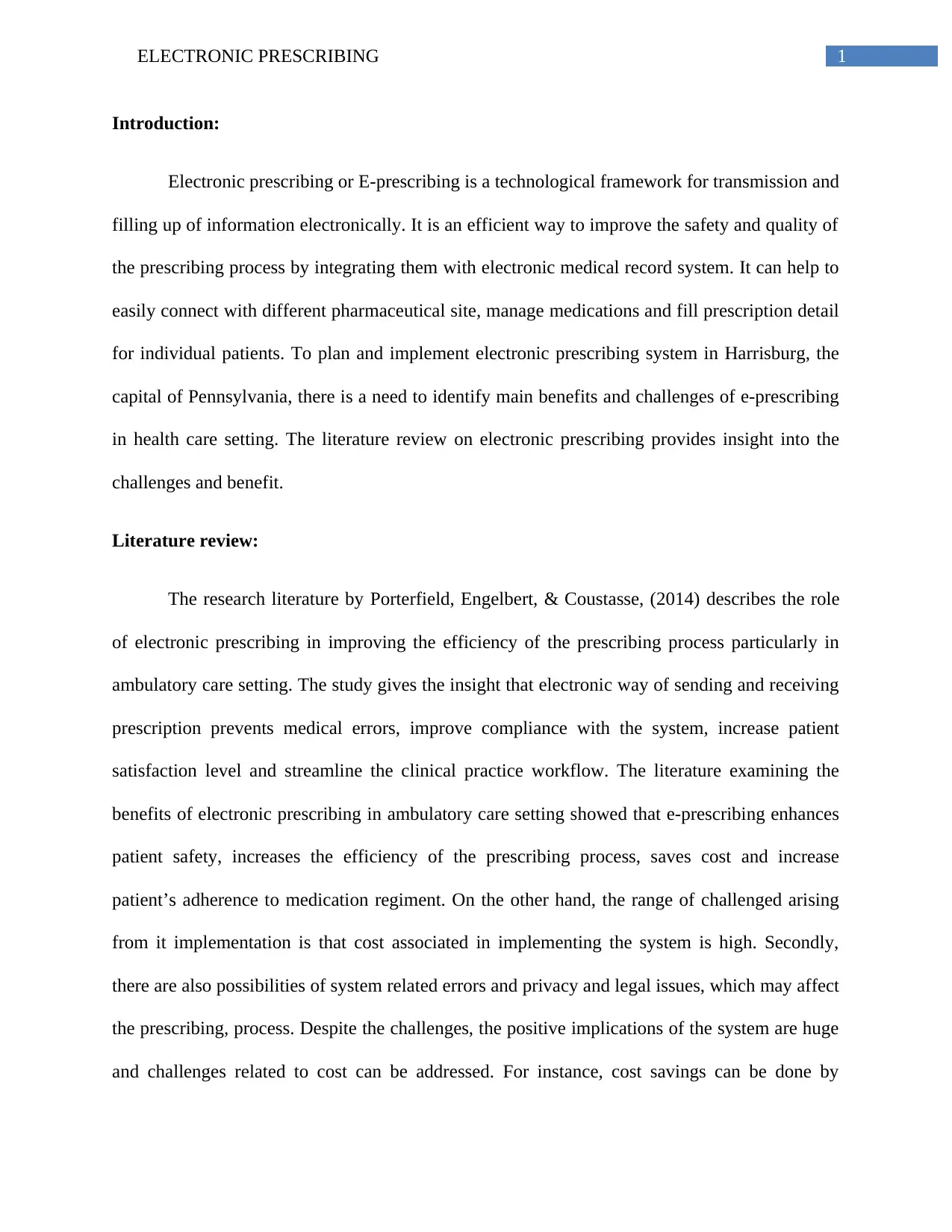
Introduction:
Electronic prescribing or E-prescribing is a technological framework for transmission and
filling up of information electronically. It is an efficient way to improve the safety and quality of
the prescribing process by integrating them with electronic medical record system. It can help to
easily connect with different pharmaceutical site, manage medications and fill prescription detail
for individual patients. To plan and implement electronic prescribing system in Harrisburg, the
capital of Pennsylvania, there is a need to identify main benefits and challenges of e-prescribing
in health care setting. The literature review on electronic prescribing provides insight into the
challenges and benefit.
Literature review:
The research literature by Porterfield, Engelbert, & Coustasse, (2014) describes the role
of electronic prescribing in improving the efficiency of the prescribing process particularly in
ambulatory care setting. The study gives the insight that electronic way of sending and receiving
prescription prevents medical errors, improve compliance with the system, increase patient
satisfaction level and streamline the clinical practice workflow. The literature examining the
benefits of electronic prescribing in ambulatory care setting showed that e-prescribing enhances
patient safety, increases the efficiency of the prescribing process, saves cost and increase
patient’s adherence to medication regiment. On the other hand, the range of challenged arising
from it implementation is that cost associated in implementing the system is high. Secondly,
there are also possibilities of system related errors and privacy and legal issues, which may affect
the prescribing, process. Despite the challenges, the positive implications of the system are huge
and challenges related to cost can be addressed. For instance, cost savings can be done by
Document Page
2ELECTRONIC PRESCRIBING
improving the efficiency of the system and reducing adverse drug event (Lander et al., 2013).
The only limitation of this study can be its search strategy and biasness in data base search.
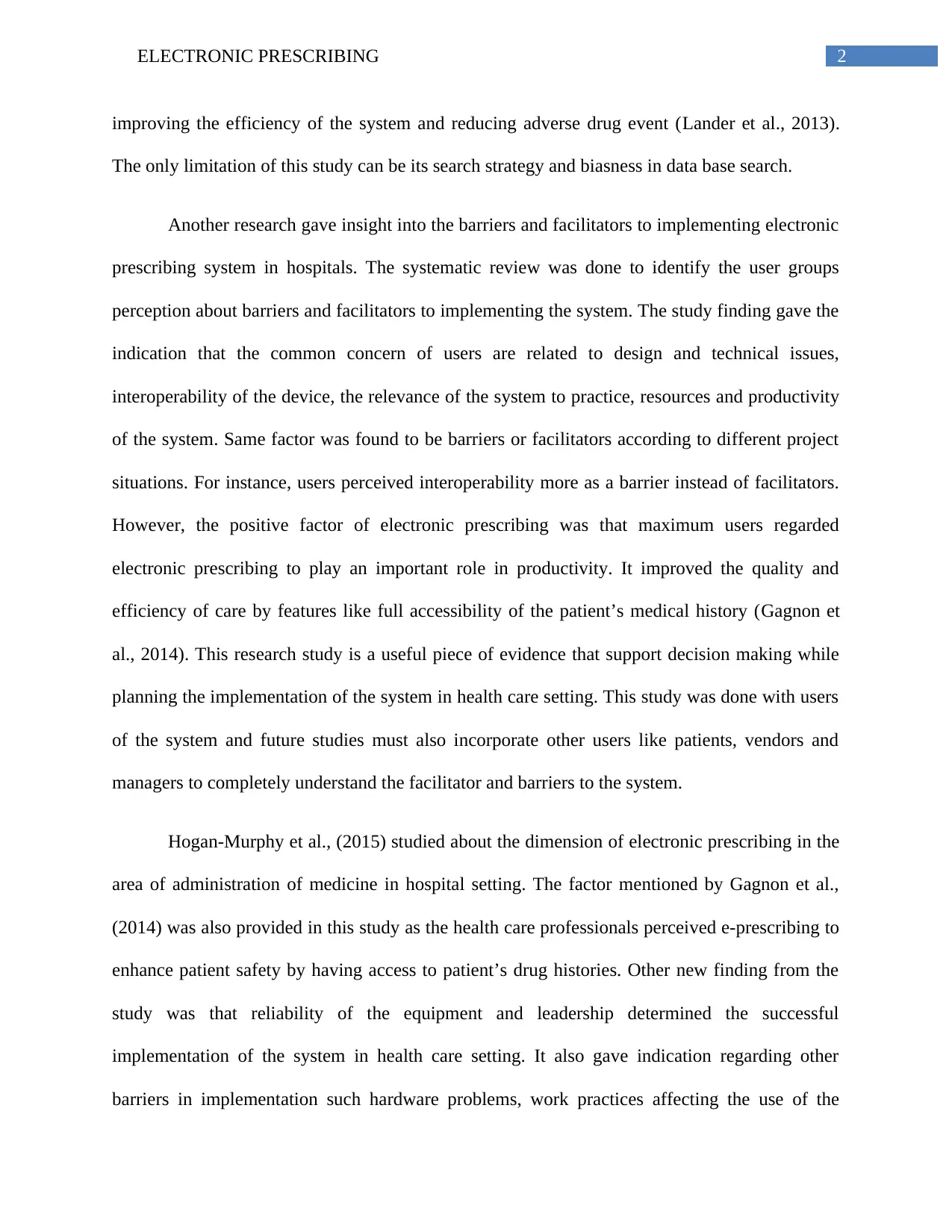
Another research gave insight into the barriers and facilitators to implementing electronic
prescribing system in hospitals. The systematic review was done to identify the user groups
perception about barriers and facilitators to implementing the system. The study finding gave the
indication that the common concern of users are related to design and technical issues,
interoperability of the device, the relevance of the system to practice, resources and productivity
of the system. Same factor was found to be barriers or facilitators according to different project
situations. For instance, users perceived interoperability more as a barrier instead of facilitators.
However, the positive factor of electronic prescribing was that maximum users regarded
electronic prescribing to play an important role in productivity. It improved the quality and
efficiency of care by features like full accessibility of the patient’s medical history (Gagnon et
al., 2014). This research study is a useful piece of evidence that support decision making while
planning the implementation of the system in health care setting. This study was done with users
of the system and future studies must also incorporate other users like patients, vendors and
managers to completely understand the facilitator and barriers to the system.
Hogan-Murphy et al., (2015) studied about the dimension of electronic prescribing in the
area of administration of medicine in hospital setting. The factor mentioned by Gagnon et al.,
(2014) was also provided in this study as the health care professionals perceived e-prescribing to
enhance patient safety by having access to patient’s drug histories. Other new finding from the
study was that reliability of the equipment and leadership determined the successful
implementation of the system in health care setting. It also gave indication regarding other
barriers in implementation such hardware problems, work practices affecting the use of the
Document Page
3ELECTRONIC PRESCRIBING
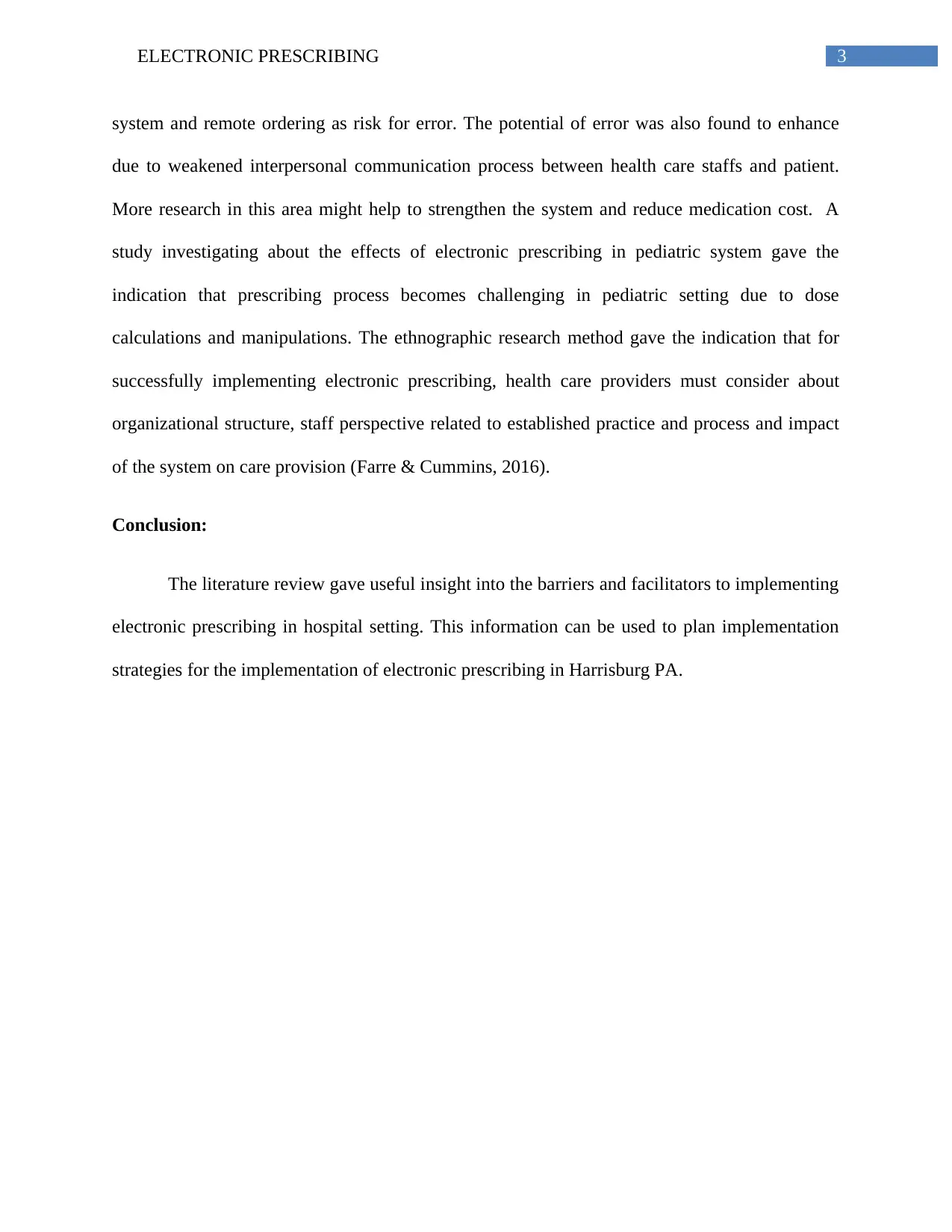
system and remote ordering as risk for error. The potential of error was also found to enhance
due to weakened interpersonal communication process between health care staffs and patient.
More research in this area might help to strengthen the system and reduce medication cost. A
study investigating about the effects of electronic prescribing in pediatric system gave the
indication that prescribing process becomes challenging in pediatric setting due to dose
calculations and manipulations. The ethnographic research method gave the indication that for
successfully implementing electronic prescribing, health care providers must consider about
organizational structure, staff perspective related to established practice and process and impact
of the system on care provision (Farre & Cummins, 2016).
Conclusion:
The literature review gave useful insight into the barriers and facilitators to implementing
electronic prescribing in hospital setting. This information can be used to plan implementation
strategies for the implementation of electronic prescribing in Harrisburg PA.
tabler-icon-diamond-filled.svg

Paraphrase This Document

Need a fresh take? Get an instant paraphrase of this document with our AI Paraphraser
Document Page
4ELECTRONIC PRESCRIBING
Reference
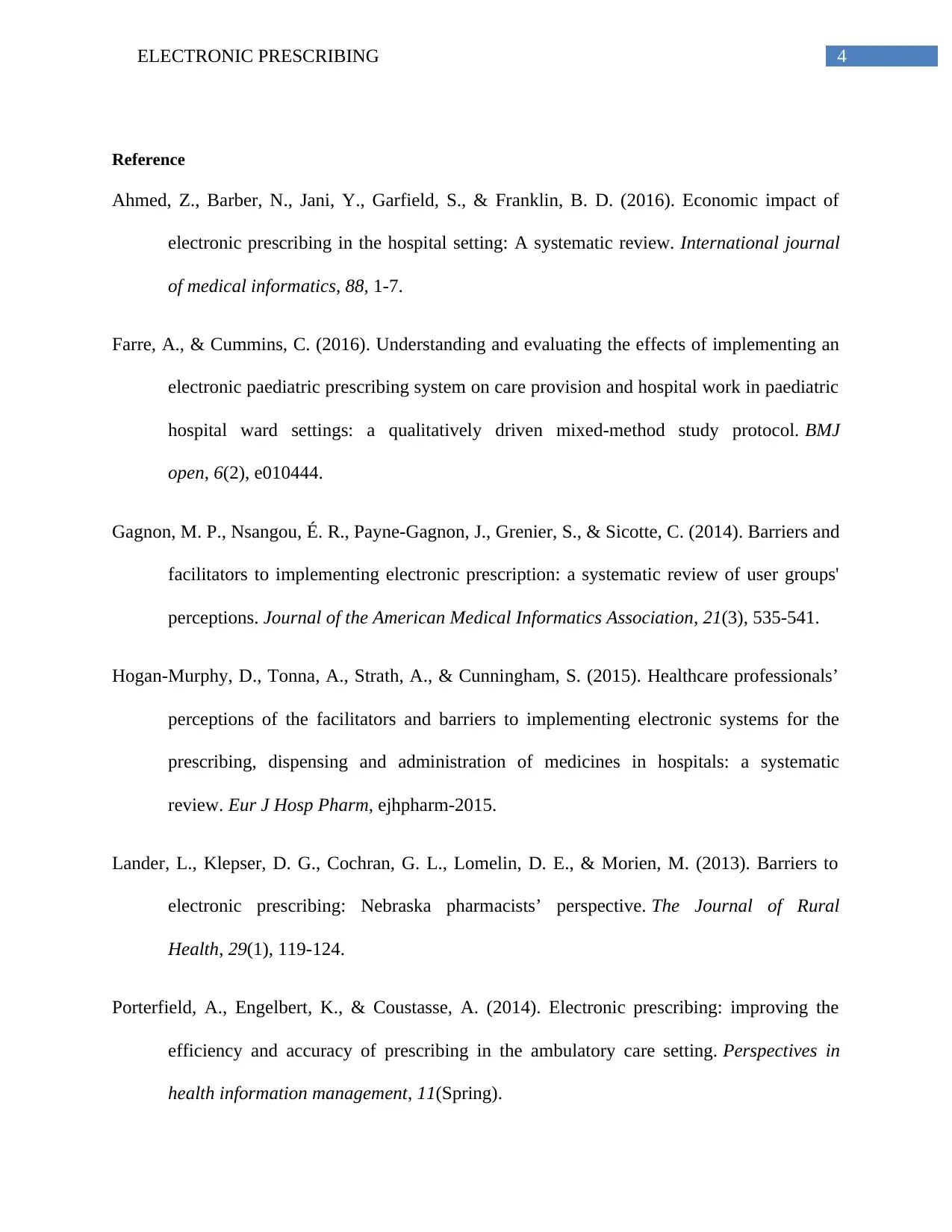
Ahmed, Z., Barber, N., Jani, Y., Garfield, S., & Franklin, B. D. (2016). Economic impact of
electronic prescribing in the hospital setting: A systematic review. International journal
of medical informatics, 88, 1-7.
Farre, A., & Cummins, C. (2016). Understanding and evaluating the effects of implementing an
electronic paediatric prescribing system on care provision and hospital work in paediatric
hospital ward settings: a qualitatively driven mixed-method study protocol. BMJ
open, 6(2), e010444.
Gagnon, M. P., Nsangou, É. R., Payne-Gagnon, J., Grenier, S., & Sicotte, C. (2014). Barriers and
facilitators to implementing electronic prescription: a systematic review of user groups'
perceptions. Journal of the American Medical Informatics Association, 21(3), 535-541.
Hogan-Murphy, D., Tonna, A., Strath, A., & Cunningham, S. (2015). Healthcare professionals’
perceptions of the facilitators and barriers to implementing electronic systems for the
prescribing, dispensing and administration of medicines in hospitals: a systematic
review. Eur J Hosp Pharm, ejhpharm-2015.
Lander, L., Klepser, D. G., Cochran, G. L., Lomelin, D. E., & Morien, M. (2013). Barriers to
electronic prescribing: Nebraska pharmacists’ perspective. The Journal of Rural
Health, 29(1), 119-124.
Porterfield, A., Engelbert, K., & Coustasse, A. (2014). Electronic prescribing: improving the
efficiency and accuracy of prescribing in the ambulatory care setting. Perspectives in
health information management, 11(Spring).
Document Page
5ELECTRONIC PRESCRIBING
chevron_up_icon
1 out of 6
circle_padding
hide_on_mobile
zoom_out_icon
[object Object]