Analyzing Embedded Liberalism in the Context of ATS 2624 Economics
VerifiedAdded on 2022/10/14
|10
|2432
|15
Essay
AI Summary
This essay delves into the concept of embedded liberalism, coined by John Gerard, focusing on its emergence during the Bretton Woods era following World War II. It explores the Allied Powers' efforts to establish international economic cooperation to prevent political instability stemming from damaged economies. The essay examines the compromise of embedded liberalism, a middle ground between open economies and domestic stability, emphasizing the importance of lowering tariffs and maintaining welfare states. It analyzes the role of multilateralism and domestic interventionism, as well as the two primary arguments developed by embedded liberals. The essay also discusses the importance of Bretton Woods in integrating contemporary thinking and providing instruments to stabilize local economies, while also addressing the challenges and gaps between the theory and practice of embedded liberalism, including the hierarchical framework of the international system and the varying experiences of countries under Bretton Woods. The conclusion emphasizes the analytical flaws that undermine embedded liberalism's conceptual ability, and the need for a review of its analytical base to realize its potential.
Embedded Liberalism
Name
ATS 2624: Economics
Instructor
Date
Name
ATS 2624: Economics
Instructor
Date

Paraphrase This Document
Need a fresh take? Get an instant paraphrase of this document with our AI Paraphraser
Name 2
John Gerard coined the term embedded liberalism during the post-World War,
particularly during Bretton Woods epoch. During this time, the Allied Powers, specifically the
US and Britain, deemed international economic cooperation as a vital strategy that could help
stop a slide back into war happening1. Such a belief originated from the concern that following
Axis Powers and other nations having damaged economies would fail to report economic
growth, and this could trigger political instability2. Also, the recession reported during the
interwar years had taken place at a period of isolationism, where economic policies such as
protectionism, for instance, Smoot-Hawley tariff was at play. It is at Bretton Woods that the
allies aimed at carrying out negotiations regarding architecting a new international economic
order. However, doubts arose over facilitating that increased trade does not sacrifice the
necessity of domestic stability. It is thus apparent that at one hand, lowering tariffs and adopting
other measures to open markets were deemed as vital to spurring economic growth.
Subsequently, John Keynes and other stakeholders expressed interest in maintaining the welfare
of the state, particularly in facilitating full employment.
It is also vital to note that there was a compromise to the embedded liberalism which
happened post-world war II Bretton Woods epoch. It marked the middle platform between liberal
economic orthodoxy associated with open economies and the policy objectives underpinning
trade discrimination and practices adopted by monetary systems during the years of interwar. It
is crucial to note that the importance of compromising the embedded liberalism as opposed to the
1 John G. Ruggie. "International Regimes, Transactions, and Change:
Embedded Liberalism in the Postwar Economic Order." International Organization 36, no. 2 (1982): 383.
2Stephen Buzdugan and Anthony Payne. The Long Battle for Global
Governance (Routlege,2019)
John Gerard coined the term embedded liberalism during the post-World War,
particularly during Bretton Woods epoch. During this time, the Allied Powers, specifically the
US and Britain, deemed international economic cooperation as a vital strategy that could help
stop a slide back into war happening1. Such a belief originated from the concern that following
Axis Powers and other nations having damaged economies would fail to report economic
growth, and this could trigger political instability2. Also, the recession reported during the
interwar years had taken place at a period of isolationism, where economic policies such as
protectionism, for instance, Smoot-Hawley tariff was at play. It is at Bretton Woods that the
allies aimed at carrying out negotiations regarding architecting a new international economic
order. However, doubts arose over facilitating that increased trade does not sacrifice the
necessity of domestic stability. It is thus apparent that at one hand, lowering tariffs and adopting
other measures to open markets were deemed as vital to spurring economic growth.
Subsequently, John Keynes and other stakeholders expressed interest in maintaining the welfare
of the state, particularly in facilitating full employment.
It is also vital to note that there was a compromise to the embedded liberalism which
happened post-world war II Bretton Woods epoch. It marked the middle platform between liberal
economic orthodoxy associated with open economies and the policy objectives underpinning
trade discrimination and practices adopted by monetary systems during the years of interwar. It
is crucial to note that the importance of compromising the embedded liberalism as opposed to the
1 John G. Ruggie. "International Regimes, Transactions, and Change:
Embedded Liberalism in the Postwar Economic Order." International Organization 36, no. 2 (1982): 383.
2Stephen Buzdugan and Anthony Payne. The Long Battle for Global
Governance (Routlege,2019)
Name 3
economic nationalism of the 1930s, it would exhibit a feature of multilateralism. Such
multilateralism, unlike the liberalism associated with the gold standard, would be underpinned by
domestic interventionism. Ruggie found a way to recognize efforts to link multilateralism with
cooperation to necessitate local growth of the economy and social security from the way things
appeared in the 1941 Atlantic Charter. The prevailing compromise came in many angles where
the US stood solely in favor of trade liberalization characterized by multilateralism. Such a
compromise also encompassed specific interest in eliminating trade discrimination and foreign
exchange. On the other hand, Allies such as the UK supported and preferred other forms such as
domestic interventionism. However, fundamentally, it was the middle passage as per Keynes
between the existing policies such as laissez-faire liberalism of the nineteenth century and at the
end, the Marxism.
Importance of embedded liberalism
According to Ruggie the purpose of coining the post-war system as embedded liberal was
to illustrate that conversely to the orthodox perception that focused on the liberal trait of money
and trade regimes, the liberalism that was established following world war II advocated different
characteristics from those of the 19th century3. It is through this conceptualization that the idea of
embedded liberalism has been used widely by both the academics and practitioners for their
various needs. Partially, the outcome of this popularity has resulted in the concept being
expanded into a term that has many meanings. Nevertheless, it is crucial to recognize the two
primary arguments developed by the embedded liberals.
3 Eric Helleiner. International Development and the Making of the Postwar Order”. Forgotten
Foundations of Bretton Woods (Cornell University Press,2014)
economic nationalism of the 1930s, it would exhibit a feature of multilateralism. Such
multilateralism, unlike the liberalism associated with the gold standard, would be underpinned by
domestic interventionism. Ruggie found a way to recognize efforts to link multilateralism with
cooperation to necessitate local growth of the economy and social security from the way things
appeared in the 1941 Atlantic Charter. The prevailing compromise came in many angles where
the US stood solely in favor of trade liberalization characterized by multilateralism. Such a
compromise also encompassed specific interest in eliminating trade discrimination and foreign
exchange. On the other hand, Allies such as the UK supported and preferred other forms such as
domestic interventionism. However, fundamentally, it was the middle passage as per Keynes
between the existing policies such as laissez-faire liberalism of the nineteenth century and at the
end, the Marxism.
Importance of embedded liberalism
According to Ruggie the purpose of coining the post-war system as embedded liberal was
to illustrate that conversely to the orthodox perception that focused on the liberal trait of money
and trade regimes, the liberalism that was established following world war II advocated different
characteristics from those of the 19th century3. It is through this conceptualization that the idea of
embedded liberalism has been used widely by both the academics and practitioners for their
various needs. Partially, the outcome of this popularity has resulted in the concept being
expanded into a term that has many meanings. Nevertheless, it is crucial to recognize the two
primary arguments developed by the embedded liberals.
3 Eric Helleiner. International Development and the Making of the Postwar Order”. Forgotten
Foundations of Bretton Woods (Cornell University Press,2014)
⊘ This is a preview!⊘
Do you want full access?
Subscribe today to unlock all pages.

Trusted by 1+ million students worldwide
Name 4
It is true, that majority of the scholars concur that an Anglo-American agreement
prevailed on postwar economic goals. The narrative follows that in anticipation of the postwar
economic plan, an agreement ensued within a team of British and American economists and
several policy specialists who discussed on the lessons of the 1930s thus envisaging a global
economic system that provided the middle ground between laissez-faire and interventionism. In
explaining this better, there was a general consensus regarding the importance of protecting
domestic social goals, and about the institutional system that the postwar economic system
should adopt to achieve such end4. For Both Britain and the US, most of the ideologies found
their way into the Agreement of Bretton Woods were widely discussed upon and shared among
the liberal-minded global economists whose views were a reflection of the lessons learned from
the historical experience and also from the continuous evolution in the occupational economic
thought. Such shared ideas and notions, it is postulated that they gave rise to the intellectual
foundation necessary for the postwar order providing Bretton Woods the embedded liberal
character.
The embedded liberals perceive the Bretton Woods order as fully integrating
contemporary thinking as viewed in the above argument. It accorded member nations
instruments to assist in stabilizing their local economies. To illustrate this better, Ruggie draws
reference from the work of Richard Cooper regarding the concept of the double screen (Ruggie
1982). Following Cooper's arguments regarding Bretton Woods, the policies of domestic
economies were to be shielded from the strictures associated with the balance of payments via
the double screen. Thus, short-term imbalances were to receive finances, if deemed necessary via
4 Eric Helleiner. "The life and times of embedded liberalism:legacies and
innovations since Bretton Woods." Review of International Political Economy 3,no.1 (2019):2 .
It is true, that majority of the scholars concur that an Anglo-American agreement
prevailed on postwar economic goals. The narrative follows that in anticipation of the postwar
economic plan, an agreement ensued within a team of British and American economists and
several policy specialists who discussed on the lessons of the 1930s thus envisaging a global
economic system that provided the middle ground between laissez-faire and interventionism. In
explaining this better, there was a general consensus regarding the importance of protecting
domestic social goals, and about the institutional system that the postwar economic system
should adopt to achieve such end4. For Both Britain and the US, most of the ideologies found
their way into the Agreement of Bretton Woods were widely discussed upon and shared among
the liberal-minded global economists whose views were a reflection of the lessons learned from
the historical experience and also from the continuous evolution in the occupational economic
thought. Such shared ideas and notions, it is postulated that they gave rise to the intellectual
foundation necessary for the postwar order providing Bretton Woods the embedded liberal
character.
The embedded liberals perceive the Bretton Woods order as fully integrating
contemporary thinking as viewed in the above argument. It accorded member nations
instruments to assist in stabilizing their local economies. To illustrate this better, Ruggie draws
reference from the work of Richard Cooper regarding the concept of the double screen (Ruggie
1982). Following Cooper's arguments regarding Bretton Woods, the policies of domestic
economies were to be shielded from the strictures associated with the balance of payments via
the double screen. Thus, short-term imbalances were to receive finances, if deemed necessary via
4 Eric Helleiner. "The life and times of embedded liberalism:legacies and
innovations since Bretton Woods." Review of International Political Economy 3,no.1 (2019):2 .
Paraphrase This Document
Need a fresh take? Get an instant paraphrase of this document with our AI Paraphraser
Name 5
drafting lines of credit at an emerging, established lending facility such as the International
Monetary Fund and the underlying imbalances were to rectified by altering the nation's exchange
rate. Such an understanding that the Bretton Woods system would help resolve the tension
arising between global and domestic stability got also advanced by advocates of the concept of
embedded liberalism. It is under the Bretton Woods system that nations were to be armed with
the financial instruments to advance their preferred experiments. This ideology was received
with high esteem by the embedded liberals as a foundation for developing a sustainable global
economic system and is often deemed as contributing to the golden age that arose between the
1950s and 1960s.
The operation of Bretton Woods as embedded liberalism is underscored by two
assumptions. One is that the embedded liberals perceive the Agreement of 1944 under Bretton
Woods as an immediate reflection of the consensus entailing Anglo-American parties. Such a
conception is apparent from the fact that most of the studies stemming from embedded liberal
notion portray the Bretton Woods negotiation as the underlying narrative. By shifting attention
and focus towards the technical remedies developed by the architects of Bretton Woods,
embedded liberals fundamentally deem the consensus as a compromise to attain the common
economic goals5. Also, proponents of embedded liberalism equated the Agreement under the
Bretton Woods with the order itself. Despite accommodating the hardships that arose during the
postwar reconstruction phase, the broad perception was that the Bretton Woods agreement that
got drafted in 1944 was effective and that it facilitated the governing of the international
economy till it collapsed. For instance, this is portrayed during the Ikenberry's hail of the
5 Ikuo Gonoi and Hiroaki Ataka."Conceptual Relevance of “Embedded Liberalism
and its Critical Social Consequences." ISA-South Annual Conference (Miami: Univeristy of Warwick,2005)
drafting lines of credit at an emerging, established lending facility such as the International
Monetary Fund and the underlying imbalances were to rectified by altering the nation's exchange
rate. Such an understanding that the Bretton Woods system would help resolve the tension
arising between global and domestic stability got also advanced by advocates of the concept of
embedded liberalism. It is under the Bretton Woods system that nations were to be armed with
the financial instruments to advance their preferred experiments. This ideology was received
with high esteem by the embedded liberals as a foundation for developing a sustainable global
economic system and is often deemed as contributing to the golden age that arose between the
1950s and 1960s.
The operation of Bretton Woods as embedded liberalism is underscored by two
assumptions. One is that the embedded liberals perceive the Agreement of 1944 under Bretton
Woods as an immediate reflection of the consensus entailing Anglo-American parties. Such a
conception is apparent from the fact that most of the studies stemming from embedded liberal
notion portray the Bretton Woods negotiation as the underlying narrative. By shifting attention
and focus towards the technical remedies developed by the architects of Bretton Woods,
embedded liberals fundamentally deem the consensus as a compromise to attain the common
economic goals5. Also, proponents of embedded liberalism equated the Agreement under the
Bretton Woods with the order itself. Despite accommodating the hardships that arose during the
postwar reconstruction phase, the broad perception was that the Bretton Woods agreement that
got drafted in 1944 was effective and that it facilitated the governing of the international
economy till it collapsed. For instance, this is portrayed during the Ikenberry's hail of the
5 Ikuo Gonoi and Hiroaki Ataka."Conceptual Relevance of “Embedded Liberalism
and its Critical Social Consequences." ISA-South Annual Conference (Miami: Univeristy of Warwick,2005)
Name 6
Agreement terming it as an unprecedented trial in global economic constitution-making. Thus,
both assumptions yield a harmonious perception of the Bretton Woods system that ensured
attaining of economic goals and institutional framework established for achieving such purposes
as they were closely interwoven and implemented efficiently.
It also imperative to draw a line of distinction in arguments between domestic and
international variants with regards to embedded liberalism. At first, the domestic variant of
embedded liberalism describes the specific kind of state-society interactions that arose during the
postwar era. The main focus is on the social compromise that sufficed within the developed
capitalist nations in the postwar epoch. In this context, embedded liberalism is defined as a
unique form of state. Closed capital markets feature such states, fiscal policies that adopt
demand-side applications, belief in the existence of the activist state, and perception of
unemployment as a resultant failure if demand. Thus, the domestic variants of embedded
liberalism concentrate on the developments of the welfare nation in the developed capitalist
nations. The global variant of embedded liberalism, on the other hand, focuses on the socially
embedded feature of the Bretton Woods system and broadly, the postwar global order. Using
Ruggie's argument, this kind of thought demonstrates that the Bretton Woods system as molding
a specific market-reforming domestic era is a reality. The post-world war II epoch and Bretton
Woods institutions got marked by a contemporary embedded liberal which was the social
purpose. The strength in this post-war order was its ability to reconcile global and domestic
pressures6. It is following this line of thought that Bretton Woods can be classified as embedded
liberalism due to its role in ensuring the domestic social goals of the member nations have been
met.
6 Ibid 1.
Agreement terming it as an unprecedented trial in global economic constitution-making. Thus,
both assumptions yield a harmonious perception of the Bretton Woods system that ensured
attaining of economic goals and institutional framework established for achieving such purposes
as they were closely interwoven and implemented efficiently.
It also imperative to draw a line of distinction in arguments between domestic and
international variants with regards to embedded liberalism. At first, the domestic variant of
embedded liberalism describes the specific kind of state-society interactions that arose during the
postwar era. The main focus is on the social compromise that sufficed within the developed
capitalist nations in the postwar epoch. In this context, embedded liberalism is defined as a
unique form of state. Closed capital markets feature such states, fiscal policies that adopt
demand-side applications, belief in the existence of the activist state, and perception of
unemployment as a resultant failure if demand. Thus, the domestic variants of embedded
liberalism concentrate on the developments of the welfare nation in the developed capitalist
nations. The global variant of embedded liberalism, on the other hand, focuses on the socially
embedded feature of the Bretton Woods system and broadly, the postwar global order. Using
Ruggie's argument, this kind of thought demonstrates that the Bretton Woods system as molding
a specific market-reforming domestic era is a reality. The post-world war II epoch and Bretton
Woods institutions got marked by a contemporary embedded liberal which was the social
purpose. The strength in this post-war order was its ability to reconcile global and domestic
pressures6. It is following this line of thought that Bretton Woods can be classified as embedded
liberalism due to its role in ensuring the domestic social goals of the member nations have been
met.
6 Ibid 1.
⊘ This is a preview!⊘
Do you want full access?
Subscribe today to unlock all pages.
Trusted by 1+ million students worldwide
Name 7
Challenges with embedded liberalism
In analyzing the gap between the theory and practice underpinning Bretton Woods,
several challenges suffice. The embedded liberals postulated that the post-war system transacted
smoothly with a lot of tranquility, particularly for the economically developed nations which lead
to the growth of their economies and prosperity. However, the proponents, on the other hand,
argued that the social piecemeal provided under Bretton Woods was only realized partially. The
embedded liberals ignored the hierarchical framework of the international system; thus,
individual experience of countries under Bretton Wood sharply varied, contrary to the objectives
of the architects and policymakers that managed its operations7. One of the striking illustrations
of this variation in outcome is the international debt challenge. However, if embedded liberalism
transacted smoothly, the challenges of highly indebted nations and heavy debt would not have
sufficed to begin with. Based on the theoretical piecemeal advanced by embedded liberals, some
of the problems of balance of payments were to be addressed in the same manner for both the
economically developed and developing economies. However, the history of the international
economy reported the unprecedented growth of the US and its targeted regional areas while on
the other side there was the piling up of massive debts arising from excessive liabilities and the
loss of economic independence in nations that fell beyond the radar of influence. The outcome
was the impoverished conditions for many countries during the turn of the century.
Many reasons explain the many difference in Bretton Woods; for instance, the
uniqueness exhibited by the cold war played a vital role in narrowing the scope of the Bretton
Woods system. The other reason may outline the often criticize assumption by the architects on
7 Meredith Kolsky Lewis. 2018. The Embedded Liberalism Compromise in the Making of the GATT and
Uruguay Round Agreements. March,22 (Accessed September 25, 2019);available from
https://papers.ssrn.com/sol3/papers.cfm?abstract_id=3144087.
Challenges with embedded liberalism
In analyzing the gap between the theory and practice underpinning Bretton Woods,
several challenges suffice. The embedded liberals postulated that the post-war system transacted
smoothly with a lot of tranquility, particularly for the economically developed nations which lead
to the growth of their economies and prosperity. However, the proponents, on the other hand,
argued that the social piecemeal provided under Bretton Woods was only realized partially. The
embedded liberals ignored the hierarchical framework of the international system; thus,
individual experience of countries under Bretton Wood sharply varied, contrary to the objectives
of the architects and policymakers that managed its operations7. One of the striking illustrations
of this variation in outcome is the international debt challenge. However, if embedded liberalism
transacted smoothly, the challenges of highly indebted nations and heavy debt would not have
sufficed to begin with. Based on the theoretical piecemeal advanced by embedded liberals, some
of the problems of balance of payments were to be addressed in the same manner for both the
economically developed and developing economies. However, the history of the international
economy reported the unprecedented growth of the US and its targeted regional areas while on
the other side there was the piling up of massive debts arising from excessive liabilities and the
loss of economic independence in nations that fell beyond the radar of influence. The outcome
was the impoverished conditions for many countries during the turn of the century.
Many reasons explain the many difference in Bretton Woods; for instance, the
uniqueness exhibited by the cold war played a vital role in narrowing the scope of the Bretton
Woods system. The other reason may outline the often criticize assumption by the architects on
7 Meredith Kolsky Lewis. 2018. The Embedded Liberalism Compromise in the Making of the GATT and
Uruguay Round Agreements. March,22 (Accessed September 25, 2019);available from
https://papers.ssrn.com/sol3/papers.cfm?abstract_id=3144087.
Paraphrase This Document
Need a fresh take? Get an instant paraphrase of this document with our AI Paraphraser
Name 8
the postwar order. It is a fact that Bretton Woods had a different mode of operation between the
developed economies and the developing nations and the resulting gap between these countries
comprise a critical component of the global fabric8. Thus, it is apparent that there is an
overlapping negative phase between theory and reality. This is manifested in first in the history
of Bretton Woods framework and second in the theorization and policy implementation of the
postwar order. The resulting repercussion of the difference between theory and practice was the
different contribution that Bretton Woods system made to developed economies and developing
nations. The challenge of inclusion was not an issue causing the problem invisible, and this lack
of uniformity grew the cleavage in the global political economy. The world, as of today, is
experiencing the second gap that exists between theory and practice. Failure by embedded
liberals to acknowledge such fault lines and the resultant impoverishment of particular nations
may lead them falling prey of the same issues as their architects. This will replicate the adverse
social repercussions that Bretton Woods system imposed on economically developing nations. In
a nutshell, the resultant effect that is seen is the invisibalisation that is generated by a theory. It is
in this context that the social consequences of embedded liberalism prevail. In preventing such a
repercussion and realize the potential of the idea of embedded liberalism, embedded liberals are
obliged to review the analytical base underpinning its operations. It is through this that the
conceptual potential of embedded liberalism can receive the desired appreciation.
Conclusion
The essay has assessed the relevance of embedded liberalism by showing its importance
and weaknesses. Though embedded liberalism has been portrayed as advancing crucial
8David E Spiro "Embedded Neo-Mercantilism in the Post-Bretton Woods Economy:Balance of Payments
Adjustment from Petrodollars to Sinodollars." annual meeting of the International Studies Association. (Princeton.
1-25,2014)
the postwar order. It is a fact that Bretton Woods had a different mode of operation between the
developed economies and the developing nations and the resulting gap between these countries
comprise a critical component of the global fabric8. Thus, it is apparent that there is an
overlapping negative phase between theory and reality. This is manifested in first in the history
of Bretton Woods framework and second in the theorization and policy implementation of the
postwar order. The resulting repercussion of the difference between theory and practice was the
different contribution that Bretton Woods system made to developed economies and developing
nations. The challenge of inclusion was not an issue causing the problem invisible, and this lack
of uniformity grew the cleavage in the global political economy. The world, as of today, is
experiencing the second gap that exists between theory and practice. Failure by embedded
liberals to acknowledge such fault lines and the resultant impoverishment of particular nations
may lead them falling prey of the same issues as their architects. This will replicate the adverse
social repercussions that Bretton Woods system imposed on economically developing nations. In
a nutshell, the resultant effect that is seen is the invisibalisation that is generated by a theory. It is
in this context that the social consequences of embedded liberalism prevail. In preventing such a
repercussion and realize the potential of the idea of embedded liberalism, embedded liberals are
obliged to review the analytical base underpinning its operations. It is through this that the
conceptual potential of embedded liberalism can receive the desired appreciation.
Conclusion
The essay has assessed the relevance of embedded liberalism by showing its importance
and weaknesses. Though embedded liberalism has been portrayed as advancing crucial
8David E Spiro "Embedded Neo-Mercantilism in the Post-Bretton Woods Economy:Balance of Payments
Adjustment from Petrodollars to Sinodollars." annual meeting of the International Studies Association. (Princeton.
1-25,2014)
Name 9
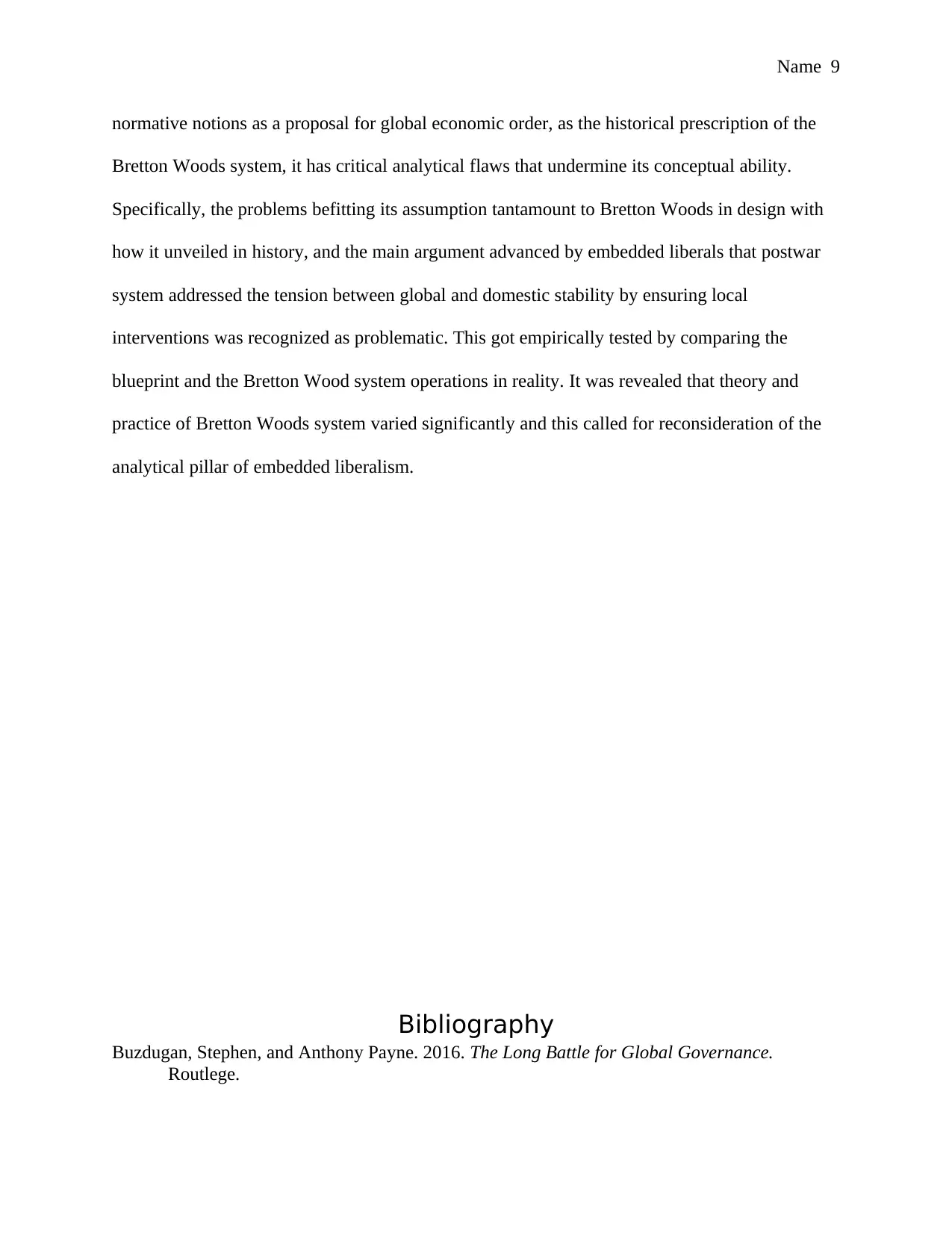
normative notions as a proposal for global economic order, as the historical prescription of the
Bretton Woods system, it has critical analytical flaws that undermine its conceptual ability.
Specifically, the problems befitting its assumption tantamount to Bretton Woods in design with
how it unveiled in history, and the main argument advanced by embedded liberals that postwar
system addressed the tension between global and domestic stability by ensuring local
interventions was recognized as problematic. This got empirically tested by comparing the
blueprint and the Bretton Wood system operations in reality. It was revealed that theory and
practice of Bretton Woods system varied significantly and this called for reconsideration of the
analytical pillar of embedded liberalism.
Bibliography
Buzdugan, Stephen, and Anthony Payne. 2016. The Long Battle for Global Governance.
Routlege.
normative notions as a proposal for global economic order, as the historical prescription of the
Bretton Woods system, it has critical analytical flaws that undermine its conceptual ability.
Specifically, the problems befitting its assumption tantamount to Bretton Woods in design with
how it unveiled in history, and the main argument advanced by embedded liberals that postwar
system addressed the tension between global and domestic stability by ensuring local
interventions was recognized as problematic. This got empirically tested by comparing the
blueprint and the Bretton Wood system operations in reality. It was revealed that theory and
practice of Bretton Woods system varied significantly and this called for reconsideration of the
analytical pillar of embedded liberalism.
Bibliography
Buzdugan, Stephen, and Anthony Payne. 2016. The Long Battle for Global Governance.
Routlege.
⊘ This is a preview!⊘
Do you want full access?
Subscribe today to unlock all pages.
Trusted by 1+ million students worldwide
Name 10
Gonoi, Ikuo, and Hiroaki Ataka. 2005. "Conceptual Relevance of “Embedded Liberalism and its
Critical Social Consequences." ISA-South Annual Conference . Miami: Univeristy of
Warwick. 2-22.
Helleiner, Eric. 2014. International Development and the Making of the Postwar Order”.
Forgotten Foundations of Bretton Woods. Cornell University Press.
Helleiner, Eric. 2019. "The life and times of embedded liberalism:legacies and innovations since
Bretton Woods." Review of International Political Economy 3 (1): 1-24.
Lewis, Meredith Kolsky. 2018. The Embedded Liberalism Compromise in the Making of the
GATT and Uruguay Round Agreements. March 22. Accessed September 25, 2019.
https://papers.ssrn.com/sol3/papers.cfm?abstract_id=3144087.
Ruggie, John G. 1982. "nternational Regimes, Transactions, and Change: Embedded Liberalism
in the Postwar Economic Order." International Organization 36 (2): 379-415.
Spiro, David E. 2012. "Embedded Neo-Mercantilism in the Post-Bretton Woods
Economy:Balance of Payments Adjustment from Petrodollars to Sinodollars." annual
meeting of the International Studies Association. Princeton. 1-25.
Gonoi, Ikuo, and Hiroaki Ataka. 2005. "Conceptual Relevance of “Embedded Liberalism and its
Critical Social Consequences." ISA-South Annual Conference . Miami: Univeristy of
Warwick. 2-22.
Helleiner, Eric. 2014. International Development and the Making of the Postwar Order”.
Forgotten Foundations of Bretton Woods. Cornell University Press.
Helleiner, Eric. 2019. "The life and times of embedded liberalism:legacies and innovations since
Bretton Woods." Review of International Political Economy 3 (1): 1-24.
Lewis, Meredith Kolsky. 2018. The Embedded Liberalism Compromise in the Making of the
GATT and Uruguay Round Agreements. March 22. Accessed September 25, 2019.
https://papers.ssrn.com/sol3/papers.cfm?abstract_id=3144087.
Ruggie, John G. 1982. "nternational Regimes, Transactions, and Change: Embedded Liberalism
in the Postwar Economic Order." International Organization 36 (2): 379-415.
Spiro, David E. 2012. "Embedded Neo-Mercantilism in the Post-Bretton Woods
Economy:Balance of Payments Adjustment from Petrodollars to Sinodollars." annual
meeting of the International Studies Association. Princeton. 1-25.

1 out of 10


Your All-in-One AI-Powered Toolkit for Academic Success.
+13062052269
info@desklib.com
Available 24*7 on WhatsApp / Email
![[object Object]](/_next/static/media/star-bottom.7253800d.svg)
Unlock your academic potential
Copyright © 2020–2025 A2Z Services. All Rights Reserved. Developed and managed by ZUCOL.