Business Leadership: Emirates Airline Financial Analysis and HR Skills
VerifiedAdded on 2022/11/16
|13
|2661
|85
Report
AI Summary
This report presents a financial analysis of Emirates Airline, a prominent multinational airline based in the United Arab Emirates. The report begins with an executive summary and table of contents, followed by an introduction that emphasizes the importance of financial analysis in assessing a business's performance through financial statements. The report provides background information on Emirates, including its founding, operations, and financial highlights from 2018 and 2019. The core of the analysis focuses on key financial ratios, including profitability (gross profit and net profit ratios), solvency (debt-equity and interest coverage ratios), liquidity (current ratio), and turnover ratios (fixed assets and receivable turnover). The report also addresses Emirates' future financial goals, such as capitalizing on global airfreight demand and expanding its services. Furthermore, the report evaluates essential skills required for post-graduation and for a career in the HR department, covering areas like communication, employee relations, and the use of HR software. The conclusion summarizes the findings, highlighting the significance of financial analysis and the required skills for HR professionals.

Running head: SKILL FOR BUSINESS LEADERSHIP
Skill for Business Leadership
Name of the Student
Name of the University
Author’s Note
Skill for Business Leadership
Name of the Student
Name of the University
Author’s Note

Paraphrase This Document
Need a fresh take? Get an instant paraphrase of this document with our AI Paraphraser
1SKILL FOR BUSINESS LEADERSHIP
Executive Summary
This current report has focused on the financial analysis of a United Arab Emirates company
which is Emirates that mainly provides services to the customers. It consist of financial
performances that are recorded by the company in their financial statement which are disclosed
in the annual report of a particular year. Different types of financial ratios have been evaluated
which points out the efficiency of the company. Moreover, it also includes the skills that are
required to work in Hr department.
Executive Summary
This current report has focused on the financial analysis of a United Arab Emirates company
which is Emirates that mainly provides services to the customers. It consist of financial
performances that are recorded by the company in their financial statement which are disclosed
in the annual report of a particular year. Different types of financial ratios have been evaluated
which points out the efficiency of the company. Moreover, it also includes the skills that are
required to work in Hr department.
2SKILL FOR BUSINESS LEADERSHIP
Table of Contents
Introduction......................................................................................................................................3
Task A..............................................................................................................................................3
Background of the company........................................................................................................3
Financial performances................................................................................................................3
Profitability ratio..........................................................................................................................5
Solvency ratio..............................................................................................................................5
Liquidity ratio..............................................................................................................................6
Turnover ratio..............................................................................................................................6
Future financial goals of the business..........................................................................................7
Task B..............................................................................................................................................7
Critically evaluating the skills that requires for post graduation and working in HR department
.....................................................................................................................................................7
Conclusion.......................................................................................................................................8
References........................................................................................................................................9
Appendices....................................................................................................................................11
Table of Contents
Introduction......................................................................................................................................3
Task A..............................................................................................................................................3
Background of the company........................................................................................................3
Financial performances................................................................................................................3
Profitability ratio..........................................................................................................................5
Solvency ratio..............................................................................................................................5
Liquidity ratio..............................................................................................................................6
Turnover ratio..............................................................................................................................6
Future financial goals of the business..........................................................................................7
Task B..............................................................................................................................................7
Critically evaluating the skills that requires for post graduation and working in HR department
.....................................................................................................................................................7
Conclusion.......................................................................................................................................8
References........................................................................................................................................9
Appendices....................................................................................................................................11
⊘ This is a preview!⊘
Do you want full access?
Subscribe today to unlock all pages.

Trusted by 1+ million students worldwide
3SKILL FOR BUSINESS LEADERSHIP
Introduction
Financial analysis is vital for a business as the analysis of the performances is measures
by the financial statement that are prepared by the company. In this study, Emirates have been
taken into consideration which is a multinational airline company based in United Arab
Emirates. Background of the company has been provided along with their financial performances
that points out the financial ratios for the firm. These evaluated ratios mainly focuses on the
liquidity, solvency and other aspects of the business. Moreover, it also includes the skills that are
required for post graduation as well as working in the HR department.
Task A
Background of the company
Emirates is an airline company which is based in Dubai, United Arab Emirates and the
subsidiary company is owned by the investment corporation of Dubai. It is considered as the
largest airline in the area of Middle East and it operates more than 3600 flights in a week. The
company has been founded in the year 1985 and serves more than 161 destinations. Headquarter
of the company is situated in Garhoud, Dubai, United Arab Emirates and Ahmed bin Saeed Al
Makhtoum has been appointed as the Chief Executive Officer of the company (Cdn.ek.aero
2019). In the year 2018, the company has earned around AED 13.3 billion as revenue and AED
62 million as net income for the company.
Financial performances
The company has disclosed their financial statement for extracting the financial
information about the company for a certain period of time. Financial performances are also
measured by the financial statement that are mainly prepared by the management of the firm
Introduction
Financial analysis is vital for a business as the analysis of the performances is measures
by the financial statement that are prepared by the company. In this study, Emirates have been
taken into consideration which is a multinational airline company based in United Arab
Emirates. Background of the company has been provided along with their financial performances
that points out the financial ratios for the firm. These evaluated ratios mainly focuses on the
liquidity, solvency and other aspects of the business. Moreover, it also includes the skills that are
required for post graduation as well as working in the HR department.
Task A
Background of the company
Emirates is an airline company which is based in Dubai, United Arab Emirates and the
subsidiary company is owned by the investment corporation of Dubai. It is considered as the
largest airline in the area of Middle East and it operates more than 3600 flights in a week. The
company has been founded in the year 1985 and serves more than 161 destinations. Headquarter
of the company is situated in Garhoud, Dubai, United Arab Emirates and Ahmed bin Saeed Al
Makhtoum has been appointed as the Chief Executive Officer of the company (Cdn.ek.aero
2019). In the year 2018, the company has earned around AED 13.3 billion as revenue and AED
62 million as net income for the company.
Financial performances
The company has disclosed their financial statement for extracting the financial
information about the company for a certain period of time. Financial performances are also
measured by the financial statement that are mainly prepared by the management of the firm
Paraphrase This Document
Need a fresh take? Get an instant paraphrase of this document with our AI Paraphraser
4SKILL FOR BUSINESS LEADERSHIP
(Tlemsani and Al Suwaidi 2016). Annual report of the business includes all of the financial
statement which mainly consist of income statement, balance sheet and cash flow statement.
Financial performance might be measured by introducing different types of accounting ratios that
mainly measures the financial position of the firm in their targeted market (Charfeddine and
Khediri 2016). Liquidity of the company is totally based on the current assets and current
liabilities of the business which deals with different other factors that might influence the nature
of the business. The external capital of the firm is based on repayment of debts which are to be
associated with financial leverage of the business. Moreover, the financial risk that are directly
associated with the business mainly focuses on the capability of the business to pay off the debts.
Emirates mainly considers their financial risks which are determined in the terms of total debts
as well as the long term debts which are associated with the business (Hassan 2014). Moreover,
accounting ratios are to be evaluated by comparing their performances which points out the
overall strength and weakness of their business for their strategies and plans.
Financial performance of the firm are based on the assets that are associated with the
business which assist in revenue generation of the business. Revenue from operation and total
amount of income is to be measured for measuring the overall performance of Emirates in the
normal course of business (Aljifri et al. 2014). It includes different types of stakeholders which
points out the investors and trade creditors which effectively manages the overall performances
of the company. The financial statement that has already been mentioned in the above part
includes the vital financial information which deals with different aspects of the company. It also
highlights the variance analysis which highlights the actual result that highlights efficiencies of
firm towards their customers. The services that are provided to the customers help in measuring
the performances of the company after adjusting the financial statement (Trabelsi and Trabelsi
(Tlemsani and Al Suwaidi 2016). Annual report of the business includes all of the financial
statement which mainly consist of income statement, balance sheet and cash flow statement.
Financial performance might be measured by introducing different types of accounting ratios that
mainly measures the financial position of the firm in their targeted market (Charfeddine and
Khediri 2016). Liquidity of the company is totally based on the current assets and current
liabilities of the business which deals with different other factors that might influence the nature
of the business. The external capital of the firm is based on repayment of debts which are to be
associated with financial leverage of the business. Moreover, the financial risk that are directly
associated with the business mainly focuses on the capability of the business to pay off the debts.
Emirates mainly considers their financial risks which are determined in the terms of total debts
as well as the long term debts which are associated with the business (Hassan 2014). Moreover,
accounting ratios are to be evaluated by comparing their performances which points out the
overall strength and weakness of their business for their strategies and plans.
Financial performance of the firm are based on the assets that are associated with the
business which assist in revenue generation of the business. Revenue from operation and total
amount of income is to be measured for measuring the overall performance of Emirates in the
normal course of business (Aljifri et al. 2014). It includes different types of stakeholders which
points out the investors and trade creditors which effectively manages the overall performances
of the company. The financial statement that has already been mentioned in the above part
includes the vital financial information which deals with different aspects of the company. It also
highlights the variance analysis which highlights the actual result that highlights efficiencies of
firm towards their customers. The services that are provided to the customers help in measuring
the performances of the company after adjusting the financial statement (Trabelsi and Trabelsi
5SKILL FOR BUSINESS LEADERSHIP
2014). It includes some accounting ratio which have been evaluated according to the financial
information that have been recorded in the annual report of Emirates. Accounting ratios mainly
focuses on the financial performance of an organisation over a certain period of time. The
following part includes some of the accounting ratios which have been evaluated from the
information in the financial statement that are disclosed by the firm over a certain fiscal year.
Profitability ratio
Profitability ratio mainly includes different types of accounting ratios such as gross profit
ratio and net profit ratio that points out the effective relationship among the profit and revenue of
the business. Gross profit ratio highlights the relationship between the gross profit that has been
earned by the company and the total amount of sales within the time period (Sbia, Shahbaz and
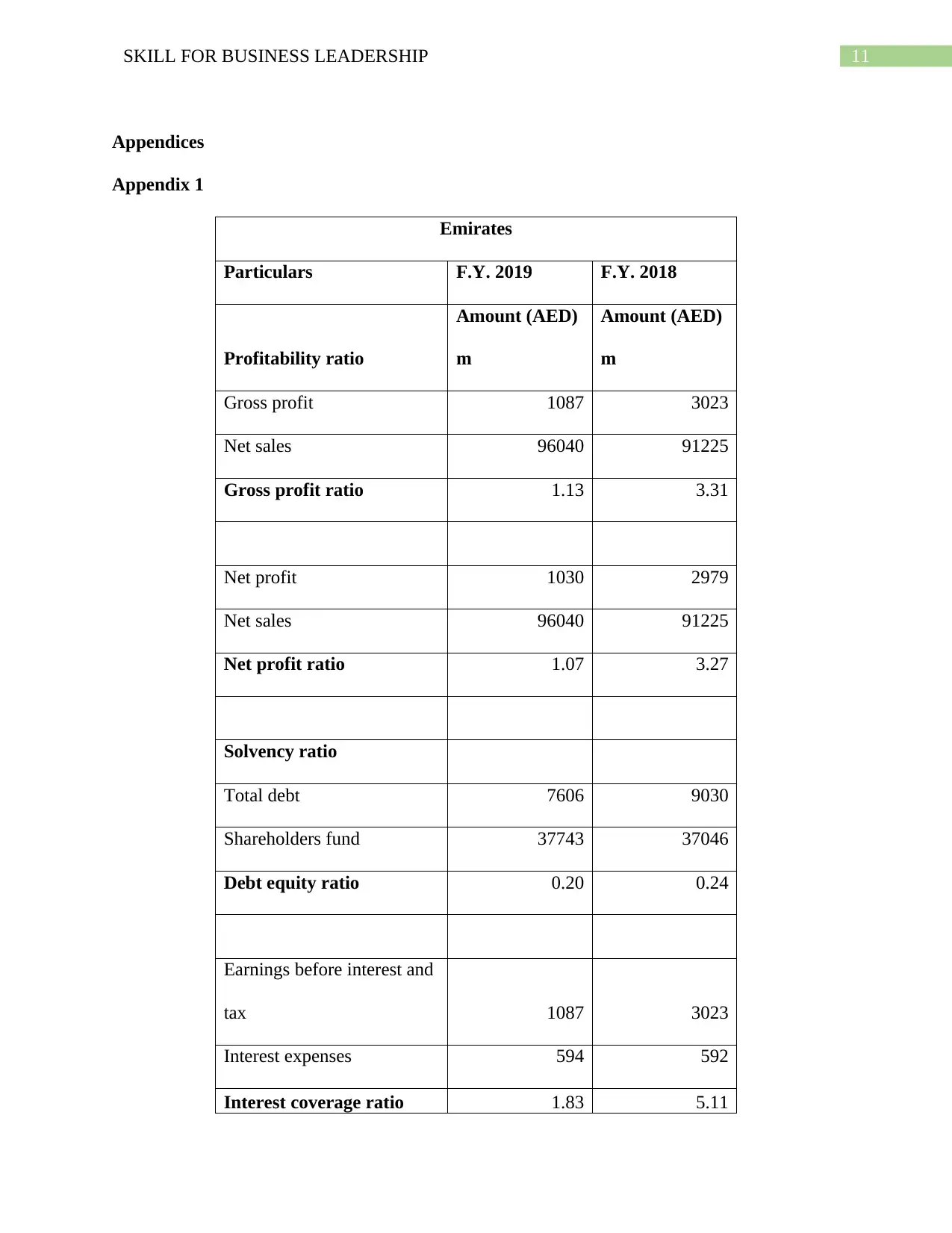
Ozturk 2014). It can be seen that gross profit ratio has been determined around 1.13 % for the
year 2019 and 3.31 % for the year 2018 which points out the slight change in the gross profit
amount. Net profit ratio has decreased in current year which has been 1.07 % in 2019 and 3.27 %
in the year 2018. The higher ratio points out the business for enhancing their performance which
assist in generating their revenue along with providing the profits and cash flow. This particular
ratio mainly analyses the overall comparison that are compared to previous amounts along with
pointing out the overall flow of cash (Refer to Appendix 1).
Solvency ratio
Solvency ratio mainly points out the debts that are taken by the company along with its
ability for paying off the debts. This particular ratio mainly includes debt equity ratio and interest
coverage ratio which mainly shows the overall relationship between the amounts of debts along
with the shareholders fund. This particular ratio has decreased from 3.27 in 2018 to 1.07 in the
year 2019 and it highlights that Emirates has lesser amount of debts within the company. Debt
2014). It includes some accounting ratio which have been evaluated according to the financial
information that have been recorded in the annual report of Emirates. Accounting ratios mainly
focuses on the financial performance of an organisation over a certain period of time. The
following part includes some of the accounting ratios which have been evaluated from the
information in the financial statement that are disclosed by the firm over a certain fiscal year.
Profitability ratio
Profitability ratio mainly includes different types of accounting ratios such as gross profit
ratio and net profit ratio that points out the effective relationship among the profit and revenue of
the business. Gross profit ratio highlights the relationship between the gross profit that has been
earned by the company and the total amount of sales within the time period (Sbia, Shahbaz and
Ozturk 2014). It can be seen that gross profit ratio has been determined around 1.13 % for the
year 2019 and 3.31 % for the year 2018 which points out the slight change in the gross profit
amount. Net profit ratio has decreased in current year which has been 1.07 % in 2019 and 3.27 %
in the year 2018. The higher ratio points out the business for enhancing their performance which
assist in generating their revenue along with providing the profits and cash flow. This particular
ratio mainly analyses the overall comparison that are compared to previous amounts along with
pointing out the overall flow of cash (Refer to Appendix 1).
Solvency ratio
Solvency ratio mainly points out the debts that are taken by the company along with its
ability for paying off the debts. This particular ratio mainly includes debt equity ratio and interest
coverage ratio which mainly shows the overall relationship between the amounts of debts along
with the shareholders fund. This particular ratio has decreased from 3.27 in 2018 to 1.07 in the
year 2019 and it highlights that Emirates has lesser amount of debts within the company. Debt
⊘ This is a preview!⊘
Do you want full access?
Subscribe today to unlock all pages.
Trusted by 1+ million students worldwide
6SKILL FOR BUSINESS LEADERSHIP
obligation in interest expenses provides smooth functions for the operation of Emirates in their
business activities (Muhammad Siddique 2015). Interest expenses along with earnings before
interest and tax is to be evaluated before the cost which have been incurred during the financial
year. This ratio has decreased from 0.24 in 2018 to 0.20 in the year 2019 and it means that
Emirates has the capability of covering the interest expenses. This mainly shows the ability of
the company for meeting its long term debts along with quantifies the overall size of the
company (Refer to Appendix 1).
Liquidity ratio
Liquidity ratio is the type of ratio which mainly points out the assets and liabilities of the
firm in a certain financial year. This ratio consist of current ratio which evaluates the effective
relationship between the current assets and current liabilities of the business (Shahwan 2015). It
can be seen that this ratio has slightly increased from 0.82 in 2018 to 0.83 in the year 2019 and it
means that Emirates has the ability to pay off their debts. This particular ratio mainly affects the
credibility of the firm along with credit rating. It plays an important role with the financial
stability along with repayment of short term liability (Refer to Appendix 1).
Turnover ratio
The relationship between the assets and liabilities along with revenue generation is
mainly pointed by this particular ration in an organisation (Abduh and Othman 2014). Fixed
assets turnover ratio has increased in current year from 1.06 in 2018 to 1.10 in the year 2019.
Moreover, receivable turnover ratio has increased from 8.58 in 2018 to 8.93 in the year 2019 and
it means that Emirates has increased their average receivables within a period of one financial
year (Refer to Appendix 1).
obligation in interest expenses provides smooth functions for the operation of Emirates in their
business activities (Muhammad Siddique 2015). Interest expenses along with earnings before
interest and tax is to be evaluated before the cost which have been incurred during the financial
year. This ratio has decreased from 0.24 in 2018 to 0.20 in the year 2019 and it means that
Emirates has the capability of covering the interest expenses. This mainly shows the ability of
the company for meeting its long term debts along with quantifies the overall size of the
company (Refer to Appendix 1).
Liquidity ratio
Liquidity ratio is the type of ratio which mainly points out the assets and liabilities of the
firm in a certain financial year. This ratio consist of current ratio which evaluates the effective
relationship between the current assets and current liabilities of the business (Shahwan 2015). It
can be seen that this ratio has slightly increased from 0.82 in 2018 to 0.83 in the year 2019 and it
means that Emirates has the ability to pay off their debts. This particular ratio mainly affects the
credibility of the firm along with credit rating. It plays an important role with the financial
stability along with repayment of short term liability (Refer to Appendix 1).
Turnover ratio
The relationship between the assets and liabilities along with revenue generation is
mainly pointed by this particular ration in an organisation (Abduh and Othman 2014). Fixed
assets turnover ratio has increased in current year from 1.06 in 2018 to 1.10 in the year 2019.
Moreover, receivable turnover ratio has increased from 8.58 in 2018 to 8.93 in the year 2019 and
it means that Emirates has increased their average receivables within a period of one financial
year (Refer to Appendix 1).
Paraphrase This Document
Need a fresh take? Get an instant paraphrase of this document with our AI Paraphraser
7SKILL FOR BUSINESS LEADERSHIP
Future financial goals of the business
The annual report of the company for the financial year 2019 has been released by the
company which states some of the financial goals that would be achieved in future years. The
demand of global airfreight has increased which has been identified by the management of the
company along with declaring certain amount of dividend to the shareholders. Each business
cycle has to work hard for facing the challenges which takes advantages for the opportunities
(Zarrouk, El Ghak and Abu Al Haija 2017). Growth across the business which are invested in the
infrastructure is to be secured for the success in the future years. In future years, Emirates has
decided to acquire few more aircraft which would provide better service to the customers.
Emirates has also launched three different passenger destinations which would provide better
service to the customers along with enhance their business objectives for upcoming years. The
company is planning to make certain partnership to provide flight services to local people by
providing local destination planes.
Task B
Critically evaluating the skills that requires for post graduation and working in HR
department
Different types of skills are required for the post graduation and working in a HR
department which consist of better communications skills and other technical skills. Employee
relation is the skill which is to be acquired for working in HR department of an organisation
(Peopleprofession.cipd.org 2019). In recent years, different types of software are present which
has to be considered by the candidate for working in HR department. Human resource
information software points out the intersection of human resources and information that helps in
handling the activities in a better way. The profession of future for working in HR department
Future financial goals of the business
The annual report of the company for the financial year 2019 has been released by the
company which states some of the financial goals that would be achieved in future years. The
demand of global airfreight has increased which has been identified by the management of the
company along with declaring certain amount of dividend to the shareholders. Each business
cycle has to work hard for facing the challenges which takes advantages for the opportunities
(Zarrouk, El Ghak and Abu Al Haija 2017). Growth across the business which are invested in the
infrastructure is to be secured for the success in the future years. In future years, Emirates has
decided to acquire few more aircraft which would provide better service to the customers.
Emirates has also launched three different passenger destinations which would provide better
service to the customers along with enhance their business objectives for upcoming years. The
company is planning to make certain partnership to provide flight services to local people by
providing local destination planes.
Task B
Critically evaluating the skills that requires for post graduation and working in HR
department
Different types of skills are required for the post graduation and working in a HR
department which consist of better communications skills and other technical skills. Employee
relation is the skill which is to be acquired for working in HR department of an organisation
(Peopleprofession.cipd.org 2019). In recent years, different types of software are present which
has to be considered by the candidate for working in HR department. Human resource
information software points out the intersection of human resources and information that helps in
handling the activities in a better way. The profession of future for working in HR department
8SKILL FOR BUSINESS LEADERSHIP
requires special knowledge which mainly deals with human resources that highlights strong
foundation of decision making. The experience of the employees and relations mainly points out
the diversification which analyses the people in the company. Human resource managers
highlights the resources as per opportunities along with making certain positive impact within
the work. Talent management is also another aspect which is to be considered for working in HR
department. Post graduation also requires certain skills which has to be acquired for achieving
the course and working for an organisation requires certain talents which has to be balancing the
economy. Work that are good in nature provides the long term benefits for the individuals and
society along with balancing the economic sustainability as well as social accountability
(Peopleprofession.cipd.org 2019). Therefore, these are the skills that are required for post
graduation as well as working in HR depart of an organisation.
Conclusion
It can be concluded from above study that, financial analysis mainly points out the
financial performance which are to be derived from their published financial statement. Financial
performance might be measured by introducing different types of accounting ratios that mainly
measures the financial position of the firm in their targeted market. It includes different types of
decision which are to be implemented by the management of the firm along with measuring the
financial performance. Both the financial analysis and the required skills for working in HR
department has been mentioned in the study that points certain skills which are to be acquired.
requires special knowledge which mainly deals with human resources that highlights strong
foundation of decision making. The experience of the employees and relations mainly points out
the diversification which analyses the people in the company. Human resource managers
highlights the resources as per opportunities along with making certain positive impact within
the work. Talent management is also another aspect which is to be considered for working in HR
department. Post graduation also requires certain skills which has to be acquired for achieving
the course and working for an organisation requires certain talents which has to be balancing the
economy. Work that are good in nature provides the long term benefits for the individuals and
society along with balancing the economic sustainability as well as social accountability
(Peopleprofession.cipd.org 2019). Therefore, these are the skills that are required for post
graduation as well as working in HR depart of an organisation.
Conclusion
It can be concluded from above study that, financial analysis mainly points out the
financial performance which are to be derived from their published financial statement. Financial
performance might be measured by introducing different types of accounting ratios that mainly
measures the financial position of the firm in their targeted market. It includes different types of
decision which are to be implemented by the management of the firm along with measuring the
financial performance. Both the financial analysis and the required skills for working in HR
department has been mentioned in the study that points certain skills which are to be acquired.
⊘ This is a preview!⊘
Do you want full access?
Subscribe today to unlock all pages.
Trusted by 1+ million students worldwide
9SKILL FOR BUSINESS LEADERSHIP
References
Abduh, M. and Othman, A.A., 2014. Service quality evaluation of Islamic banks in UAE: an
importance-performance analysis approach. Journal of Islamic Economics, Banking and
Finance, 113(3199), pp.1-11.
Aljifri, K., Alzarouni, A., Ng, C. and Tahir, M.I., 2014. The association between firm
characteristics and corporate financial disclosures: evidence from UAE companies. The
International Journal of Business and Finance Research, 8(2), pp.101-123.
Cdn.ek.aero (2019). The Emirates Group Annual Report. Available at:
https://cdn.ek.aero/downloads/ek/pdfs/report/annual_report_2019.pdf [Accessed on 18 October
2019]
Charfeddine, L. and Khediri, K.B., 2016. Financial development and environmental quality in
UAE: Cointegration with structural breaks. Renewable and Sustainable Energy Reviews, 55,
pp.1322-1335.
Hassan, M.K., 2014. Risk narrative disclosure strategies to enhance organizational legitimacy:
Evidence from UAE financial institutions. International Journal of disclosure and
Governance, 11(1), pp.1-17.
Muhammad Siddique, C., 2015. A Comparative Study of Strategic Planning Practices of SMEs
and Large‐Sized Business Organizations in Emerging Economies: The Case of UAE. Strategic
Change, 24(6), pp.553-567.
Peopleprofession.cipd.org (2019). Profession for the Future. Available at:
https://peopleprofession.cipd.org/profession-map [Accessed on 17 October 2019]
References
Abduh, M. and Othman, A.A., 2014. Service quality evaluation of Islamic banks in UAE: an
importance-performance analysis approach. Journal of Islamic Economics, Banking and
Finance, 113(3199), pp.1-11.
Aljifri, K., Alzarouni, A., Ng, C. and Tahir, M.I., 2014. The association between firm
characteristics and corporate financial disclosures: evidence from UAE companies. The
International Journal of Business and Finance Research, 8(2), pp.101-123.
Cdn.ek.aero (2019). The Emirates Group Annual Report. Available at:
https://cdn.ek.aero/downloads/ek/pdfs/report/annual_report_2019.pdf [Accessed on 18 October
2019]
Charfeddine, L. and Khediri, K.B., 2016. Financial development and environmental quality in
UAE: Cointegration with structural breaks. Renewable and Sustainable Energy Reviews, 55,
pp.1322-1335.
Hassan, M.K., 2014. Risk narrative disclosure strategies to enhance organizational legitimacy:
Evidence from UAE financial institutions. International Journal of disclosure and
Governance, 11(1), pp.1-17.
Muhammad Siddique, C., 2015. A Comparative Study of Strategic Planning Practices of SMEs
and Large‐Sized Business Organizations in Emerging Economies: The Case of UAE. Strategic
Change, 24(6), pp.553-567.
Peopleprofession.cipd.org (2019). Profession for the Future. Available at:
https://peopleprofession.cipd.org/profession-map [Accessed on 17 October 2019]
Paraphrase This Document
Need a fresh take? Get an instant paraphrase of this document with our AI Paraphraser
10SKILL FOR BUSINESS LEADERSHIP
Sbia, R., Shahbaz, M. and Ozturk, I., 2017. Economic growth, financial development,
urbanisation and electricity consumption nexus in UAE. Economic research-Ekonomska
istraživanja, 30(1), pp.527-549.
Shahwan, T.M., 2015. The effects of corporate governance on financial performance and
financial distress: evidence from Egypt. Corporate Governance, 15(5), pp.641-662.
Tlemsani, I. and Al Suwaidi, H., 2016. Comparative analysis of Islamic and conventional banks
in the UAE during the financial crisis. Asian Economic and Financial Review, 6(6), p.298.
Trabelsi, N.S. and Trabelsi, M., 2014. The value relevance of IFRS in the UAE banking industry:
Empirical evidence from Dubai financial market, 2008-2013. International Journal of Academic
Research in Accounting, Finance and Management Sciences, 4(4), pp.60-71.
Zarrouk, H., El Ghak, T. and Abu Al Haija, E., 2017. Financial development, Islamic finance
and economic growth: evidence of the UAE. Journal of Islamic Accounting and Business
Research, 8(1), pp.2-22.
Sbia, R., Shahbaz, M. and Ozturk, I., 2017. Economic growth, financial development,
urbanisation and electricity consumption nexus in UAE. Economic research-Ekonomska
istraživanja, 30(1), pp.527-549.
Shahwan, T.M., 2015. The effects of corporate governance on financial performance and
financial distress: evidence from Egypt. Corporate Governance, 15(5), pp.641-662.
Tlemsani, I. and Al Suwaidi, H., 2016. Comparative analysis of Islamic and conventional banks
in the UAE during the financial crisis. Asian Economic and Financial Review, 6(6), p.298.
Trabelsi, N.S. and Trabelsi, M., 2014. The value relevance of IFRS in the UAE banking industry:
Empirical evidence from Dubai financial market, 2008-2013. International Journal of Academic
Research in Accounting, Finance and Management Sciences, 4(4), pp.60-71.
Zarrouk, H., El Ghak, T. and Abu Al Haija, E., 2017. Financial development, Islamic finance
and economic growth: evidence of the UAE. Journal of Islamic Accounting and Business
Research, 8(1), pp.2-22.
11SKILL FOR BUSINESS LEADERSHIP
Appendices
Appendix 1
Emirates
Particulars F.Y. 2019 F.Y. 2018
Profitability ratio
Amount (AED)
m
Amount (AED)
m
Gross profit 1087 3023
Net sales 96040 91225
Gross profit ratio 1.13 3.31
Net profit 1030 2979
Net sales 96040 91225
Net profit ratio 1.07 3.27
Solvency ratio
Total debt 7606 9030
Shareholders fund 37743 37046
Debt equity ratio 0.20 0.24
Earnings before interest and
tax 1087 3023
Interest expenses 594 592
Interest coverage ratio 1.83 5.11
Appendices
Appendix 1
Emirates
Particulars F.Y. 2019 F.Y. 2018
Profitability ratio
Amount (AED)
m
Amount (AED)
m
Gross profit 1087 3023
Net sales 96040 91225
Gross profit ratio 1.13 3.31
Net profit 1030 2979
Net sales 96040 91225
Net profit ratio 1.07 3.27
Solvency ratio
Total debt 7606 9030
Shareholders fund 37743 37046
Debt equity ratio 0.20 0.24
Earnings before interest and
tax 1087 3023
Interest expenses 594 592
Interest coverage ratio 1.83 5.11
⊘ This is a preview!⊘
Do you want full access?
Subscribe today to unlock all pages.
Trusted by 1+ million students worldwide

1 out of 13


Related Documents


Your All-in-One AI-Powered Toolkit for Academic Success.
+13062052269
info@desklib.com
Available 24*7 on WhatsApp / Email
![[object Object]](/_next/static/media/star-bottom.7253800d.svg)
Unlock your academic potential
Copyright © 2020–2026 A2Z Services. All Rights Reserved. Developed and managed by ZUCOL.