Analysis of Emirates Group: Business Economics & Strategy

Verified

Added on  2022/08/19

|9
|1498
|23
Report
AI Summary
This report provides a comprehensive analysis of the Emirates Group, focusing on its approach to scarce resources, revenue generation, pricing strategies, cost structure, and the dynamics of demand. The analysis delves into the airline's resource management, identifying both tangible and intangible assets, and highlights the challenges associated with talent acquisition. The report examines Emirates Group's diverse pricing techniques, catering to various customer segments, and suggests competitive pricing strategies. It assesses the company's revenue growth strategies, including customer retention methods, while also addressing the associated revenue losses. Furthermore, the report scrutinizes the cost structure of Emirates Group, particularly its efforts to reduce unit costs and the impact of fuel expenses. Recommendations are provided throughout to enhance the airline's performance, including suggestions for broader hiring practices, competitive pricing, and strategies to mitigate revenue losses and manage costs effectively. The report concludes by emphasizing the need for cost reduction and competitive pricing to boost sales and customer retention.

Document Page
Running head: BUSINESS ECONOMICS & ANALYSIS
Business Economics & Analysis
Name of the Student:
Name of the University:
Author Note
tabler-icon-diamond-filled.svg

Paraphrase This Document

Need a fresh take? Get an instant paraphrase of this document with our AI Paraphraser
Document Page
1
BUSINESS ECONOMICS & ANALYSIS
Table of Contents
Introduction................................................................................................................................2
Discussion..................................................................................................................................2
Management of the scarce resources......................................................................................2
Recommendation....................................................................................................................3
Pricing Strategy of Emirates Group.......................................................................................3
Recommendation....................................................................................................................3
Revenue growth strategy........................................................................................................3
Recommendation....................................................................................................................4
Cost Structure of Emirates Group..........................................................................................4
Recommendation....................................................................................................................4
Demand for Emirates Airlines...............................................................................................5
Recommendation....................................................................................................................5
Conclusion..................................................................................................................................5
Reference....................................................................................................................................6
Document Page
2
BUSINESS ECONOMICS & ANALYSIS
Introduction
This study will provide an analysis of the aviation company Emirates Group based on
its treatment of the scarce resources, revenue, demand, cost structure and pricing strategy.
Emirates Group is owned by the government of Dubai. Emirates Group is present globally
throughout the world. Emirates Group is the owner of DNATA and Emirates Airline.
DNATA provides services for the ground level for many different airports. Emirates Airline
is one of the big giants in the airline industry. This study will then recommend ways in which
Emirates Group may try and improve their company. These ways will help Emirates Group to
make their business better.
Discussion
Management of the scarce resources
Emirates Group uses two types of resources for its organization that is tangible and
intangible (Wanke and Barros 2017). The intangible resources for Emirates Group are the
staff or the employees that work for the company and the time in which they complete their
processes (Liu Zhai and Chen 2019). The tangible resources for Emirates Group are the
technology and finances. Emirates Group uses a robust resource management technique to
manage its scarce resources. There are some resources that are found to be limited to the
Emirates Group. One of the limited resources that lead to issues for Emirates Group is the
staff or the employees of the company. Emirates Group faces the problem of getting the
appropriate talent for the different job roles within the organization. Emirates Group mostly
hires its employees from the UAE region itself. To solve this problem, Emirates Group has
designed a hiring department for its different job roles.
Document Page
3
BUSINESS ECONOMICS & ANALYSIS
Recommendation
Emirates Group must hire from a broader range to get better talents and more
employees for the various job roles it has. Emirates Group being a global company, must
employ for each of the individual companies that the company is operating in.
Pricing Strategy of Emirates Group
Emirates Group uses a totally diverse pricing technique. The price is set in such a way
that it satisfies the needs of all types of customers (Riebsame 2019). It has set different rates
and services for its high paying customers. These customers go for the luxury that is provided
in their travel. Only the wealthiest people in the society can afford to travel for this price.
During the time when people travel, fewer Emirates Group uses different types of attractive
offers to drag the attention of customers (Kung and Zhong 2017). Emirates Group has
designed prices for the lower sections of the customers as well. Emirates Group had also
started a package that is beneficial for the children. Parents travelling with two children will
receive this benefit. The children would be given free tickets, food and some other services.
tabler-icon-diamond-filled.svg

Paraphrase This Document

Need a fresh take? Get an instant paraphrase of this document with our AI Paraphraser
Document Page
4
BUSINESS ECONOMICS & ANALYSIS
Recommendation
Emirates Group must use a competitive pricing technique to compete in the market. In
this type of pricing technique, the price of the tickets is set based on the price of the tickets of
the competitors of Emirates Group.
Revenue growth strategy
Emirates Group concentrates on retention of its customers from one year to the next
year (Kienzler and Kowalkowski 2017). To retain the customers, Emirates Group provides
different discounts and offers to the market. But in this process, Emirates Group loses some
of its revenues that it could have earned (Kireyev, Kumar and Ofek 2017). Also, the some of
the customers may not remain loyal to Emirates Group even after receiving such discounts
and offers. The lower end customers of Emirates Group look for the best price or the best
offer that is being provided to them. Emirates Group can retain about 79% of its customers
every year. But this costs the company a significant percentage of its revenue or in other
words, declines its business to a certain extent.
Recommendation
Emirates Group must use different techniques to cover the losses in the revenues.
Emirates Group may increase its services to its high end customers and increase its ticket
prices for those services. This type of customers are ones who don’t look for lower prices but
for luxury.
Document Page
5
BUSINESS ECONOMICS & ANALYSIS
Cost Structure of Emirates Group
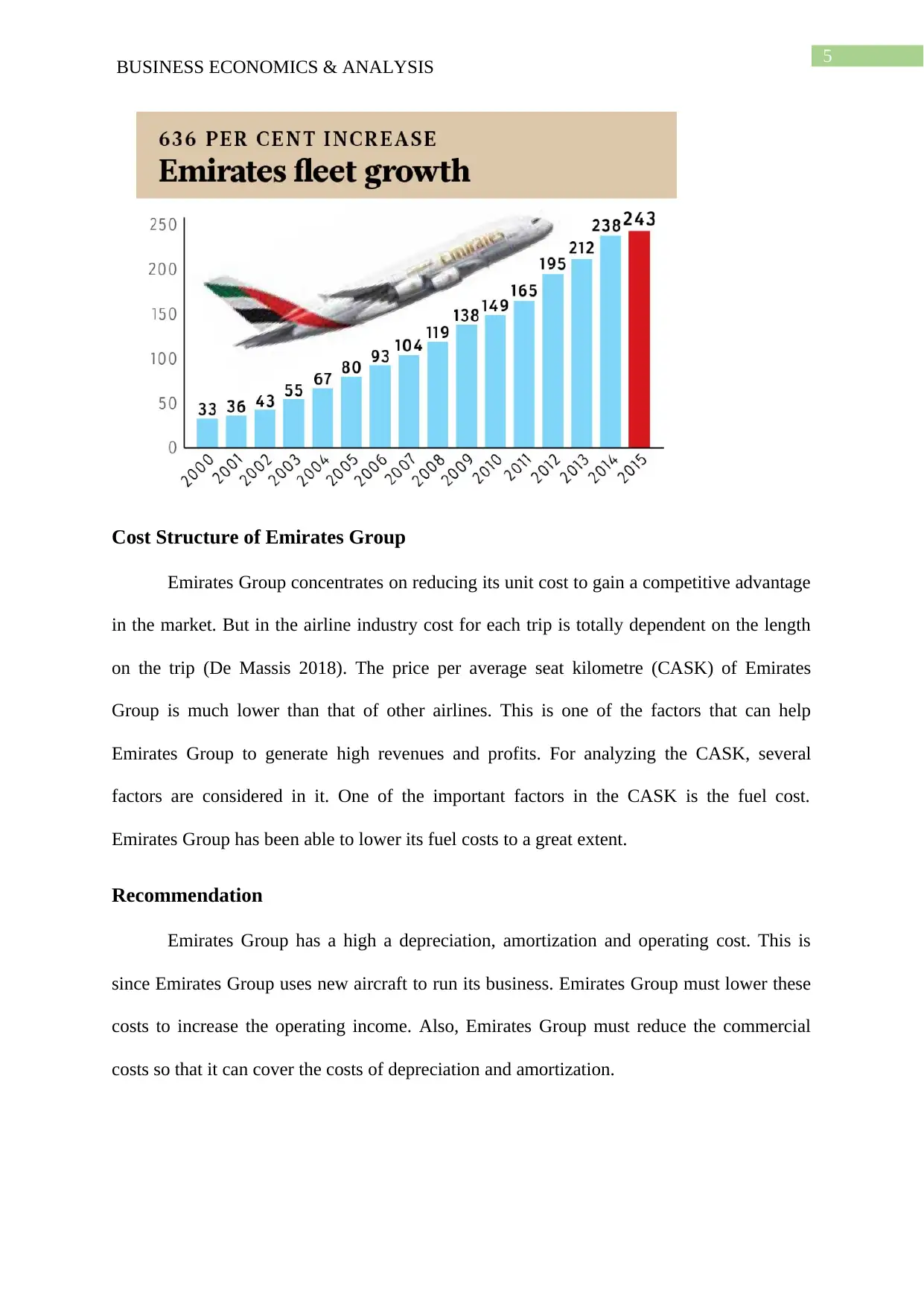
Emirates Group concentrates on reducing its unit cost to gain a competitive advantage
in the market. But in the airline industry cost for each trip is totally dependent on the length
on the trip (De Massis 2018). The price per average seat kilometre (CASK) of Emirates
Group is much lower than that of other airlines. This is one of the factors that can help
Emirates Group to generate high revenues and profits. For analyzing the CASK, several
factors are considered in it. One of the important factors in the CASK is the fuel cost.
Emirates Group has been able to lower its fuel costs to a great extent.
Recommendation
Emirates Group has a high a depreciation, amortization and operating cost. This is
since Emirates Group uses new aircraft to run its business. Emirates Group must lower these
costs to increase the operating income. Also, Emirates Group must reduce the commercial
costs so that it can cover the costs of depreciation and amortization.
Document Page
6
BUSINESS ECONOMICS & ANALYSIS
Demand for Emirates Airlines
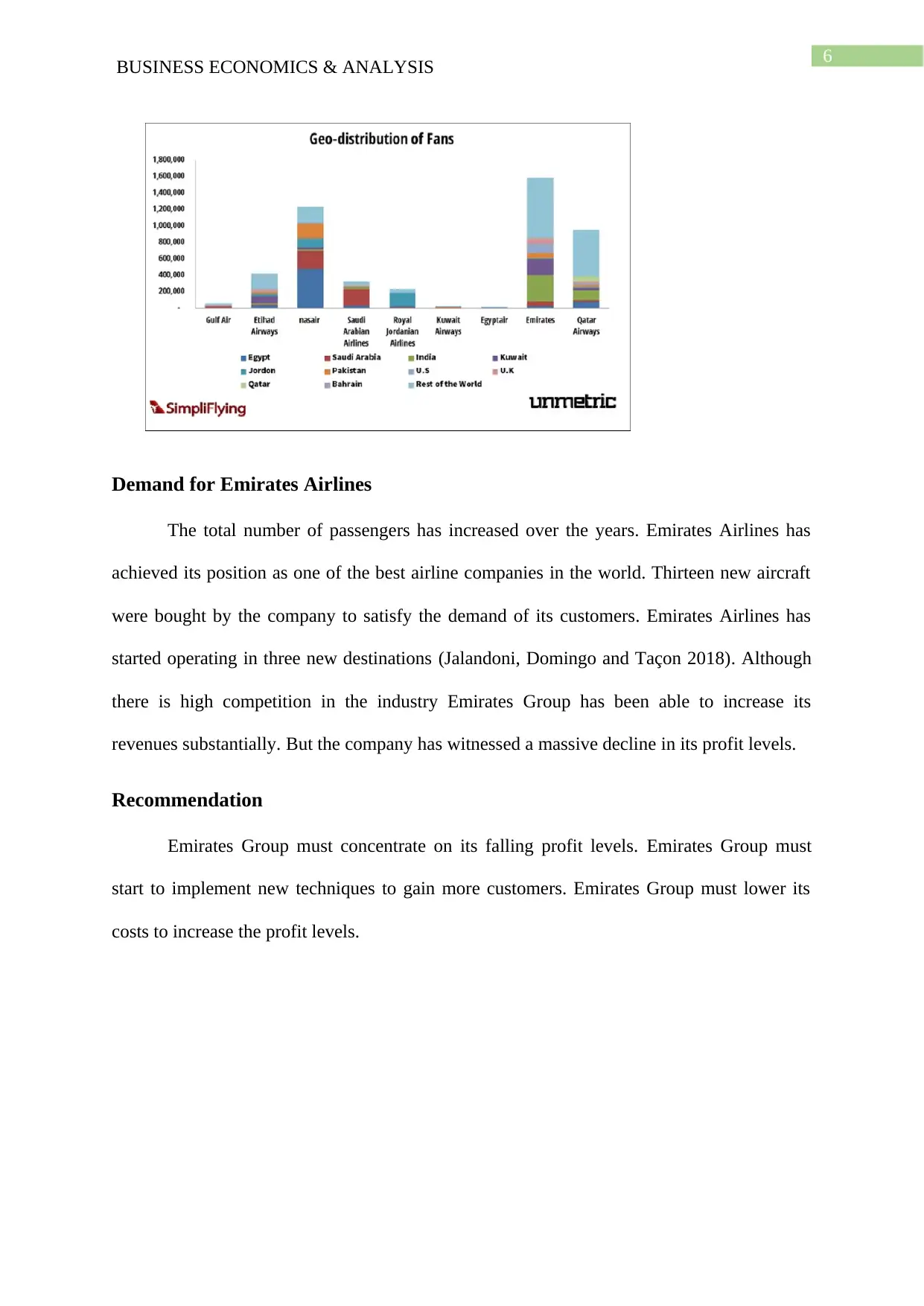
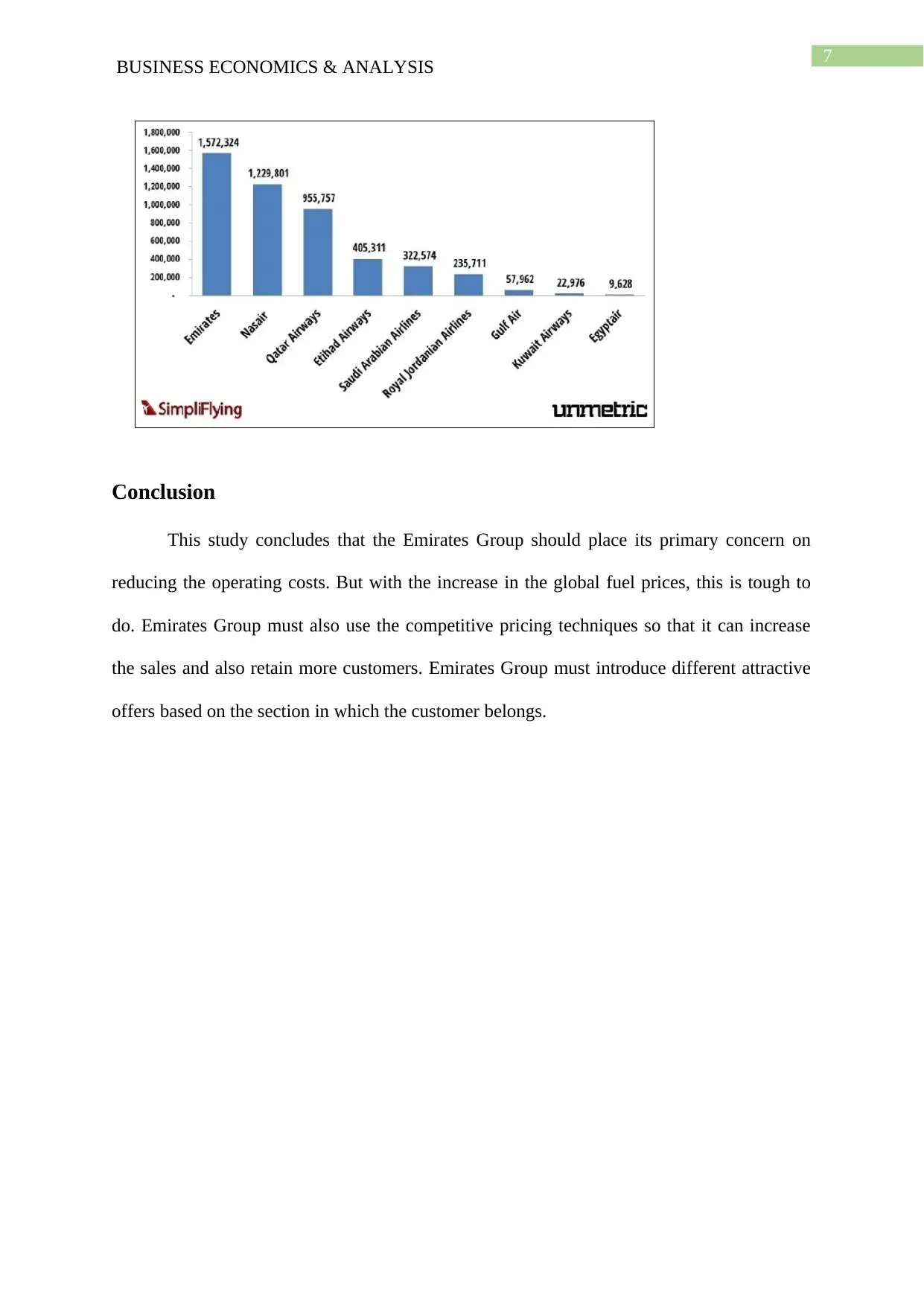
The total number of passengers has increased over the years. Emirates Airlines has
achieved its position as one of the best airline companies in the world. Thirteen new aircraft
were bought by the company to satisfy the demand of its customers. Emirates Airlines has
started operating in three new destinations (Jalandoni, Domingo and Taçon 2018). Although
there is high competition in the industry Emirates Group has been able to increase its
revenues substantially. But the company has witnessed a massive decline in its profit levels.
Recommendation
Emirates Group must concentrate on its falling profit levels. Emirates Group must
start to implement new techniques to gain more customers. Emirates Group must lower its
costs to increase the profit levels.
tabler-icon-diamond-filled.svg

Paraphrase This Document

Need a fresh take? Get an instant paraphrase of this document with our AI Paraphraser
Document Page
7
BUSINESS ECONOMICS & ANALYSIS
Conclusion
This study concludes that the Emirates Group should place its primary concern on
reducing the operating costs. But with the increase in the global fuel prices, this is tough to
do. Emirates Group must also use the competitive pricing techniques so that it can increase
the sales and also retain more customers. Emirates Group must introduce different attractive
offers based on the section in which the customer belongs.
Document Page
8
BUSINESS ECONOMICS & ANALYSIS
Reference
De Massis, A., Audretsch, D., Uhlaner, L. and Kammerlander, N., 2018. Innovation with
Limited Resources: Management Lessons from the G erman M ittelstand. Journal of Product
Innovation Management, 35(1), pp.125-146.
Jalandoni, A., Domingo, I. and Taçon, P.S., 2018. Testing the value of low-cost Structure-
from-Motion (SfM) photogrammetry for metric and visual analysis of rock art. Journal of
Archaeological Science: Reports, 17, pp.605-616.
Kienzler, M. and Kowalkowski, C., 2017. Pricing strategy: A review of 22 years of marketing
research. Journal of Business Research, 78, pp.101-110.
Kireyev, P., Kumar, V. and Ofek, E., 2017. Match your own price? Self-matching as a
retailer’s multichannel pricing strategy. Marketing Science, 36(6), pp.908-930.
Kung, L.C. and Zhong, G.Y., 2017. The optimal pricing strategy for two-sided platform
delivery in the sharing economy. Transportation Research Part E: Logistics and
Transportation Review, 101, pp.1-12.
Liu, J., Zhai, X. and Chen, L., 2019. Optimal pricing strategy under trade-in program in the
presence of strategic consumers. Omega, 84, pp.1-17.
Riebsame, W.E., 2019. Drought and natural resources management in the United States:
impacts and implications of the 1987-89 drought. Routledge.
Wanke, P. and Barros, C.P., 2017. Efficiency thresholds and cost structure in Senegal
airports. Journal of Air Transport Management, 58, pp.100-112.
chevron_up_icon
1 out of 9
circle_padding
hide_on_mobile
zoom_out_icon
[object Object]