Leadership and Management Diploma: Emotional Intelligence Report
VerifiedAdded on 2022/11/15
|28
|9887
|78
Report
AI Summary
This assessment report, prepared for the Diploma of Leadership and Management course (BSB51918) and focusing on the unit BSBLDR511 (Develop and use emotional intelligence), evaluates a student's understanding of emotional intelligence (EI) concepts. The report encompasses both written responses and an emotional intelligence analysis, addressing key areas such as defining EI, its application in managing businesses and building workplace relationships, and effective communication strategies. The analysis delves into the student's strengths and weaknesses, stressors, and emotional triggers, alongside self-reflection and feedback. It also covers adapting to cultural expressions of emotions, fostering a positive emotional climate, and applying Maslow's hierarchy. The assessment concludes with a role-play component to assess practical application. The goal is to assess the student's ability to use emotional intelligence to enhance team performance, build productive relationships, and achieve organizational objectives, with a total of 100 marks allocated across various components.
T-1.8.1_v3
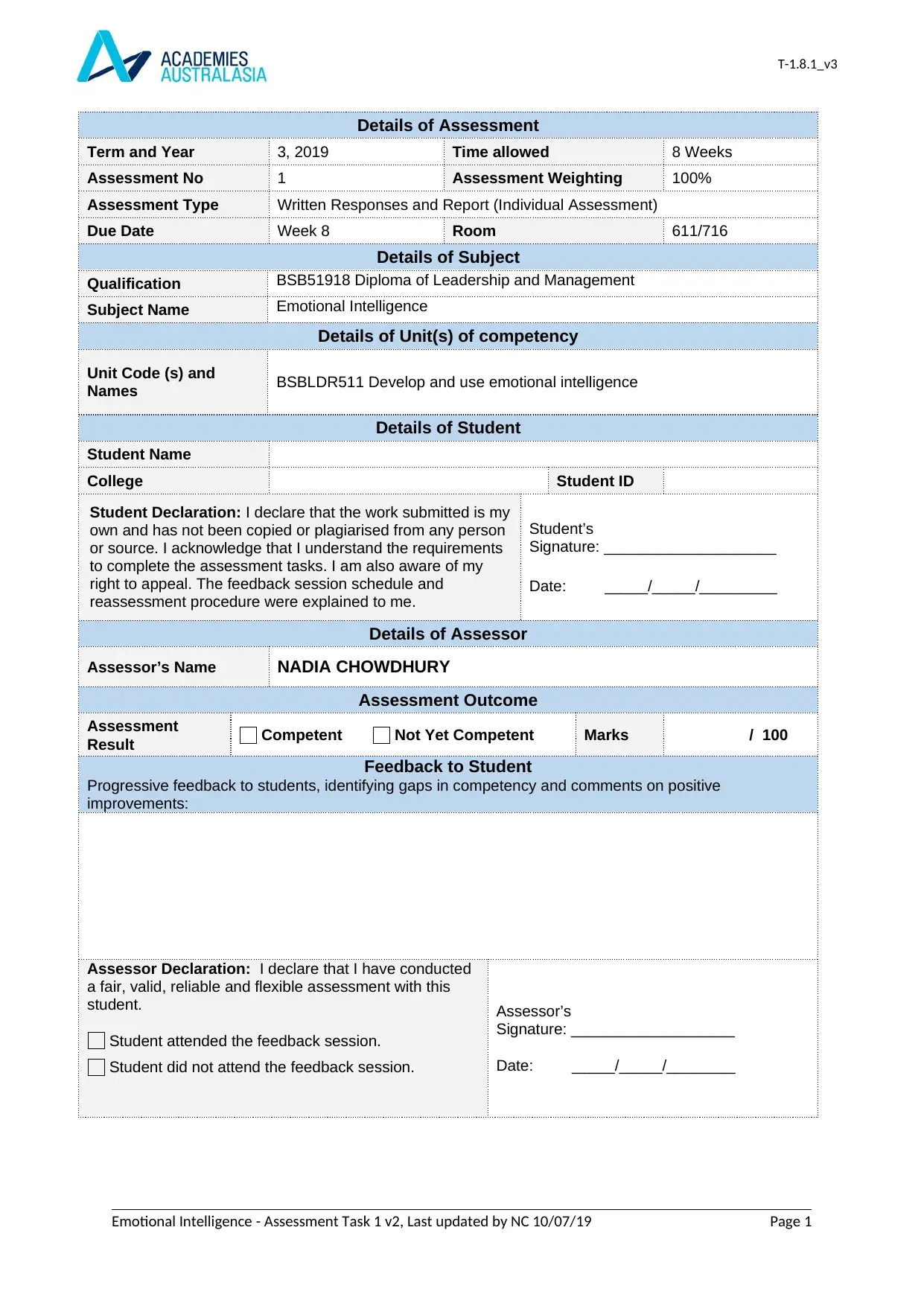
Details of Assessment
Term and Year 3, 2019 Time allowed 8 Weeks
Assessment No 1 Assessment Weighting 100%
Assessment Type Written Responses and Report (Individual Assessment)
Due Date Week 8 Room 611/716
Details of Subject
Qualification BSB51918 Diploma of Leadership and Management
Subject Name Emotional Intelligence
Details of Unit(s) of competency
Unit Code (s) and
Names BSBLDR511 Develop and use emotional intelligence
Details of Student
Student Name
College Student ID
Student Declaration: I declare that the work submitted is my
own and has not been copied or plagiarised from any person
or source. I acknowledge that I understand the requirements
to complete the assessment tasks. I am also aware of my
right to appeal. The feedback session schedule and
reassessment procedure were explained to me.
Student’s
Signature: ____________________
Date: _____/_____/_________
Details of Assessor
Assessor’s Name NADIA CHOWDHURY
Assessment Outcome
Assessment
Result Competent Not Yet Competent Marks / 100
Feedback to Student
Progressive feedback to students, identifying gaps in competency and comments on positive
improvements:
Assessor Declaration: I declare that I have conducted
a fair, valid, reliable and flexible assessment with this
student.
Student attended the feedback session.
Student did not attend the feedback session.
Assessor’s
Signature: ___________________
Date: _____/_____/________
Emotional Intelligence - Assessment Task 1 v2, Last updated by NC 10/07/19 Page 1
Details of Assessment
Term and Year 3, 2019 Time allowed 8 Weeks
Assessment No 1 Assessment Weighting 100%
Assessment Type Written Responses and Report (Individual Assessment)
Due Date Week 8 Room 611/716
Details of Subject
Qualification BSB51918 Diploma of Leadership and Management
Subject Name Emotional Intelligence
Details of Unit(s) of competency
Unit Code (s) and
Names BSBLDR511 Develop and use emotional intelligence
Details of Student
Student Name
College Student ID
Student Declaration: I declare that the work submitted is my
own and has not been copied or plagiarised from any person
or source. I acknowledge that I understand the requirements
to complete the assessment tasks. I am also aware of my
right to appeal. The feedback session schedule and
reassessment procedure were explained to me.
Student’s
Signature: ____________________
Date: _____/_____/_________
Details of Assessor
Assessor’s Name NADIA CHOWDHURY
Assessment Outcome
Assessment
Result Competent Not Yet Competent Marks / 100
Feedback to Student
Progressive feedback to students, identifying gaps in competency and comments on positive
improvements:
Assessor Declaration: I declare that I have conducted
a fair, valid, reliable and flexible assessment with this
student.
Student attended the feedback session.
Student did not attend the feedback session.
Assessor’s
Signature: ___________________
Date: _____/_____/________
Emotional Intelligence - Assessment Task 1 v2, Last updated by NC 10/07/19 Page 1

Paraphrase This Document
Need a fresh take? Get an instant paraphrase of this document with our AI Paraphraser
T-1.8.1_v3
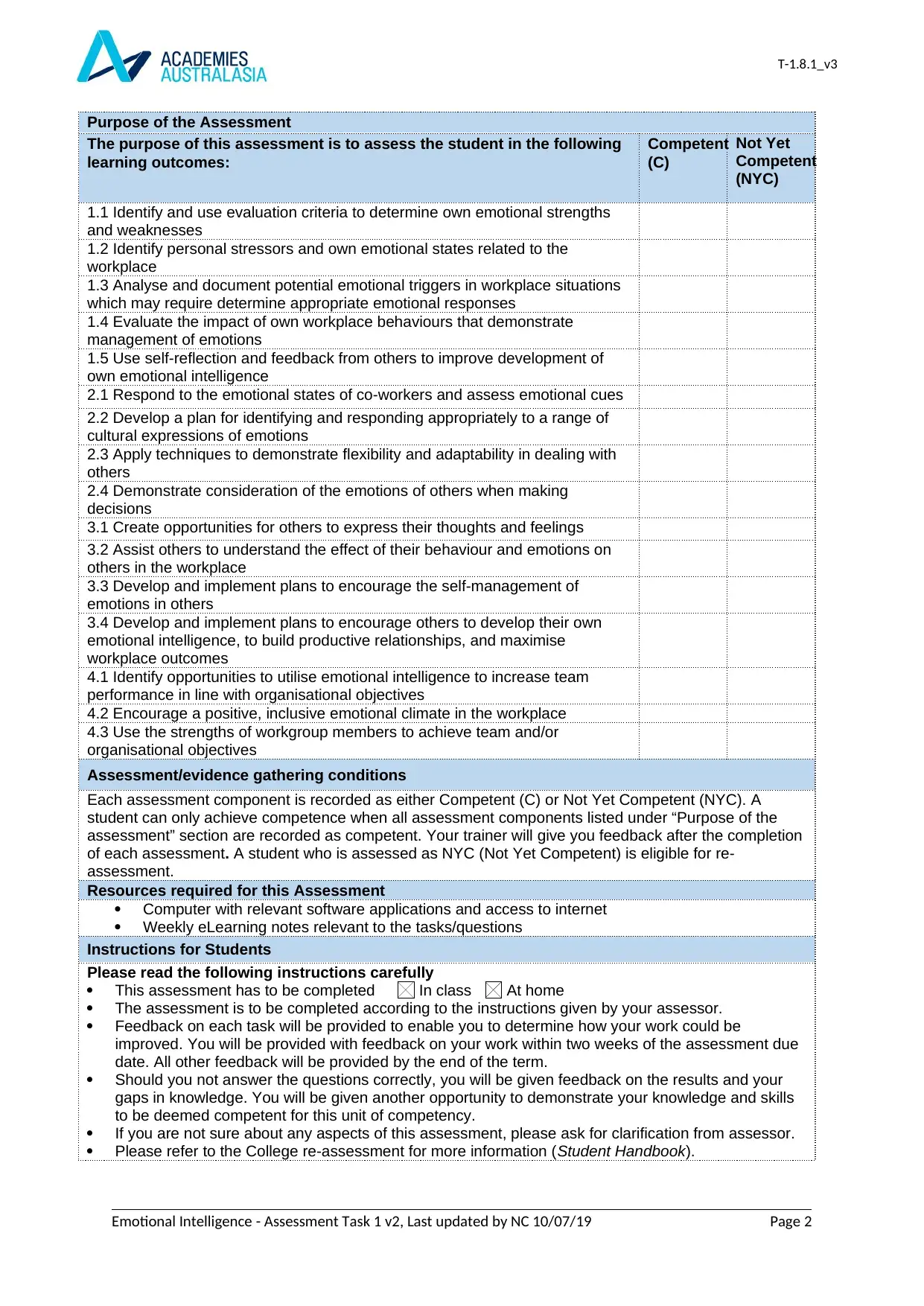
Purpose of the Assessment
The purpose of this assessment is to assess the student in the following
learning outcomes:
Competent
(C)
Not Yet
Competent
(NYC)
1.1 Identify and use evaluation criteria to determine own emotional strengths
and weaknesses
1.2 Identify personal stressors and own emotional states related to the
workplace
1.3 Analyse and document potential emotional triggers in workplace situations
which may require determine appropriate emotional responses
1.4 Evaluate the impact of own workplace behaviours that demonstrate
management of emotions
1.5 Use self-reflection and feedback from others to improve development of
own emotional intelligence
2.1 Respond to the emotional states of co-workers and assess emotional cues
2.2 Develop a plan for identifying and responding appropriately to a range of
cultural expressions of emotions
2.3 Apply techniques to demonstrate flexibility and adaptability in dealing with
others
2.4 Demonstrate consideration of the emotions of others when making
decisions
3.1 Create opportunities for others to express their thoughts and feelings
3.2 Assist others to understand the effect of their behaviour and emotions on
others in the workplace
3.3 Develop and implement plans to encourage the self-management of
emotions in others
3.4 Develop and implement plans to encourage others to develop their own
emotional intelligence, to build productive relationships, and maximise
workplace outcomes
4.1 Identify opportunities to utilise emotional intelligence to increase team
performance in line with organisational objectives
4.2 Encourage a positive, inclusive emotional climate in the workplace
4.3 Use the strengths of workgroup members to achieve team and/or
organisational objectives
Assessment/evidence gathering conditions
Each assessment component is recorded as either Competent (C) or Not Yet Competent (NYC). A
student can only achieve competence when all assessment components listed under “Purpose of the
assessment” section are recorded as competent. Your trainer will give you feedback after the completion
of each assessment. A student who is assessed as NYC (Not Yet Competent) is eligible for re-
assessment.
Resources required for this Assessment
Computer with relevant software applications and access to internet
Weekly eLearning notes relevant to the tasks/questions
Instructions for Students
Please read the following instructions carefully
This assessment has to be completed In class At home
The assessment is to be completed according to the instructions given by your assessor.
Feedback on each task will be provided to enable you to determine how your work could be
improved. You will be provided with feedback on your work within two weeks of the assessment due
date. All other feedback will be provided by the end of the term.
Should you not answer the questions correctly, you will be given feedback on the results and your
gaps in knowledge. You will be given another opportunity to demonstrate your knowledge and skills
to be deemed competent for this unit of competency.
If you are not sure about any aspects of this assessment, please ask for clarification from assessor.
Please refer to the College re-assessment for more information (Student Handbook).
Emotional Intelligence - Assessment Task 1 v2, Last updated by NC 10/07/19 Page 2
Purpose of the Assessment
The purpose of this assessment is to assess the student in the following
learning outcomes:
Competent
(C)
Not Yet
Competent
(NYC)
1.1 Identify and use evaluation criteria to determine own emotional strengths
and weaknesses
1.2 Identify personal stressors and own emotional states related to the
workplace
1.3 Analyse and document potential emotional triggers in workplace situations
which may require determine appropriate emotional responses
1.4 Evaluate the impact of own workplace behaviours that demonstrate
management of emotions
1.5 Use self-reflection and feedback from others to improve development of
own emotional intelligence
2.1 Respond to the emotional states of co-workers and assess emotional cues
2.2 Develop a plan for identifying and responding appropriately to a range of
cultural expressions of emotions
2.3 Apply techniques to demonstrate flexibility and adaptability in dealing with
others
2.4 Demonstrate consideration of the emotions of others when making
decisions
3.1 Create opportunities for others to express their thoughts and feelings
3.2 Assist others to understand the effect of their behaviour and emotions on
others in the workplace
3.3 Develop and implement plans to encourage the self-management of
emotions in others
3.4 Develop and implement plans to encourage others to develop their own
emotional intelligence, to build productive relationships, and maximise
workplace outcomes
4.1 Identify opportunities to utilise emotional intelligence to increase team
performance in line with organisational objectives
4.2 Encourage a positive, inclusive emotional climate in the workplace
4.3 Use the strengths of workgroup members to achieve team and/or
organisational objectives
Assessment/evidence gathering conditions
Each assessment component is recorded as either Competent (C) or Not Yet Competent (NYC). A
student can only achieve competence when all assessment components listed under “Purpose of the
assessment” section are recorded as competent. Your trainer will give you feedback after the completion
of each assessment. A student who is assessed as NYC (Not Yet Competent) is eligible for re-
assessment.
Resources required for this Assessment
Computer with relevant software applications and access to internet
Weekly eLearning notes relevant to the tasks/questions
Instructions for Students
Please read the following instructions carefully
This assessment has to be completed In class At home
The assessment is to be completed according to the instructions given by your assessor.
Feedback on each task will be provided to enable you to determine how your work could be
improved. You will be provided with feedback on your work within two weeks of the assessment due
date. All other feedback will be provided by the end of the term.
Should you not answer the questions correctly, you will be given feedback on the results and your
gaps in knowledge. You will be given another opportunity to demonstrate your knowledge and skills
to be deemed competent for this unit of competency.
If you are not sure about any aspects of this assessment, please ask for clarification from assessor.
Please refer to the College re-assessment for more information (Student Handbook).
Emotional Intelligence - Assessment Task 1 v2, Last updated by NC 10/07/19 Page 2
T-1.8.1_v3
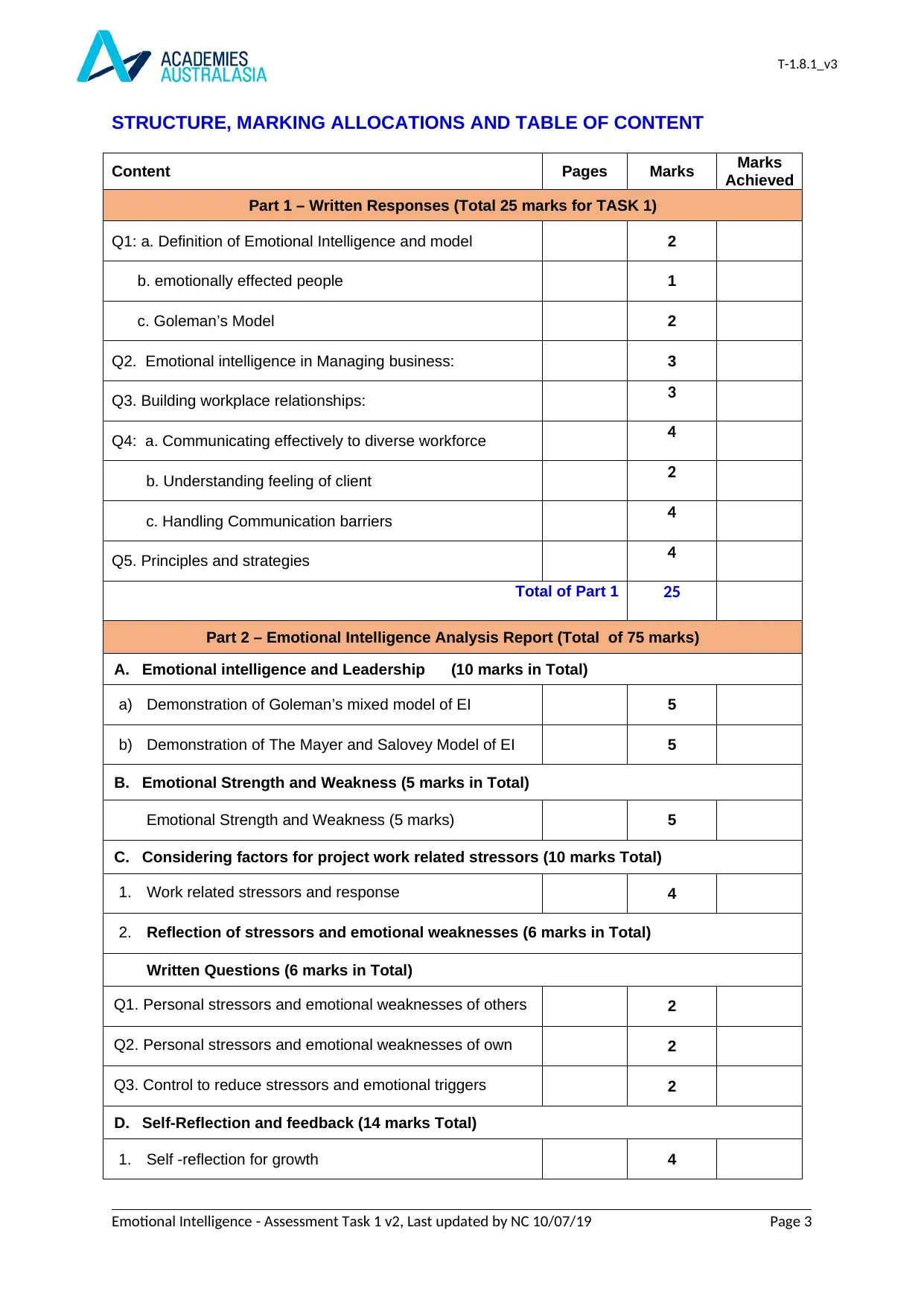
STRUCTURE, MARKING ALLOCATIONS AND TABLE OF CONTENT
Content Pages Marks Marks
Achieved
Part 1 – Written Responses (Total 25 marks for TASK 1)
Q1: a. Definition of Emotional Intelligence and model 2
b. emotionally effected people 1
c. Goleman’s Model 2
Q2. Emotional intelligence in Managing business: 3
Q3. Building workplace relationships: 3
Q4: a. Communicating effectively to diverse workforce 4
b. Understanding feeling of client 2
c. Handling Communication barriers 4
Q5. Principles and strategies 4
Total of Part 1 25
Part 2 – Emotional Intelligence Analysis Report (Total of 75 marks)
A. Emotional intelligence and Leadership (10 marks in Total)
a) Demonstration of Goleman’s mixed model of EI 5
b) Demonstration of The Mayer and Salovey Model of EI 5
B. Emotional Strength and Weakness (5 marks in Total)
Emotional Strength and Weakness (5 marks) 5
C. Considering factors for project work related stressors (10 marks Total)
1. Work related stressors and response 4
2. Reflection of stressors and emotional weaknesses (6 marks in Total)
Written Questions (6 marks in Total)
Q1. Personal stressors and emotional weaknesses of others 2
Q2. Personal stressors and emotional weaknesses of own 2
Q3. Control to reduce stressors and emotional triggers 2
D. Self-Reflection and feedback (14 marks Total)
1. Self -reflection for growth 4
Emotional Intelligence - Assessment Task 1 v2, Last updated by NC 10/07/19 Page 3
STRUCTURE, MARKING ALLOCATIONS AND TABLE OF CONTENT
Content Pages Marks Marks
Achieved
Part 1 – Written Responses (Total 25 marks for TASK 1)
Q1: a. Definition of Emotional Intelligence and model 2
b. emotionally effected people 1
c. Goleman’s Model 2
Q2. Emotional intelligence in Managing business: 3
Q3. Building workplace relationships: 3
Q4: a. Communicating effectively to diverse workforce 4
b. Understanding feeling of client 2
c. Handling Communication barriers 4
Q5. Principles and strategies 4
Total of Part 1 25
Part 2 – Emotional Intelligence Analysis Report (Total of 75 marks)
A. Emotional intelligence and Leadership (10 marks in Total)
a) Demonstration of Goleman’s mixed model of EI 5
b) Demonstration of The Mayer and Salovey Model of EI 5
B. Emotional Strength and Weakness (5 marks in Total)
Emotional Strength and Weakness (5 marks) 5
C. Considering factors for project work related stressors (10 marks Total)
1. Work related stressors and response 4
2. Reflection of stressors and emotional weaknesses (6 marks in Total)
Written Questions (6 marks in Total)
Q1. Personal stressors and emotional weaknesses of others 2
Q2. Personal stressors and emotional weaknesses of own 2
Q3. Control to reduce stressors and emotional triggers 2
D. Self-Reflection and feedback (14 marks Total)
1. Self -reflection for growth 4
Emotional Intelligence - Assessment Task 1 v2, Last updated by NC 10/07/19 Page 3
⊘ This is a preview!⊘
Do you want full access?
Subscribe today to unlock all pages.

Trusted by 1+ million students worldwide
T-1.8.1_v3
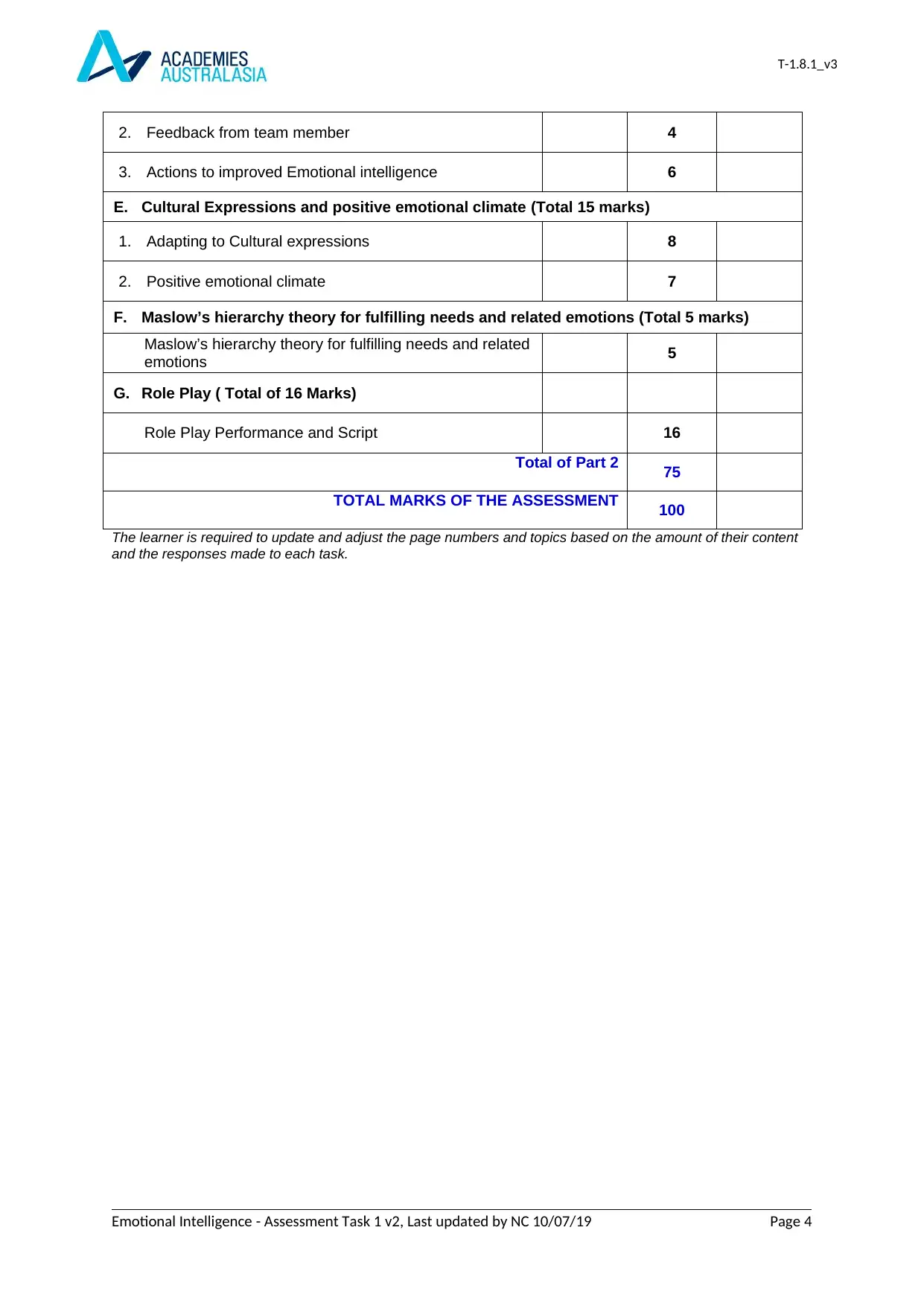
2. Feedback from team member 4
3. Actions to improved Emotional intelligence 6
E. Cultural Expressions and positive emotional climate (Total 15 marks)
1. Adapting to Cultural expressions 8
2. Positive emotional climate 7
F. Maslow’s hierarchy theory for fulfilling needs and related emotions (Total 5 marks)
Maslow’s hierarchy theory for fulfilling needs and related
emotions 5
G. Role Play ( Total of 16 Marks)
Role Play Performance and Script 16
Total of Part 2 75
TOTAL MARKS OF THE ASSESSMENT 100
The learner is required to update and adjust the page numbers and topics based on the amount of their content
and the responses made to each task.
Emotional Intelligence - Assessment Task 1 v2, Last updated by NC 10/07/19 Page 4
2. Feedback from team member 4
3. Actions to improved Emotional intelligence 6
E. Cultural Expressions and positive emotional climate (Total 15 marks)
1. Adapting to Cultural expressions 8
2. Positive emotional climate 7
F. Maslow’s hierarchy theory for fulfilling needs and related emotions (Total 5 marks)
Maslow’s hierarchy theory for fulfilling needs and related
emotions 5
G. Role Play ( Total of 16 Marks)
Role Play Performance and Script 16
Total of Part 2 75
TOTAL MARKS OF THE ASSESSMENT 100
The learner is required to update and adjust the page numbers and topics based on the amount of their content
and the responses made to each task.
Emotional Intelligence - Assessment Task 1 v2, Last updated by NC 10/07/19 Page 4
Paraphrase This Document
Need a fresh take? Get an instant paraphrase of this document with our AI Paraphraser
T-1.8.1_v3
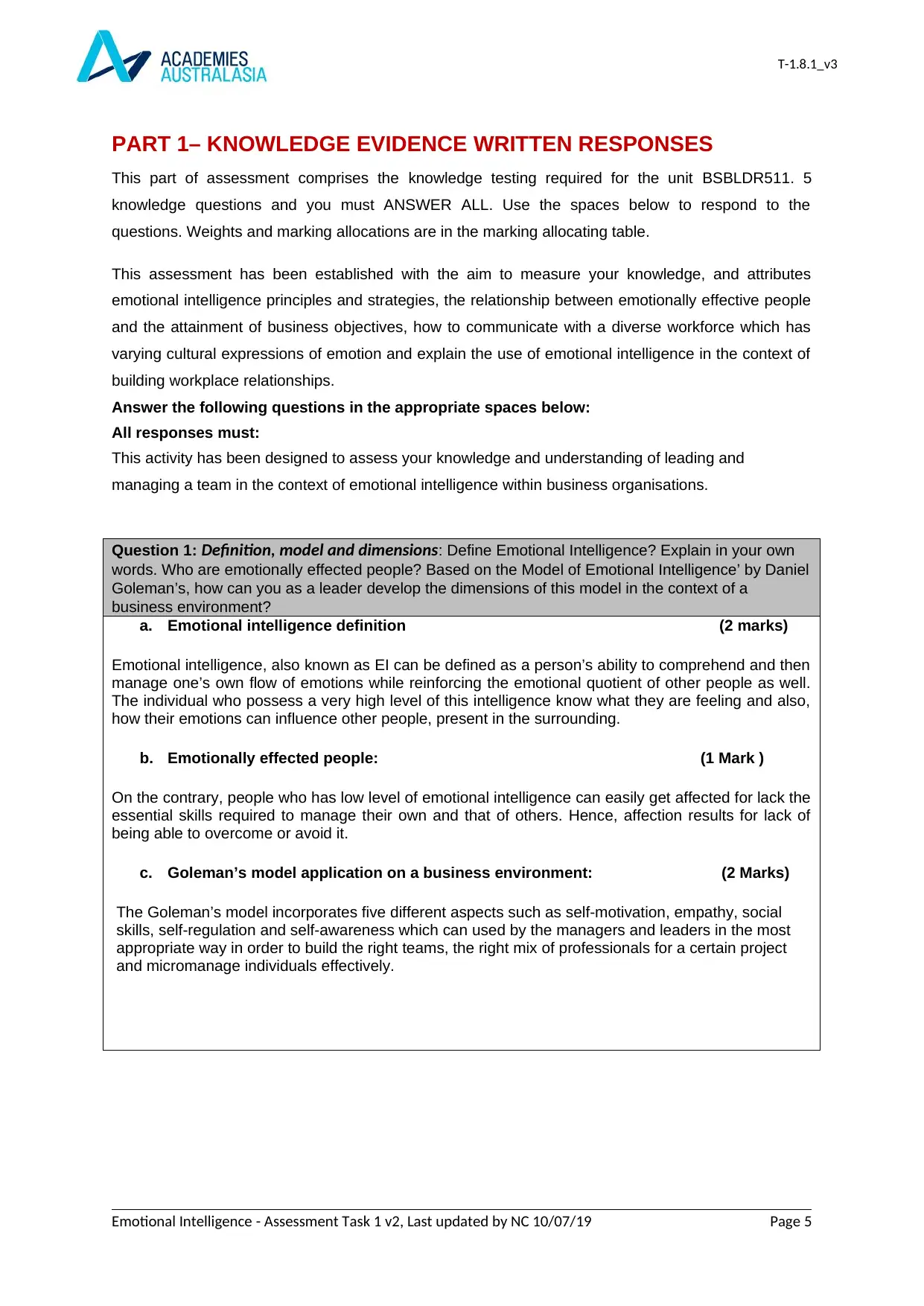
PART 1– KNOWLEDGE EVIDENCE WRITTEN RESPONSES
This part of assessment comprises the knowledge testing required for the unit BSBLDR511. 5
knowledge questions and you must ANSWER ALL. Use the spaces below to respond to the
questions. Weights and marking allocations are in the marking allocating table.
This assessment has been established with the aim to measure your knowledge, and attributes
emotional intelligence principles and strategies, the relationship between emotionally effective people
and the attainment of business objectives, how to communicate with a diverse workforce which has
varying cultural expressions of emotion and explain the use of emotional intelligence in the context of
building workplace relationships.
Answer the following questions in the appropriate spaces below:
All responses must:
This activity has been designed to assess your knowledge and understanding of leading and
managing a team in the context of emotional intelligence within business organisations.
Question 1: Definition, model and dimensions: Define Emotional Intelligence? Explain in your own
words. Who are emotionally effected people? Based on the Model of Emotional Intelligence’ by Daniel
Goleman’s, how can you as a leader develop the dimensions of this model in the context of a
business environment?
a. Emotional intelligence definition (2 marks)
Emotional intelligence, also known as EI can be defined as a person’s ability to comprehend and then
manage one’s own flow of emotions while reinforcing the emotional quotient of other people as well.
The individual who possess a very high level of this intelligence know what they are feeling and also,
how their emotions can influence other people, present in the surrounding.
b. Emotionally effected people: (1 Mark )
On the contrary, people who has low level of emotional intelligence can easily get affected for lack the
essential skills required to manage their own and that of others. Hence, affection results for lack of
being able to overcome or avoid it.
c. Goleman’s model application on a business environment: (2 Marks)
The Goleman’s model incorporates five different aspects such as self-motivation, empathy, social
skills, self-regulation and self-awareness which can used by the managers and leaders in the most
appropriate way in order to build the right teams, the right mix of professionals for a certain project
and micromanage individuals effectively.
Emotional Intelligence - Assessment Task 1 v2, Last updated by NC 10/07/19 Page 5
PART 1– KNOWLEDGE EVIDENCE WRITTEN RESPONSES
This part of assessment comprises the knowledge testing required for the unit BSBLDR511. 5
knowledge questions and you must ANSWER ALL. Use the spaces below to respond to the
questions. Weights and marking allocations are in the marking allocating table.
This assessment has been established with the aim to measure your knowledge, and attributes
emotional intelligence principles and strategies, the relationship between emotionally effective people
and the attainment of business objectives, how to communicate with a diverse workforce which has
varying cultural expressions of emotion and explain the use of emotional intelligence in the context of
building workplace relationships.
Answer the following questions in the appropriate spaces below:
All responses must:
This activity has been designed to assess your knowledge and understanding of leading and
managing a team in the context of emotional intelligence within business organisations.
Question 1: Definition, model and dimensions: Define Emotional Intelligence? Explain in your own
words. Who are emotionally effected people? Based on the Model of Emotional Intelligence’ by Daniel
Goleman’s, how can you as a leader develop the dimensions of this model in the context of a
business environment?
a. Emotional intelligence definition (2 marks)
Emotional intelligence, also known as EI can be defined as a person’s ability to comprehend and then
manage one’s own flow of emotions while reinforcing the emotional quotient of other people as well.
The individual who possess a very high level of this intelligence know what they are feeling and also,
how their emotions can influence other people, present in the surrounding.
b. Emotionally effected people: (1 Mark )
On the contrary, people who has low level of emotional intelligence can easily get affected for lack the
essential skills required to manage their own and that of others. Hence, affection results for lack of
being able to overcome or avoid it.
c. Goleman’s model application on a business environment: (2 Marks)
The Goleman’s model incorporates five different aspects such as self-motivation, empathy, social
skills, self-regulation and self-awareness which can used by the managers and leaders in the most
appropriate way in order to build the right teams, the right mix of professionals for a certain project
and micromanage individuals effectively.
Emotional Intelligence - Assessment Task 1 v2, Last updated by NC 10/07/19 Page 5
T-1.8.1_v3
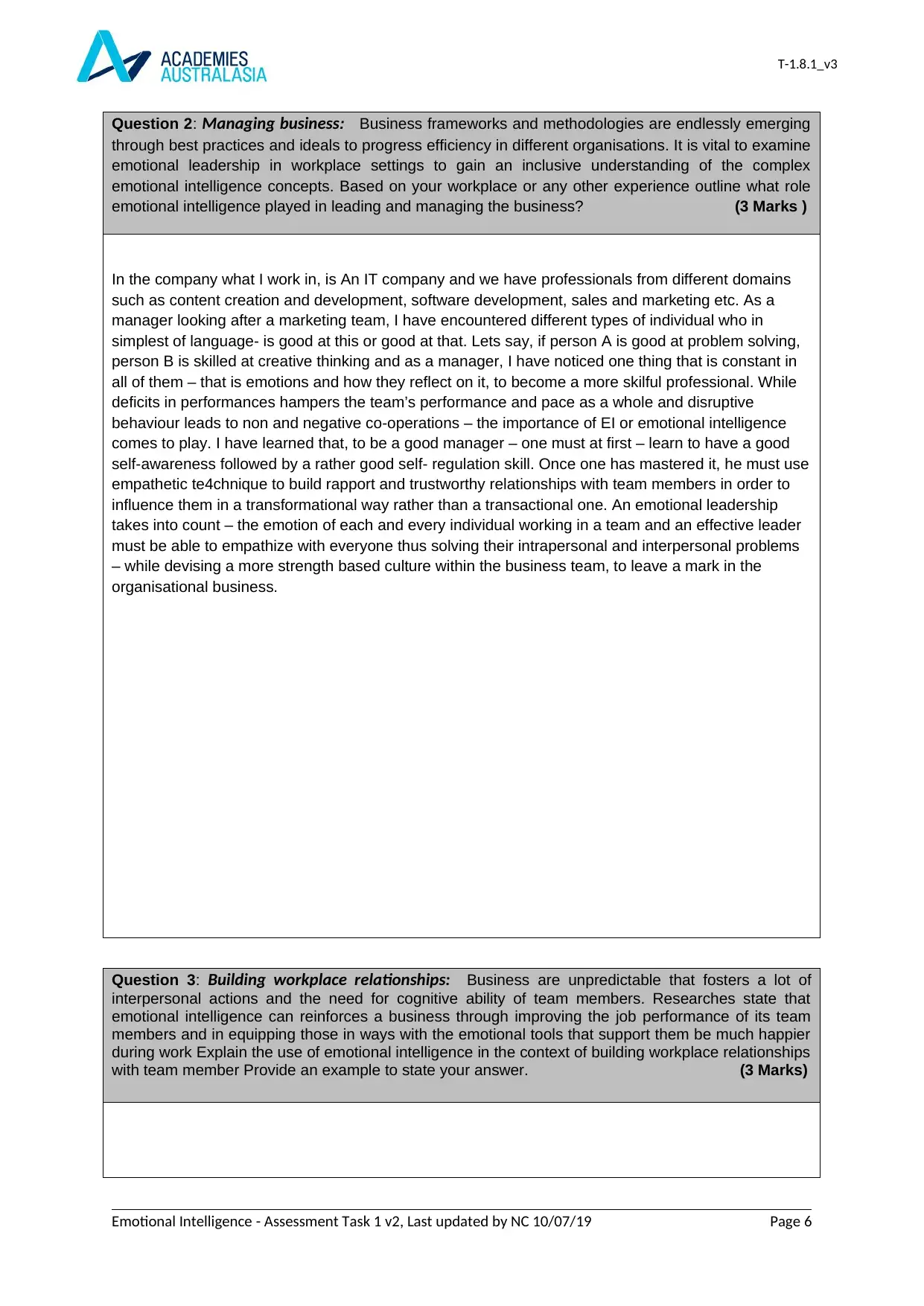
Question 2: Managing business: Business frameworks and methodologies are endlessly emerging
through best practices and ideals to progress efficiency in different organisations. It is vital to examine
emotional leadership in workplace settings to gain an inclusive understanding of the complex
emotional intelligence concepts. Based on your workplace or any other experience outline what role
emotional intelligence played in leading and managing the business? (3 Marks )
In the company what I work in, is An IT company and we have professionals from different domains
such as content creation and development, software development, sales and marketing etc. As a
manager looking after a marketing team, I have encountered different types of individual who in
simplest of language- is good at this or good at that. Lets say, if person A is good at problem solving,
person B is skilled at creative thinking and as a manager, I have noticed one thing that is constant in
all of them – that is emotions and how they reflect on it, to become a more skilful professional. While
deficits in performances hampers the team’s performance and pace as a whole and disruptive
behaviour leads to non and negative co-operations – the importance of EI or emotional intelligence
comes to play. I have learned that, to be a good manager – one must at first – learn to have a good
self-awareness followed by a rather good self- regulation skill. Once one has mastered it, he must use
empathetic te4chnique to build rapport and trustworthy relationships with team members in order to
influence them in a transformational way rather than a transactional one. An emotional leadership
takes into count – the emotion of each and every individual working in a team and an effective leader
must be able to empathize with everyone thus solving their intrapersonal and interpersonal problems
– while devising a more strength based culture within the business team, to leave a mark in the
organisational business.
Question 3: Building workplace relationships: Business are unpredictable that fosters a lot of
interpersonal actions and the need for cognitive ability of team members. Researches state that
emotional intelligence can reinforces a business through improving the job performance of its team
members and in equipping those in ways with the emotional tools that support them be much happier
during work Explain the use of emotional intelligence in the context of building workplace relationships
with team member Provide an example to state your answer. (3 Marks)
Emotional Intelligence - Assessment Task 1 v2, Last updated by NC 10/07/19 Page 6
Question 2: Managing business: Business frameworks and methodologies are endlessly emerging
through best practices and ideals to progress efficiency in different organisations. It is vital to examine
emotional leadership in workplace settings to gain an inclusive understanding of the complex
emotional intelligence concepts. Based on your workplace or any other experience outline what role
emotional intelligence played in leading and managing the business? (3 Marks )
In the company what I work in, is An IT company and we have professionals from different domains
such as content creation and development, software development, sales and marketing etc. As a
manager looking after a marketing team, I have encountered different types of individual who in
simplest of language- is good at this or good at that. Lets say, if person A is good at problem solving,
person B is skilled at creative thinking and as a manager, I have noticed one thing that is constant in
all of them – that is emotions and how they reflect on it, to become a more skilful professional. While
deficits in performances hampers the team’s performance and pace as a whole and disruptive
behaviour leads to non and negative co-operations – the importance of EI or emotional intelligence
comes to play. I have learned that, to be a good manager – one must at first – learn to have a good
self-awareness followed by a rather good self- regulation skill. Once one has mastered it, he must use
empathetic te4chnique to build rapport and trustworthy relationships with team members in order to
influence them in a transformational way rather than a transactional one. An emotional leadership
takes into count – the emotion of each and every individual working in a team and an effective leader
must be able to empathize with everyone thus solving their intrapersonal and interpersonal problems
– while devising a more strength based culture within the business team, to leave a mark in the
organisational business.
Question 3: Building workplace relationships: Business are unpredictable that fosters a lot of
interpersonal actions and the need for cognitive ability of team members. Researches state that
emotional intelligence can reinforces a business through improving the job performance of its team
members and in equipping those in ways with the emotional tools that support them be much happier
during work Explain the use of emotional intelligence in the context of building workplace relationships
with team member Provide an example to state your answer. (3 Marks)
Emotional Intelligence - Assessment Task 1 v2, Last updated by NC 10/07/19 Page 6
⊘ This is a preview!⊘
Do you want full access?
Subscribe today to unlock all pages.
Trusted by 1+ million students worldwide
T-1.8.1_v3
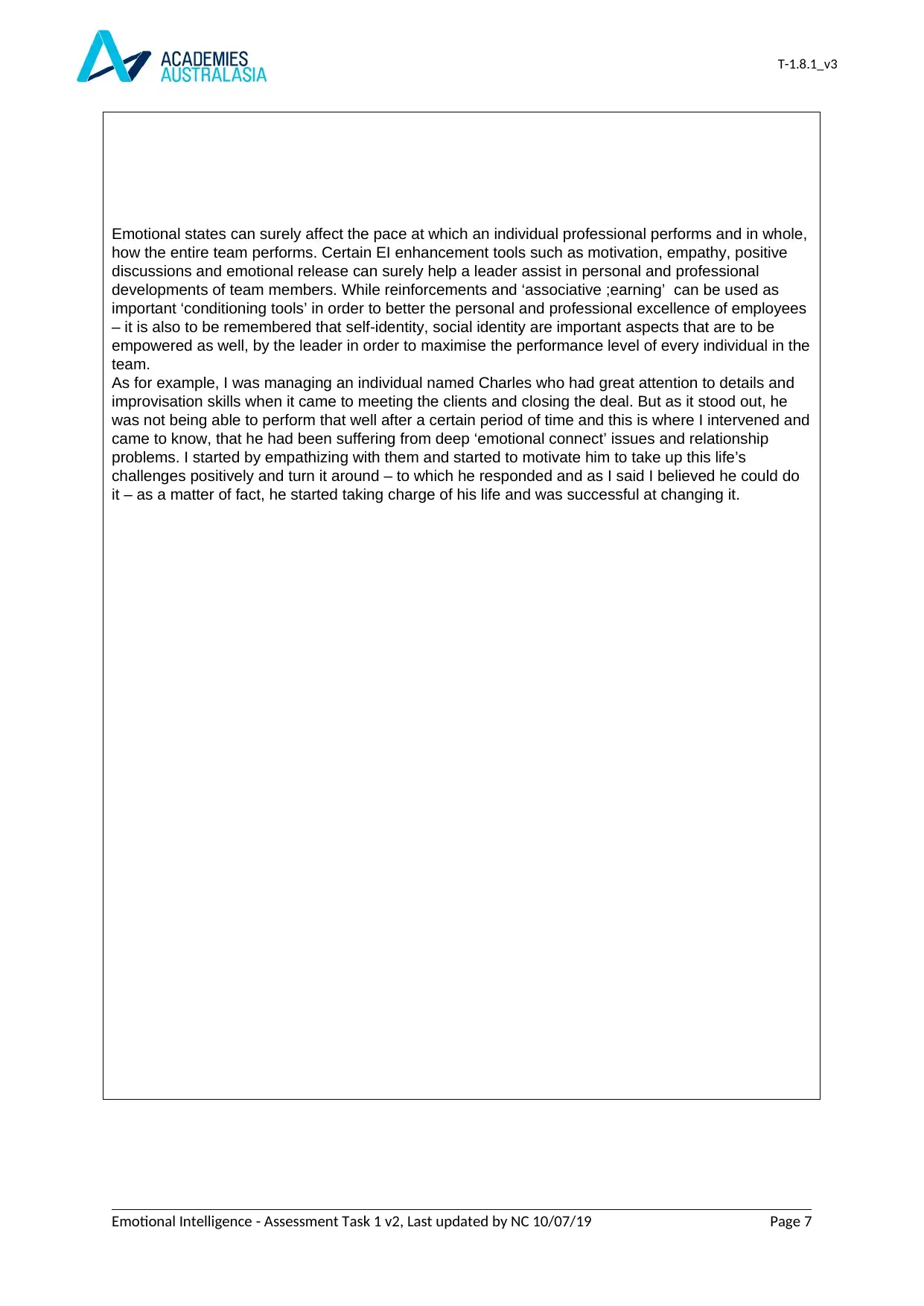
Emotional states can surely affect the pace at which an individual professional performs and in whole,
how the entire team performs. Certain EI enhancement tools such as motivation, empathy, positive
discussions and emotional release can surely help a leader assist in personal and professional
developments of team members. While reinforcements and ‘associative ;earning’ can be used as
important ‘conditioning tools’ in order to better the personal and professional excellence of employees
– it is also to be remembered that self-identity, social identity are important aspects that are to be
empowered as well, by the leader in order to maximise the performance level of every individual in the
team.
As for example, I was managing an individual named Charles who had great attention to details and
improvisation skills when it came to meeting the clients and closing the deal. But as it stood out, he
was not being able to perform that well after a certain period of time and this is where I intervened and
came to know, that he had been suffering from deep ‘emotional connect’ issues and relationship
problems. I started by empathizing with them and started to motivate him to take up this life’s
challenges positively and turn it around – to which he responded and as I said I believed he could do
it – as a matter of fact, he started taking charge of his life and was successful at changing it.
Emotional Intelligence - Assessment Task 1 v2, Last updated by NC 10/07/19 Page 7
Emotional states can surely affect the pace at which an individual professional performs and in whole,
how the entire team performs. Certain EI enhancement tools such as motivation, empathy, positive
discussions and emotional release can surely help a leader assist in personal and professional
developments of team members. While reinforcements and ‘associative ;earning’ can be used as
important ‘conditioning tools’ in order to better the personal and professional excellence of employees
– it is also to be remembered that self-identity, social identity are important aspects that are to be
empowered as well, by the leader in order to maximise the performance level of every individual in the
team.
As for example, I was managing an individual named Charles who had great attention to details and
improvisation skills when it came to meeting the clients and closing the deal. But as it stood out, he
was not being able to perform that well after a certain period of time and this is where I intervened and
came to know, that he had been suffering from deep ‘emotional connect’ issues and relationship
problems. I started by empathizing with them and started to motivate him to take up this life’s
challenges positively and turn it around – to which he responded and as I said I believed he could do
it – as a matter of fact, he started taking charge of his life and was successful at changing it.
Emotional Intelligence - Assessment Task 1 v2, Last updated by NC 10/07/19 Page 7
Paraphrase This Document
Need a fresh take? Get an instant paraphrase of this document with our AI Paraphraser
T-1.8.1_v3
Emotional Intelligence - Assessment Task 1 v2, Last updated by NC 10/07/19 Page 8
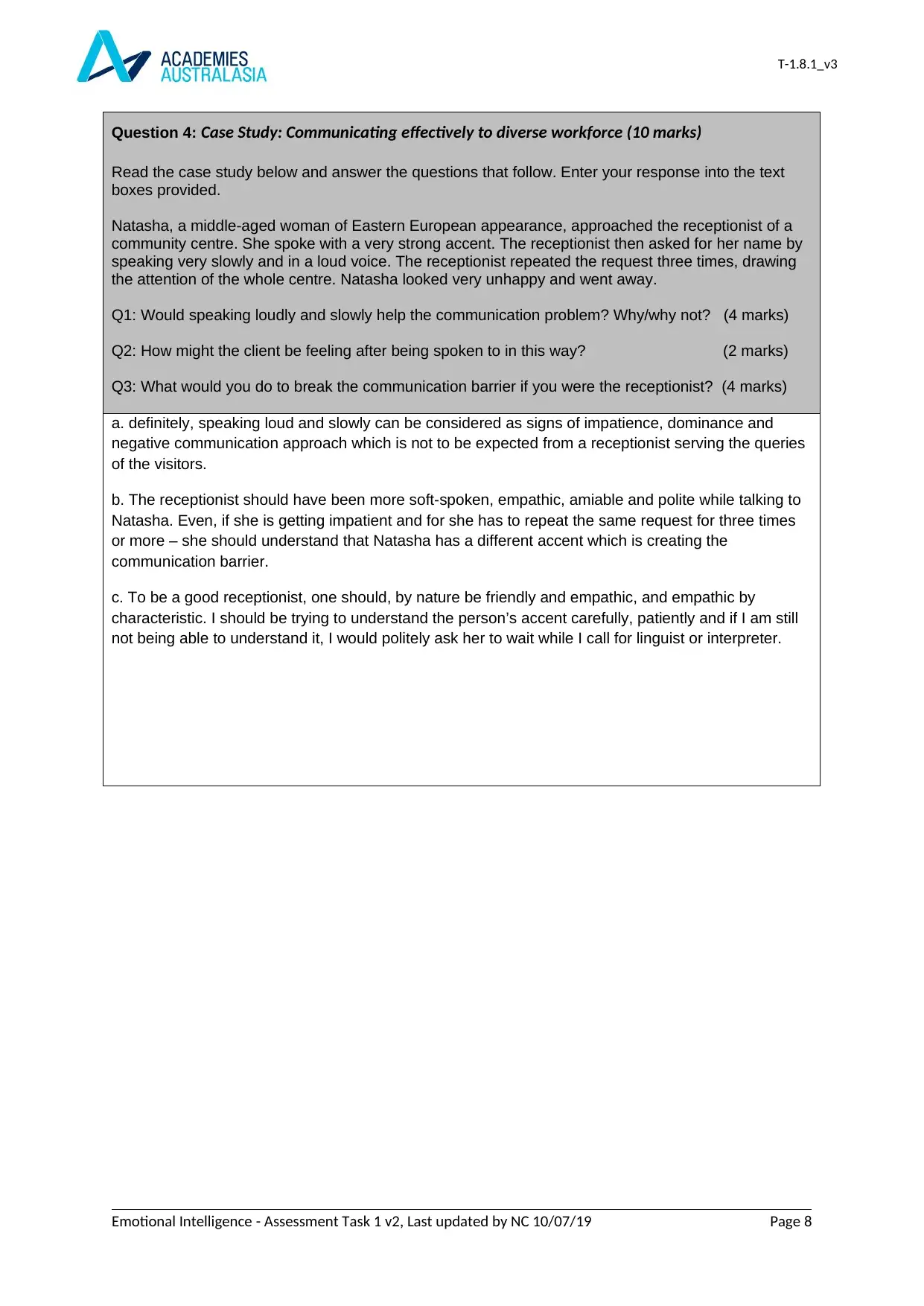
Question 4: Case Study: Communicating effectively to diverse workforce (10 marks)
Read the case study below and answer the questions that follow. Enter your response into the text
boxes provided.
Natasha, a middle-aged woman of Eastern European appearance, approached the receptionist of a
community centre. She spoke with a very strong accent. The receptionist then asked for her name by
speaking very slowly and in a loud voice. The receptionist repeated the request three times, drawing
the attention of the whole centre. Natasha looked very unhappy and went away.
Q1: Would speaking loudly and slowly help the communication problem? Why/why not? (4 marks)
Q2: How might the client be feeling after being spoken to in this way? (2 marks)
Q3: What would you do to break the communication barrier if you were the receptionist? (4 marks)
a. definitely, speaking loud and slowly can be considered as signs of impatience, dominance and
negative communication approach which is not to be expected from a receptionist serving the queries
of the visitors.
b. The receptionist should have been more soft-spoken, empathic, amiable and polite while talking to
Natasha. Even, if she is getting impatient and for she has to repeat the same request for three times
or more – she should understand that Natasha has a different accent which is creating the
communication barrier.
c. To be a good receptionist, one should, by nature be friendly and empathic, and empathic by
characteristic. I should be trying to understand the person’s accent carefully, patiently and if I am still
not being able to understand it, I would politely ask her to wait while I call for linguist or interpreter.
Emotional Intelligence - Assessment Task 1 v2, Last updated by NC 10/07/19 Page 8
Question 4: Case Study: Communicating effectively to diverse workforce (10 marks)
Read the case study below and answer the questions that follow. Enter your response into the text
boxes provided.
Natasha, a middle-aged woman of Eastern European appearance, approached the receptionist of a
community centre. She spoke with a very strong accent. The receptionist then asked for her name by
speaking very slowly and in a loud voice. The receptionist repeated the request three times, drawing
the attention of the whole centre. Natasha looked very unhappy and went away.
Q1: Would speaking loudly and slowly help the communication problem? Why/why not? (4 marks)
Q2: How might the client be feeling after being spoken to in this way? (2 marks)
Q3: What would you do to break the communication barrier if you were the receptionist? (4 marks)
a. definitely, speaking loud and slowly can be considered as signs of impatience, dominance and
negative communication approach which is not to be expected from a receptionist serving the queries
of the visitors.
b. The receptionist should have been more soft-spoken, empathic, amiable and polite while talking to
Natasha. Even, if she is getting impatient and for she has to repeat the same request for three times
or more – she should understand that Natasha has a different accent which is creating the
communication barrier.
c. To be a good receptionist, one should, by nature be friendly and empathic, and empathic by
characteristic. I should be trying to understand the person’s accent carefully, patiently and if I am still
not being able to understand it, I would politely ask her to wait while I call for linguist or interpreter.
T-1.8.1_v3
PART 2 - WORKPLACE SCENARIO BASED ON A CASE
ORGANISATION- PORTFOLIO OF EVIDENCE
SIMULATED WORK ORGANISATION:
The portfolio of evidence comprises the assessment of the application of your emotional
intelligence usage knowledge whilst managing a project and its team. You will use the given case
study below and will need to demonstrate your emotional intelligence to increase self-awareness,
self-management, social awareness and relationship management as well as identifying the impact
of own emotions on others whilst managing your team applied to any workplace.
Emotional Intelligence - Assessment Task 1 v2, Last updated by NC 10/07/19 Page 9
Question 5: Principles and strategies: Considering the reflection of your personal attributes,
impact on others and/or adjustment of your tactics to support your development, outline a situation
from your workplace or any other experience, when you exemplified model of workplace behaviour
signifying management of emotions as an illustration for your team members/workmates/classmates
to follow. (You may refer to emotional principles and strategies and/or impact of your own emotions on
others and their feedback in your response)
(4 Marks)
Given my personal attributes while are active listening, creative thinking, empathic behaviour, self-
motivation, enthusiastic and moralistic – I use all of my skills to reinforce my overall daily experiences
and from the reflection of it, I contribute to my personal growth and professional growth of others.
About one year ago, our team came across several shortcomings such as attrition, terminations of
employees and low revenue generation which deeply affected the morale of the entire team. At first, I
took a group counselling session and performed interpersonal empathy building exercises that
strengthened the positive tie4s of the group and transformed the negative or neutral ones. Followed
by that, I had a one-on-one talk session where I tried to comprehend the emotional and cognitive
states of each and every individual in our team while taking perspective on how to solve the situation
which was getting difficult. When I came out with revised ethical practices to be followed by everyone
including me as a leader, they appreciate the ‘change’ for the new guidelines included ‘points’ made
by someone or other which in whole, made them feel valued and added to their socio – emotional
needs.
PART 2 - WORKPLACE SCENARIO BASED ON A CASE
ORGANISATION- PORTFOLIO OF EVIDENCE
SIMULATED WORK ORGANISATION:
The portfolio of evidence comprises the assessment of the application of your emotional
intelligence usage knowledge whilst managing a project and its team. You will use the given case
study below and will need to demonstrate your emotional intelligence to increase self-awareness,
self-management, social awareness and relationship management as well as identifying the impact
of own emotions on others whilst managing your team applied to any workplace.
Emotional Intelligence - Assessment Task 1 v2, Last updated by NC 10/07/19 Page 9
Question 5: Principles and strategies: Considering the reflection of your personal attributes,
impact on others and/or adjustment of your tactics to support your development, outline a situation
from your workplace or any other experience, when you exemplified model of workplace behaviour
signifying management of emotions as an illustration for your team members/workmates/classmates
to follow. (You may refer to emotional principles and strategies and/or impact of your own emotions on
others and their feedback in your response)
(4 Marks)
Given my personal attributes while are active listening, creative thinking, empathic behaviour, self-
motivation, enthusiastic and moralistic – I use all of my skills to reinforce my overall daily experiences
and from the reflection of it, I contribute to my personal growth and professional growth of others.
About one year ago, our team came across several shortcomings such as attrition, terminations of
employees and low revenue generation which deeply affected the morale of the entire team. At first, I
took a group counselling session and performed interpersonal empathy building exercises that
strengthened the positive tie4s of the group and transformed the negative or neutral ones. Followed
by that, I had a one-on-one talk session where I tried to comprehend the emotional and cognitive
states of each and every individual in our team while taking perspective on how to solve the situation
which was getting difficult. When I came out with revised ethical practices to be followed by everyone
including me as a leader, they appreciate the ‘change’ for the new guidelines included ‘points’ made
by someone or other which in whole, made them feel valued and added to their socio – emotional
needs.
⊘ This is a preview!⊘
Do you want full access?
Subscribe today to unlock all pages.
Trusted by 1+ million students worldwide
T-1.8.1_v3
ORGANISATIONAL BACKGROUND
(Information partly sourced from various similar organisational sources and other external source. The
information contexts have been significantly modified and re-written.)
APS (Australian Parcel Service) is Australian based cargo organisation with over 5,000 employees
moving one million packages each month through the use of air, rail, sea and land transportation
systems. For the last decade, the organisation has been one of the most successful cargo and parcel
enterprises of Australia. This is due to innovation with their digital technologies and also human
management system.
While founder Joe Burns was focused on logistics and speed, from the start he believed that people
were the key to business, and that leadership and human management is about continuous growth:
“Leaders get out in front and stay there by raising the standards by which they judge themselves –
and by which they are willing to be judged.” This vision has translated to the “PSP Philosophy” –
People-Service-Profit – which drives APS today.
The company identifies that the human-side of leadership has grown more complex, and looking to
the future, is committed to developing leadership capabilities to manage the changing nature of
workforce. The goal is leaders who are better at emotional intelligence, influence, make decisions
that are both quick and accurate, and are able to build a culture where people feel the dedication and
drive for exceptional performance in a way that’s sustainable and creates real value for all
stakeholders.
To measure leadership and Emotional Intelligence performance, APS administers an annual survey
where every employee can provide feedback about managers. The survey themes include respect,
fairness, listening, and trust – leadership responsibilities that are all about relationships and emotions.
This commitment to people-first leadership created an interest in “emotional intelligence” as a
learnable skillset that would equip managers to deliver the APS way.
Even though the leadership training was state of the art — among the top ten in the world – the APS
Global Leadership Institute is charged with continuously updating and innovating in keeping with that
Joe Burns call for continuously “raising the standards.” Located near the company’s primary hub, the
Leadership Institute (TLI) serves as the leadership university for APS Express.
ORGANISATIONAL VALUES
The success of human management and leadership at APS offers several insights to us. Firstly, the
organisation has not only placed some moral values but also implemented them with appropriate
projects and process. One good example is the INTELLIGENCE LEGACY training program for new
leaders and managers. Below exhibit the three major values of the organisation.
Link to what matters. At APS, concepts like “discretionary effort” and the leadership requirements
from the annual survey create an internal “case” for emotional intelligence. The champions of this
project have helped leaders see that the learnable skills of emotional intelligence are building blocks
to create the kind of people-first leadership the company wants – which, in turn, increases economic
value. This recognition has built support of the initiative at very senior levels.
Build internal capacity. By developing an internal team of emotional intelligence practitioners, the
company has been able to assimilate the concepts and skills of EQ and “translate” them to work
within the company culture. Having a large, strong team of emotional intelligence coaches and
trainers means this program can be delivered at a large scale, creating a new “strand of DNA” to
support the desired organizational culture.
Emotional Intelligence - Assessment Task 1 v2, Last updated by NC 10/07/19 Page 10
ORGANISATIONAL BACKGROUND
(Information partly sourced from various similar organisational sources and other external source. The
information contexts have been significantly modified and re-written.)
APS (Australian Parcel Service) is Australian based cargo organisation with over 5,000 employees
moving one million packages each month through the use of air, rail, sea and land transportation
systems. For the last decade, the organisation has been one of the most successful cargo and parcel
enterprises of Australia. This is due to innovation with their digital technologies and also human
management system.
While founder Joe Burns was focused on logistics and speed, from the start he believed that people
were the key to business, and that leadership and human management is about continuous growth:
“Leaders get out in front and stay there by raising the standards by which they judge themselves –
and by which they are willing to be judged.” This vision has translated to the “PSP Philosophy” –
People-Service-Profit – which drives APS today.
The company identifies that the human-side of leadership has grown more complex, and looking to
the future, is committed to developing leadership capabilities to manage the changing nature of
workforce. The goal is leaders who are better at emotional intelligence, influence, make decisions
that are both quick and accurate, and are able to build a culture where people feel the dedication and
drive for exceptional performance in a way that’s sustainable and creates real value for all
stakeholders.
To measure leadership and Emotional Intelligence performance, APS administers an annual survey
where every employee can provide feedback about managers. The survey themes include respect,
fairness, listening, and trust – leadership responsibilities that are all about relationships and emotions.
This commitment to people-first leadership created an interest in “emotional intelligence” as a
learnable skillset that would equip managers to deliver the APS way.
Even though the leadership training was state of the art — among the top ten in the world – the APS
Global Leadership Institute is charged with continuously updating and innovating in keeping with that
Joe Burns call for continuously “raising the standards.” Located near the company’s primary hub, the
Leadership Institute (TLI) serves as the leadership university for APS Express.
ORGANISATIONAL VALUES
The success of human management and leadership at APS offers several insights to us. Firstly, the
organisation has not only placed some moral values but also implemented them with appropriate
projects and process. One good example is the INTELLIGENCE LEGACY training program for new
leaders and managers. Below exhibit the three major values of the organisation.
Link to what matters. At APS, concepts like “discretionary effort” and the leadership requirements
from the annual survey create an internal “case” for emotional intelligence. The champions of this
project have helped leaders see that the learnable skills of emotional intelligence are building blocks
to create the kind of people-first leadership the company wants – which, in turn, increases economic
value. This recognition has built support of the initiative at very senior levels.
Build internal capacity. By developing an internal team of emotional intelligence practitioners, the
company has been able to assimilate the concepts and skills of EQ and “translate” them to work
within the company culture. Having a large, strong team of emotional intelligence coaches and
trainers means this program can be delivered at a large scale, creating a new “strand of DNA” to
support the desired organizational culture.
Emotional Intelligence - Assessment Task 1 v2, Last updated by NC 10/07/19 Page 10
Paraphrase This Document
Need a fresh take? Get an instant paraphrase of this document with our AI Paraphraser
T-1.8.1_v3
Walk the Talk. The company tells managers to put people first, so the company puts people first. By
supporting new managers to be good people and investing in their growth right at the start of their
management careers, APS senior leadership is providing a powerful role model.
In 2018, APS implemented a new training program for new managers to consider the impact they
wished to have as leaders – the intelligence legacy they were creating. A core component of the
INTELLIGENCE LEGACY course was a module on emotional intelligence using the organisational
Emotional Intelligence situations. The results were very positive, in part because the course was very
realistic and practical with scenarios from previous organisational situations.
Recently the organisation had a recruitment drive and you have been hired as one of the branch
managers of this company. As part of the induction and training, you have also completed the
INTELLIGENCE LEGACY course and ready to move to your regional branch as the new branch
manager. As a branch manager you will lead a team that consists of several employees and as well
as team leaders.
Your task is to create a report on “Emotional Intelligence Analysis”, assuming you are the newly
hired/appointed Branch Manager of APS Company.
The report comprises of completing all the tasks from Task A-Task G, as given below. This aims on
demonstrating your ability on how you can implement and utilise the information you adopted through
attending the course.
To generate the report, you must complete all tasks from Task A - Task G by following the
instructions as stated for each. Ensure to provide details of the front cover page template of the report
as given in the next page.
Emotional Intelligence - Assessment Task 1 v2, Last updated by NC 10/07/19 Page 11
Walk the Talk. The company tells managers to put people first, so the company puts people first. By
supporting new managers to be good people and investing in their growth right at the start of their
management careers, APS senior leadership is providing a powerful role model.
In 2018, APS implemented a new training program for new managers to consider the impact they
wished to have as leaders – the intelligence legacy they were creating. A core component of the
INTELLIGENCE LEGACY course was a module on emotional intelligence using the organisational
Emotional Intelligence situations. The results were very positive, in part because the course was very
realistic and practical with scenarios from previous organisational situations.
Recently the organisation had a recruitment drive and you have been hired as one of the branch
managers of this company. As part of the induction and training, you have also completed the
INTELLIGENCE LEGACY course and ready to move to your regional branch as the new branch
manager. As a branch manager you will lead a team that consists of several employees and as well
as team leaders.
Your task is to create a report on “Emotional Intelligence Analysis”, assuming you are the newly
hired/appointed Branch Manager of APS Company.
The report comprises of completing all the tasks from Task A-Task G, as given below. This aims on
demonstrating your ability on how you can implement and utilise the information you adopted through
attending the course.
To generate the report, you must complete all tasks from Task A - Task G by following the
instructions as stated for each. Ensure to provide details of the front cover page template of the report
as given in the next page.
Emotional Intelligence - Assessment Task 1 v2, Last updated by NC 10/07/19 Page 11
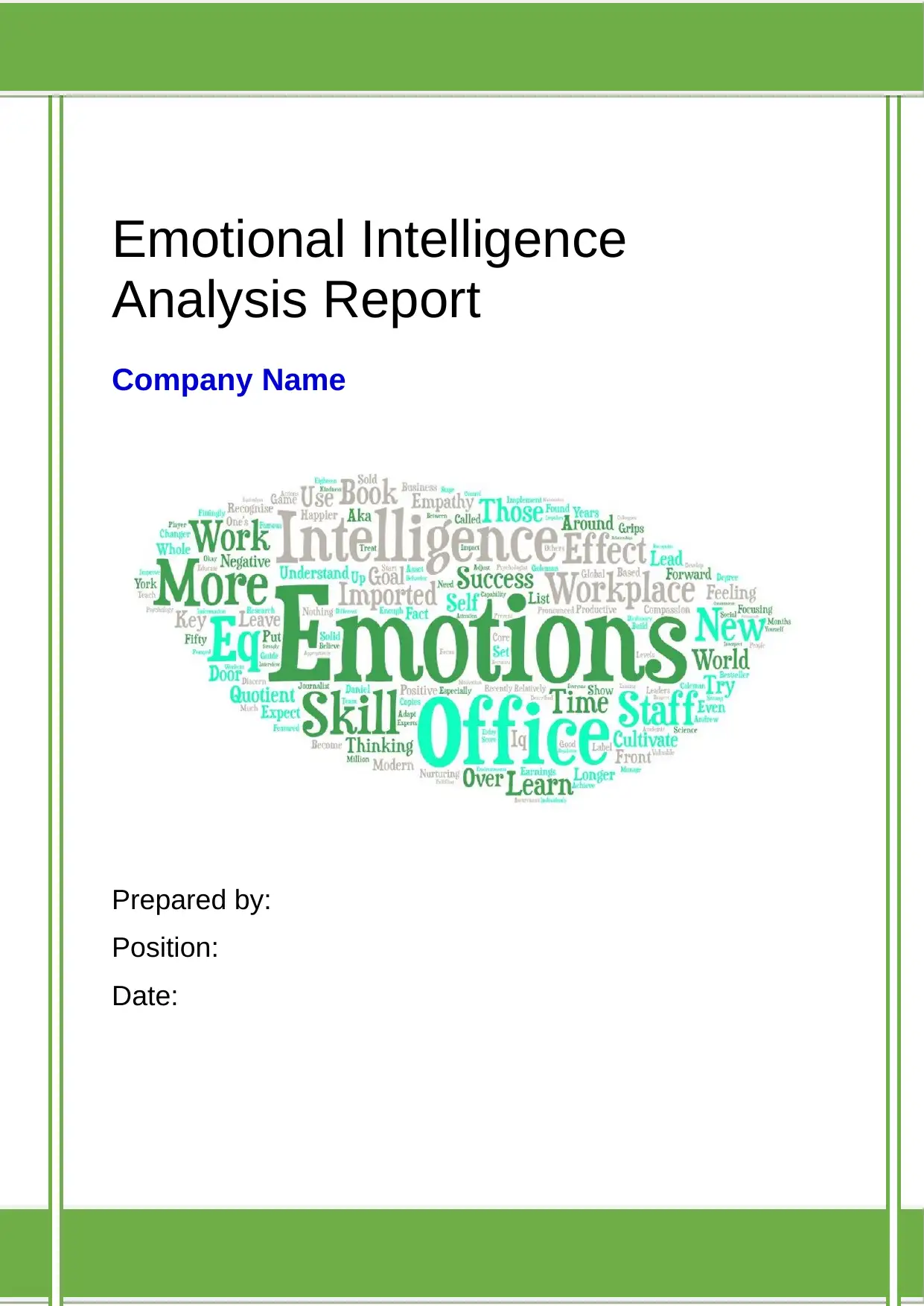
T-1.8.1_v3
Emotional Intelligence
Analysis Report
Company Name
Prepared by:
Position:
Date:
Emotional Intelligence - Assessment Task 1 v2, Last updated by NC 10/07/19 Page 12
Emotional Intelligence
Analysis Report
Company Name
Prepared by:
Position:
Date:
Emotional Intelligence - Assessment Task 1 v2, Last updated by NC 10/07/19 Page 12
⊘ This is a preview!⊘
Do you want full access?
Subscribe today to unlock all pages.
Trusted by 1+ million students worldwide

1 out of 28


Related Documents


Your All-in-One AI-Powered Toolkit for Academic Success.
+13062052269
info@desklib.com
Available 24*7 on WhatsApp / Email
![[object Object]](/_next/static/media/star-bottom.7253800d.svg)
Unlock your academic potential
Copyright © 2020–2026 A2Z Services. All Rights Reserved. Developed and managed by ZUCOL.