University Essay: Emotional Intelligence Development in Infants

Verified

Added on  2022/11/25

|4
|744
|249
Essay
AI Summary
This essay delves into the realm of emotional intelligence in infants, highlighting its profound influence on their actions and behaviors. It explores three crucial aspects: attachment, infant curriculum, and conceptualizing relationships with objects. The essay emphasizes the significance of emotional intelligence in early childhood, particularly the role of teachers in fostering emotional maturity. It identifies attachment behavior as a key area for development, recognizing its potential impact on the child's future independence. The essay underscores the need for interventions to promote healthy emotional growth and reduce dependence on caregivers. The essay also mentions the importance of the teacher's role in understanding the kind of curriculum which needs to be developed which would ensure the imparting of necessary education. In essence, this essay offers valuable insights into the emotional landscape of infants and the critical role of caregivers and educators in nurturing their emotional intelligence.
Document Page
Running head: EMOTIONAL INTELLIGENCE IN INFANTS
Emotional Intelligence in infants
Name of the Student
Name of the University
Author Note
tabler-icon-diamond-filled.svg

Paraphrase This Document

Need a fresh take? Get an instant paraphrase of this document with our AI Paraphraser
Document Page
1EMOTIONAL INTELLIGENCE IN INFANTS
Introduction
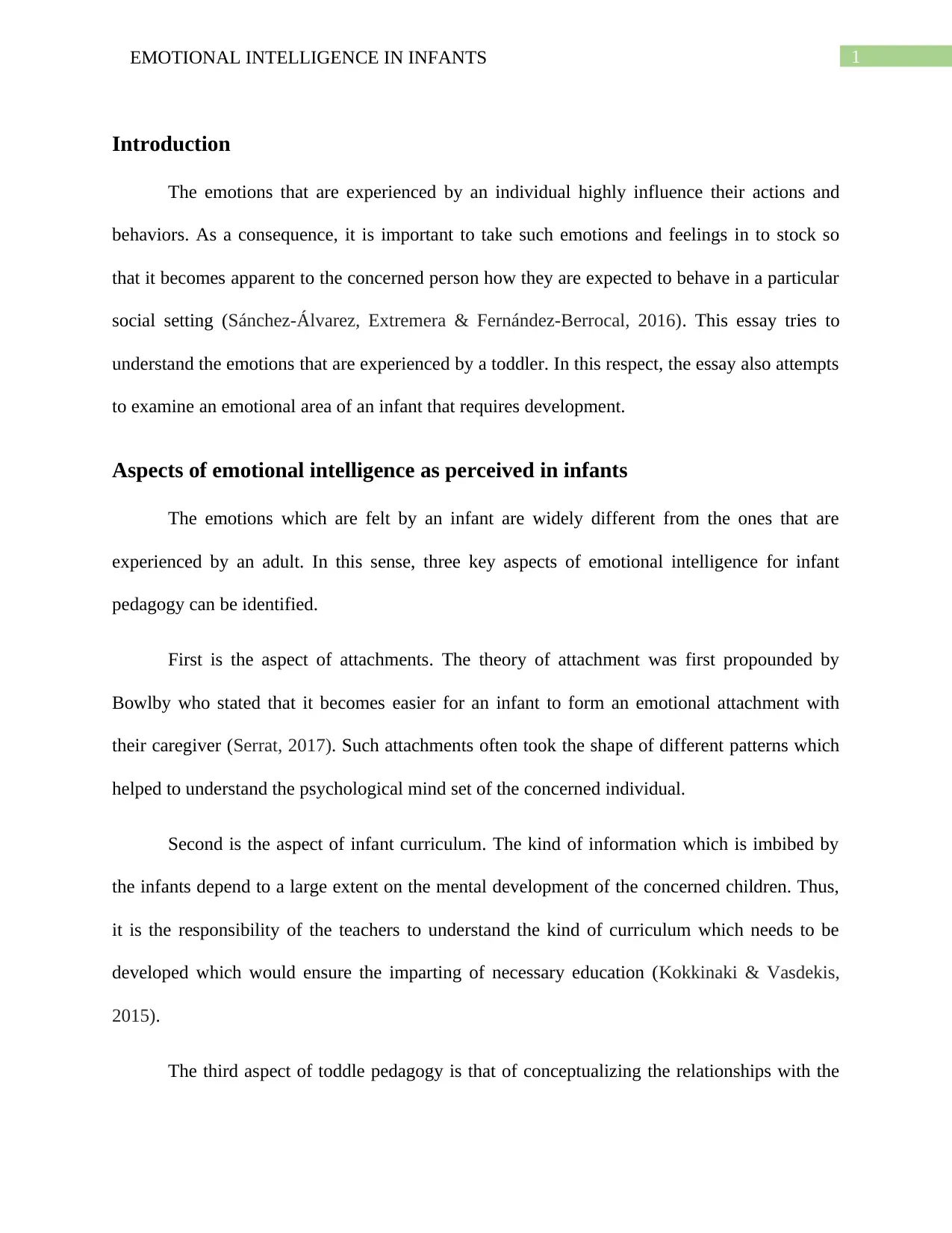
The emotions that are experienced by an individual highly influence their actions and
behaviors. As a consequence, it is important to take such emotions and feelings in to stock so
that it becomes apparent to the concerned person how they are expected to behave in a particular
social setting (Sánchez-Álvarez, Extremera & Fernández-Berrocal, 2016). This essay tries to
understand the emotions that are experienced by a toddler. In this respect, the essay also attempts
to examine an emotional area of an infant that requires development.
Aspects of emotional intelligence as perceived in infants
The emotions which are felt by an infant are widely different from the ones that are
experienced by an adult. In this sense, three key aspects of emotional intelligence for infant
pedagogy can be identified.
First is the aspect of attachments. The theory of attachment was first propounded by
Bowlby who stated that it becomes easier for an infant to form an emotional attachment with
their caregiver (Serrat, 2017). Such attachments often took the shape of different patterns which
helped to understand the psychological mind set of the concerned individual.
Second is the aspect of infant curriculum. The kind of information which is imbibed by
the infants depend to a large extent on the mental development of the concerned children. Thus,
it is the responsibility of the teachers to understand the kind of curriculum which needs to be
developed which would ensure the imparting of necessary education (Kokkinaki & Vasdekis,
2015).
The third aspect of toddle pedagogy is that of conceptualizing the relationships with the
Document Page
2EMOTIONAL INTELLIGENCE IN INFANTS
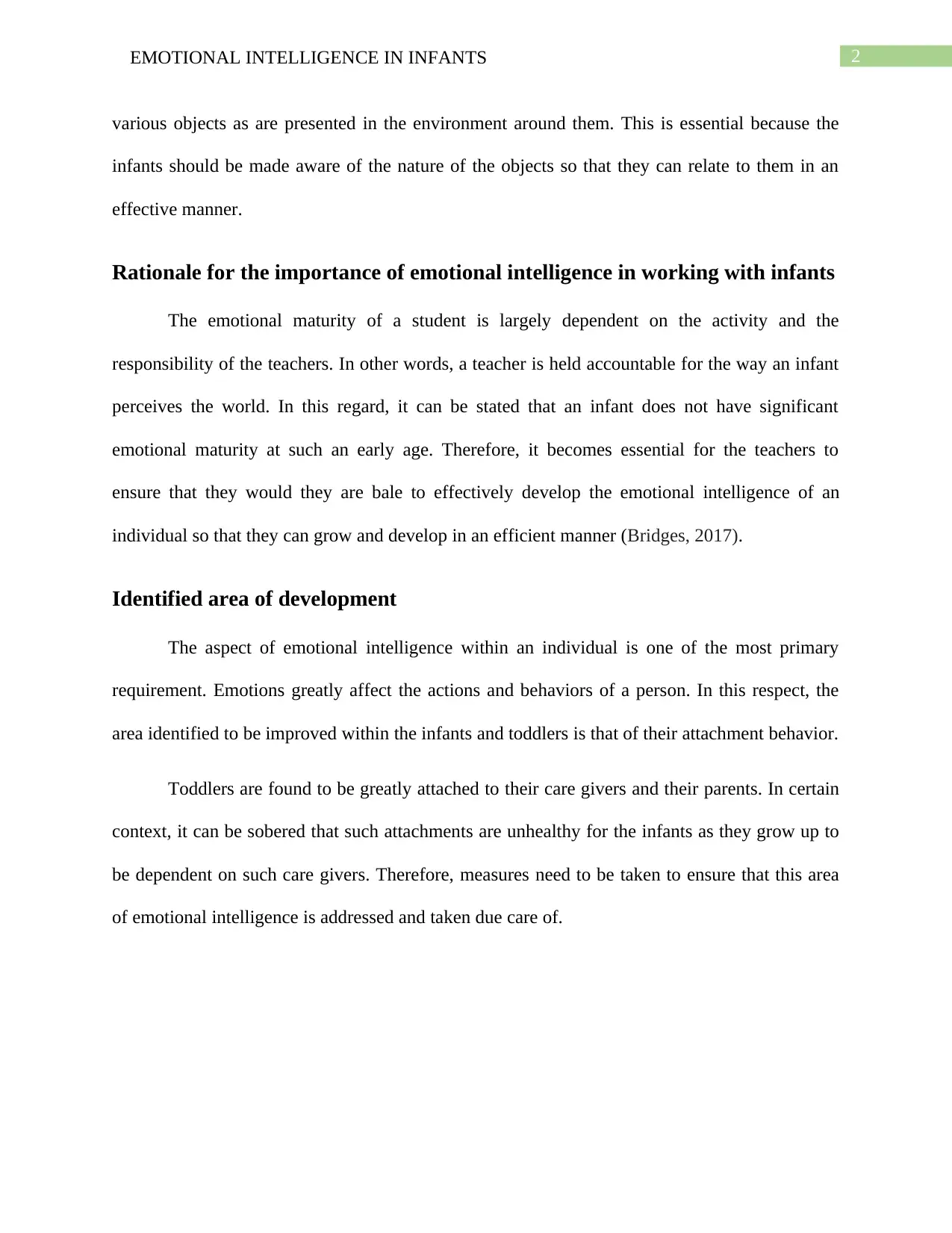
various objects as are presented in the environment around them. This is essential because the
infants should be made aware of the nature of the objects so that they can relate to them in an
effective manner.
Rationale for the importance of emotional intelligence in working with infants
The emotional maturity of a student is largely dependent on the activity and the
responsibility of the teachers. In other words, a teacher is held accountable for the way an infant
perceives the world. In this regard, it can be stated that an infant does not have significant
emotional maturity at such an early age. Therefore, it becomes essential for the teachers to
ensure that they would they are bale to effectively develop the emotional intelligence of an
individual so that they can grow and develop in an efficient manner (Bridges, 2017).
Identified area of development
The aspect of emotional intelligence within an individual is one of the most primary
requirement. Emotions greatly affect the actions and behaviors of a person. In this respect, the
area identified to be improved within the infants and toddlers is that of their attachment behavior.
Toddlers are found to be greatly attached to their care givers and their parents. In certain
context, it can be sobered that such attachments are unhealthy for the infants as they grow up to
be dependent on such care givers. Therefore, measures need to be taken to ensure that this area
of emotional intelligence is addressed and taken due care of.
Document Page
3EMOTIONAL INTELLIGENCE IN INFANTS
References:
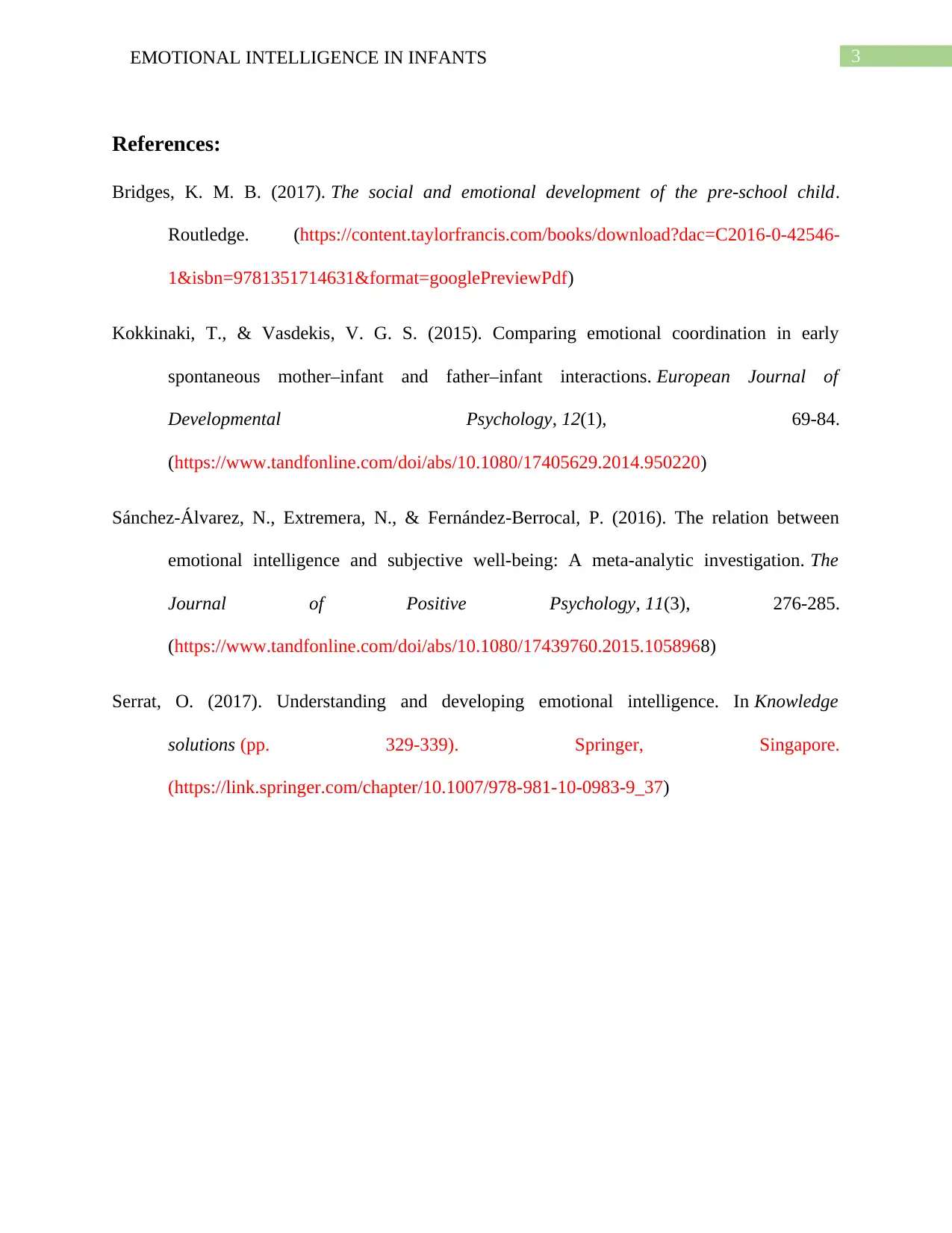
Bridges, K. M. B. (2017). The social and emotional development of the pre-school child.
Routledge. (https://content.taylorfrancis.com/books/download?dac=C2016-0-42546-
1&isbn=9781351714631&format=googlePreviewPdf)
Kokkinaki, T., & Vasdekis, V. G. S. (2015). Comparing emotional coordination in early
spontaneous mother–infant and father–infant interactions. European Journal of
Developmental Psychology, 12(1), 69-84.
(https://www.tandfonline.com/doi/abs/10.1080/17405629.2014.950220)
Sánchez-Álvarez, N., Extremera, N., & Fernández-Berrocal, P. (2016). The relation between
emotional intelligence and subjective well-being: A meta-analytic investigation. The
Journal of Positive Psychology, 11(3), 276-285.
(https://www.tandfonline.com/doi/abs/10.1080/17439760.2015.1058968)
Serrat, O. (2017). Understanding and developing emotional intelligence. In Knowledge
solutions (pp. 329-339). Springer, Singapore.
(https://link.springer.com/chapter/10.1007/978-981-10-0983-9_37)
chevron_up_icon
1 out of 4
circle_padding
hide_on_mobile
zoom_out_icon
[object Object]