The Impact of Emotional Intelligence on Leadership and Connection
VerifiedAdded on 2022/01/18
|7
|2122
|159
Essay
AI Summary
This essay delves into the critical role of emotional intelligence (EI) in effective leadership. It argues that managers with high EI are better equipped to connect with their employees, understand their emotions, and foster improved working relationships. The essay defines EI, highlighting its core components: self-awareness, self-regulation, social awareness, and relationship management. It explores how these competencies contribute to enhanced employee performance and organizational success. The author supports the argument with references to various studies and research, emphasizing that emotionally intelligent leaders can create a more positive and productive work environment by understanding and responding to the emotional needs of their staff. The essay concludes that EI is essential for modern leadership, driving both individual and organizational success.

1
Leadership and Emotional Connection
Table of Contents
Leadership and Emotional Connection
Table of Contents

Paraphrase This Document
Need a fresh take? Get an instant paraphrase of this document with our AI Paraphraser
2
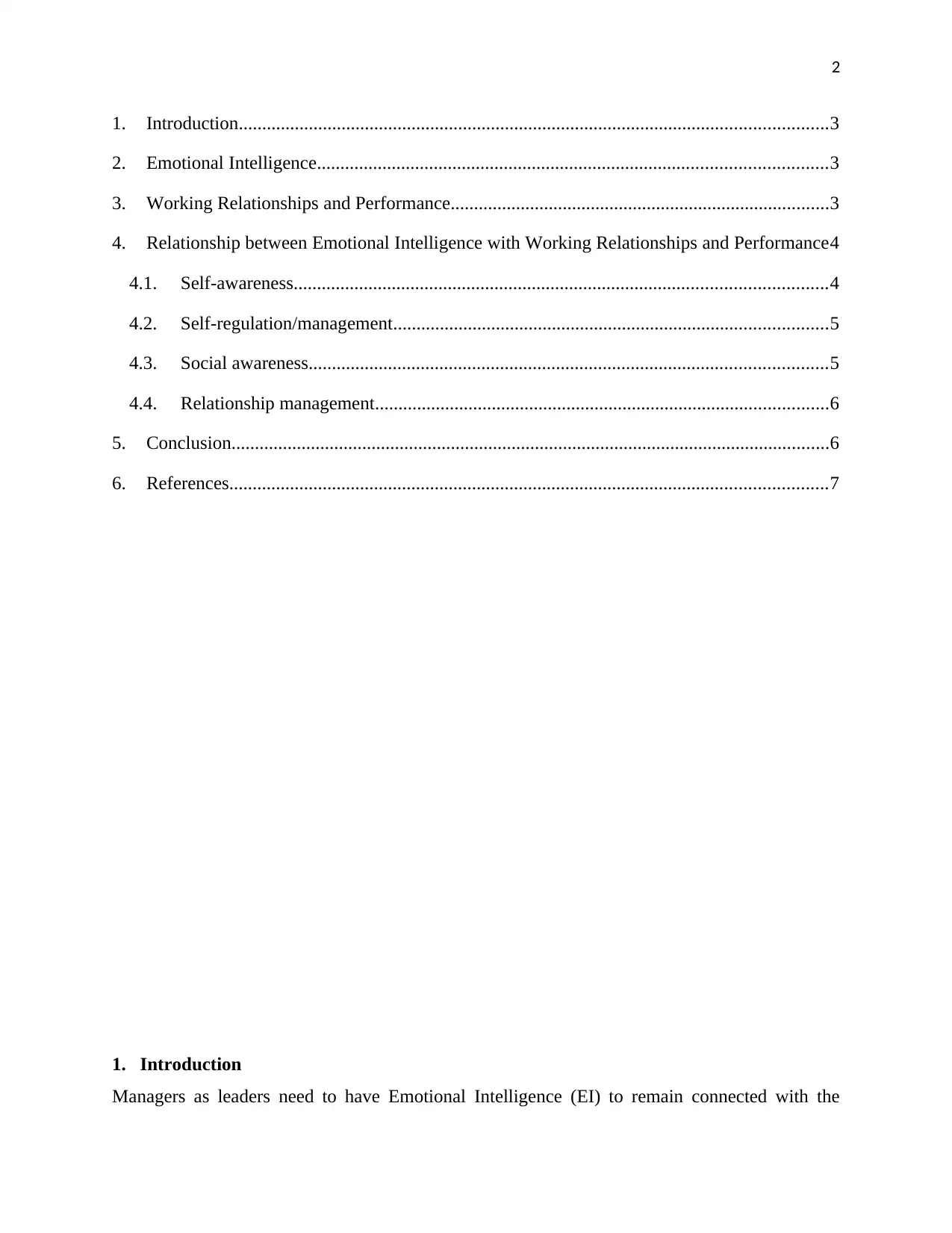
1. Introduction..............................................................................................................................3
2. Emotional Intelligence.............................................................................................................3
3. Working Relationships and Performance.................................................................................3
4. Relationship between Emotional Intelligence with Working Relationships and Performance4
4.1. Self-awareness..................................................................................................................4
4.2. Self-regulation/management.............................................................................................5
4.3. Social awareness...............................................................................................................5
4.4. Relationship management.................................................................................................6
5. Conclusion................................................................................................................................6
6. References................................................................................................................................7
1. Introduction
Managers as leaders need to have Emotional Intelligence (EI) to remain connected with the
1. Introduction..............................................................................................................................3
2. Emotional Intelligence.............................................................................................................3
3. Working Relationships and Performance.................................................................................3
4. Relationship between Emotional Intelligence with Working Relationships and Performance4
4.1. Self-awareness..................................................................................................................4
4.2. Self-regulation/management.............................................................................................5
4.3. Social awareness...............................................................................................................5
4.4. Relationship management.................................................................................................6
5. Conclusion................................................................................................................................6
6. References................................................................................................................................7
1. Introduction
Managers as leaders need to have Emotional Intelligence (EI) to remain connected with the
3
employees through understanding the staff emotions which improves the working relationship
between the managers leading to improved performance. Essentially, managers with expansive
knowledge on the application of EI can read the employees than those without EI skills. EI is a
fundamental competence required from the managers as they get along with the employees in a
workplace. Managers as leaders with high emotional intelligence understand the employees’
emotions as they manifest through the emotional connection the managers have with their staff.
This fosters the employees to flourish as the managers can observe changes in the employees’
emotions triggered by the situation the staff are going through. The essay agrees that emotional
intelligence leads to an emotional connection with the employees that leads to improved working
relationships and performance.
2. Emotional Intelligence
Emotional intelligence relates to the individual ability to perceive, identify, comprehend and
effectively manage own emotions and those of others. Desti & Shanthi (2015: 147) support this
definition through the assertion that EI combines the mind cognition/intelligence and
effect/emotion. Interestingly, EI is inherently an inborn characteristic (p. 147) meaning that not
all managers possess EI. Singh (2015: 1179) elude that lack of EI under the theory of tobephobic
leadership leads to the managers showing no compassion hence no emotional connection with
the staff. Singh (2018: 1) proceeds and explains that previously good leaders were believed to
have only high cognitive abilities or Intelligent Quotient (IQ) under tobephobic leadership but
the contemporary studies have reassessed the need to have leaders who are emotionally endowed
as inferred to by (Nabih, Metwally & Nawar, 2016: 133). A Harvard Business School blog by
Landry (2019) stresses more on the need for managers to have a higher EI. However, Landry
states that IQ is as much important but it is only an entry-level requirement for an individual into
the managerial position as EI is required as quality managers should possess. Landry refers to a
study done by CareerBuilder that indicated that 71% of the employees prefer to be led by
managers with higher EQ than IQ.
3. Working Relationships and Performance
Saidi et al. (2019: 1) defines a working relationship as the employees’ ability to work together
including with the management which determines a good working relationship. Performance on
the other hand is the level of productivity, effectiveness and efficiency in the employees.
employees through understanding the staff emotions which improves the working relationship
between the managers leading to improved performance. Essentially, managers with expansive
knowledge on the application of EI can read the employees than those without EI skills. EI is a
fundamental competence required from the managers as they get along with the employees in a
workplace. Managers as leaders with high emotional intelligence understand the employees’
emotions as they manifest through the emotional connection the managers have with their staff.
This fosters the employees to flourish as the managers can observe changes in the employees’
emotions triggered by the situation the staff are going through. The essay agrees that emotional
intelligence leads to an emotional connection with the employees that leads to improved working
relationships and performance.
2. Emotional Intelligence
Emotional intelligence relates to the individual ability to perceive, identify, comprehend and
effectively manage own emotions and those of others. Desti & Shanthi (2015: 147) support this
definition through the assertion that EI combines the mind cognition/intelligence and
effect/emotion. Interestingly, EI is inherently an inborn characteristic (p. 147) meaning that not
all managers possess EI. Singh (2015: 1179) elude that lack of EI under the theory of tobephobic
leadership leads to the managers showing no compassion hence no emotional connection with
the staff. Singh (2018: 1) proceeds and explains that previously good leaders were believed to
have only high cognitive abilities or Intelligent Quotient (IQ) under tobephobic leadership but
the contemporary studies have reassessed the need to have leaders who are emotionally endowed
as inferred to by (Nabih, Metwally & Nawar, 2016: 133). A Harvard Business School blog by
Landry (2019) stresses more on the need for managers to have a higher EI. However, Landry
states that IQ is as much important but it is only an entry-level requirement for an individual into
the managerial position as EI is required as quality managers should possess. Landry refers to a
study done by CareerBuilder that indicated that 71% of the employees prefer to be led by
managers with higher EQ than IQ.
3. Working Relationships and Performance
Saidi et al. (2019: 1) defines a working relationship as the employees’ ability to work together
including with the management which determines a good working relationship. Performance on
the other hand is the level of productivity, effectiveness and efficiency in the employees.
⊘ This is a preview!⊘
Do you want full access?
Subscribe today to unlock all pages.

Trusted by 1+ million students worldwide
4
4. Relationship between Emotional Intelligence with Working Relationships and
Performance
Emotional intelligence leads to increased emotional connection with the employees which
improves working relationships and performance. (Ugoani, Amu, & Kalu, 2015: 564) support
this assertion that there is a significant positive relationship between EI and employee
performance under transformational leadership. When managers put a value on emotions, they
surrender their positional status quo and embrace the value of the employees' feelings and
emotions (Issah, 2018: 1). EI savvy managers possess the ability to manage their own emotions
as well as those of others. Ugoani, Amu, & Kalu (2015: 564) and Landry (2019) outline the core
competencies of EI required by managers: self-awareness, self-regulation/management, social
awareness and relationship management.
4.1. Self-awareness
Singh (2015: 1183) recognizes that self-awareness is an essential attribute that managers must
have to recognize changes in emotions as they happen to conduct self-assessment and assess self-
confidence for the employees. On aggregate, these ensure that the manager checks self-disruptive
emotions and impulses among the employees for appropriate actions resulting from the
management decisions made previously. In essence, a manager has to understand self-strengths
and weaknesses and the impact the internal self-assessment has on own emotions on the
employees because, it will affect the team performance (Landry, 2019). Eurich (2018) in a
Harvard Business Review challenges managers in line with self-awareness that 95% of the
managers think that they are self-aware of themselves while only 10%-15% actually are.
Consequentially, this raises challenges for the employees such as increased stress and reduced
motivation leading to a reduction in the team's success by 50%. Conversely, Eurich notes the
essence of external self-assessment which is determined by how the others (employees) view one
(manager). If one is empathetic from the employees' point of view, there will be the development
of a good relationship between the manager and the employees. The employees are satisfied with
the management making them more comfortable working in an organization culminating in
better performance.
4.2. Self-regulation/management
Nabih, Metwally & Nawar (2016: 136) note that self-regulation/management determines how
4. Relationship between Emotional Intelligence with Working Relationships and
Performance
Emotional intelligence leads to increased emotional connection with the employees which
improves working relationships and performance. (Ugoani, Amu, & Kalu, 2015: 564) support
this assertion that there is a significant positive relationship between EI and employee
performance under transformational leadership. When managers put a value on emotions, they
surrender their positional status quo and embrace the value of the employees' feelings and
emotions (Issah, 2018: 1). EI savvy managers possess the ability to manage their own emotions
as well as those of others. Ugoani, Amu, & Kalu (2015: 564) and Landry (2019) outline the core
competencies of EI required by managers: self-awareness, self-regulation/management, social
awareness and relationship management.
4.1. Self-awareness
Singh (2015: 1183) recognizes that self-awareness is an essential attribute that managers must
have to recognize changes in emotions as they happen to conduct self-assessment and assess self-
confidence for the employees. On aggregate, these ensure that the manager checks self-disruptive
emotions and impulses among the employees for appropriate actions resulting from the
management decisions made previously. In essence, a manager has to understand self-strengths
and weaknesses and the impact the internal self-assessment has on own emotions on the
employees because, it will affect the team performance (Landry, 2019). Eurich (2018) in a
Harvard Business Review challenges managers in line with self-awareness that 95% of the
managers think that they are self-aware of themselves while only 10%-15% actually are.
Consequentially, this raises challenges for the employees such as increased stress and reduced
motivation leading to a reduction in the team's success by 50%. Conversely, Eurich notes the
essence of external self-assessment which is determined by how the others (employees) view one
(manager). If one is empathetic from the employees' point of view, there will be the development
of a good relationship between the manager and the employees. The employees are satisfied with
the management making them more comfortable working in an organization culminating in
better performance.
4.2. Self-regulation/management
Nabih, Metwally & Nawar (2016: 136) note that self-regulation/management determines how
Paraphrase This Document
Need a fresh take? Get an instant paraphrase of this document with our AI Paraphraser
5
managers as leaders behave in front of the employees hence affecting the relationship that the
two parties will have. Singh (2015: 1080) asserts that 90% of competencies in leadership
positions is determined by how manager handle him/herself emotionally. Therefore, according to
Landry (2019), managers have to conduct a self-management assessment on their ability to
handle emotional situations, especially stressful situations. this is because, during such trying
times, a leader who can maintain calmness will lead to the development of effective
relationships, command effective leadership on the best way forward, promote personal as well
as the employees’ growth and development and identify the challenges the company is facing.
Due to the good relationship between the managers and the employees, the employees will be
willing to be part of the solution and not the problem too as the manager has conducted
him/herself calmly during trying times leading to better employees and organizational
performance. Landry (2019) highlights the challenge behind having a manager with low EQ in
relation to self-management. Such an individual will tend to react to the problem instantly from
the impulse which is problematic as it increases the stress levels. Consequentially, such a
manager will rough up the employees hence increasing conflict leading to reduced motivation
from the employees to join the managers in problem-solving.
4.3. Social awareness
Social awareness increases with increased EQ. Nabih, Metwally & Nawar (2016: 134) equates
emotional intelligence with social intelligence which is the ability to understand and relate with
people. Issah (2018: 1) notes that the possession of these social skills influence the way
managers perceive themselves amidst the employees which influence the social relationships
they will have. Singh (2015: 1185) eludes to the Knowledge-Attitude-Behavior model of EQ and
the social dimension of EQ in the model is a reflection of the experience one has in the social
interactions with others which is a factor of Empathy and Social Competency. The more a
manager is empathetic and socially competent, the higher the social awareness he/she will have
when one is with the employees. Landry (2019) expounds that social awareness capabilities
enable a manager to read the employees mood in a room and dynamically strategize the best way
to address the employees without hurting their feelings. If one of the employees is sad, a leader
who has social awareness straits will spot this hence and will go further to trigger a conversation
that will lead to the employee opening up which is part of the problem-solving process. After
opening up, the management will help in solving the problem hence returning the individual to
managers as leaders behave in front of the employees hence affecting the relationship that the
two parties will have. Singh (2015: 1080) asserts that 90% of competencies in leadership
positions is determined by how manager handle him/herself emotionally. Therefore, according to
Landry (2019), managers have to conduct a self-management assessment on their ability to
handle emotional situations, especially stressful situations. this is because, during such trying
times, a leader who can maintain calmness will lead to the development of effective
relationships, command effective leadership on the best way forward, promote personal as well
as the employees’ growth and development and identify the challenges the company is facing.
Due to the good relationship between the managers and the employees, the employees will be
willing to be part of the solution and not the problem too as the manager has conducted
him/herself calmly during trying times leading to better employees and organizational
performance. Landry (2019) highlights the challenge behind having a manager with low EQ in
relation to self-management. Such an individual will tend to react to the problem instantly from
the impulse which is problematic as it increases the stress levels. Consequentially, such a
manager will rough up the employees hence increasing conflict leading to reduced motivation
from the employees to join the managers in problem-solving.
4.3. Social awareness
Social awareness increases with increased EQ. Nabih, Metwally & Nawar (2016: 134) equates
emotional intelligence with social intelligence which is the ability to understand and relate with
people. Issah (2018: 1) notes that the possession of these social skills influence the way
managers perceive themselves amidst the employees which influence the social relationships
they will have. Singh (2015: 1185) eludes to the Knowledge-Attitude-Behavior model of EQ and
the social dimension of EQ in the model is a reflection of the experience one has in the social
interactions with others which is a factor of Empathy and Social Competency. The more a
manager is empathetic and socially competent, the higher the social awareness he/she will have
when one is with the employees. Landry (2019) expounds that social awareness capabilities
enable a manager to read the employees mood in a room and dynamically strategize the best way
to address the employees without hurting their feelings. If one of the employees is sad, a leader
who has social awareness straits will spot this hence and will go further to trigger a conversation
that will lead to the employee opening up which is part of the problem-solving process. After
opening up, the management will help in solving the problem hence returning the individual to
6
the original optimum performance levels.
4.4. Relationship management
Better utilization of EQ leads to better relationship management. Relationship management
according to Ugoani, Amu, & Kalu (2015: 572) manifests through handling emotions well,
reading social situations, smooth interactions with the employees, using persuasion skills after
reading the individuals feelings for the manager to effect effective leadership skills, negotiating
and settling disputes with and among the employees. Applying the above attributes needed in
relationship management will lead to the building of transformational leadership as the manager
has already brought all employees on board and neutralized any emotional disarray that was
previously present. Resultantly, according to Landry (2019), the manager will be in a better
position to coach and mentor the employees leading to better performance. Issah (2018: 3)
believes that with better relations with the employees, managers can read the mood and trace the
source of the problem because the employees’ dissatisfaction with the management can alter
their moods hence demotivating them. From understanding the employees, the managers will
strategize the best efforts to motivate them through extrinsic motivators such as rewards to help
the employees perform optimally.
5. Conclusion
From the above analysis, it is evident that emotional intelligence is a crucial requirement for the
management in the execution of the leadership roles in an organization. Having emotionally
intelligent management leads to better emotional connections with the employees which in turn
builds upon better relationships between the management and the employees. In the end, this will
translate to better employees’ performance as well as the firm's performance. It is also evident
that even the managers with high IQ as a management position requirement, after being hired,
the ones with higher EQ provides an avenue for better performance. As a requirement for
managers with high EQ, they must have high self-awareness, self-regulation/management, social
awareness and relationship management. These will lead to the management being empathetic,
listen to the employees, react by motivating them leading to improved workplace relationships
and performance.
the original optimum performance levels.
4.4. Relationship management
Better utilization of EQ leads to better relationship management. Relationship management
according to Ugoani, Amu, & Kalu (2015: 572) manifests through handling emotions well,
reading social situations, smooth interactions with the employees, using persuasion skills after
reading the individuals feelings for the manager to effect effective leadership skills, negotiating
and settling disputes with and among the employees. Applying the above attributes needed in
relationship management will lead to the building of transformational leadership as the manager
has already brought all employees on board and neutralized any emotional disarray that was
previously present. Resultantly, according to Landry (2019), the manager will be in a better
position to coach and mentor the employees leading to better performance. Issah (2018: 3)
believes that with better relations with the employees, managers can read the mood and trace the
source of the problem because the employees’ dissatisfaction with the management can alter
their moods hence demotivating them. From understanding the employees, the managers will
strategize the best efforts to motivate them through extrinsic motivators such as rewards to help
the employees perform optimally.
5. Conclusion
From the above analysis, it is evident that emotional intelligence is a crucial requirement for the
management in the execution of the leadership roles in an organization. Having emotionally
intelligent management leads to better emotional connections with the employees which in turn
builds upon better relationships between the management and the employees. In the end, this will
translate to better employees’ performance as well as the firm's performance. It is also evident
that even the managers with high IQ as a management position requirement, after being hired,
the ones with higher EQ provides an avenue for better performance. As a requirement for
managers with high EQ, they must have high self-awareness, self-regulation/management, social
awareness and relationship management. These will lead to the management being empathetic,
listen to the employees, react by motivating them leading to improved workplace relationships
and performance.
⊘ This is a preview!⊘
Do you want full access?
Subscribe today to unlock all pages.
Trusted by 1+ million students worldwide
7
6. References
Desti, K., & Shanthi, R. 2015. ‘A study on emotional intelligence at work place’. European
Journal of Business and Management, vol. 24, no. 7, pp. 147-154.
Eurich T. 2018, What self-awareness really is (and how to cultivate it), Harvard Business
Review, viewed August 15, 2021, https://hbr.org/2018/01/what-self-awareness-really-is-
and-how-to-cultivate-it
Issah, M. 2018, 'Change leadership: The role of emotional intelligence. SAGE Open, vol. 8, no.
3, pp. 1-6.
Landry L. 2019, Emotional intelligence in leadership: Why it's important, Harvard Business
School Online, viewed August 15, 2021, https://online.hbs.edu/blog/post/emotional-
intelligence-in-leadership
Nabih, Y., Metwally, A. H., & Nawar, Y. S. 2016, 'Emotional intelligence as a predictor of
leadership effectiveness. The Business & Management Review, vol. 7, no. 5, pp.133-140.
Saidi, N. S. A., Michael, F. L., Sumilan, H., Lim, S. L. O., Jonathan, V., Hamidi, H., & Ahmad,
A. I. A. 2019, 'The relationship between working environment and employee
performance. Journal of Cognitive Sciences and Human Development, vol. 5, no 2, pp. 1-
9.
Singh, P. 2015, ‘Leaders lacking emotional intelligence: Towards A theory of tobephobic
leaders’. Journal of Applied Business Research (JABR), vol. 31, no 3, pp. 1179-1198.
Singh, P. 2018, ‘Tobephobic Leadership: Flip Side of Collegial Leadership’. The International
Journal of Knowledge, Culture, and Change Management: Annual Review vol. 18, no 1,
pp. 1-17.
Ugoani, J. N., Amu, C. U., & Kalu, E. O. 2015, 'Dimensions of emotional intelligence and
transformational leadership: A correlation analysis. Independent Journal of Management
& Production, vol. 6, no. 2, pp. 563-579.
6. References
Desti, K., & Shanthi, R. 2015. ‘A study on emotional intelligence at work place’. European
Journal of Business and Management, vol. 24, no. 7, pp. 147-154.
Eurich T. 2018, What self-awareness really is (and how to cultivate it), Harvard Business
Review, viewed August 15, 2021, https://hbr.org/2018/01/what-self-awareness-really-is-
and-how-to-cultivate-it
Issah, M. 2018, 'Change leadership: The role of emotional intelligence. SAGE Open, vol. 8, no.
3, pp. 1-6.
Landry L. 2019, Emotional intelligence in leadership: Why it's important, Harvard Business
School Online, viewed August 15, 2021, https://online.hbs.edu/blog/post/emotional-
intelligence-in-leadership
Nabih, Y., Metwally, A. H., & Nawar, Y. S. 2016, 'Emotional intelligence as a predictor of
leadership effectiveness. The Business & Management Review, vol. 7, no. 5, pp.133-140.
Saidi, N. S. A., Michael, F. L., Sumilan, H., Lim, S. L. O., Jonathan, V., Hamidi, H., & Ahmad,
A. I. A. 2019, 'The relationship between working environment and employee
performance. Journal of Cognitive Sciences and Human Development, vol. 5, no 2, pp. 1-
9.
Singh, P. 2015, ‘Leaders lacking emotional intelligence: Towards A theory of tobephobic
leaders’. Journal of Applied Business Research (JABR), vol. 31, no 3, pp. 1179-1198.
Singh, P. 2018, ‘Tobephobic Leadership: Flip Side of Collegial Leadership’. The International
Journal of Knowledge, Culture, and Change Management: Annual Review vol. 18, no 1,
pp. 1-17.
Ugoani, J. N., Amu, C. U., & Kalu, E. O. 2015, 'Dimensions of emotional intelligence and
transformational leadership: A correlation analysis. Independent Journal of Management
& Production, vol. 6, no. 2, pp. 563-579.

1 out of 7


Related Documents


Your All-in-One AI-Powered Toolkit for Academic Success.
+13062052269
info@desklib.com
Available 24*7 on WhatsApp / Email
![[object Object]](/_next/static/media/star-bottom.7253800d.svg)
Unlock your academic potential
Copyright © 2020–2026 A2Z Services. All Rights Reserved. Developed and managed by ZUCOL.