University Assessment: Emotional Intelligence in the Workplace
VerifiedAdded on 2022/08/16
|22
|4649
|18
Homework Assignment
AI Summary
This assignment assesses a student's understanding and application of emotional intelligence (EI) in a workplace context. The assessment includes answering questions on EI concepts, such as self-awareness, self-management, social awareness, and relationship management. The student analyzes personal stressors, provides examples of EI in action, and reflects on feedback received. The assignment also includes an emotional intelligence test, the student's reflection on stress management, and case studies analyzing workplace scenarios requiring the application of EI principles. The student demonstrates their ability to identify the impact of emotions, address strengths and weaknesses, and promote EI within a team setting. Finally, the student examines the importance of EI in diverse and professional relationships.
Running head: ASSESSMENT
ASSESSMENT
Name of the student:
Name of the University:
Author Note:
ASSESSMENT
Name of the student:
Name of the University:
Author Note:

Paraphrase This Document
Need a fresh take? Get an instant paraphrase of this document with our AI Paraphraser
1ASSESSMENT
Assessment 1: Written Questions
Question 1.
Emotional intelligence is the capability to identify one’s own emptions and that of the others1.
This leads to self-motivation and help in monitoring ad knowing how to monitor the emotions
and those of the persons around them.
Question 2.
Understanding emotional intelligence and its importance in the workplace is a necessity
as this helps employees to realise the factors affecting emotion and prevent immediate relation of
it. This is important because, this leads to understand the emotions of the others and act correctly
avoiding any scope of conflict.
Question 3.
Three personal stressors in the workplace are physical discomfort, interpersonal conflicts and
disorganisation.
Question 4.
Managers are set in such a position that remain in the focus of the employees and other
stakeholders. They keep watching each and every move, actions, and decisions and keep on
learning from their behaviours. Therefore the managers are to act according to the expiations of
their employees and maintain congruency between their words and actions.
1 Lee, Ye Hoon, and Packianathan Chelladurai. "Emotional intelligence, emotional labor, coach burnout, job satisfaction, and
turnover intention in sport leadership." European Sport Management Quarterly 18.4 (2018): 393-412.
Assessment 1: Written Questions
Question 1.
Emotional intelligence is the capability to identify one’s own emptions and that of the others1.
This leads to self-motivation and help in monitoring ad knowing how to monitor the emotions
and those of the persons around them.
Question 2.
Understanding emotional intelligence and its importance in the workplace is a necessity
as this helps employees to realise the factors affecting emotion and prevent immediate relation of
it. This is important because, this leads to understand the emotions of the others and act correctly
avoiding any scope of conflict.
Question 3.
Three personal stressors in the workplace are physical discomfort, interpersonal conflicts and
disorganisation.
Question 4.
Managers are set in such a position that remain in the focus of the employees and other
stakeholders. They keep watching each and every move, actions, and decisions and keep on
learning from their behaviours. Therefore the managers are to act according to the expiations of
their employees and maintain congruency between their words and actions.
1 Lee, Ye Hoon, and Packianathan Chelladurai. "Emotional intelligence, emotional labor, coach burnout, job satisfaction, and
turnover intention in sport leadership." European Sport Management Quarterly 18.4 (2018): 393-412.
2ASSESSMENT
Question 5.
I was given a constructive feedback from one of my colleagues about the gender biasness. I had a
bias regarding the ability of the female workers in the workplace. This was pointed out by one of
my colleagues and developing upon his feedback I have overcome that issue now.
Question 6.
There are various factors that contribute towards a healthy workplace. These are-
Comfortable place
Clean surroundings
Organistion
Great connection with the colleagues
Minimum distraction
Time away
Work life balance2.
Question 7.
Emotions play an important role in the cross culture communication. The individualistic culture
impresses people to observe high arousal of emotions and they are valued. In the collective
culture like that of china, personal emotions are dominated by the team emotion.
Question 8.
2 Carson, Kerry D., Paula Phillips Carson, and Betty J. Birkenmeier. "Measuring emotional intelligence: Development and
validation of an instrument." Journal of Behavioral and applied Management 2.1 (2016): 810.
Question 5.
I was given a constructive feedback from one of my colleagues about the gender biasness. I had a
bias regarding the ability of the female workers in the workplace. This was pointed out by one of
my colleagues and developing upon his feedback I have overcome that issue now.
Question 6.
There are various factors that contribute towards a healthy workplace. These are-
Comfortable place
Clean surroundings
Organistion
Great connection with the colleagues
Minimum distraction
Time away
Work life balance2.
Question 7.
Emotions play an important role in the cross culture communication. The individualistic culture
impresses people to observe high arousal of emotions and they are valued. In the collective
culture like that of china, personal emotions are dominated by the team emotion.
Question 8.
2 Carson, Kerry D., Paula Phillips Carson, and Betty J. Birkenmeier. "Measuring emotional intelligence: Development and
validation of an instrument." Journal of Behavioral and applied Management 2.1 (2016): 810.
⊘ This is a preview!⊘
Do you want full access?
Subscribe today to unlock all pages.

Trusted by 1+ million students worldwide
3ASSESSMENT
In working in the organistion I have come across different situations in which I have shown
emotional flexibility and adaptability in the workplace. I have controlled emotions at the tie of
conflicts and searched for alternative solutions to a critical problem. I have accepted surprise and
tremendous pressure of work and showed calm and confidence.
Question 9.
Emotional reasoning has been a cognitive process by which the persons conclude that his
emotional reactions can prove something to be true without taking care of any observed
evidences. Emotional reasoning amplifies effects of other cognitive distortions. Emotional
reasoning has close connection with the decision making process3. This is due to the fact that
people keep strong focus upon the reasoning while decision making. Emotional reasoning
prevents overreaction this reduce scope for conflicts.
Question 10.
Upward communication refers to the process of information flowing from the lower level
of hierarchy to the upper levels. This type of communication in the organisation is becoming
more popular because this is an effective way of reaching the employees by the managers. The
voice of the employee through the type of communication reaches more effectively to the
management level which gives scope for perfect handling of conflicts in the growund level.
Question 11.
3 Serrat, Olivier. "Understanding and developing emotional intelligence." Knowledge solutions. Springer, Singapore, 2017. 329-
339.
In working in the organistion I have come across different situations in which I have shown
emotional flexibility and adaptability in the workplace. I have controlled emotions at the tie of
conflicts and searched for alternative solutions to a critical problem. I have accepted surprise and
tremendous pressure of work and showed calm and confidence.
Question 9.
Emotional reasoning has been a cognitive process by which the persons conclude that his
emotional reactions can prove something to be true without taking care of any observed
evidences. Emotional reasoning amplifies effects of other cognitive distortions. Emotional
reasoning has close connection with the decision making process3. This is due to the fact that
people keep strong focus upon the reasoning while decision making. Emotional reasoning
prevents overreaction this reduce scope for conflicts.
Question 10.
Upward communication refers to the process of information flowing from the lower level
of hierarchy to the upper levels. This type of communication in the organisation is becoming
more popular because this is an effective way of reaching the employees by the managers. The
voice of the employee through the type of communication reaches more effectively to the
management level which gives scope for perfect handling of conflicts in the growund level.
Question 11.
3 Serrat, Olivier. "Understanding and developing emotional intelligence." Knowledge solutions. Springer, Singapore, 2017. 329-
339.
Paraphrase This Document
Need a fresh take? Get an instant paraphrase of this document with our AI Paraphraser
4ASSESSMENT
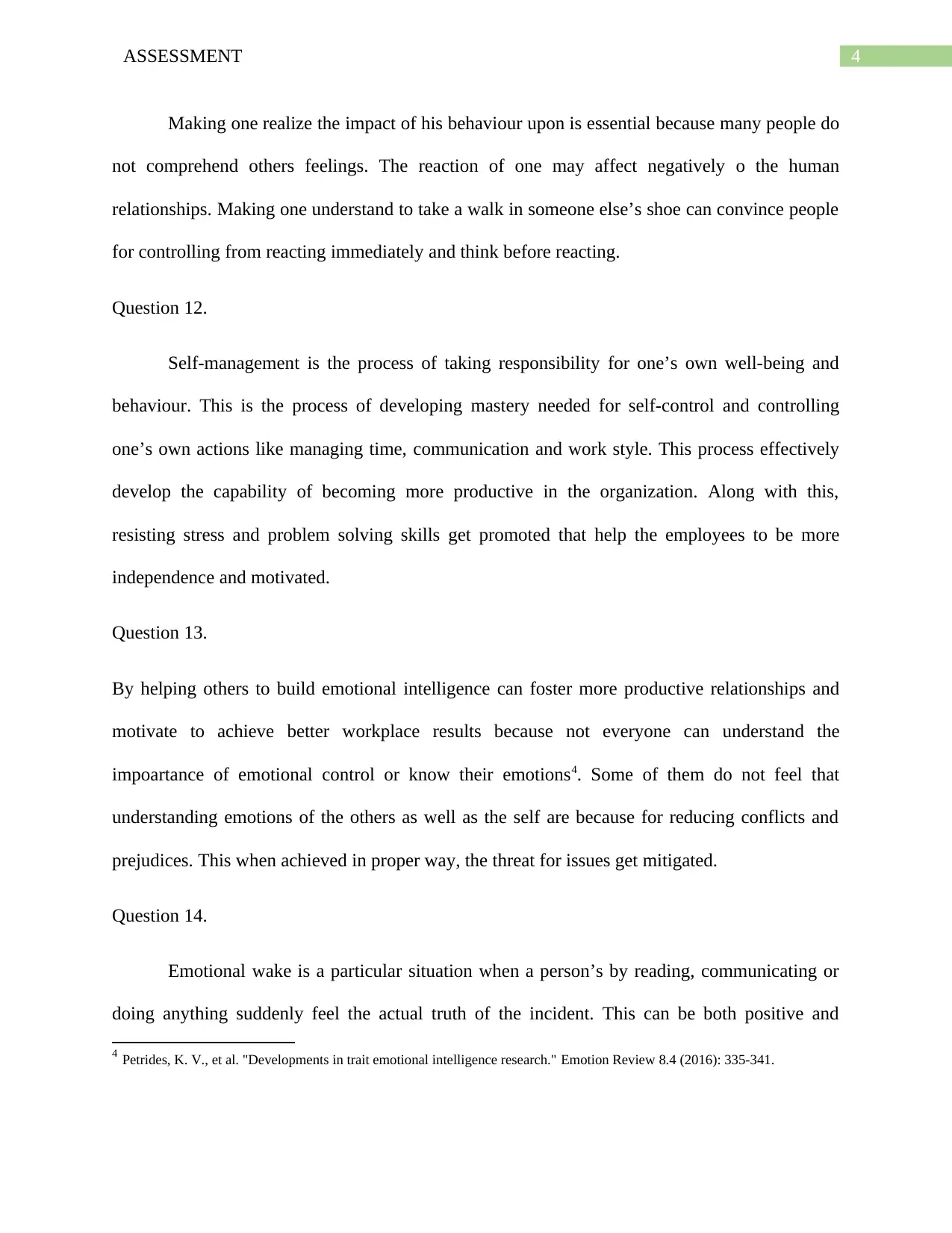
Making one realize the impact of his behaviour upon is essential because many people do
not comprehend others feelings. The reaction of one may affect negatively o the human
relationships. Making one understand to take a walk in someone else’s shoe can convince people
for controlling from reacting immediately and think before reacting.
Question 12.
Self-management is the process of taking responsibility for one’s own well-being and
behaviour. This is the process of developing mastery needed for self-control and controlling
one’s own actions like managing time, communication and work style. This process effectively
develop the capability of becoming more productive in the organization. Along with this,
resisting stress and problem solving skills get promoted that help the employees to be more
independence and motivated.
Question 13.
By helping others to build emotional intelligence can foster more productive relationships and
motivate to achieve better workplace results because not everyone can understand the
impoartance of emotional control or know their emotions4. Some of them do not feel that
understanding emotions of the others as well as the self are because for reducing conflicts and
prejudices. This when achieved in proper way, the threat for issues get mitigated.
Question 14.
Emotional wake is a particular situation when a person’s by reading, communicating or
doing anything suddenly feel the actual truth of the incident. This can be both positive and
4 Petrides, K. V., et al. "Developments in trait emotional intelligence research." Emotion Review 8.4 (2016): 335-341.
Making one realize the impact of his behaviour upon is essential because many people do
not comprehend others feelings. The reaction of one may affect negatively o the human
relationships. Making one understand to take a walk in someone else’s shoe can convince people
for controlling from reacting immediately and think before reacting.
Question 12.
Self-management is the process of taking responsibility for one’s own well-being and
behaviour. This is the process of developing mastery needed for self-control and controlling
one’s own actions like managing time, communication and work style. This process effectively
develop the capability of becoming more productive in the organization. Along with this,
resisting stress and problem solving skills get promoted that help the employees to be more
independence and motivated.
Question 13.
By helping others to build emotional intelligence can foster more productive relationships and
motivate to achieve better workplace results because not everyone can understand the
impoartance of emotional control or know their emotions4. Some of them do not feel that
understanding emotions of the others as well as the self are because for reducing conflicts and
prejudices. This when achieved in proper way, the threat for issues get mitigated.
Question 14.
Emotional wake is a particular situation when a person’s by reading, communicating or
doing anything suddenly feel the actual truth of the incident. This can be both positive and
4 Petrides, K. V., et al. "Developments in trait emotional intelligence research." Emotion Review 8.4 (2016): 335-341.
5ASSESSMENT
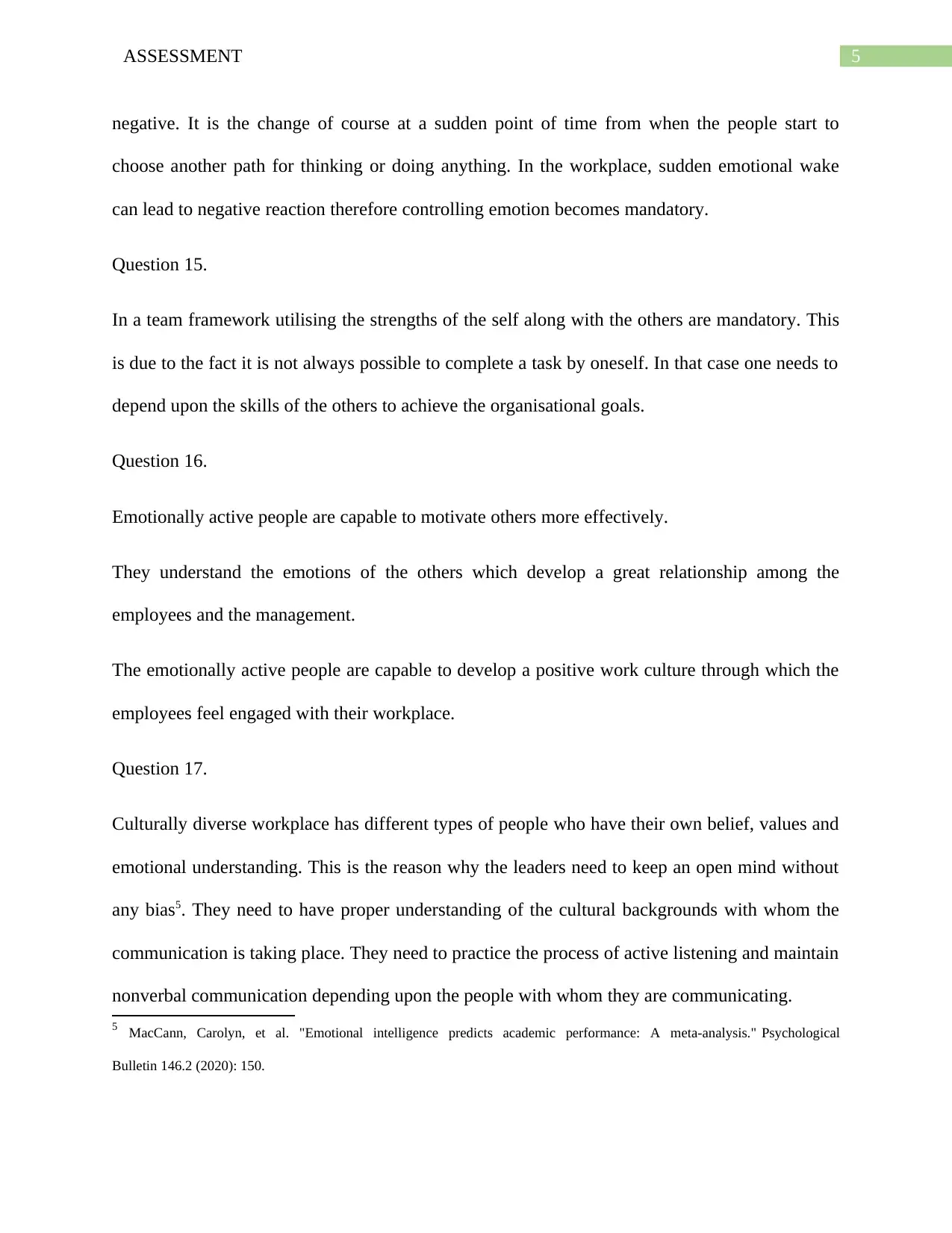
negative. It is the change of course at a sudden point of time from when the people start to
choose another path for thinking or doing anything. In the workplace, sudden emotional wake
can lead to negative reaction therefore controlling emotion becomes mandatory.
Question 15.
In a team framework utilising the strengths of the self along with the others are mandatory. This
is due to the fact it is not always possible to complete a task by oneself. In that case one needs to
depend upon the skills of the others to achieve the organisational goals.
Question 16.
Emotionally active people are capable to motivate others more effectively.
They understand the emotions of the others which develop a great relationship among the
employees and the management.
The emotionally active people are capable to develop a positive work culture through which the
employees feel engaged with their workplace.
Question 17.
Culturally diverse workplace has different types of people who have their own belief, values and
emotional understanding. This is the reason why the leaders need to keep an open mind without
any bias5. They need to have proper understanding of the cultural backgrounds with whom the
communication is taking place. They need to practice the process of active listening and maintain
nonverbal communication depending upon the people with whom they are communicating.
5 MacCann, Carolyn, et al. "Emotional intelligence predicts academic performance: A meta-analysis." Psychological
Bulletin 146.2 (2020): 150.
negative. It is the change of course at a sudden point of time from when the people start to
choose another path for thinking or doing anything. In the workplace, sudden emotional wake
can lead to negative reaction therefore controlling emotion becomes mandatory.
Question 15.
In a team framework utilising the strengths of the self along with the others are mandatory. This
is due to the fact it is not always possible to complete a task by oneself. In that case one needs to
depend upon the skills of the others to achieve the organisational goals.
Question 16.
Emotionally active people are capable to motivate others more effectively.
They understand the emotions of the others which develop a great relationship among the
employees and the management.
The emotionally active people are capable to develop a positive work culture through which the
employees feel engaged with their workplace.
Question 17.
Culturally diverse workplace has different types of people who have their own belief, values and
emotional understanding. This is the reason why the leaders need to keep an open mind without
any bias5. They need to have proper understanding of the cultural backgrounds with whom the
communication is taking place. They need to practice the process of active listening and maintain
nonverbal communication depending upon the people with whom they are communicating.
5 MacCann, Carolyn, et al. "Emotional intelligence predicts academic performance: A meta-analysis." Psychological
Bulletin 146.2 (2020): 150.
⊘ This is a preview!⊘
Do you want full access?
Subscribe today to unlock all pages.
Trusted by 1+ million students worldwide
6ASSESSMENT
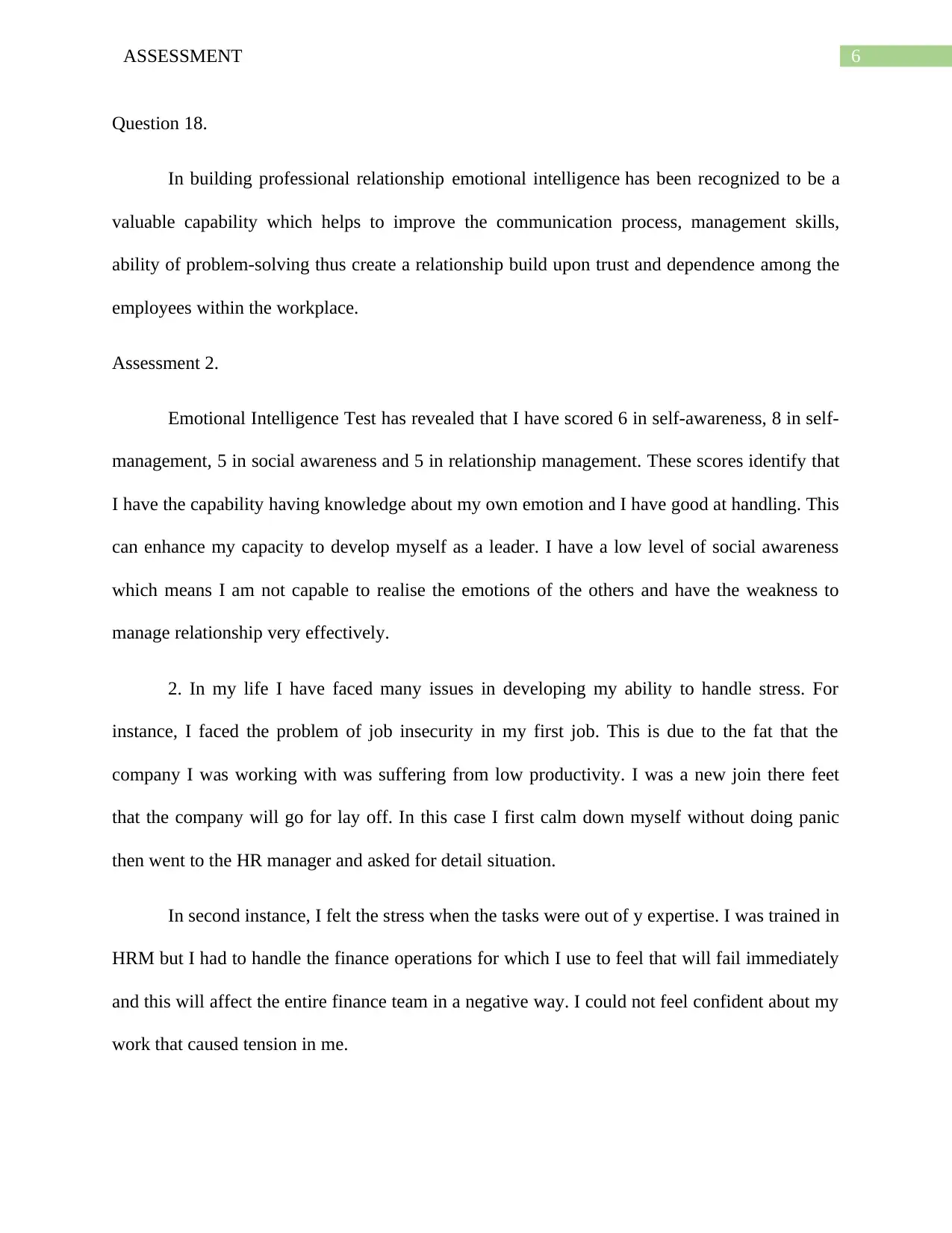
Question 18.
In building professional relationship emotional intelligence has been recognized to be a
valuable capability which helps to improve the communication process, management skills,
ability of problem-solving thus create a relationship build upon trust and dependence among the
employees within the workplace.
Assessment 2.
Emotional Intelligence Test has revealed that I have scored 6 in self-awareness, 8 in self-
management, 5 in social awareness and 5 in relationship management. These scores identify that
I have the capability having knowledge about my own emotion and I have good at handling. This
can enhance my capacity to develop myself as a leader. I have a low level of social awareness
which means I am not capable to realise the emotions of the others and have the weakness to
manage relationship very effectively.
2. In my life I have faced many issues in developing my ability to handle stress. For
instance, I faced the problem of job insecurity in my first job. This is due to the fat that the
company I was working with was suffering from low productivity. I was a new join there feet
that the company will go for lay off. In this case I first calm down myself without doing panic
then went to the HR manager and asked for detail situation.
In second instance, I felt the stress when the tasks were out of y expertise. I was trained in
HRM but I had to handle the finance operations for which I use to feel that will fail immediately
and this will affect the entire finance team in a negative way. I could not feel confident about my
work that caused tension in me.
Question 18.
In building professional relationship emotional intelligence has been recognized to be a
valuable capability which helps to improve the communication process, management skills,
ability of problem-solving thus create a relationship build upon trust and dependence among the
employees within the workplace.
Assessment 2.
Emotional Intelligence Test has revealed that I have scored 6 in self-awareness, 8 in self-
management, 5 in social awareness and 5 in relationship management. These scores identify that
I have the capability having knowledge about my own emotion and I have good at handling. This
can enhance my capacity to develop myself as a leader. I have a low level of social awareness
which means I am not capable to realise the emotions of the others and have the weakness to
manage relationship very effectively.
2. In my life I have faced many issues in developing my ability to handle stress. For
instance, I faced the problem of job insecurity in my first job. This is due to the fat that the
company I was working with was suffering from low productivity. I was a new join there feet
that the company will go for lay off. In this case I first calm down myself without doing panic
then went to the HR manager and asked for detail situation.
In second instance, I felt the stress when the tasks were out of y expertise. I was trained in
HRM but I had to handle the finance operations for which I use to feel that will fail immediately
and this will affect the entire finance team in a negative way. I could not feel confident about my
work that caused tension in me.
Paraphrase This Document
Need a fresh take? Get an instant paraphrase of this document with our AI Paraphraser
7ASSESSMENT
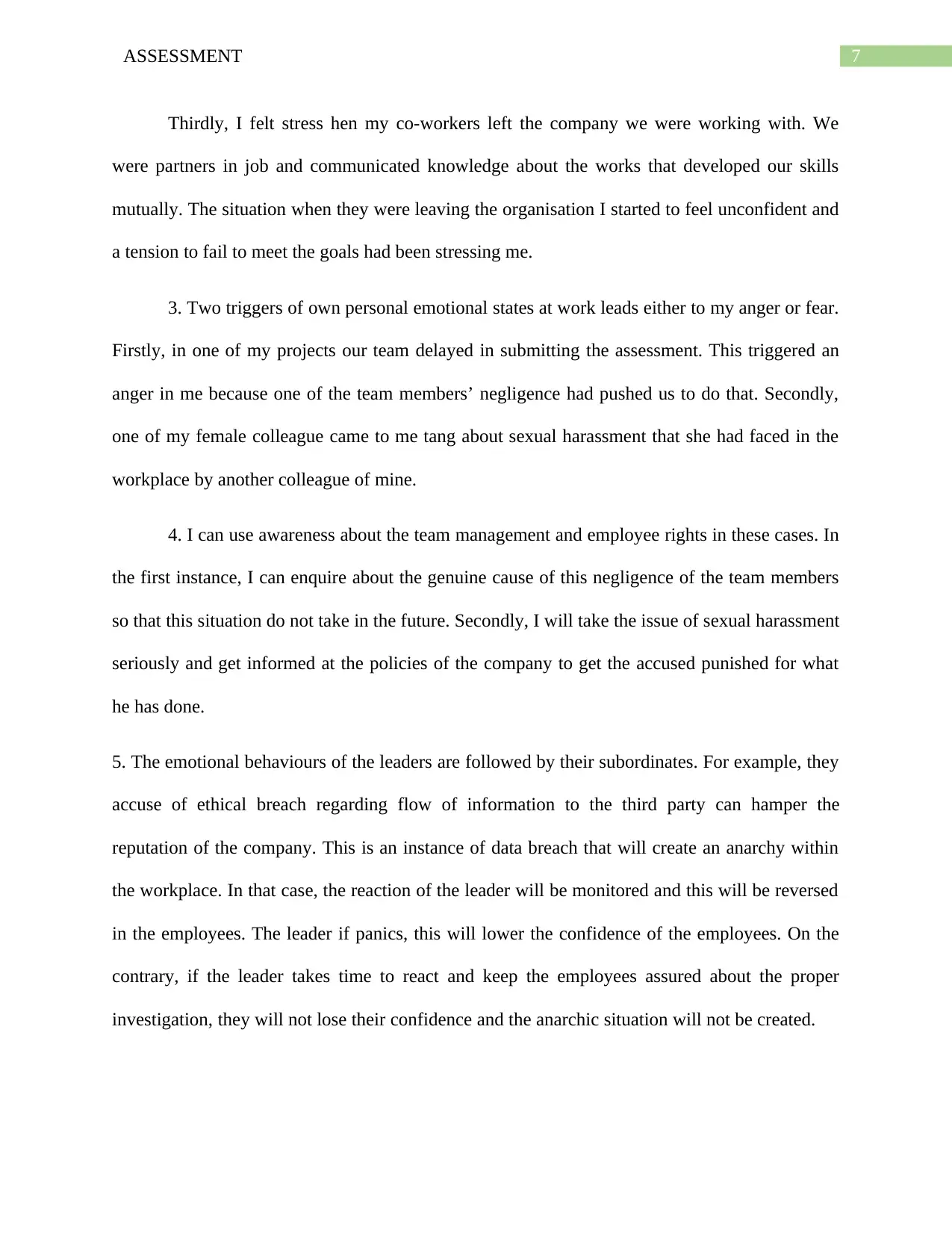
Thirdly, I felt stress hen my co-workers left the company we were working with. We
were partners in job and communicated knowledge about the works that developed our skills
mutually. The situation when they were leaving the organisation I started to feel unconfident and
a tension to fail to meet the goals had been stressing me.
3. Two triggers of own personal emotional states at work leads either to my anger or fear.
Firstly, in one of my projects our team delayed in submitting the assessment. This triggered an
anger in me because one of the team members’ negligence had pushed us to do that. Secondly,
one of my female colleague came to me tang about sexual harassment that she had faced in the
workplace by another colleague of mine.
4. I can use awareness about the team management and employee rights in these cases. In
the first instance, I can enquire about the genuine cause of this negligence of the team members
so that this situation do not take in the future. Secondly, I will take the issue of sexual harassment
seriously and get informed at the policies of the company to get the accused punished for what
he has done.
5. The emotional behaviours of the leaders are followed by their subordinates. For example, they
accuse of ethical breach regarding flow of information to the third party can hamper the
reputation of the company. This is an instance of data breach that will create an anarchy within
the workplace. In that case, the reaction of the leader will be monitored and this will be reversed
in the employees. The leader if panics, this will lower the confidence of the employees. On the
contrary, if the leader takes time to react and keep the employees assured about the proper
investigation, they will not lose their confidence and the anarchic situation will not be created.
Thirdly, I felt stress hen my co-workers left the company we were working with. We
were partners in job and communicated knowledge about the works that developed our skills
mutually. The situation when they were leaving the organisation I started to feel unconfident and
a tension to fail to meet the goals had been stressing me.
3. Two triggers of own personal emotional states at work leads either to my anger or fear.
Firstly, in one of my projects our team delayed in submitting the assessment. This triggered an
anger in me because one of the team members’ negligence had pushed us to do that. Secondly,
one of my female colleague came to me tang about sexual harassment that she had faced in the
workplace by another colleague of mine.
4. I can use awareness about the team management and employee rights in these cases. In
the first instance, I can enquire about the genuine cause of this negligence of the team members
so that this situation do not take in the future. Secondly, I will take the issue of sexual harassment
seriously and get informed at the policies of the company to get the accused punished for what
he has done.
5. The emotional behaviours of the leaders are followed by their subordinates. For example, they
accuse of ethical breach regarding flow of information to the third party can hamper the
reputation of the company. This is an instance of data breach that will create an anarchy within
the workplace. In that case, the reaction of the leader will be monitored and this will be reversed
in the employees. The leader if panics, this will lower the confidence of the employees. On the
contrary, if the leader takes time to react and keep the employees assured about the proper
investigation, they will not lose their confidence and the anarchic situation will not be created.
8ASSESSMENT
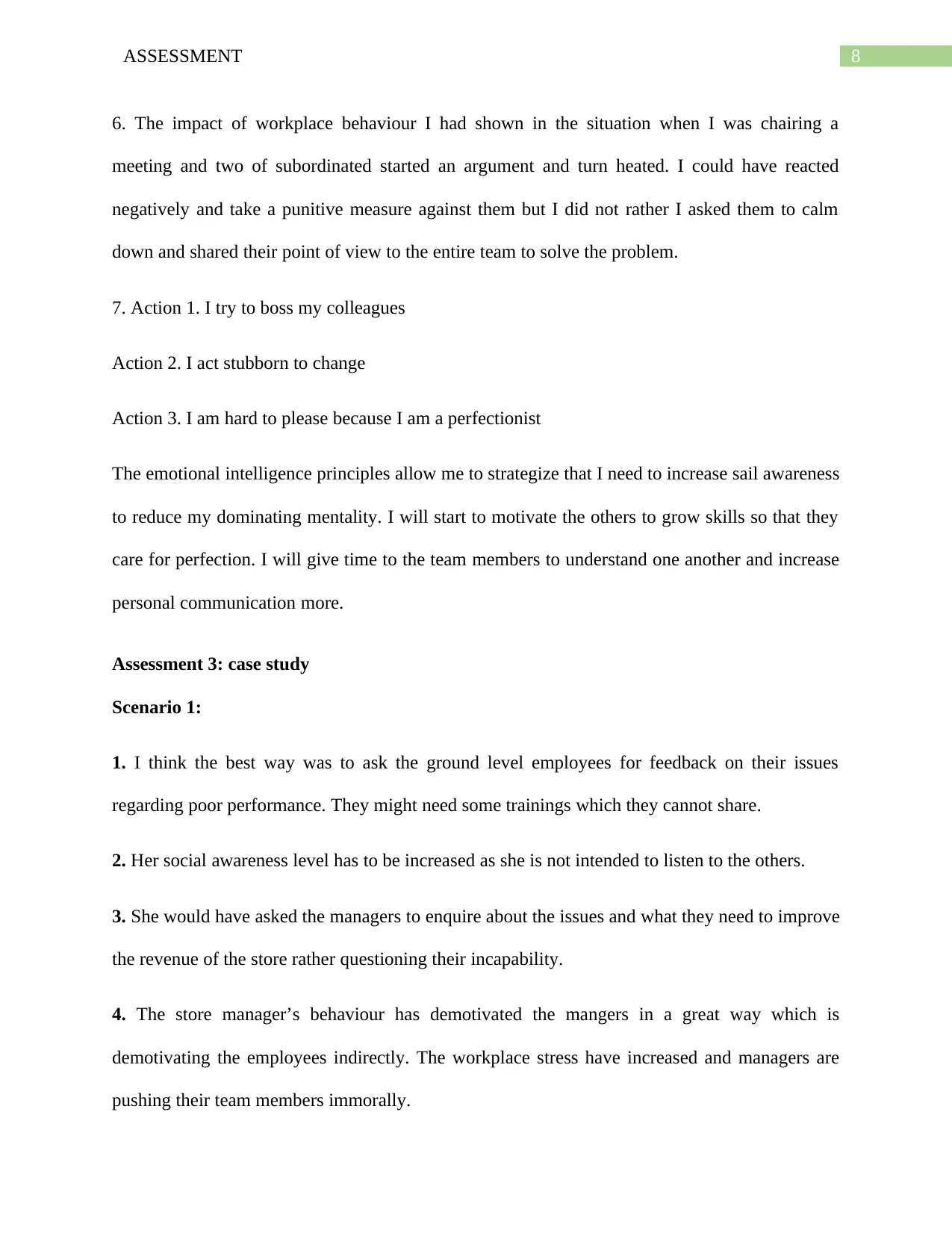
6. The impact of workplace behaviour I had shown in the situation when I was chairing a
meeting and two of subordinated started an argument and turn heated. I could have reacted
negatively and take a punitive measure against them but I did not rather I asked them to calm
down and shared their point of view to the entire team to solve the problem.
7. Action 1. I try to boss my colleagues
Action 2. I act stubborn to change
Action 3. I am hard to please because I am a perfectionist
The emotional intelligence principles allow me to strategize that I need to increase sail awareness
to reduce my dominating mentality. I will start to motivate the others to grow skills so that they
care for perfection. I will give time to the team members to understand one another and increase
personal communication more.
Assessment 3: case study
Scenario 1:
1. I think the best way was to ask the ground level employees for feedback on their issues
regarding poor performance. They might need some trainings which they cannot share.
2. Her social awareness level has to be increased as she is not intended to listen to the others.
3. She would have asked the managers to enquire about the issues and what they need to improve
the revenue of the store rather questioning their incapability.
4. The store manager’s behaviour has demotivated the mangers in a great way which is
demotivating the employees indirectly. The workplace stress have increased and managers are
pushing their team members immorally.
6. The impact of workplace behaviour I had shown in the situation when I was chairing a
meeting and two of subordinated started an argument and turn heated. I could have reacted
negatively and take a punitive measure against them but I did not rather I asked them to calm
down and shared their point of view to the entire team to solve the problem.
7. Action 1. I try to boss my colleagues
Action 2. I act stubborn to change
Action 3. I am hard to please because I am a perfectionist
The emotional intelligence principles allow me to strategize that I need to increase sail awareness
to reduce my dominating mentality. I will start to motivate the others to grow skills so that they
care for perfection. I will give time to the team members to understand one another and increase
personal communication more.
Assessment 3: case study
Scenario 1:
1. I think the best way was to ask the ground level employees for feedback on their issues
regarding poor performance. They might need some trainings which they cannot share.
2. Her social awareness level has to be increased as she is not intended to listen to the others.
3. She would have asked the managers to enquire about the issues and what they need to improve
the revenue of the store rather questioning their incapability.
4. The store manager’s behaviour has demotivated the mangers in a great way which is
demotivating the employees indirectly. The workplace stress have increased and managers are
pushing their team members immorally.
⊘ This is a preview!⊘
Do you want full access?
Subscribe today to unlock all pages.
Trusted by 1+ million students worldwide
9ASSESSMENT
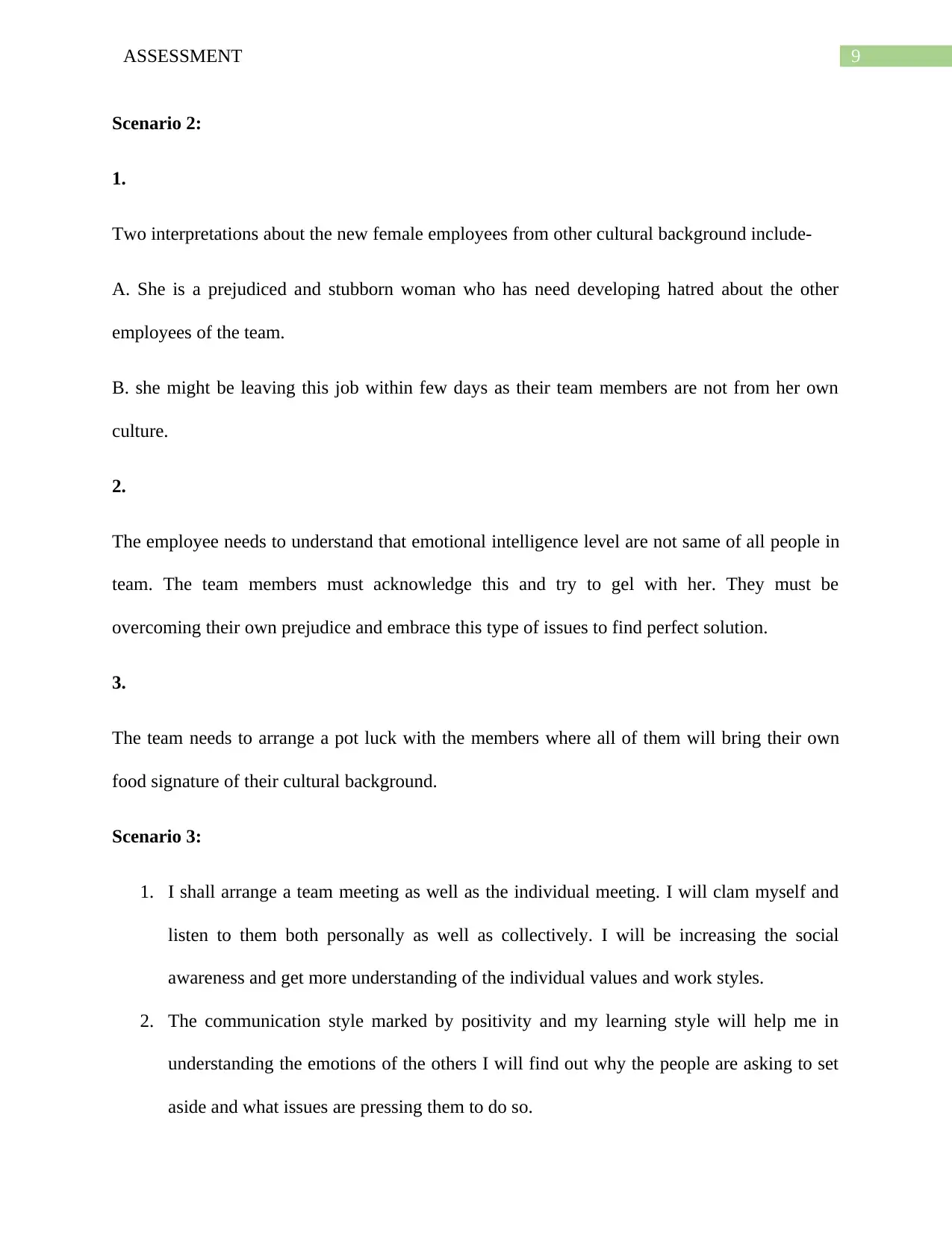
Scenario 2:
1.
Two interpretations about the new female employees from other cultural background include-
A. She is a prejudiced and stubborn woman who has need developing hatred about the other
employees of the team.
B. she might be leaving this job within few days as their team members are not from her own
culture.
2.
The employee needs to understand that emotional intelligence level are not same of all people in
team. The team members must acknowledge this and try to gel with her. They must be
overcoming their own prejudice and embrace this type of issues to find perfect solution.
3.
The team needs to arrange a pot luck with the members where all of them will bring their own
food signature of their cultural background.
Scenario 3:
1. I shall arrange a team meeting as well as the individual meeting. I will clam myself and
listen to them both personally as well as collectively. I will be increasing the social
awareness and get more understanding of the individual values and work styles.
2. The communication style marked by positivity and my learning style will help me in
understanding the emotions of the others I will find out why the people are asking to set
aside and what issues are pressing them to do so.
Scenario 2:
1.
Two interpretations about the new female employees from other cultural background include-
A. She is a prejudiced and stubborn woman who has need developing hatred about the other
employees of the team.
B. she might be leaving this job within few days as their team members are not from her own
culture.
2.
The employee needs to understand that emotional intelligence level are not same of all people in
team. The team members must acknowledge this and try to gel with her. They must be
overcoming their own prejudice and embrace this type of issues to find perfect solution.
3.
The team needs to arrange a pot luck with the members where all of them will bring their own
food signature of their cultural background.
Scenario 3:
1. I shall arrange a team meeting as well as the individual meeting. I will clam myself and
listen to them both personally as well as collectively. I will be increasing the social
awareness and get more understanding of the individual values and work styles.
2. The communication style marked by positivity and my learning style will help me in
understanding the emotions of the others I will find out why the people are asking to set
aside and what issues are pressing them to do so.
Paraphrase This Document
Need a fresh take? Get an instant paraphrase of this document with our AI Paraphraser
10ASSESSMENT
3. My emotional needs include the attainment of goals and create motivate team where the
members will have perfect bonding among themselves and thus ascribe the objectives.
The employee needs also aligns with me where a positive working culture will keep them
motivated to face any challenge.
Scenario 4:
1. The emotionally active people understanding the reasons of stress and they can handle
the pressures. They attain the business objectives and do not panic with any sudden
changes in the organistion.
2. The emotional connection with the decision making make people to take ethical steps to
attain goals. They think of the others’ emotions and align the task flow accordingly.
3. Setting performance strategies to the senior employees who do not need training can be
acceptable but delaying programs can increase stress among the new or junior employees.
They will not have proper resources to face this changes.
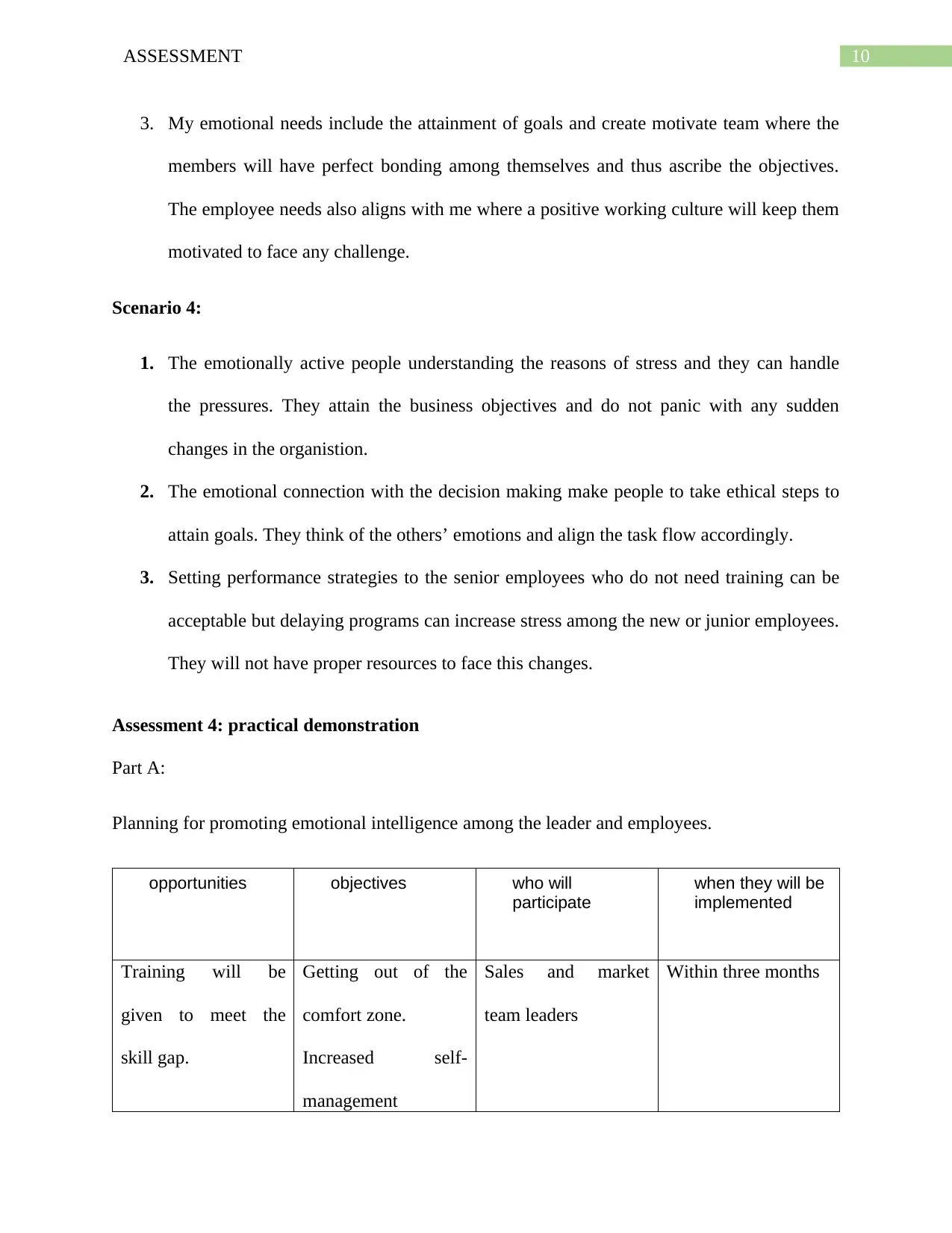
Assessment 4: practical demonstration
Part A:
Planning for promoting emotional intelligence among the leader and employees.
opportunities objectives who will
participate
when they will be
implemented
Training will be
given to meet the
skill gap.
Getting out of the
comfort zone.
Increased self-
management
Sales and market
team leaders
Within three months
3. My emotional needs include the attainment of goals and create motivate team where the
members will have perfect bonding among themselves and thus ascribe the objectives.
The employee needs also aligns with me where a positive working culture will keep them
motivated to face any challenge.
Scenario 4:
1. The emotionally active people understanding the reasons of stress and they can handle
the pressures. They attain the business objectives and do not panic with any sudden
changes in the organistion.
2. The emotional connection with the decision making make people to take ethical steps to
attain goals. They think of the others’ emotions and align the task flow accordingly.
3. Setting performance strategies to the senior employees who do not need training can be
acceptable but delaying programs can increase stress among the new or junior employees.
They will not have proper resources to face this changes.
Assessment 4: practical demonstration
Part A:
Planning for promoting emotional intelligence among the leader and employees.
opportunities objectives who will
participate
when they will be
implemented
Training will be
given to meet the
skill gap.
Getting out of the
comfort zone.
Increased self-
management
Sales and market
team leaders
Within three months
11ASSESSMENT
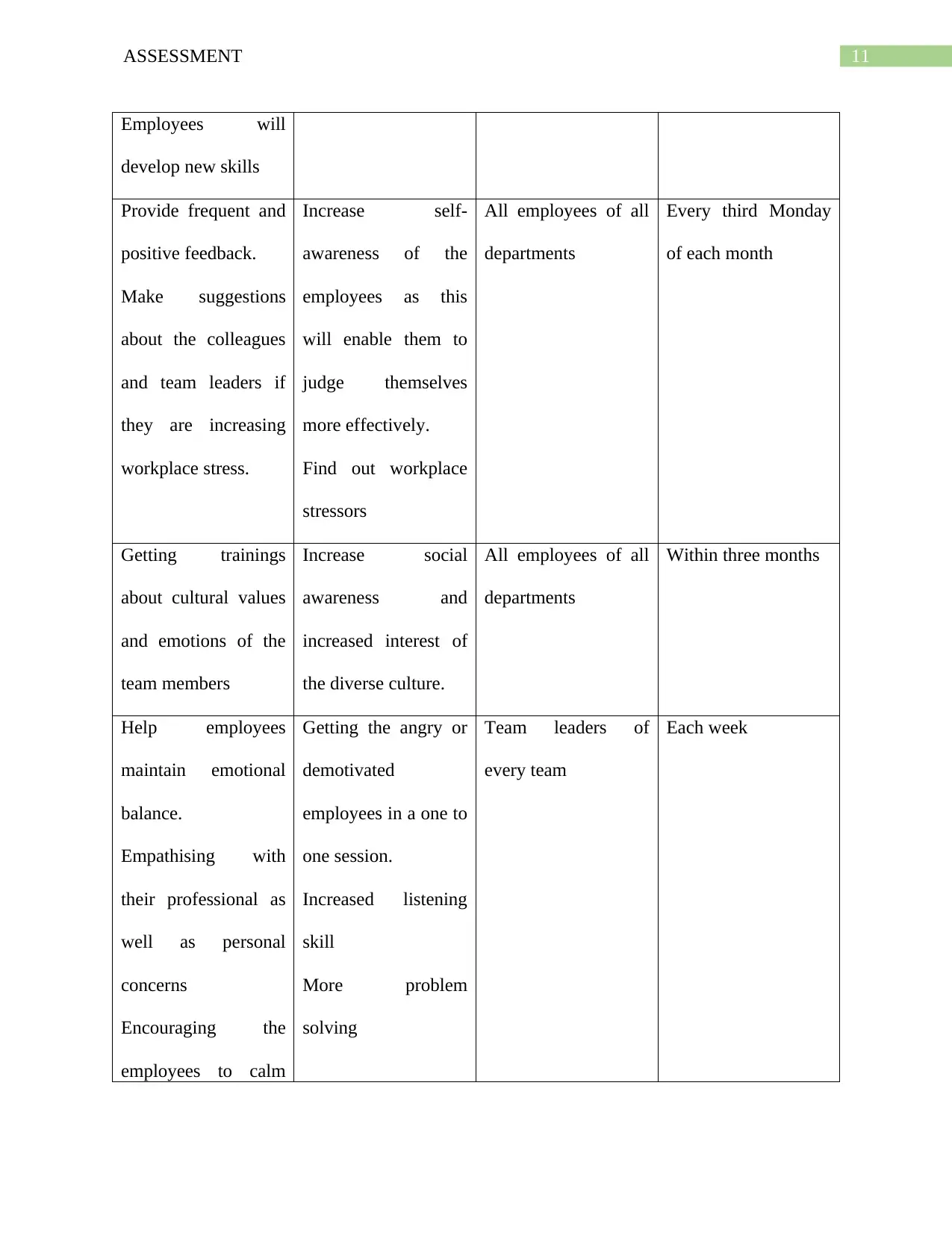
Employees will
develop new skills
Provide frequent and
positive feedback.
Make suggestions
about the colleagues
and team leaders if
they are increasing
workplace stress.
Increase self-
awareness of the
employees as this
will enable them to
judge themselves
more effectively.
Find out workplace
stressors
All employees of all
departments
Every third Monday
of each month
Getting trainings
about cultural values
and emotions of the
team members
Increase social
awareness and
increased interest of
the diverse culture.
All employees of all
departments
Within three months
Help employees
maintain emotional
balance.
Empathising with
their professional as
well as personal
concerns
Encouraging the
employees to calm
Getting the angry or
demotivated
employees in a one to
one session.
Increased listening
skill
More problem
solving
Team leaders of
every team
Each week
Employees will
develop new skills
Provide frequent and
positive feedback.
Make suggestions
about the colleagues
and team leaders if
they are increasing
workplace stress.
Increase self-
awareness of the
employees as this
will enable them to
judge themselves
more effectively.
Find out workplace
stressors
All employees of all
departments
Every third Monday
of each month
Getting trainings
about cultural values
and emotions of the
team members
Increase social
awareness and
increased interest of
the diverse culture.
All employees of all
departments
Within three months
Help employees
maintain emotional
balance.
Empathising with
their professional as
well as personal
concerns
Encouraging the
employees to calm
Getting the angry or
demotivated
employees in a one to
one session.
Increased listening
skill
More problem
solving
Team leaders of
every team
Each week
⊘ This is a preview!⊘
Do you want full access?
Subscribe today to unlock all pages.
Trusted by 1+ million students worldwide

1 out of 22


Related Documents


Your All-in-One AI-Powered Toolkit for Academic Success.
+13062052269
info@desklib.com
Available 24*7 on WhatsApp / Email
![[object Object]](/_next/static/media/star-bottom.7253800d.svg)
Unlock your academic potential
Copyright © 2020–2026 A2Z Services. All Rights Reserved. Developed and managed by ZUCOL.