Project Management Plan for Empire State Building Construction
VerifiedAdded on 2023/06/10
|20
|3831
|216
Project
AI Summary
This project management plan outlines the construction of the Empire State Building, developed by ABC Construction Company. The plan begins with an executive summary and project description, detailing the building type, intended use, and proposed delivery method and contract agreement. It then delves into stakeholder management, including analysis, a communication plan, organizational structure, and a responsibility matrix. Cost management is addressed through estimated baseline costs, project estimates broken down by trade, and a project fee proposal. Schedule management includes qualifications, a management plan, and a rough baseline schedule. Finally, the plan covers risk management, including a plan, risk register, and logistics plan with safety measures. The plan aims to convince the client of the company's ability to successfully manage the construction project.
Running head: PROJECT MANAGEMENT PLAN
Project Management Plan
(Empire State Building, ABC Construction Company)
Name of the student:
Name of the university:
Author Note
Project Management Plan
(Empire State Building, ABC Construction Company)
Name of the student:
Name of the university:
Author Note

Paraphrase This Document
Need a fresh take? Get an instant paraphrase of this document with our AI Paraphraser
1PROJECT MANAGEMENT PLAN
Executive summary
In the following study, ABC organization is chosen as the construction company to work on Empire
State Building, USA. The study aims at convincing clients about the best builders. For this
stakeholder management, cost management, schedule management and risk management are
analyzed for the construction project.
Executive summary
In the following study, ABC organization is chosen as the construction company to work on Empire
State Building, USA. The study aims at convincing clients about the best builders. For this
stakeholder management, cost management, schedule management and risk management are
analyzed for the construction project.
2PROJECT MANAGEMENT PLAN
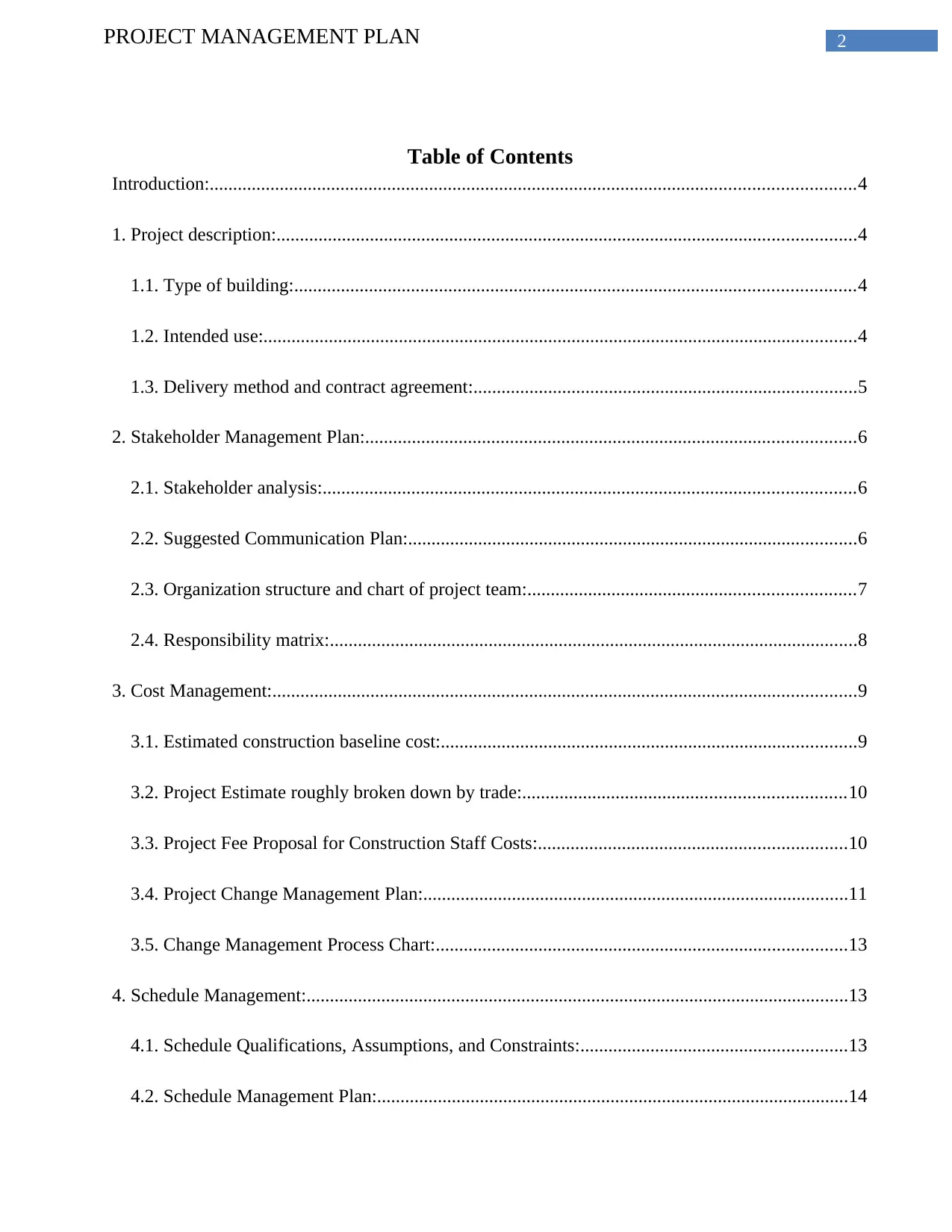
Table of Contents
Introduction:..........................................................................................................................................4
1. Project description:............................................................................................................................4
1.1. Type of building:........................................................................................................................4
1.2. Intended use:...............................................................................................................................4
1.3. Delivery method and contract agreement:..................................................................................5
2. Stakeholder Management Plan:.........................................................................................................6
2.1. Stakeholder analysis:..................................................................................................................6
2.2. Suggested Communication Plan:................................................................................................6
2.3. Organization structure and chart of project team:......................................................................7
2.4. Responsibility matrix:.................................................................................................................8
3. Cost Management:.............................................................................................................................9
3.1. Estimated construction baseline cost:.........................................................................................9
3.2. Project Estimate roughly broken down by trade:.....................................................................10
3.3. Project Fee Proposal for Construction Staff Costs:..................................................................10
3.4. Project Change Management Plan:...........................................................................................11
3.5. Change Management Process Chart:........................................................................................13
4. Schedule Management:....................................................................................................................13
4.1. Schedule Qualifications, Assumptions, and Constraints:.........................................................13
4.2. Schedule Management Plan:.....................................................................................................14
Table of Contents
Introduction:..........................................................................................................................................4
1. Project description:............................................................................................................................4
1.1. Type of building:........................................................................................................................4
1.2. Intended use:...............................................................................................................................4
1.3. Delivery method and contract agreement:..................................................................................5
2. Stakeholder Management Plan:.........................................................................................................6
2.1. Stakeholder analysis:..................................................................................................................6
2.2. Suggested Communication Plan:................................................................................................6
2.3. Organization structure and chart of project team:......................................................................7
2.4. Responsibility matrix:.................................................................................................................8
3. Cost Management:.............................................................................................................................9
3.1. Estimated construction baseline cost:.........................................................................................9
3.2. Project Estimate roughly broken down by trade:.....................................................................10
3.3. Project Fee Proposal for Construction Staff Costs:..................................................................10
3.4. Project Change Management Plan:...........................................................................................11
3.5. Change Management Process Chart:........................................................................................13
4. Schedule Management:....................................................................................................................13
4.1. Schedule Qualifications, Assumptions, and Constraints:.........................................................13
4.2. Schedule Management Plan:.....................................................................................................14
⊘ This is a preview!⊘
Do you want full access?
Subscribe today to unlock all pages.

Trusted by 1+ million students worldwide
3PROJECT MANAGEMENT PLAN
4.3. Rough Baseline Schedule:........................................................................................................14
5. Risk Management:...........................................................................................................................16
5.1. Risk Management Plan:............................................................................................................16
5.2. Risk Register:............................................................................................................................16
5.3. Logistics Plan:..........................................................................................................................17
5.4. Primary Safety measures in Logistic Plan:...............................................................................18
Conclusion:..........................................................................................................................................19
4.3. Rough Baseline Schedule:........................................................................................................14
5. Risk Management:...........................................................................................................................16
5.1. Risk Management Plan:............................................................................................................16
5.2. Risk Register:............................................................................................................................16
5.3. Logistics Plan:..........................................................................................................................17
5.4. Primary Safety measures in Logistic Plan:...............................................................................18
Conclusion:..........................................................................................................................................19
Paraphrase This Document
Need a fresh take? Get an instant paraphrase of this document with our AI Paraphraser
4PROJECT MANAGEMENT PLAN
Introduction:
The “Project Management Plan” or PMP demonstrates the typical responsibilities of project
teams. Further, it consists of various plans developed and implemented ensuring compliances with
PMP and Federal and State policy.
The following research has chosen ABC Company. This is a hypothetical construction
company. Here, the study aims to convince the client that they are best builders to take the project on
their shoulders.
Here the stakeholder management plan is analysed. Then a cost management plan is
demonstrated. Schedule management is illustrated along with an investigation of risk management
for the project of ABC Company.
1. Project description:
1.1. Type of building:
Here, the building assigned is the Empire State Building, at New York, U.S.A. Though it is
not the tallest building in New York, it is one of the most famous sites in the city. The building has
the plot has been comprising of numerous of distinct owners. Its iconic spire has been developed as
the port regarding airship. Thus the building has turned out to be one of the most popular and iconic
landmarks.
1.2. Intended use:
The United States never created the Empire State Building. The private owners and investors
developed this over the site of the previous Waldorf Astoria Hotel at the 5th Avenue on the 34th
street. This has been designed before the Great Depression while the economic system has been
Introduction:
The “Project Management Plan” or PMP demonstrates the typical responsibilities of project
teams. Further, it consists of various plans developed and implemented ensuring compliances with
PMP and Federal and State policy.
The following research has chosen ABC Company. This is a hypothetical construction
company. Here, the study aims to convince the client that they are best builders to take the project on
their shoulders.
Here the stakeholder management plan is analysed. Then a cost management plan is
demonstrated. Schedule management is illustrated along with an investigation of risk management
for the project of ABC Company.
1. Project description:
1.1. Type of building:
Here, the building assigned is the Empire State Building, at New York, U.S.A. Though it is
not the tallest building in New York, it is one of the most famous sites in the city. The building has
the plot has been comprising of numerous of distinct owners. Its iconic spire has been developed as
the port regarding airship. Thus the building has turned out to be one of the most popular and iconic
landmarks.
1.2. Intended use:
The United States never created the Empire State Building. The private owners and investors
developed this over the site of the previous Waldorf Astoria Hotel at the 5th Avenue on the 34th
street. This has been designed before the Great Depression while the economic system has been
5PROJECT MANAGEMENT PLAN
blooming and the space of office was under huge demand in Manhattan. Here, at that time it has
been developed since it was highly required. However, until it was finished U.S. economy collapsed
and the demand for the working area stopped eventually. This has been over two decades till the site
became occupied.
1.3. Delivery method and contract agreement:
Delivery method:
The delivery method must get success through innovation of designing and envisioning
projects at the mechanical and short-term manufacturing processes. This has evolved dynamically
and organically for meeting the perquisites of schedule and values. This must stand as the
confirmation of the method in which the separation and industrials and commercial concerns must be
differentiated ostensibly. This has been cross-fertilising the establishments of central management
principles that must be adaptable to a broad range of the human endeavours co-operatively.
Contract agreement:
Firstly, the agreement must consider security. Here no recordable or any lost time or
reportable injuries and lesser than the industry must be present. Then the schedule must be
considered where the established project milestone must be met. Regarding budget, the risks must be
managed to consist of the expenses under the budget. Next, as far as quality is concerned, the project
requirements must have adverse effects. For budget or milestones the environment compliances the
project should be completed instead of any violations. Regarding public perceptions, there must be
strong support through smart communications.
blooming and the space of office was under huge demand in Manhattan. Here, at that time it has
been developed since it was highly required. However, until it was finished U.S. economy collapsed
and the demand for the working area stopped eventually. This has been over two decades till the site
became occupied.
1.3. Delivery method and contract agreement:
Delivery method:
The delivery method must get success through innovation of designing and envisioning
projects at the mechanical and short-term manufacturing processes. This has evolved dynamically
and organically for meeting the perquisites of schedule and values. This must stand as the
confirmation of the method in which the separation and industrials and commercial concerns must be
differentiated ostensibly. This has been cross-fertilising the establishments of central management
principles that must be adaptable to a broad range of the human endeavours co-operatively.
Contract agreement:
Firstly, the agreement must consider security. Here no recordable or any lost time or
reportable injuries and lesser than the industry must be present. Then the schedule must be
considered where the established project milestone must be met. Regarding budget, the risks must be
managed to consist of the expenses under the budget. Next, as far as quality is concerned, the project
requirements must have adverse effects. For budget or milestones the environment compliances the
project should be completed instead of any violations. Regarding public perceptions, there must be
strong support through smart communications.
⊘ This is a preview!⊘
Do you want full access?
Subscribe today to unlock all pages.
Trusted by 1+ million students worldwide
6PROJECT MANAGEMENT PLAN
2. Stakeholder Management Plan:
2.1. Stakeholder analysis:
Here the first organisations to construct and design the Empire State Building have been the
Empire State, owners, architect, Starrett Bros and contractors. The organisations have been
committed to the companies to the group approach. This was influential regarding the project’s
success. This background had influenced project managements close to lean principles before the
lean construction got formalised.
2.2. Suggested Communication Plan:
The project must achieve success by innovating of designing and envisioning projects as the
short-term and self-regulating process of manufacturing. This has evolved dynamically and
organically for meeting the necessities of schedule and values. This has stood as the confirmation of
the method where they must ostensibly distinguish the industrial and commercial concerns. This has
been cross-fertilising the establishing of core principles of project management that is adaptable to a
broad range of cooperative endeavour of a human.
2. Stakeholder Management Plan:
2.1. Stakeholder analysis:
Here the first organisations to construct and design the Empire State Building have been the
Empire State, owners, architect, Starrett Bros and contractors. The organisations have been
committed to the companies to the group approach. This was influential regarding the project’s
success. This background had influenced project managements close to lean principles before the
lean construction got formalised.
2.2. Suggested Communication Plan:
The project must achieve success by innovating of designing and envisioning projects as the
short-term and self-regulating process of manufacturing. This has evolved dynamically and
organically for meeting the necessities of schedule and values. This has stood as the confirmation of
the method where they must ostensibly distinguish the industrial and commercial concerns. This has
been cross-fertilising the establishing of core principles of project management that is adaptable to a
broad range of cooperative endeavour of a human.
Paraphrase This Document
Need a fresh take? Get an instant paraphrase of this document with our AI Paraphraser
7PROJECT MANAGEMENT PLAN
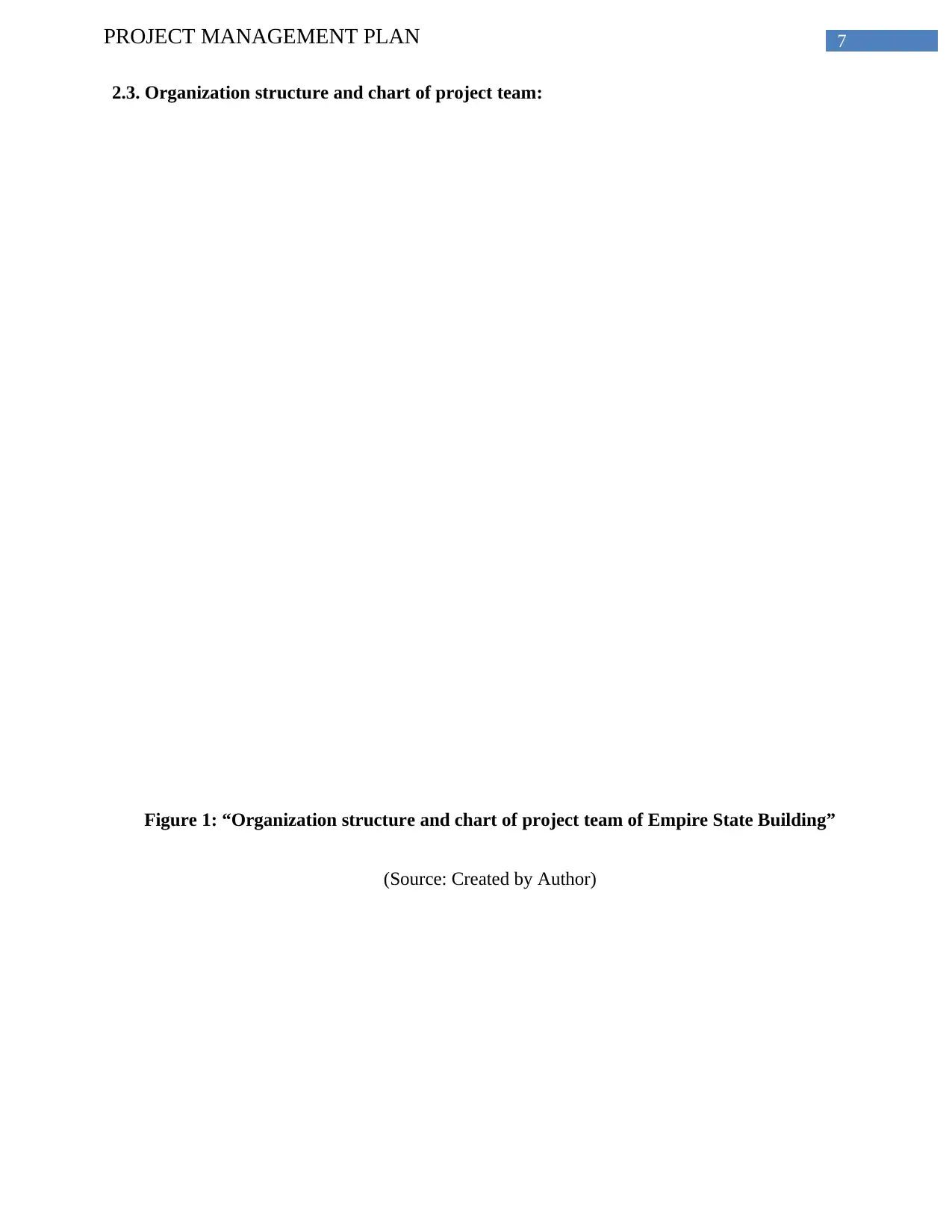
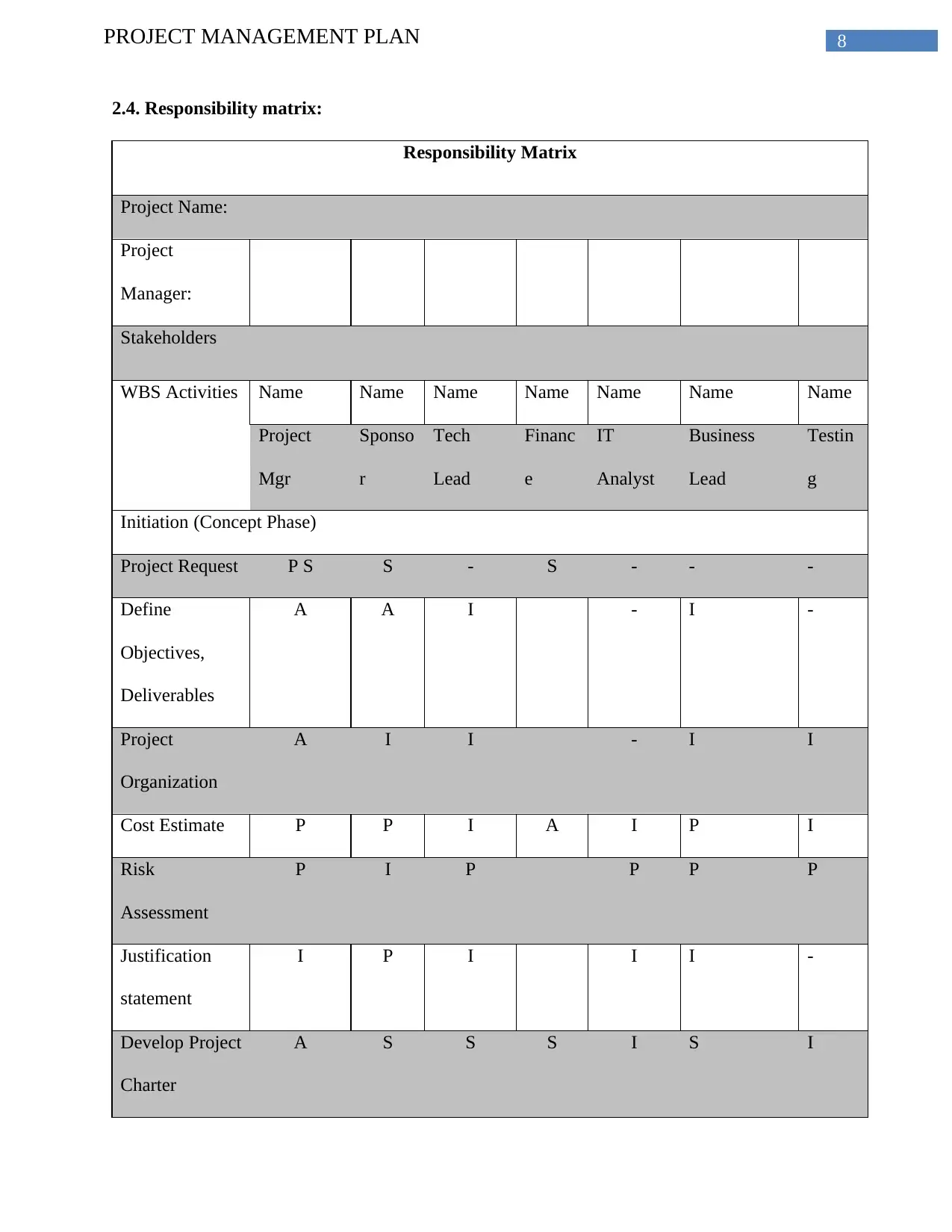
2.3. Organization structure and chart of project team:
Figure 1: “Organization structure and chart of project team of Empire State Building”
(Source: Created by Author)
PresidentAdministration(Accountinggeneraladministrationpayroll,publicrelations,purchasing)ConstructionProjectmanagerBusiness(accounting,administration,payroll)Engineering(changes,claims,costandp[rograms,engineering,plantdesign)Equipment(maintaninence,shopoperations)Purchasing(expedicting,purchasing,warehousisng)SpecialStaff(laborrelationssafety)Superintendent(cpsttructionforces)Engineering(Design,estimating,planning,scheduling)Specialstaff(Laborrelations,legalcounselandsafety)
2.3. Organization structure and chart of project team:
Figure 1: “Organization structure and chart of project team of Empire State Building”
(Source: Created by Author)
PresidentAdministration(Accountinggeneraladministrationpayroll,publicrelations,purchasing)ConstructionProjectmanagerBusiness(accounting,administration,payroll)Engineering(changes,claims,costandp[rograms,engineering,plantdesign)Equipment(maintaninence,shopoperations)Purchasing(expedicting,purchasing,warehousisng)SpecialStaff(laborrelationssafety)Superintendent(cpsttructionforces)Engineering(Design,estimating,planning,scheduling)Specialstaff(Laborrelations,legalcounselandsafety)
8PROJECT MANAGEMENT PLAN
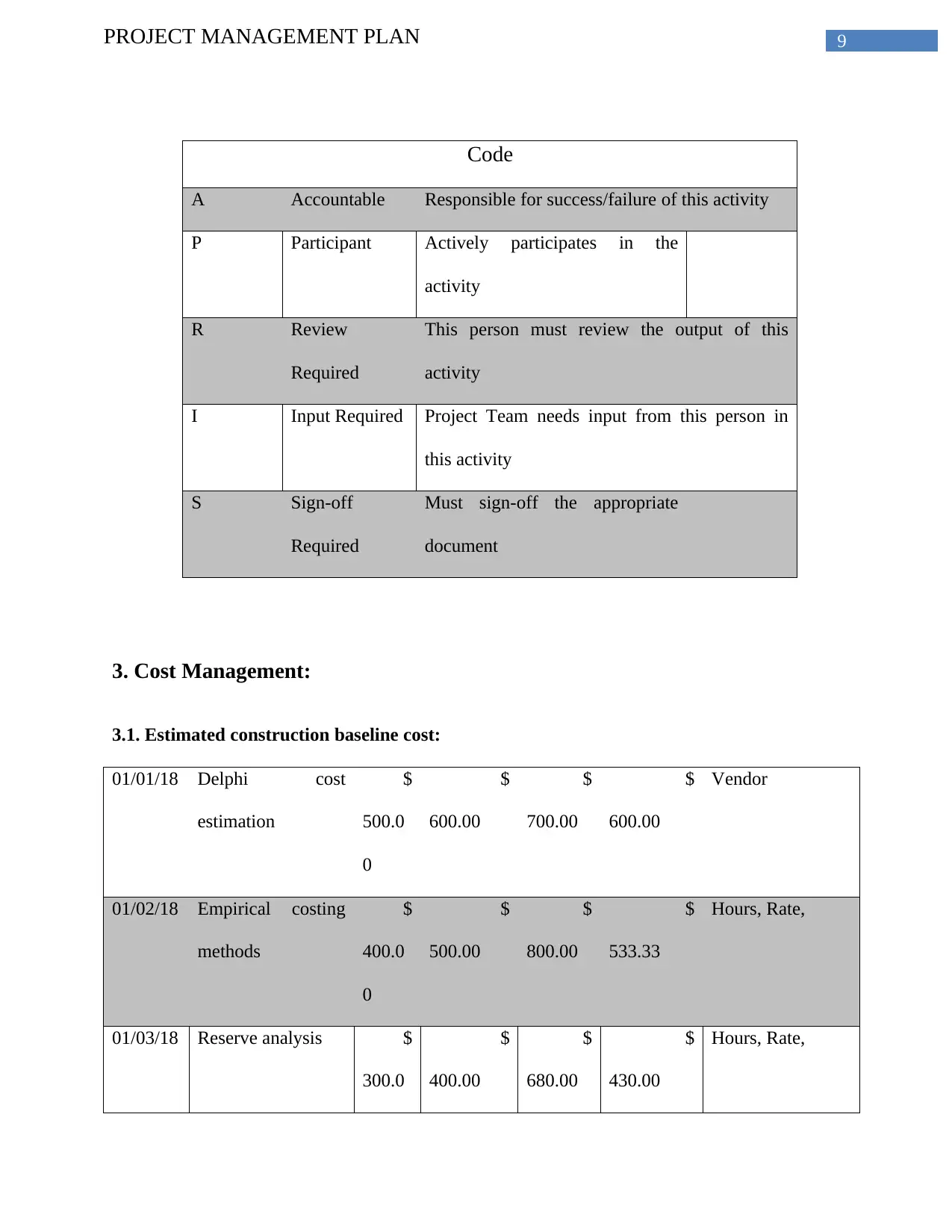
2.4. Responsibility matrix:
Responsibility Matrix
Project Name:
Project
Manager:
Stakeholders
WBS Activities Name Name Name Name Name Name Name
Project
Mgr
Sponso
r
Tech
Lead
Financ
e
IT
Analyst
Business
Lead
Testin
g
Initiation (Concept Phase)
Project Request P S S - S - - -
Define
Objectives,
Deliverables
A A I - I -
Project
Organization
A I I - I I
Cost Estimate P P I A I P I
Risk
Assessment
P I P P P P
Justification
statement
I P I I I -
Develop Project
Charter
A S S S I S I
2.4. Responsibility matrix:
Responsibility Matrix
Project Name:
Project
Manager:
Stakeholders
WBS Activities Name Name Name Name Name Name Name
Project
Mgr
Sponso
r
Tech
Lead
Financ
e
IT
Analyst
Business
Lead
Testin
g
Initiation (Concept Phase)
Project Request P S S - S - - -
Define
Objectives,
Deliverables
A A I - I -
Project
Organization
A I I - I I
Cost Estimate P P I A I P I
Risk
Assessment
P I P P P P
Justification
statement
I P I I I -
Develop Project
Charter
A S S S I S I
⊘ This is a preview!⊘
Do you want full access?
Subscribe today to unlock all pages.
Trusted by 1+ million students worldwide
9PROJECT MANAGEMENT PLAN
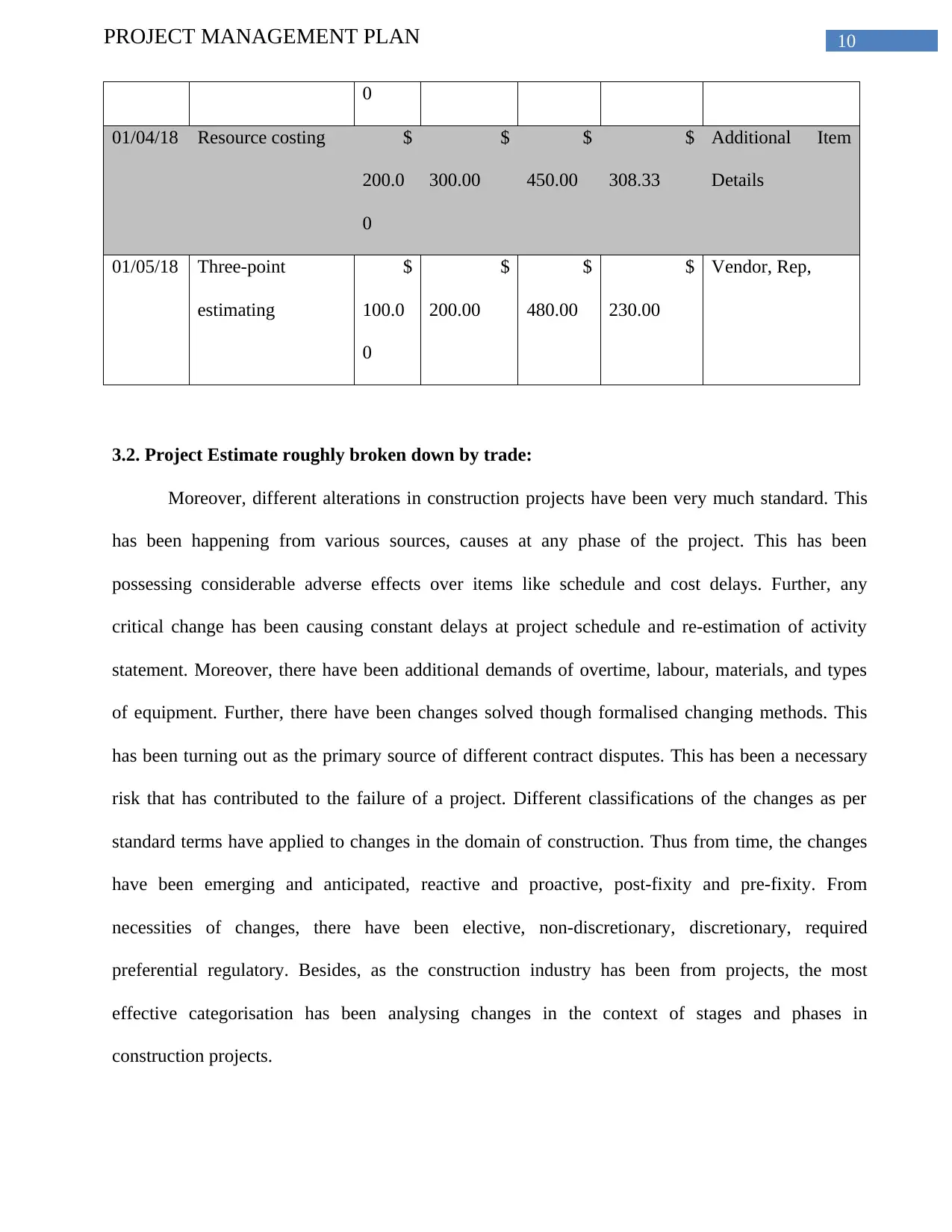
Code
A Accountable Responsible for success/failure of this activity
P Participant Actively participates in the
activity
R Review
Required
This person must review the output of this
activity
I Input Required Project Team needs input from this person in
this activity
S Sign-off
Required
Must sign-off the appropriate
document
3. Cost Management:
3.1. Estimated construction baseline cost:
01/01/18 Delphi cost
estimation
$
500.0
0
$
600.00
$
700.00
$
600.00
Vendor
01/02/18 Empirical costing
methods
$
400.0
0
$
500.00
$
800.00
$
533.33
Hours, Rate,
01/03/18 Reserve analysis $
300.0
$
400.00
$
680.00
$
430.00
Hours, Rate,
Code
A Accountable Responsible for success/failure of this activity
P Participant Actively participates in the
activity
R Review
Required
This person must review the output of this
activity
I Input Required Project Team needs input from this person in
this activity
S Sign-off
Required
Must sign-off the appropriate
document
3. Cost Management:
3.1. Estimated construction baseline cost:
01/01/18 Delphi cost
estimation
$
500.0
0
$
600.00
$
700.00
$
600.00
Vendor
01/02/18 Empirical costing
methods
$
400.0
0
$
500.00
$
800.00
$
533.33
Hours, Rate,
01/03/18 Reserve analysis $
300.0
$
400.00
$
680.00
$
430.00
Hours, Rate,
Paraphrase This Document
Need a fresh take? Get an instant paraphrase of this document with our AI Paraphraser
10PROJECT MANAGEMENT PLAN
0
01/04/18 Resource costing $
200.0
0
$
300.00
$
450.00
$
308.33
Additional Item
Details
01/05/18 Three-point
estimating
$
100.0
0
$
200.00
$
480.00
$
230.00
Vendor, Rep,
3.2. Project Estimate roughly broken down by trade:
Moreover, different alterations in construction projects have been very much standard. This
has been happening from various sources, causes at any phase of the project. This has been
possessing considerable adverse effects over items like schedule and cost delays. Further, any
critical change has been causing constant delays at project schedule and re-estimation of activity
statement. Moreover, there have been additional demands of overtime, labour, materials, and types
of equipment. Further, there have been changes solved though formalised changing methods. This
has been turning out as the primary source of different contract disputes. This has been a necessary
risk that has contributed to the failure of a project. Different classifications of the changes as per
standard terms have applied to changes in the domain of construction. Thus from time, the changes
have been emerging and anticipated, reactive and proactive, post-fixity and pre-fixity. From
necessities of changes, there have been elective, non-discretionary, discretionary, required
preferential regulatory. Besides, as the construction industry has been from projects, the most
effective categorisation has been analysing changes in the context of stages and phases in
construction projects.
0
01/04/18 Resource costing $
200.0
0
$
300.00
$
450.00
$
308.33
Additional Item
Details
01/05/18 Three-point
estimating
$
100.0
0
$
200.00
$
480.00
$
230.00
Vendor, Rep,
3.2. Project Estimate roughly broken down by trade:
Moreover, different alterations in construction projects have been very much standard. This
has been happening from various sources, causes at any phase of the project. This has been
possessing considerable adverse effects over items like schedule and cost delays. Further, any
critical change has been causing constant delays at project schedule and re-estimation of activity
statement. Moreover, there have been additional demands of overtime, labour, materials, and types
of equipment. Further, there have been changes solved though formalised changing methods. This
has been turning out as the primary source of different contract disputes. This has been a necessary
risk that has contributed to the failure of a project. Different classifications of the changes as per
standard terms have applied to changes in the domain of construction. Thus from time, the changes
have been emerging and anticipated, reactive and proactive, post-fixity and pre-fixity. From
necessities of changes, there have been elective, non-discretionary, discretionary, required
preferential regulatory. Besides, as the construction industry has been from projects, the most
effective categorisation has been analysing changes in the context of stages and phases in
construction projects.
11PROJECT MANAGEMENT PLAN
3.3. Project Fee Proposal for Construction Staff Costs:
ABC Company must design a change management toolkit for Empire State Building
including change dependency system, change prediction applications, workflow tools and an active
knowledge management principle. A requirement design relationship has been enabling traceable
tolls regarding architectural design. Here, they must develop a prototype. A system dynamics is
proposed for creating models of dynamic projects for assisting control and planning of Empire State
Building. Here, the dynamic project model has been capturing various non-values to incorporate
iterations of change. This includes managerial change cycle and reworks cycle. This simulation can
be demonstrated through this case study, and various policies and options can be summarised from
this case. Some primary outcomes over proactive changes are present on the change management
around the integrated system of change management. This has been consisting of the prediction
which is based on fuzzy logic change models. This system dynamics model has been on the based on
control methodology and dynamic planning. Here, a “change order management” system and “web-
based project management” is mainly created to cope with various changes during the construction
project of Empire State Building.
Moreover, standard web technologies are utilised and various change order process
construction projects. This has been including documents, roles-actors, keeping records and a
centralised database is being developed. Further, a change control tool (CCT) can be created that has
been consisting of requirement traceability across links between building design and client
requirements. It is also believed that various changes or effects of revisions are managed through
capturing client necessities correctly at the starting of the project and through traceability of
requirements that have been created afterwards.
3.3. Project Fee Proposal for Construction Staff Costs:
ABC Company must design a change management toolkit for Empire State Building
including change dependency system, change prediction applications, workflow tools and an active
knowledge management principle. A requirement design relationship has been enabling traceable
tolls regarding architectural design. Here, they must develop a prototype. A system dynamics is
proposed for creating models of dynamic projects for assisting control and planning of Empire State
Building. Here, the dynamic project model has been capturing various non-values to incorporate
iterations of change. This includes managerial change cycle and reworks cycle. This simulation can
be demonstrated through this case study, and various policies and options can be summarised from
this case. Some primary outcomes over proactive changes are present on the change management
around the integrated system of change management. This has been consisting of the prediction
which is based on fuzzy logic change models. This system dynamics model has been on the based on
control methodology and dynamic planning. Here, a “change order management” system and “web-
based project management” is mainly created to cope with various changes during the construction
project of Empire State Building.
Moreover, standard web technologies are utilised and various change order process
construction projects. This has been including documents, roles-actors, keeping records and a
centralised database is being developed. Further, a change control tool (CCT) can be created that has
been consisting of requirement traceability across links between building design and client
requirements. It is also believed that various changes or effects of revisions are managed through
capturing client necessities correctly at the starting of the project and through traceability of
requirements that have been created afterwards.
⊘ This is a preview!⊘
Do you want full access?
Subscribe today to unlock all pages.
Trusted by 1+ million students worldwide

1 out of 20


Related Documents


Your All-in-One AI-Powered Toolkit for Academic Success.
+13062052269
info@desklib.com
Available 24*7 on WhatsApp / Email
![[object Object]](/_next/static/media/star-bottom.7253800d.svg)
Unlock your academic potential
Copyright © 2020–2026 A2Z Services. All Rights Reserved. Developed and managed by ZUCOL.