Employability Skills Report: Analysis of United Biscuits Strategies
VerifiedAdded on 2020/01/28
|19
|5394
|51
Report
AI Summary
This report delves into the realm of employability skills, using United Biscuits as a case study to illustrate key concepts. It begins by defining self-responsibilities and performance objectives for a quality analyst, followed by a self-SWOT analysis to identify strengths, weaknesses, opportunities, and threats. The report then explores the effectiveness of objectives and provides improvement recommendations, emphasizing the use of motivational techniques to enhance performance quality. Solutions to work-based problems, communication styles at various levels, and effective time-management strategies are also discussed. Furthermore, the report examines team roles, team dynamics, and alternative approaches to task completion and target achievement. It concludes by outlining tools and methods for developing real-time solutions, strategically solving specific problems, and assessing their impact on the business. The report emphasizes the importance of continuous improvement, effective communication, and strategic problem-solving within an organizational context.
Employability Skills
1
1

Paraphrase This Document
Need a fresh take? Get an instant paraphrase of this document with our AI Paraphraser
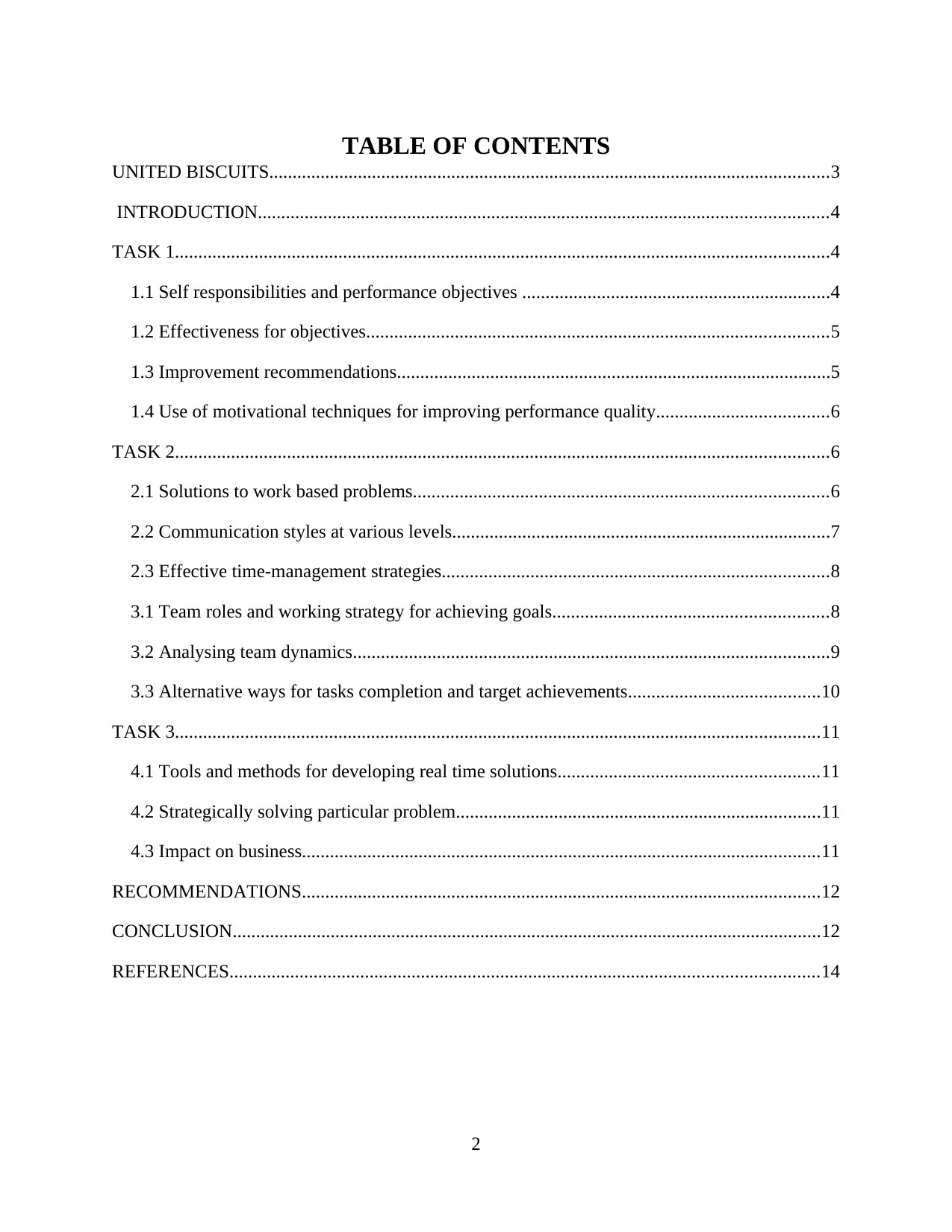
TABLE OF CONTENTS
UNITED BISCUITS........................................................................................................................3
INTRODUCTION..........................................................................................................................4
TASK 1............................................................................................................................................4
1.1 Self responsibilities and performance objectives ..................................................................4
1.2 Effectiveness for objectives...................................................................................................5
1.3 Improvement recommendations.............................................................................................5
1.4 Use of motivational techniques for improving performance quality.....................................6
TASK 2............................................................................................................................................6
2.1 Solutions to work based problems.........................................................................................6
2.2 Communication styles at various levels.................................................................................7
2.3 Effective time-management strategies...................................................................................8
3.1 Team roles and working strategy for achieving goals...........................................................8
3.2 Analysing team dynamics......................................................................................................9
3.3 Alternative ways for tasks completion and target achievements.........................................10
TASK 3..........................................................................................................................................11
4.1 Tools and methods for developing real time solutions........................................................11
4.2 Strategically solving particular problem..............................................................................11
4.3 Impact on business...............................................................................................................11
RECOMMENDATIONS...............................................................................................................12
CONCLUSION..............................................................................................................................12
REFERENCES..............................................................................................................................14
2
UNITED BISCUITS........................................................................................................................3
INTRODUCTION..........................................................................................................................4
TASK 1............................................................................................................................................4
1.1 Self responsibilities and performance objectives ..................................................................4
1.2 Effectiveness for objectives...................................................................................................5
1.3 Improvement recommendations.............................................................................................5
1.4 Use of motivational techniques for improving performance quality.....................................6
TASK 2............................................................................................................................................6
2.1 Solutions to work based problems.........................................................................................6
2.2 Communication styles at various levels.................................................................................7
2.3 Effective time-management strategies...................................................................................8
3.1 Team roles and working strategy for achieving goals...........................................................8
3.2 Analysing team dynamics......................................................................................................9
3.3 Alternative ways for tasks completion and target achievements.........................................10
TASK 3..........................................................................................................................................11
4.1 Tools and methods for developing real time solutions........................................................11
4.2 Strategically solving particular problem..............................................................................11
4.3 Impact on business...............................................................................................................11
RECOMMENDATIONS...............................................................................................................12
CONCLUSION..............................................................................................................................12
REFERENCES..............................................................................................................................14
2
UNITED BISCUITS
United Biscuits was founded in 1948 by two people McVitie and Price MacFarane Long
in London. The brand is majorly known for its products like McVitie’s biscuits, Jacob’s cream,
crackers and twiglets. At the days of foundation the company was just a merger of family
businesses. With great innovation and tastier food the company gained a brand reputation that is
recognised globally. The headquarters of the company are in London, UK while the
manufacturing sites are across many nations like India, Netherlands, Belgium, etc.
Main products of the company are McVities digestive biscuits that were globally endorsed by
many celebrities as the marketing strategy. The company had radio service inside its premises for
internal communication but was active for a very short period. Although the company has
intricate qualities in its products but the basic requirements of the company is labour and
dedication for work. UB never faced any sort of financial crisis because it was a food sector
undertaking. This advantage helped it survive the initial years of crisis during recession and
inflation (About Us, 2016). While there has been a set back with the organisation and that is the
cost structure. Major future strategies are not devised according to the current requirements of
cost and capital. With growing competition and diversity in the food industry, UB has been
facing issues like decreasing market share and a reduction in the sales for less innovation in its
products. But the company has opportunities for acquiring new markets in many other countries
and can also work in some new sector within the food industry.
3
United Biscuits was founded in 1948 by two people McVitie and Price MacFarane Long
in London. The brand is majorly known for its products like McVitie’s biscuits, Jacob’s cream,
crackers and twiglets. At the days of foundation the company was just a merger of family
businesses. With great innovation and tastier food the company gained a brand reputation that is
recognised globally. The headquarters of the company are in London, UK while the
manufacturing sites are across many nations like India, Netherlands, Belgium, etc.
Main products of the company are McVities digestive biscuits that were globally endorsed by
many celebrities as the marketing strategy. The company had radio service inside its premises for
internal communication but was active for a very short period. Although the company has
intricate qualities in its products but the basic requirements of the company is labour and
dedication for work. UB never faced any sort of financial crisis because it was a food sector
undertaking. This advantage helped it survive the initial years of crisis during recession and
inflation (About Us, 2016). While there has been a set back with the organisation and that is the
cost structure. Major future strategies are not devised according to the current requirements of
cost and capital. With growing competition and diversity in the food industry, UB has been
facing issues like decreasing market share and a reduction in the sales for less innovation in its
products. But the company has opportunities for acquiring new markets in many other countries
and can also work in some new sector within the food industry.
3
⊘ This is a preview!⊘
Do you want full access?
Subscribe today to unlock all pages.

Trusted by 1+ million students worldwide
INTRODUCTION
Employment is the basic requirement for every person through which they can earn a
living. To grab this opportunity of earning desired dreams requires efforts and skills that need to
be developed before working in an organisation. These skills are irrelevant to the nature of job an
individual is going to apply. Communication, team work, leadership, problem solving, planning,
organising and the most important learning are some skills that every prospecting employee
needs to develop. An employability skill helps not only in developing the employee but also adds
up to the development of the organisation that is going to hire. For getting a deeper
understanding report is based with relevant information on United Biscuits one of the leading
snack brand of UK that has been functioning efficiently since 68 years because of its dedicated
employees and great market strategies. The main aim of this report is to achieve knowledge
about the requirements and skills needed for becoming an asset for the company.
TASK 1
1.1 Self responsibilities and performance objectives
Being a quality analyst following responsibilities and performance objectives are
considered for this position in the company.
Responsibilities: The company United Biscuits is a huge brand and belonging to the food sector
makes the company and its employees highly responsible towards their consumers. Quality
analyst has to make sure that each and every packet of biscuit that is been manufactured has to be
of appropriate quality (de Guzman and Choi, 2013). Complete parameters like weight, quality
and taste is completely according to the company standards. There is another big responsibility
that a quality checker has to fulfil and it is that he/she has to maintain proper discipline and
dedication towards the company so that discrepancies are not entertained.
Objectives: The objectives are quite clear from the responsibilities that were mentioned above.
Although the traditional standards are maintained but the quality analyst must develop goals that
are oriented to give inputs in the company. Every employee has to give his cent per cent skills
and talent for the company so that the goals and objectives of the organisation are fulfilled
(Benson, Morgan and Filippaios, 2014). Basic objectives also include working extremely well
for being eligible for the appraisals and incentives according to the position of the employee. A
4
Employment is the basic requirement for every person through which they can earn a
living. To grab this opportunity of earning desired dreams requires efforts and skills that need to
be developed before working in an organisation. These skills are irrelevant to the nature of job an
individual is going to apply. Communication, team work, leadership, problem solving, planning,
organising and the most important learning are some skills that every prospecting employee
needs to develop. An employability skill helps not only in developing the employee but also adds
up to the development of the organisation that is going to hire. For getting a deeper
understanding report is based with relevant information on United Biscuits one of the leading
snack brand of UK that has been functioning efficiently since 68 years because of its dedicated
employees and great market strategies. The main aim of this report is to achieve knowledge
about the requirements and skills needed for becoming an asset for the company.
TASK 1
1.1 Self responsibilities and performance objectives
Being a quality analyst following responsibilities and performance objectives are
considered for this position in the company.
Responsibilities: The company United Biscuits is a huge brand and belonging to the food sector
makes the company and its employees highly responsible towards their consumers. Quality
analyst has to make sure that each and every packet of biscuit that is been manufactured has to be
of appropriate quality (de Guzman and Choi, 2013). Complete parameters like weight, quality
and taste is completely according to the company standards. There is another big responsibility
that a quality checker has to fulfil and it is that he/she has to maintain proper discipline and
dedication towards the company so that discrepancies are not entertained.
Objectives: The objectives are quite clear from the responsibilities that were mentioned above.
Although the traditional standards are maintained but the quality analyst must develop goals that
are oriented to give inputs in the company. Every employee has to give his cent per cent skills
and talent for the company so that the goals and objectives of the organisation are fulfilled
(Benson, Morgan and Filippaios, 2014). Basic objectives also include working extremely well
for being eligible for the appraisals and incentives according to the position of the employee. A
4
Paraphrase This Document
Need a fresh take? Get an instant paraphrase of this document with our AI Paraphraser
performance objective like these help in getting great outputs for the company and is a self-
motivational technique to improve weaknesses and threats of an employee.
1.2 Effectiveness for objectives
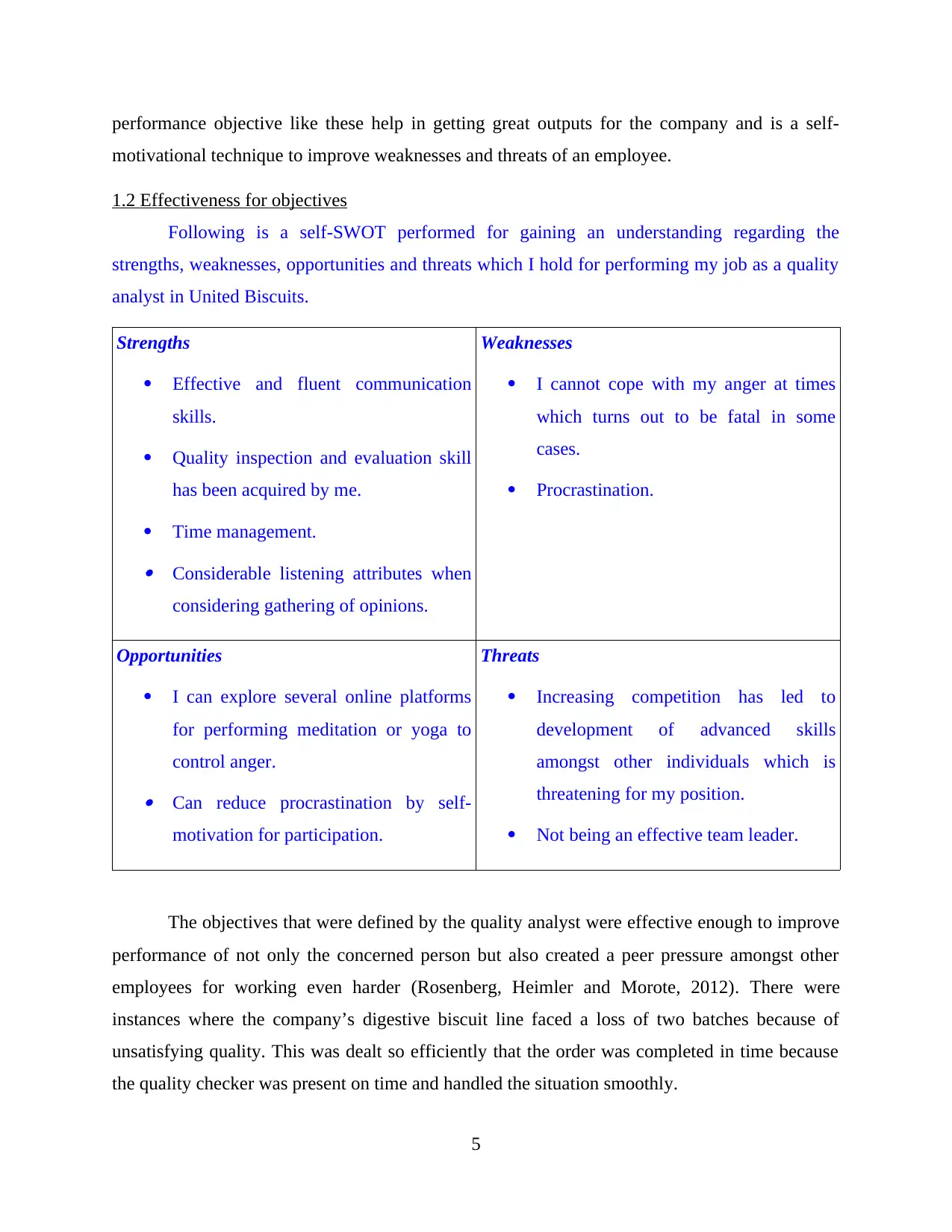
Following is a self-SWOT performed for gaining an understanding regarding the
strengths, weaknesses, opportunities and threats which I hold for performing my job as a quality
analyst in United Biscuits.
Strengths
Effective and fluent communication
skills.
Quality inspection and evaluation skill
has been acquired by me.
Time management. Considerable listening attributes when
considering gathering of opinions.
Weaknesses
I cannot cope with my anger at times
which turns out to be fatal in some
cases.
Procrastination.
Opportunities
I can explore several online platforms
for performing meditation or yoga to
control anger. Can reduce procrastination by self-
motivation for participation.
Threats
Increasing competition has led to
development of advanced skills
amongst other individuals which is
threatening for my position.
Not being an effective team leader.
The objectives that were defined by the quality analyst were effective enough to improve
performance of not only the concerned person but also created a peer pressure amongst other
employees for working even harder (Rosenberg, Heimler and Morote, 2012). There were
instances where the company’s digestive biscuit line faced a loss of two batches because of
unsatisfying quality. This was dealt so efficiently that the order was completed in time because
the quality checker was present on time and handled the situation smoothly.
5
motivational technique to improve weaknesses and threats of an employee.
1.2 Effectiveness for objectives
Following is a self-SWOT performed for gaining an understanding regarding the
strengths, weaknesses, opportunities and threats which I hold for performing my job as a quality
analyst in United Biscuits.
Strengths
Effective and fluent communication
skills.
Quality inspection and evaluation skill
has been acquired by me.
Time management. Considerable listening attributes when
considering gathering of opinions.
Weaknesses
I cannot cope with my anger at times
which turns out to be fatal in some
cases.
Procrastination.
Opportunities
I can explore several online platforms
for performing meditation or yoga to
control anger. Can reduce procrastination by self-
motivation for participation.
Threats
Increasing competition has led to
development of advanced skills
amongst other individuals which is
threatening for my position.
Not being an effective team leader.
The objectives that were defined by the quality analyst were effective enough to improve
performance of not only the concerned person but also created a peer pressure amongst other
employees for working even harder (Rosenberg, Heimler and Morote, 2012). There were
instances where the company’s digestive biscuit line faced a loss of two batches because of
unsatisfying quality. This was dealt so efficiently that the order was completed in time because
the quality checker was present on time and handled the situation smoothly.
5
The above situation shows that when an employee sets some objectives and goals for
him, then the person not only develops internally but also helps in the development of the
company. Objectives give a direction for working better. The employee can gather all the
required skills and information that will help in achieving such goals. Moreover, the organisation
must give proper incentives and perks that are applicable for the employees who work in such an
efficient manner (Graf, Lachance and Mishra, 2016). Targets and objectives enhance the
strengths of the employees and gives dimensions for their working styles.
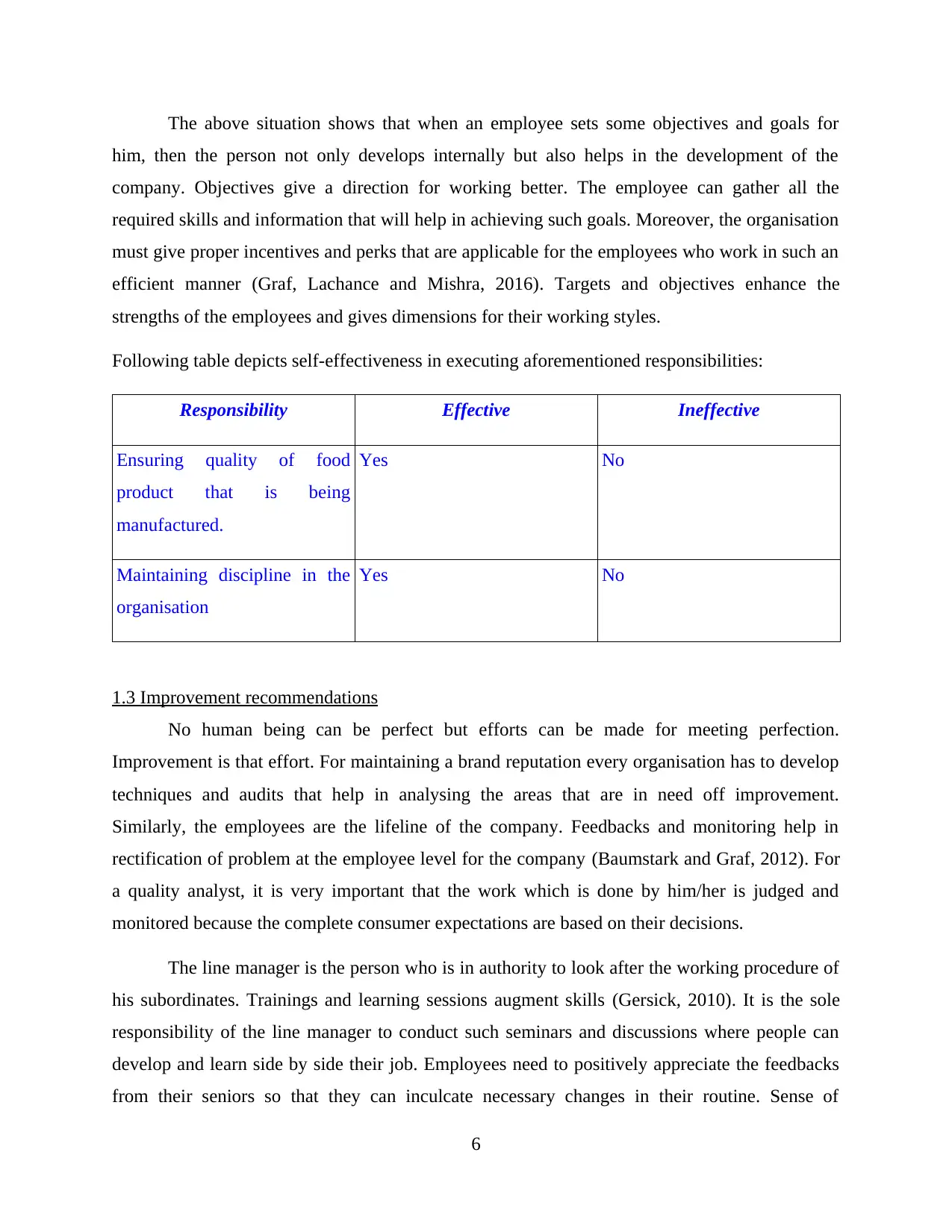
Following table depicts self-effectiveness in executing aforementioned responsibilities:
Responsibility Effective Ineffective
Ensuring quality of food
product that is being
manufactured.
Yes No
Maintaining discipline in the
organisation
Yes No
1.3 Improvement recommendations
No human being can be perfect but efforts can be made for meeting perfection.
Improvement is that effort. For maintaining a brand reputation every organisation has to develop
techniques and audits that help in analysing the areas that are in need off improvement.
Similarly, the employees are the lifeline of the company. Feedbacks and monitoring help in
rectification of problem at the employee level for the company (Baumstark and Graf, 2012). For
a quality analyst, it is very important that the work which is done by him/her is judged and
monitored because the complete consumer expectations are based on their decisions.
The line manager is the person who is in authority to look after the working procedure of
his subordinates. Trainings and learning sessions augment skills (Gersick, 2010). It is the sole
responsibility of the line manager to conduct such seminars and discussions where people can
develop and learn side by side their job. Employees need to positively appreciate the feedbacks
from their seniors so that they can inculcate necessary changes in their routine. Sense of
6
him, then the person not only develops internally but also helps in the development of the
company. Objectives give a direction for working better. The employee can gather all the
required skills and information that will help in achieving such goals. Moreover, the organisation
must give proper incentives and perks that are applicable for the employees who work in such an
efficient manner (Graf, Lachance and Mishra, 2016). Targets and objectives enhance the
strengths of the employees and gives dimensions for their working styles.
Following table depicts self-effectiveness in executing aforementioned responsibilities:
Responsibility Effective Ineffective
Ensuring quality of food
product that is being
manufactured.
Yes No
Maintaining discipline in the
organisation
Yes No
1.3 Improvement recommendations
No human being can be perfect but efforts can be made for meeting perfection.
Improvement is that effort. For maintaining a brand reputation every organisation has to develop
techniques and audits that help in analysing the areas that are in need off improvement.
Similarly, the employees are the lifeline of the company. Feedbacks and monitoring help in
rectification of problem at the employee level for the company (Baumstark and Graf, 2012). For
a quality analyst, it is very important that the work which is done by him/her is judged and
monitored because the complete consumer expectations are based on their decisions.
The line manager is the person who is in authority to look after the working procedure of
his subordinates. Trainings and learning sessions augment skills (Gersick, 2010). It is the sole
responsibility of the line manager to conduct such seminars and discussions where people can
develop and learn side by side their job. Employees need to positively appreciate the feedbacks
from their seniors so that they can inculcate necessary changes in their routine. Sense of
6
⊘ This is a preview!⊘
Do you want full access?
Subscribe today to unlock all pages.
Trusted by 1+ million students worldwide
responsibility and dedication for the company are the qualities that help in improvising and
accepting necessary changes. It is also necessary that the working atmosphere is good enough to
cope with these changes.
After witnessing that I have been lacking in some of the areas with weaknesses like
procrastination and ineffective control over anger. Following recommendations have been
developed for making necessary improvements in functioning:
Recommendations
The anger management task can be accomplished with help of developing self-control
and monitoring. I can enrol myself in anger management sessions for quick recovery.
I can also indulge in learning activities which will help in enhancing knowledge and
bringing more opportunities for development in the company.
These recommendations or improvement techniques can be useful in overcoming the
before mentioned weaknesses within a short period of time.
1.4 Use of motivational techniques for improving performance quality
Despite of various attempts in increasing the motivation and moral of employees
companies sometimes face the problem of non-cooperation or disproportionate performance.
This happens due to lack of motivational techniques. The following techniques can be used for
effectively improving performance quality:
1. The first step to motivation is setting up of goals and objectives. Aimless employees end
up either on the same position or have to leave the company for their inefficiency. Hence,
goals must be set up.
2. Proper communication of expectations from the company to the employees is necessary.
When expectations are clearly set, employees feel motivated and they work with much
greater enthusiasm (Crisp and Jarvenpaa, 2013).
3. Evaluation and monitoring is another face of motivation. When a person works he/she
has to be intimated that the work being done is correct or not. Hence, feedbacks must be
provided with a note to make improvements in the particular area.
7
accepting necessary changes. It is also necessary that the working atmosphere is good enough to
cope with these changes.
After witnessing that I have been lacking in some of the areas with weaknesses like
procrastination and ineffective control over anger. Following recommendations have been
developed for making necessary improvements in functioning:
Recommendations
The anger management task can be accomplished with help of developing self-control
and monitoring. I can enrol myself in anger management sessions for quick recovery.
I can also indulge in learning activities which will help in enhancing knowledge and
bringing more opportunities for development in the company.
These recommendations or improvement techniques can be useful in overcoming the
before mentioned weaknesses within a short period of time.
1.4 Use of motivational techniques for improving performance quality
Despite of various attempts in increasing the motivation and moral of employees
companies sometimes face the problem of non-cooperation or disproportionate performance.
This happens due to lack of motivational techniques. The following techniques can be used for
effectively improving performance quality:
1. The first step to motivation is setting up of goals and objectives. Aimless employees end
up either on the same position or have to leave the company for their inefficiency. Hence,
goals must be set up.
2. Proper communication of expectations from the company to the employees is necessary.
When expectations are clearly set, employees feel motivated and they work with much
greater enthusiasm (Crisp and Jarvenpaa, 2013).
3. Evaluation and monitoring is another face of motivation. When a person works he/she
has to be intimated that the work being done is correct or not. Hence, feedbacks must be
provided with a note to make improvements in the particular area.
7
Paraphrase This Document
Need a fresh take? Get an instant paraphrase of this document with our AI Paraphraser
4. Humiliation must be avoided. If a person is corrected personally, then he doesn’t feel
insulted but if the process of correction is not legitimate then, conflicts can arise and the
employee will be demotivated (Cooke and et. al., 2013).
Out of all the given ways, incentives and appraisals are always the leader in motivating
employees. From sharing profits to creating a healthy competitive atmosphere, motivation will
definitely conquer an employee’s mind.
TASK 2
2.1 Solutions to work based problems
Every business organisation faces problems and situations where crucial decisions and
steps are to be taken by the respective persons for sailing the company out of the black holes (Ju
and et. al., 2014). At the time of launch of a new flagship store such real time problems can arise,
which can be solved by adapting following steps:
Every basic solution has the first initial step of detecting the issue. Before devising any
strategy or solution it is important to know what the real problem is and from where did it
came. Hence, detecting the problem is the first step.
After this detection, the next step is to understand everyone’s perspectives and
perceptions about the problem. This will give complete view from every direction for the
concerned situation.
All the possible outcomes must be noted. Being at a position of authority and position it
is essential that all the considerations are taken for formulating the solution of the
problem.
Weighing the options is the next step. After a near to perfect solution is derived, it is
essential that the company evaluates these without being bias. Unbiased solution has the
maximum probability of working.
It is the duty of the decision maker to keep a record of all the activities that took place at
the time of this problem solving session so that if the derived or agreed solution doesn’t
work a back-up plan can be implemented immediately without wasting much more time
and resources (Kerzner, 2013).
8
insulted but if the process of correction is not legitimate then, conflicts can arise and the
employee will be demotivated (Cooke and et. al., 2013).
Out of all the given ways, incentives and appraisals are always the leader in motivating
employees. From sharing profits to creating a healthy competitive atmosphere, motivation will
definitely conquer an employee’s mind.
TASK 2
2.1 Solutions to work based problems
Every business organisation faces problems and situations where crucial decisions and
steps are to be taken by the respective persons for sailing the company out of the black holes (Ju
and et. al., 2014). At the time of launch of a new flagship store such real time problems can arise,
which can be solved by adapting following steps:
Every basic solution has the first initial step of detecting the issue. Before devising any
strategy or solution it is important to know what the real problem is and from where did it
came. Hence, detecting the problem is the first step.
After this detection, the next step is to understand everyone’s perspectives and
perceptions about the problem. This will give complete view from every direction for the
concerned situation.
All the possible outcomes must be noted. Being at a position of authority and position it
is essential that all the considerations are taken for formulating the solution of the
problem.
Weighing the options is the next step. After a near to perfect solution is derived, it is
essential that the company evaluates these without being bias. Unbiased solution has the
maximum probability of working.
It is the duty of the decision maker to keep a record of all the activities that took place at
the time of this problem solving session so that if the derived or agreed solution doesn’t
work a back-up plan can be implemented immediately without wasting much more time
and resources (Kerzner, 2013).
8
Following these steps will definitely help in creating solutions to work based problems for an
employee at any level.
2.2 Communication styles at various levels
Professionalism is the most important part when coming to the internal environment of a
company. The HR or the human resource department are the care takers of this feature. From a
ground staff member to an executive it is very important that all the views and opinions of a
person are communicated effectively but in a disciplined manner. For the basic level employee,
the communication media is through efficient language and mails for seeking sufficient time
from the respective authorities and then share their views in a genuine manner (Lupuleac,
Lupuleac. and Rusu, 2012).
Although professionalism is needed but it is the responsibility of the organisation that it
takes care that none of the employees face discrimination or are getting oppressed.
Communication in the organisation is also through seminars, meetings and group discussions
where the objectives and strategies of the organisation are shared.
2.3 Effective time-management strategies
Strategies are paralysed if they are not time managed. For every organisation like United
Biscuits, time management is the key to success. As it is well said that time and tide wait for
none. Every employee has to imbibe this philosophy in his/her professional life (Gong and et. al.,
2013). Following strategies can be effective in time management at professional level:
Dividing time according to the need of the task. Employees must be efficient enough to
divide their time according to their priorities at workplace
Planning tool can be used for getting guidance in time management. They will help in
aiding the procedure.
Time management is getting organised. Hence, for effectively achieving the goals and
objectives an employee must get organised.
Seeking help from seniors or successful authorities can be an option for time
management. This strategy can be delegating. This helps in creating friendly circles as
well as people collectively work for improving each other’s weaknesses.
9
employee at any level.
2.2 Communication styles at various levels
Professionalism is the most important part when coming to the internal environment of a
company. The HR or the human resource department are the care takers of this feature. From a
ground staff member to an executive it is very important that all the views and opinions of a
person are communicated effectively but in a disciplined manner. For the basic level employee,
the communication media is through efficient language and mails for seeking sufficient time
from the respective authorities and then share their views in a genuine manner (Lupuleac,
Lupuleac. and Rusu, 2012).
Although professionalism is needed but it is the responsibility of the organisation that it
takes care that none of the employees face discrimination or are getting oppressed.
Communication in the organisation is also through seminars, meetings and group discussions
where the objectives and strategies of the organisation are shared.
2.3 Effective time-management strategies
Strategies are paralysed if they are not time managed. For every organisation like United
Biscuits, time management is the key to success. As it is well said that time and tide wait for
none. Every employee has to imbibe this philosophy in his/her professional life (Gong and et. al.,
2013). Following strategies can be effective in time management at professional level:
Dividing time according to the need of the task. Employees must be efficient enough to
divide their time according to their priorities at workplace
Planning tool can be used for getting guidance in time management. They will help in
aiding the procedure.
Time management is getting organised. Hence, for effectively achieving the goals and
objectives an employee must get organised.
Seeking help from seniors or successful authorities can be an option for time
management. This strategy can be delegating. This helps in creating friendly circles as
well as people collectively work for improving each other’s weaknesses.
9
⊘ This is a preview!⊘
Do you want full access?
Subscribe today to unlock all pages.
Trusted by 1+ million students worldwide
Procrastination is the hindrance to time management. For utilising time correctly it is
advisable to stop extending the deadline of a task. If a person doesn’t seem to be
interested in performing a particular task but has to do that then, he must develop
strategies in such a way that time is managed and not delayed (Abas-Mastura, Imam and
Osman, 2013).
Deletion can also be a strategy in managing time. If a person is unable to develop a
contingency plan for managing time then he/she can remove those tasks that force
indulgence in time wastage.
3.1 Team roles and working strategy for achieving goals
The team is an important part of an organisation. Belbin theory can be used for
understanding and deploying the team roles and responsibilities in a team (Belbin, 2012).
According to this theory every team can be divided into nine roles which are described as
follows:
1. Shaper: A person who challenges the team at every point is the shaper. Challenges help
in moulding the team.
2. Implementer: The ideas and thoughts that are collected in the team by continuous efforts
and analysis are to be formed completely into actions. These actions are designed by the
implementer who puts these thoughts into real time action.
3. Completer-Finisher: This person helps the team in assurance for completion of the given
task in the stipulated time. It is the final but crucial part of the team.
4. Coordinator: This person can be the leader or the main working support for the leader
who correlates all the different functions in the team.
5. Team Worker: When cooperation is at stake and situations arise where the team can
disintegrate then the team worker comes into action and encourages others for working
together. He is like the binding agent of the team.
6. Resource Investigator: All the information and resource are gathered by this person and
given to the team. They are like the suppliers of resources which is very important as
without this the team won’t be able to function.
10
advisable to stop extending the deadline of a task. If a person doesn’t seem to be
interested in performing a particular task but has to do that then, he must develop
strategies in such a way that time is managed and not delayed (Abas-Mastura, Imam and
Osman, 2013).
Deletion can also be a strategy in managing time. If a person is unable to develop a
contingency plan for managing time then he/she can remove those tasks that force
indulgence in time wastage.
3.1 Team roles and working strategy for achieving goals
The team is an important part of an organisation. Belbin theory can be used for
understanding and deploying the team roles and responsibilities in a team (Belbin, 2012).
According to this theory every team can be divided into nine roles which are described as
follows:
1. Shaper: A person who challenges the team at every point is the shaper. Challenges help
in moulding the team.
2. Implementer: The ideas and thoughts that are collected in the team by continuous efforts
and analysis are to be formed completely into actions. These actions are designed by the
implementer who puts these thoughts into real time action.
3. Completer-Finisher: This person helps the team in assurance for completion of the given
task in the stipulated time. It is the final but crucial part of the team.
4. Coordinator: This person can be the leader or the main working support for the leader
who correlates all the different functions in the team.
5. Team Worker: When cooperation is at stake and situations arise where the team can
disintegrate then the team worker comes into action and encourages others for working
together. He is like the binding agent of the team.
6. Resource Investigator: All the information and resource are gathered by this person and
given to the team. They are like the suppliers of resources which is very important as
without this the team won’t be able to function.
10
Paraphrase This Document
Need a fresh take? Get an instant paraphrase of this document with our AI Paraphraser
7. Plant: The complete set of ideas and approaches are presented by the plant. They are also
responsible for generating new ideas and techniques that the other members will apply.
8. Evaluator: All the actions and working strategies of the company are evaluated and
weighted by this person so that any scope of improvement can be realised before
implementation.
9. Specialist: These people are specific in their approach and do not have any sort of interest
in getting involved in other activities. They are specialised in their own skill set.
3.2 Analysing team dynamics
The word team dynamics depicts the functioning process of a team or a group of
individuals that form a team. It defines the working and competency level of the team
collectively (White and Balder, 2014). The team dynamics are measured on various parameters
like leadership, attitudes and attributes of the team members as well as compatibility that the
team members share together.
The factors above mentioned can definitely affect the team dynamics of a company in a
negative way by creating problems. These problems can be blockages in the path of achieving
the goals and objectives (Miller, Biggart and Newton, 2013). Ineffective leadership,
aggressiveness, negations, withdrawal are certain aspects that take place when a team works. The
duties not only lie on the shoulders of the leader but also with the team members. It is very
important for the group to work together without taking any such steps that will hinder the
required processing. For tackling such problems, it is the leader who takes the initiative in
improving the team dynamics.
The basic footstep starts with knowing the team members. It is important for the leader as
well the team members to know each other as it creates bonding and togetherness. Assigning
roles and responsibilities to particular people according to their working styles and characteristic
behaviour will also enhance the team dynamics (Jones, 2013).
3.3 Alternative ways for tasks completion and target achievements
The main aim of the team or the organisation is to achieve its targets and goals in a
smooth manner. But an efficient strategy is said to be that which definitely has a contingency
plan. This alternative plan is always necessary for completing the task. Before execution of this
11
responsible for generating new ideas and techniques that the other members will apply.
8. Evaluator: All the actions and working strategies of the company are evaluated and
weighted by this person so that any scope of improvement can be realised before
implementation.
9. Specialist: These people are specific in their approach and do not have any sort of interest
in getting involved in other activities. They are specialised in their own skill set.
3.2 Analysing team dynamics
The word team dynamics depicts the functioning process of a team or a group of
individuals that form a team. It defines the working and competency level of the team
collectively (White and Balder, 2014). The team dynamics are measured on various parameters
like leadership, attitudes and attributes of the team members as well as compatibility that the
team members share together.
The factors above mentioned can definitely affect the team dynamics of a company in a
negative way by creating problems. These problems can be blockages in the path of achieving
the goals and objectives (Miller, Biggart and Newton, 2013). Ineffective leadership,
aggressiveness, negations, withdrawal are certain aspects that take place when a team works. The
duties not only lie on the shoulders of the leader but also with the team members. It is very
important for the group to work together without taking any such steps that will hinder the
required processing. For tackling such problems, it is the leader who takes the initiative in
improving the team dynamics.
The basic footstep starts with knowing the team members. It is important for the leader as
well the team members to know each other as it creates bonding and togetherness. Assigning
roles and responsibilities to particular people according to their working styles and characteristic
behaviour will also enhance the team dynamics (Jones, 2013).
3.3 Alternative ways for tasks completion and target achievements
The main aim of the team or the organisation is to achieve its targets and goals in a
smooth manner. But an efficient strategy is said to be that which definitely has a contingency
plan. This alternative plan is always necessary for completing the task. Before execution of this
11
alternative strategy the team members must be able to analyse the reasons behind the dysfunction
of the previous strategy.
Some reasons that can be developed as the alternative techniques are effective
communication, better teamwork, specialisation in respective fields, etc. can be employed.
Motivation can be the key tool for implementing good strategies (de Guzman and Choi, 2013).
However, it is very important to maintain a harmony in the team so that planned strategies do not
get disrupted. Another alternative can be use of strategic team building tools so that every person
uses his particular and unique skill set in such a manner that the whole team is benefited.
Furthermore, the following alternatives help in bringing more effectiveness in teamwork
and leads to achievement of team goals:
Team performance is subjective to number of team members, individual skills and
knowledge, resources which are acquired by the group and the communication system
that exists. If any of these parameters are not considered then performance is
significantly affected.
The leader has to take his responsibility of defining roles and duties for every particular
member so that any sort of confusion doesn't exist in the team functioning.
When considering problem solving techniques, then specific systems can be instigated for
the same. Voting, negotiations and compromising is one of the key approaches to gain
opinions and thoughts for a particular subject without creating clashes and conflicts.
TASK 3
4.1 Tools and methods for developing real time solutions
United Biscuits can use various tools and methods for effectively choosing the staff
members that are fit according to the requirements of the organisation. It is very essential for the
company to know what it actually wants from an employee before listing the candidates. This
filtration helps in segregating capable people from the liabilities (Rosenberg, Heimler and
Morote, 2012).
Major problem that is often faced by the organisation is retention of employees at lower
or ground level. This problem came up because the company has not been giving proper working
12
of the previous strategy.
Some reasons that can be developed as the alternative techniques are effective
communication, better teamwork, specialisation in respective fields, etc. can be employed.
Motivation can be the key tool for implementing good strategies (de Guzman and Choi, 2013).
However, it is very important to maintain a harmony in the team so that planned strategies do not
get disrupted. Another alternative can be use of strategic team building tools so that every person
uses his particular and unique skill set in such a manner that the whole team is benefited.
Furthermore, the following alternatives help in bringing more effectiveness in teamwork
and leads to achievement of team goals:
Team performance is subjective to number of team members, individual skills and
knowledge, resources which are acquired by the group and the communication system
that exists. If any of these parameters are not considered then performance is
significantly affected.
The leader has to take his responsibility of defining roles and duties for every particular
member so that any sort of confusion doesn't exist in the team functioning.
When considering problem solving techniques, then specific systems can be instigated for
the same. Voting, negotiations and compromising is one of the key approaches to gain
opinions and thoughts for a particular subject without creating clashes and conflicts.
TASK 3
4.1 Tools and methods for developing real time solutions
United Biscuits can use various tools and methods for effectively choosing the staff
members that are fit according to the requirements of the organisation. It is very essential for the
company to know what it actually wants from an employee before listing the candidates. This
filtration helps in segregating capable people from the liabilities (Rosenberg, Heimler and
Morote, 2012).
Major problem that is often faced by the organisation is retention of employees at lower
or ground level. This problem came up because the company has not been giving proper working
12
⊘ This is a preview!⊘
Do you want full access?
Subscribe today to unlock all pages.
Trusted by 1+ million students worldwide

1 out of 19


Related Documents


Your All-in-One AI-Powered Toolkit for Academic Success.
+13062052269
info@desklib.com
Available 24*7 on WhatsApp / Email
![[object Object]](/_next/static/media/star-bottom.7253800d.svg)
Unlock your academic potential
Copyright © 2020–2026 A2Z Services. All Rights Reserved. Developed and managed by ZUCOL.