Employee Engagement and Customer Loyalty in UK Hospitality: Proposal
VerifiedAdded on 2023/01/18
|14
|4066
|64
Report
AI Summary
This research proposal investigates the relationship between employee engagement and customer loyalty within the UK hospitality sector, using Marriott hotels as a case study. The introduction provides background information on the significance of employee engagement in fostering customer loyalty, particularly in the hospitality industry. The research aims to understand employee engagement, identify its positive and negative impacts on customer loyalty, assess challenges in managing customer loyalty through employee engagement strategies, and offer recommendations. The literature review explores the concept of employee engagement, its positive and negative aspects concerning customer loyalty, and the challenges encountered in managing customer loyalty through employee engagement strategies. The methodology section outlines the research approach, including qualitative methods, interpretivism, inductive approaches, and data collection methods. The proposal also describes data analysis using thematic methods and the application of non-probabilistic sampling. The proposal seeks to provide insights into strategies for enhancing employee engagement and, consequently, building customer loyalty in the hospitality industry.

RESEARCH PROPOSAL

Paraphrase This Document
Need a fresh take? Get an instant paraphrase of this document with our AI Paraphraser
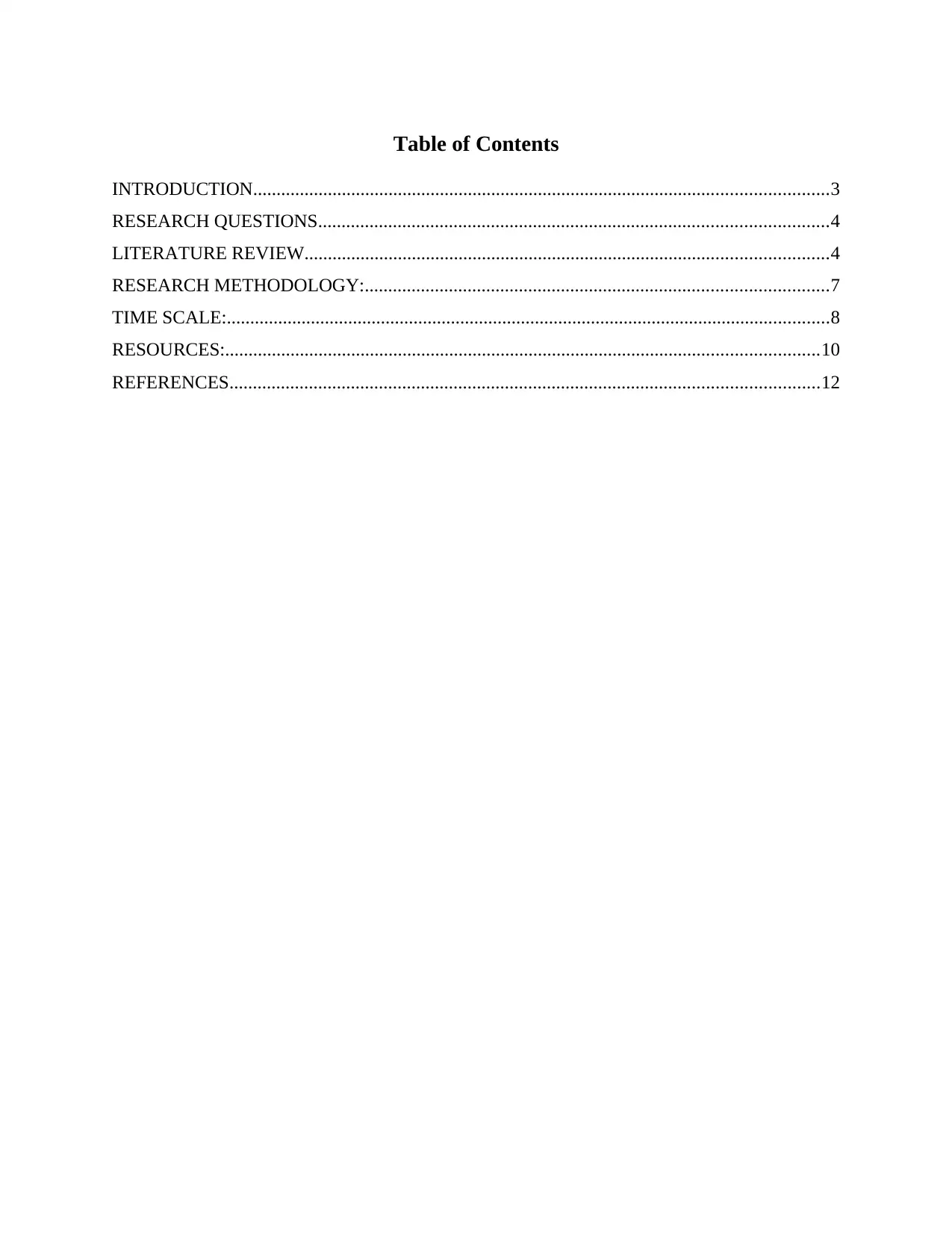
Table of Contents
INTRODUCTION...........................................................................................................................3
RESEARCH QUESTIONS.............................................................................................................4
LITERATURE REVIEW................................................................................................................4
RESEARCH METHODOLOGY:...................................................................................................7
TIME SCALE:.................................................................................................................................8
RESOURCES:...............................................................................................................................10
REFERENCES..............................................................................................................................12
INTRODUCTION...........................................................................................................................3
RESEARCH QUESTIONS.............................................................................................................4
LITERATURE REVIEW................................................................................................................4
RESEARCH METHODOLOGY:...................................................................................................7
TIME SCALE:.................................................................................................................................8
RESOURCES:...............................................................................................................................10
REFERENCES..............................................................................................................................12
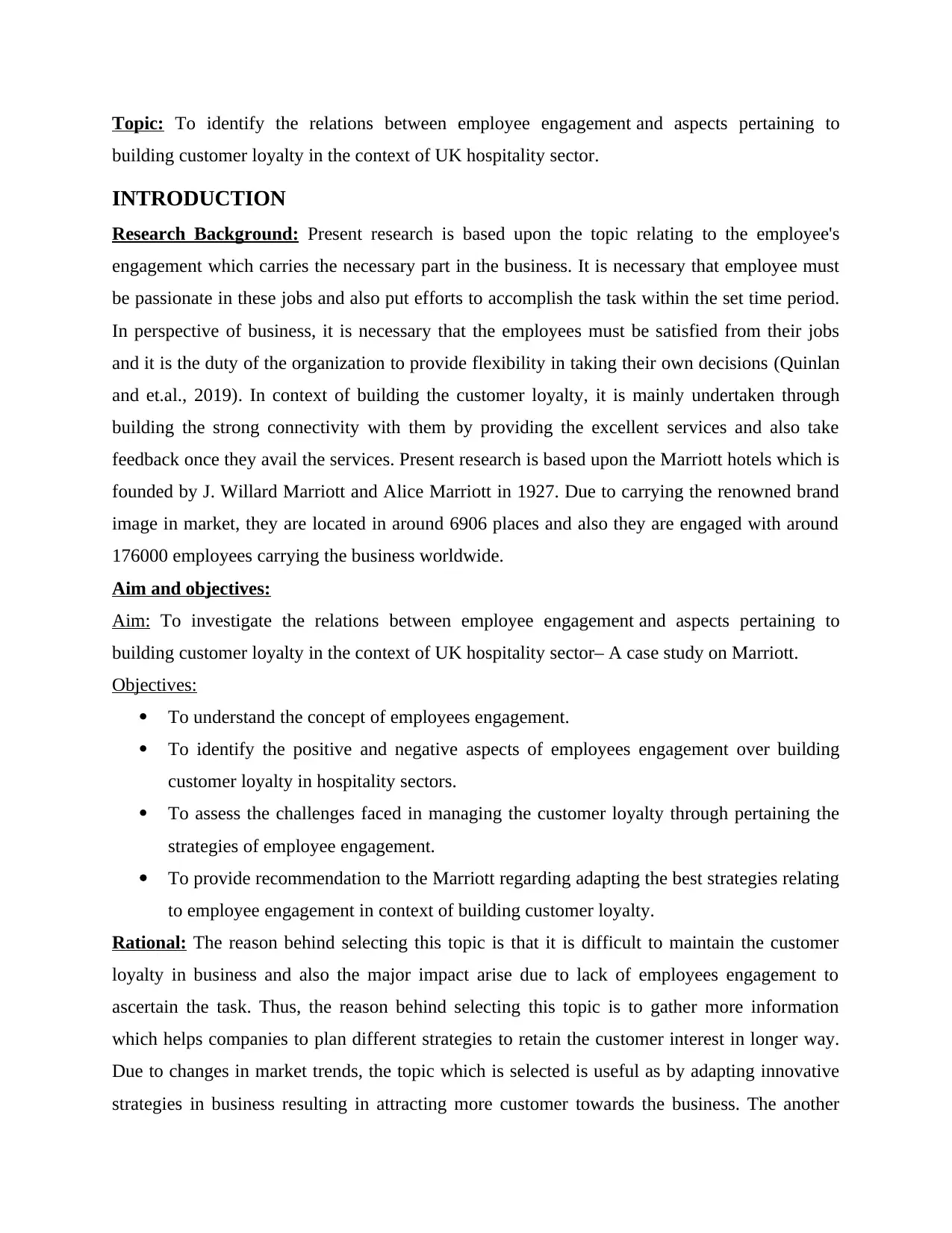
Topic: To identify the relations between employee engagement and aspects pertaining to
building customer loyalty in the context of UK hospitality sector.
INTRODUCTION
Research Background: Present research is based upon the topic relating to the employee's
engagement which carries the necessary part in the business. It is necessary that employee must
be passionate in these jobs and also put efforts to accomplish the task within the set time period.
In perspective of business, it is necessary that the employees must be satisfied from their jobs
and it is the duty of the organization to provide flexibility in taking their own decisions (Quinlan
and et.al., 2019). In context of building the customer loyalty, it is mainly undertaken through
building the strong connectivity with them by providing the excellent services and also take
feedback once they avail the services. Present research is based upon the Marriott hotels which is
founded by J. Willard Marriott and Alice Marriott in 1927. Due to carrying the renowned brand
image in market, they are located in around 6906 places and also they are engaged with around
176000 employees carrying the business worldwide.
Aim and objectives:
Aim: To investigate the relations between employee engagement and aspects pertaining to
building customer loyalty in the context of UK hospitality sector– A case study on Marriott.
Objectives:
To understand the concept of employees engagement.
To identify the positive and negative aspects of employees engagement over building
customer loyalty in hospitality sectors.
To assess the challenges faced in managing the customer loyalty through pertaining the
strategies of employee engagement.
To provide recommendation to the Marriott regarding adapting the best strategies relating
to employee engagement in context of building customer loyalty.
Rational: The reason behind selecting this topic is that it is difficult to maintain the customer
loyalty in business and also the major impact arise due to lack of employees engagement to
ascertain the task. Thus, the reason behind selecting this topic is to gather more information
which helps companies to plan different strategies to retain the customer interest in longer way.
Due to changes in market trends, the topic which is selected is useful as by adapting innovative
strategies in business resulting in attracting more customer towards the business. The another
building customer loyalty in the context of UK hospitality sector.
INTRODUCTION
Research Background: Present research is based upon the topic relating to the employee's
engagement which carries the necessary part in the business. It is necessary that employee must
be passionate in these jobs and also put efforts to accomplish the task within the set time period.
In perspective of business, it is necessary that the employees must be satisfied from their jobs
and it is the duty of the organization to provide flexibility in taking their own decisions (Quinlan
and et.al., 2019). In context of building the customer loyalty, it is mainly undertaken through
building the strong connectivity with them by providing the excellent services and also take
feedback once they avail the services. Present research is based upon the Marriott hotels which is
founded by J. Willard Marriott and Alice Marriott in 1927. Due to carrying the renowned brand
image in market, they are located in around 6906 places and also they are engaged with around
176000 employees carrying the business worldwide.
Aim and objectives:
Aim: To investigate the relations between employee engagement and aspects pertaining to
building customer loyalty in the context of UK hospitality sector– A case study on Marriott.
Objectives:
To understand the concept of employees engagement.
To identify the positive and negative aspects of employees engagement over building
customer loyalty in hospitality sectors.
To assess the challenges faced in managing the customer loyalty through pertaining the
strategies of employee engagement.
To provide recommendation to the Marriott regarding adapting the best strategies relating
to employee engagement in context of building customer loyalty.
Rational: The reason behind selecting this topic is that it is difficult to maintain the customer
loyalty in business and also the major impact arise due to lack of employees engagement to
ascertain the task. Thus, the reason behind selecting this topic is to gather more information
which helps companies to plan different strategies to retain the customer interest in longer way.
Due to changes in market trends, the topic which is selected is useful as by adapting innovative
strategies in business resulting in attracting more customer towards the business. The another
⊘ This is a preview!⊘
Do you want full access?
Subscribe today to unlock all pages.

Trusted by 1+ million students worldwide
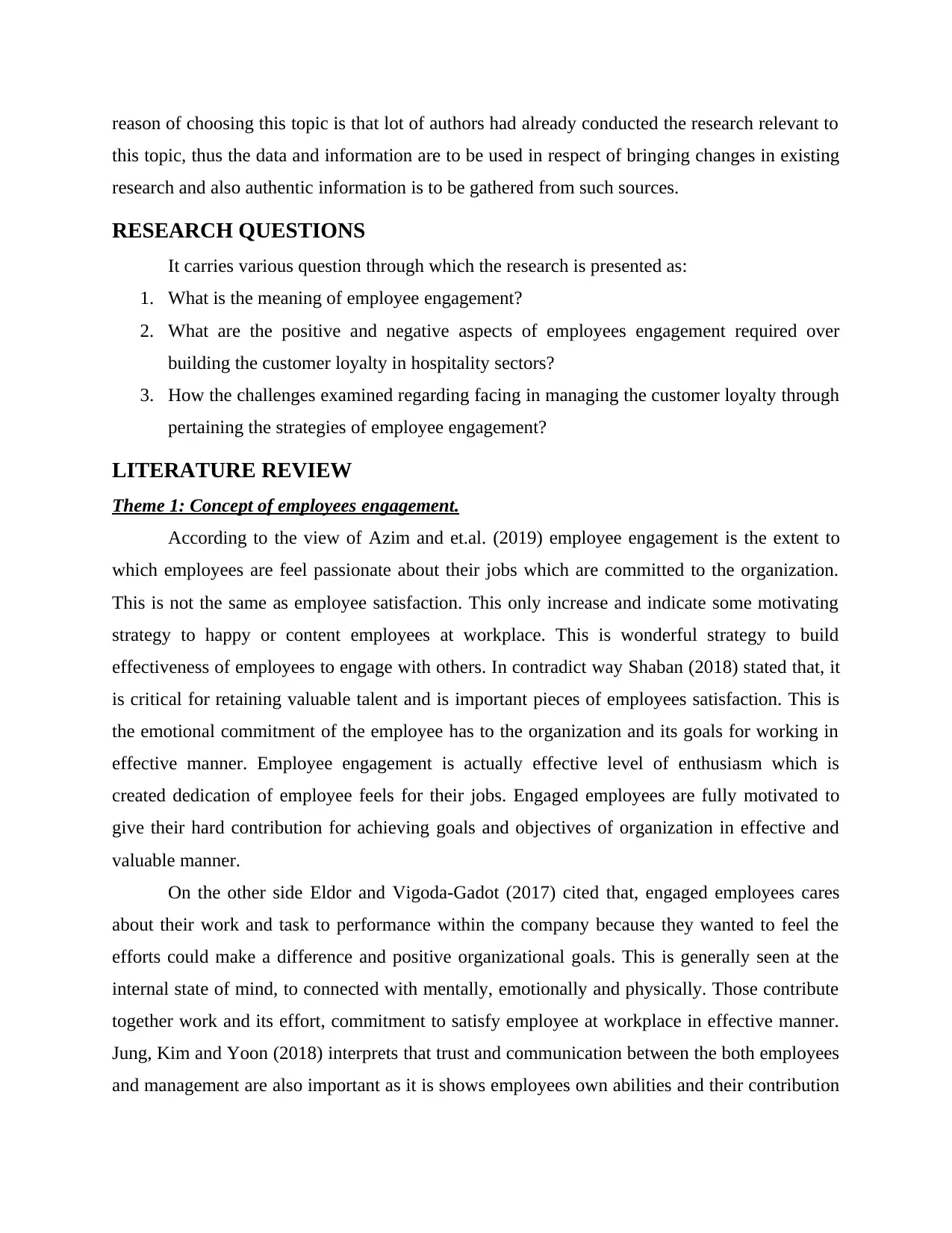
reason of choosing this topic is that lot of authors had already conducted the research relevant to
this topic, thus the data and information are to be used in respect of bringing changes in existing
research and also authentic information is to be gathered from such sources.
RESEARCH QUESTIONS
It carries various question through which the research is presented as:
1. What is the meaning of employee engagement?
2. What are the positive and negative aspects of employees engagement required over
building the customer loyalty in hospitality sectors?
3. How the challenges examined regarding facing in managing the customer loyalty through
pertaining the strategies of employee engagement?
LITERATURE REVIEW
Theme 1: Concept of employees engagement.
According to the view of Azim and et.al. (2019) employee engagement is the extent to
which employees are feel passionate about their jobs which are committed to the organization.
This is not the same as employee satisfaction. This only increase and indicate some motivating
strategy to happy or content employees at workplace. This is wonderful strategy to build
effectiveness of employees to engage with others. In contradict way Shaban (2018) stated that, it
is critical for retaining valuable talent and is important pieces of employees satisfaction. This is
the emotional commitment of the employee has to the organization and its goals for working in
effective manner. Employee engagement is actually effective level of enthusiasm which is
created dedication of employee feels for their jobs. Engaged employees are fully motivated to
give their hard contribution for achieving goals and objectives of organization in effective and
valuable manner.
On the other side Eldor and Vigoda-Gadot (2017) cited that, engaged employees cares
about their work and task to performance within the company because they wanted to feel the
efforts could make a difference and positive organizational goals. This is generally seen at the
internal state of mind, to connected with mentally, emotionally and physically. Those contribute
together work and its effort, commitment to satisfy employee at workplace in effective manner.
Jung, Kim and Yoon (2018) interprets that trust and communication between the both employees
and management are also important as it is shows employees own abilities and their contribution
this topic, thus the data and information are to be used in respect of bringing changes in existing
research and also authentic information is to be gathered from such sources.
RESEARCH QUESTIONS
It carries various question through which the research is presented as:
1. What is the meaning of employee engagement?
2. What are the positive and negative aspects of employees engagement required over
building the customer loyalty in hospitality sectors?
3. How the challenges examined regarding facing in managing the customer loyalty through
pertaining the strategies of employee engagement?
LITERATURE REVIEW
Theme 1: Concept of employees engagement.
According to the view of Azim and et.al. (2019) employee engagement is the extent to
which employees are feel passionate about their jobs which are committed to the organization.
This is not the same as employee satisfaction. This only increase and indicate some motivating
strategy to happy or content employees at workplace. This is wonderful strategy to build
effectiveness of employees to engage with others. In contradict way Shaban (2018) stated that, it
is critical for retaining valuable talent and is important pieces of employees satisfaction. This is
the emotional commitment of the employee has to the organization and its goals for working in
effective manner. Employee engagement is actually effective level of enthusiasm which is
created dedication of employee feels for their jobs. Engaged employees are fully motivated to
give their hard contribution for achieving goals and objectives of organization in effective and
valuable manner.
On the other side Eldor and Vigoda-Gadot (2017) cited that, engaged employees cares
about their work and task to performance within the company because they wanted to feel the
efforts could make a difference and positive organizational goals. This is generally seen at the
internal state of mind, to connected with mentally, emotionally and physically. Those contribute
together work and its effort, commitment to satisfy employee at workplace in effective manner.
Jung, Kim and Yoon (2018) interprets that trust and communication between the both employees
and management are also important as it is shows employees own abilities and their contribution
Paraphrase This Document
Need a fresh take? Get an instant paraphrase of this document with our AI Paraphraser
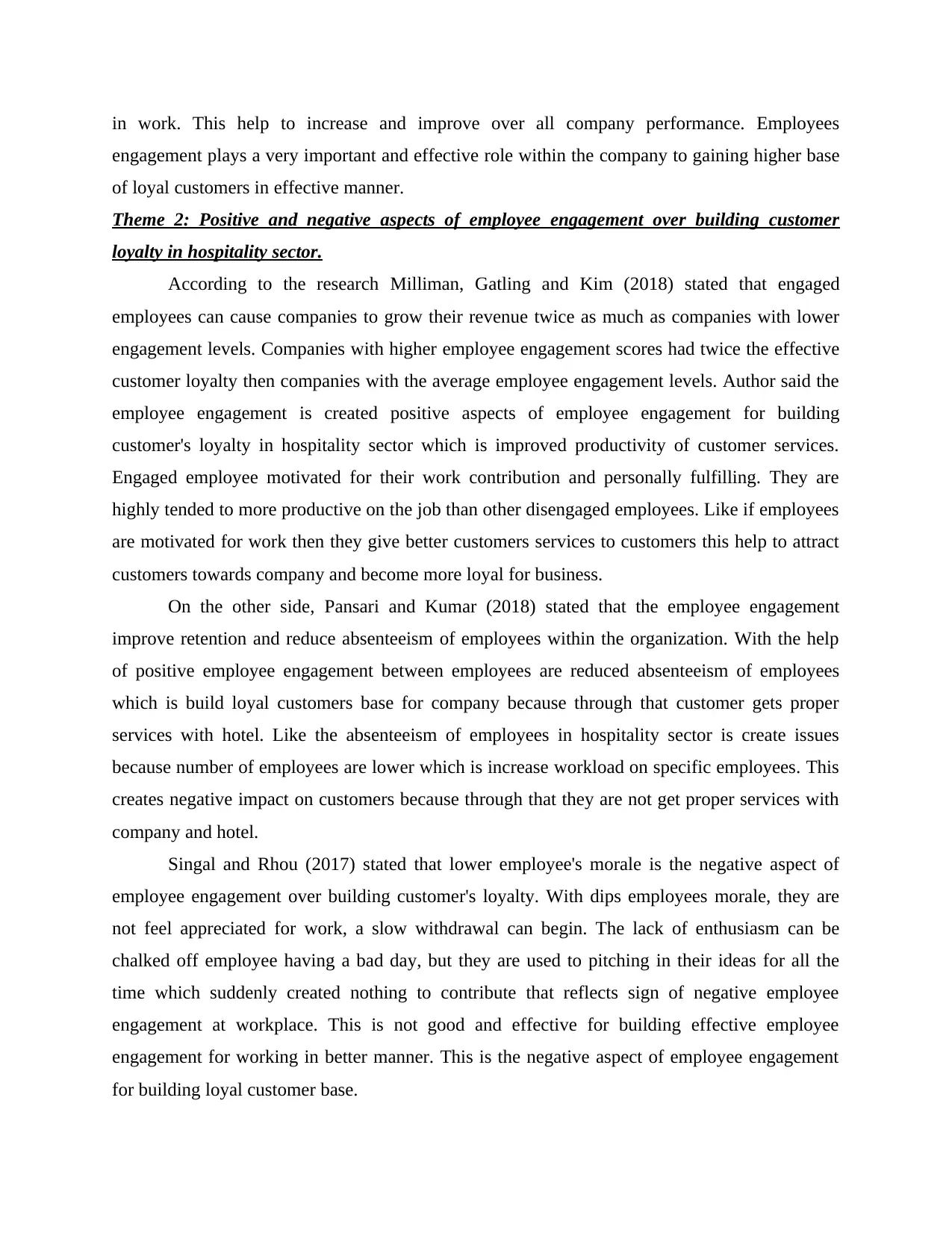
in work. This help to increase and improve over all company performance. Employees
engagement plays a very important and effective role within the company to gaining higher base
of loyal customers in effective manner.
Theme 2: Positive and negative aspects of employee engagement over building customer
loyalty in hospitality sector.
According to the research Milliman, Gatling and Kim (2018) stated that engaged
employees can cause companies to grow their revenue twice as much as companies with lower
engagement levels. Companies with higher employee engagement scores had twice the effective
customer loyalty then companies with the average employee engagement levels. Author said the
employee engagement is created positive aspects of employee engagement for building
customer's loyalty in hospitality sector which is improved productivity of customer services.
Engaged employee motivated for their work contribution and personally fulfilling. They are
highly tended to more productive on the job than other disengaged employees. Like if employees
are motivated for work then they give better customers services to customers this help to attract
customers towards company and become more loyal for business.
On the other side, Pansari and Kumar (2018) stated that the employee engagement
improve retention and reduce absenteeism of employees within the organization. With the help
of positive employee engagement between employees are reduced absenteeism of employees
which is build loyal customers base for company because through that customer gets proper
services with hotel. Like the absenteeism of employees in hospitality sector is create issues
because number of employees are lower which is increase workload on specific employees. This
creates negative impact on customers because through that they are not get proper services with
company and hotel.
Singal and Rhou (2017) stated that lower employee's morale is the negative aspect of
employee engagement over building customer's loyalty. With dips employees morale, they are
not feel appreciated for work, a slow withdrawal can begin. The lack of enthusiasm can be
chalked off employee having a bad day, but they are used to pitching in their ideas for all the
time which suddenly created nothing to contribute that reflects sign of negative employee
engagement at workplace. This is not good and effective for building effective employee
engagement for working in better manner. This is the negative aspect of employee engagement
for building loyal customer base.
engagement plays a very important and effective role within the company to gaining higher base
of loyal customers in effective manner.
Theme 2: Positive and negative aspects of employee engagement over building customer
loyalty in hospitality sector.
According to the research Milliman, Gatling and Kim (2018) stated that engaged
employees can cause companies to grow their revenue twice as much as companies with lower
engagement levels. Companies with higher employee engagement scores had twice the effective
customer loyalty then companies with the average employee engagement levels. Author said the
employee engagement is created positive aspects of employee engagement for building
customer's loyalty in hospitality sector which is improved productivity of customer services.
Engaged employee motivated for their work contribution and personally fulfilling. They are
highly tended to more productive on the job than other disengaged employees. Like if employees
are motivated for work then they give better customers services to customers this help to attract
customers towards company and become more loyal for business.
On the other side, Pansari and Kumar (2018) stated that the employee engagement
improve retention and reduce absenteeism of employees within the organization. With the help
of positive employee engagement between employees are reduced absenteeism of employees
which is build loyal customers base for company because through that customer gets proper
services with hotel. Like the absenteeism of employees in hospitality sector is create issues
because number of employees are lower which is increase workload on specific employees. This
creates negative impact on customers because through that they are not get proper services with
company and hotel.
Singal and Rhou (2017) stated that lower employee's morale is the negative aspect of
employee engagement over building customer's loyalty. With dips employees morale, they are
not feel appreciated for work, a slow withdrawal can begin. The lack of enthusiasm can be
chalked off employee having a bad day, but they are used to pitching in their ideas for all the
time which suddenly created nothing to contribute that reflects sign of negative employee
engagement at workplace. This is not good and effective for building effective employee
engagement for working in better manner. This is the negative aspect of employee engagement
for building loyal customer base.
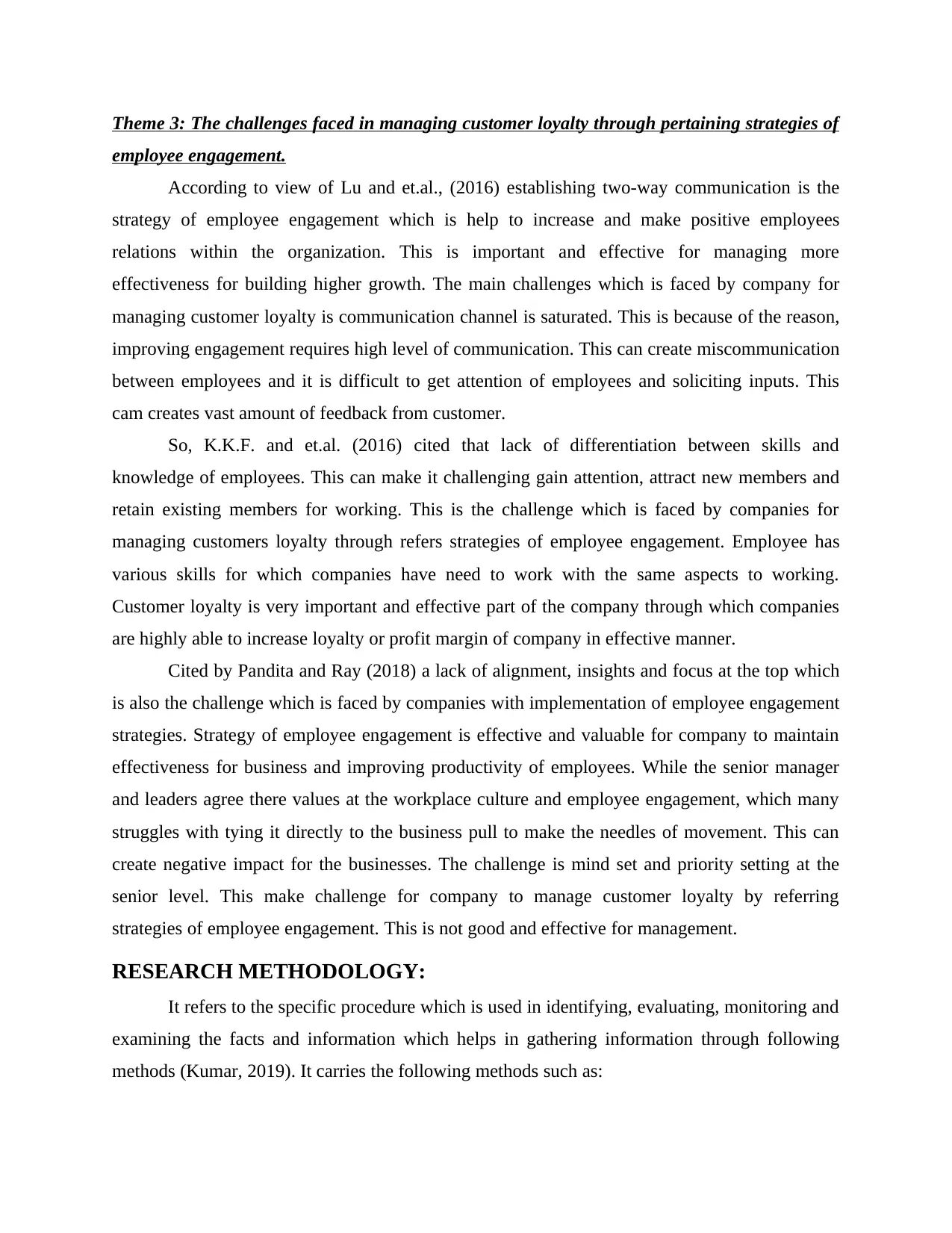
Theme 3: The challenges faced in managing customer loyalty through pertaining strategies of
employee engagement.
According to view of Lu and et.al., (2016) establishing two-way communication is the
strategy of employee engagement which is help to increase and make positive employees
relations within the organization. This is important and effective for managing more
effectiveness for building higher growth. The main challenges which is faced by company for
managing customer loyalty is communication channel is saturated. This is because of the reason,
improving engagement requires high level of communication. This can create miscommunication
between employees and it is difficult to get attention of employees and soliciting inputs. This
cam creates vast amount of feedback from customer.
So, K.K.F. and et.al. (2016) cited that lack of differentiation between skills and
knowledge of employees. This can make it challenging gain attention, attract new members and
retain existing members for working. This is the challenge which is faced by companies for
managing customers loyalty through refers strategies of employee engagement. Employee has
various skills for which companies have need to work with the same aspects to working.
Customer loyalty is very important and effective part of the company through which companies
are highly able to increase loyalty or profit margin of company in effective manner.
Cited by Pandita and Ray (2018) a lack of alignment, insights and focus at the top which
is also the challenge which is faced by companies with implementation of employee engagement
strategies. Strategy of employee engagement is effective and valuable for company to maintain
effectiveness for business and improving productivity of employees. While the senior manager
and leaders agree there values at the workplace culture and employee engagement, which many
struggles with tying it directly to the business pull to make the needles of movement. This can
create negative impact for the businesses. The challenge is mind set and priority setting at the
senior level. This make challenge for company to manage customer loyalty by referring
strategies of employee engagement. This is not good and effective for management.
RESEARCH METHODOLOGY:
It refers to the specific procedure which is used in identifying, evaluating, monitoring and
examining the facts and information which helps in gathering information through following
methods (Kumar, 2019). It carries the following methods such as:
employee engagement.
According to view of Lu and et.al., (2016) establishing two-way communication is the
strategy of employee engagement which is help to increase and make positive employees
relations within the organization. This is important and effective for managing more
effectiveness for building higher growth. The main challenges which is faced by company for
managing customer loyalty is communication channel is saturated. This is because of the reason,
improving engagement requires high level of communication. This can create miscommunication
between employees and it is difficult to get attention of employees and soliciting inputs. This
cam creates vast amount of feedback from customer.
So, K.K.F. and et.al. (2016) cited that lack of differentiation between skills and
knowledge of employees. This can make it challenging gain attention, attract new members and
retain existing members for working. This is the challenge which is faced by companies for
managing customers loyalty through refers strategies of employee engagement. Employee has
various skills for which companies have need to work with the same aspects to working.
Customer loyalty is very important and effective part of the company through which companies
are highly able to increase loyalty or profit margin of company in effective manner.
Cited by Pandita and Ray (2018) a lack of alignment, insights and focus at the top which
is also the challenge which is faced by companies with implementation of employee engagement
strategies. Strategy of employee engagement is effective and valuable for company to maintain
effectiveness for business and improving productivity of employees. While the senior manager
and leaders agree there values at the workplace culture and employee engagement, which many
struggles with tying it directly to the business pull to make the needles of movement. This can
create negative impact for the businesses. The challenge is mind set and priority setting at the
senior level. This make challenge for company to manage customer loyalty by referring
strategies of employee engagement. This is not good and effective for management.
RESEARCH METHODOLOGY:
It refers to the specific procedure which is used in identifying, evaluating, monitoring and
examining the facts and information which helps in gathering information through following
methods (Kumar, 2019). It carries the following methods such as:
⊘ This is a preview!⊘
Do you want full access?
Subscribe today to unlock all pages.
Trusted by 1+ million students worldwide
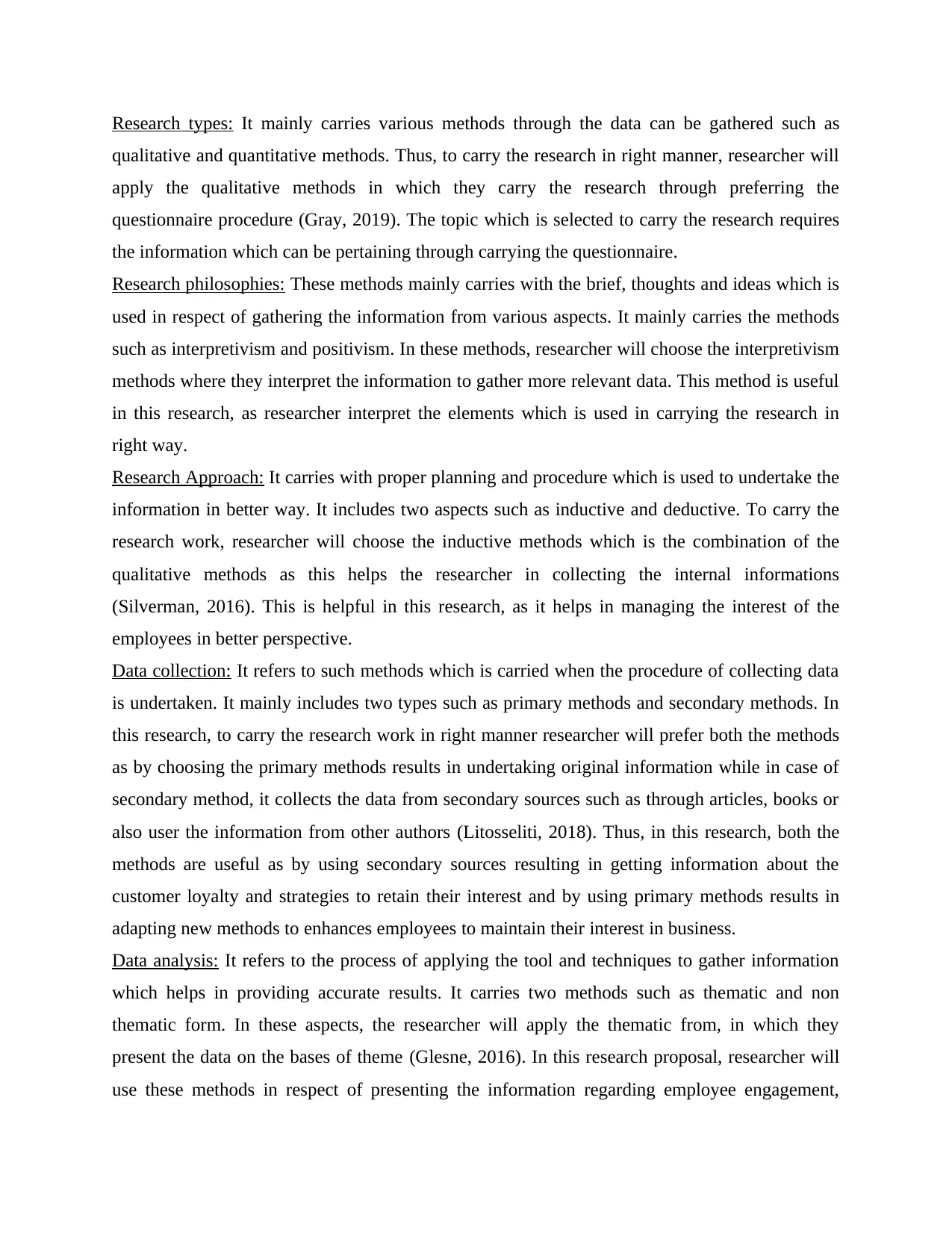
Research types: It mainly carries various methods through the data can be gathered such as
qualitative and quantitative methods. Thus, to carry the research in right manner, researcher will
apply the qualitative methods in which they carry the research through preferring the
questionnaire procedure (Gray, 2019). The topic which is selected to carry the research requires
the information which can be pertaining through carrying the questionnaire.
Research philosophies: These methods mainly carries with the brief, thoughts and ideas which is
used in respect of gathering the information from various aspects. It mainly carries the methods
such as interpretivism and positivism. In these methods, researcher will choose the interpretivism
methods where they interpret the information to gather more relevant data. This method is useful
in this research, as researcher interpret the elements which is used in carrying the research in
right way.
Research Approach: It carries with proper planning and procedure which is used to undertake the
information in better way. It includes two aspects such as inductive and deductive. To carry the
research work, researcher will choose the inductive methods which is the combination of the
qualitative methods as this helps the researcher in collecting the internal informations
(Silverman, 2016). This is helpful in this research, as it helps in managing the interest of the
employees in better perspective.
Data collection: It refers to such methods which is carried when the procedure of collecting data
is undertaken. It mainly includes two types such as primary methods and secondary methods. In
this research, to carry the research work in right manner researcher will prefer both the methods
as by choosing the primary methods results in undertaking original information while in case of
secondary method, it collects the data from secondary sources such as through articles, books or
also user the information from other authors (Litosseliti, 2018). Thus, in this research, both the
methods are useful as by using secondary sources resulting in getting information about the
customer loyalty and strategies to retain their interest and by using primary methods results in
adapting new methods to enhances employees to maintain their interest in business.
Data analysis: It refers to the process of applying the tool and techniques to gather information
which helps in providing accurate results. It carries two methods such as thematic and non
thematic form. In these aspects, the researcher will apply the thematic from, in which they
present the data on the bases of theme (Glesne, 2016). In this research proposal, researcher will
use these methods in respect of presenting the information regarding employee engagement,
qualitative and quantitative methods. Thus, to carry the research in right manner, researcher will
apply the qualitative methods in which they carry the research through preferring the
questionnaire procedure (Gray, 2019). The topic which is selected to carry the research requires
the information which can be pertaining through carrying the questionnaire.
Research philosophies: These methods mainly carries with the brief, thoughts and ideas which is
used in respect of gathering the information from various aspects. It mainly carries the methods
such as interpretivism and positivism. In these methods, researcher will choose the interpretivism
methods where they interpret the information to gather more relevant data. This method is useful
in this research, as researcher interpret the elements which is used in carrying the research in
right way.
Research Approach: It carries with proper planning and procedure which is used to undertake the
information in better way. It includes two aspects such as inductive and deductive. To carry the
research work, researcher will choose the inductive methods which is the combination of the
qualitative methods as this helps the researcher in collecting the internal informations
(Silverman, 2016). This is helpful in this research, as it helps in managing the interest of the
employees in better perspective.
Data collection: It refers to such methods which is carried when the procedure of collecting data
is undertaken. It mainly includes two types such as primary methods and secondary methods. In
this research, to carry the research work in right manner researcher will prefer both the methods
as by choosing the primary methods results in undertaking original information while in case of
secondary method, it collects the data from secondary sources such as through articles, books or
also user the information from other authors (Litosseliti, 2018). Thus, in this research, both the
methods are useful as by using secondary sources resulting in getting information about the
customer loyalty and strategies to retain their interest and by using primary methods results in
adapting new methods to enhances employees to maintain their interest in business.
Data analysis: It refers to the process of applying the tool and techniques to gather information
which helps in providing accurate results. It carries two methods such as thematic and non
thematic form. In these aspects, the researcher will apply the thematic from, in which they
present the data on the bases of theme (Glesne, 2016). In this research proposal, researcher will
use these methods in respect of presenting the information regarding employee engagement,
Paraphrase This Document
Need a fresh take? Get an instant paraphrase of this document with our AI Paraphraser
customer loyalty in Marriott hotels in theme based format. Through these aspects, they can
present the information in better way.
Sampling: It is such method which is mainly adapted in respect of dealing with large number of
population. It carries two aspects such as probabilistic and non probabilistic methods. In this
research, researcher will use the non probabilistic method in which random sampling is
undertaken to gather information from random people. To carry the research, researcher will
gather information from 20 managers of the Marriott hotels. Through these aspects, they can
determine the strategies and techniques which they used to retain the employees interest in
business for loner way.
Ethical consideration: It carries to be one of the most important part of the research. As ethics is
to be carried by the researcher regarding communicating with any employees or managers in
relation to gathering information (Ethical considerations, 2020). Researcher will carry the
consent form regarding signing the form from every manager in respect of not disclosing any
such information without their prior consent.
Reliability and validity: Theses two method are mainly carried regarding examining the quality
of the research. Reliability is mainly carried regarding examining the consistency of the research
while validity refer to the accuracy of measuring the data or information to provide better results
(Mohajan, 2018). In this research, researcher will undertake the data from past 5 year and then
interpret the data from the current results. The data mainly provide the accurate results and also
the information which is useful in presenting the research different from others.
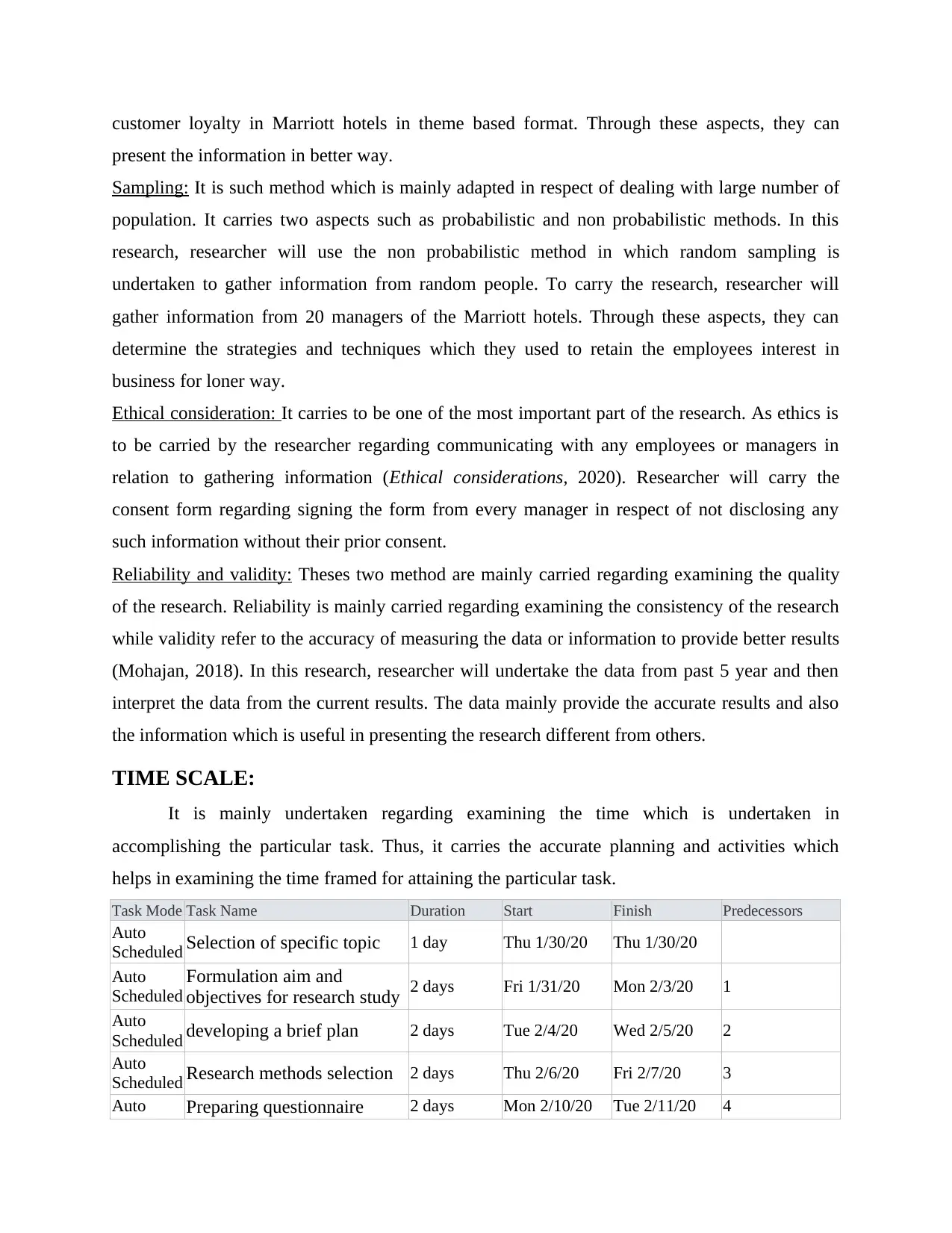
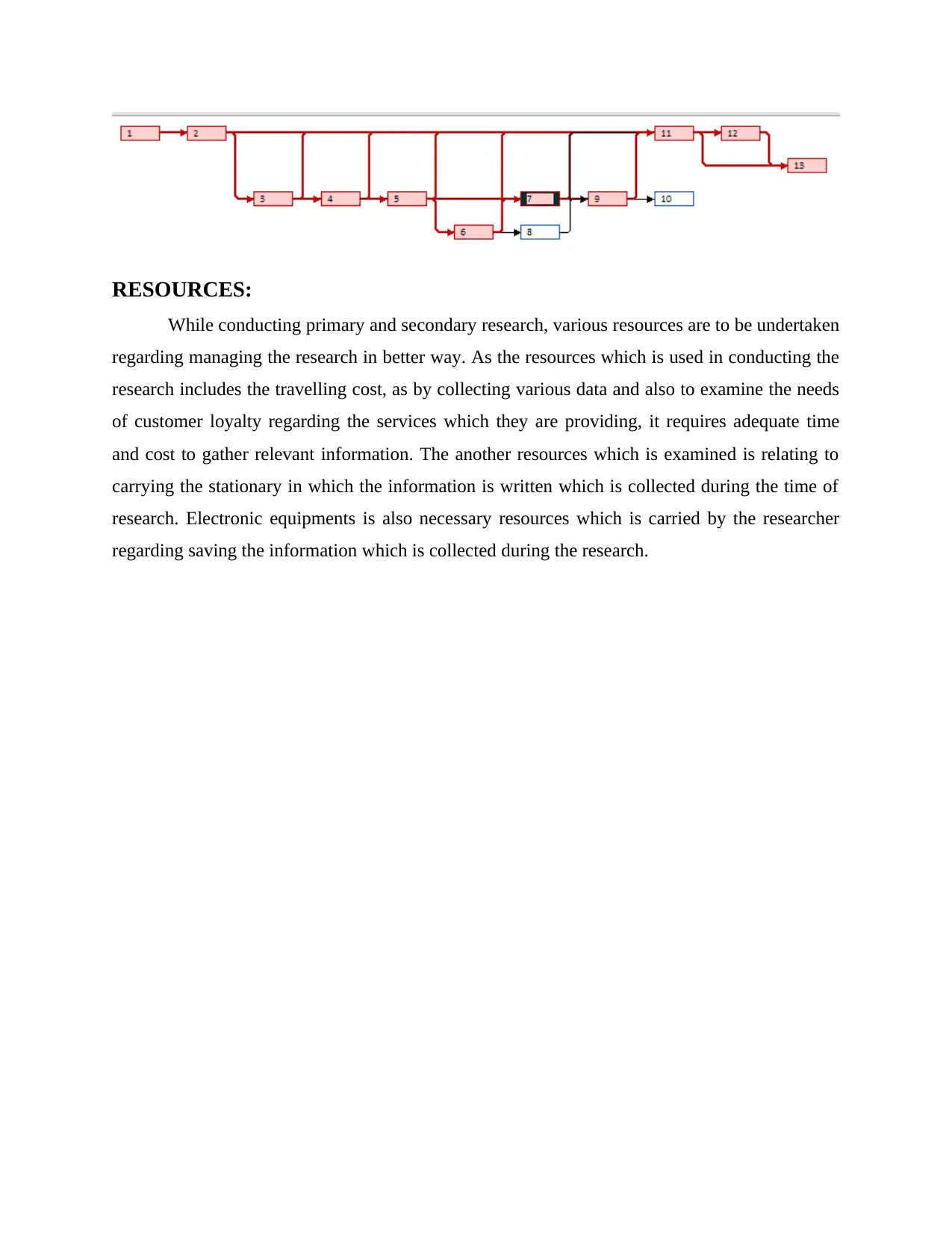
TIME SCALE:
It is mainly undertaken regarding examining the time which is undertaken in
accomplishing the particular task. Thus, it carries the accurate planning and activities which
helps in examining the time framed for attaining the particular task.
Task Mode Task Name Duration Start Finish Predecessors
Auto
Scheduled Selection of specific topic 1 day Thu 1/30/20 Thu 1/30/20
Auto
Scheduled
Formulation aim and
objectives for research study 2 days Fri 1/31/20 Mon 2/3/20 1
Auto
Scheduled developing a brief plan 2 days Tue 2/4/20 Wed 2/5/20 2
Auto
Scheduled Research methods selection 2 days Thu 2/6/20 Fri 2/7/20 3
Auto Preparing questionnaire 2 days Mon 2/10/20 Tue 2/11/20 4
present the information in better way.
Sampling: It is such method which is mainly adapted in respect of dealing with large number of
population. It carries two aspects such as probabilistic and non probabilistic methods. In this
research, researcher will use the non probabilistic method in which random sampling is
undertaken to gather information from random people. To carry the research, researcher will
gather information from 20 managers of the Marriott hotels. Through these aspects, they can
determine the strategies and techniques which they used to retain the employees interest in
business for loner way.
Ethical consideration: It carries to be one of the most important part of the research. As ethics is
to be carried by the researcher regarding communicating with any employees or managers in
relation to gathering information (Ethical considerations, 2020). Researcher will carry the
consent form regarding signing the form from every manager in respect of not disclosing any
such information without their prior consent.
Reliability and validity: Theses two method are mainly carried regarding examining the quality
of the research. Reliability is mainly carried regarding examining the consistency of the research
while validity refer to the accuracy of measuring the data or information to provide better results
(Mohajan, 2018). In this research, researcher will undertake the data from past 5 year and then
interpret the data from the current results. The data mainly provide the accurate results and also
the information which is useful in presenting the research different from others.
TIME SCALE:
It is mainly undertaken regarding examining the time which is undertaken in
accomplishing the particular task. Thus, it carries the accurate planning and activities which
helps in examining the time framed for attaining the particular task.
Task Mode Task Name Duration Start Finish Predecessors
Auto
Scheduled Selection of specific topic 1 day Thu 1/30/20 Thu 1/30/20
Auto
Scheduled
Formulation aim and
objectives for research study 2 days Fri 1/31/20 Mon 2/3/20 1
Auto
Scheduled developing a brief plan 2 days Tue 2/4/20 Wed 2/5/20 2
Auto
Scheduled Research methods selection 2 days Thu 2/6/20 Fri 2/7/20 3
Auto Preparing questionnaire 2 days Mon 2/10/20 Tue 2/11/20 4
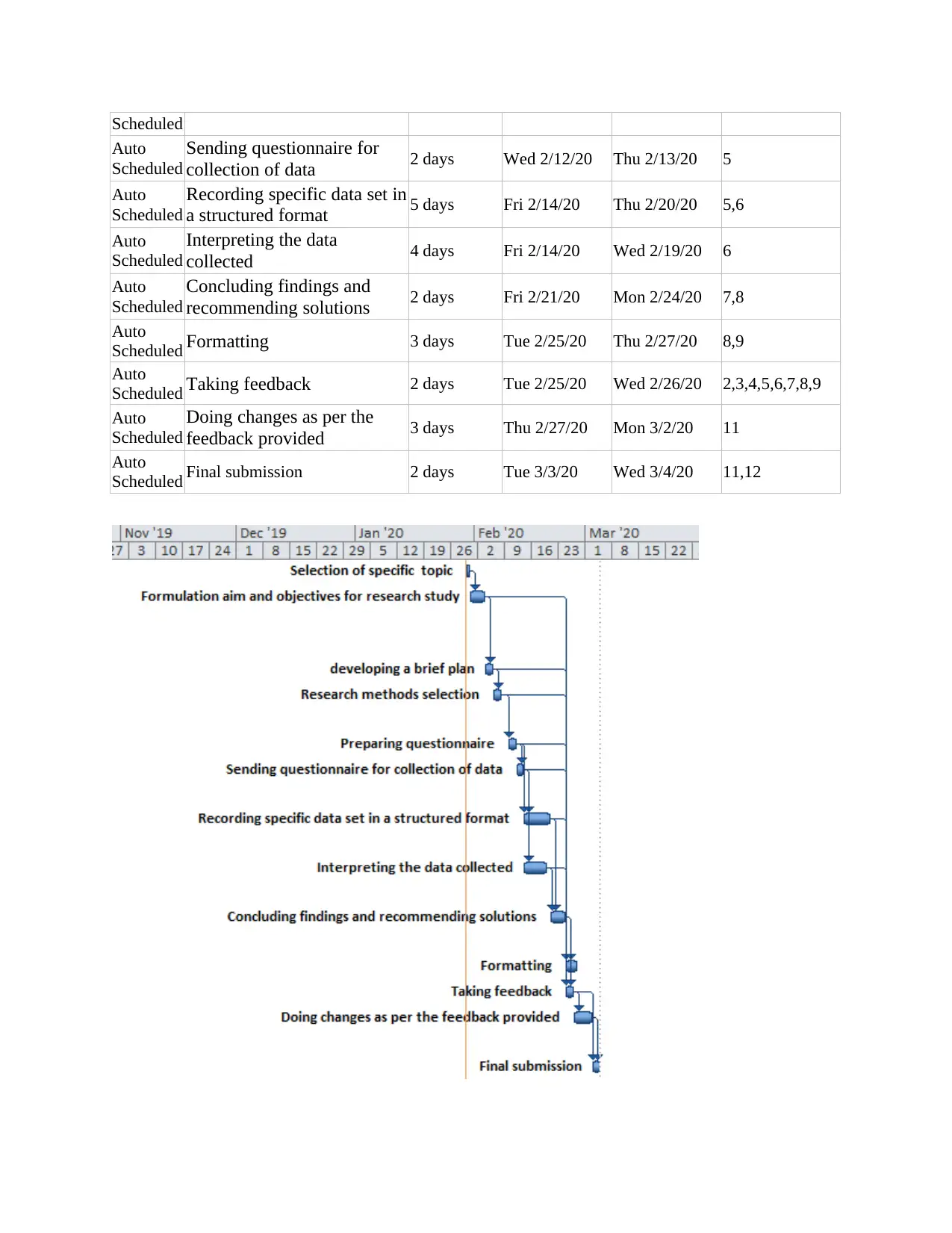
Scheduled
Auto
Scheduled
Sending questionnaire for
collection of data 2 days Wed 2/12/20 Thu 2/13/20 5
Auto
Scheduled
Recording specific data set in
a structured format 5 days Fri 2/14/20 Thu 2/20/20 5,6
Auto
Scheduled
Interpreting the data
collected 4 days Fri 2/14/20 Wed 2/19/20 6
Auto
Scheduled
Concluding findings and
recommending solutions 2 days Fri 2/21/20 Mon 2/24/20 7,8
Auto
Scheduled Formatting 3 days Tue 2/25/20 Thu 2/27/20 8,9
Auto
Scheduled Taking feedback 2 days Tue 2/25/20 Wed 2/26/20 2,3,4,5,6,7,8,9
Auto
Scheduled
Doing changes as per the
feedback provided 3 days Thu 2/27/20 Mon 3/2/20 11
Auto
Scheduled Final submission 2 days Tue 3/3/20 Wed 3/4/20 11,12
Auto
Scheduled
Sending questionnaire for
collection of data 2 days Wed 2/12/20 Thu 2/13/20 5
Auto
Scheduled
Recording specific data set in
a structured format 5 days Fri 2/14/20 Thu 2/20/20 5,6
Auto
Scheduled
Interpreting the data
collected 4 days Fri 2/14/20 Wed 2/19/20 6
Auto
Scheduled
Concluding findings and
recommending solutions 2 days Fri 2/21/20 Mon 2/24/20 7,8
Auto
Scheduled Formatting 3 days Tue 2/25/20 Thu 2/27/20 8,9
Auto
Scheduled Taking feedback 2 days Tue 2/25/20 Wed 2/26/20 2,3,4,5,6,7,8,9
Auto
Scheduled
Doing changes as per the
feedback provided 3 days Thu 2/27/20 Mon 3/2/20 11
Auto
Scheduled Final submission 2 days Tue 3/3/20 Wed 3/4/20 11,12
⊘ This is a preview!⊘
Do you want full access?
Subscribe today to unlock all pages.
Trusted by 1+ million students worldwide
RESOURCES:
While conducting primary and secondary research, various resources are to be undertaken
regarding managing the research in better way. As the resources which is used in conducting the
research includes the travelling cost, as by collecting various data and also to examine the needs
of customer loyalty regarding the services which they are providing, it requires adequate time
and cost to gather relevant information. The another resources which is examined is relating to
carrying the stationary in which the information is written which is collected during the time of
research. Electronic equipments is also necessary resources which is carried by the researcher
regarding saving the information which is collected during the research.
While conducting primary and secondary research, various resources are to be undertaken
regarding managing the research in better way. As the resources which is used in conducting the
research includes the travelling cost, as by collecting various data and also to examine the needs
of customer loyalty regarding the services which they are providing, it requires adequate time
and cost to gather relevant information. The another resources which is examined is relating to
carrying the stationary in which the information is written which is collected during the time of
research. Electronic equipments is also necessary resources which is carried by the researcher
regarding saving the information which is collected during the research.
Paraphrase This Document
Need a fresh take? Get an instant paraphrase of this document with our AI Paraphraser
REFERENCES
Books and Journals
Azim, M. T. and et.al., 2019. Linking transformational leadership with employees’ engagement
in the creative process. Management Research Review.
Eldor, L. and Vigoda-Gadot, E., 2017. The nature of employee engagement: Rethinking the
employee–organization relationship. The International Journal of Human Resource
Management. 28(3). pp.526-552.
Glesne, C., 2016. Becoming qualitative researchers: An introduction. Pearson. One Lake Street,
Upper Saddle River, New Jersey 07458.
Gray, D. E., 2019. Doing research in the business world. Sage Publications Limited.
Jung, H. S., Kim, K. B. and Yoon, H. H., 2018. Understanding Abusive Supervision: The
Impacts of Abusive Supervision on Employees’ Engagement and Organizational
Commitment in the Deluxe Hotel. Culinary Science & Hospitality Research. 24(2).
pp.8-15.
Kumar, R., 2019. Research methodology: A step-by-step guide for beginners. Sage Publications
Limited.
Litosseliti, L. ed., 2018. Research methods in linguistics. Bloomsbury Publishing.
Lu, L. and et.al., 2016. Work engagement, job satisfaction, and turnover intentions. International
Journal of Contemporary Hospitality Management.
Milliman, J., Gatling, A. and Kim, J. S., 2018. The effect of workplace spirituality on hospitality
employee engagement, intention to stay, and service delivery. Journal of Hospitality
and Tourism Management. 35. pp.56-65.
Mohajan, H. K., 2018. Qualitative research methodology in social sciences and related subjects.
Journal of Economic Development, Environment and People. 7(1). pp.23-48.
Pandita, D. and Ray, S., 2018. Talent management and employee engagement–a meta-analysis of
their impact on talent retention. Industrial and Commercial Training.
Pansari, A. and Kumar, V., 2018. Customer engagement marketing. In Customer engagement
marketing (pp. 1-27). Palgrave Macmillan, Cham.
Quinlan, C. and et.al., 2019. Business research methods. South Western Cengage.
Shaban, S., 2018. Predicting big-five personality traits relation with employees’ engagement in
public sector in Egypt. International Journal of Business and Management Review.
6(1). pp.33-43.
Silverman, D. ed., 2016. Qualitative research. Sage.
Singal, M. and Rhou, Y., 2017. Corporate social responsibility in the hospitality sector. Boston
hospitality review. 5(1). pp.1-16.
So, K. K. F. and et.al., 2016. The role of customer engagement in building consumer loyalty to
tourism brands. Journal of Travel Research. 55(1). pp.64-78.
Online
Ethical considerations. 2020. Online. Available through:
<https://www.ncbi.nlm.nih.gov/books/NBK305506/>.
Books and Journals
Azim, M. T. and et.al., 2019. Linking transformational leadership with employees’ engagement
in the creative process. Management Research Review.
Eldor, L. and Vigoda-Gadot, E., 2017. The nature of employee engagement: Rethinking the
employee–organization relationship. The International Journal of Human Resource
Management. 28(3). pp.526-552.
Glesne, C., 2016. Becoming qualitative researchers: An introduction. Pearson. One Lake Street,
Upper Saddle River, New Jersey 07458.
Gray, D. E., 2019. Doing research in the business world. Sage Publications Limited.
Jung, H. S., Kim, K. B. and Yoon, H. H., 2018. Understanding Abusive Supervision: The
Impacts of Abusive Supervision on Employees’ Engagement and Organizational
Commitment in the Deluxe Hotel. Culinary Science & Hospitality Research. 24(2).
pp.8-15.
Kumar, R., 2019. Research methodology: A step-by-step guide for beginners. Sage Publications
Limited.
Litosseliti, L. ed., 2018. Research methods in linguistics. Bloomsbury Publishing.
Lu, L. and et.al., 2016. Work engagement, job satisfaction, and turnover intentions. International
Journal of Contemporary Hospitality Management.
Milliman, J., Gatling, A. and Kim, J. S., 2018. The effect of workplace spirituality on hospitality
employee engagement, intention to stay, and service delivery. Journal of Hospitality
and Tourism Management. 35. pp.56-65.
Mohajan, H. K., 2018. Qualitative research methodology in social sciences and related subjects.
Journal of Economic Development, Environment and People. 7(1). pp.23-48.
Pandita, D. and Ray, S., 2018. Talent management and employee engagement–a meta-analysis of
their impact on talent retention. Industrial and Commercial Training.
Pansari, A. and Kumar, V., 2018. Customer engagement marketing. In Customer engagement
marketing (pp. 1-27). Palgrave Macmillan, Cham.
Quinlan, C. and et.al., 2019. Business research methods. South Western Cengage.
Shaban, S., 2018. Predicting big-five personality traits relation with employees’ engagement in
public sector in Egypt. International Journal of Business and Management Review.
6(1). pp.33-43.
Silverman, D. ed., 2016. Qualitative research. Sage.
Singal, M. and Rhou, Y., 2017. Corporate social responsibility in the hospitality sector. Boston
hospitality review. 5(1). pp.1-16.
So, K. K. F. and et.al., 2016. The role of customer engagement in building consumer loyalty to
tourism brands. Journal of Travel Research. 55(1). pp.64-78.
Online
Ethical considerations. 2020. Online. Available through:
<https://www.ncbi.nlm.nih.gov/books/NBK305506/>.
Research Ethics approval form
All students conducting research activity that involves human participants or the use of data
collected form human participants are required to gain ethical approval before commencing their
research. Please answer all relevant questions and note that your form may be returned if
incomplete.
For further support and guidance please see your respective Unit Tutor:
Before completing this form, we advise that you discuss your proposed research fully with your
unit tutor. Please complete this form in good time before your research project is due to
commence.
Section 1: Basic details:
Project title:
To investigate the relations between employee engagement and aspects pertaining to building customer
loyalty in the context of UK hospitality sector– A case study on Marriott.
Student name:
Student ID number:
Programme:
College Name:
Intended research start date:
Intended research end date:
Section 2 Project summary
Please select all research methods that you plan to use as a part of your project:
Interviews Yes No
Questionnaires Yes No
Observations Yes No
Use of personal records Yes No
Data Analysis Yes No
Action Research Yes No
Focus Groups Yes No
Others (Please specify) :
Section 3: Participants
Please answer the following questions, giving full details where necessary.
Will your research involve human participants?
Who are the participants? Tick all that apply:
Ages 12-16: Young people aged: 17-18 Adults: 18>
How will participants be recruited (identified an approached)?
Email,Text
Describe the processes you will use to inform participants about what you are doing:
The method of email will be used
How will you obtain consent from participants? Will this be written? How will it be made clear to participants that
they may withdraw consent to participate at any time?
By signing the consent form with the participants
Studies involving questionnaires: will participants be given the option of omitting questions that do not wish to
answer? Yes No
All students conducting research activity that involves human participants or the use of data
collected form human participants are required to gain ethical approval before commencing their
research. Please answer all relevant questions and note that your form may be returned if
incomplete.
For further support and guidance please see your respective Unit Tutor:
Before completing this form, we advise that you discuss your proposed research fully with your
unit tutor. Please complete this form in good time before your research project is due to
commence.
Section 1: Basic details:
Project title:
To investigate the relations between employee engagement and aspects pertaining to building customer
loyalty in the context of UK hospitality sector– A case study on Marriott.
Student name:
Student ID number:
Programme:
College Name:
Intended research start date:
Intended research end date:
Section 2 Project summary
Please select all research methods that you plan to use as a part of your project:
Interviews Yes No
Questionnaires Yes No
Observations Yes No
Use of personal records Yes No
Data Analysis Yes No
Action Research Yes No
Focus Groups Yes No
Others (Please specify) :
Section 3: Participants
Please answer the following questions, giving full details where necessary.
Will your research involve human participants?
Who are the participants? Tick all that apply:
Ages 12-16: Young people aged: 17-18 Adults: 18>
How will participants be recruited (identified an approached)?
Email,Text
Describe the processes you will use to inform participants about what you are doing:
The method of email will be used
How will you obtain consent from participants? Will this be written? How will it be made clear to participants that
they may withdraw consent to participate at any time?
By signing the consent form with the participants
Studies involving questionnaires: will participants be given the option of omitting questions that do not wish to
answer? Yes No
⊘ This is a preview!⊘
Do you want full access?
Subscribe today to unlock all pages.
Trusted by 1+ million students worldwide

1 out of 14


Related Documents


Your All-in-One AI-Powered Toolkit for Academic Success.
+13062052269
info@desklib.com
Available 24*7 on WhatsApp / Email
![[object Object]](/_next/static/media/star-bottom.7253800d.svg)
Unlock your academic potential
Copyright © 2020–2026 A2Z Services. All Rights Reserved. Developed and managed by ZUCOL.