Employee Engagement: A Detailed Literature Review and Analysis
VerifiedAdded on 2023/03/23
|36
|10188
|65
Literature Review
AI Summary
This literature review delves into the multifaceted concept of employee engagement, examining its historical evolution, various definitions, and key antecedents. The review explores the significance of employee engagement within organizations, highlighting its impact on productivity, loyalty, and customer satisfaction. It also discusses practical management tools and strategies for fostering employee engagement. Furthermore, the review extends to related topics such as immigration and its implications on the workforce, comparing migrant and local employees. The review incorporates various perspectives and research findings, providing a comprehensive overview of the topic and its relevance in the modern workplace.

Employee Engagement: Literature Review

Paraphrase This Document
Need a fresh take? Get an instant paraphrase of this document with our AI Paraphraser
Running Head: Literature Review
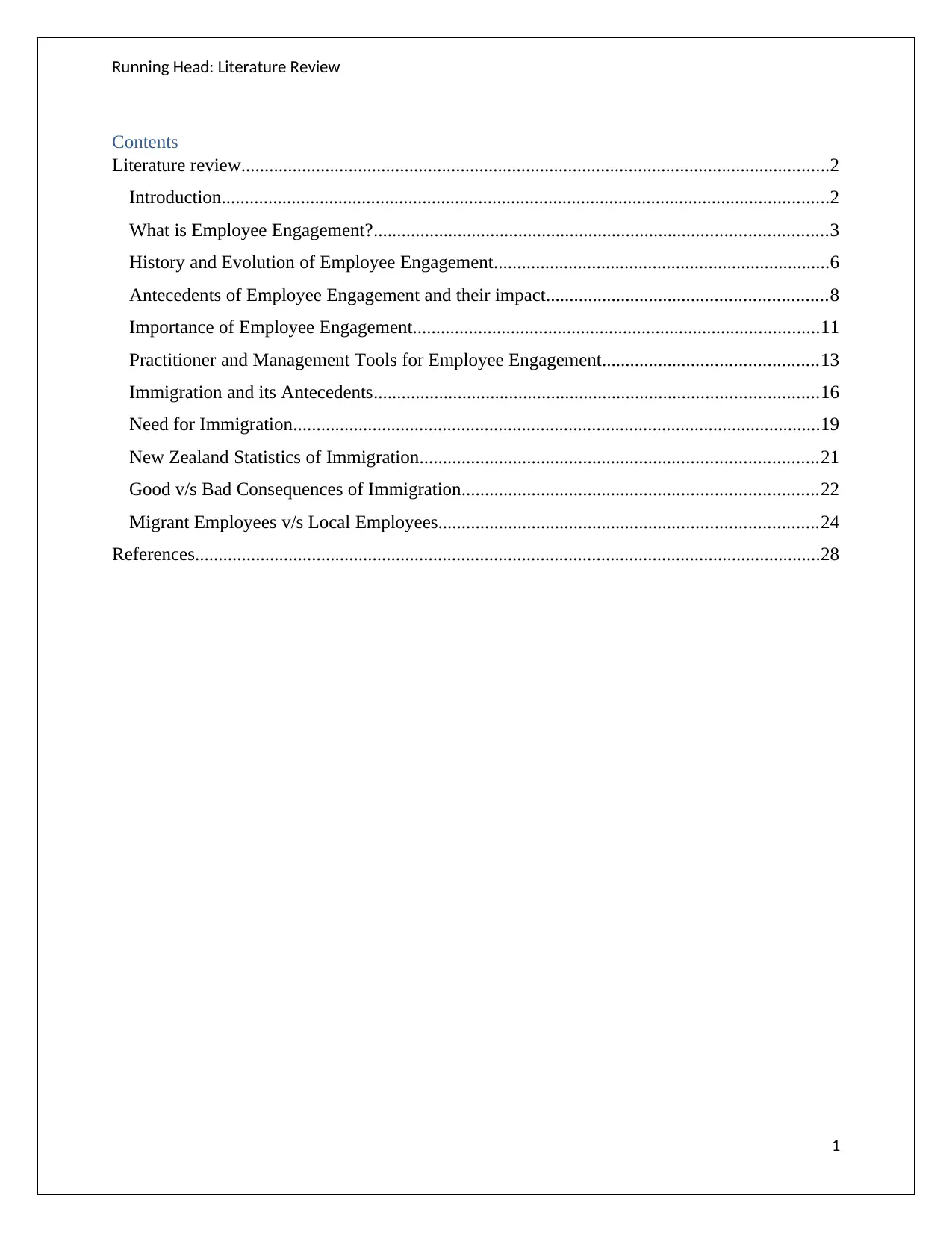
Contents
Literature review..............................................................................................................................2
Introduction..................................................................................................................................2
What is Employee Engagement?.................................................................................................3
History and Evolution of Employee Engagement........................................................................6
Antecedents of Employee Engagement and their impact............................................................8
Importance of Employee Engagement.......................................................................................11
Practitioner and Management Tools for Employee Engagement..............................................13
Immigration and its Antecedents...............................................................................................16
Need for Immigration.................................................................................................................19
New Zealand Statistics of Immigration.....................................................................................21
Good v/s Bad Consequences of Immigration............................................................................22
Migrant Employees v/s Local Employees.................................................................................24
References......................................................................................................................................28
1
Contents
Literature review..............................................................................................................................2
Introduction..................................................................................................................................2
What is Employee Engagement?.................................................................................................3
History and Evolution of Employee Engagement........................................................................6
Antecedents of Employee Engagement and their impact............................................................8
Importance of Employee Engagement.......................................................................................11
Practitioner and Management Tools for Employee Engagement..............................................13
Immigration and its Antecedents...............................................................................................16
Need for Immigration.................................................................................................................19
New Zealand Statistics of Immigration.....................................................................................21
Good v/s Bad Consequences of Immigration............................................................................22
Migrant Employees v/s Local Employees.................................................................................24
References......................................................................................................................................28
1
Running Head: Literature Review
Literature review
Introduction
To survive in the modern-era organizations the employees have to be enthusiastic and should
even take initiatives at work. The firms are not only concerned about their own development, but
also compel the employees to work for their personal career development also. In other words,
the company wants their employees to be engaged and this could only be attained when the
employees know that their leaders and their company on a whole respects their work and the
services they are discharging are eventually contributing to the overall development of the firm.
An employee is engaged when his personal ambitions of pay, rewards and growth are met by a
firm.
In these increasingly competitive markets and global corporate world, the companies are
working hard to keep the employees satisfied and determined and obtain necessary business
results. However, in order to obtain higher performance, the satisfied employees are not enough
because they will just meet the work demands in a given time frame. To be highly competitive an
employer needs to work beyond the satisfaction attainment of the employees and should
motivate them to deliver services with full energy (Allen M. , 2014). So to survive in the modern
organizations an employee needs to be enthusiastic at the workplace, excited about the services
they deliver, show creativity at work, accept challenges and remain competitive while delivering
services at work.
If a company manages to maintain high morale among the employees, it receives a number of
benefits as the active staff members are more productive and they remain loyal to a firm for a
longer duration. It is believed that the production level of companies with high level of
2
Literature review
Introduction
To survive in the modern-era organizations the employees have to be enthusiastic and should
even take initiatives at work. The firms are not only concerned about their own development, but
also compel the employees to work for their personal career development also. In other words,
the company wants their employees to be engaged and this could only be attained when the
employees know that their leaders and their company on a whole respects their work and the
services they are discharging are eventually contributing to the overall development of the firm.
An employee is engaged when his personal ambitions of pay, rewards and growth are met by a
firm.
In these increasingly competitive markets and global corporate world, the companies are
working hard to keep the employees satisfied and determined and obtain necessary business
results. However, in order to obtain higher performance, the satisfied employees are not enough
because they will just meet the work demands in a given time frame. To be highly competitive an
employer needs to work beyond the satisfaction attainment of the employees and should
motivate them to deliver services with full energy (Allen M. , 2014). So to survive in the modern
organizations an employee needs to be enthusiastic at the workplace, excited about the services
they deliver, show creativity at work, accept challenges and remain competitive while delivering
services at work.
If a company manages to maintain high morale among the employees, it receives a number of
benefits as the active staff members are more productive and they remain loyal to a firm for a
longer duration. It is believed that the production level of companies with high level of
2
⊘ This is a preview!⊘
Do you want full access?
Subscribe today to unlock all pages.

Trusted by 1+ million students worldwide
Running Head: Literature Review
engagement is quite higher than their counterparts with low level of employee engagement
(USC, 2015). This concept has emerged as a popular organizational concept among the
practitioner audiences. The engaged workforce has become the prime asset and the topmost
priority for corporate executives. The employee engagement can also be a deciding factor for the
effectiveness of the organization as this factor has not only a capability to affect the retention and
loyalty of the employees, but it has a positive impact on the level of customer satisfaction also.
The reputation of the company is also improved and there’s a noticeable change in the overall
value of the stakeholder. Thus, to survive in this highly competitive environment the managers of
the firm are turning to the HR to set agenda for the improvement of the employee engagement
practices and commitment strategies (Wachter & Yorio, 2014).
What is Employee Engagement?
Employees are considered as a crucial asset of any organization and in the last few decades, there
has been a “talent war” which has compelled the organizations to not only attracts the topmost
talent, but also to retain it for a longer duration. One of the toughest challenges faced by the
CEOs, Human Resource Managers and other leaders in an organization is to connect the
employees not only physically in the workplace, but to compel them to establish an equal
emotional and mental connection with their work and the services they deliver on the daily basis.
The engaged employees contribute positively towards achieving the organizational
goals(Sanders, 2012).
Employee Engagement is a complex and a broad construct that includes ideas such as
commitment, loyalty, satisfaction, motivation and extra role behavior. An employee, who is
3
engagement is quite higher than their counterparts with low level of employee engagement
(USC, 2015). This concept has emerged as a popular organizational concept among the
practitioner audiences. The engaged workforce has become the prime asset and the topmost
priority for corporate executives. The employee engagement can also be a deciding factor for the
effectiveness of the organization as this factor has not only a capability to affect the retention and
loyalty of the employees, but it has a positive impact on the level of customer satisfaction also.
The reputation of the company is also improved and there’s a noticeable change in the overall
value of the stakeholder. Thus, to survive in this highly competitive environment the managers of
the firm are turning to the HR to set agenda for the improvement of the employee engagement
practices and commitment strategies (Wachter & Yorio, 2014).
What is Employee Engagement?
Employees are considered as a crucial asset of any organization and in the last few decades, there
has been a “talent war” which has compelled the organizations to not only attracts the topmost
talent, but also to retain it for a longer duration. One of the toughest challenges faced by the
CEOs, Human Resource Managers and other leaders in an organization is to connect the
employees not only physically in the workplace, but to compel them to establish an equal
emotional and mental connection with their work and the services they deliver on the daily basis.
The engaged employees contribute positively towards achieving the organizational
goals(Sanders, 2012).
Employee Engagement is a complex and a broad construct that includes ideas such as
commitment, loyalty, satisfaction, motivation and extra role behavior. An employee, who is
3
Paraphrase This Document
Need a fresh take? Get an instant paraphrase of this document with our AI Paraphraser
Running Head: Literature Review
highly engaged, extends himself to meet the specific needs of the organization, take initiatives
when the firms are stuck and have to take crucial decisions, reinforces and creates the culture of
a firm, stays focused and vigilantly deliver his/her services and even possess a belief that their
services could make a huge difference in the firm’s status and brand identity in the current and
prospective markets. At a practical level, a firm usually defines Employee Engagement as an act
where employees consider themselves as an integral part of the company and usually have pride
and loyalty to the company. To make the strategies of the firm successful such employees
usually go “above and beyond the call of duty” (Kamau & Sma, 2016).
As the concept of Employee Engagement has gained a lot of popularity, there have been a
number of changes in its definition, conceptualization and measurement. The researchers in the
academic community have, however lagged in defining the term engagement as it is entirely a
new concept. Different researchers have given different definitions of this term. For instance,
Kahn (1900) who was considered as the “father of employee engagement movement” defines it
as the harnessing of organization members’ selves to their work roles. He also stated that “in the
engagement people involve and express them physically, cognitively and emotionally during role
performances” (Knight, 2012). This means an employee has to be present both physically and
psychologically in order to discharge his/her duties in an effective manner and also undertake
organizational roles and responsibilities. According to Mortimer, employee engagement can be
defined as the commitment towards the firm and its values and also the willingness of the
employees and leaders to provide a precise guidance to the coworkers and subordinates.
Robinson, Perryman and Hayday (2004) defined this concept as an optimistic attitude of an
employee towards the firm and a strong belief in its cultural values. An employee who has been
engaged for long is aware of all the changes that are occurring in the business world; hence he
4
highly engaged, extends himself to meet the specific needs of the organization, take initiatives
when the firms are stuck and have to take crucial decisions, reinforces and creates the culture of
a firm, stays focused and vigilantly deliver his/her services and even possess a belief that their
services could make a huge difference in the firm’s status and brand identity in the current and
prospective markets. At a practical level, a firm usually defines Employee Engagement as an act
where employees consider themselves as an integral part of the company and usually have pride
and loyalty to the company. To make the strategies of the firm successful such employees
usually go “above and beyond the call of duty” (Kamau & Sma, 2016).
As the concept of Employee Engagement has gained a lot of popularity, there have been a
number of changes in its definition, conceptualization and measurement. The researchers in the
academic community have, however lagged in defining the term engagement as it is entirely a
new concept. Different researchers have given different definitions of this term. For instance,
Kahn (1900) who was considered as the “father of employee engagement movement” defines it
as the harnessing of organization members’ selves to their work roles. He also stated that “in the
engagement people involve and express them physically, cognitively and emotionally during role
performances” (Knight, 2012). This means an employee has to be present both physically and
psychologically in order to discharge his/her duties in an effective manner and also undertake
organizational roles and responsibilities. According to Mortimer, employee engagement can be
defined as the commitment towards the firm and its values and also the willingness of the
employees and leaders to provide a precise guidance to the coworkers and subordinates.
Robinson, Perryman and Hayday (2004) defined this concept as an optimistic attitude of an
employee towards the firm and a strong belief in its cultural values. An employee who has been
engaged for long is aware of all the changes that are occurring in the business world; hence he
4
Running Head: Literature Review
delivers services in order to improve the sales and profits of the firm (Tran, 2018). According to
them a two-way relationship could be built between the employees and the employers hence the
organization must work to nurture and develop the engagement. The engaged employees are
more satisfied with the work they deliver and they not only have much energy, but they apply
this energy enthusiastically to work also. Saks (2006) defined “employee engagement” as the
extent to which an individual is attentive and absorbed in their jobs and role given to them in the
workplace (Kular, Gatenby, Rees, Soane, & Truss, 2008). According to the author, Employee
Engagement is also a positive attitude one develops for the company he/she is serving. This
concept also improves the relationships between the employees and their leaders by establishing
better communication among them. Mone and London (2010) defined employee engagement as a
condition of the employee in which he/she feels motivated, involved, committed and passionate
towards the organization and demonstrates those feelings in his/her working behavior. This
means if an employee is highly engaged, then he is happy and this would be eventually reflected
in his working behavior. Bhatla (2011) tried to establish a close relation between engagement of
an employee with the firm and his/her psychological state during that period. He even stated that
an employee is highly engaged when it has a psychological commitment towards the assigned
task and this reflects the employee’s dedication towards his/her work (MacLeod & Clarke,
2018). Mani (2011) states that an engaged employee is aware of the changes occurring in the
business environment and hence closely aligns with his/her colleagues and leaders to improve
his/her individual performance and create a number of benefits for the organization. The engaged
employees put a focus on the future of the firm and also over his/her own future career growth.
Johnson (2014) has described this concept as the workplace approach in which the managers and
5
delivers services in order to improve the sales and profits of the firm (Tran, 2018). According to
them a two-way relationship could be built between the employees and the employers hence the
organization must work to nurture and develop the engagement. The engaged employees are
more satisfied with the work they deliver and they not only have much energy, but they apply
this energy enthusiastically to work also. Saks (2006) defined “employee engagement” as the
extent to which an individual is attentive and absorbed in their jobs and role given to them in the
workplace (Kular, Gatenby, Rees, Soane, & Truss, 2008). According to the author, Employee
Engagement is also a positive attitude one develops for the company he/she is serving. This
concept also improves the relationships between the employees and their leaders by establishing
better communication among them. Mone and London (2010) defined employee engagement as a
condition of the employee in which he/she feels motivated, involved, committed and passionate
towards the organization and demonstrates those feelings in his/her working behavior. This
means if an employee is highly engaged, then he is happy and this would be eventually reflected
in his working behavior. Bhatla (2011) tried to establish a close relation between engagement of
an employee with the firm and his/her psychological state during that period. He even stated that
an employee is highly engaged when it has a psychological commitment towards the assigned
task and this reflects the employee’s dedication towards his/her work (MacLeod & Clarke,
2018). Mani (2011) states that an engaged employee is aware of the changes occurring in the
business environment and hence closely aligns with his/her colleagues and leaders to improve
his/her individual performance and create a number of benefits for the organization. The engaged
employees put a focus on the future of the firm and also over his/her own future career growth.
Johnson (2014) has described this concept as the workplace approach in which the managers and
5
⊘ This is a preview!⊘
Do you want full access?
Subscribe today to unlock all pages.
Trusted by 1+ million students worldwide
Running Head: Literature Review
other leaders ensure that the employees are highly committed towards the goals and objectives of
the firm (Mehta & Mehta, 2013).
History and Evolution of Employee Engagement
The Employee Engagement appears a relatively new concept, but it goes back to over 25 years
when the term appeared for the first time in the academic journals in the year 1990. In the period
of 70s and 80s the HR focused on Employee Satisfaction only. This concept had no connection
with the quality of services delivered by the employees and even with the performance of an
individual employee. This concept only considers an employee and its connection with the firm
and not about the organization as a whole. Till this period an employee was just considered as a
“personnel”. With the advancements in the thoughts and ideas, the focus shifted from
satisfaction towards commitment and at that moment the “personnel” actually became “human
resources”. The employee will be loyal and committed towards an organization in return of the
job offered to him/her. Although commitment is a crucial element of engagement, however, it
cannot replace engagement (Shuck & Wollard, 2009).
As the global competition began to increase at a rapid pace, there was a requirement that the
employers should become more flexible and competitive. As the traditional industries were
closed and employees were cut back, at that moment the people realized that they need to be
more flexible in their career choices and grab the opportunities wherever they find them. The old
contract of “job for life” was broken and people were free from to explore and move from job to
job. This was benefitting the employees, but the employers were losing their top talents and
along with that a good amount of money and crucial resources of the company too. In the midst
of all these events the concept of Employee Engagement rose and an important act in this period
was the publication of a paper in Institute of Employment Studies (IES) titled, ‘From People to
6
other leaders ensure that the employees are highly committed towards the goals and objectives of
the firm (Mehta & Mehta, 2013).
History and Evolution of Employee Engagement
The Employee Engagement appears a relatively new concept, but it goes back to over 25 years
when the term appeared for the first time in the academic journals in the year 1990. In the period
of 70s and 80s the HR focused on Employee Satisfaction only. This concept had no connection
with the quality of services delivered by the employees and even with the performance of an
individual employee. This concept only considers an employee and its connection with the firm
and not about the organization as a whole. Till this period an employee was just considered as a
“personnel”. With the advancements in the thoughts and ideas, the focus shifted from
satisfaction towards commitment and at that moment the “personnel” actually became “human
resources”. The employee will be loyal and committed towards an organization in return of the
job offered to him/her. Although commitment is a crucial element of engagement, however, it
cannot replace engagement (Shuck & Wollard, 2009).
As the global competition began to increase at a rapid pace, there was a requirement that the
employers should become more flexible and competitive. As the traditional industries were
closed and employees were cut back, at that moment the people realized that they need to be
more flexible in their career choices and grab the opportunities wherever they find them. The old
contract of “job for life” was broken and people were free from to explore and move from job to
job. This was benefitting the employees, but the employers were losing their top talents and
along with that a good amount of money and crucial resources of the company too. In the midst
of all these events the concept of Employee Engagement rose and an important act in this period
was the publication of a paper in Institute of Employment Studies (IES) titled, ‘From People to
6
Paraphrase This Document
Need a fresh take? Get an instant paraphrase of this document with our AI Paraphraser
Running Head: Literature Review
Profits, the HR link to the service-profit chain’ (Byrne, 2019). This paper showed that with the
improved behavior and attitude of the employees at the workplace, there could be an
enhancement in the customer satisfaction and retention level and at the same time in the overall
sales performance. For the service based businesses, the old mantra ‘Staff is your greatest attest’
was demolished and a new one ‘Staff is your only asset’ was adopted. Due to this the leaders
began to invest greater assets in the incentives of the staff and as a result, there was a drastic
increase in the level of the employee commitment, motivation, productivity and eventually the
profit rates of the firm (Sharma & Kaur, 2014).
There was acceleration in the adoption of the concept of employee engagement by the firms as
another seminal study was conducted in the year 2002 which showed a precise link between the
employee engagement and the profit rates of the firm. The concept that was introduced back in
1990 was confined only to the academic level, but now this new concept of employee
engagement was applied at the practitioner level (Harvard Business School, 2013). The leaders
began to observe that this concept has a capability to affect a number of business measures like
employee recruitment and retention, sales, profits, turnover, customer satisfaction, etc.
There has been a drastic evolution in the concept of Employee Engagement. Two decades ago
when this concept gained popularity, then the focus shifted on overall satisfaction of the
employees as the employers had a belief that satisfied employees deliver better services than the
unsatisfied ones. But, the employee satisfaction process did not work out which forced the
employers to adopt employee commitment. This was introduced to improve staff loyalty to
reduce employee turnover. But, this also failed during the economic crisis as the employers had
7
Profits, the HR link to the service-profit chain’ (Byrne, 2019). This paper showed that with the
improved behavior and attitude of the employees at the workplace, there could be an
enhancement in the customer satisfaction and retention level and at the same time in the overall
sales performance. For the service based businesses, the old mantra ‘Staff is your greatest attest’
was demolished and a new one ‘Staff is your only asset’ was adopted. Due to this the leaders
began to invest greater assets in the incentives of the staff and as a result, there was a drastic
increase in the level of the employee commitment, motivation, productivity and eventually the
profit rates of the firm (Sharma & Kaur, 2014).
There was acceleration in the adoption of the concept of employee engagement by the firms as
another seminal study was conducted in the year 2002 which showed a precise link between the
employee engagement and the profit rates of the firm. The concept that was introduced back in
1990 was confined only to the academic level, but now this new concept of employee
engagement was applied at the practitioner level (Harvard Business School, 2013). The leaders
began to observe that this concept has a capability to affect a number of business measures like
employee recruitment and retention, sales, profits, turnover, customer satisfaction, etc.
There has been a drastic evolution in the concept of Employee Engagement. Two decades ago
when this concept gained popularity, then the focus shifted on overall satisfaction of the
employees as the employers had a belief that satisfied employees deliver better services than the
unsatisfied ones. But, the employee satisfaction process did not work out which forced the
employers to adopt employee commitment. This was introduced to improve staff loyalty to
reduce employee turnover. But, this also failed during the economic crisis as the employers had
7
Running Head: Literature Review
to lay off employees who in turn started looking for better opportunities instead of sticking to the
firm due to loyalty. After this finally came the concept of Employee Engagement through which
the employers discovered that the employees were more productive, loyal, satisfied and efficient
if they felt legitimately connected to the company. With the introduction of this concept the
employees started to provide the best possible services to the firm (Vance, 2006).
Antecedents of Employee Engagement and their impact
Employee Engagement elements are directly and indirectly related to the overall performance of
the organisation. Shuck and Rocco (2011) considered factors like job fit, psychological climate
and affective commitment and established a close link of such factors with employee
engagement. A good job fit has a tendency to engage an employee cognitively and behaviorally
and thus the overall employee performance is improved. Also, when the employees receive
psychological meaningfulness at work, then they develop a great passion to accomplish their
tasks. The affective commitment refers to the emotional connection of an employee to his/her
work and the duties discharged by him/her at the workplace (Aston, 2014).
Psychological Climate was defined as “capturing the meaningful psychological representations
made by the individuals relative to the structures, processes and events that occur within
organizations. In the year 1996, Brown and Leigh developed a model of psychological climate,
performance, effort and involvement and along with this stated that to achieve a high level of
employee engagement the employers need to maintain a positive psychological environment
across the workplace. Later a number of reformations were made to this model and it was
discovered that a good psychological climate has an effective relationship with the employee’s
8
to lay off employees who in turn started looking for better opportunities instead of sticking to the
firm due to loyalty. After this finally came the concept of Employee Engagement through which
the employers discovered that the employees were more productive, loyal, satisfied and efficient
if they felt legitimately connected to the company. With the introduction of this concept the
employees started to provide the best possible services to the firm (Vance, 2006).
Antecedents of Employee Engagement and their impact
Employee Engagement elements are directly and indirectly related to the overall performance of
the organisation. Shuck and Rocco (2011) considered factors like job fit, psychological climate
and affective commitment and established a close link of such factors with employee
engagement. A good job fit has a tendency to engage an employee cognitively and behaviorally
and thus the overall employee performance is improved. Also, when the employees receive
psychological meaningfulness at work, then they develop a great passion to accomplish their
tasks. The affective commitment refers to the emotional connection of an employee to his/her
work and the duties discharged by him/her at the workplace (Aston, 2014).
Psychological Climate was defined as “capturing the meaningful psychological representations
made by the individuals relative to the structures, processes and events that occur within
organizations. In the year 1996, Brown and Leigh developed a model of psychological climate,
performance, effort and involvement and along with this stated that to achieve a high level of
employee engagement the employers need to maintain a positive psychological environment
across the workplace. Later a number of reformations were made to this model and it was
discovered that a good psychological climate has an effective relationship with the employee’s
8
⊘ This is a preview!⊘
Do you want full access?
Subscribe today to unlock all pages.
Trusted by 1+ million students worldwide
Running Head: Literature Review
capability to deliver best performance in the workplace and even develop the willingness to be
regular at the job (Shimazu, Schaufeli, Kamiyama, & Kawakami, 2015).
High Level of Employee Communication leads to proper communication of organizational goals
and objectives to the employees. According to a study conducted by Andrew and Sofian (2012),
the process of engagement is highly influenced by the type of communication that occurs
between employees and even among the leaders and the subordinates. When the voice of the
employees is heard and when they are made aware of the ongoing activities in the company then
they feel more attached towards the company and hence deliver their services in an enthusiastic
manner.
According to Andrew and Sofian (2012), training, skill development and learning play a crucial
role in the overall development of the employees. When a learning-oriented culture is created in
an organization, then it becomes an effective way to enhance the engagement of the employees
in the firm’s activities and decisions. Most of the young employees are always interested to learn
new skills and gain myriads of knowledge in their core working areas and even in the ones that
are quite new to them. The reason behind this is they want to keep their work interesting and
fresh. Also by learning new skills and developing good knowledge about different tools and
technologies help the employees to seek different job opportunities and activate the motivation
process while the employees readily throw themselves to work (Wang, 2016).
Co-workers support is crucial in creating a positive working environment in the organization.
Cooperative workers drive positive energy and the workers tend to deliver better services in the
workplace where the team members support and motivate each other to perform better. Rewards
and Recognitions are also important in establishing firm engagement with the employees Kahn
9
capability to deliver best performance in the workplace and even develop the willingness to be
regular at the job (Shimazu, Schaufeli, Kamiyama, & Kawakami, 2015).
High Level of Employee Communication leads to proper communication of organizational goals
and objectives to the employees. According to a study conducted by Andrew and Sofian (2012),
the process of engagement is highly influenced by the type of communication that occurs
between employees and even among the leaders and the subordinates. When the voice of the
employees is heard and when they are made aware of the ongoing activities in the company then
they feel more attached towards the company and hence deliver their services in an enthusiastic
manner.
According to Andrew and Sofian (2012), training, skill development and learning play a crucial
role in the overall development of the employees. When a learning-oriented culture is created in
an organization, then it becomes an effective way to enhance the engagement of the employees
in the firm’s activities and decisions. Most of the young employees are always interested to learn
new skills and gain myriads of knowledge in their core working areas and even in the ones that
are quite new to them. The reason behind this is they want to keep their work interesting and
fresh. Also by learning new skills and developing good knowledge about different tools and
technologies help the employees to seek different job opportunities and activate the motivation
process while the employees readily throw themselves to work (Wang, 2016).
Co-workers support is crucial in creating a positive working environment in the organization.
Cooperative workers drive positive energy and the workers tend to deliver better services in the
workplace where the team members support and motivate each other to perform better. Rewards
and Recognitions are also important in establishing firm engagement with the employees Kahn
9
Paraphrase This Document
Need a fresh take? Get an instant paraphrase of this document with our AI Paraphraser
Running Head: Literature Review
(1990) reported that the engagement of the people varies as a function of their perceptions of the
benefits, rewards and recognition they receive from the role they are performing at the firm. This
means that if the employees are not recognized for their work and efforts, then there will be a
situation of burnout where such employees will either develop an aversion of working at such
places or they will simply quit and search for a better opportunity in the markets (Shenoy &
Uchil, 2018). Also, the rewards may push the uninterested employees towards delivering better
performances in the workplace and even motivate the hard workers to strive in challenging
conditions in the markets. The highly engaged workforce expects that the senior and co-workers
acknowledge their efforts and the creativity of their skills and ideas. If this acknowledgement
occurs periodically then an employee remains highly engaged for a long term (Wang, 2016).
Saks (2006) argued that one way of repayment for an individual towards his organization is
Engagement. If an individual develops a good level of engagement, then he may repay the
organization foe what it has taught him in his employment period. The employee chose to engage
with employees on the level of resources it receives in return from the firm.
Robertson and Cooper (2010) established a great relationship between employee engagement
and psychological well-being. The individuals who are psychologically stable have a tendency to
deliver better performance in the workplace and they even behave differently which leads to
better ways of employee engagement. The psychological well-being could be provided by the
company to its employees by not giving much stress to the employees about the work and giving
them proper rewards, recognition and incentives in a timely manner (Kumar & Renugadevi,
2013). Roof (2015) showed that there is a specific link between spirituality and engagement. The
spirituality has a positive and specific correlation with the engagement of the employees towards
their organization. This factor is directly and indirectly related to elements like vigor and
10
(1990) reported that the engagement of the people varies as a function of their perceptions of the
benefits, rewards and recognition they receive from the role they are performing at the firm. This
means that if the employees are not recognized for their work and efforts, then there will be a
situation of burnout where such employees will either develop an aversion of working at such
places or they will simply quit and search for a better opportunity in the markets (Shenoy &
Uchil, 2018). Also, the rewards may push the uninterested employees towards delivering better
performances in the workplace and even motivate the hard workers to strive in challenging
conditions in the markets. The highly engaged workforce expects that the senior and co-workers
acknowledge their efforts and the creativity of their skills and ideas. If this acknowledgement
occurs periodically then an employee remains highly engaged for a long term (Wang, 2016).
Saks (2006) argued that one way of repayment for an individual towards his organization is
Engagement. If an individual develops a good level of engagement, then he may repay the
organization foe what it has taught him in his employment period. The employee chose to engage
with employees on the level of resources it receives in return from the firm.
Robertson and Cooper (2010) established a great relationship between employee engagement
and psychological well-being. The individuals who are psychologically stable have a tendency to
deliver better performance in the workplace and they even behave differently which leads to
better ways of employee engagement. The psychological well-being could be provided by the
company to its employees by not giving much stress to the employees about the work and giving
them proper rewards, recognition and incentives in a timely manner (Kumar & Renugadevi,
2013). Roof (2015) showed that there is a specific link between spirituality and engagement. The
spirituality has a positive and specific correlation with the engagement of the employees towards
their organization. This factor is directly and indirectly related to elements like vigor and
10
Running Head: Literature Review
dedication which eventually empowers an individual to perform in a better manner in the
workplace.
Importance of Employee Engagement
Employee Engagement is a crucial decision for a company as it seeks to retain the talented
employees for a longer period. This concept allows the leaders to effectively utilize the available
human resource and even remove unnecessary obstacles in the way of success of the
organization. Kang (2014) suggested that engaged employees provide a competitive advantage to
the organization and also generate a favorable business environment where a business not only
develop in an enhanced manner, but survives for long. This means that when employees are
firmly engaged to a firm, then they perform better than the others in the market and eventually
increase the sales improving the brand image for the company in the current and prospective
markets. The leaders provide a great working environment for the employees and in return the
employees perform in an enhanced manner to give a competitive edge to the companies over
other similar companies in the markets. The engaged employees are less likely to quit the firm
because they are happy and content in serving their company. The engaged employees cannot be
easily lured by other opportunities available in markets. Hence, in other words, it could be said
with the implementation of employee engagement concept a company can simultaneously reduce
the turnover rates and improve employee retention rates (Kumar & Pansari, 2015).
The engaged employees are said to be more committed to the company as compared to the other
and due to this there is a challenging task for the leaders of the firm and other managers to
provide a healthy working atmosphere to them. There are a number of advantages of the
Employee Engagement. Ference (2009) suggested that employee engagement instills enthusiasm
and passion among the employees towards their job due to which they feel motivated in
11
dedication which eventually empowers an individual to perform in a better manner in the
workplace.
Importance of Employee Engagement
Employee Engagement is a crucial decision for a company as it seeks to retain the talented
employees for a longer period. This concept allows the leaders to effectively utilize the available
human resource and even remove unnecessary obstacles in the way of success of the
organization. Kang (2014) suggested that engaged employees provide a competitive advantage to
the organization and also generate a favorable business environment where a business not only
develop in an enhanced manner, but survives for long. This means that when employees are
firmly engaged to a firm, then they perform better than the others in the market and eventually
increase the sales improving the brand image for the company in the current and prospective
markets. The leaders provide a great working environment for the employees and in return the
employees perform in an enhanced manner to give a competitive edge to the companies over
other similar companies in the markets. The engaged employees are less likely to quit the firm
because they are happy and content in serving their company. The engaged employees cannot be
easily lured by other opportunities available in markets. Hence, in other words, it could be said
with the implementation of employee engagement concept a company can simultaneously reduce
the turnover rates and improve employee retention rates (Kumar & Pansari, 2015).
The engaged employees are said to be more committed to the company as compared to the other
and due to this there is a challenging task for the leaders of the firm and other managers to
provide a healthy working atmosphere to them. There are a number of advantages of the
Employee Engagement. Ference (2009) suggested that employee engagement instills enthusiasm
and passion among the employees towards their job due to which they feel motivated in
11
⊘ This is a preview!⊘
Do you want full access?
Subscribe today to unlock all pages.
Trusted by 1+ million students worldwide

1 out of 36


Related Documents


Your All-in-One AI-Powered Toolkit for Academic Success.
+13062052269
info@desklib.com
Available 24*7 on WhatsApp / Email
![[object Object]](/_next/static/media/star-bottom.7253800d.svg)
Unlock your academic potential
Copyright © 2020–2026 A2Z Services. All Rights Reserved. Developed and managed by ZUCOL.