A Proposal on Employee Engagement Strategies Impact on Performance
VerifiedAdded on 2023/06/08
|15
|3548
|346
Report
AI Summary
This research proposal investigates employee engagement strategies within the UK retail sector, focusing on Marks & Spencer (M&S). The study aims to identify the impact of these strategies on employee performance. It includes an introduction, background on M&S, a literature review covering the concept of employee engagement, various engagement strategies, and the relationship between these strategies and employee performance. The methodology section details the research approach (inductive), philosophy (interpretivism), strategy (random sampling), and design (thematic analysis). Data collection methods include both primary (questionnaires) and secondary sources. A pilot study was conducted to refine the research process, and the analysis of the pilot study results is presented. Ethical considerations, limitations, validity, relevance, and the potential impact and value of the research on theory, practice, and policy are also discussed. The proposal concludes with references and a research timeline, highlighting the steps involved in conducting the research.

ASSESSMENT 1
PROPOSAL
PROPOSAL

Paraphrase This Document
Need a fresh take? Get an instant paraphrase of this document with our AI Paraphraser
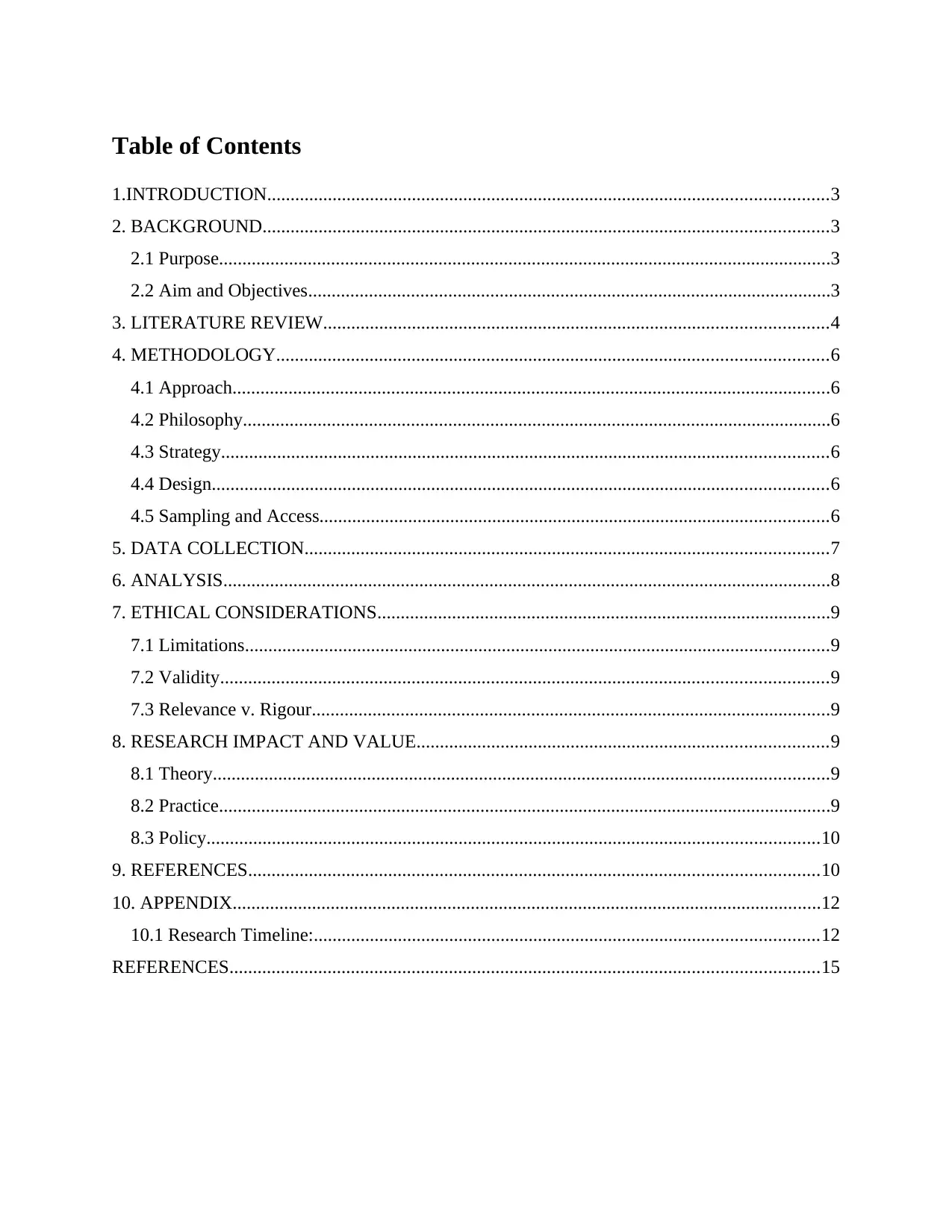
Table of Contents
1.INTRODUCTION........................................................................................................................3
2. BACKGROUND.........................................................................................................................3
2.1 Purpose...................................................................................................................................3
2.2 Aim and Objectives................................................................................................................3
3. LITERATURE REVIEW............................................................................................................4
4. METHODOLOGY......................................................................................................................6
4.1 Approach................................................................................................................................6
4.2 Philosophy..............................................................................................................................6
4.3 Strategy..................................................................................................................................6
4.4 Design....................................................................................................................................6
4.5 Sampling and Access.............................................................................................................6
5. DATA COLLECTION................................................................................................................7
6. ANALYSIS..................................................................................................................................8
7. ETHICAL CONSIDERATIONS.................................................................................................9
7.1 Limitations.............................................................................................................................9
7.2 Validity..................................................................................................................................9
7.3 Relevance v. Rigour...............................................................................................................9
8. RESEARCH IMPACT AND VALUE........................................................................................9
8.1 Theory....................................................................................................................................9
8.2 Practice...................................................................................................................................9
8.3 Policy...................................................................................................................................10
9. REFERENCES..........................................................................................................................10
10. APPENDIX..............................................................................................................................12
10.1 Research Timeline:............................................................................................................12
REFERENCES..............................................................................................................................15
1.INTRODUCTION........................................................................................................................3
2. BACKGROUND.........................................................................................................................3
2.1 Purpose...................................................................................................................................3
2.2 Aim and Objectives................................................................................................................3
3. LITERATURE REVIEW............................................................................................................4
4. METHODOLOGY......................................................................................................................6
4.1 Approach................................................................................................................................6
4.2 Philosophy..............................................................................................................................6
4.3 Strategy..................................................................................................................................6
4.4 Design....................................................................................................................................6
4.5 Sampling and Access.............................................................................................................6
5. DATA COLLECTION................................................................................................................7
6. ANALYSIS..................................................................................................................................8
7. ETHICAL CONSIDERATIONS.................................................................................................9
7.1 Limitations.............................................................................................................................9
7.2 Validity..................................................................................................................................9
7.3 Relevance v. Rigour...............................................................................................................9
8. RESEARCH IMPACT AND VALUE........................................................................................9
8.1 Theory....................................................................................................................................9
8.2 Practice...................................................................................................................................9
8.3 Policy...................................................................................................................................10
9. REFERENCES..........................................................................................................................10
10. APPENDIX..............................................................................................................................12
10.1 Research Timeline:............................................................................................................12
REFERENCES..............................................................................................................................15
1.INTRODUCTION
This research proposal is aimed to work on the employee engagement area. It is supposed
to reveal that how in the UK retail sector the organizations are working in order to make their
employees deeply engaged in the organizational operations. With this regard, the research
proposal would be considering on M&S, which is one of the most influencing retail sector giant.
The aim is to identify the engagement of employees. In this proposal along with aim and
objectives, some other key elements such as data collection, sampling, methodology and
foremost thing is Pilot study would also be conducted so can present the research proposal in
fully fledged manner (Sun and Bunchapattanasakda, 2019)
2. BACKGROUND
The research proposal is intended to scrutinize different employee engagement strategies
and their impact on the performance of employees. With this regard, UK retail industry is being
taken into consideration. M&S plc which is engaged in retail sector is being taken as the
organization research is being carried out upon. M&S was established in the year 1884, it is
having its worldwide operations (Robertson, 2019)
2.1 Purpose
This topic is being taken since the UK retail industry is getting widened with the progress
of time and the role of employees becomes quite essential. The research would be helpful to
articulate their role and how employee engagement strategies are paving way for better
performance.
2.2 Aim and Objectives
Aim:
To identify the impact of using different employee engagement strategies upon employee
performance within UK retail industry: A study on M&S.
Objectives:
To understand the concept of employee engagement strategies.
To assess different employee engagement strategies upon employee performance within
UK retain industry.
To examine relationship between different employee engagement strategies upon
employee performance.
To recommend strategies to improve effectiveness employee engagement strategies.
This research proposal is aimed to work on the employee engagement area. It is supposed
to reveal that how in the UK retail sector the organizations are working in order to make their
employees deeply engaged in the organizational operations. With this regard, the research
proposal would be considering on M&S, which is one of the most influencing retail sector giant.
The aim is to identify the engagement of employees. In this proposal along with aim and
objectives, some other key elements such as data collection, sampling, methodology and
foremost thing is Pilot study would also be conducted so can present the research proposal in
fully fledged manner (Sun and Bunchapattanasakda, 2019)
2. BACKGROUND
The research proposal is intended to scrutinize different employee engagement strategies
and their impact on the performance of employees. With this regard, UK retail industry is being
taken into consideration. M&S plc which is engaged in retail sector is being taken as the
organization research is being carried out upon. M&S was established in the year 1884, it is
having its worldwide operations (Robertson, 2019)
2.1 Purpose
This topic is being taken since the UK retail industry is getting widened with the progress
of time and the role of employees becomes quite essential. The research would be helpful to
articulate their role and how employee engagement strategies are paving way for better
performance.
2.2 Aim and Objectives
Aim:
To identify the impact of using different employee engagement strategies upon employee
performance within UK retail industry: A study on M&S.
Objectives:
To understand the concept of employee engagement strategies.
To assess different employee engagement strategies upon employee performance within
UK retain industry.
To examine relationship between different employee engagement strategies upon
employee performance.
To recommend strategies to improve effectiveness employee engagement strategies.
⊘ This is a preview!⊘
Do you want full access?
Subscribe today to unlock all pages.

Trusted by 1+ million students worldwide
3. LITERATURE REVIEW
Theme-1 Concept of employee engagement strategies-
As per the viewpoints of Opoku‐Dakwa, Chen and Rupp, (2018) employee engagement
can be referred as development of such predicaments in an organization which can make
employee engagement higher. For organizations, it is essential to keep their employees deeply
engaged in order to hike their potential of working and their efficiency too. It would be helpful
for organization in attempt to grab their aims and objectives.
Contrasting the above statements Ismail, Iqbal and Nasr, (2019) supported the idea, that it
is not only about participation of employees but it covers a range of ideas such as their
emotional, cognitivist, behavioural inclination towards organization so can contribute to the
maximum extend.
Theme-2 Different employee engagement strategies upon employee performance within UK
retain industry-
According to Fidyah and Setiawati, (2020) there are number of ways and methods which
can be used for hiking employee engagement in an organization. The retail sector of UK is quite
drastic in nature so there are rigours need to have such strong norms and strategies which can
help to make employees deeply engaged.
Some key strategies are Work life balance, Organizational transparency, providing
adequate compensation and benefits, autonomy and challenges, rewards and recognitions,
extending training and development services, installation of strong communication methodology
etc.
Contrasting the above arguments Albrecht, et al. (2018) stated that besides these all
facilities or privileges there must be clarity of vision. The all employees are having their unique
needs so there must be strong internal mechanism which may extend them best sets of visions
what drives employees to work with full of their emotional, cognitive and professional
inclination.
Ghosh, Sekiguchi and Fujimoto, (2020) shared the idea that with the progress of time
there are some new strategies are being used. For instance “Holistic approach” is one of the best
form of such employee engagement strategy. In this strategy range of notions, ideas, drivers are
taken into consideration so can provide best and the most suitable practice to employees.
Theme-1 Concept of employee engagement strategies-
As per the viewpoints of Opoku‐Dakwa, Chen and Rupp, (2018) employee engagement
can be referred as development of such predicaments in an organization which can make
employee engagement higher. For organizations, it is essential to keep their employees deeply
engaged in order to hike their potential of working and their efficiency too. It would be helpful
for organization in attempt to grab their aims and objectives.
Contrasting the above statements Ismail, Iqbal and Nasr, (2019) supported the idea, that it
is not only about participation of employees but it covers a range of ideas such as their
emotional, cognitivist, behavioural inclination towards organization so can contribute to the
maximum extend.
Theme-2 Different employee engagement strategies upon employee performance within UK
retain industry-
According to Fidyah and Setiawati, (2020) there are number of ways and methods which
can be used for hiking employee engagement in an organization. The retail sector of UK is quite
drastic in nature so there are rigours need to have such strong norms and strategies which can
help to make employees deeply engaged.
Some key strategies are Work life balance, Organizational transparency, providing
adequate compensation and benefits, autonomy and challenges, rewards and recognitions,
extending training and development services, installation of strong communication methodology
etc.
Contrasting the above arguments Albrecht, et al. (2018) stated that besides these all
facilities or privileges there must be clarity of vision. The all employees are having their unique
needs so there must be strong internal mechanism which may extend them best sets of visions
what drives employees to work with full of their emotional, cognitive and professional
inclination.
Ghosh, Sekiguchi and Fujimoto, (2020) shared the idea that with the progress of time
there are some new strategies are being used. For instance “Holistic approach” is one of the best
form of such employee engagement strategy. In this strategy range of notions, ideas, drivers are
taken into consideration so can provide best and the most suitable practice to employees.
Paraphrase This Document
Need a fresh take? Get an instant paraphrase of this document with our AI Paraphraser
Chen and Peng, (2021) shared the ideas that there is need to keep attention on a few
things which are directly related to the engagement of employees. There must be proper
mechanism which pays attention to every and each who is working in the entity. They must be
addressed individually so can decipher their needs.
Over the time Ibrahim, et al. (2020) found that some key strategies which are having their
great importance are The values of organization, Vision, Mission, Opportunities it offers,
Relationship between workers and higher authorities, Mutual trust building etc. These all are
those drivers which make employees get deeply engaged. So, while making strategies these
notions must be kept in centre.
Theme-3 Examining relationship between different employee engagement strategies upon
employee performance-
Jabeen and Rahim, (2021) supported the view that if employees are rigorously engaged
then they would be utilizing their best efforts. It will help them to achieve their potential and will
make them believe in higher goal setting. As it is seen that the employees who get engaged in
organizational activities are more likely to perform on their merit.
It is also seen that such employee generally keep learning and align with the changes
come in the market. UK retail sector is one of the most frequent sector which is getting shuffled
with hyper density. So with this regard it is inevitable to avoid employee engagement practises.
The organizations are bound to ensure their best in order to ensure better organizational
development.
Contrasting the statement above Albrecht, et al. (2018) suggested that more than such
individual attention there must be proper communication channel, along with communication,
some aspects such as getting proper business environment, focusing on vision, mission,
providing training and development opportunities, using modern tools and techniques, giving
sense of superiority etc.
Fidyah and Setiawati, (2020) supported the views that rather than articulating some
strategies the organizations working in retail sector are supposed to make strong and fully
fledged policy with this respect. It would be helpful if there is a complete strategy so without any
issues they may make their employees deeply engaged and all potential perils can also be
eradicated.
things which are directly related to the engagement of employees. There must be proper
mechanism which pays attention to every and each who is working in the entity. They must be
addressed individually so can decipher their needs.
Over the time Ibrahim, et al. (2020) found that some key strategies which are having their
great importance are The values of organization, Vision, Mission, Opportunities it offers,
Relationship between workers and higher authorities, Mutual trust building etc. These all are
those drivers which make employees get deeply engaged. So, while making strategies these
notions must be kept in centre.
Theme-3 Examining relationship between different employee engagement strategies upon
employee performance-
Jabeen and Rahim, (2021) supported the view that if employees are rigorously engaged
then they would be utilizing their best efforts. It will help them to achieve their potential and will
make them believe in higher goal setting. As it is seen that the employees who get engaged in
organizational activities are more likely to perform on their merit.
It is also seen that such employee generally keep learning and align with the changes
come in the market. UK retail sector is one of the most frequent sector which is getting shuffled
with hyper density. So with this regard it is inevitable to avoid employee engagement practises.
The organizations are bound to ensure their best in order to ensure better organizational
development.
Contrasting the statement above Albrecht, et al. (2018) suggested that more than such
individual attention there must be proper communication channel, along with communication,
some aspects such as getting proper business environment, focusing on vision, mission,
providing training and development opportunities, using modern tools and techniques, giving
sense of superiority etc.
Fidyah and Setiawati, (2020) supported the views that rather than articulating some
strategies the organizations working in retail sector are supposed to make strong and fully
fledged policy with this respect. It would be helpful if there is a complete strategy so without any
issues they may make their employees deeply engaged and all potential perils can also be
eradicated.
4. METHODOLOGY
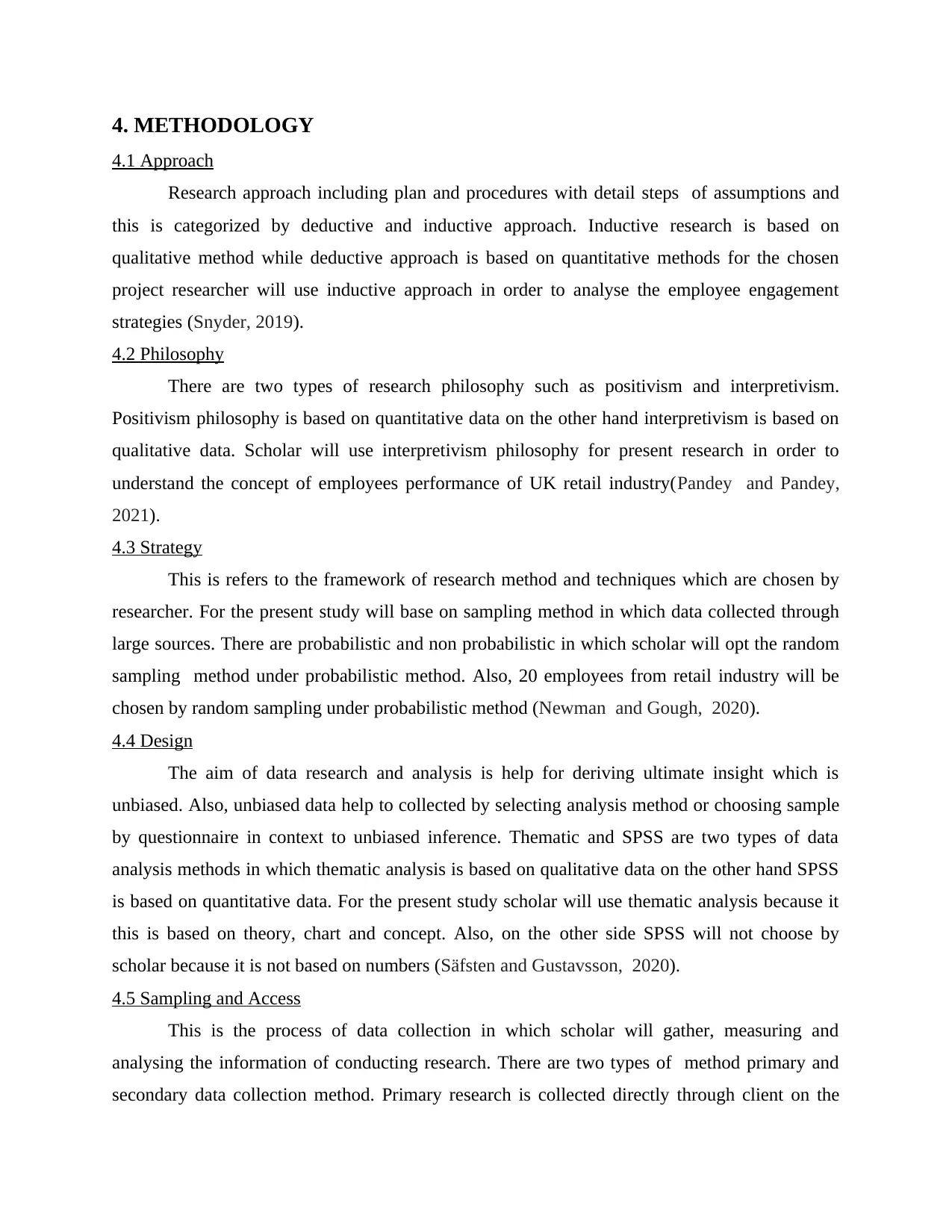
4.1 Approach
Research approach including plan and procedures with detail steps of assumptions and
this is categorized by deductive and inductive approach. Inductive research is based on
qualitative method while deductive approach is based on quantitative methods for the chosen
project researcher will use inductive approach in order to analyse the employee engagement
strategies (Snyder, 2019).
4.2 Philosophy
There are two types of research philosophy such as positivism and interpretivism.
Positivism philosophy is based on quantitative data on the other hand interpretivism is based on
qualitative data. Scholar will use interpretivism philosophy for present research in order to
understand the concept of employees performance of UK retail industry(Pandey and Pandey,
2021).
4.3 Strategy
This is refers to the framework of research method and techniques which are chosen by
researcher. For the present study will base on sampling method in which data collected through
large sources. There are probabilistic and non probabilistic in which scholar will opt the random
sampling method under probabilistic method. Also, 20 employees from retail industry will be
chosen by random sampling under probabilistic method (Newman and Gough, 2020).
4.4 Design
The aim of data research and analysis is help for deriving ultimate insight which is
unbiased. Also, unbiased data help to collected by selecting analysis method or choosing sample
by questionnaire in context to unbiased inference. Thematic and SPSS are two types of data
analysis methods in which thematic analysis is based on qualitative data on the other hand SPSS
is based on quantitative data. For the present study scholar will use thematic analysis because it
this is based on theory, chart and concept. Also, on the other side SPSS will not choose by
scholar because it is not based on numbers (Säfsten and Gustavsson, 2020).
4.5 Sampling and Access
This is the process of data collection in which scholar will gather, measuring and
analysing the information of conducting research. There are two types of method primary and
secondary data collection method. Primary research is collected directly through client on the
4.1 Approach
Research approach including plan and procedures with detail steps of assumptions and
this is categorized by deductive and inductive approach. Inductive research is based on
qualitative method while deductive approach is based on quantitative methods for the chosen
project researcher will use inductive approach in order to analyse the employee engagement
strategies (Snyder, 2019).
4.2 Philosophy
There are two types of research philosophy such as positivism and interpretivism.
Positivism philosophy is based on quantitative data on the other hand interpretivism is based on
qualitative data. Scholar will use interpretivism philosophy for present research in order to
understand the concept of employees performance of UK retail industry(Pandey and Pandey,
2021).
4.3 Strategy
This is refers to the framework of research method and techniques which are chosen by
researcher. For the present study will base on sampling method in which data collected through
large sources. There are probabilistic and non probabilistic in which scholar will opt the random
sampling method under probabilistic method. Also, 20 employees from retail industry will be
chosen by random sampling under probabilistic method (Newman and Gough, 2020).
4.4 Design
The aim of data research and analysis is help for deriving ultimate insight which is
unbiased. Also, unbiased data help to collected by selecting analysis method or choosing sample
by questionnaire in context to unbiased inference. Thematic and SPSS are two types of data
analysis methods in which thematic analysis is based on qualitative data on the other hand SPSS
is based on quantitative data. For the present study scholar will use thematic analysis because it
this is based on theory, chart and concept. Also, on the other side SPSS will not choose by
scholar because it is not based on numbers (Säfsten and Gustavsson, 2020).
4.5 Sampling and Access
This is the process of data collection in which scholar will gather, measuring and
analysing the information of conducting research. There are two types of method primary and
secondary data collection method. Primary research is collected directly through client on the
⊘ This is a preview!⊘
Do you want full access?
Subscribe today to unlock all pages.
Trusted by 1+ million students worldwide
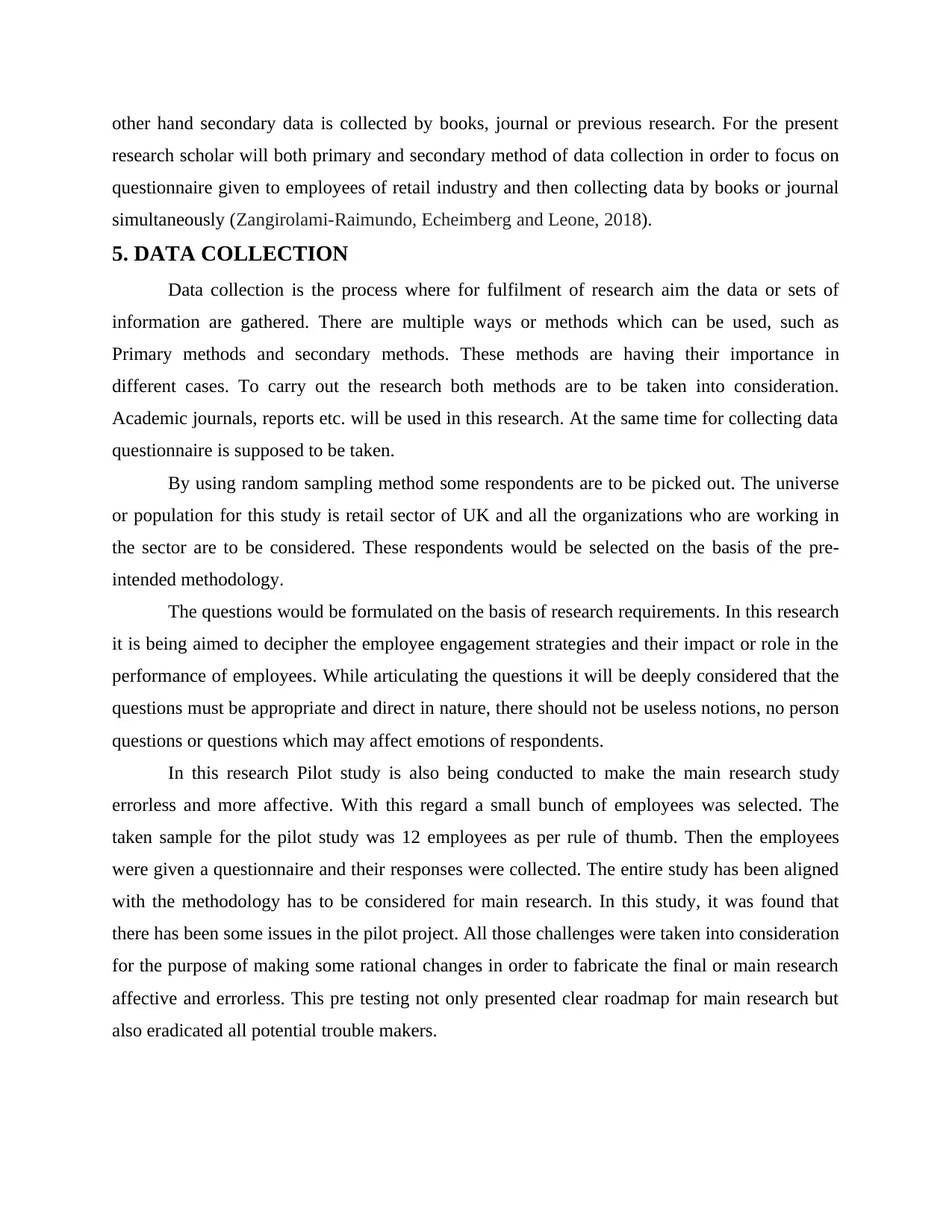
other hand secondary data is collected by books, journal or previous research. For the present
research scholar will both primary and secondary method of data collection in order to focus on
questionnaire given to employees of retail industry and then collecting data by books or journal
simultaneously (Zangirolami-Raimundo, Echeimberg and Leone, 2018).
5. DATA COLLECTION
Data collection is the process where for fulfilment of research aim the data or sets of
information are gathered. There are multiple ways or methods which can be used, such as
Primary methods and secondary methods. These methods are having their importance in
different cases. To carry out the research both methods are to be taken into consideration.
Academic journals, reports etc. will be used in this research. At the same time for collecting data
questionnaire is supposed to be taken.
By using random sampling method some respondents are to be picked out. The universe
or population for this study is retail sector of UK and all the organizations who are working in
the sector are to be considered. These respondents would be selected on the basis of the pre-
intended methodology.
The questions would be formulated on the basis of research requirements. In this research
it is being aimed to decipher the employee engagement strategies and their impact or role in the
performance of employees. While articulating the questions it will be deeply considered that the
questions must be appropriate and direct in nature, there should not be useless notions, no person
questions or questions which may affect emotions of respondents.
In this research Pilot study is also being conducted to make the main research study
errorless and more affective. With this regard a small bunch of employees was selected. The
taken sample for the pilot study was 12 employees as per rule of thumb. Then the employees
were given a questionnaire and their responses were collected. The entire study has been aligned
with the methodology has to be considered for main research. In this study, it was found that
there has been some issues in the pilot project. All those challenges were taken into consideration
for the purpose of making some rational changes in order to fabricate the final or main research
affective and errorless. This pre testing not only presented clear roadmap for main research but
also eradicated all potential trouble makers.
research scholar will both primary and secondary method of data collection in order to focus on
questionnaire given to employees of retail industry and then collecting data by books or journal
simultaneously (Zangirolami-Raimundo, Echeimberg and Leone, 2018).
5. DATA COLLECTION
Data collection is the process where for fulfilment of research aim the data or sets of
information are gathered. There are multiple ways or methods which can be used, such as
Primary methods and secondary methods. These methods are having their importance in
different cases. To carry out the research both methods are to be taken into consideration.
Academic journals, reports etc. will be used in this research. At the same time for collecting data
questionnaire is supposed to be taken.
By using random sampling method some respondents are to be picked out. The universe
or population for this study is retail sector of UK and all the organizations who are working in
the sector are to be considered. These respondents would be selected on the basis of the pre-
intended methodology.
The questions would be formulated on the basis of research requirements. In this research
it is being aimed to decipher the employee engagement strategies and their impact or role in the
performance of employees. While articulating the questions it will be deeply considered that the
questions must be appropriate and direct in nature, there should not be useless notions, no person
questions or questions which may affect emotions of respondents.
In this research Pilot study is also being conducted to make the main research study
errorless and more affective. With this regard a small bunch of employees was selected. The
taken sample for the pilot study was 12 employees as per rule of thumb. Then the employees
were given a questionnaire and their responses were collected. The entire study has been aligned
with the methodology has to be considered for main research. In this study, it was found that
there has been some issues in the pilot project. All those challenges were taken into consideration
for the purpose of making some rational changes in order to fabricate the final or main research
affective and errorless. This pre testing not only presented clear roadmap for main research but
also eradicated all potential trouble makers.
Paraphrase This Document
Need a fresh take? Get an instant paraphrase of this document with our AI Paraphraser
6. ANALYSIS
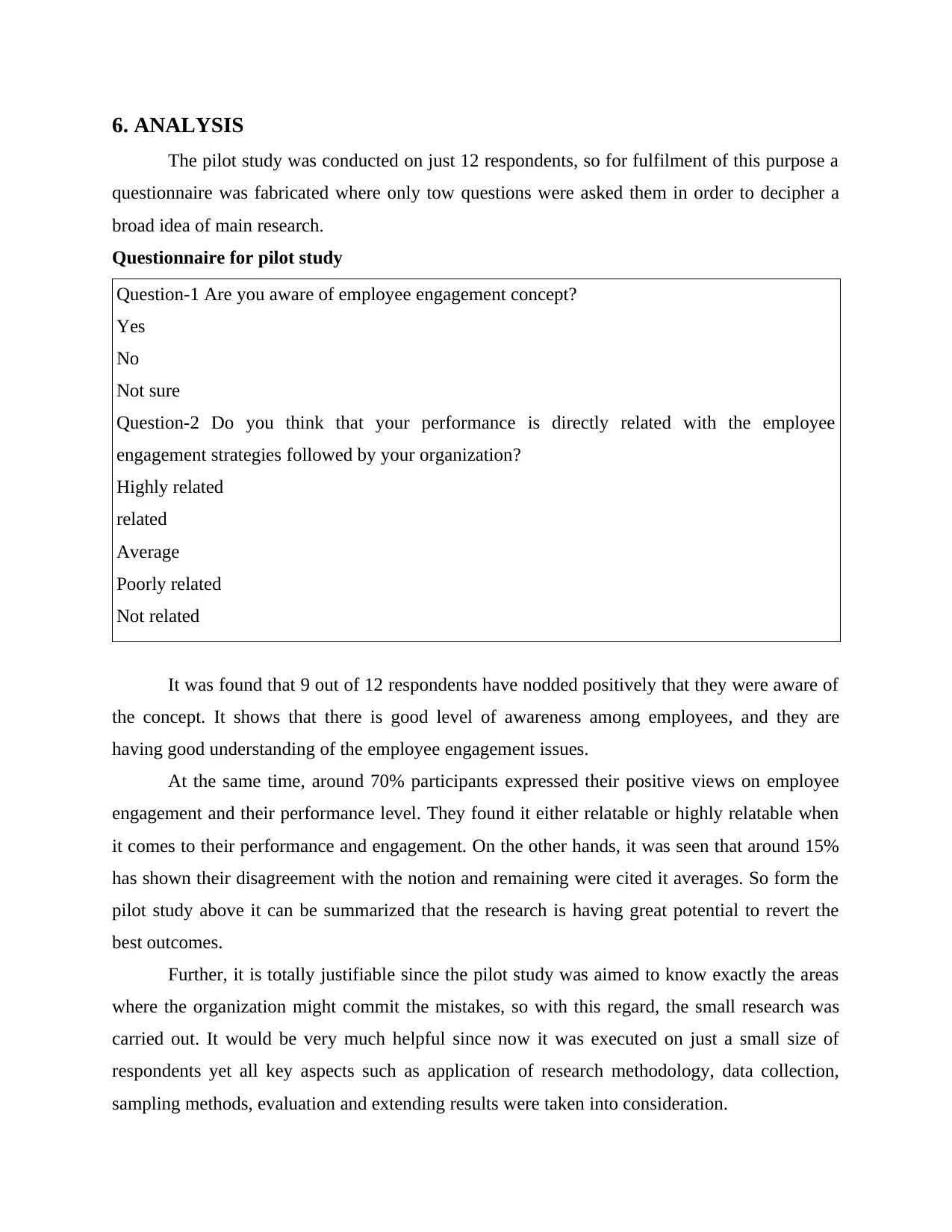
The pilot study was conducted on just 12 respondents, so for fulfilment of this purpose a
questionnaire was fabricated where only tow questions were asked them in order to decipher a
broad idea of main research.
Questionnaire for pilot study
Question-1 Are you aware of employee engagement concept?
Yes
No
Not sure
Question-2 Do you think that your performance is directly related with the employee
engagement strategies followed by your organization?
Highly related
related
Average
Poorly related
Not related
It was found that 9 out of 12 respondents have nodded positively that they were aware of
the concept. It shows that there is good level of awareness among employees, and they are
having good understanding of the employee engagement issues.
At the same time, around 70% participants expressed their positive views on employee
engagement and their performance level. They found it either relatable or highly relatable when
it comes to their performance and engagement. On the other hands, it was seen that around 15%
has shown their disagreement with the notion and remaining were cited it averages. So form the
pilot study above it can be summarized that the research is having great potential to revert the
best outcomes.
Further, it is totally justifiable since the pilot study was aimed to know exactly the areas
where the organization might commit the mistakes, so with this regard, the small research was
carried out. It would be very much helpful since now it was executed on just a small size of
respondents yet all key aspects such as application of research methodology, data collection,
sampling methods, evaluation and extending results were taken into consideration.
The pilot study was conducted on just 12 respondents, so for fulfilment of this purpose a
questionnaire was fabricated where only tow questions were asked them in order to decipher a
broad idea of main research.
Questionnaire for pilot study
Question-1 Are you aware of employee engagement concept?
Yes
No
Not sure
Question-2 Do you think that your performance is directly related with the employee
engagement strategies followed by your organization?
Highly related
related
Average
Poorly related
Not related
It was found that 9 out of 12 respondents have nodded positively that they were aware of
the concept. It shows that there is good level of awareness among employees, and they are
having good understanding of the employee engagement issues.
At the same time, around 70% participants expressed their positive views on employee
engagement and their performance level. They found it either relatable or highly relatable when
it comes to their performance and engagement. On the other hands, it was seen that around 15%
has shown their disagreement with the notion and remaining were cited it averages. So form the
pilot study above it can be summarized that the research is having great potential to revert the
best outcomes.
Further, it is totally justifiable since the pilot study was aimed to know exactly the areas
where the organization might commit the mistakes, so with this regard, the small research was
carried out. It would be very much helpful since now it was executed on just a small size of
respondents yet all key aspects such as application of research methodology, data collection,
sampling methods, evaluation and extending results were taken into consideration.
7. ETHICAL CONSIDERATIONS
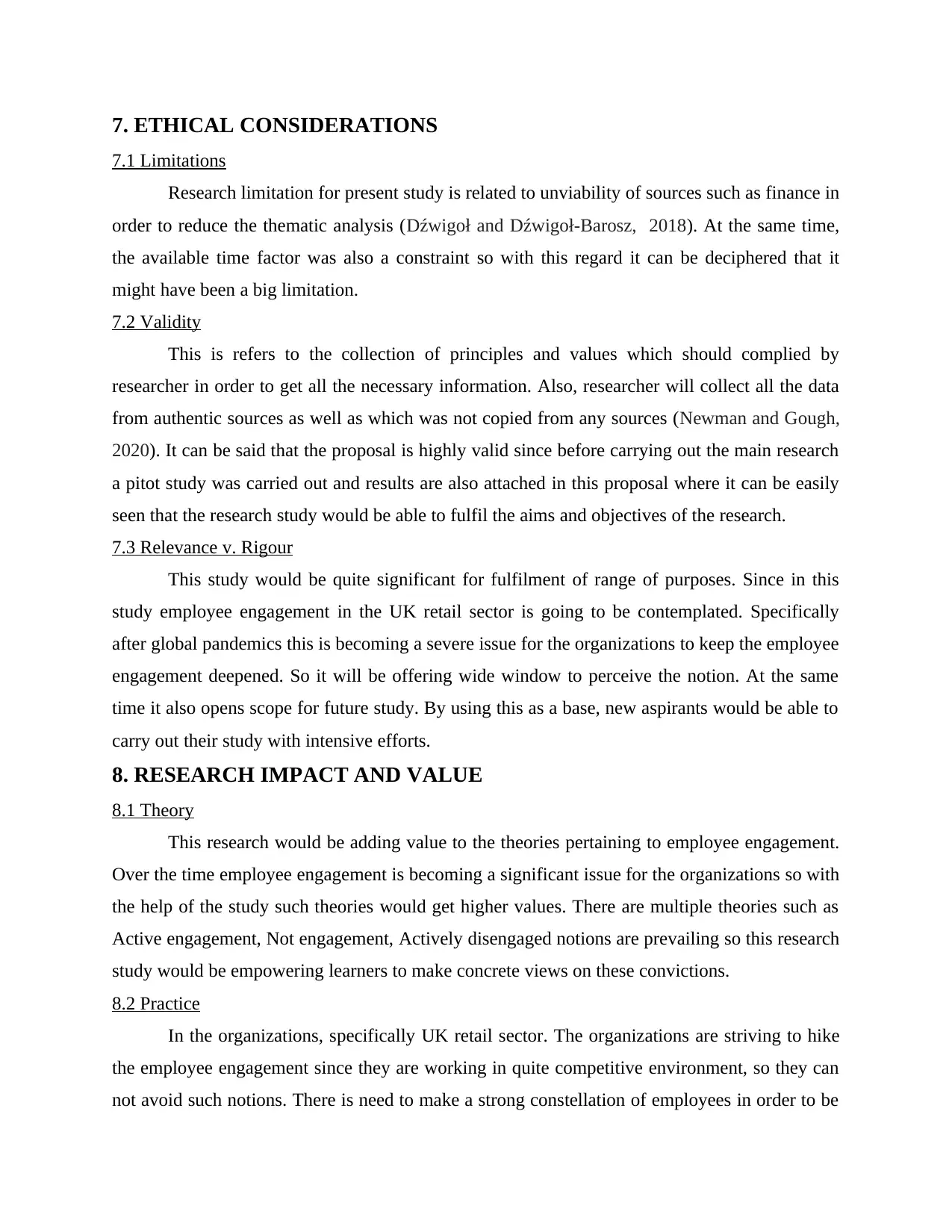
7.1 Limitations
Research limitation for present study is related to unviability of sources such as finance in
order to reduce the thematic analysis (Dźwigoł and Dźwigoł-Barosz, 2018). At the same time,
the available time factor was also a constraint so with this regard it can be deciphered that it
might have been a big limitation.
7.2 Validity
This is refers to the collection of principles and values which should complied by
researcher in order to get all the necessary information. Also, researcher will collect all the data
from authentic sources as well as which was not copied from any sources (Newman and Gough,
2020). It can be said that the proposal is highly valid since before carrying out the main research
a pitot study was carried out and results are also attached in this proposal where it can be easily
seen that the research study would be able to fulfil the aims and objectives of the research.
7.3 Relevance v. Rigour
This study would be quite significant for fulfilment of range of purposes. Since in this
study employee engagement in the UK retail sector is going to be contemplated. Specifically
after global pandemics this is becoming a severe issue for the organizations to keep the employee
engagement deepened. So it will be offering wide window to perceive the notion. At the same
time it also opens scope for future study. By using this as a base, new aspirants would be able to
carry out their study with intensive efforts.
8. RESEARCH IMPACT AND VALUE
8.1 Theory
This research would be adding value to the theories pertaining to employee engagement.
Over the time employee engagement is becoming a significant issue for the organizations so with
the help of the study such theories would get higher values. There are multiple theories such as
Active engagement, Not engagement, Actively disengaged notions are prevailing so this research
study would be empowering learners to make concrete views on these convictions.
8.2 Practice
In the organizations, specifically UK retail sector. The organizations are striving to hike
the employee engagement since they are working in quite competitive environment, so they can
not avoid such notions. There is need to make a strong constellation of employees in order to be
7.1 Limitations
Research limitation for present study is related to unviability of sources such as finance in
order to reduce the thematic analysis (Dźwigoł and Dźwigoł-Barosz, 2018). At the same time,
the available time factor was also a constraint so with this regard it can be deciphered that it
might have been a big limitation.
7.2 Validity
This is refers to the collection of principles and values which should complied by
researcher in order to get all the necessary information. Also, researcher will collect all the data
from authentic sources as well as which was not copied from any sources (Newman and Gough,
2020). It can be said that the proposal is highly valid since before carrying out the main research
a pitot study was carried out and results are also attached in this proposal where it can be easily
seen that the research study would be able to fulfil the aims and objectives of the research.
7.3 Relevance v. Rigour
This study would be quite significant for fulfilment of range of purposes. Since in this
study employee engagement in the UK retail sector is going to be contemplated. Specifically
after global pandemics this is becoming a severe issue for the organizations to keep the employee
engagement deepened. So it will be offering wide window to perceive the notion. At the same
time it also opens scope for future study. By using this as a base, new aspirants would be able to
carry out their study with intensive efforts.
8. RESEARCH IMPACT AND VALUE
8.1 Theory
This research would be adding value to the theories pertaining to employee engagement.
Over the time employee engagement is becoming a significant issue for the organizations so with
the help of the study such theories would get higher values. There are multiple theories such as
Active engagement, Not engagement, Actively disengaged notions are prevailing so this research
study would be empowering learners to make concrete views on these convictions.
8.2 Practice
In the organizations, specifically UK retail sector. The organizations are striving to hike
the employee engagement since they are working in quite competitive environment, so they can
not avoid such notions. There is need to make a strong constellation of employees in order to be
⊘ This is a preview!⊘
Do you want full access?
Subscribe today to unlock all pages.
Trusted by 1+ million students worldwide
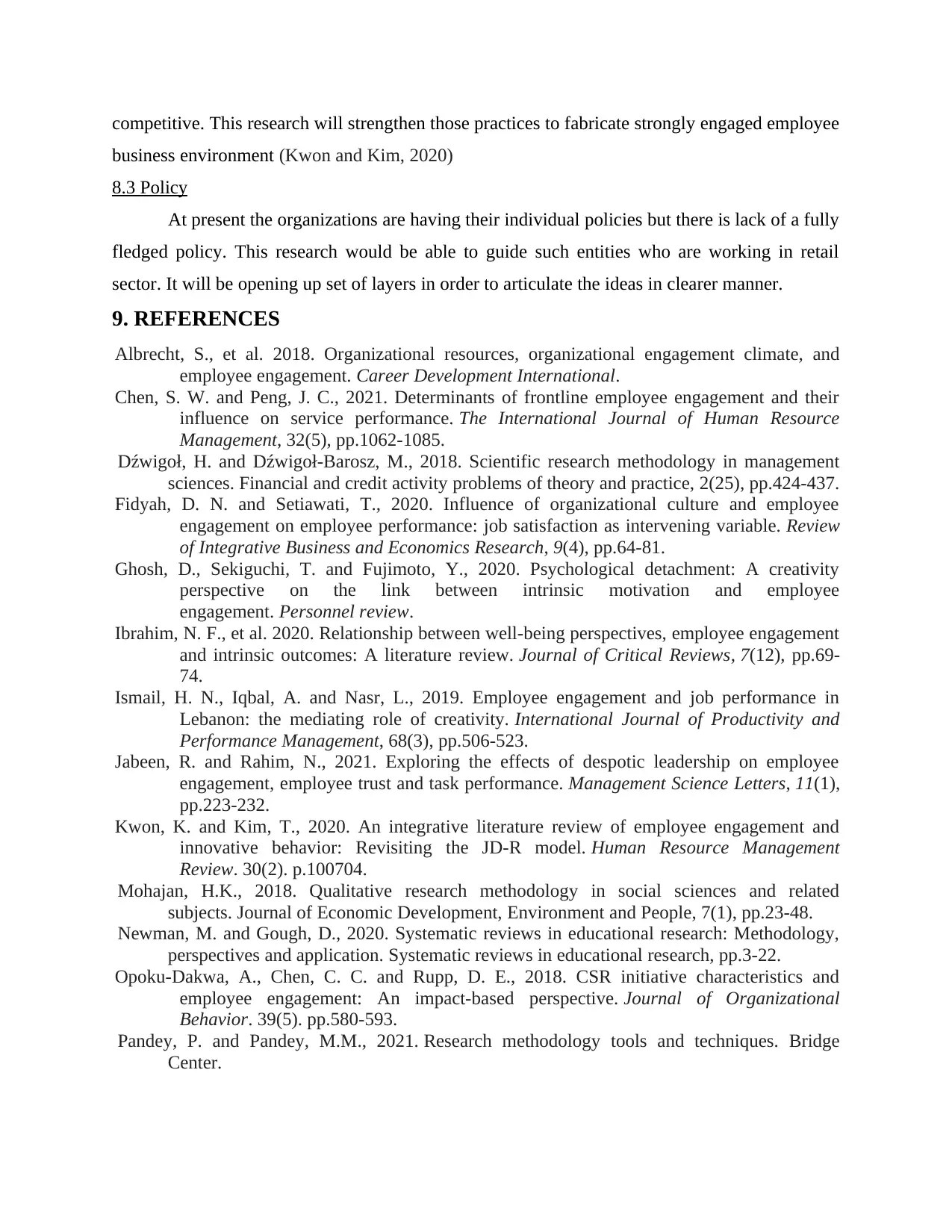
competitive. This research will strengthen those practices to fabricate strongly engaged employee
business environment (Kwon and Kim, 2020)
8.3 Policy
At present the organizations are having their individual policies but there is lack of a fully
fledged policy. This research would be able to guide such entities who are working in retail
sector. It will be opening up set of layers in order to articulate the ideas in clearer manner.
9. REFERENCES
Albrecht, S., et al. 2018. Organizational resources, organizational engagement climate, and
employee engagement. Career Development International.
Chen, S. W. and Peng, J. C., 2021. Determinants of frontline employee engagement and their
influence on service performance. The International Journal of Human Resource
Management, 32(5), pp.1062-1085.
Dźwigoł, H. and Dźwigoł-Barosz, M., 2018. Scientific research methodology in management
sciences. Financial and credit activity problems of theory and practice, 2(25), pp.424-437.
Fidyah, D. N. and Setiawati, T., 2020. Influence of organizational culture and employee
engagement on employee performance: job satisfaction as intervening variable. Review
of Integrative Business and Economics Research, 9(4), pp.64-81.
Ghosh, D., Sekiguchi, T. and Fujimoto, Y., 2020. Psychological detachment: A creativity
perspective on the link between intrinsic motivation and employee
engagement. Personnel review.
Ibrahim, N. F., et al. 2020. Relationship between well-being perspectives, employee engagement
and intrinsic outcomes: A literature review. Journal of Critical Reviews, 7(12), pp.69-
74.
Ismail, H. N., Iqbal, A. and Nasr, L., 2019. Employee engagement and job performance in
Lebanon: the mediating role of creativity. International Journal of Productivity and
Performance Management, 68(3), pp.506-523.
Jabeen, R. and Rahim, N., 2021. Exploring the effects of despotic leadership on employee
engagement, employee trust and task performance. Management Science Letters, 11(1),
pp.223-232.
Kwon, K. and Kim, T., 2020. An integrative literature review of employee engagement and
innovative behavior: Revisiting the JD-R model. Human Resource Management
Review. 30(2). p.100704.
Mohajan, H.K., 2018. Qualitative research methodology in social sciences and related
subjects. Journal of Economic Development, Environment and People, 7(1), pp.23-48.
Newman, M. and Gough, D., 2020. Systematic reviews in educational research: Methodology,
perspectives and application. Systematic reviews in educational research, pp.3-22.
Opoku‐Dakwa, A., Chen, C. C. and Rupp, D. E., 2018. CSR initiative characteristics and
employee engagement: An impact‐based perspective. Journal of Organizational
Behavior. 39(5). pp.580-593.
Pandey, P. and Pandey, M.M., 2021. Research methodology tools and techniques. Bridge
Center.
business environment (Kwon and Kim, 2020)
8.3 Policy
At present the organizations are having their individual policies but there is lack of a fully
fledged policy. This research would be able to guide such entities who are working in retail
sector. It will be opening up set of layers in order to articulate the ideas in clearer manner.
9. REFERENCES
Albrecht, S., et al. 2018. Organizational resources, organizational engagement climate, and
employee engagement. Career Development International.
Chen, S. W. and Peng, J. C., 2021. Determinants of frontline employee engagement and their
influence on service performance. The International Journal of Human Resource
Management, 32(5), pp.1062-1085.
Dźwigoł, H. and Dźwigoł-Barosz, M., 2018. Scientific research methodology in management
sciences. Financial and credit activity problems of theory and practice, 2(25), pp.424-437.
Fidyah, D. N. and Setiawati, T., 2020. Influence of organizational culture and employee
engagement on employee performance: job satisfaction as intervening variable. Review
of Integrative Business and Economics Research, 9(4), pp.64-81.
Ghosh, D., Sekiguchi, T. and Fujimoto, Y., 2020. Psychological detachment: A creativity
perspective on the link between intrinsic motivation and employee
engagement. Personnel review.
Ibrahim, N. F., et al. 2020. Relationship between well-being perspectives, employee engagement
and intrinsic outcomes: A literature review. Journal of Critical Reviews, 7(12), pp.69-
74.
Ismail, H. N., Iqbal, A. and Nasr, L., 2019. Employee engagement and job performance in
Lebanon: the mediating role of creativity. International Journal of Productivity and
Performance Management, 68(3), pp.506-523.
Jabeen, R. and Rahim, N., 2021. Exploring the effects of despotic leadership on employee
engagement, employee trust and task performance. Management Science Letters, 11(1),
pp.223-232.
Kwon, K. and Kim, T., 2020. An integrative literature review of employee engagement and
innovative behavior: Revisiting the JD-R model. Human Resource Management
Review. 30(2). p.100704.
Mohajan, H.K., 2018. Qualitative research methodology in social sciences and related
subjects. Journal of Economic Development, Environment and People, 7(1), pp.23-48.
Newman, M. and Gough, D., 2020. Systematic reviews in educational research: Methodology,
perspectives and application. Systematic reviews in educational research, pp.3-22.
Opoku‐Dakwa, A., Chen, C. C. and Rupp, D. E., 2018. CSR initiative characteristics and
employee engagement: An impact‐based perspective. Journal of Organizational
Behavior. 39(5). pp.580-593.
Pandey, P. and Pandey, M.M., 2021. Research methodology tools and techniques. Bridge
Center.
Paraphrase This Document
Need a fresh take? Get an instant paraphrase of this document with our AI Paraphraser
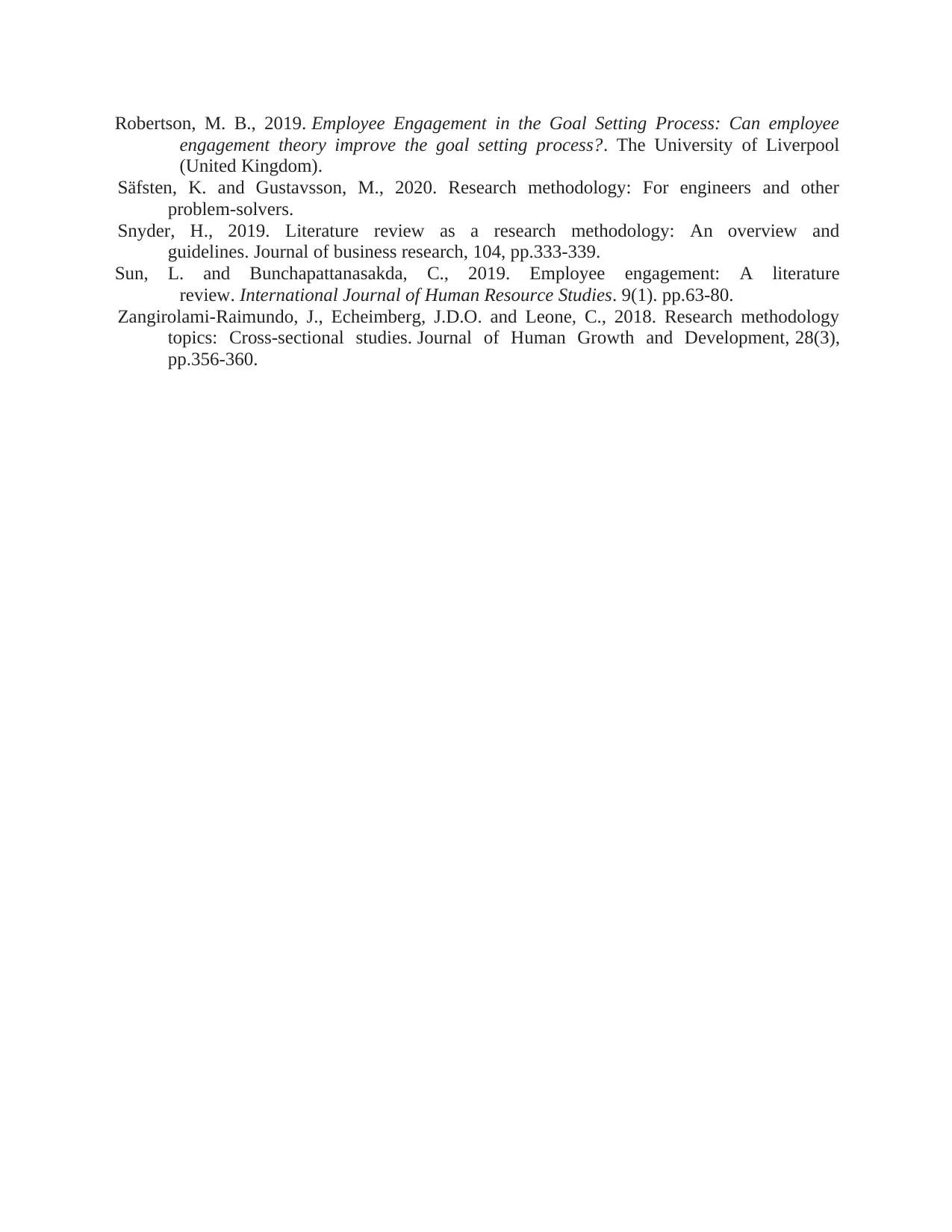
Robertson, M. B., 2019. Employee Engagement in the Goal Setting Process: Can employee
engagement theory improve the goal setting process?. The University of Liverpool
(United Kingdom).
Säfsten, K. and Gustavsson, M., 2020. Research methodology: For engineers and other
problem-solvers.
Snyder, H., 2019. Literature review as a research methodology: An overview and
guidelines. Journal of business research, 104, pp.333-339.
Sun, L. and Bunchapattanasakda, C., 2019. Employee engagement: A literature
review. International Journal of Human Resource Studies. 9(1). pp.63-80.
Zangirolami-Raimundo, J., Echeimberg, J.D.O. and Leone, C., 2018. Research methodology
topics: Cross-sectional studies. Journal of Human Growth and Development, 28(3),
pp.356-360.
engagement theory improve the goal setting process?. The University of Liverpool
(United Kingdom).
Säfsten, K. and Gustavsson, M., 2020. Research methodology: For engineers and other
problem-solvers.
Snyder, H., 2019. Literature review as a research methodology: An overview and
guidelines. Journal of business research, 104, pp.333-339.
Sun, L. and Bunchapattanasakda, C., 2019. Employee engagement: A literature
review. International Journal of Human Resource Studies. 9(1). pp.63-80.
Zangirolami-Raimundo, J., Echeimberg, J.D.O. and Leone, C., 2018. Research methodology
topics: Cross-sectional studies. Journal of Human Growth and Development, 28(3),
pp.356-360.
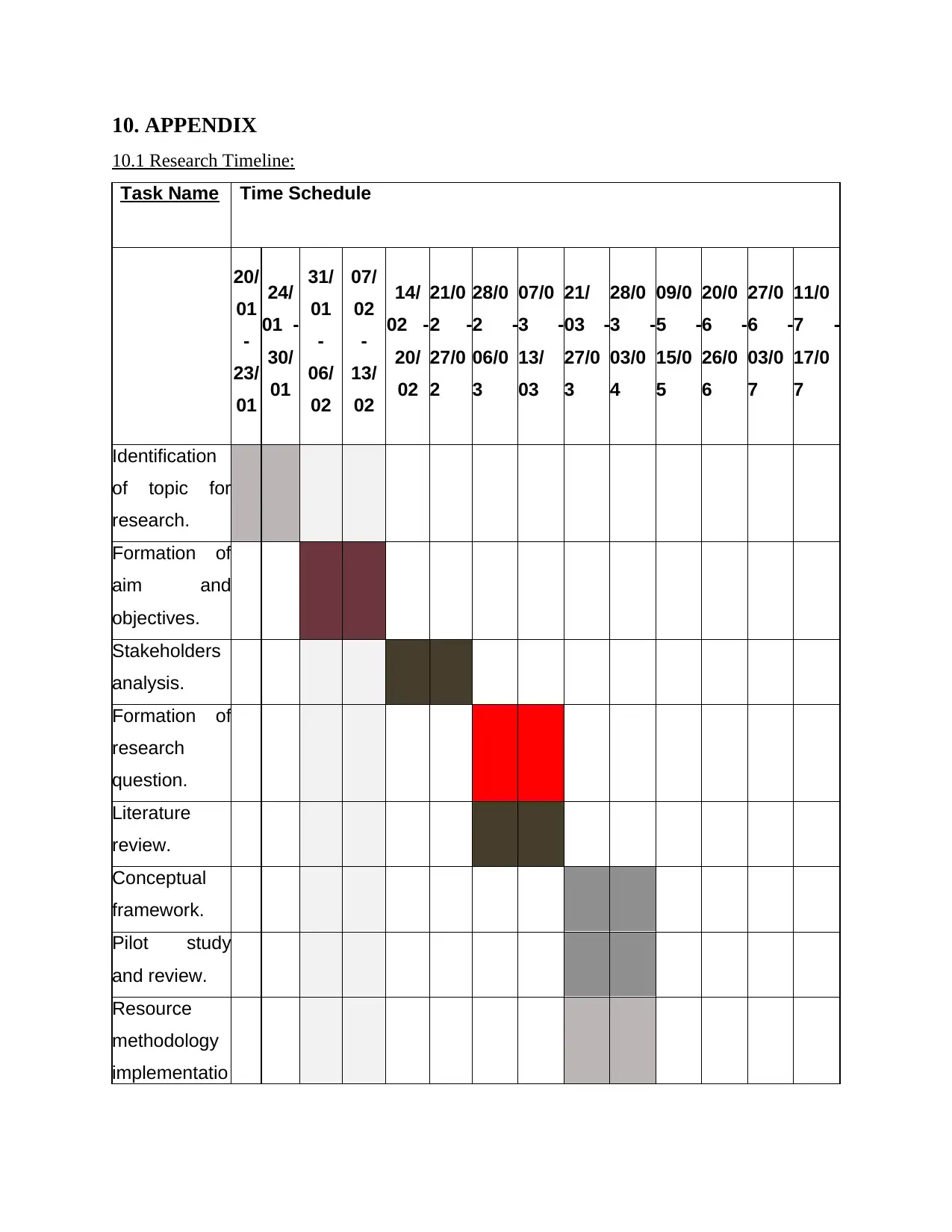
10. APPENDIX
10.1 Research Timeline:
Task Name Time Schedule
20/
01
-
23/
01
24/
01 -
30/
01
31/
01
-
06/
02
07/
02
-
13/
02
14/
02 -
20/
02
21/0
2 -
27/0
2
28/0
2 -
06/0
3
07/0
3 -
13/
03
21/
03 -
27/0
3
28/0
3 -
03/0
4
09/0
5 -
15/0
5
20/0
6 -
26/0
6
27/0
6 -
03/0
7
11/0
7 -
17/0
7
Identification
of topic for
research.
Formation of
aim and
objectives.
Stakeholders
analysis.
Formation of
research
question.
Literature
review.
Conceptual
framework.
Pilot study
and review.
Resource
methodology
implementatio
10.1 Research Timeline:
Task Name Time Schedule
20/
01
-
23/
01
24/
01 -
30/
01
31/
01
-
06/
02
07/
02
-
13/
02
14/
02 -
20/
02
21/0
2 -
27/0
2
28/0
2 -
06/0
3
07/0
3 -
13/
03
21/
03 -
27/0
3
28/0
3 -
03/0
4
09/0
5 -
15/0
5
20/0
6 -
26/0
6
27/0
6 -
03/0
7
11/0
7 -
17/0
7
Identification
of topic for
research.
Formation of
aim and
objectives.
Stakeholders
analysis.
Formation of
research
question.
Literature
review.
Conceptual
framework.
Pilot study
and review.
Resource
methodology
implementatio
⊘ This is a preview!⊘
Do you want full access?
Subscribe today to unlock all pages.
Trusted by 1+ million students worldwide

1 out of 15


Related Documents


Your All-in-One AI-Powered Toolkit for Academic Success.
+13062052269
info@desklib.com
Available 24*7 on WhatsApp / Email
![[object Object]](/_next/static/media/star-bottom.7253800d.svg)
Unlock your academic potential
Copyright © 2020–2025 A2Z Services. All Rights Reserved. Developed and managed by ZUCOL.