BSBWRK411: Learning Module on Industrial Relations Procedures Support
VerifiedAdded on 2021/07/13
|57
|20527
|275
Homework Assignment
AI Summary
This learning module, centered around the BSBWRK411 unit, comprehensively addresses the skills and knowledge required to support employee and industrial relations procedures within an organization. The module starts by introducing key concepts in employee and industrial relations, including legislative requirements such as the Fair Work System, awards, and agreements. It emphasizes the importance of effectively communicating and implementing ER policies and procedures, with a focus on strategies for communication and promoting organizational IR. The module then delves into minimizing industrial relations conflict, covering workplace conflict, dispute resolution, and reporting conflicts to management. Furthermore, it outlines strategies to enhance employee relations by monitoring policy implementation, facilitating feedback on the industrial climate, and strengthening relationships with relevant groups. The module includes a scenario based on Australian Hardware, and provides practical examples, appendices, and references to aid understanding. Overall, the module aims to equip individuals with the necessary skills to navigate and support employee and industrial relations effectively.
BSBWRK411
Support Employee and
Industrial Relations Procedures
Learning Module
Support Employee and
Industrial Relations Procedures
Learning Module

Paraphrase This Document
Need a fresh take? Get an instant paraphrase of this document with our AI Paraphraser
BSBWRK411 Support Employee and Industrial Relations Procedures - Learning Module (v.1.0) 2
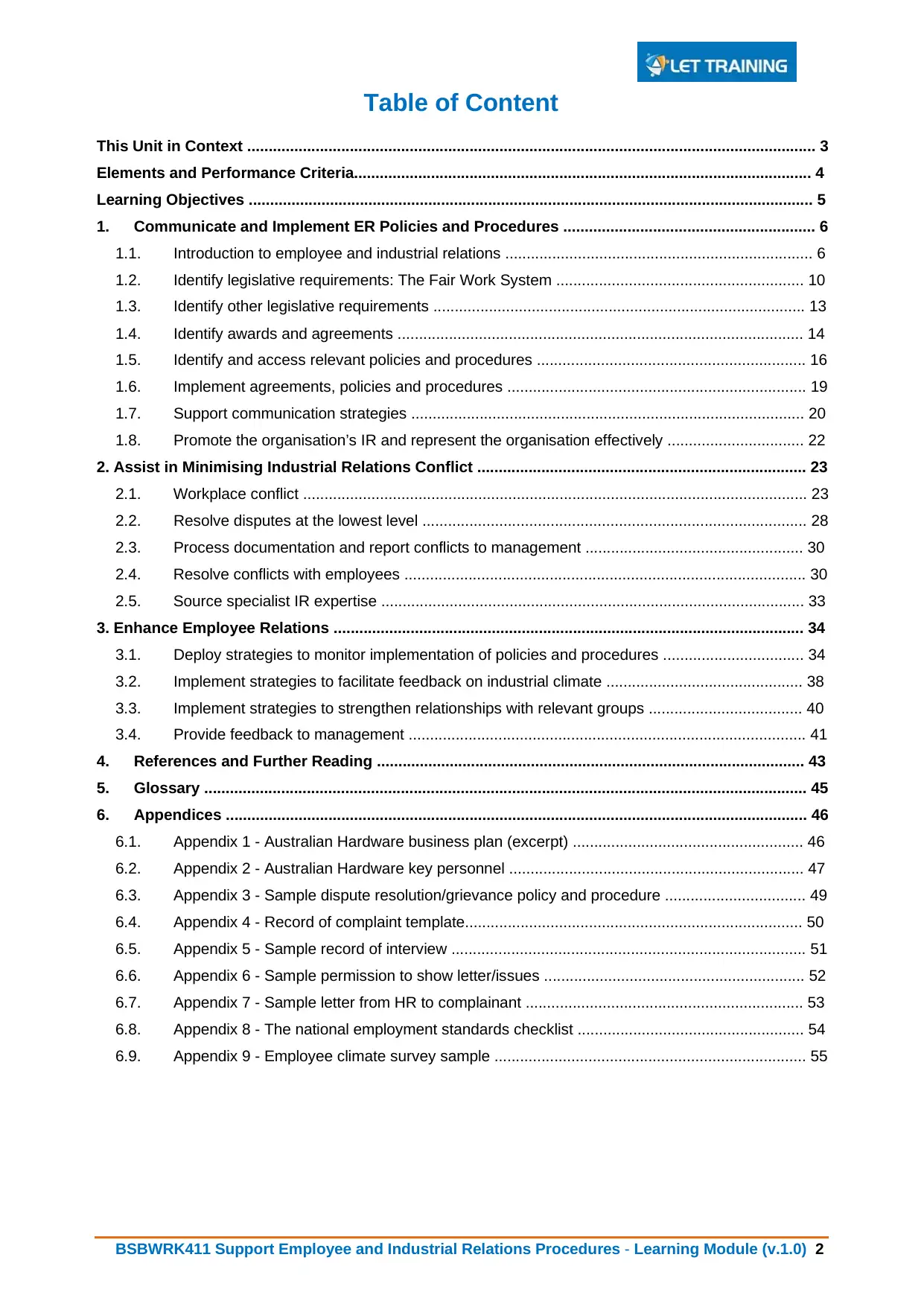
Table of Content
This Unit in Context ..................................................................................................................................... 3
Elements and Performance Criteria........................................................................................................... 4
Learning Objectives .................................................................................................................................... 5
1. Communicate and Implement ER Policies and Procedures ........................................................... 6
1.1. Introduction to employee and industrial relations ........................................................................ 6
1.2. Identify legislative requirements: The Fair Work System .......................................................... 10
1.3. Identify other legislative requirements ....................................................................................... 13
1.4. Identify awards and agreements ............................................................................................... 14
1.5. Identify and access relevant policies and procedures ............................................................... 16
1.6. Implement agreements, policies and procedures ...................................................................... 19
1.7. Support communication strategies ............................................................................................ 20
1.8. Promote the organisation’s IR and represent the organisation effectively ................................ 22
2. Assist in Minimising Industrial Relations Conflict ............................................................................. 23
2.1. Workplace conflict ...................................................................................................................... 23
2.2. Resolve disputes at the lowest level .......................................................................................... 28
2.3. Process documentation and report conflicts to management ................................................... 30
2.4. Resolve conflicts with employees .............................................................................................. 30
2.5. Source specialist IR expertise ................................................................................................... 33
3. Enhance Employee Relations .............................................................................................................. 34
3.1. Deploy strategies to monitor implementation of policies and procedures ................................. 34
3.2. Implement strategies to facilitate feedback on industrial climate .............................................. 38
3.3. Implement strategies to strengthen relationships with relevant groups .................................... 40
3.4. Provide feedback to management ............................................................................................. 41
4. References and Further Reading .................................................................................................... 43
5. Glossary ............................................................................................................................................. 45
6. Appendices ........................................................................................................................................ 46
6.1. Appendix 1 - Australian Hardware business plan (excerpt) ...................................................... 46
6.2. Appendix 2 - Australian Hardware key personnel ..................................................................... 47
6.3. Appendix 3 - Sample dispute resolution/grievance policy and procedure ................................. 49
6.4. Appendix 4 - Record of complaint template............................................................................... 50
6.5. Appendix 5 - Sample record of interview ................................................................................... 51
6.6. Appendix 6 - Sample permission to show letter/issues ............................................................. 52
6.7. Appendix 7 - Sample letter from HR to complainant ................................................................. 53
6.8. Appendix 8 - The national employment standards checklist ..................................................... 54
6.9. Appendix 9 - Employee climate survey sample ......................................................................... 55
Table of Content
This Unit in Context ..................................................................................................................................... 3
Elements and Performance Criteria........................................................................................................... 4
Learning Objectives .................................................................................................................................... 5
1. Communicate and Implement ER Policies and Procedures ........................................................... 6
1.1. Introduction to employee and industrial relations ........................................................................ 6
1.2. Identify legislative requirements: The Fair Work System .......................................................... 10
1.3. Identify other legislative requirements ....................................................................................... 13
1.4. Identify awards and agreements ............................................................................................... 14
1.5. Identify and access relevant policies and procedures ............................................................... 16
1.6. Implement agreements, policies and procedures ...................................................................... 19
1.7. Support communication strategies ............................................................................................ 20
1.8. Promote the organisation’s IR and represent the organisation effectively ................................ 22
2. Assist in Minimising Industrial Relations Conflict ............................................................................. 23
2.1. Workplace conflict ...................................................................................................................... 23
2.2. Resolve disputes at the lowest level .......................................................................................... 28
2.3. Process documentation and report conflicts to management ................................................... 30
2.4. Resolve conflicts with employees .............................................................................................. 30
2.5. Source specialist IR expertise ................................................................................................... 33
3. Enhance Employee Relations .............................................................................................................. 34
3.1. Deploy strategies to monitor implementation of policies and procedures ................................. 34
3.2. Implement strategies to facilitate feedback on industrial climate .............................................. 38
3.3. Implement strategies to strengthen relationships with relevant groups .................................... 40
3.4. Provide feedback to management ............................................................................................. 41
4. References and Further Reading .................................................................................................... 43
5. Glossary ............................................................................................................................................. 45
6. Appendices ........................................................................................................................................ 46
6.1. Appendix 1 - Australian Hardware business plan (excerpt) ...................................................... 46
6.2. Appendix 2 - Australian Hardware key personnel ..................................................................... 47
6.3. Appendix 3 - Sample dispute resolution/grievance policy and procedure ................................. 49
6.4. Appendix 4 - Record of complaint template............................................................................... 50
6.5. Appendix 5 - Sample record of interview ................................................................................... 51
6.6. Appendix 6 - Sample permission to show letter/issues ............................................................. 52
6.7. Appendix 7 - Sample letter from HR to complainant ................................................................. 53
6.8. Appendix 8 - The national employment standards checklist ..................................................... 54
6.9. Appendix 9 - Employee climate survey sample ......................................................................... 55
BSBWRK411 Support Employee and Industrial Relations Procedures - Learning Module (v.1.0) 3
This Unit in Context
Welcome to Support Employee and Industrial Relations Procedures.
This unit describes the skills and knowledge required to communicate and implement industrial relations
policies and procedures to effectively represent organisations/employers.
It applies to individuals who work in support positions, assisting others in dealing with industrial relations
conflicts and issues.
No licensing, legislative or certification requirements apply to this unit at the time of publication.
This Unit in Context
Welcome to Support Employee and Industrial Relations Procedures.
This unit describes the skills and knowledge required to communicate and implement industrial relations
policies and procedures to effectively represent organisations/employers.
It applies to individuals who work in support positions, assisting others in dealing with industrial relations
conflicts and issues.
No licensing, legislative or certification requirements apply to this unit at the time of publication.
⊘ This is a preview!⊘
Do you want full access?
Subscribe today to unlock all pages.

Trusted by 1+ million students worldwide
BSBWRK411 Support Employee and Industrial Relations Procedures - Learning Module (v.1.0) 4
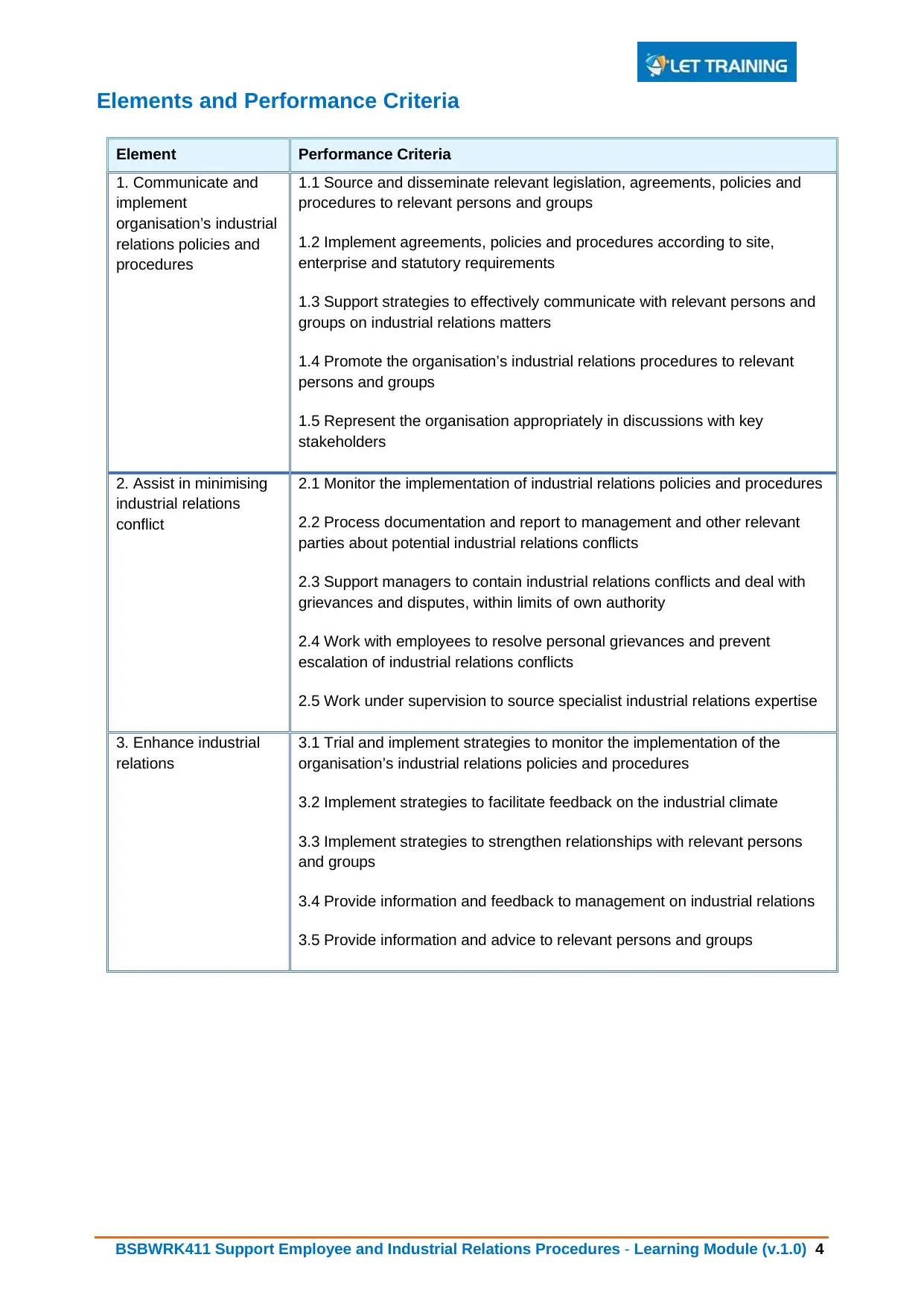
Elements and Performance Criteria
Element Performance Criteria
1. Communicate and
implement
organisation’s industrial
relations policies and
procedures
1.1 Source and disseminate relevant legislation, agreements, policies and
procedures to relevant persons and groups
1.2 Implement agreements, policies and procedures according to site,
enterprise and statutory requirements
1.3 Support strategies to effectively communicate with relevant persons and
groups on industrial relations matters
1.4 Promote the organisation’s industrial relations procedures to relevant
persons and groups
1.5 Represent the organisation appropriately in discussions with key
stakeholders
2. Assist in minimising
industrial relations
conflict
2.1 Monitor the implementation of industrial relations policies and procedures
2.2 Process documentation and report to management and other relevant
parties about potential industrial relations conflicts
2.3 Support managers to contain industrial relations conflicts and deal with
grievances and disputes, within limits of own authority
2.4 Work with employees to resolve personal grievances and prevent
escalation of industrial relations conflicts
2.5 Work under supervision to source specialist industrial relations expertise
3. Enhance industrial
relations
3.1 Trial and implement strategies to monitor the implementation of the
organisation’s industrial relations policies and procedures
3.2 Implement strategies to facilitate feedback on the industrial climate
3.3 Implement strategies to strengthen relationships with relevant persons
and groups
3.4 Provide information and feedback to management on industrial relations
3.5 Provide information and advice to relevant persons and groups
Elements and Performance Criteria
Element Performance Criteria
1. Communicate and
implement
organisation’s industrial
relations policies and
procedures
1.1 Source and disseminate relevant legislation, agreements, policies and
procedures to relevant persons and groups
1.2 Implement agreements, policies and procedures according to site,
enterprise and statutory requirements
1.3 Support strategies to effectively communicate with relevant persons and
groups on industrial relations matters
1.4 Promote the organisation’s industrial relations procedures to relevant
persons and groups
1.5 Represent the organisation appropriately in discussions with key
stakeholders
2. Assist in minimising
industrial relations
conflict
2.1 Monitor the implementation of industrial relations policies and procedures
2.2 Process documentation and report to management and other relevant
parties about potential industrial relations conflicts
2.3 Support managers to contain industrial relations conflicts and deal with
grievances and disputes, within limits of own authority
2.4 Work with employees to resolve personal grievances and prevent
escalation of industrial relations conflicts
2.5 Work under supervision to source specialist industrial relations expertise
3. Enhance industrial
relations
3.1 Trial and implement strategies to monitor the implementation of the
organisation’s industrial relations policies and procedures
3.2 Implement strategies to facilitate feedback on the industrial climate
3.3 Implement strategies to strengthen relationships with relevant persons
and groups
3.4 Provide information and feedback to management on industrial relations
3.5 Provide information and advice to relevant persons and groups
Paraphrase This Document
Need a fresh take? Get an instant paraphrase of this document with our AI Paraphraser
BSBWRK411 Support Employee and Industrial Relations Procedures - Learning Module (v.1.0) 5
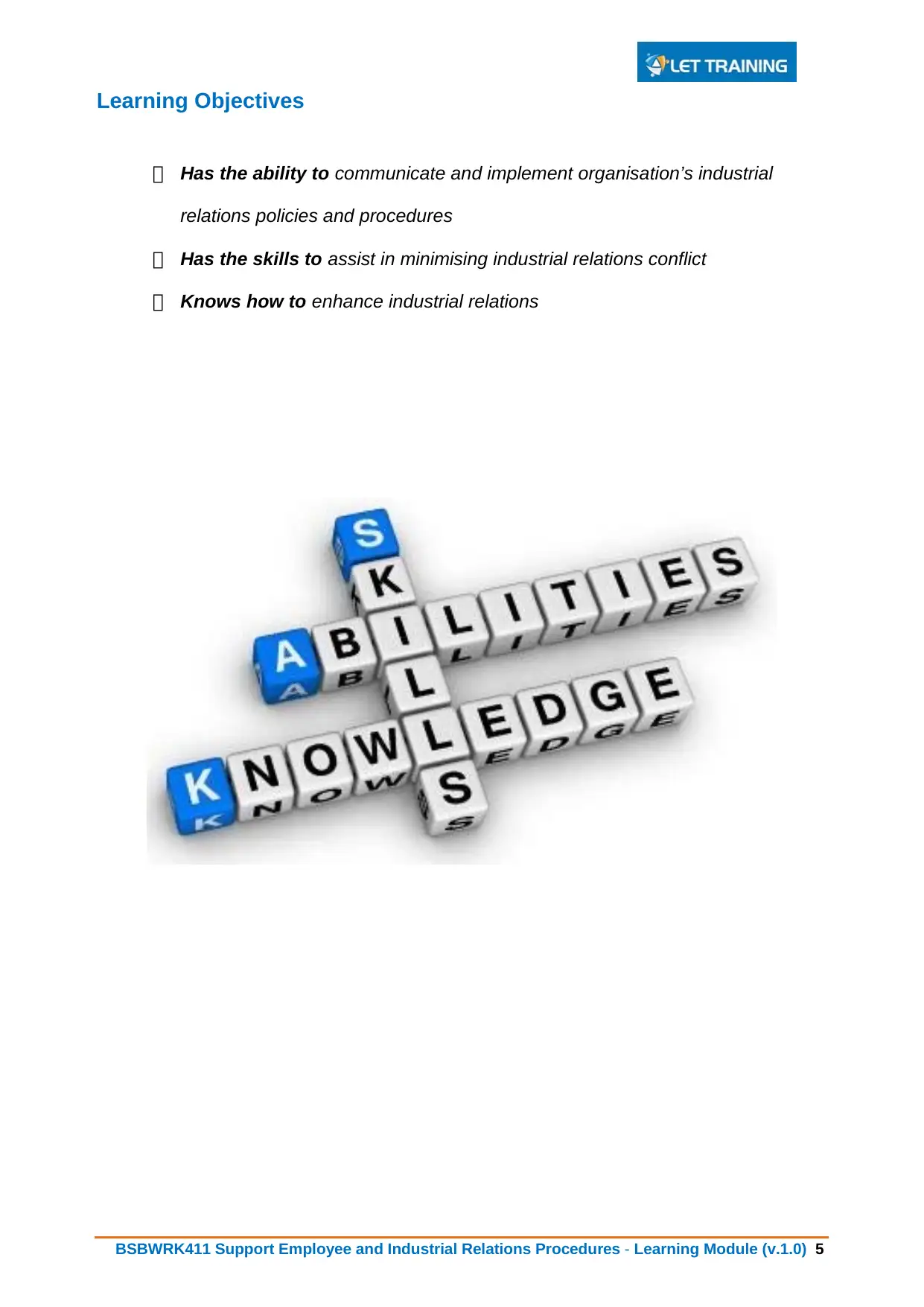
Learning Objectives
Has the ability to communicate and implement organisation’s industrial
relations policies and procedures
Has the skills to assist in minimising industrial relations conflict
Knows how to enhance industrial relations
Learning Objectives
Has the ability to communicate and implement organisation’s industrial
relations policies and procedures
Has the skills to assist in minimising industrial relations conflict
Knows how to enhance industrial relations
BSBWRK411 Support Employee and Industrial Relations Procedures - Learning Module (v.1.0) 6
1. Communicate and Implement ER Policies and Procedures
The focus of this section is on the skills and knowledge required to communicate and implement employee
relations (ER) policies and procedures.
Scenario: Australian Hardware
Australian Hardware (a simulated business) is a large and expanding hardware and homewares
retailer with approximately 140 stores located across Australia. In its vision statement, Australian
Hardware outlines that it intends to lead the hardware and home improvement market in Australia
within five years.
In order to realise this vision, the organisation will need to ensure the capability and engagement of its
people. To this end, Australian Hardware intends to improve its approach to ER. It intends to review
its ER and IR policies and enterprise agreements to ensure these align with the organisation's goals.
Pat is newly employed as an HR Business Partner at Australian Hardware. Her manager has asked
her to review, communicate, and implement the organisation's ER policies.
Australian Hardware simulated business information, including business and operational plans,
financial information, and policies and procedures can be accessed online at
<http://simulations.ibsa.org.au>.
What skills will you need?
In order to communicate and implement ER policies, you must be able to:
source and disseminate relevant legislation, agreements, policies and procedures to relevant
persons and groups
implement agreements, policies and procedures according to site, enterprise and statutory
requirements
support workplace strategies to effectively communicate with relevant persons and groups on ER
promote the organisation's ER procedures to relevant persons and groups
represent the organisation appropriately in discussions with key stakeholders.
1.1. Introduction to employee and industrial relations
Employee relations (ER) and industrial relations (IR) can have a huge impact, for better or worse, on an
organisation’s ability to achieve their objectives and provide value to their main stakeholders. From a
human resources (HR) perspective, the ability of the organisation to attract, retain and develop workforce
capacity can be helped or hindered depending on the quality of the industrial relations climate.
IR may be taken in two related senses. The broad sense of IR may be described as: “The relationship
between management and labour, shaped by individual employers and employees and by employer and
employee organisations and government institutions, that exists at a workplace or in an industry and
influences how effectively they work together or achieve their joint and separate goals” (Cole 2007). This
broad sense is now often referred to as ER (or workplace relations).
The second sense of IR is narrower and refers to the formal processes by which good industrial relations
are maintained and disputes are settled, including the process of collective bargaining between employers
and unions or direct negotiations between employers and employees.
1. Communicate and Implement ER Policies and Procedures
The focus of this section is on the skills and knowledge required to communicate and implement employee
relations (ER) policies and procedures.
Scenario: Australian Hardware
Australian Hardware (a simulated business) is a large and expanding hardware and homewares
retailer with approximately 140 stores located across Australia. In its vision statement, Australian
Hardware outlines that it intends to lead the hardware and home improvement market in Australia
within five years.
In order to realise this vision, the organisation will need to ensure the capability and engagement of its
people. To this end, Australian Hardware intends to improve its approach to ER. It intends to review
its ER and IR policies and enterprise agreements to ensure these align with the organisation's goals.
Pat is newly employed as an HR Business Partner at Australian Hardware. Her manager has asked
her to review, communicate, and implement the organisation's ER policies.
Australian Hardware simulated business information, including business and operational plans,
financial information, and policies and procedures can be accessed online at
<http://simulations.ibsa.org.au>.
What skills will you need?
In order to communicate and implement ER policies, you must be able to:
source and disseminate relevant legislation, agreements, policies and procedures to relevant
persons and groups
implement agreements, policies and procedures according to site, enterprise and statutory
requirements
support workplace strategies to effectively communicate with relevant persons and groups on ER
promote the organisation's ER procedures to relevant persons and groups
represent the organisation appropriately in discussions with key stakeholders.
1.1. Introduction to employee and industrial relations
Employee relations (ER) and industrial relations (IR) can have a huge impact, for better or worse, on an
organisation’s ability to achieve their objectives and provide value to their main stakeholders. From a
human resources (HR) perspective, the ability of the organisation to attract, retain and develop workforce
capacity can be helped or hindered depending on the quality of the industrial relations climate.
IR may be taken in two related senses. The broad sense of IR may be described as: “The relationship
between management and labour, shaped by individual employers and employees and by employer and
employee organisations and government institutions, that exists at a workplace or in an industry and
influences how effectively they work together or achieve their joint and separate goals” (Cole 2007). This
broad sense is now often referred to as ER (or workplace relations).
The second sense of IR is narrower and refers to the formal processes by which good industrial relations
are maintained and disputes are settled, including the process of collective bargaining between employers
and unions or direct negotiations between employers and employees.
⊘ This is a preview!⊘
Do you want full access?
Subscribe today to unlock all pages.
Trusted by 1+ million students worldwide
BSBWRK411 Support Employee and Industrial Relations Procedures - Learning Module (v.1.0) 7
This unit will discuss organisational policies and procedures, as well as the legal context of industrial
relations. Let's take a brief look at the history of IR in Australia, external factors affecting workplace
relations, and stakeholders.
History of IR
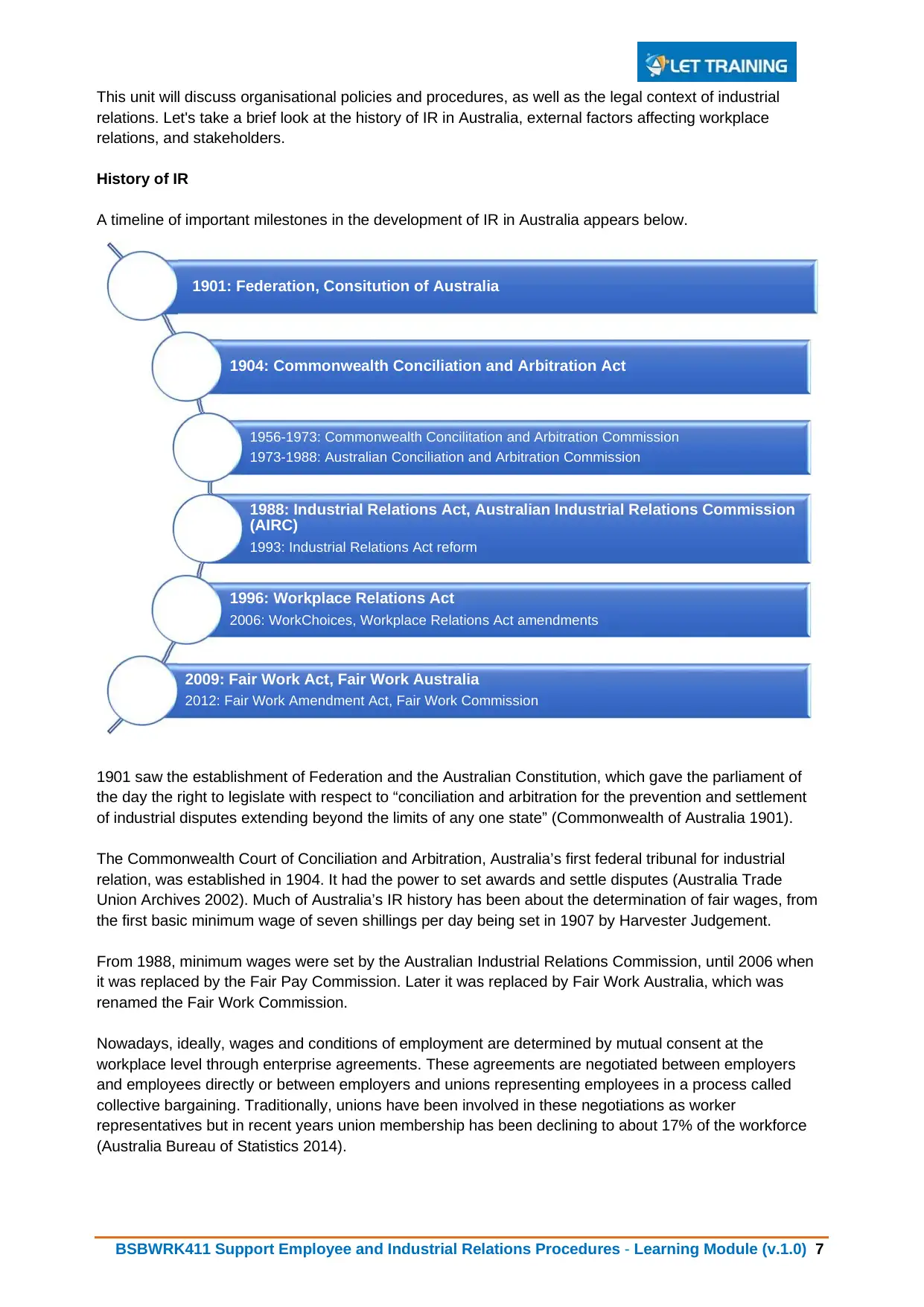
A timeline of important milestones in the development of IR in Australia appears below.
1901 saw the establishment of Federation and the Australian Constitution, which gave the parliament of
the day the right to legislate with respect to “conciliation and arbitration for the prevention and settlement
of industrial disputes extending beyond the limits of any one state” (Commonwealth of Australia 1901).
The Commonwealth Court of Conciliation and Arbitration, Australia’s first federal tribunal for industrial
relation, was established in 1904. It had the power to set awards and settle disputes (Australia Trade
Union Archives 2002). Much of Australia’s IR history has been about the determination of fair wages, from
the first basic minimum wage of seven shillings per day being set in 1907 by Harvester Judgement.
From 1988, minimum wages were set by the Australian Industrial Relations Commission, until 2006 when
it was replaced by the Fair Pay Commission. Later it was replaced by Fair Work Australia, which was
renamed the Fair Work Commission.
Nowadays, ideally, wages and conditions of employment are determined by mutual consent at the
workplace level through enterprise agreements. These agreements are negotiated between employers
and employees directly or between employers and unions representing employees in a process called
collective bargaining. Traditionally, unions have been involved in these negotiations as worker
representatives but in recent years union membership has been declining to about 17% of the workforce
(Australia Bureau of Statistics 2014).
1901: Federation, Consitution of Australia
1904: Commonwealth Conciliation and Arbitration Act
1956-1973: Commonwealth Concilitation and Arbitration Commission
1973-1988: Australian Conciliation and Arbitration Commission
1988: Industrial Relations Act, Australian Industrial Relations Commission
(AIRC)
1993: Industrial Relations Act reform
1996: Workplace Relations Act
2006: WorkChoices, Workplace Relations Act amendments
2009: Fair Work Act, Fair Work Australia
2012: Fair Work Amendment Act, Fair Work Commission
This unit will discuss organisational policies and procedures, as well as the legal context of industrial
relations. Let's take a brief look at the history of IR in Australia, external factors affecting workplace
relations, and stakeholders.
History of IR
A timeline of important milestones in the development of IR in Australia appears below.
1901 saw the establishment of Federation and the Australian Constitution, which gave the parliament of
the day the right to legislate with respect to “conciliation and arbitration for the prevention and settlement
of industrial disputes extending beyond the limits of any one state” (Commonwealth of Australia 1901).
The Commonwealth Court of Conciliation and Arbitration, Australia’s first federal tribunal for industrial
relation, was established in 1904. It had the power to set awards and settle disputes (Australia Trade
Union Archives 2002). Much of Australia’s IR history has been about the determination of fair wages, from
the first basic minimum wage of seven shillings per day being set in 1907 by Harvester Judgement.
From 1988, minimum wages were set by the Australian Industrial Relations Commission, until 2006 when
it was replaced by the Fair Pay Commission. Later it was replaced by Fair Work Australia, which was
renamed the Fair Work Commission.
Nowadays, ideally, wages and conditions of employment are determined by mutual consent at the
workplace level through enterprise agreements. These agreements are negotiated between employers
and employees directly or between employers and unions representing employees in a process called
collective bargaining. Traditionally, unions have been involved in these negotiations as worker
representatives but in recent years union membership has been declining to about 17% of the workforce
(Australia Bureau of Statistics 2014).
1901: Federation, Consitution of Australia
1904: Commonwealth Conciliation and Arbitration Act
1956-1973: Commonwealth Concilitation and Arbitration Commission
1973-1988: Australian Conciliation and Arbitration Commission
1988: Industrial Relations Act, Australian Industrial Relations Commission
(AIRC)
1993: Industrial Relations Act reform
1996: Workplace Relations Act
2006: WorkChoices, Workplace Relations Act amendments
2009: Fair Work Act, Fair Work Australia
2012: Fair Work Amendment Act, Fair Work Commission
Paraphrase This Document
Need a fresh take? Get an instant paraphrase of this document with our AI Paraphraser
BSBWRK411 Support Employee and Industrial Relations Procedures - Learning Module (v.1.0) 8
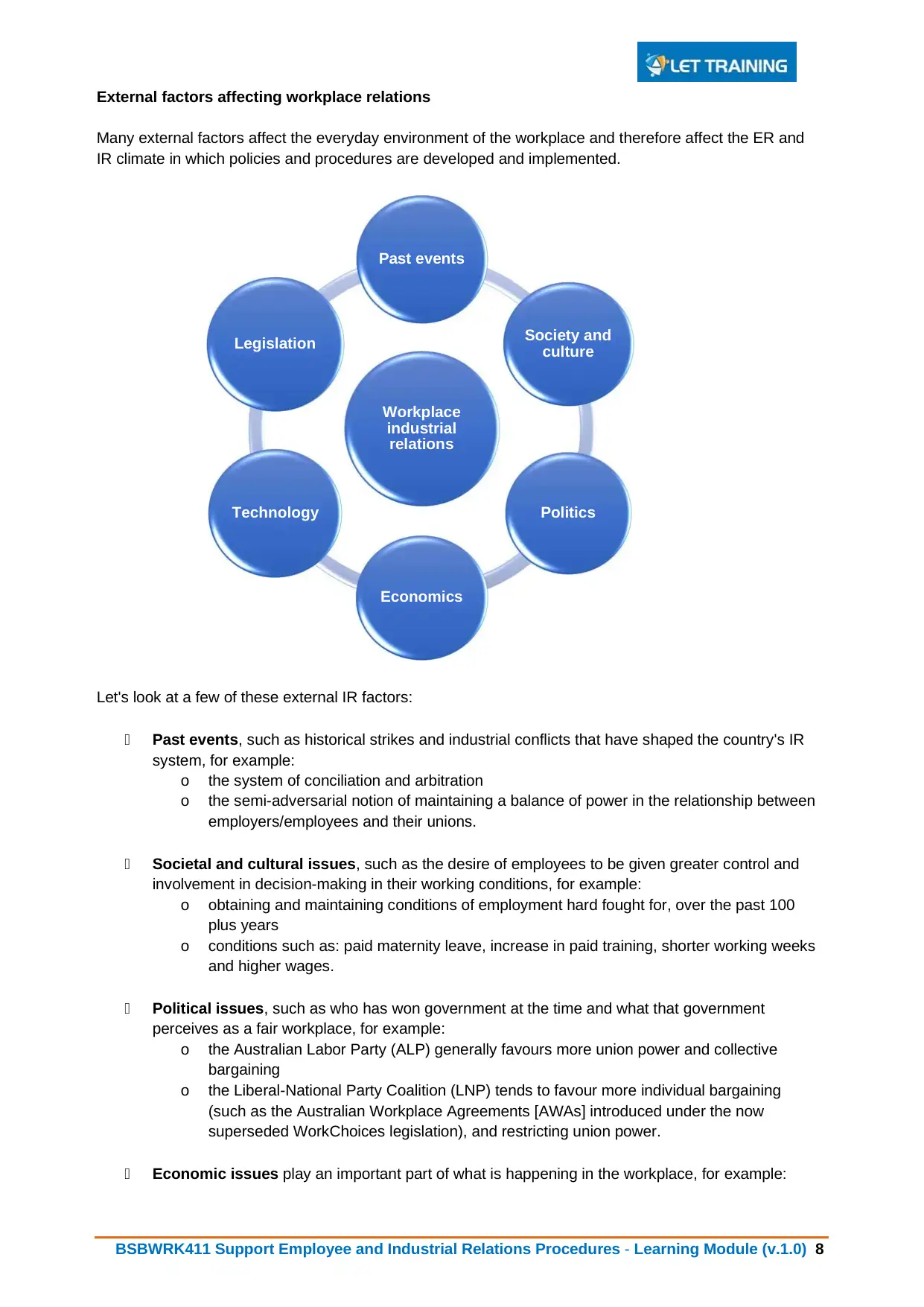
External factors affecting workplace relations
Many external factors affect the everyday environment of the workplace and therefore affect the ER and
IR climate in which policies and procedures are developed and implemented.
Let's look at a few of these external IR factors:
Past events, such as historical strikes and industrial conflicts that have shaped the country's IR
system, for example:
o the system of conciliation and arbitration
o the semi-adversarial notion of maintaining a balance of power in the relationship between
employers/employees and their unions.
Societal and cultural issues, such as the desire of employees to be given greater control and
involvement in decision-making in their working conditions, for example:
o obtaining and maintaining conditions of employment hard fought for, over the past 100
plus years
o conditions such as: paid maternity leave, increase in paid training, shorter working weeks
and higher wages.
Political issues, such as who has won government at the time and what that government
perceives as a fair workplace, for example:
o the Australian Labor Party (ALP) generally favours more union power and collective
bargaining
o the Liberal-National Party Coalition (LNP) tends to favour more individual bargaining
(such as the Australian Workplace Agreements [AWAs] introduced under the now
superseded WorkChoices legislation), and restricting union power.
Economic issues play an important part of what is happening in the workplace, for example:
Workplace
industrial
relations
Past events
Society and
culture
Politics
Economics
Technology
Legislation
External factors affecting workplace relations
Many external factors affect the everyday environment of the workplace and therefore affect the ER and
IR climate in which policies and procedures are developed and implemented.
Let's look at a few of these external IR factors:
Past events, such as historical strikes and industrial conflicts that have shaped the country's IR
system, for example:
o the system of conciliation and arbitration
o the semi-adversarial notion of maintaining a balance of power in the relationship between
employers/employees and their unions.
Societal and cultural issues, such as the desire of employees to be given greater control and
involvement in decision-making in their working conditions, for example:
o obtaining and maintaining conditions of employment hard fought for, over the past 100
plus years
o conditions such as: paid maternity leave, increase in paid training, shorter working weeks
and higher wages.
Political issues, such as who has won government at the time and what that government
perceives as a fair workplace, for example:
o the Australian Labor Party (ALP) generally favours more union power and collective
bargaining
o the Liberal-National Party Coalition (LNP) tends to favour more individual bargaining
(such as the Australian Workplace Agreements [AWAs] introduced under the now
superseded WorkChoices legislation), and restricting union power.
Economic issues play an important part of what is happening in the workplace, for example:
Workplace
industrial
relations
Past events
Society and
culture
Politics
Economics
Technology
Legislation
BSBWRK411 Support Employee and Industrial Relations Procedures - Learning Module (v.1.0) 9
o the global economic downturn during 2009 saw many redundancies and downsizing of
organisations
o the decline of manufacturing
o a decline in productivity, e.g. employer groups campaigning for the need for IR reforms to
wages and conditions or for flexible bargaining.
Technological issues have an impact on the way that work is designed and the hours that
employees are required to work, e.g.:
o modern technology has resulted in using such items as laptops and PDAs away from the
worksite, to work more efficiently and save time by not requiring workers to be on site as
in traditional workplaces
o a lessening need for labour, particularly in trade union-dominated industries, e.g.
manufacturing
o communications technology enabling the outsourcing of labour needs.
Legislation has seen a number of changes, particularly over the past 15 years, e.g.:
o 2006 saw WorkChoices legislation and the ability of employers and employees to bargain
away conditions through AWAs
o 2009 saw the abolishment of WorkChoices and the introduction of the Fair Work Act,
generally seen to increase union power and encourage collective bargaining
o individual cases and decisions continue to contribute to precedent and influence future
decisions by the courts.
Stakeholders
Australian IR has three main stakeholders: employers and their representatives, employees and their
representatives, and the government:
Employers in the workplace are represented by:
industry and employer associations, e.g. the Australian Chamber of Commerce and Industry
organisational representatives, e.g. managers, bargaining agents, and legal counsel.
Employees in the workplace are represented by:
unions, e.g. the Australian Council of Trade Unions and specific unions
Workplace
Industrial
Relations
Federal and state/territory
government:
legislation, Fair Work Commission,
Fair Work Ombudsman
Employees
Employers:
managers, team
leaders/supervisors, HR staff
Employer representatives:
industry groups, employer
associations, bargaining,
legal counsel
Employee representatives:
ACTU, specific unions, WHS
representatives, bargaining
agents, legal counsel
o the global economic downturn during 2009 saw many redundancies and downsizing of
organisations
o the decline of manufacturing
o a decline in productivity, e.g. employer groups campaigning for the need for IR reforms to
wages and conditions or for flexible bargaining.
Technological issues have an impact on the way that work is designed and the hours that
employees are required to work, e.g.:
o modern technology has resulted in using such items as laptops and PDAs away from the
worksite, to work more efficiently and save time by not requiring workers to be on site as
in traditional workplaces
o a lessening need for labour, particularly in trade union-dominated industries, e.g.
manufacturing
o communications technology enabling the outsourcing of labour needs.
Legislation has seen a number of changes, particularly over the past 15 years, e.g.:
o 2006 saw WorkChoices legislation and the ability of employers and employees to bargain
away conditions through AWAs
o 2009 saw the abolishment of WorkChoices and the introduction of the Fair Work Act,
generally seen to increase union power and encourage collective bargaining
o individual cases and decisions continue to contribute to precedent and influence future
decisions by the courts.
Stakeholders
Australian IR has three main stakeholders: employers and their representatives, employees and their
representatives, and the government:
Employers in the workplace are represented by:
industry and employer associations, e.g. the Australian Chamber of Commerce and Industry
organisational representatives, e.g. managers, bargaining agents, and legal counsel.
Employees in the workplace are represented by:
unions, e.g. the Australian Council of Trade Unions and specific unions
Workplace
Industrial
Relations
Federal and state/territory
government:
legislation, Fair Work Commission,
Fair Work Ombudsman
Employees
Employers:
managers, team
leaders/supervisors, HR staff
Employer representatives:
industry groups, employer
associations, bargaining,
legal counsel
Employee representatives:
ACTU, specific unions, WHS
representatives, bargaining
agents, legal counsel
⊘ This is a preview!⊘
Do you want full access?
Subscribe today to unlock all pages.
Trusted by 1+ million students worldwide
BSBWRK411 Support Employee and Industrial Relations Procedures - Learning Module (v.1.0) 10
elected employee representatives, e.g. health and safety representatives, bargaining agents and
legal counsel.
The government regulates the workplace via:
legislation, e.g. Fair Work Act 2009 (Cwlth), Equal Employment Opportunity Act 1995 (Vic)
tribunals and commissions, e.g. Fair Work Commission.
1.2. Identify legislative requirements: The Fair Work System
As an HR professional responsible for developing, reviewing and implementing employee and industrial
relations, you will need to identify, access, and distribute information on legislation. The key piece of IR
legislation is the Fair Work Act 2009.
Let's look at a summary of the Act, the conditions of employment set under the Act and an overview of the
Fair Work System.
The Fair Work Act 2009
The Fair Work Act 2009 (Fair Work Act) was created to strike an appropriate balance between the needs
of employers to promote productivity and the needs of workers for fair treatment. The Fair Work Act sets
out to offer:
a fair and comprehensive safety net of minimum employment conditions
a bargaining system of good faith at the enterprise level
protections from unfair dismissal for all employees
protection for the low paid
a balance between work and family life
the right to be represented in the workplace
The following are some key elements of the Fair Work Act. As an HR professional responsible for
reviewing policies and procedures for hiring and dismissal, you should be aware of these elements to
ensure relevant policies and procedures are compliant:
Fair Work Commission (FWC): Overlooks workplace relations. Has the power to vary awards,
make orders relating to minimum wage and settle unfair dismissal claims.
Unfair dismissal: Employees may lodge unfair dismissal claims to FWC within seven days if they
were employed for six months or longer (12 months if the business employs 15 people or less).
Safety net: Minimum standards protect workers' rights through, for example:
o flexible working arrangements after 12 months
o 12 months' unpaid parental leave
contracts, agreements and policies between employers and employees that reflects the National
Employment Standards (NES)
Discrimination: Prohibition of discrimination based on: race, colour, sex, sexual preferences,
age, physical, mental disability, marital status, religion or pregnancy.
Increased union right of entry: Unions may enter a workplace in which they have a member
who works on the premises, to investigate any suspected breache s of legislation.
elected employee representatives, e.g. health and safety representatives, bargaining agents and
legal counsel.
The government regulates the workplace via:
legislation, e.g. Fair Work Act 2009 (Cwlth), Equal Employment Opportunity Act 1995 (Vic)
tribunals and commissions, e.g. Fair Work Commission.
1.2. Identify legislative requirements: The Fair Work System
As an HR professional responsible for developing, reviewing and implementing employee and industrial
relations, you will need to identify, access, and distribute information on legislation. The key piece of IR
legislation is the Fair Work Act 2009.
Let's look at a summary of the Act, the conditions of employment set under the Act and an overview of the
Fair Work System.
The Fair Work Act 2009
The Fair Work Act 2009 (Fair Work Act) was created to strike an appropriate balance between the needs
of employers to promote productivity and the needs of workers for fair treatment. The Fair Work Act sets
out to offer:
a fair and comprehensive safety net of minimum employment conditions
a bargaining system of good faith at the enterprise level
protections from unfair dismissal for all employees
protection for the low paid
a balance between work and family life
the right to be represented in the workplace
The following are some key elements of the Fair Work Act. As an HR professional responsible for
reviewing policies and procedures for hiring and dismissal, you should be aware of these elements to
ensure relevant policies and procedures are compliant:
Fair Work Commission (FWC): Overlooks workplace relations. Has the power to vary awards,
make orders relating to minimum wage and settle unfair dismissal claims.
Unfair dismissal: Employees may lodge unfair dismissal claims to FWC within seven days if they
were employed for six months or longer (12 months if the business employs 15 people or less).
Safety net: Minimum standards protect workers' rights through, for example:
o flexible working arrangements after 12 months
o 12 months' unpaid parental leave
contracts, agreements and policies between employers and employees that reflects the National
Employment Standards (NES)
Discrimination: Prohibition of discrimination based on: race, colour, sex, sexual preferences,
age, physical, mental disability, marital status, religion or pregnancy.
Increased union right of entry: Unions may enter a workplace in which they have a member
who works on the premises, to investigate any suspected breache s of legislation.
Paraphrase This Document
Need a fresh take? Get an instant paraphrase of this document with our AI Paraphraser
BSBWRK411 Support Employee and Industrial Relations Procedures - Learning Module (v.1.0) 11
Enterprise bargaining: FWC will grant approval to enterprise agreements (either single
enterprise or multi-enterprise) if they consider 'that each employee is "better off overall" under the
agreement, compared to an applicable modern award' (NSW Business Chamber 2013).
Transfer of business: After the transfer of assets, employees (between related companies),
outsourcing or insourcing, the work is not to be significantly different after the transfer, compared
to that pre-transfer.
National Employment Standards (NES)
Under the Fair Work Act 2009, National Employment Standards (NES) have been developed to underpin
any award conditions and pay rates. These standards apply to all employees in the federal system,
regardless of industry, occupation or income. They also provide employers with flexibility and simplicity
while also ensuring employees’ key entitlements are protected.
In general, the NES sets out the following ten conditions:
minimum rates of pay, such as hourly rates and annual salaries
ordinary hours of work
annual leave and leave loading
long service leave
personal or carer’s leave
notice to be given on termination
rest periods
loadings for overtime, casual work and shift work
anti-discrimination provisions
provision of a Fair Work Information Statement, which contains information about the NES,
modern awards, agreement-making and conditions (Fair Work Ombudsman 2017a).
A NES checklist is provided in Appendix 8.
The Fair Work System
The Fair Work System is comprised of four main organisations. Let’s look at these four organisations.
Fair Work
Commission (FWC) Formerly Fair Work Australia (FWA), the FWC is Australia 's national
workplace relations tribunal. It:
oversees workplace relations
has the power to vary awards, make orders relating to minimum
wage and settle unfair dismissal claims.
The FWC deals with applications for unfair dismissal, termination of
employment or contravention of a general protection. If the FWC is not able
to conciliate or resolve the issue, the applicant can then apply to the Federal
Court or the Fair Work Division of the Federal Circuit Court (see below) (Fair
Work Commission 2017a).
Enterprise bargaining: FWC will grant approval to enterprise agreements (either single
enterprise or multi-enterprise) if they consider 'that each employee is "better off overall" under the
agreement, compared to an applicable modern award' (NSW Business Chamber 2013).
Transfer of business: After the transfer of assets, employees (between related companies),
outsourcing or insourcing, the work is not to be significantly different after the transfer, compared
to that pre-transfer.
National Employment Standards (NES)
Under the Fair Work Act 2009, National Employment Standards (NES) have been developed to underpin
any award conditions and pay rates. These standards apply to all employees in the federal system,
regardless of industry, occupation or income. They also provide employers with flexibility and simplicity
while also ensuring employees’ key entitlements are protected.
In general, the NES sets out the following ten conditions:
minimum rates of pay, such as hourly rates and annual salaries
ordinary hours of work
annual leave and leave loading
long service leave
personal or carer’s leave
notice to be given on termination
rest periods
loadings for overtime, casual work and shift work
anti-discrimination provisions
provision of a Fair Work Information Statement, which contains information about the NES,
modern awards, agreement-making and conditions (Fair Work Ombudsman 2017a).
A NES checklist is provided in Appendix 8.
The Fair Work System
The Fair Work System is comprised of four main organisations. Let’s look at these four organisations.
Fair Work
Commission (FWC) Formerly Fair Work Australia (FWA), the FWC is Australia 's national
workplace relations tribunal. It:
oversees workplace relations
has the power to vary awards, make orders relating to minimum
wage and settle unfair dismissal claims.
The FWC deals with applications for unfair dismissal, termination of
employment or contravention of a general protection. If the FWC is not able
to conciliate or resolve the issue, the applicant can then apply to the Federal
Court or the Fair Work Division of the Federal Circuit Court (see below) (Fair
Work Commission 2017a).
BSBWRK411 Support Employee and Industrial Relations Procedures - Learning Module (v.1.0) 12
Fair Work
Ombudsman
(FWO)
A statutory office, which works closely with the FWC to coordinate and
integrate its services. It:
offers people a single point of contact for information about Australia
's workplace relations system
educates Australian workers about fair work practices, rights and
obligations
investigates complaints or breaches of workplace laws, awards and
agreements
takes action through the courts (Fair Work Ombudsman 2017b).
Fair Work Building
and Construction An organisation that provides education, performs audits and enforces
compliance with Commonwealth workplace laws in the building and
construction industry (Fair Work Ombudsman 2017c).
The Federal Court
of Australia The Federal Court has jurisdiction over all civil and criminal matters arising in
the Fair Work jurisdiction. The Fair Work Division of the Federal Circuit Court
provides a simpler alternative to employment litigation in the Federal Circuit
Court. It uses streamlined procedures aimed at a quick resolution of IR
disputes (Fair Work Commission 2017a).
Coverage
While the national workplace relation s system covers most workplaces, some are covered by state -
based workplace relations systems. Consider the following:
Note: New South Wales, Queensland, South Australia and Tasmania have referred their IR powers to the
Commonwealth. Western Australia, on the other hand, has chosen not to participate in the national
system; however, since most private sector employers in that state are ‘constitutional corporations’ most
workplaces are, in fact, covered by the Fair Work system (CCH Australia 2010).
Your workplace is covered if it is: Your workplace is NOT covered if it is:
a constitutional corporation
in Victoria, the Australian Capital
Territory or the Northern Territory
in the private sector in New South
Wales, Queensland or South Australia
in the Tasmanian private sector or local
government sector.
in the Western Australian state public
sector or a non-constitutional corporation
in the New South Wales, Queensland or
South Australian state public sector or
local government
in the Tasmanian state public sector (Fair
Work Commission 2017b).
Definition: Constitutional corporation
A constitutional corporation is a
financial corporation formed in Australia
a trading corporation formed in Australia or
a corporation incorporated outside Australia that does business in Australia.
Fair Work
Ombudsman
(FWO)
A statutory office, which works closely with the FWC to coordinate and
integrate its services. It:
offers people a single point of contact for information about Australia
's workplace relations system
educates Australian workers about fair work practices, rights and
obligations
investigates complaints or breaches of workplace laws, awards and
agreements
takes action through the courts (Fair Work Ombudsman 2017b).
Fair Work Building
and Construction An organisation that provides education, performs audits and enforces
compliance with Commonwealth workplace laws in the building and
construction industry (Fair Work Ombudsman 2017c).
The Federal Court
of Australia The Federal Court has jurisdiction over all civil and criminal matters arising in
the Fair Work jurisdiction. The Fair Work Division of the Federal Circuit Court
provides a simpler alternative to employment litigation in the Federal Circuit
Court. It uses streamlined procedures aimed at a quick resolution of IR
disputes (Fair Work Commission 2017a).
Coverage
While the national workplace relation s system covers most workplaces, some are covered by state -
based workplace relations systems. Consider the following:
Note: New South Wales, Queensland, South Australia and Tasmania have referred their IR powers to the
Commonwealth. Western Australia, on the other hand, has chosen not to participate in the national
system; however, since most private sector employers in that state are ‘constitutional corporations’ most
workplaces are, in fact, covered by the Fair Work system (CCH Australia 2010).
Your workplace is covered if it is: Your workplace is NOT covered if it is:
a constitutional corporation
in Victoria, the Australian Capital
Territory or the Northern Territory
in the private sector in New South
Wales, Queensland or South Australia
in the Tasmanian private sector or local
government sector.
in the Western Australian state public
sector or a non-constitutional corporation
in the New South Wales, Queensland or
South Australian state public sector or
local government
in the Tasmanian state public sector (Fair
Work Commission 2017b).
Definition: Constitutional corporation
A constitutional corporation is a
financial corporation formed in Australia
a trading corporation formed in Australia or
a corporation incorporated outside Australia that does business in Australia.
⊘ This is a preview!⊘
Do you want full access?
Subscribe today to unlock all pages.
Trusted by 1+ million students worldwide

1 out of 57


Related Documents


Your All-in-One AI-Powered Toolkit for Academic Success.
+13062052269
info@desklib.com
Available 24*7 on WhatsApp / Email
![[object Object]](/_next/static/media/star-bottom.7253800d.svg)
Unlock your academic potential
Copyright © 2020–2026 A2Z Services. All Rights Reserved. Developed and managed by ZUCOL.