Investigating Employee Job Satisfaction: A Dissertation Analysis
VerifiedAdded on 2020/06/06
|66
|20657
|69
Thesis and Dissertation
AI Summary
This dissertation investigates the relationship between pay, benefits, and employee job satisfaction, focusing on Guinness Nigeria PLC. The study explores whether wages and salaries, regular benefits and rewards, and perceived organizational support contribute to job satisfaction. The research employs both qualitative and quantitative methods, including primary and secondary data collection, to analyze the factors influencing employee satisfaction. Key findings reveal insights into employee perceptions of wages, benefits, and organizational support, and the study offers recommendations for organizations to enhance employee satisfaction. The dissertation examines job satisfaction along dispositional and behavioral dimensions, providing a comprehensive analysis of the factors that contribute to employee well-being and organizational effectiveness. The study aims to provide practical insights for managers and researchers, contributing to a better understanding of employee motivation and satisfaction in the workplace.

DISSERTATION
EDITING
1
EDITING
1

Paraphrase This Document
Need a fresh take? Get an instant paraphrase of this document with our AI Paraphraser
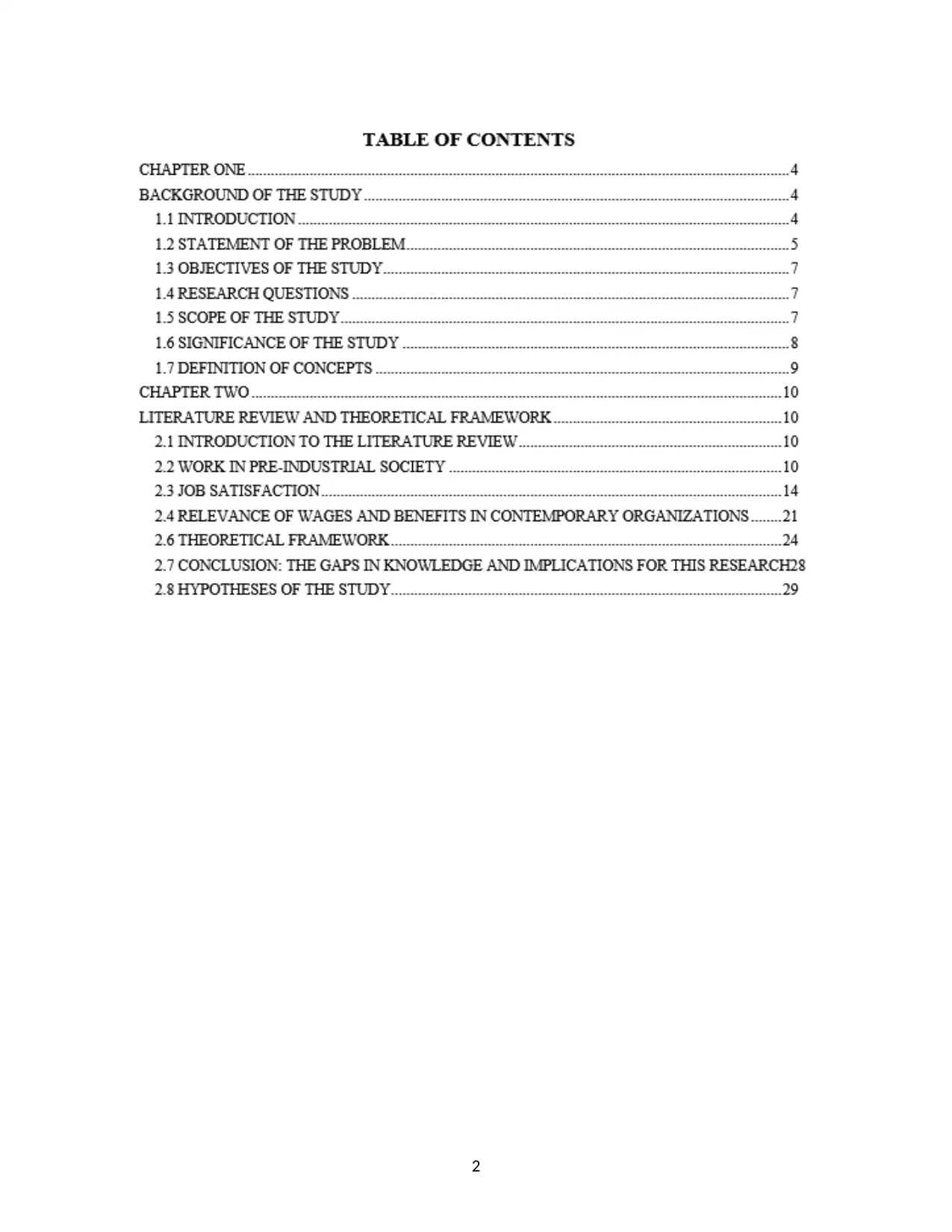
2
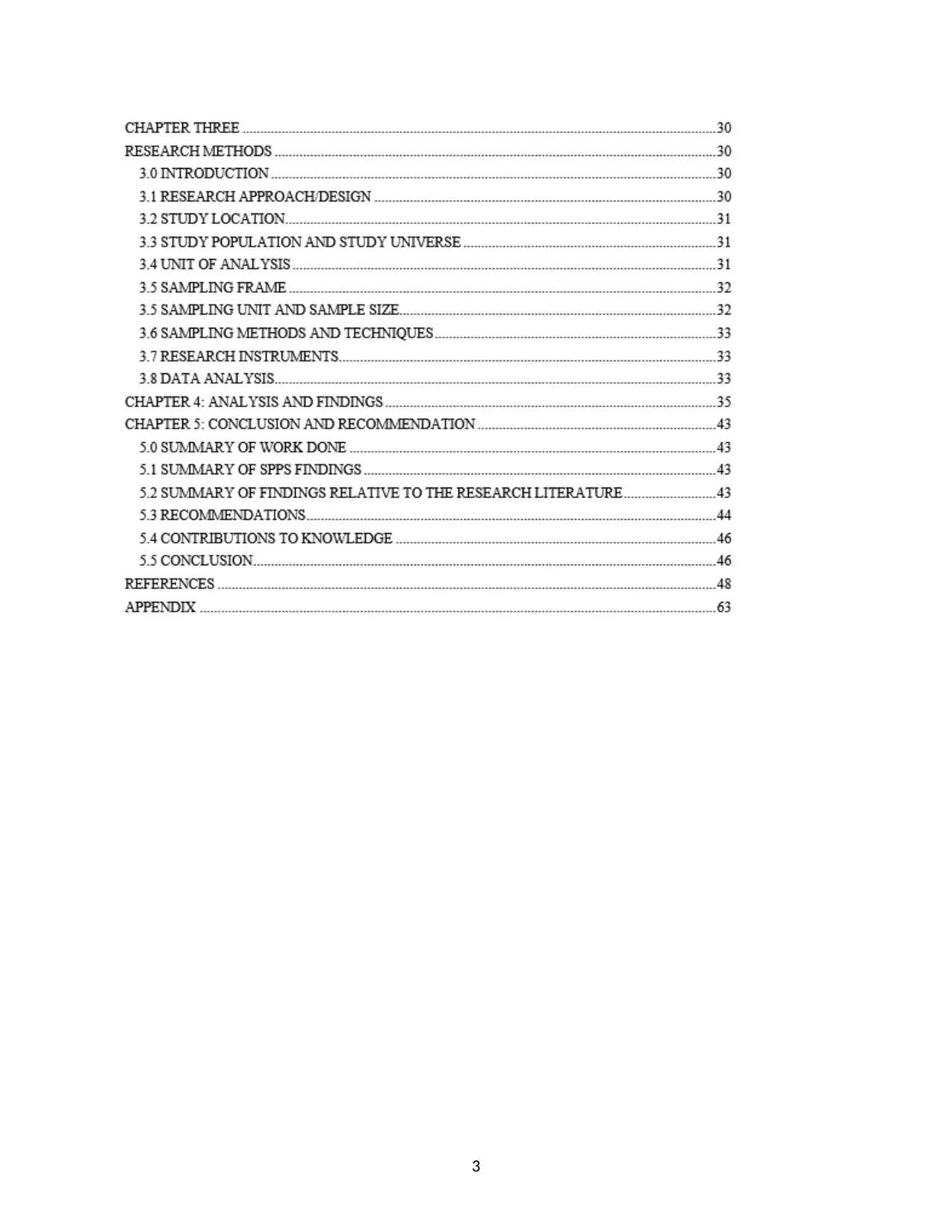
3
⊘ This is a preview!⊘
Do you want full access?
Subscribe today to unlock all pages.

Trusted by 1+ million students worldwide
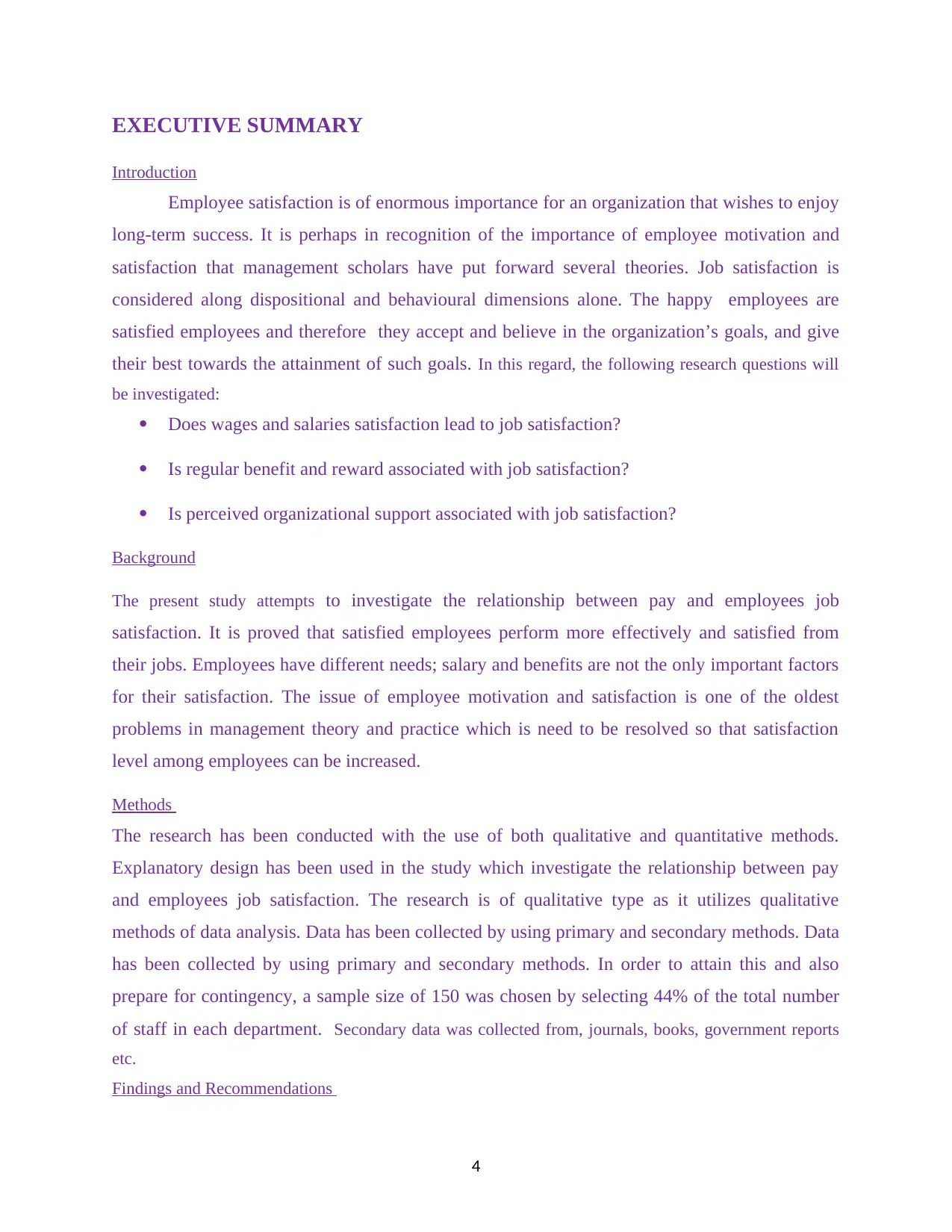
EXECUTIVE SUMMARY
Introduction
Employee satisfaction is of enormous importance for an organization that wishes to enjoy
long-term success. It is perhaps in recognition of the importance of employee motivation and
satisfaction that management scholars have put forward several theories. Job satisfaction is
considered along dispositional and behavioural dimensions alone. The happy employees are
satisfied employees and therefore they accept and believe in the organization’s goals, and give
their best towards the attainment of such goals. In this regard, the following research questions will
be investigated:
Does wages and salaries satisfaction lead to job satisfaction?
Is regular benefit and reward associated with job satisfaction?
Is perceived organizational support associated with job satisfaction?
Background
The present study attempts to investigate the relationship between pay and employees job
satisfaction. It is proved that satisfied employees perform more effectively and satisfied from
their jobs. Employees have different needs; salary and benefits are not the only important factors
for their satisfaction. The issue of employee motivation and satisfaction is one of the oldest
problems in management theory and practice which is need to be resolved so that satisfaction
level among employees can be increased.
Methods
The research has been conducted with the use of both qualitative and quantitative methods.
Explanatory design has been used in the study which investigate the relationship between pay
and employees job satisfaction. The research is of qualitative type as it utilizes qualitative
methods of data analysis. Data has been collected by using primary and secondary methods. Data
has been collected by using primary and secondary methods. In order to attain this and also
prepare for contingency, a sample size of 150 was chosen by selecting 44% of the total number
of staff in each department. Secondary data was collected from, journals, books, government reports
etc.
Findings and Recommendations
4
Introduction
Employee satisfaction is of enormous importance for an organization that wishes to enjoy
long-term success. It is perhaps in recognition of the importance of employee motivation and
satisfaction that management scholars have put forward several theories. Job satisfaction is
considered along dispositional and behavioural dimensions alone. The happy employees are
satisfied employees and therefore they accept and believe in the organization’s goals, and give
their best towards the attainment of such goals. In this regard, the following research questions will
be investigated:
Does wages and salaries satisfaction lead to job satisfaction?
Is regular benefit and reward associated with job satisfaction?
Is perceived organizational support associated with job satisfaction?
Background
The present study attempts to investigate the relationship between pay and employees job
satisfaction. It is proved that satisfied employees perform more effectively and satisfied from
their jobs. Employees have different needs; salary and benefits are not the only important factors
for their satisfaction. The issue of employee motivation and satisfaction is one of the oldest
problems in management theory and practice which is need to be resolved so that satisfaction
level among employees can be increased.
Methods
The research has been conducted with the use of both qualitative and quantitative methods.
Explanatory design has been used in the study which investigate the relationship between pay
and employees job satisfaction. The research is of qualitative type as it utilizes qualitative
methods of data analysis. Data has been collected by using primary and secondary methods. Data
has been collected by using primary and secondary methods. In order to attain this and also
prepare for contingency, a sample size of 150 was chosen by selecting 44% of the total number
of staff in each department. Secondary data was collected from, journals, books, government reports
etc.
Findings and Recommendations
4
Paraphrase This Document
Need a fresh take? Get an instant paraphrase of this document with our AI Paraphraser
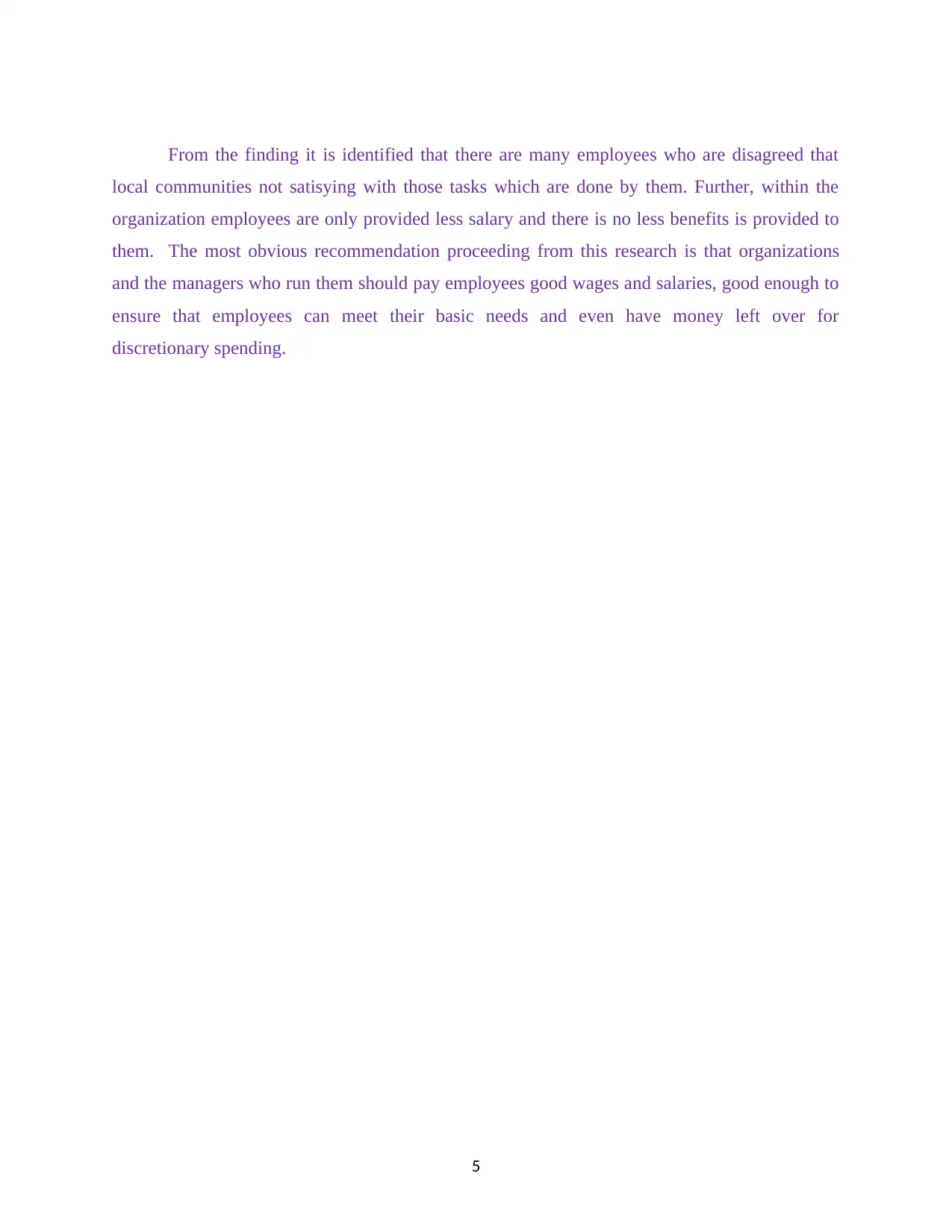
From the finding it is identified that there are many employees who are disagreed that
local communities not satisying with those tasks which are done by them. Further, within the
organization employees are only provided less salary and there is no less benefits is provided to
them. The most obvious recommendation proceeding from this research is that organizations
and the managers who run them should pay employees good wages and salaries, good enough to
ensure that employees can meet their basic needs and even have money left over for
discretionary spending.
5
local communities not satisying with those tasks which are done by them. Further, within the
organization employees are only provided less salary and there is no less benefits is provided to
them. The most obvious recommendation proceeding from this research is that organizations
and the managers who run them should pay employees good wages and salaries, good enough to
ensure that employees can meet their basic needs and even have money left over for
discretionary spending.
5
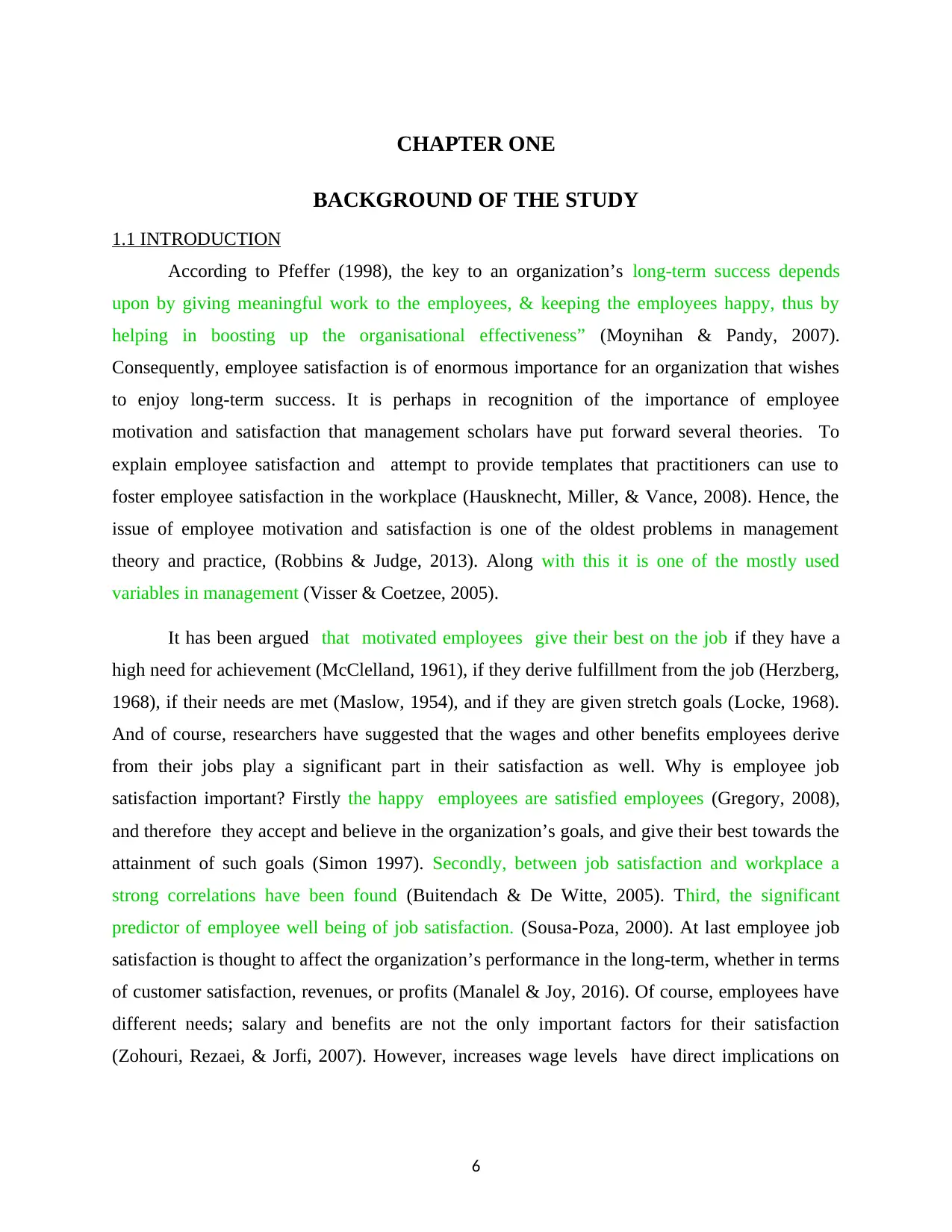
CHAPTER ONE
BACKGROUND OF THE STUDY
1.1 INTRODUCTION
According to Pfeffer (1998), the key to an organization’s long-term success depends
upon by giving meaningful work to the employees, & keeping the employees happy, thus by
helping in boosting up the organisational effectiveness” (Moynihan & Pandy, 2007).
Consequently, employee satisfaction is of enormous importance for an organization that wishes
to enjoy long-term success. It is perhaps in recognition of the importance of employee
motivation and satisfaction that management scholars have put forward several theories. To
explain employee satisfaction and attempt to provide templates that practitioners can use to
foster employee satisfaction in the workplace (Hausknecht, Miller, & Vance, 2008). Hence, the
issue of employee motivation and satisfaction is one of the oldest problems in management
theory and practice, (Robbins & Judge, 2013). Along with this it is one of the mostly used
variables in management (Visser & Coetzee, 2005).
It has been argued that motivated employees give their best on the job if they have a
high need for achievement (McClelland, 1961), if they derive fulfillment from the job (Herzberg,
1968), if their needs are met (Maslow, 1954), and if they are given stretch goals (Locke, 1968).
And of course, researchers have suggested that the wages and other benefits employees derive
from their jobs play a significant part in their satisfaction as well. Why is employee job
satisfaction important? Firstly the happy employees are satisfied employees (Gregory, 2008),
and therefore they accept and believe in the organization’s goals, and give their best towards the
attainment of such goals (Simon 1997). Secondly, between job satisfaction and workplace a
strong correlations have been found (Buitendach & De Witte, 2005). Third, the significant
predictor of employee well being of job satisfaction. (Sousa-Poza, 2000). At last employee job
satisfaction is thought to affect the organization’s performance in the long-term, whether in terms
of customer satisfaction, revenues, or profits (Manalel & Joy, 2016). Of course, employees have
different needs; salary and benefits are not the only important factors for their satisfaction
(Zohouri, Rezaei, & Jorfi, 2007). However, increases wage levels have direct implications on
6
BACKGROUND OF THE STUDY
1.1 INTRODUCTION
According to Pfeffer (1998), the key to an organization’s long-term success depends
upon by giving meaningful work to the employees, & keeping the employees happy, thus by
helping in boosting up the organisational effectiveness” (Moynihan & Pandy, 2007).
Consequently, employee satisfaction is of enormous importance for an organization that wishes
to enjoy long-term success. It is perhaps in recognition of the importance of employee
motivation and satisfaction that management scholars have put forward several theories. To
explain employee satisfaction and attempt to provide templates that practitioners can use to
foster employee satisfaction in the workplace (Hausknecht, Miller, & Vance, 2008). Hence, the
issue of employee motivation and satisfaction is one of the oldest problems in management
theory and practice, (Robbins & Judge, 2013). Along with this it is one of the mostly used
variables in management (Visser & Coetzee, 2005).
It has been argued that motivated employees give their best on the job if they have a
high need for achievement (McClelland, 1961), if they derive fulfillment from the job (Herzberg,
1968), if their needs are met (Maslow, 1954), and if they are given stretch goals (Locke, 1968).
And of course, researchers have suggested that the wages and other benefits employees derive
from their jobs play a significant part in their satisfaction as well. Why is employee job
satisfaction important? Firstly the happy employees are satisfied employees (Gregory, 2008),
and therefore they accept and believe in the organization’s goals, and give their best towards the
attainment of such goals (Simon 1997). Secondly, between job satisfaction and workplace a
strong correlations have been found (Buitendach & De Witte, 2005). Third, the significant
predictor of employee well being of job satisfaction. (Sousa-Poza, 2000). At last employee job
satisfaction is thought to affect the organization’s performance in the long-term, whether in terms
of customer satisfaction, revenues, or profits (Manalel & Joy, 2016). Of course, employees have
different needs; salary and benefits are not the only important factors for their satisfaction
(Zohouri, Rezaei, & Jorfi, 2007). However, increases wage levels have direct implications on
6
⊘ This is a preview!⊘
Do you want full access?
Subscribe today to unlock all pages.
Trusted by 1+ million students worldwide
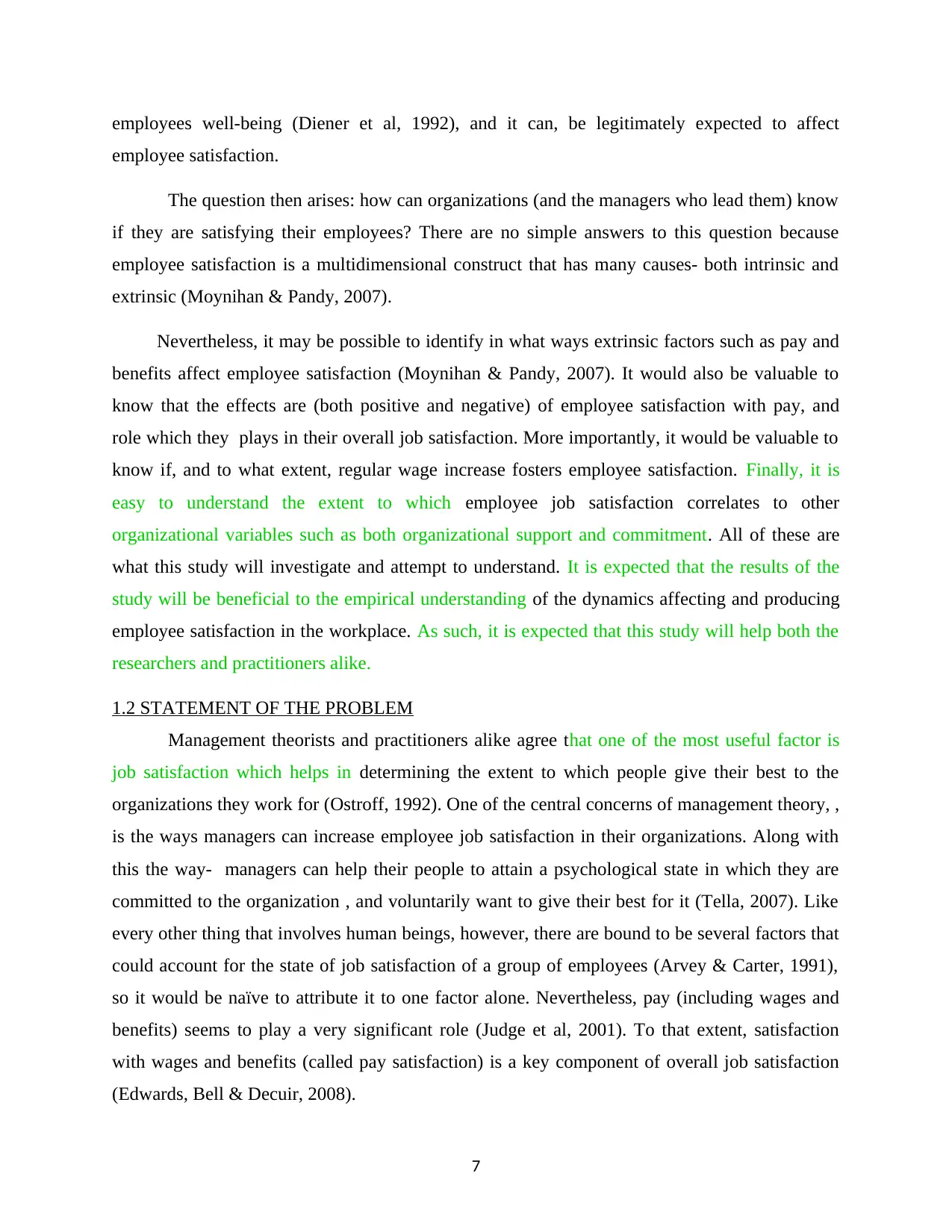
employees well-being (Diener et al, 1992), and it can, be legitimately expected to affect
employee satisfaction.
The question then arises: how can organizations (and the managers who lead them) know
if they are satisfying their employees? There are no simple answers to this question because
employee satisfaction is a multidimensional construct that has many causes- both intrinsic and
extrinsic (Moynihan & Pandy, 2007).
Nevertheless, it may be possible to identify in what ways extrinsic factors such as pay and
benefits affect employee satisfaction (Moynihan & Pandy, 2007). It would also be valuable to
know that the effects are (both positive and negative) of employee satisfaction with pay, and
role which they plays in their overall job satisfaction. More importantly, it would be valuable to
know if, and to what extent, regular wage increase fosters employee satisfaction. Finally, it is
easy to understand the extent to which employee job satisfaction correlates to other
organizational variables such as both organizational support and commitment. All of these are
what this study will investigate and attempt to understand. It is expected that the results of the
study will be beneficial to the empirical understanding of the dynamics affecting and producing
employee satisfaction in the workplace. As such, it is expected that this study will help both the
researchers and practitioners alike.
1.2 STATEMENT OF THE PROBLEM
Management theorists and practitioners alike agree that one of the most useful factor is
job satisfaction which helps in determining the extent to which people give their best to the
organizations they work for (Ostroff, 1992). One of the central concerns of management theory, ,
is the ways managers can increase employee job satisfaction in their organizations. Along with
this the way- managers can help their people to attain a psychological state in which they are
committed to the organization , and voluntarily want to give their best for it (Tella, 2007). Like
every other thing that involves human beings, however, there are bound to be several factors that
could account for the state of job satisfaction of a group of employees (Arvey & Carter, 1991),
so it would be naïve to attribute it to one factor alone. Nevertheless, pay (including wages and
benefits) seems to play a very significant role (Judge et al, 2001). To that extent, satisfaction
with wages and benefits (called pay satisfaction) is a key component of overall job satisfaction
(Edwards, Bell & Decuir, 2008).
7
employee satisfaction.
The question then arises: how can organizations (and the managers who lead them) know
if they are satisfying their employees? There are no simple answers to this question because
employee satisfaction is a multidimensional construct that has many causes- both intrinsic and
extrinsic (Moynihan & Pandy, 2007).
Nevertheless, it may be possible to identify in what ways extrinsic factors such as pay and
benefits affect employee satisfaction (Moynihan & Pandy, 2007). It would also be valuable to
know that the effects are (both positive and negative) of employee satisfaction with pay, and
role which they plays in their overall job satisfaction. More importantly, it would be valuable to
know if, and to what extent, regular wage increase fosters employee satisfaction. Finally, it is
easy to understand the extent to which employee job satisfaction correlates to other
organizational variables such as both organizational support and commitment. All of these are
what this study will investigate and attempt to understand. It is expected that the results of the
study will be beneficial to the empirical understanding of the dynamics affecting and producing
employee satisfaction in the workplace. As such, it is expected that this study will help both the
researchers and practitioners alike.
1.2 STATEMENT OF THE PROBLEM
Management theorists and practitioners alike agree that one of the most useful factor is
job satisfaction which helps in determining the extent to which people give their best to the
organizations they work for (Ostroff, 1992). One of the central concerns of management theory, ,
is the ways managers can increase employee job satisfaction in their organizations. Along with
this the way- managers can help their people to attain a psychological state in which they are
committed to the organization , and voluntarily want to give their best for it (Tella, 2007). Like
every other thing that involves human beings, however, there are bound to be several factors that
could account for the state of job satisfaction of a group of employees (Arvey & Carter, 1991),
so it would be naïve to attribute it to one factor alone. Nevertheless, pay (including wages and
benefits) seems to play a very significant role (Judge et al, 2001). To that extent, satisfaction
with wages and benefits (called pay satisfaction) is a key component of overall job satisfaction
(Edwards, Bell & Decuir, 2008).
7
Paraphrase This Document
Need a fresh take? Get an instant paraphrase of this document with our AI Paraphraser
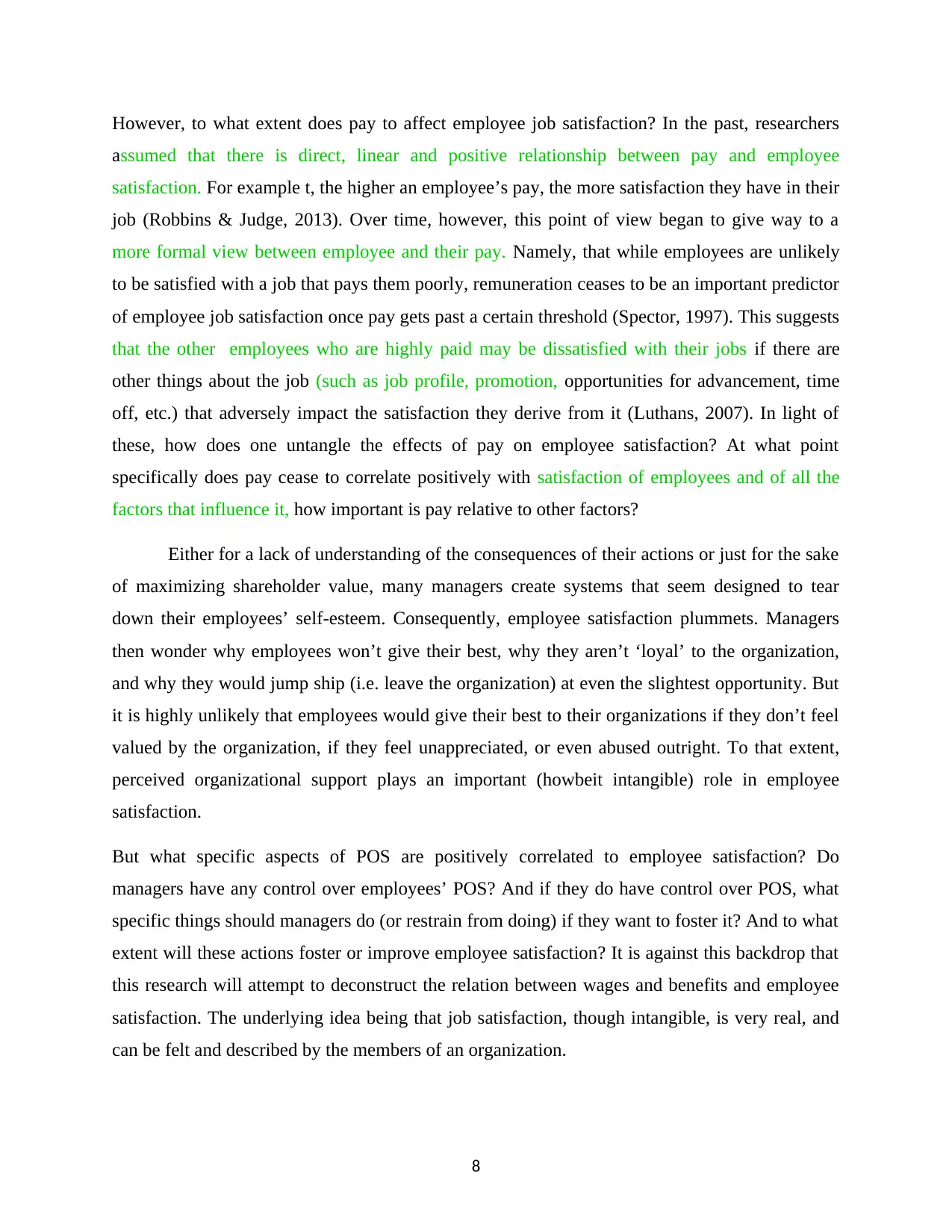
However, to what extent does pay to affect employee job satisfaction? In the past, researchers
assumed that there is direct, linear and positive relationship between pay and employee
satisfaction. For example t, the higher an employee’s pay, the more satisfaction they have in their
job (Robbins & Judge, 2013). Over time, however, this point of view began to give way to a
more formal view between employee and their pay. Namely, that while employees are unlikely
to be satisfied with a job that pays them poorly, remuneration ceases to be an important predictor
of employee job satisfaction once pay gets past a certain threshold (Spector, 1997). This suggests
that the other employees who are highly paid may be dissatisfied with their jobs if there are
other things about the job (such as job profile, promotion, opportunities for advancement, time
off, etc.) that adversely impact the satisfaction they derive from it (Luthans, 2007). In light of
these, how does one untangle the effects of pay on employee satisfaction? At what point
specifically does pay cease to correlate positively with satisfaction of employees and of all the
factors that influence it, how important is pay relative to other factors?
Either for a lack of understanding of the consequences of their actions or just for the sake
of maximizing shareholder value, many managers create systems that seem designed to tear
down their employees’ self-esteem. Consequently, employee satisfaction plummets. Managers
then wonder why employees won’t give their best, why they aren’t ‘loyal’ to the organization,
and why they would jump ship (i.e. leave the organization) at even the slightest opportunity. But
it is highly unlikely that employees would give their best to their organizations if they don’t feel
valued by the organization, if they feel unappreciated, or even abused outright. To that extent,
perceived organizational support plays an important (howbeit intangible) role in employee
satisfaction.
But what specific aspects of POS are positively correlated to employee satisfaction? Do
managers have any control over employees’ POS? And if they do have control over POS, what
specific things should managers do (or restrain from doing) if they want to foster it? And to what
extent will these actions foster or improve employee satisfaction? It is against this backdrop that
this research will attempt to deconstruct the relation between wages and benefits and employee
satisfaction. The underlying idea being that job satisfaction, though intangible, is very real, and
can be felt and described by the members of an organization.
8
assumed that there is direct, linear and positive relationship between pay and employee
satisfaction. For example t, the higher an employee’s pay, the more satisfaction they have in their
job (Robbins & Judge, 2013). Over time, however, this point of view began to give way to a
more formal view between employee and their pay. Namely, that while employees are unlikely
to be satisfied with a job that pays them poorly, remuneration ceases to be an important predictor
of employee job satisfaction once pay gets past a certain threshold (Spector, 1997). This suggests
that the other employees who are highly paid may be dissatisfied with their jobs if there are
other things about the job (such as job profile, promotion, opportunities for advancement, time
off, etc.) that adversely impact the satisfaction they derive from it (Luthans, 2007). In light of
these, how does one untangle the effects of pay on employee satisfaction? At what point
specifically does pay cease to correlate positively with satisfaction of employees and of all the
factors that influence it, how important is pay relative to other factors?
Either for a lack of understanding of the consequences of their actions or just for the sake
of maximizing shareholder value, many managers create systems that seem designed to tear
down their employees’ self-esteem. Consequently, employee satisfaction plummets. Managers
then wonder why employees won’t give their best, why they aren’t ‘loyal’ to the organization,
and why they would jump ship (i.e. leave the organization) at even the slightest opportunity. But
it is highly unlikely that employees would give their best to their organizations if they don’t feel
valued by the organization, if they feel unappreciated, or even abused outright. To that extent,
perceived organizational support plays an important (howbeit intangible) role in employee
satisfaction.
But what specific aspects of POS are positively correlated to employee satisfaction? Do
managers have any control over employees’ POS? And if they do have control over POS, what
specific things should managers do (or restrain from doing) if they want to foster it? And to what
extent will these actions foster or improve employee satisfaction? It is against this backdrop that
this research will attempt to deconstruct the relation between wages and benefits and employee
satisfaction. The underlying idea being that job satisfaction, though intangible, is very real, and
can be felt and described by the members of an organization.
8
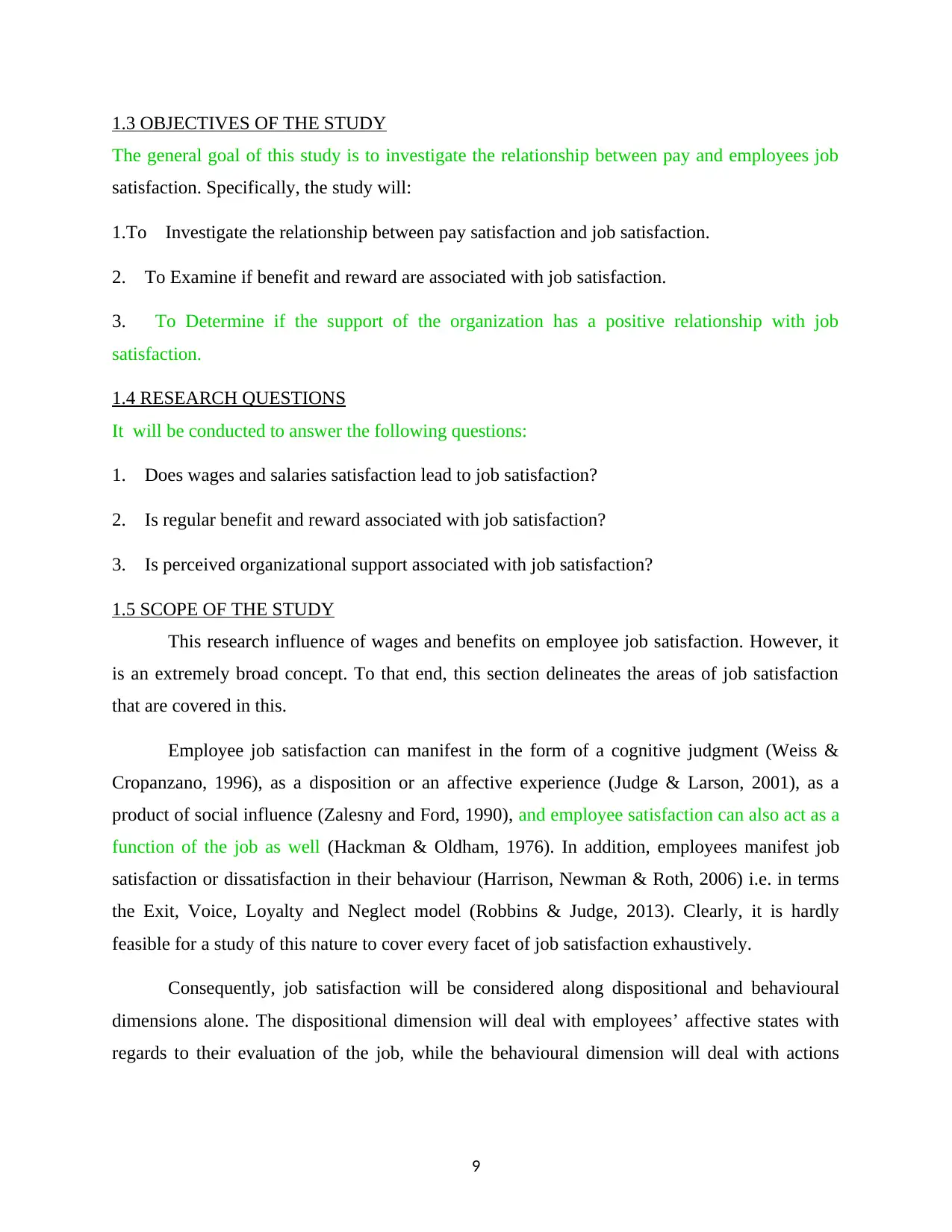
1.3 OBJECTIVES OF THE STUDY
The general goal of this study is to investigate the relationship between pay and employees job
satisfaction. Specifically, the study will:
1.To Investigate the relationship between pay satisfaction and job satisfaction.
2. To Examine if benefit and reward are associated with job satisfaction.
3. To Determine if the support of the organization has a positive relationship with job
satisfaction.
1.4 RESEARCH QUESTIONS
It will be conducted to answer the following questions:
1. Does wages and salaries satisfaction lead to job satisfaction?
2. Is regular benefit and reward associated with job satisfaction?
3. Is perceived organizational support associated with job satisfaction?
1.5 SCOPE OF THE STUDY
This research influence of wages and benefits on employee job satisfaction. However, it
is an extremely broad concept. To that end, this section delineates the areas of job satisfaction
that are covered in this.
Employee job satisfaction can manifest in the form of a cognitive judgment (Weiss &
Cropanzano, 1996), as a disposition or an affective experience (Judge & Larson, 2001), as a
product of social influence (Zalesny and Ford, 1990), and employee satisfaction can also act as a
function of the job as well (Hackman & Oldham, 1976). In addition, employees manifest job
satisfaction or dissatisfaction in their behaviour (Harrison, Newman & Roth, 2006) i.e. in terms
the Exit, Voice, Loyalty and Neglect model (Robbins & Judge, 2013). Clearly, it is hardly
feasible for a study of this nature to cover every facet of job satisfaction exhaustively.
Consequently, job satisfaction will be considered along dispositional and behavioural
dimensions alone. The dispositional dimension will deal with employees’ affective states with
regards to their evaluation of the job, while the behavioural dimension will deal with actions
9
The general goal of this study is to investigate the relationship between pay and employees job
satisfaction. Specifically, the study will:
1.To Investigate the relationship between pay satisfaction and job satisfaction.
2. To Examine if benefit and reward are associated with job satisfaction.
3. To Determine if the support of the organization has a positive relationship with job
satisfaction.
1.4 RESEARCH QUESTIONS
It will be conducted to answer the following questions:
1. Does wages and salaries satisfaction lead to job satisfaction?
2. Is regular benefit and reward associated with job satisfaction?
3. Is perceived organizational support associated with job satisfaction?
1.5 SCOPE OF THE STUDY
This research influence of wages and benefits on employee job satisfaction. However, it
is an extremely broad concept. To that end, this section delineates the areas of job satisfaction
that are covered in this.
Employee job satisfaction can manifest in the form of a cognitive judgment (Weiss &
Cropanzano, 1996), as a disposition or an affective experience (Judge & Larson, 2001), as a
product of social influence (Zalesny and Ford, 1990), and employee satisfaction can also act as a
function of the job as well (Hackman & Oldham, 1976). In addition, employees manifest job
satisfaction or dissatisfaction in their behaviour (Harrison, Newman & Roth, 2006) i.e. in terms
the Exit, Voice, Loyalty and Neglect model (Robbins & Judge, 2013). Clearly, it is hardly
feasible for a study of this nature to cover every facet of job satisfaction exhaustively.
Consequently, job satisfaction will be considered along dispositional and behavioural
dimensions alone. The dispositional dimension will deal with employees’ affective states with
regards to their evaluation of the job, while the behavioural dimension will deal with actions
9
⊘ This is a preview!⊘
Do you want full access?
Subscribe today to unlock all pages.
Trusted by 1+ million students worldwide
employees take (such as citizenship behaviour, absenteeism, tardiness, or turnover) that suggest
either satisfaction or dissatisfaction with the job.
Finally, this study is limited to Guinness Nigeria PLC, a publicly listed alcoholic
beverage company with its Nigerian headquarters in Lagos. However, the study will focus on the
professional cadre of employees at the company, such as human resource professionals,
accountants, sales, marketing and branding professionals, legal practitioners, and other categories
of knowledge workers.
1.6 SIGNIFICANCE OF THE STUDY
It also has several potential practical applications:
Firstly, the study suggests steps top management can take to foster employee satisfaction
in the workplace in the sense that it could help managers see more clearly the differences
between intrinsic and extrinsic sources of employee satisfaction. Wages and benefits, for
instance, have been identified as extrinsic sources of employee satisfaction. Nevertheless, wages
and benefits alone are unlikely to be all-effective in producing employee satisfaction. To that
extent, managers must be aware of other intrinsic sources of employee satisfaction so as to help
them understand the dynamics governing each source of employee satisfaction, and therefore
how to manage employees in ways that maximize the benefits offered by both sources. This
enables managers to align compensation systems with the behaviours and results they desire to
see in their employees.
Secondly, the study could serve as a useful template for designing organization
compensation system. Based on the discussion of findings in this study, practising managers can
understand the role that expectancies and perceived equities play in employee satisfaction and
dissatisfaction with the organization’s pay and compensation systems generally. This can help
managers ensure that expectations are clear, and can help them detect and eliminate whatever
inequities may exist in the organization’s compensation systems.
Third, this study suggests that managers should take employees’ needs into account when
they design compensation systems. All employees aren’t at the same need level. Therefore, it is
imperative that managers tailor compensation to meet employees’ individual needs, not just
apply broad strokes that assume everybody wants, and are motivated by the same things. The
10
either satisfaction or dissatisfaction with the job.
Finally, this study is limited to Guinness Nigeria PLC, a publicly listed alcoholic
beverage company with its Nigerian headquarters in Lagos. However, the study will focus on the
professional cadre of employees at the company, such as human resource professionals,
accountants, sales, marketing and branding professionals, legal practitioners, and other categories
of knowledge workers.
1.6 SIGNIFICANCE OF THE STUDY
It also has several potential practical applications:
Firstly, the study suggests steps top management can take to foster employee satisfaction
in the workplace in the sense that it could help managers see more clearly the differences
between intrinsic and extrinsic sources of employee satisfaction. Wages and benefits, for
instance, have been identified as extrinsic sources of employee satisfaction. Nevertheless, wages
and benefits alone are unlikely to be all-effective in producing employee satisfaction. To that
extent, managers must be aware of other intrinsic sources of employee satisfaction so as to help
them understand the dynamics governing each source of employee satisfaction, and therefore
how to manage employees in ways that maximize the benefits offered by both sources. This
enables managers to align compensation systems with the behaviours and results they desire to
see in their employees.
Secondly, the study could serve as a useful template for designing organization
compensation system. Based on the discussion of findings in this study, practising managers can
understand the role that expectancies and perceived equities play in employee satisfaction and
dissatisfaction with the organization’s pay and compensation systems generally. This can help
managers ensure that expectations are clear, and can help them detect and eliminate whatever
inequities may exist in the organization’s compensation systems.
Third, this study suggests that managers should take employees’ needs into account when
they design compensation systems. All employees aren’t at the same need level. Therefore, it is
imperative that managers tailor compensation to meet employees’ individual needs, not just
apply broad strokes that assume everybody wants, and are motivated by the same things. The
10
Paraphrase This Document
Need a fresh take? Get an instant paraphrase of this document with our AI Paraphraser
study could, therefore, help managers create buy-in to the organization’s espoused values by
helping them align their behaviours to be more in line with the results that they want to get.
1.7 DEFINITION OF CONCEPTS
The following concepts are central to this research: job satisfaction, pay satisfaction and
perceived organizational support.
Job satisfaction is “a feeling of enjoyment that a person derives from their job” (Locke,
1976).
Pay satisfaction is defined as the “ positive or negative feelings that a person have
towards its pay”. (Miceli & Lane, 1991).
Perceived organizational support (POS) refers “ to employees believes concerning the
extent to which employees believe the organization values their contribution and cares about
their well-being” (Rhoades & Eisenberger, 2002).
11
helping them align their behaviours to be more in line with the results that they want to get.
1.7 DEFINITION OF CONCEPTS
The following concepts are central to this research: job satisfaction, pay satisfaction and
perceived organizational support.
Job satisfaction is “a feeling of enjoyment that a person derives from their job” (Locke,
1976).
Pay satisfaction is defined as the “ positive or negative feelings that a person have
towards its pay”. (Miceli & Lane, 1991).
Perceived organizational support (POS) refers “ to employees believes concerning the
extent to which employees believe the organization values their contribution and cares about
their well-being” (Rhoades & Eisenberger, 2002).
11
CHAPTER TWO
LITERATURE REVIEW AND THEORETICAL FRAMEWORK
2.1 INTRODUCTION TO THE LITERATURE REVIEW
It is divided into six sections. The first section discusses work in pre-industrial society,
tracing the evolution and organization of work in pre-industrial society, and linking that to the
changing conditions of work at the dawn of industrialization. The implications of these for
worker satisfaction in the industrial age are discussed. The second section introduces the concept
of job satisfaction, including its nature, correlates, antecedents, consequences, and measurement.
The third section introduces the concept of pay satisfaction and deals with the influence of wages
and benefits on employee job satisfaction. The fourth section deals with the relevance of pay and
other benefits in contemporary organizations, including for such issues as job satisfaction, job
performance and organizational growth. The fifth section deals with issues relating to perceived
organizational support and its relationship to job satisfaction. And the sixth and final section sets
forth the theoretical framework on which this study is based, viz: John Adams’ Equity Theory,
and Abraham Maslow’s Hierarchy of Needs. The gaps in knowledge in the literature reviewed
are identified and discussed, leading to the conclusion.
2.2 WORK IN PRE-INDUSTRIAL SOCIETY
‘Work’ is defined as “ to be engaged in mental and physical activity, in order to achieve a
result like the production of goods and services that satisfy to human needs” (Giddens, 2009). In
this sense, ‘work’ is somewhat different from ‘occupation’- which is “work that is done in
exchange for a fixed wage or salary” (Giddens, 2009). The purpose of this section is to trace the
evolution of work from pre-industrial times to the emergence of the Industrial Revolution, and
thereby to show how work organization has evolved up to the present time since the legacy of
the Industrial Revolution is still very much alive and thriving.
2.2.1 Evolution and Organization of Work in Pre-Industrial Society
Historians and anthropologists alike have identified at least four kinds of societies that
existed before the advent of industrialization, in terms of the organization of work and the
12
LITERATURE REVIEW AND THEORETICAL FRAMEWORK
2.1 INTRODUCTION TO THE LITERATURE REVIEW
It is divided into six sections. The first section discusses work in pre-industrial society,
tracing the evolution and organization of work in pre-industrial society, and linking that to the
changing conditions of work at the dawn of industrialization. The implications of these for
worker satisfaction in the industrial age are discussed. The second section introduces the concept
of job satisfaction, including its nature, correlates, antecedents, consequences, and measurement.
The third section introduces the concept of pay satisfaction and deals with the influence of wages
and benefits on employee job satisfaction. The fourth section deals with the relevance of pay and
other benefits in contemporary organizations, including for such issues as job satisfaction, job
performance and organizational growth. The fifth section deals with issues relating to perceived
organizational support and its relationship to job satisfaction. And the sixth and final section sets
forth the theoretical framework on which this study is based, viz: John Adams’ Equity Theory,
and Abraham Maslow’s Hierarchy of Needs. The gaps in knowledge in the literature reviewed
are identified and discussed, leading to the conclusion.
2.2 WORK IN PRE-INDUSTRIAL SOCIETY
‘Work’ is defined as “ to be engaged in mental and physical activity, in order to achieve a
result like the production of goods and services that satisfy to human needs” (Giddens, 2009). In
this sense, ‘work’ is somewhat different from ‘occupation’- which is “work that is done in
exchange for a fixed wage or salary” (Giddens, 2009). The purpose of this section is to trace the
evolution of work from pre-industrial times to the emergence of the Industrial Revolution, and
thereby to show how work organization has evolved up to the present time since the legacy of
the Industrial Revolution is still very much alive and thriving.
2.2.1 Evolution and Organization of Work in Pre-Industrial Society
Historians and anthropologists alike have identified at least four kinds of societies that
existed before the advent of industrialization, in terms of the organization of work and the
12
⊘ This is a preview!⊘
Do you want full access?
Subscribe today to unlock all pages.
Trusted by 1+ million students worldwide

1 out of 66


Related Documents


Your All-in-One AI-Powered Toolkit for Academic Success.
+13062052269
info@desklib.com
Available 24*7 on WhatsApp / Email
![[object Object]](/_next/static/media/star-bottom.7253800d.svg)
Unlock your academic potential
Copyright © 2020–2026 A2Z Services. All Rights Reserved. Developed and managed by ZUCOL.