Employee Management Strategies at Waitrose: A Comprehensive Report
VerifiedAdded on 2023/01/19
|12
|3773
|89
Report
AI Summary
This report provides a detailed analysis of Waitrose's employee management practices. It begins with an overview of the company and then delves into the hiring process, including recruitment, selection, training, and induction. The report examines factors affecting employee behavior and teamwork, such as cohesiveness, communication, group-think, and team size. It then explores motivation and performance management theories, including Maslow's hierarchy of needs and Herzberg's motivation theory. The report also discusses different management and leadership styles, as well as the relationship between organizational structure and culture. The analysis highlights Waitrose's strategies for creating a productive and motivated workforce within its retail operations. The report concludes by summarizing the key findings and offering insights into Waitrose's approach to people management.
MANAGING
PEOPLE IN
ORGANISATIONS
PEOPLE IN
ORGANISATIONS

Paraphrase This Document
Need a fresh take? Get an instant paraphrase of this document with our AI Paraphraser
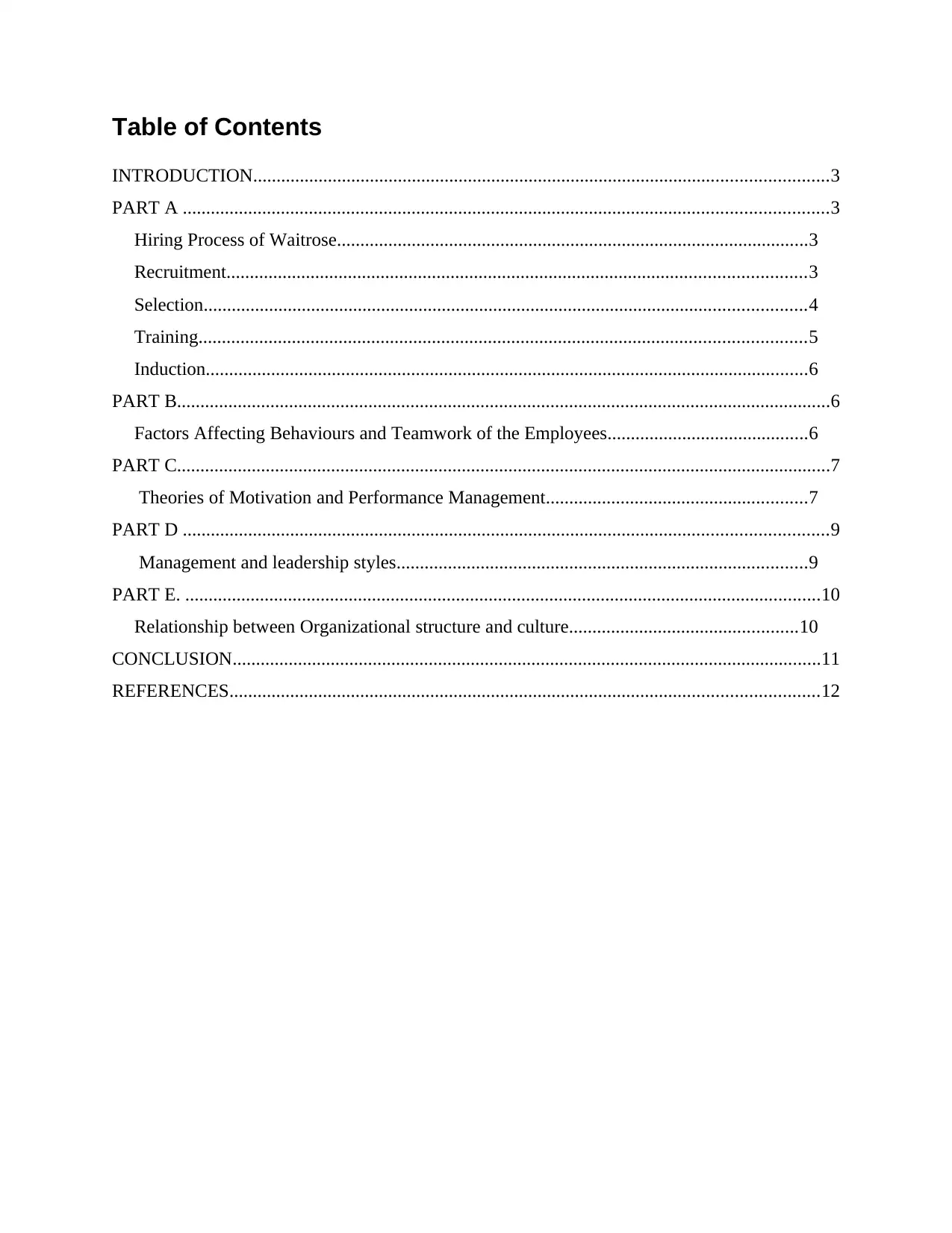
Table of Contents
INTRODUCTION...........................................................................................................................3
PART A ..........................................................................................................................................3
Hiring Process of Waitrose.....................................................................................................3
Recruitment............................................................................................................................3
Selection.................................................................................................................................4
Training..................................................................................................................................5
Induction.................................................................................................................................6
PART B............................................................................................................................................6
Factors Affecting Behaviours and Teamwork of the Employees...........................................6
PART C............................................................................................................................................7
Theories of Motivation and Performance Management........................................................7
PART D ..........................................................................................................................................9
Management and leadership styles........................................................................................9
PART E. ........................................................................................................................................10
Relationship between Organizational structure and culture.................................................10
CONCLUSION..............................................................................................................................11
REFERENCES..............................................................................................................................12
INTRODUCTION...........................................................................................................................3
PART A ..........................................................................................................................................3
Hiring Process of Waitrose.....................................................................................................3
Recruitment............................................................................................................................3
Selection.................................................................................................................................4
Training..................................................................................................................................5
Induction.................................................................................................................................6
PART B............................................................................................................................................6
Factors Affecting Behaviours and Teamwork of the Employees...........................................6
PART C............................................................................................................................................7
Theories of Motivation and Performance Management........................................................7
PART D ..........................................................................................................................................9
Management and leadership styles........................................................................................9
PART E. ........................................................................................................................................10
Relationship between Organizational structure and culture.................................................10
CONCLUSION..............................................................................................................................11
REFERENCES..............................................................................................................................12
INTRODUCTION
Managing people in an organization is very essential in making the organization
very effective and productive in doing the operations. Managing employees according to
the department helps the organization help to analyse the potential of the employee and
also help the management to increase their efficiency by making better strategies and
policies. Different departments help the employees to concentrate on the single aspect
of the operation and help them to attain the knowledge and skills for that department, as
it helps the management to understand their behaviour and also allow them to motivate
according to them. Departments also help the employee to be developed overall as the
managers place them in all the departments for their training and increasing their
knowledge so that the employees can make better decision and also increase the
efficiency of their work effectively. The need to manage employee in the organization
also analysed by Waitrose & partners and evaluated the importance of managing and
motivating people with the help of different strategies which will help the company to
increase the sales and also increase the productivity of the employees as well. Waitrose
is a British retail chain which mainly deals in food products and also have the largest
employment capacity in UK. The company was established in 1904 in UK which
presently have 340 stores in all around UK and it is supermarkets which have all
groceries and is also very essential for the consumer daily needs. This report has a
detailed study about how the company use the strategies to manage their employees
and also make them satisfy their jobs.
PART A
Hiring Process of Waitrose
Recruitment
Recruitment Planning
It is the first step which Waitrose will be doing in the recruiting the potential
candidates for the company. In this step the company have to set the standard
according the objectives of the company and what the company needs in the
candidate's skills, knowledge which will increase which will help the company to achieve
its objectives. The company will design a job performa or job description which will help
Managing people in an organization is very essential in making the organization
very effective and productive in doing the operations. Managing employees according to
the department helps the organization help to analyse the potential of the employee and
also help the management to increase their efficiency by making better strategies and
policies. Different departments help the employees to concentrate on the single aspect
of the operation and help them to attain the knowledge and skills for that department, as
it helps the management to understand their behaviour and also allow them to motivate
according to them. Departments also help the employee to be developed overall as the
managers place them in all the departments for their training and increasing their
knowledge so that the employees can make better decision and also increase the
efficiency of their work effectively. The need to manage employee in the organization
also analysed by Waitrose & partners and evaluated the importance of managing and
motivating people with the help of different strategies which will help the company to
increase the sales and also increase the productivity of the employees as well. Waitrose
is a British retail chain which mainly deals in food products and also have the largest
employment capacity in UK. The company was established in 1904 in UK which
presently have 340 stores in all around UK and it is supermarkets which have all
groceries and is also very essential for the consumer daily needs. This report has a
detailed study about how the company use the strategies to manage their employees
and also make them satisfy their jobs.
PART A
Hiring Process of Waitrose
Recruitment
Recruitment Planning
It is the first step which Waitrose will be doing in the recruiting the potential
candidates for the company. In this step the company have to set the standard
according the objectives of the company and what the company needs in the
candidate's skills, knowledge which will increase which will help the company to achieve
its objectives. The company will design a job performa or job description which will help
⊘ This is a preview!⊘
Do you want full access?
Subscribe today to unlock all pages.

Trusted by 1+ million students worldwide
the company to attract the potential candidates from the huge open market of human
resource (Aljuwaiber, 2016). In recruitment planning there are many factors which the
managers have to analyze before making all the recruitment process.
Strategy development
The managers of the company are also responsible to analyse the right
expectation of the company and what the company need to fulfil their goals to make a
effective strategy which will help the company to achieve the objectives and also
increase the efficiency of the company.
Searching
After the strategy of recruiting is made the company will now start looking for the
candidates in the market with help of advertisements, emails, calls and messages, to
invite the candidate which is right for the job.
Screening
After the candidates are chosen the management of Waitrose will filter the
candidate according to some test and will check which candidate is best suited for the
job description. As the candidate after meeting face to facer it is easy for the company
to shortlist the candidates easily according to their resumes, and personality.
Evaluation and controlling
This is the last step of recruitment in Waitrose where the managers will analyse
the total cost incurred in the recruitment process by evaluating the salaries of the
recruiters, if any candidate is not selected for the seat that will also be a cost of the
company.
Selection
Waitrose have divided the selection process into task ensure the proper analysis
of the candidate and hire a talent which will help the company in many aspects.
Task 1
The selection of the candidate in this stage is done in form interviews where In
the first task the candidates have to play some games which help all the candidates to
comfortable with each other so that there will be no hesitation while portraying their
skills and knowledge to the selectors of the company (Watson and Shannon, 2016).
resource (Aljuwaiber, 2016). In recruitment planning there are many factors which the
managers have to analyze before making all the recruitment process.
Strategy development
The managers of the company are also responsible to analyse the right
expectation of the company and what the company need to fulfil their goals to make a
effective strategy which will help the company to achieve the objectives and also
increase the efficiency of the company.
Searching
After the strategy of recruiting is made the company will now start looking for the
candidates in the market with help of advertisements, emails, calls and messages, to
invite the candidate which is right for the job.
Screening
After the candidates are chosen the management of Waitrose will filter the
candidate according to some test and will check which candidate is best suited for the
job description. As the candidate after meeting face to facer it is easy for the company
to shortlist the candidates easily according to their resumes, and personality.
Evaluation and controlling
This is the last step of recruitment in Waitrose where the managers will analyse
the total cost incurred in the recruitment process by evaluating the salaries of the
recruiters, if any candidate is not selected for the seat that will also be a cost of the
company.
Selection
Waitrose have divided the selection process into task ensure the proper analysis
of the candidate and hire a talent which will help the company in many aspects.
Task 1
The selection of the candidate in this stage is done in form interviews where In
the first task the candidates have to play some games which help all the candidates to
comfortable with each other so that there will be no hesitation while portraying their
skills and knowledge to the selectors of the company (Watson and Shannon, 2016).
Paraphrase This Document
Need a fresh take? Get an instant paraphrase of this document with our AI Paraphraser
Task 2
In this task the candidates have to present themselves in front of other
candidates and tell everyone about their skills, achievements and why the candidate
want to join this company and what will be his or her vision after joining the company.
And the candidate also have to answer some questions which is asked by the selectors
to analyse the analytical skills of the candidates.
Task 3
In this the company ask the candidates to divide them into teams and make a
hypothetical situation to sell a product so that the selectors of the company can analyse
their coordination skills and communication skills as well.
Second Round of Interview
In this the company selects the candidates which are nearly right and can be
analysed further (Jarrett, 2019). The candidate will be interviewed with the HR manager of
Waitrose face to face where the manager swill be able to focus on every detail about
the candidate, so they can evaluate that the candidate is right or not for the job.
Training
Waitrose have also analysed the importance of training their employees as they
need to improve their skill and knowledge that will the candidates to achieve the
personal as well as the company's objectives efficiently (Johnson, 2016). The company
have adopted both on job training and off job training for the employees.
On job training
In this training method the employee is employed in the job setting where he can
increase the skills and knowledge as this method of training is cost-efficient and it also
helps the employee to get motivated from it. This method include job rotations,
coaching, job instructions, committee assignments, training under some specializes
employee.
Off job training
In this type of training the employees are given knowledge about the job and
increase their skills outside the job premises which includes case studies, incident
analysis, role-play, in basket method and business games which will help the employee
In this task the candidates have to present themselves in front of other
candidates and tell everyone about their skills, achievements and why the candidate
want to join this company and what will be his or her vision after joining the company.
And the candidate also have to answer some questions which is asked by the selectors
to analyse the analytical skills of the candidates.
Task 3
In this the company ask the candidates to divide them into teams and make a
hypothetical situation to sell a product so that the selectors of the company can analyse
their coordination skills and communication skills as well.
Second Round of Interview
In this the company selects the candidates which are nearly right and can be
analysed further (Jarrett, 2019). The candidate will be interviewed with the HR manager of
Waitrose face to face where the manager swill be able to focus on every detail about
the candidate, so they can evaluate that the candidate is right or not for the job.
Training
Waitrose have also analysed the importance of training their employees as they
need to improve their skill and knowledge that will the candidates to achieve the
personal as well as the company's objectives efficiently (Johnson, 2016). The company
have adopted both on job training and off job training for the employees.
On job training
In this training method the employee is employed in the job setting where he can
increase the skills and knowledge as this method of training is cost-efficient and it also
helps the employee to get motivated from it. This method include job rotations,
coaching, job instructions, committee assignments, training under some specializes
employee.
Off job training
In this type of training the employees are given knowledge about the job and
increase their skills outside the job premises which includes case studies, incident
analysis, role-play, in basket method and business games which will help the employee
to gain the specific skills and knowledge about the job and become more efficient in
doing it (Algahtani and et.al., 2019).
Induction
Wait rose is also responsible after selecting and training the employee to
introduce to their organization and also provide a brief about all the activities which are
being done in the company.
PART B
Factors Affecting Behaviours and Teamwork of the Employees
Cohesiveness
This factor can be responsible for inefficiency team work as the employee ii the
team are not united and it can be seen that the team members can have many disputes
which affects the activities of the task and also in ineffective strategy making and
planning of the team task. As the employee is not willing to work in the team, and they
are unable to understand the importance of being in the team (Salah, 2015).
Communication
Waitrose need to have the employees who have good communication skills as
the company is dealing with the customers and the communication skills help the
customers to understand the products and also help them to increase the knowledge.
The company have also analysed the communication skills can also affect the
teamwork of the company, and they can also impact the company due to lack of proper
information about the task (Tovey, Uren and Sheldon, 2015). Good communication skills are
required in the team as it will help the employees to understand the team task and also
enable them to share their thoughts and skills with each other.
Group-think
This factors can also affect the efficiency of the teams o the company. Waitrose
have analysed that the teams which is having the ability to understand each other and
be coordinated achieve the team goals faster, as the team thinking factor can disable all
the conflicts and work as a one team to attain the set objectives. Group think can be
negative for the teams as the leader of the team is of negative mind set it will also
impact the thought process of all the team members.
doing it (Algahtani and et.al., 2019).
Induction
Wait rose is also responsible after selecting and training the employee to
introduce to their organization and also provide a brief about all the activities which are
being done in the company.
PART B
Factors Affecting Behaviours and Teamwork of the Employees
Cohesiveness
This factor can be responsible for inefficiency team work as the employee ii the
team are not united and it can be seen that the team members can have many disputes
which affects the activities of the task and also in ineffective strategy making and
planning of the team task. As the employee is not willing to work in the team, and they
are unable to understand the importance of being in the team (Salah, 2015).
Communication
Waitrose need to have the employees who have good communication skills as
the company is dealing with the customers and the communication skills help the
customers to understand the products and also help them to increase the knowledge.
The company have also analysed the communication skills can also affect the
teamwork of the company, and they can also impact the company due to lack of proper
information about the task (Tovey, Uren and Sheldon, 2015). Good communication skills are
required in the team as it will help the employees to understand the team task and also
enable them to share their thoughts and skills with each other.
Group-think
This factors can also affect the efficiency of the teams o the company. Waitrose
have analysed that the teams which is having the ability to understand each other and
be coordinated achieve the team goals faster, as the team thinking factor can disable all
the conflicts and work as a one team to attain the set objectives. Group think can be
negative for the teams as the leader of the team is of negative mind set it will also
impact the thought process of all the team members.
⊘ This is a preview!⊘
Do you want full access?
Subscribe today to unlock all pages.
Trusted by 1+ million students worldwide
Time Size
The efficiency of the team will be increased with the increase in the members of
the team and will help the team to achieve the team objectives faster. Waitrose have
analysed this factor is affecting the team to be effective as more members will have
more different point of views and that will also create more disputes of the thoughts and
skills. The company have to analyse the behaviour the team members according to the
team size and assign the team which will be effective in decision-making and also have
sufficient members to support all the activities of the team (Chandler, Csepregi and Heidrich,
2018).
PART C
Theories of Motivation and Performance Management
The company have also analysed the same effective methods which will help the
company to motivate the employee and analyse the factors which are affecting the
employees' inefficiency (Harrison, 2016).
Maslow's hierarchy of needs.
It is a theory which help the company to understand how to motivate the
employees by knowing the needs of the employees, according to this theory motivation
will be more effective when there will be more need of the employees as it will also help
the emp0lopyee to achieve the personal goals. The theory is divided into five needs of
the employees and this need have to be analysed by the company in order to motivate
the employees.
Psychological needs
These are the basic need of the employees which have to be fulfilled to achieve
their efficiency and these need include the food, rest and money as these are very
essential for any person to survive and live healthy (Harper, 2018).
Safety
These needs are also very important need for the individuals as these need
arises after the achievement of the basic need and the employees who are having
satisfied their basic needs will also need some safety and security in life which include
shelter and money to survive longer and have a bright future ahead, the company have
The efficiency of the team will be increased with the increase in the members of
the team and will help the team to achieve the team objectives faster. Waitrose have
analysed this factor is affecting the team to be effective as more members will have
more different point of views and that will also create more disputes of the thoughts and
skills. The company have to analyse the behaviour the team members according to the
team size and assign the team which will be effective in decision-making and also have
sufficient members to support all the activities of the team (Chandler, Csepregi and Heidrich,
2018).
PART C
Theories of Motivation and Performance Management
The company have also analysed the same effective methods which will help the
company to motivate the employee and analyse the factors which are affecting the
employees' inefficiency (Harrison, 2016).
Maslow's hierarchy of needs.
It is a theory which help the company to understand how to motivate the
employees by knowing the needs of the employees, according to this theory motivation
will be more effective when there will be more need of the employees as it will also help
the emp0lopyee to achieve the personal goals. The theory is divided into five needs of
the employees and this need have to be analysed by the company in order to motivate
the employees.
Psychological needs
These are the basic need of the employees which have to be fulfilled to achieve
their efficiency and these need include the food, rest and money as these are very
essential for any person to survive and live healthy (Harper, 2018).
Safety
These needs are also very important need for the individuals as these need
arises after the achievement of the basic need and the employees who are having
satisfied their basic needs will also need some safety and security in life which include
shelter and money to survive longer and have a bright future ahead, the company have
Paraphrase This Document
Need a fresh take? Get an instant paraphrase of this document with our AI Paraphraser
to analyse these need and make the motivation strategy according to The needs which
will fulfil the needs of the employees and make them efficient.
Love and belonging
After achieving the safety need the next need the employees wants is love and
belongingness and some comfort and affection form the near and dear, and they want
someone to share their feelings and mentally support them (Pick and et.al., 2015). This
need will be analysed by the company and there will the strategy made to motivative the
employee and also provide him the better affection and protection to make him efficient
in his work.
Esteem
The fourth need any person need will be esteem this come after the employee
have achieved all the needs, and he does not want anything else but respect and
achievement in life so that he could feel he is successful in doing his task. The company
have to analyse these need and also appreciate the employees who are doing good
which will automatically motivate them and also help them to do their work more
efficiently.
Self actualisation
This is the top most need and in this need the employees desire to have a skill
which is unique from everyone else, and they also want that every other employee
admire him because of his skills and efficiency, this need helps the employee to get
self-motivated generally (Gouveia, 2016).
Herzberg's Motivation theory
Herzberg's motivation helped Waitrose to analyse the factors which will help the
employees to get motivated and increase the efficiency of them. The theory is all about
two factors which help the company to analyse the motivation strategies for the
employees. This motivation theory is also called the dual factor or motivation-hygiene
theory which is based on the behavioural patterns of the employees in making the
motivation techniques and policies. The theory have also divided into two factors of job
satisfaction and dis satisfaction of the employees so that the motivation can be provided
to improve the expectancy rates of the employees and retain them in the company by
will fulfil the needs of the employees and make them efficient.
Love and belonging
After achieving the safety need the next need the employees wants is love and
belongingness and some comfort and affection form the near and dear, and they want
someone to share their feelings and mentally support them (Pick and et.al., 2015). This
need will be analysed by the company and there will the strategy made to motivative the
employee and also provide him the better affection and protection to make him efficient
in his work.
Esteem
The fourth need any person need will be esteem this come after the employee
have achieved all the needs, and he does not want anything else but respect and
achievement in life so that he could feel he is successful in doing his task. The company
have to analyse these need and also appreciate the employees who are doing good
which will automatically motivate them and also help them to do their work more
efficiently.
Self actualisation
This is the top most need and in this need the employees desire to have a skill
which is unique from everyone else, and they also want that every other employee
admire him because of his skills and efficiency, this need helps the employee to get
self-motivated generally (Gouveia, 2016).
Herzberg's Motivation theory
Herzberg's motivation helped Waitrose to analyse the factors which will help the
employees to get motivated and increase the efficiency of them. The theory is all about
two factors which help the company to analyse the motivation strategies for the
employees. This motivation theory is also called the dual factor or motivation-hygiene
theory which is based on the behavioural patterns of the employees in making the
motivation techniques and policies. The theory have also divided into two factors of job
satisfaction and dis satisfaction of the employees so that the motivation can be provided
to improve the expectancy rates of the employees and retain them in the company by
making them loyal (Brunt and Akingbola, 2019). This will also help the company to analyse
the employees' satisfaction level and motivation level. If the company have the high
healthy work environment but the employees are still not motivated, and they are only
working for salary. Another condition which the management have analysed where the
work environment in poor and motivation level of the employee are high, and they have
many grievances about their salary. The management of the company have to make a
better communication channel which will help the employee communicate and get the
better information about the task and also provide their problems which they face in
doing their work. The company have to make an effective salary pay system where all
the employees are paid according to their work capacity and not any employee is
dissatisfied about their pay (Lasrado and Thirlwall, 2015).
PART D
Management and leadership styles
The leadership style also help the employee to give better support and motivate
the employee more effectively and make the organization move towards its goals faster.
Autocratic Leadership Style
This leadership style is adopted by the Waitrose when the company have to
apply some rule and regulation and don't need any suggestion from another employee.
As in this leadership style the management takes the decision for the employees with
taking their point of views, and they motivate them without analyzing their behavior and
seeing all the factors which hinders the effective motivation in the employees. This
leadership style is traditional is not effective to use this leadership for long term. As it
will create a high rate of employee turnover and there will be no healthy work
environment (Marin-Lamellet and Haustein, 2015). The management of Waitrose uses this
leadership to apply some harsh decision-making where they know any employee will
not support their decision.
Democratic leadership Style
It is very effective leadership style Waitrose use this leadership to make the
better effective workforce and the management of the company also take the
suggestions from the employees and understand all the factors which they are facing
the employees' satisfaction level and motivation level. If the company have the high
healthy work environment but the employees are still not motivated, and they are only
working for salary. Another condition which the management have analysed where the
work environment in poor and motivation level of the employee are high, and they have
many grievances about their salary. The management of the company have to make a
better communication channel which will help the employee communicate and get the
better information about the task and also provide their problems which they face in
doing their work. The company have to make an effective salary pay system where all
the employees are paid according to their work capacity and not any employee is
dissatisfied about their pay (Lasrado and Thirlwall, 2015).
PART D
Management and leadership styles
The leadership style also help the employee to give better support and motivate
the employee more effectively and make the organization move towards its goals faster.
Autocratic Leadership Style
This leadership style is adopted by the Waitrose when the company have to
apply some rule and regulation and don't need any suggestion from another employee.
As in this leadership style the management takes the decision for the employees with
taking their point of views, and they motivate them without analyzing their behavior and
seeing all the factors which hinders the effective motivation in the employees. This
leadership style is traditional is not effective to use this leadership for long term. As it
will create a high rate of employee turnover and there will be no healthy work
environment (Marin-Lamellet and Haustein, 2015). The management of Waitrose uses this
leadership to apply some harsh decision-making where they know any employee will
not support their decision.
Democratic leadership Style
It is very effective leadership style Waitrose use this leadership to make the
better effective workforce and the management of the company also take the
suggestions from the employees and understand all the factors which they are facing
⊘ This is a preview!⊘
Do you want full access?
Subscribe today to unlock all pages.
Trusted by 1+ million students worldwide
while doing the work in the company work environment and the management make the
effective strategies which also increase the efficiency of the company and motivates the
employees so that they can increase their performance and become high performance
work forces of the company. In this leadership style the employees with lower level jobs
also are provided with the authorities , this help the employees to motivate as their
opinions are considered in making their company's decision and it will also increase the
employee retention and increase the loyal employee of the company.
Laissez-Faire Leadership Style
In this leadership style the management of the Waitrose also provide all the
authority to their employees to some aspect of the company's strategies so that the
management can analyze the talents and skills the employees have as this will also
increase the motivation level of the employees (Rauffet, Da Cunha and Bernard, 2016). This
will also help the employees to increase the high performative workforce but it is not
safe for the company as this leadership style will disturb all the policies and rules of the
company and this leadership style is the best suitable for the small companies and it will
also increase their efficiency but not for large scale company like Waitrose.
PART E.
Relationship between Organizational structure and culture
Waitrose's structure decides which employees have what role and duties in the
company which will help them to make the authority and it will also make the better
support system of the company which enable the employees work with better
information channel.
The company and culture is blood which provide all the main nutrition requires to
the entire company. Culture is supported by its structure and any company cannot have
any culture which have not established its structure and it will also face many problems
in increasing the productivity of the employees. This vulture work as the blood on the
body where body is the structure of the company and culture is blood which provide all
the main nutrition requires to the entire company.
The culture of the company also play a very important role as it help the
company to decide the better company's structure according to their culture to increase
the productivity of the company and also increase the efficiency of the employees.
effective strategies which also increase the efficiency of the company and motivates the
employees so that they can increase their performance and become high performance
work forces of the company. In this leadership style the employees with lower level jobs
also are provided with the authorities , this help the employees to motivate as their
opinions are considered in making their company's decision and it will also increase the
employee retention and increase the loyal employee of the company.
Laissez-Faire Leadership Style
In this leadership style the management of the Waitrose also provide all the
authority to their employees to some aspect of the company's strategies so that the
management can analyze the talents and skills the employees have as this will also
increase the motivation level of the employees (Rauffet, Da Cunha and Bernard, 2016). This
will also help the employees to increase the high performative workforce but it is not
safe for the company as this leadership style will disturb all the policies and rules of the
company and this leadership style is the best suitable for the small companies and it will
also increase their efficiency but not for large scale company like Waitrose.
PART E.
Relationship between Organizational structure and culture
Waitrose's structure decides which employees have what role and duties in the
company which will help them to make the authority and it will also make the better
support system of the company which enable the employees work with better
information channel.
The company and culture is blood which provide all the main nutrition requires to
the entire company. Culture is supported by its structure and any company cannot have
any culture which have not established its structure and it will also face many problems
in increasing the productivity of the employees. This vulture work as the blood on the
body where body is the structure of the company and culture is blood which provide all
the main nutrition requires to the entire company.
The culture of the company also play a very important role as it help the
company to decide the better company's structure according to their culture to increase
the productivity of the company and also increase the efficiency of the employees.
Paraphrase This Document
Need a fresh take? Get an instant paraphrase of this document with our AI Paraphraser
If the structure and the culture of the company does not match then the operation
and activities of the company will not be useful and the handwork done by any
employee will not be credited. this will also impact the future strategy of the company as
the culture and structure of the company is not matched it will important all the future
possible outcome and that will also decrease the growth of the company (Beech and
MacIntosh, 2017).
CONCLUSION
This report has a brief study about all the factors which would influence the
growth and failure of Waitrose. The company had also analyzed the importance of
making a better strategy of recruiting the candidates, as that will increase potential of
the employee in the company. That had also helped the company to increase the
productivity as recruitment is the first step of hiring any employee and after recruitment
process the company goes to shortlisting the candidates by interviewing, written test in
the section process the company also understand the value, beliefs, background,
personality, nature, characteristics of the candidate which help the company to decide
according to their job description which was designed in the recruitment process. After
the company hire the right potential candidate required training and induction had to be
conducted to provide the proper knowledge to the new employee. Waitrose had also
analyzed the factors which affected the behavior of their employees in achieving the
objectives as a team. The company had also increased the analysis by finding the
challenges faced in increasing the productivity of the company. Leadership styles which
the company adopted also helped the company to become successful as they had also
adopted effective motivational theories.
and activities of the company will not be useful and the handwork done by any
employee will not be credited. this will also impact the future strategy of the company as
the culture and structure of the company is not matched it will important all the future
possible outcome and that will also decrease the growth of the company (Beech and
MacIntosh, 2017).
CONCLUSION
This report has a brief study about all the factors which would influence the
growth and failure of Waitrose. The company had also analyzed the importance of
making a better strategy of recruiting the candidates, as that will increase potential of
the employee in the company. That had also helped the company to increase the
productivity as recruitment is the first step of hiring any employee and after recruitment
process the company goes to shortlisting the candidates by interviewing, written test in
the section process the company also understand the value, beliefs, background,
personality, nature, characteristics of the candidate which help the company to decide
according to their job description which was designed in the recruitment process. After
the company hire the right potential candidate required training and induction had to be
conducted to provide the proper knowledge to the new employee. Waitrose had also
analyzed the factors which affected the behavior of their employees in achieving the
objectives as a team. The company had also increased the analysis by finding the
challenges faced in increasing the productivity of the company. Leadership styles which
the company adopted also helped the company to become successful as they had also
adopted effective motivational theories.
REFERENCES
Books and Journals
Algahtani, K and et.al., 2019, September. The key Challenges for Managing Knowledge
in the Kingdom of Saudi Arabia's Public Sector Organisations. In ECKM 2019
20th European Conference on Knowledge Management 2 VOLS (p. 18).
Academic Conferences and publishing limited.
Aljuwaiber, A., 2016. Communities of practice as an initiative for knowledge sharing in
business organisations: a literature review. Journal of Knowledge
Management. 20(4). pp.731-748.
Beech, N. and MacIntosh, R., 2017. Managing change: Enquiry and action. Cambridge
University Press.
Brunt, C. and Akingbola, K., 2019. How Strategic are Resource-Dependent
Organisations? Experience of an International NGO in Kenya. The European
Journal of Development Research. 31(2). pp.235-252.
Chandler, N., Csepregi, A. and Heidrich, B., 2018. The World I Know: Knowledge
Sharing and Subcultures in Large Complex Organisations. In Knowledge
Management in the Sharing Economy. (pp. 117-143). Springer, Cham.
Gouveia, L.B., 2016. Holacracy as an alternative to organisations governance.
Harper, H., 2018. Management in Further Education: theory and practice. Routledge.
Harrison, S. ed., 2016. Disasters and the media: Managing crisis communications.
Springer.
Jarrett, D.C., 2019. Managing commercial relationships between indigenous business
and large purchasing organisations: changing the play and the rules of the
game(Doctoral dissertation).
Johnson, G., 2016. Exploring strategy: text and cases. Pearson Education.
Lasrado, F. and Thirlwall, A., 2015. Peak Performance Prism: A conceptual model of
people enablers in organisations.
Marin-Lamellet, C. and Haustein, S., 2015. Managing the safe mobility of older road
users: How to cope with their diversity?. Journal of Transport & Health. 2(1).
pp.22-31.
Pick, D and et.al., 2015. Managing exploration and exploitation paradoxes in creative
organisations. Management Decision.
Rauffet, P., Da Cunha, C. and Bernard, A., 2016. Managing resource learning in
distributed organisations with the organisational capability approach.
Salah, S., 2015. A project selection, prioritisation and classification approach for
organisations managing continuous improvement (CI). International Journal of
Project Organisation and Management. 7(1).pp.98-110.
Tovey, M.D., Uren, M.A.L. and Sheldon, N.E., 2015. Managing performance
improvement. Pearson Higher Education AU.
Watson, S. and Shannon, M., 2016. Voices from the Middle: A radical approach to
developing organisations and people-eBooks and textbooks from bookboon.
com. bookboon. Com.
Books and Journals
Algahtani, K and et.al., 2019, September. The key Challenges for Managing Knowledge
in the Kingdom of Saudi Arabia's Public Sector Organisations. In ECKM 2019
20th European Conference on Knowledge Management 2 VOLS (p. 18).
Academic Conferences and publishing limited.
Aljuwaiber, A., 2016. Communities of practice as an initiative for knowledge sharing in
business organisations: a literature review. Journal of Knowledge
Management. 20(4). pp.731-748.
Beech, N. and MacIntosh, R., 2017. Managing change: Enquiry and action. Cambridge
University Press.
Brunt, C. and Akingbola, K., 2019. How Strategic are Resource-Dependent
Organisations? Experience of an International NGO in Kenya. The European
Journal of Development Research. 31(2). pp.235-252.
Chandler, N., Csepregi, A. and Heidrich, B., 2018. The World I Know: Knowledge
Sharing and Subcultures in Large Complex Organisations. In Knowledge
Management in the Sharing Economy. (pp. 117-143). Springer, Cham.
Gouveia, L.B., 2016. Holacracy as an alternative to organisations governance.
Harper, H., 2018. Management in Further Education: theory and practice. Routledge.
Harrison, S. ed., 2016. Disasters and the media: Managing crisis communications.
Springer.
Jarrett, D.C., 2019. Managing commercial relationships between indigenous business
and large purchasing organisations: changing the play and the rules of the
game(Doctoral dissertation).
Johnson, G., 2016. Exploring strategy: text and cases. Pearson Education.
Lasrado, F. and Thirlwall, A., 2015. Peak Performance Prism: A conceptual model of
people enablers in organisations.
Marin-Lamellet, C. and Haustein, S., 2015. Managing the safe mobility of older road
users: How to cope with their diversity?. Journal of Transport & Health. 2(1).
pp.22-31.
Pick, D and et.al., 2015. Managing exploration and exploitation paradoxes in creative
organisations. Management Decision.
Rauffet, P., Da Cunha, C. and Bernard, A., 2016. Managing resource learning in
distributed organisations with the organisational capability approach.
Salah, S., 2015. A project selection, prioritisation and classification approach for
organisations managing continuous improvement (CI). International Journal of
Project Organisation and Management. 7(1).pp.98-110.
Tovey, M.D., Uren, M.A.L. and Sheldon, N.E., 2015. Managing performance
improvement. Pearson Higher Education AU.
Watson, S. and Shannon, M., 2016. Voices from the Middle: A radical approach to
developing organisations and people-eBooks and textbooks from bookboon.
com. bookboon. Com.
⊘ This is a preview!⊘
Do you want full access?
Subscribe today to unlock all pages.
Trusted by 1+ million students worldwide

1 out of 12


Related Documents


Your All-in-One AI-Powered Toolkit for Academic Success.
+13062052269
info@desklib.com
Available 24*7 on WhatsApp / Email
![[object Object]](/_next/static/media/star-bottom.7253800d.svg)
Unlock your academic potential
Copyright © 2020–2026 A2Z Services. All Rights Reserved. Developed and managed by ZUCOL.