Business Research Proposal: Employee Motivation and Engagement
VerifiedAdded on 2023/01/06
|17
|3679
|21
Report
AI Summary
This research proposal investigates the crucial role of employee motivation and engagement in driving business growth and success, with a specific focus on Marks & Spencer. The proposal outlines the background, purpose, research questions, and objectives, followed by a detailed research framework and rationale. The methodology section covers research philosophy (positivism), approach (deductive), strategy (survey), and choice (quantitative), along with sampling methods, data collection techniques, and ethical considerations. A Gantt chart is included to illustrate the project timeline. The research aims to understand the key concepts, benefits, and ways to enhance employee engagement and motivation, providing a comprehensive analysis of the topic. The proposal utilizes a survey strategy with a questionnaire for primary data collection and will analyze the data to draw valid outcomes. Finally, the research also focuses on the ways through which employees can be motivated, and the results will serve as a base for performing future research on the topic.

Business Research Proposal
1
1

Paraphrase This Document
Need a fresh take? Get an instant paraphrase of this document with our AI Paraphraser
Contents
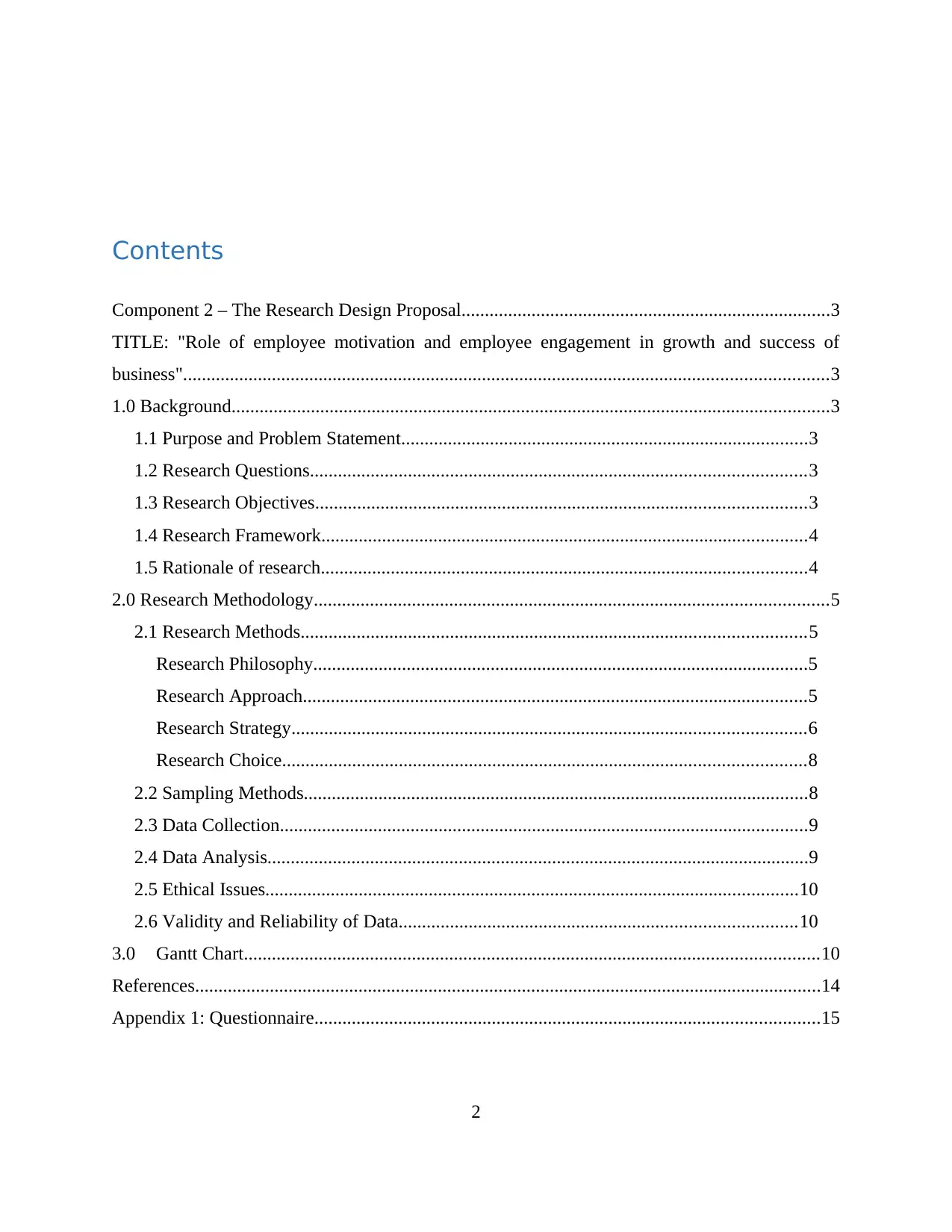
Component 2 – The Research Design Proposal...............................................................................3
TITLE: "Role of employee motivation and employee engagement in growth and success of
business"..........................................................................................................................................3
1.0 Background................................................................................................................................3
1.1 Purpose and Problem Statement.......................................................................................3
1.2 Research Questions..........................................................................................................3
1.3 Research Objectives.........................................................................................................3
1.4 Research Framework........................................................................................................4
1.5 Rationale of research........................................................................................................4
2.0 Research Methodology..............................................................................................................5
2.1 Research Methods............................................................................................................5
Research Philosophy..........................................................................................................5
Research Approach............................................................................................................5
Research Strategy..............................................................................................................6
Research Choice................................................................................................................8
2.2 Sampling Methods............................................................................................................8
2.3 Data Collection.................................................................................................................9
2.4 Data Analysis....................................................................................................................9
2.5 Ethical Issues..................................................................................................................10
2.6 Validity and Reliability of Data.....................................................................................10
3.0 Gantt Chart...........................................................................................................................10
References......................................................................................................................................14
Appendix 1: Questionnaire............................................................................................................15
2
Component 2 – The Research Design Proposal...............................................................................3
TITLE: "Role of employee motivation and employee engagement in growth and success of
business"..........................................................................................................................................3
1.0 Background................................................................................................................................3
1.1 Purpose and Problem Statement.......................................................................................3
1.2 Research Questions..........................................................................................................3
1.3 Research Objectives.........................................................................................................3
1.4 Research Framework........................................................................................................4
1.5 Rationale of research........................................................................................................4
2.0 Research Methodology..............................................................................................................5
2.1 Research Methods............................................................................................................5
Research Philosophy..........................................................................................................5
Research Approach............................................................................................................5
Research Strategy..............................................................................................................6
Research Choice................................................................................................................8
2.2 Sampling Methods............................................................................................................8
2.3 Data Collection.................................................................................................................9
2.4 Data Analysis....................................................................................................................9
2.5 Ethical Issues..................................................................................................................10
2.6 Validity and Reliability of Data.....................................................................................10
3.0 Gantt Chart...........................................................................................................................10
References......................................................................................................................................14
Appendix 1: Questionnaire............................................................................................................15
2

3
⊘ This is a preview!⊘
Do you want full access?
Subscribe today to unlock all pages.

Trusted by 1+ million students worldwide
Component 2 – The Research Design Proposal
TITLE: "Role of employee motivation and employee engagement in growth
and success of business".
1.0 Background
Employee motivation is a crucial aspect which help in keeping the employees satisfied in the
organisation. This provide significant benefits to organisation in terms of increasing employee
engagement, improve productivity, maximize growth and leads the organisation towards success.
Employee engagement is directly linked with the productivity and profit of company (Kuranchie-
Mensah, and Amponsah-Tawiah, 2016). Engaged employees are more satisfied and able to
perform in better manner in the workplace. Marks and Spencer is a British retailer which has its
headquarters in London, United Kingdom. The company was established in year 1884 and is
providing its products all over the world. Employee motivation and employee engagement plays
very significant role in company. Thus, the report emphasizes on assessing the role of employee
motivation and employee engagement in success and growth of business.
1.1 Purpose and Problem Statement
The purpose or problem statement of this research is “To assess the role of employee
motivation and employees’ engagement in success and growth of business organisation. A case
study on Marks & Spencer.”
1.2 Research Questions
The key questions associated with this investigation are as follows:
1. What is the key concept of employee motivation and employee engagement?
2. What are the various benefits of employee engagement for business organisation?
3. What is the role of employee motivation and engagement in growth and success of
business?
4. Which are the various ways to motivate employees and increase their engagement level
within firm?
1.3 Research Objectives
The main objectives associated with this research study are as follows:
4
TITLE: "Role of employee motivation and employee engagement in growth
and success of business".
1.0 Background
Employee motivation is a crucial aspect which help in keeping the employees satisfied in the
organisation. This provide significant benefits to organisation in terms of increasing employee
engagement, improve productivity, maximize growth and leads the organisation towards success.
Employee engagement is directly linked with the productivity and profit of company (Kuranchie-
Mensah, and Amponsah-Tawiah, 2016). Engaged employees are more satisfied and able to
perform in better manner in the workplace. Marks and Spencer is a British retailer which has its
headquarters in London, United Kingdom. The company was established in year 1884 and is
providing its products all over the world. Employee motivation and employee engagement plays
very significant role in company. Thus, the report emphasizes on assessing the role of employee
motivation and employee engagement in success and growth of business.
1.1 Purpose and Problem Statement
The purpose or problem statement of this research is “To assess the role of employee
motivation and employees’ engagement in success and growth of business organisation. A case
study on Marks & Spencer.”
1.2 Research Questions
The key questions associated with this investigation are as follows:
1. What is the key concept of employee motivation and employee engagement?
2. What are the various benefits of employee engagement for business organisation?
3. What is the role of employee motivation and engagement in growth and success of
business?
4. Which are the various ways to motivate employees and increase their engagement level
within firm?
1.3 Research Objectives
The main objectives associated with this research study are as follows:
4
Paraphrase This Document
Need a fresh take? Get an instant paraphrase of this document with our AI Paraphraser
1. To understand the key concept of employee motivation and employee engagement.
2. To determine the benefits of employee engagement for business organisation.
3. To analyse the role of employee motivation and engagement in growth and success of
business.
4. To identify various ways to motivate employees and increase their engagement level
within firm.
1.4 Research Framework
This research includes an introduction part which consist of background of research along
with problem statement, research questions and objectives. In addition to this, it includes review
of literatures in which view point of authors are compared on the research topic. Apart from this,
it includes rationale of research in which the reason of conducting the research is defined
(Mackey, and Gass, 2015). Apart from this, it includes different research methodologies which
involves research philosophy, approach, strategy of research, result choice, data collection
method and sampling. Data analysis and interpretation is done of the data which will collect
through questionnaire. After that, recommendation, reflection and conclusion are provided based
on the overall research.
1.5 Rationale of research
This research is based on “To assess the role of employee motivation and employees’
engagement in success and growth of business organisation. A case study on Marks & Spencer.”
The main reason behind conducting the research is that it helps in gaining knowledge about the
concept of employee motivation in employee engagement along with its role in success and
growth of company (Flick, 2015). it also helps in determining the benefits that employee
engagement bring for the business organisation. This research is highly significant for the
organisation as it assists in determining the ways through which employees can motivated. By
the help of this research, deep insight on the topic can be gain. This result also serves as a base
for performing future research on the topic.
5
2. To determine the benefits of employee engagement for business organisation.
3. To analyse the role of employee motivation and engagement in growth and success of
business.
4. To identify various ways to motivate employees and increase their engagement level
within firm.
1.4 Research Framework
This research includes an introduction part which consist of background of research along
with problem statement, research questions and objectives. In addition to this, it includes review
of literatures in which view point of authors are compared on the research topic. Apart from this,
it includes rationale of research in which the reason of conducting the research is defined
(Mackey, and Gass, 2015). Apart from this, it includes different research methodologies which
involves research philosophy, approach, strategy of research, result choice, data collection
method and sampling. Data analysis and interpretation is done of the data which will collect
through questionnaire. After that, recommendation, reflection and conclusion are provided based
on the overall research.
1.5 Rationale of research
This research is based on “To assess the role of employee motivation and employees’
engagement in success and growth of business organisation. A case study on Marks & Spencer.”
The main reason behind conducting the research is that it helps in gaining knowledge about the
concept of employee motivation in employee engagement along with its role in success and
growth of company (Flick, 2015). it also helps in determining the benefits that employee
engagement bring for the business organisation. This research is highly significant for the
organisation as it assists in determining the ways through which employees can motivated. By
the help of this research, deep insight on the topic can be gain. This result also serves as a base
for performing future research on the topic.
5
2.0 Research Methodology
2.1 Research Methods
Research methodology is defined as the specific procedures that are used to determine,
select and analyze information and data regarding topics. This section in research enable the
reader to evaluate the reliability and validity of overall study. There are two main questions of
which the research methodology section answers including how the data was collected and how
it was analyzed (Dumay, and Cai, 2015). Use of different methods help in performing the study
in most systematic and structured way. There are different methods including in research
methodology. These methods are discussed below:
Research Philosophy
Research philosophy is stated as the set of principles which are considered while the
research is performed. It is studied as epistemology and ontology. Epistemology is defined as the
valid information needed for investigation and the way an individual can obtain it whereas,
ontology is defined as authenticity of data or information and the way and individual understand
its existence. The philosophical positions utilized in research studies are often categorized into
interpretevism and positivism. The interpretivism study claims that each observer has his or her
own perception as well as understanding of reality and the positivism assume that of the subject
which is being studied, knowledge is independent (Dodds, and Hess, 2020). Thus, interpretivism
study is qualitative in nature whereas, positivism study is more scientific in nature as well as
outcomes in testing phenomena. In this study, positivism philosophy is considered as it comes up
with question and hypothesis of research that researcher can test and can find out the
explanations which measure accepted knowledge of world.
Research Approach
There are two approaches of research named as inductive and deductive approach.
Deductive approach initiates with development of specific hypothesis on the basis of review of
literature which have been observed through researcher and tries to test it if it holds specific
context. On the other hand, inductive approach initiates with such observations which researcher
used so as to create a new theory. This approach moves from specific to general and deductive
6
2.1 Research Methods
Research methodology is defined as the specific procedures that are used to determine,
select and analyze information and data regarding topics. This section in research enable the
reader to evaluate the reliability and validity of overall study. There are two main questions of
which the research methodology section answers including how the data was collected and how
it was analyzed (Dumay, and Cai, 2015). Use of different methods help in performing the study
in most systematic and structured way. There are different methods including in research
methodology. These methods are discussed below:
Research Philosophy
Research philosophy is stated as the set of principles which are considered while the
research is performed. It is studied as epistemology and ontology. Epistemology is defined as the
valid information needed for investigation and the way an individual can obtain it whereas,
ontology is defined as authenticity of data or information and the way and individual understand
its existence. The philosophical positions utilized in research studies are often categorized into
interpretevism and positivism. The interpretivism study claims that each observer has his or her
own perception as well as understanding of reality and the positivism assume that of the subject
which is being studied, knowledge is independent (Dodds, and Hess, 2020). Thus, interpretivism
study is qualitative in nature whereas, positivism study is more scientific in nature as well as
outcomes in testing phenomena. In this study, positivism philosophy is considered as it comes up
with question and hypothesis of research that researcher can test and can find out the
explanations which measure accepted knowledge of world.
Research Approach
There are two approaches of research named as inductive and deductive approach.
Deductive approach initiates with development of specific hypothesis on the basis of review of
literature which have been observed through researcher and tries to test it if it holds specific
context. On the other hand, inductive approach initiates with such observations which researcher
used so as to create a new theory. This approach moves from specific to general and deductive
6
⊘ This is a preview!⊘
Do you want full access?
Subscribe today to unlock all pages.
Trusted by 1+ million students worldwide
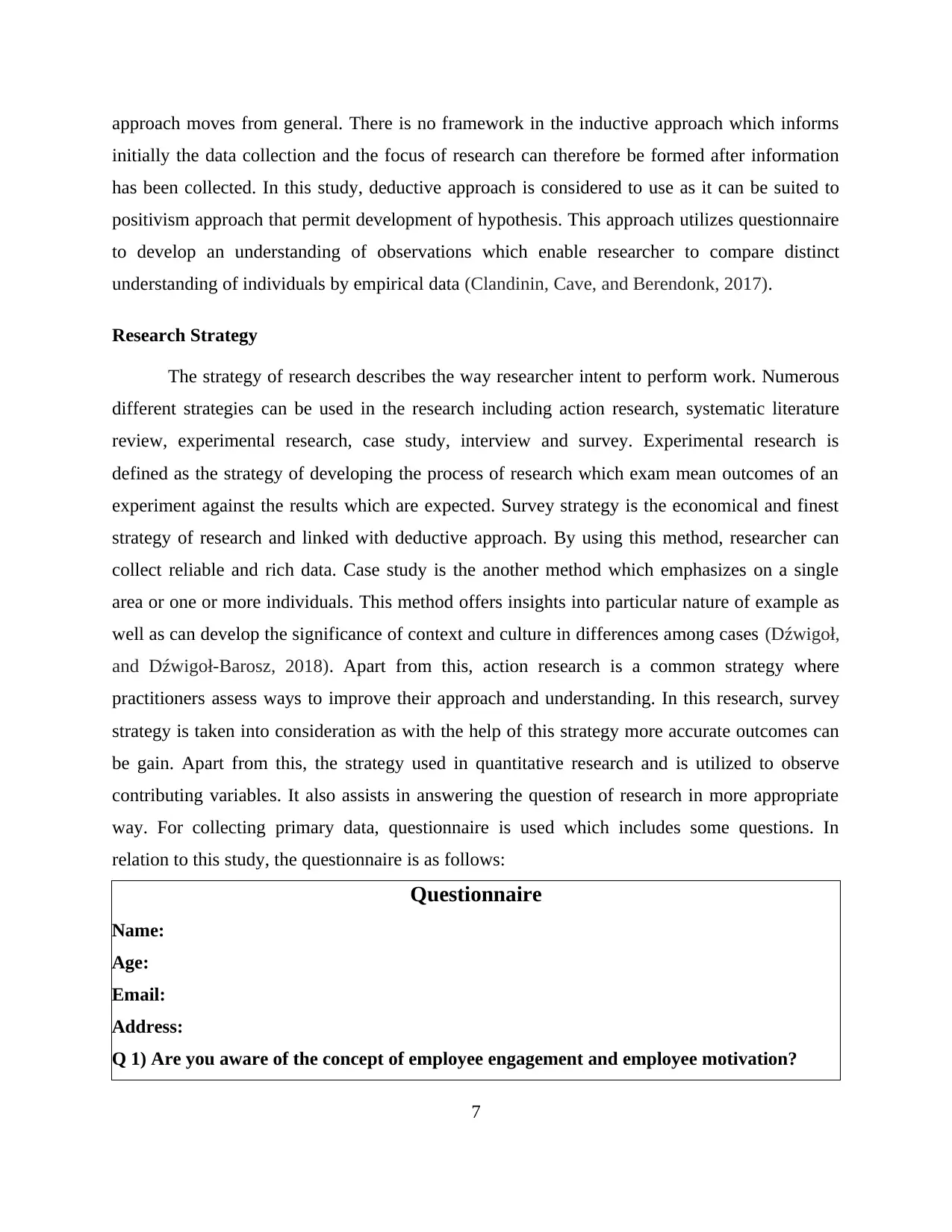
approach moves from general. There is no framework in the inductive approach which informs
initially the data collection and the focus of research can therefore be formed after information
has been collected. In this study, deductive approach is considered to use as it can be suited to
positivism approach that permit development of hypothesis. This approach utilizes questionnaire
to develop an understanding of observations which enable researcher to compare distinct
understanding of individuals by empirical data (Clandinin, Cave, and Berendonk, 2017).
Research Strategy
The strategy of research describes the way researcher intent to perform work. Numerous
different strategies can be used in the research including action research, systematic literature
review, experimental research, case study, interview and survey. Experimental research is
defined as the strategy of developing the process of research which exam mean outcomes of an
experiment against the results which are expected. Survey strategy is the economical and finest
strategy of research and linked with deductive approach. By using this method, researcher can
collect reliable and rich data. Case study is the another method which emphasizes on a single
area or one or more individuals. This method offers insights into particular nature of example as
well as can develop the significance of context and culture in differences among cases (Dźwigoł,
and Dźwigoł-Barosz, 2018). Apart from this, action research is a common strategy where
practitioners assess ways to improve their approach and understanding. In this research, survey
strategy is taken into consideration as with the help of this strategy more accurate outcomes can
be gain. Apart from this, the strategy used in quantitative research and is utilized to observe
contributing variables. It also assists in answering the question of research in more appropriate
way. For collecting primary data, questionnaire is used which includes some questions. In
relation to this study, the questionnaire is as follows:
Questionnaire
Name:
Age:
Email:
Address:
Q 1) Are you aware of the concept of employee engagement and employee motivation?
7
initially the data collection and the focus of research can therefore be formed after information
has been collected. In this study, deductive approach is considered to use as it can be suited to
positivism approach that permit development of hypothesis. This approach utilizes questionnaire
to develop an understanding of observations which enable researcher to compare distinct
understanding of individuals by empirical data (Clandinin, Cave, and Berendonk, 2017).
Research Strategy
The strategy of research describes the way researcher intent to perform work. Numerous
different strategies can be used in the research including action research, systematic literature
review, experimental research, case study, interview and survey. Experimental research is
defined as the strategy of developing the process of research which exam mean outcomes of an
experiment against the results which are expected. Survey strategy is the economical and finest
strategy of research and linked with deductive approach. By using this method, researcher can
collect reliable and rich data. Case study is the another method which emphasizes on a single
area or one or more individuals. This method offers insights into particular nature of example as
well as can develop the significance of context and culture in differences among cases (Dźwigoł,
and Dźwigoł-Barosz, 2018). Apart from this, action research is a common strategy where
practitioners assess ways to improve their approach and understanding. In this research, survey
strategy is taken into consideration as with the help of this strategy more accurate outcomes can
be gain. Apart from this, the strategy used in quantitative research and is utilized to observe
contributing variables. It also assists in answering the question of research in more appropriate
way. For collecting primary data, questionnaire is used which includes some questions. In
relation to this study, the questionnaire is as follows:
Questionnaire
Name:
Age:
Email:
Address:
Q 1) Are you aware of the concept of employee engagement and employee motivation?
7
Paraphrase This Document
Need a fresh take? Get an instant paraphrase of this document with our AI Paraphraser
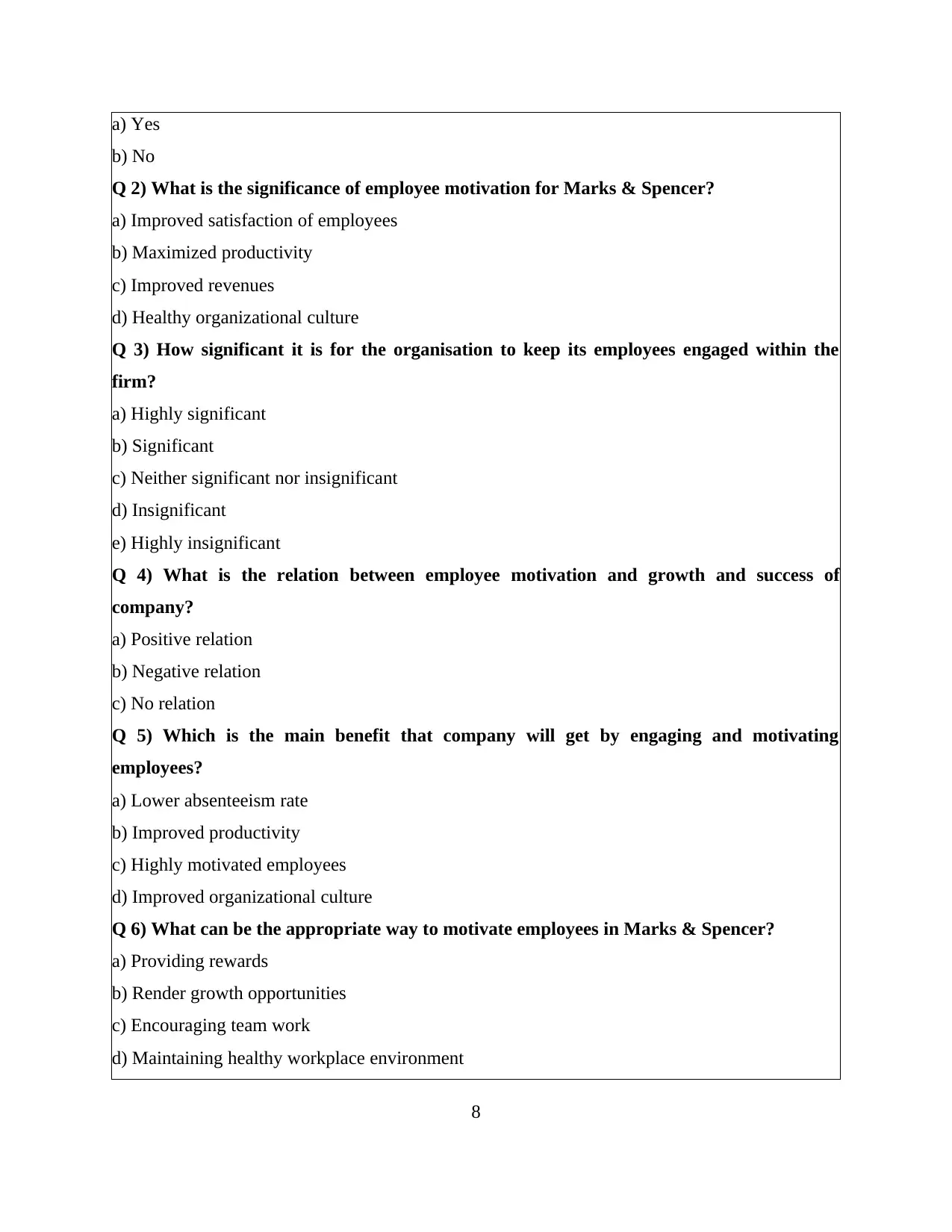
a) Yes
b) No
Q 2) What is the significance of employee motivation for Marks & Spencer?
a) Improved satisfaction of employees
b) Maximized productivity
c) Improved revenues
d) Healthy organizational culture
Q 3) How significant it is for the organisation to keep its employees engaged within the
firm?
a) Highly significant
b) Significant
c) Neither significant nor insignificant
d) Insignificant
e) Highly insignificant
Q 4) What is the relation between employee motivation and growth and success of
company?
a) Positive relation
b) Negative relation
c) No relation
Q 5) Which is the main benefit that company will get by engaging and motivating
employees?
a) Lower absenteeism rate
b) Improved productivity
c) Highly motivated employees
d) Improved organizational culture
Q 6) What can be the appropriate way to motivate employees in Marks & Spencer?
a) Providing rewards
b) Render growth opportunities
c) Encouraging team work
d) Maintaining healthy workplace environment
8
b) No
Q 2) What is the significance of employee motivation for Marks & Spencer?
a) Improved satisfaction of employees
b) Maximized productivity
c) Improved revenues
d) Healthy organizational culture
Q 3) How significant it is for the organisation to keep its employees engaged within the
firm?
a) Highly significant
b) Significant
c) Neither significant nor insignificant
d) Insignificant
e) Highly insignificant
Q 4) What is the relation between employee motivation and growth and success of
company?
a) Positive relation
b) Negative relation
c) No relation
Q 5) Which is the main benefit that company will get by engaging and motivating
employees?
a) Lower absenteeism rate
b) Improved productivity
c) Highly motivated employees
d) Improved organizational culture
Q 6) What can be the appropriate way to motivate employees in Marks & Spencer?
a) Providing rewards
b) Render growth opportunities
c) Encouraging team work
d) Maintaining healthy workplace environment
8
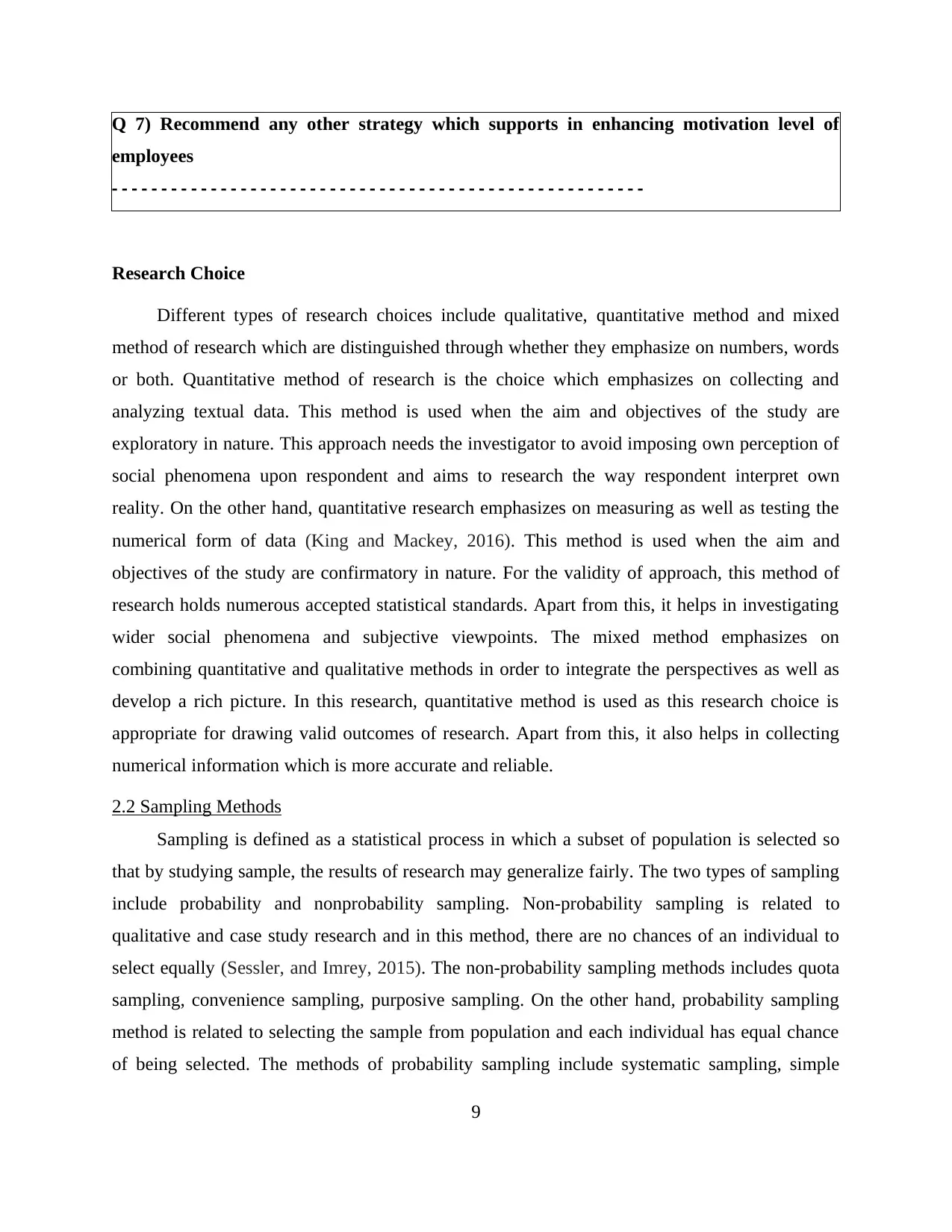
Q 7) Recommend any other strategy which supports in enhancing motivation level of
employees
- - - - - - - - - - - - - - - - - - - - - - - - - - - - - - - - - - - - - - - - - - - - - - - - - - - - - -
Research Choice
Different types of research choices include qualitative, quantitative method and mixed
method of research which are distinguished through whether they emphasize on numbers, words
or both. Quantitative method of research is the choice which emphasizes on collecting and
analyzing textual data. This method is used when the aim and objectives of the study are
exploratory in nature. This approach needs the investigator to avoid imposing own perception of
social phenomena upon respondent and aims to research the way respondent interpret own
reality. On the other hand, quantitative research emphasizes on measuring as well as testing the
numerical form of data (King and Mackey, 2016). This method is used when the aim and
objectives of the study are confirmatory in nature. For the validity of approach, this method of
research holds numerous accepted statistical standards. Apart from this, it helps in investigating
wider social phenomena and subjective viewpoints. The mixed method emphasizes on
combining quantitative and qualitative methods in order to integrate the perspectives as well as
develop a rich picture. In this research, quantitative method is used as this research choice is
appropriate for drawing valid outcomes of research. Apart from this, it also helps in collecting
numerical information which is more accurate and reliable.
2.2 Sampling Methods
Sampling is defined as a statistical process in which a subset of population is selected so
that by studying sample, the results of research may generalize fairly. The two types of sampling
include probability and nonprobability sampling. Non-probability sampling is related to
qualitative and case study research and in this method, there are no chances of an individual to
select equally (Sessler, and Imrey, 2015). The non-probability sampling methods includes quota
sampling, convenience sampling, purposive sampling. On the other hand, probability sampling
method is related to selecting the sample from population and each individual has equal chance
of being selected. The methods of probability sampling include systematic sampling, simple
9
employees
- - - - - - - - - - - - - - - - - - - - - - - - - - - - - - - - - - - - - - - - - - - - - - - - - - - - - -
Research Choice
Different types of research choices include qualitative, quantitative method and mixed
method of research which are distinguished through whether they emphasize on numbers, words
or both. Quantitative method of research is the choice which emphasizes on collecting and
analyzing textual data. This method is used when the aim and objectives of the study are
exploratory in nature. This approach needs the investigator to avoid imposing own perception of
social phenomena upon respondent and aims to research the way respondent interpret own
reality. On the other hand, quantitative research emphasizes on measuring as well as testing the
numerical form of data (King and Mackey, 2016). This method is used when the aim and
objectives of the study are confirmatory in nature. For the validity of approach, this method of
research holds numerous accepted statistical standards. Apart from this, it helps in investigating
wider social phenomena and subjective viewpoints. The mixed method emphasizes on
combining quantitative and qualitative methods in order to integrate the perspectives as well as
develop a rich picture. In this research, quantitative method is used as this research choice is
appropriate for drawing valid outcomes of research. Apart from this, it also helps in collecting
numerical information which is more accurate and reliable.
2.2 Sampling Methods
Sampling is defined as a statistical process in which a subset of population is selected so
that by studying sample, the results of research may generalize fairly. The two types of sampling
include probability and nonprobability sampling. Non-probability sampling is related to
qualitative and case study research and in this method, there are no chances of an individual to
select equally (Sessler, and Imrey, 2015). The non-probability sampling methods includes quota
sampling, convenience sampling, purposive sampling. On the other hand, probability sampling
method is related to selecting the sample from population and each individual has equal chance
of being selected. The methods of probability sampling include systematic sampling, simple
9
⊘ This is a preview!⊘
Do you want full access?
Subscribe today to unlock all pages.
Trusted by 1+ million students worldwide
random sampling, stratified random sampling, cluster sampling and systematic sampling. In this
research, simple random sampling method is used in which the respondents are selected
randomly from the entire population and individual has the equal chances of being selected. This
helps in eliminating the possibilities of biasness.
2.3 Data Collection
Data collection method is the way of collecting information by using relevant sources for
determining the solution to issue of study. Data is collected through two methods including
primary and secondary data collection. Primary data is obtained through observations,
experiments or survey and is first hand data. Primary data is often objective, authentic and
reliable. This is collected at real time and the investigator has complete control on data gathered
through primary investigation (Arantes do Amaral, dos Santos, and Rodrigues, 2018). On the
other hand, secondary data is collected through government publications, trade journals, public
records, articles, books etc. It is the data which is collected previously by the people and is
second hand data. The data can be accessible easily by the researcher as it is shared publicly.
Apart from this, secondary data can be collected in less time and assist in developing new
insights in primary data which is existing. In this research, both the methods are used as by the
help of this, the investigator is able to collect large amount of data which in turn help in gaining
accurate outcomes of the research.
2.4 Data Analysis
The method of data analysis can be grouped as per whether the research is quantitative or
qualitative. The main methods of analyzing the qualitative research data involves grounded
theory, narrative analysis, qualitative content analysis, IPA and discourse analysis. On the other
hand, in the quantitative research, the method of data analysis includes descriptive statistics and
inferential statistics. In this research, quantitative analysis method is used as it provides
researcher with tools to examine as well as analyze the data. Apart from this, this helps in
analyzing in depth data and there are less chances to biasness. In addition to this, from
quantitative analysis, the obtained results are objective in nature so these are extremely accurate
(Farooq, and O'Brien, 2015).
10
research, simple random sampling method is used in which the respondents are selected
randomly from the entire population and individual has the equal chances of being selected. This
helps in eliminating the possibilities of biasness.
2.3 Data Collection
Data collection method is the way of collecting information by using relevant sources for
determining the solution to issue of study. Data is collected through two methods including
primary and secondary data collection. Primary data is obtained through observations,
experiments or survey and is first hand data. Primary data is often objective, authentic and
reliable. This is collected at real time and the investigator has complete control on data gathered
through primary investigation (Arantes do Amaral, dos Santos, and Rodrigues, 2018). On the
other hand, secondary data is collected through government publications, trade journals, public
records, articles, books etc. It is the data which is collected previously by the people and is
second hand data. The data can be accessible easily by the researcher as it is shared publicly.
Apart from this, secondary data can be collected in less time and assist in developing new
insights in primary data which is existing. In this research, both the methods are used as by the
help of this, the investigator is able to collect large amount of data which in turn help in gaining
accurate outcomes of the research.
2.4 Data Analysis
The method of data analysis can be grouped as per whether the research is quantitative or
qualitative. The main methods of analyzing the qualitative research data involves grounded
theory, narrative analysis, qualitative content analysis, IPA and discourse analysis. On the other
hand, in the quantitative research, the method of data analysis includes descriptive statistics and
inferential statistics. In this research, quantitative analysis method is used as it provides
researcher with tools to examine as well as analyze the data. Apart from this, this helps in
analyzing in depth data and there are less chances to biasness. In addition to this, from
quantitative analysis, the obtained results are objective in nature so these are extremely accurate
(Farooq, and O'Brien, 2015).
10
Paraphrase This Document
Need a fresh take? Get an instant paraphrase of this document with our AI Paraphraser
2.5 Ethical Issues
Ethics involves the set of rules which govern the behavior of own as well as others. In
context of research, the ethics governs the way research is being performed. Research ethics
promote aim of study and support the values needed for collaborative working like fairness
mutual respect. The issues associated with the research study includes maintaining privacy and
confidentiality of data. While performing the study, research needs to ensure that privacy is
maintained and the data will be kept confidential so that it cannot be accessed by a third party
(Park, 2017). The objectivity of research also needs to be maintained and research need to
emphasize on avoiding biasness in any aspect of study including interpretation and analysis,
design of research etc. At the time of collecting samples, it is crucial to ensure that no biasness
takes place. In addition to this, researcher must take informed consent from all the participants of
research prior to perform the study. The participants should be made aware about their
withdrawal from research. The researcher need to provide the respondents with the option that
they can withdraw their consent anytime from the research.
2.6 Validity and Reliability of Data
Validity and reliability in research are the concepts which are used to assess the quality of
study. They depict how well a test; technique or method measures something. The validity of
research is all about accuracy of measure and reliability is regarding consistency of measure.
While performing the research, it is crucial to consider validity and reliability aspects by the
researcher at the time of planning the methods, research design and writing outcomes (Nakata,
2015). If the validity of research is high, then It loves outcomes which correspond to real
variations, characteristics and properties. This particular research is highly valid and reliable as
the methods used in the research are reliable which help in ensuring validity of research.
11
Ethics involves the set of rules which govern the behavior of own as well as others. In
context of research, the ethics governs the way research is being performed. Research ethics
promote aim of study and support the values needed for collaborative working like fairness
mutual respect. The issues associated with the research study includes maintaining privacy and
confidentiality of data. While performing the study, research needs to ensure that privacy is
maintained and the data will be kept confidential so that it cannot be accessed by a third party
(Park, 2017). The objectivity of research also needs to be maintained and research need to
emphasize on avoiding biasness in any aspect of study including interpretation and analysis,
design of research etc. At the time of collecting samples, it is crucial to ensure that no biasness
takes place. In addition to this, researcher must take informed consent from all the participants of
research prior to perform the study. The participants should be made aware about their
withdrawal from research. The researcher need to provide the respondents with the option that
they can withdraw their consent anytime from the research.
2.6 Validity and Reliability of Data
Validity and reliability in research are the concepts which are used to assess the quality of
study. They depict how well a test; technique or method measures something. The validity of
research is all about accuracy of measure and reliability is regarding consistency of measure.
While performing the research, it is crucial to consider validity and reliability aspects by the
researcher at the time of planning the methods, research design and writing outcomes (Nakata,
2015). If the validity of research is high, then It loves outcomes which correspond to real
variations, characteristics and properties. This particular research is highly valid and reliable as
the methods used in the research are reliable which help in ensuring validity of research.
11
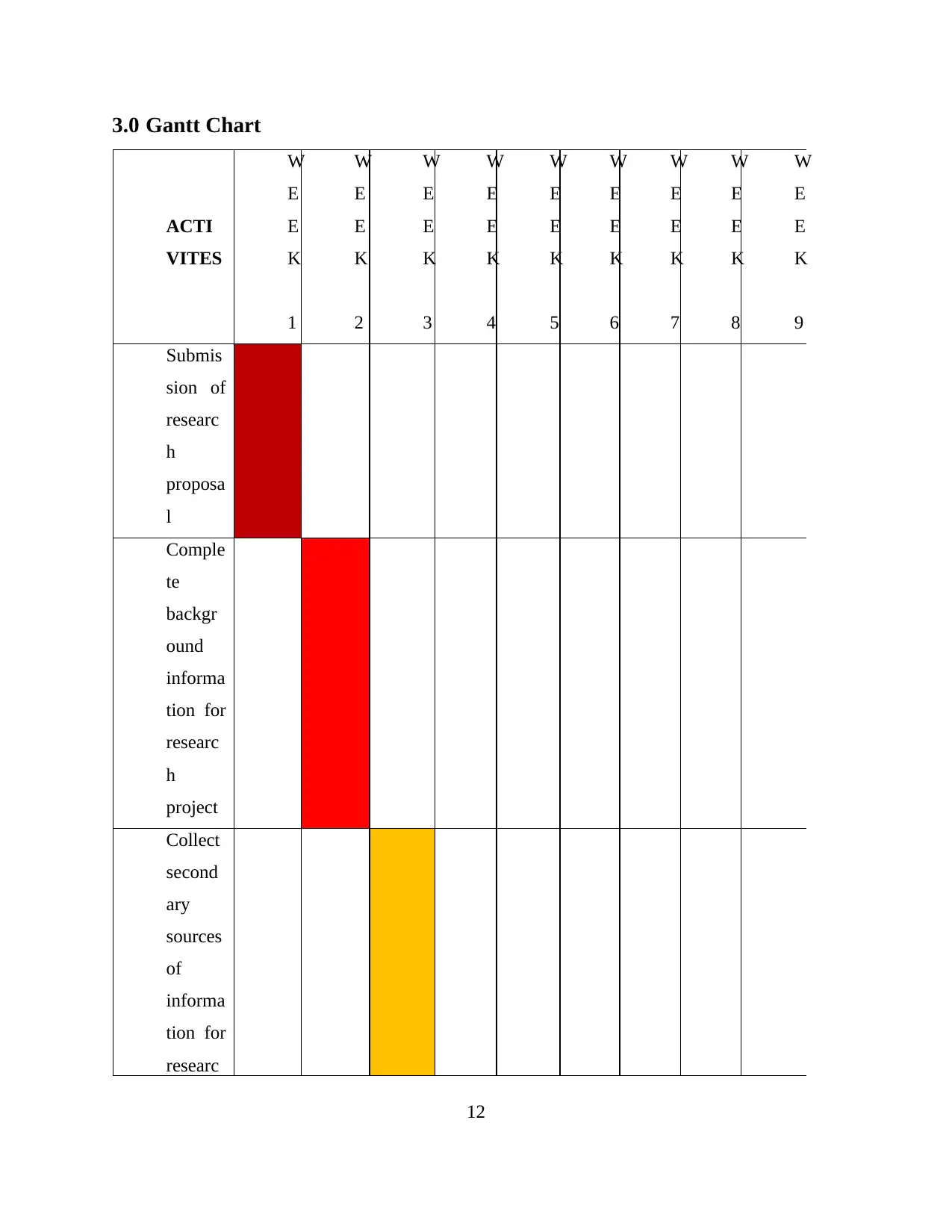
3.0 Gantt Chart
ACTI
VITES
W
E
E
K
1
W
E
E
K
2
W
E
E
K
3
W
E
E
K
4
W
E
E
K
5
W
E
E
K
6
W
E
E
K
7
W
E
E
K
8
W
E
E
K
9
Submis
sion of
researc
h
proposa
l
Comple
te
backgr
ound
informa
tion for
researc
h
project
Collect
second
ary
sources
of
informa
tion for
researc
12
ACTI
VITES
W
E
E
K
1
W
E
E
K
2
W
E
E
K
3
W
E
E
K
4
W
E
E
K
5
W
E
E
K
6
W
E
E
K
7
W
E
E
K
8
W
E
E
K
9
Submis
sion of
researc
h
proposa
l
Comple
te
backgr
ound
informa
tion for
researc
h
project
Collect
second
ary
sources
of
informa
tion for
researc
12
⊘ This is a preview!⊘
Do you want full access?
Subscribe today to unlock all pages.
Trusted by 1+ million students worldwide

1 out of 17


Related Documents


Your All-in-One AI-Powered Toolkit for Academic Success.
+13062052269
info@desklib.com
Available 24*7 on WhatsApp / Email
![[object Object]](/_next/static/media/star-bottom.7253800d.svg)
Unlock your academic potential
Copyright © 2020–2026 A2Z Services. All Rights Reserved. Developed and managed by ZUCOL.