Research: Employee Motivation in Customer Service at Lidl Romania
VerifiedAdded on 2023/06/12
|13
|2710
|360
Project
AI Summary
This research proposal investigates the level of employee motivation in customer service within multinational companies, focusing on Lidl's operations in Romania. It aims to examine and analyze the current motivation levels, and subsequently, provide recommendations for best practices. The methodology employs a deductive approach with a survey strategy, utilizing quantitative methods and primary data collection through questionnaires from 30 Lidl Romania employees. Ethical considerations are addressed to ensure participant well-being and data integrity. The expected outcome is the development of a motivational strategy that fosters high levels of energy, enthusiasm, and dedication among the workforce, ultimately improving customer service and contributing to the company's long-term goals. The research acknowledges limitations such as limited resources and time management challenges.
RESEARCH PROPOSAL
(Motivation of employees in customer
service within multinational
companies in Romania)
(Motivation of employees in customer
service within multinational
companies in Romania)

Paraphrase This Document
Need a fresh take? Get an instant paraphrase of this document with our AI Paraphraser
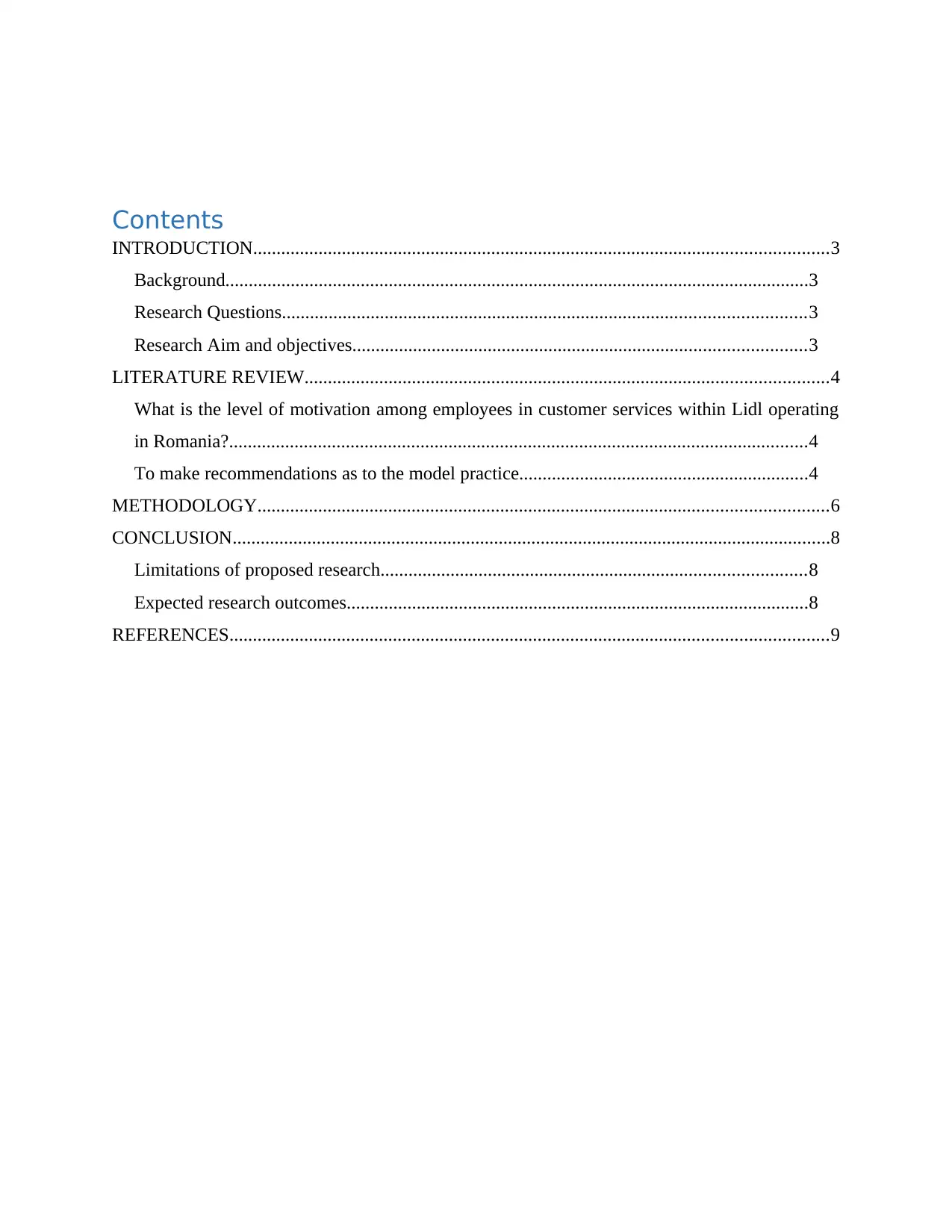
Contents
INTRODUCTION...........................................................................................................................3
Background.............................................................................................................................3
Research Questions................................................................................................................3
Research Aim and objectives.................................................................................................3
LITERATURE REVIEW................................................................................................................4
What is the level of motivation among employees in customer services within Lidl operating
in Romania?............................................................................................................................4
To make recommendations as to the model practice..............................................................4
METHODOLOGY..........................................................................................................................6
CONCLUSION................................................................................................................................8
Limitations of proposed research...........................................................................................8
Expected research outcomes...................................................................................................8
REFERENCES................................................................................................................................9
INTRODUCTION...........................................................................................................................3
Background.............................................................................................................................3
Research Questions................................................................................................................3
Research Aim and objectives.................................................................................................3
LITERATURE REVIEW................................................................................................................4
What is the level of motivation among employees in customer services within Lidl operating
in Romania?............................................................................................................................4
To make recommendations as to the model practice..............................................................4
METHODOLOGY..........................................................................................................................6
CONCLUSION................................................................................................................................8
Limitations of proposed research...........................................................................................8
Expected research outcomes...................................................................................................8
REFERENCES................................................................................................................................9
INTRODUCTION
Background
In an organisation, employees are the individuals who hold great significance because they
are responsible for doing activities (Alsuwaidi and et. al., 2020). Companies use method of
motivation for encouraging employees so that they can perform their assigned duties in an
effective and efficient manner. Customer service is an important activity for the success and
development of a business and for this companies appreciate and motivate workforce so that they
can put great efforts in providing great services to customers (Xu and Wang, 2020). Therefore,
the existing investigation carries out the role played by motivation in providing customer
services within multinational company operating in Romania.
Research Questions
What is the level of motivation among employees in the customer services within Lidl
operating in Romania?
Research Aim and objectives
Research Aim
To investigate the level of motivation of employees in customer services within
multinational companies’ in Romania. A study on Lidl operating in Romania
Research Objectives
To examine and analyse the level of motivation among employees in customer services
within Lidl operating in Romania
To make recommendations as to the model practice
Background
In an organisation, employees are the individuals who hold great significance because they
are responsible for doing activities (Alsuwaidi and et. al., 2020). Companies use method of
motivation for encouraging employees so that they can perform their assigned duties in an
effective and efficient manner. Customer service is an important activity for the success and
development of a business and for this companies appreciate and motivate workforce so that they
can put great efforts in providing great services to customers (Xu and Wang, 2020). Therefore,
the existing investigation carries out the role played by motivation in providing customer
services within multinational company operating in Romania.
Research Questions
What is the level of motivation among employees in the customer services within Lidl
operating in Romania?
Research Aim and objectives
Research Aim
To investigate the level of motivation of employees in customer services within
multinational companies’ in Romania. A study on Lidl operating in Romania
Research Objectives
To examine and analyse the level of motivation among employees in customer services
within Lidl operating in Romania
To make recommendations as to the model practice
⊘ This is a preview!⊘
Do you want full access?
Subscribe today to unlock all pages.

Trusted by 1+ million students worldwide
LITERATURE REVIEW
Literature review is the second chapter of the research which contain past published
information about the chosen topic. This section helps the researcher to gain deeper
understanding about the topic in order to enhance knowledge. It contain the secondary
information from various second hand sources some of them are books, magazine, articles,
website and many more.
What is the level of motivation among employees in customer services within Lidl operating in
Romania?
As per the view of Setiyani and et. al., (2019), high level of motivation is required among
the workforce of the Lidl in order to operate the business in Romania. Employees are the biggest
assets of the organisation because the actual working is done by them without employee no
organisation can operate their function in effective and efficient manner. Customers are the
biggest stakeholder as they make a final consumption of the goods and services provided by the
organisation. Providing the best customer service is a vital activity which is needed to be done by
the employee and if employee motivation is low then they cannot satisfy the buyers as per their
expectation which affect the reputation of the company (Johnson, Park and Bartlett, 2018). If the
morale of the employee in Lidl will be high then various benefits can be obtained by them in
perspective to customer which are as follow;
Higher productivity level: If the employee in Romania works with more energy and dedication
then they can match the demand and supply chain which helps them to satisfy the need and
customer of the buyers in wider manner Potipiroon and Srisuthisa-ard Faerman, (2019).
Competitive edge: High quality of motivation among employee will helps in providing sound
customer service which assist them to gain competitive advantage from the rivalry. Motivated
employee will understand the need of the buyers in Romania and will try to serve them in the
best possible manner.
To make recommendations as to the model practice
As per the view of Kauppila, (2018), it is highly recommended to the organisation to use
best motivational strategy in order to boost the morale of the employee. If organisation adopts
the strategy of employee motivation in their company then they will improve their organisational
performance as well as also assist in enhancing their market reputation and image. To boost the
Literature review is the second chapter of the research which contain past published
information about the chosen topic. This section helps the researcher to gain deeper
understanding about the topic in order to enhance knowledge. It contain the secondary
information from various second hand sources some of them are books, magazine, articles,
website and many more.
What is the level of motivation among employees in customer services within Lidl operating in
Romania?
As per the view of Setiyani and et. al., (2019), high level of motivation is required among
the workforce of the Lidl in order to operate the business in Romania. Employees are the biggest
assets of the organisation because the actual working is done by them without employee no
organisation can operate their function in effective and efficient manner. Customers are the
biggest stakeholder as they make a final consumption of the goods and services provided by the
organisation. Providing the best customer service is a vital activity which is needed to be done by
the employee and if employee motivation is low then they cannot satisfy the buyers as per their
expectation which affect the reputation of the company (Johnson, Park and Bartlett, 2018). If the
morale of the employee in Lidl will be high then various benefits can be obtained by them in
perspective to customer which are as follow;
Higher productivity level: If the employee in Romania works with more energy and dedication
then they can match the demand and supply chain which helps them to satisfy the need and
customer of the buyers in wider manner Potipiroon and Srisuthisa-ard Faerman, (2019).
Competitive edge: High quality of motivation among employee will helps in providing sound
customer service which assist them to gain competitive advantage from the rivalry. Motivated
employee will understand the need of the buyers in Romania and will try to serve them in the
best possible manner.
To make recommendations as to the model practice
As per the view of Kauppila, (2018), it is highly recommended to the organisation to use
best motivational strategy in order to boost the morale of the employee. If organisation adopts
the strategy of employee motivation in their company then they will improve their organisational
performance as well as also assist in enhancing their market reputation and image. To boost the
Paraphrase This Document
Need a fresh take? Get an instant paraphrase of this document with our AI Paraphraser

motivation of the employee company can develop a employee incentive program were they can
pay high wages to their employee, appreciate their workers by providing rewards and benefit and
many more. It is very important for Lidl to use this model so that they can serve their customer in
Romania in more effective manner.
pay high wages to their employee, appreciate their workers by providing rewards and benefit and
many more. It is very important for Lidl to use this model so that they can serve their customer in
Romania in more effective manner.
METHODOLOGY
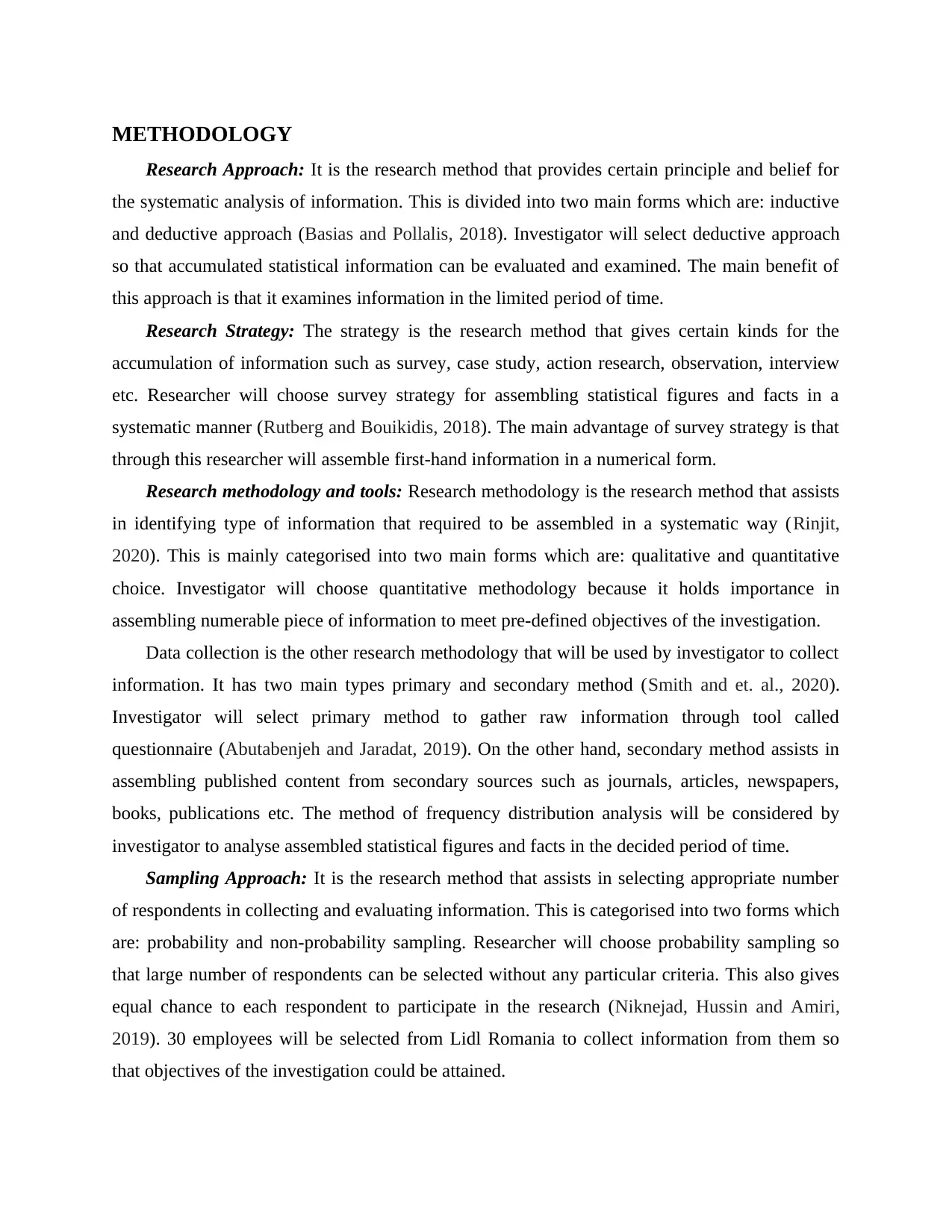
Research Approach: It is the research method that provides certain principle and belief for
the systematic analysis of information. This is divided into two main forms which are: inductive
and deductive approach (Basias and Pollalis, 2018). Investigator will select deductive approach
so that accumulated statistical information can be evaluated and examined. The main benefit of
this approach is that it examines information in the limited period of time.
Research Strategy: The strategy is the research method that gives certain kinds for the
accumulation of information such as survey, case study, action research, observation, interview
etc. Researcher will choose survey strategy for assembling statistical figures and facts in a
systematic manner (Rutberg and Bouikidis, 2018). The main advantage of survey strategy is that
through this researcher will assemble first-hand information in a numerical form.
Research methodology and tools: Research methodology is the research method that assists
in identifying type of information that required to be assembled in a systematic way (Rinjit,
2020). This is mainly categorised into two main forms which are: qualitative and quantitative
choice. Investigator will choose quantitative methodology because it holds importance in
assembling numerable piece of information to meet pre-defined objectives of the investigation.
Data collection is the other research methodology that will be used by investigator to collect
information. It has two main types primary and secondary method (Smith and et. al., 2020).
Investigator will select primary method to gather raw information through tool called
questionnaire (Abutabenjeh and Jaradat, 2019). On the other hand, secondary method assists in
assembling published content from secondary sources such as journals, articles, newspapers,
books, publications etc. The method of frequency distribution analysis will be considered by
investigator to analyse assembled statistical figures and facts in the decided period of time.
Sampling Approach: It is the research method that assists in selecting appropriate number
of respondents in collecting and evaluating information. This is categorised into two forms which
are: probability and non-probability sampling. Researcher will choose probability sampling so
that large number of respondents can be selected without any particular criteria. This also gives
equal chance to each respondent to participate in the research (Niknejad, Hussin and Amiri,
2019). 30 employees will be selected from Lidl Romania to collect information from them so
that objectives of the investigation could be attained.
Research Approach: It is the research method that provides certain principle and belief for
the systematic analysis of information. This is divided into two main forms which are: inductive
and deductive approach (Basias and Pollalis, 2018). Investigator will select deductive approach
so that accumulated statistical information can be evaluated and examined. The main benefit of
this approach is that it examines information in the limited period of time.
Research Strategy: The strategy is the research method that gives certain kinds for the
accumulation of information such as survey, case study, action research, observation, interview
etc. Researcher will choose survey strategy for assembling statistical figures and facts in a
systematic manner (Rutberg and Bouikidis, 2018). The main advantage of survey strategy is that
through this researcher will assemble first-hand information in a numerical form.
Research methodology and tools: Research methodology is the research method that assists
in identifying type of information that required to be assembled in a systematic way (Rinjit,
2020). This is mainly categorised into two main forms which are: qualitative and quantitative
choice. Investigator will choose quantitative methodology because it holds importance in
assembling numerable piece of information to meet pre-defined objectives of the investigation.
Data collection is the other research methodology that will be used by investigator to collect
information. It has two main types primary and secondary method (Smith and et. al., 2020).
Investigator will select primary method to gather raw information through tool called
questionnaire (Abutabenjeh and Jaradat, 2019). On the other hand, secondary method assists in
assembling published content from secondary sources such as journals, articles, newspapers,
books, publications etc. The method of frequency distribution analysis will be considered by
investigator to analyse assembled statistical figures and facts in the decided period of time.
Sampling Approach: It is the research method that assists in selecting appropriate number
of respondents in collecting and evaluating information. This is categorised into two forms which
are: probability and non-probability sampling. Researcher will choose probability sampling so
that large number of respondents can be selected without any particular criteria. This also gives
equal chance to each respondent to participate in the research (Niknejad, Hussin and Amiri,
2019). 30 employees will be selected from Lidl Romania to collect information from them so
that objectives of the investigation could be attained.
⊘ This is a preview!⊘
Do you want full access?
Subscribe today to unlock all pages.
Trusted by 1+ million students worldwide

Ethical Considerations: Ethics are the significant element while conducting investigation
because it assists in making investigation more relevant, accurate and reliable (Bauer and
Scheim, 2019). Some of the ethical principles followed by investigator are: decreasing the risk of
harm, getting informed consent, protecting confidentiality and anonymity, giving the right to
withdraw to every participant and avoiding deceptive practices.
because it assists in making investigation more relevant, accurate and reliable (Bauer and
Scheim, 2019). Some of the ethical principles followed by investigator are: decreasing the risk of
harm, getting informed consent, protecting confidentiality and anonymity, giving the right to
withdraw to every participant and avoiding deceptive practices.
Paraphrase This Document
Need a fresh take? Get an instant paraphrase of this document with our AI Paraphraser
CONCLUSION
Limitations of proposed research
The major limitation of the above research is limited resource to conduct the investigation
in systematic manner. The foremost problem that is faced is lack of detailed knowledge about the
study so to attain the answer first there is need to study various resources. The other problem is
allocating the time to each and every activity. Time management is the biggest problem in the
above investigation.
Expected research outcomes
From the above gathered data it is concluded that employee motivation is very important in
the organisation in order to provide better customer service. Employee motivation is very
important aspect of the business as it helps in improving the market image which indirectly
assists in attracting more new buyers for the company. The expected research outcome is to
develop that motivational strategy in the organisation which aids in building high level of
energy, enthusiasm and dedication among the workforce to attain long tern gaol in valuable
manner.
Limitations of proposed research
The major limitation of the above research is limited resource to conduct the investigation
in systematic manner. The foremost problem that is faced is lack of detailed knowledge about the
study so to attain the answer first there is need to study various resources. The other problem is
allocating the time to each and every activity. Time management is the biggest problem in the
above investigation.
Expected research outcomes
From the above gathered data it is concluded that employee motivation is very important in
the organisation in order to provide better customer service. Employee motivation is very
important aspect of the business as it helps in improving the market image which indirectly
assists in attracting more new buyers for the company. The expected research outcome is to
develop that motivational strategy in the organisation which aids in building high level of
energy, enthusiasm and dedication among the workforce to attain long tern gaol in valuable
manner.
REFERENCES
Books and Journals
Abutabenjeh, S. and Jaradat, R., 2018. Clarification of research design, research methods, and
research methodology: A guide for public administration researchers and
practitioners. Teaching Public Administration, 36(3), pp.237-258.
Alsuwaidi and et. al., 2020, October. Performance appraisal on employees’ motivation: A
comprehensive analysis. In International Conference on Advanced Intelligent Systems and
Informatics (pp. 681-693). Springer, Cham.
Basias, N. and Pollalis, Y., 2018. Quantitative and qualitative research in business & technology:
Justifying a suitable research methodology. Review of Integrative Business and Economics
Research, 7, pp.91-105.
Bauer, G.R. and Scheim, A.I., 2019. Methods for analytic intercategorical intersectionality in
quantitative research: discrimination as a mediator of health inequalities. Social Science &
Medicine, 226, pp.236-245.
Johnson, K.R., Park, S. and Bartlett, K.R., 2018. Perceptions of customer service orientation,
training, and employee engagement in Jamaica’s hospitality sector. European Journal of
Training and Development.
Kauppila, O.P., 2018. How does it feel and how does it look? The role of employee motivation in
organizational learning type. Journal of Organizational Behavior, 39(8), pp.941-955.
Niknejad, N., Hussin, A.R.C. and Amiri, I.S., 2019. Quantitative Research Methodology for
Service-Oriented Architecture (SOA) Adoption in Organizations. In The Impact of Service
Oriented Architecture Adoption on Organizations (pp. 43-51). Springer, Cham.
Potipiroon W, Srisuthisa-ard A, Faerman S. Public service motivation and customer service
behaviour: Testing the mediating role of emotional labour and the moderating role of
gender. Public Management Review. 2019 May 4;21(5):650-68.
Rinjit, K., 2020. Research methodology.
Rutberg, S. and Bouikidis, C.D., 2018. Focusing on the fundamentals: A simplistic
differentiation between qualitative and quantitative research. Nephrology Nursing
Journal, 45(2), pp.209-213.
Setiyani and et. al., 2019. The effect of work environment on flexible working hours, employee
engagement and employee motivation. International Review of Management and
Marketing, 9(3), p.112.
Smith and et. al., 2020. Evolution of methodology and reporting of emergency medicine
quantitative research over a 20-year period. Emergency Medicine Journal, 37(6), pp.324-
329.
Xu, F.Z. and Wang, Y., 2020. Enhancing employee innovation through customer engagement:
The role of customer interactivity, employee affect, and motivations. Journal of
Hospitality & Tourism Research, 44(2), pp.351-376.
Books and Journals
Abutabenjeh, S. and Jaradat, R., 2018. Clarification of research design, research methods, and
research methodology: A guide for public administration researchers and
practitioners. Teaching Public Administration, 36(3), pp.237-258.
Alsuwaidi and et. al., 2020, October. Performance appraisal on employees’ motivation: A
comprehensive analysis. In International Conference on Advanced Intelligent Systems and
Informatics (pp. 681-693). Springer, Cham.
Basias, N. and Pollalis, Y., 2018. Quantitative and qualitative research in business & technology:
Justifying a suitable research methodology. Review of Integrative Business and Economics
Research, 7, pp.91-105.
Bauer, G.R. and Scheim, A.I., 2019. Methods for analytic intercategorical intersectionality in
quantitative research: discrimination as a mediator of health inequalities. Social Science &
Medicine, 226, pp.236-245.
Johnson, K.R., Park, S. and Bartlett, K.R., 2018. Perceptions of customer service orientation,
training, and employee engagement in Jamaica’s hospitality sector. European Journal of
Training and Development.
Kauppila, O.P., 2018. How does it feel and how does it look? The role of employee motivation in
organizational learning type. Journal of Organizational Behavior, 39(8), pp.941-955.
Niknejad, N., Hussin, A.R.C. and Amiri, I.S., 2019. Quantitative Research Methodology for
Service-Oriented Architecture (SOA) Adoption in Organizations. In The Impact of Service
Oriented Architecture Adoption on Organizations (pp. 43-51). Springer, Cham.
Potipiroon W, Srisuthisa-ard A, Faerman S. Public service motivation and customer service
behaviour: Testing the mediating role of emotional labour and the moderating role of
gender. Public Management Review. 2019 May 4;21(5):650-68.
Rinjit, K., 2020. Research methodology.
Rutberg, S. and Bouikidis, C.D., 2018. Focusing on the fundamentals: A simplistic
differentiation between qualitative and quantitative research. Nephrology Nursing
Journal, 45(2), pp.209-213.
Setiyani and et. al., 2019. The effect of work environment on flexible working hours, employee
engagement and employee motivation. International Review of Management and
Marketing, 9(3), p.112.
Smith and et. al., 2020. Evolution of methodology and reporting of emergency medicine
quantitative research over a 20-year period. Emergency Medicine Journal, 37(6), pp.324-
329.
Xu, F.Z. and Wang, Y., 2020. Enhancing employee innovation through customer engagement:
The role of customer interactivity, employee affect, and motivations. Journal of
Hospitality & Tourism Research, 44(2), pp.351-376.
⊘ This is a preview!⊘
Do you want full access?
Subscribe today to unlock all pages.
Trusted by 1+ million students worldwide
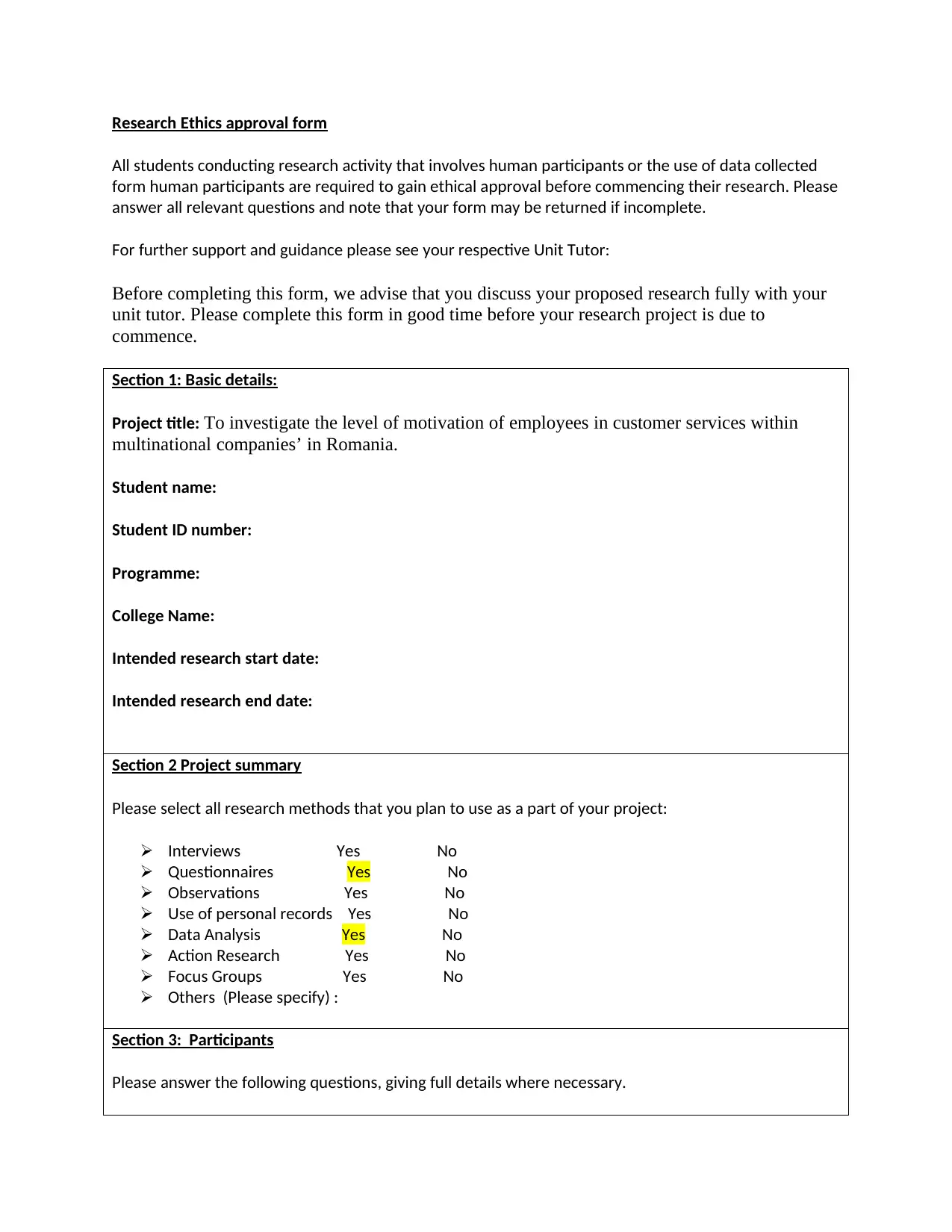
Research Ethics approval form
All students conducting research activity that involves human participants or the use of data collected
form human participants are required to gain ethical approval before commencing their research. Please
answer all relevant questions and note that your form may be returned if incomplete.
For further support and guidance please see your respective Unit Tutor:
Before completing this form, we advise that you discuss your proposed research fully with your
unit tutor. Please complete this form in good time before your research project is due to
commence.
Section 1: Basic details:
Project title: To investigate the level of motivation of employees in customer services within
multinational companies’ in Romania.
Student name:
Student ID number:
Programme:
College Name:
Intended research start date:
Intended research end date:
Section 2 Project summary
Please select all research methods that you plan to use as a part of your project:
Interviews Yes No
Questionnaires Yes No
Observations Yes No
Use of personal records Yes No
Data Analysis Yes No
Action Research Yes No
Focus Groups Yes No
Others (Please specify) :
Section 3: Participants
Please answer the following questions, giving full details where necessary.
All students conducting research activity that involves human participants or the use of data collected
form human participants are required to gain ethical approval before commencing their research. Please
answer all relevant questions and note that your form may be returned if incomplete.
For further support and guidance please see your respective Unit Tutor:
Before completing this form, we advise that you discuss your proposed research fully with your
unit tutor. Please complete this form in good time before your research project is due to
commence.
Section 1: Basic details:
Project title: To investigate the level of motivation of employees in customer services within
multinational companies’ in Romania.
Student name:
Student ID number:
Programme:
College Name:
Intended research start date:
Intended research end date:
Section 2 Project summary
Please select all research methods that you plan to use as a part of your project:
Interviews Yes No
Questionnaires Yes No
Observations Yes No
Use of personal records Yes No
Data Analysis Yes No
Action Research Yes No
Focus Groups Yes No
Others (Please specify) :
Section 3: Participants
Please answer the following questions, giving full details where necessary.
Paraphrase This Document
Need a fresh take? Get an instant paraphrase of this document with our AI Paraphraser
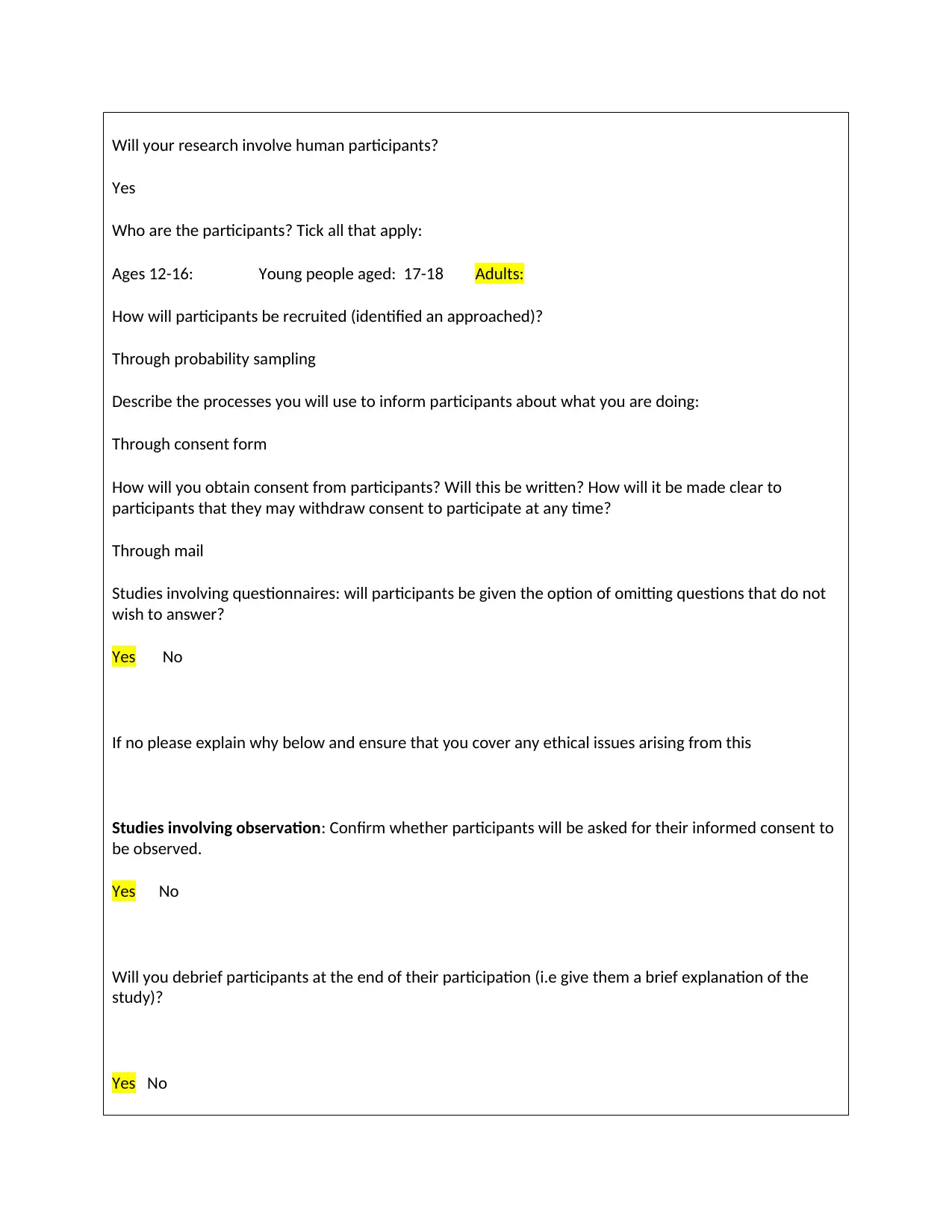
Will your research involve human participants?
Yes
Who are the participants? Tick all that apply:
Ages 12-16: Young people aged: 17-18 Adults:
How will participants be recruited (identified an approached)?
Through probability sampling
Describe the processes you will use to inform participants about what you are doing:
Through consent form
How will you obtain consent from participants? Will this be written? How will it be made clear to
participants that they may withdraw consent to participate at any time?
Through mail
Studies involving questionnaires: will participants be given the option of omitting questions that do not
wish to answer?
Yes No
If no please explain why below and ensure that you cover any ethical issues arising from this
Studies involving observation: Confirm whether participants will be asked for their informed consent to
be observed.
Yes No
Will you debrief participants at the end of their participation (i.e give them a brief explanation of the
study)?
Yes No
Yes
Who are the participants? Tick all that apply:
Ages 12-16: Young people aged: 17-18 Adults:
How will participants be recruited (identified an approached)?
Through probability sampling
Describe the processes you will use to inform participants about what you are doing:
Through consent form
How will you obtain consent from participants? Will this be written? How will it be made clear to
participants that they may withdraw consent to participate at any time?
Through mail
Studies involving questionnaires: will participants be given the option of omitting questions that do not
wish to answer?
Yes No
If no please explain why below and ensure that you cover any ethical issues arising from this
Studies involving observation: Confirm whether participants will be asked for their informed consent to
be observed.
Yes No
Will you debrief participants at the end of their participation (i.e give them a brief explanation of the
study)?
Yes No
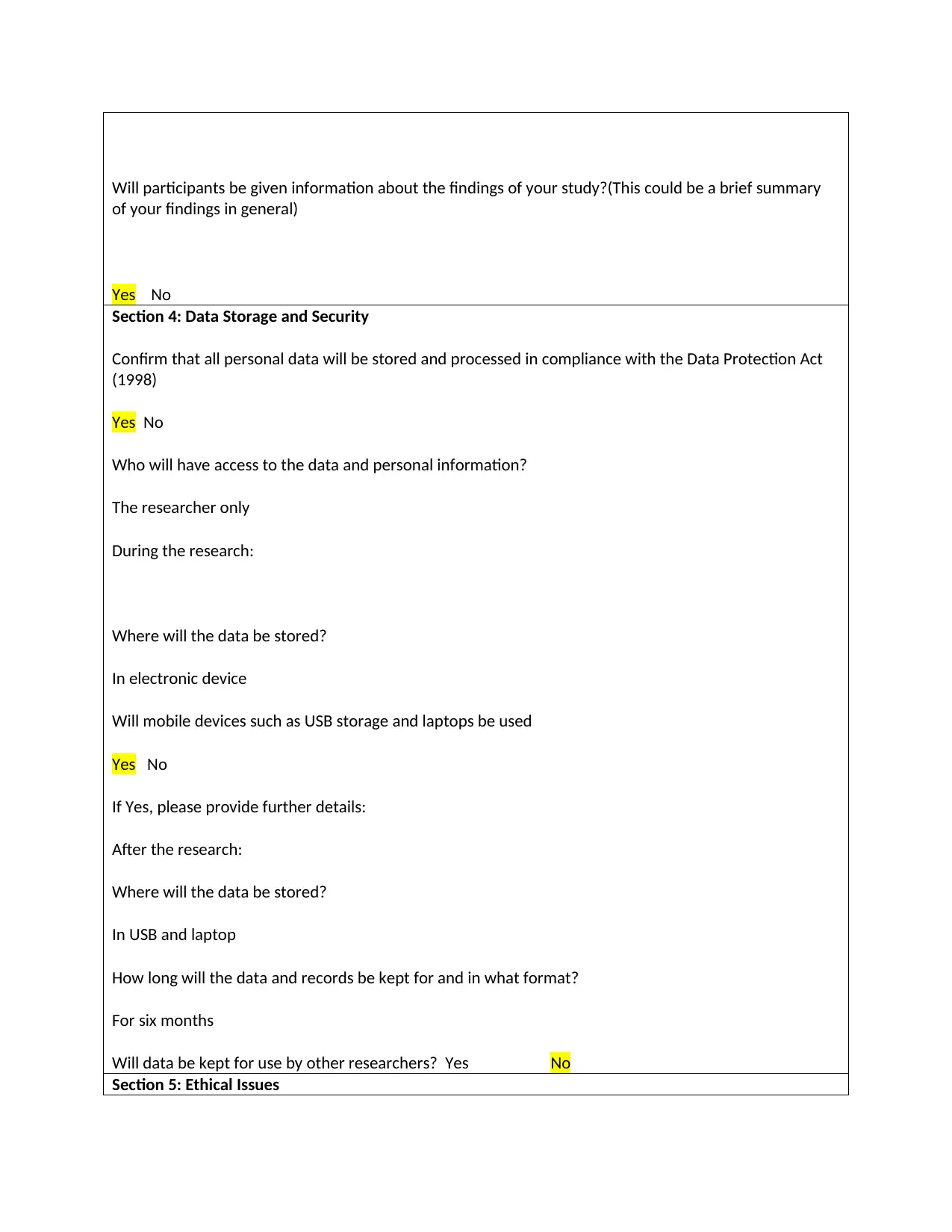
Will participants be given information about the findings of your study?(This could be a brief summary
of your findings in general)
Yes No
Section 4: Data Storage and Security
Confirm that all personal data will be stored and processed in compliance with the Data Protection Act
(1998)
Yes No
Who will have access to the data and personal information?
The researcher only
During the research:
Where will the data be stored?
In electronic device
Will mobile devices such as USB storage and laptops be used
Yes No
If Yes, please provide further details:
After the research:
Where will the data be stored?
In USB and laptop
How long will the data and records be kept for and in what format?
For six months
Will data be kept for use by other researchers? Yes No
Section 5: Ethical Issues
of your findings in general)
Yes No
Section 4: Data Storage and Security
Confirm that all personal data will be stored and processed in compliance with the Data Protection Act
(1998)
Yes No
Who will have access to the data and personal information?
The researcher only
During the research:
Where will the data be stored?
In electronic device
Will mobile devices such as USB storage and laptops be used
Yes No
If Yes, please provide further details:
After the research:
Where will the data be stored?
In USB and laptop
How long will the data and records be kept for and in what format?
For six months
Will data be kept for use by other researchers? Yes No
Section 5: Ethical Issues
⊘ This is a preview!⊘
Do you want full access?
Subscribe today to unlock all pages.
Trusted by 1+ million students worldwide

1 out of 13


Related Documents


Your All-in-One AI-Powered Toolkit for Academic Success.
+13062052269
info@desklib.com
Available 24*7 on WhatsApp / Email
![[object Object]](/_next/static/media/star-bottom.7253800d.svg)
Unlock your academic potential
Copyright © 2020–2026 A2Z Services. All Rights Reserved. Developed and managed by ZUCOL.