Impact of Employee Motivation on Knowledge Management: A Report
VerifiedAdded on 2020/06/06
|9
|2353
|62
Report
AI Summary
This report investigates the impact of employee motivation on an organization's knowledge management practices, focusing on the airline industry with a case study of Alitalia Airline. The study explores the relationship between employee motivation and knowledge management, aiming to evaluate how motivation influences knowledge sharing, organizational capabilities, job satisfaction, and commitment. The report outlines the problem statement, research aims, objectives, and research questions, alongside a theoretical framework. It examines the factors influencing employee willingness to share knowledge, the contribution of knowledge management to organizational capabilities, and the impact of motivational tools on employees. The research also addresses the significance of knowledge management and employee motivation, discussing assumptions, limitations, and the scope of the study. The findings emphasize the importance of motivation for improving organizational performance, and the report suggests strategies for enhancing knowledge management practices through employee engagement and commitment.

Chapter 1

Paraphrase This Document
Need a fresh take? Get an instant paraphrase of this document with our AI Paraphraser
Abstract
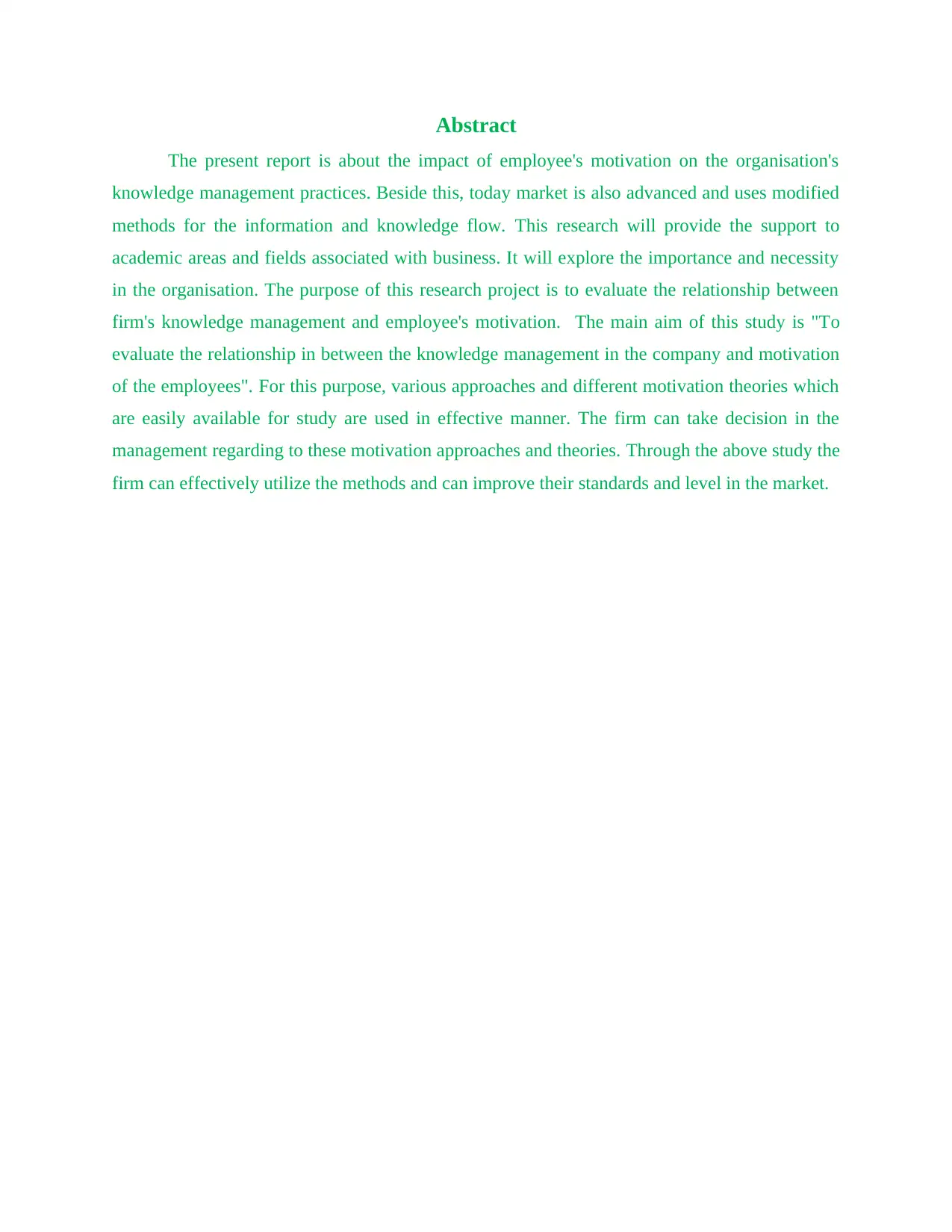
The present report is about the impact of employee's motivation on the organisation's
knowledge management practices. Beside this, today market is also advanced and uses modified
methods for the information and knowledge flow. This research will provide the support to
academic areas and fields associated with business. It will explore the importance and necessity
in the organisation. The purpose of this research project is to evaluate the relationship between
firm's knowledge management and employee's motivation. The main aim of this study is "To
evaluate the relationship in between the knowledge management in the company and motivation
of the employees". For this purpose, various approaches and different motivation theories which
are easily available for study are used in effective manner. The firm can take decision in the
management regarding to these motivation approaches and theories. Through the above study the
firm can effectively utilize the methods and can improve their standards and level in the market.
The present report is about the impact of employee's motivation on the organisation's
knowledge management practices. Beside this, today market is also advanced and uses modified
methods for the information and knowledge flow. This research will provide the support to
academic areas and fields associated with business. It will explore the importance and necessity
in the organisation. The purpose of this research project is to evaluate the relationship between
firm's knowledge management and employee's motivation. The main aim of this study is "To
evaluate the relationship in between the knowledge management in the company and motivation
of the employees". For this purpose, various approaches and different motivation theories which
are easily available for study are used in effective manner. The firm can take decision in the
management regarding to these motivation approaches and theories. Through the above study the
firm can effectively utilize the methods and can improve their standards and level in the market.
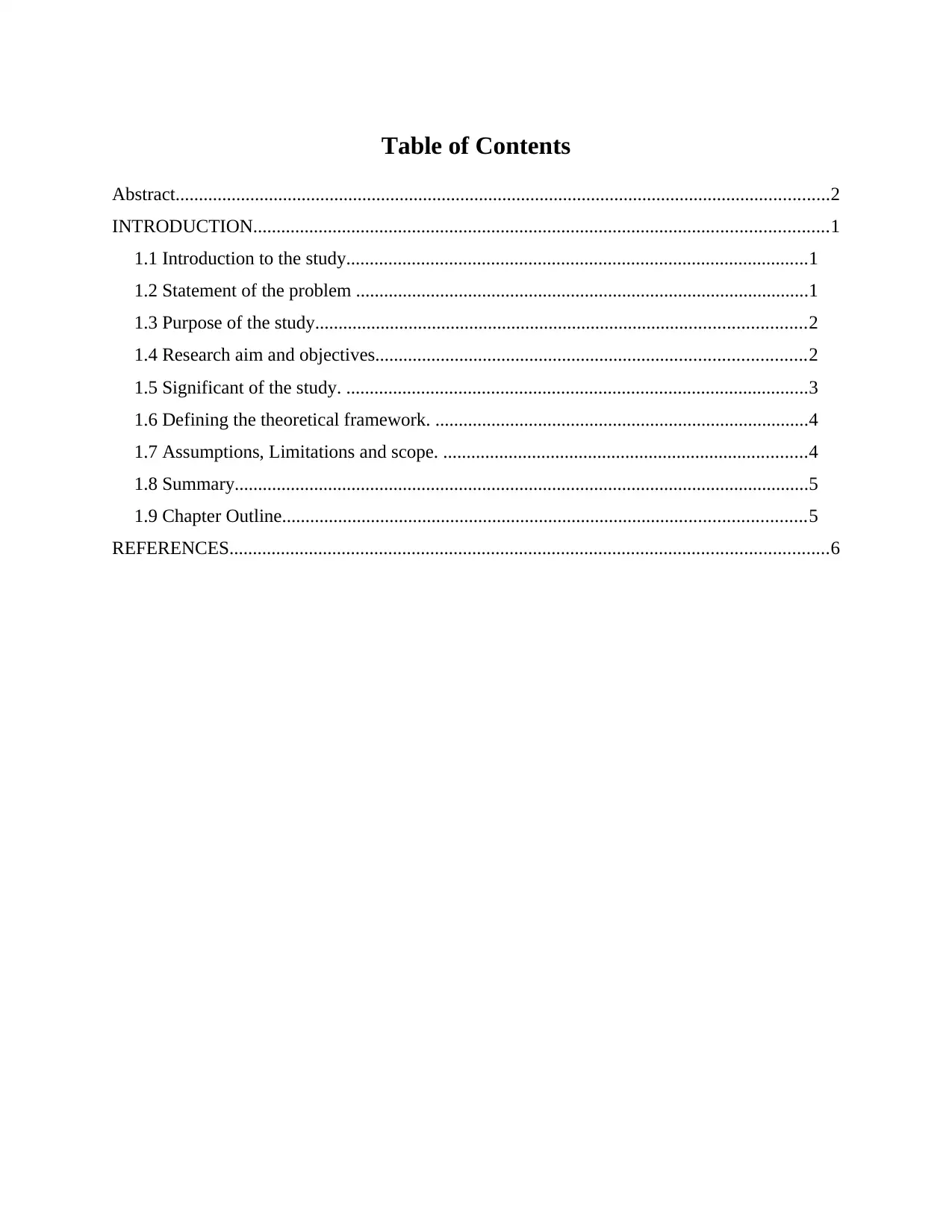
Table of Contents
Abstract............................................................................................................................................2
INTRODUCTION...........................................................................................................................1
1.1 Introduction to the study...................................................................................................1
1.2 Statement of the problem .................................................................................................1
1.3 Purpose of the study.........................................................................................................2
1.4 Research aim and objectives............................................................................................2
1.5 Significant of the study. ...................................................................................................3
1.6 Defining the theoretical framework. ................................................................................4
1.7 Assumptions, Limitations and scope. ..............................................................................4
1.8 Summary...........................................................................................................................5
1.9 Chapter Outline................................................................................................................5
REFERENCES................................................................................................................................6
Abstract............................................................................................................................................2
INTRODUCTION...........................................................................................................................1
1.1 Introduction to the study...................................................................................................1
1.2 Statement of the problem .................................................................................................1
1.3 Purpose of the study.........................................................................................................2
1.4 Research aim and objectives............................................................................................2
1.5 Significant of the study. ...................................................................................................3
1.6 Defining the theoretical framework. ................................................................................4
1.7 Assumptions, Limitations and scope. ..............................................................................4
1.8 Summary...........................................................................................................................5
1.9 Chapter Outline................................................................................................................5
REFERENCES................................................................................................................................6
⊘ This is a preview!⊘
Do you want full access?
Subscribe today to unlock all pages.

Trusted by 1+ million students worldwide
INTRODUCTION
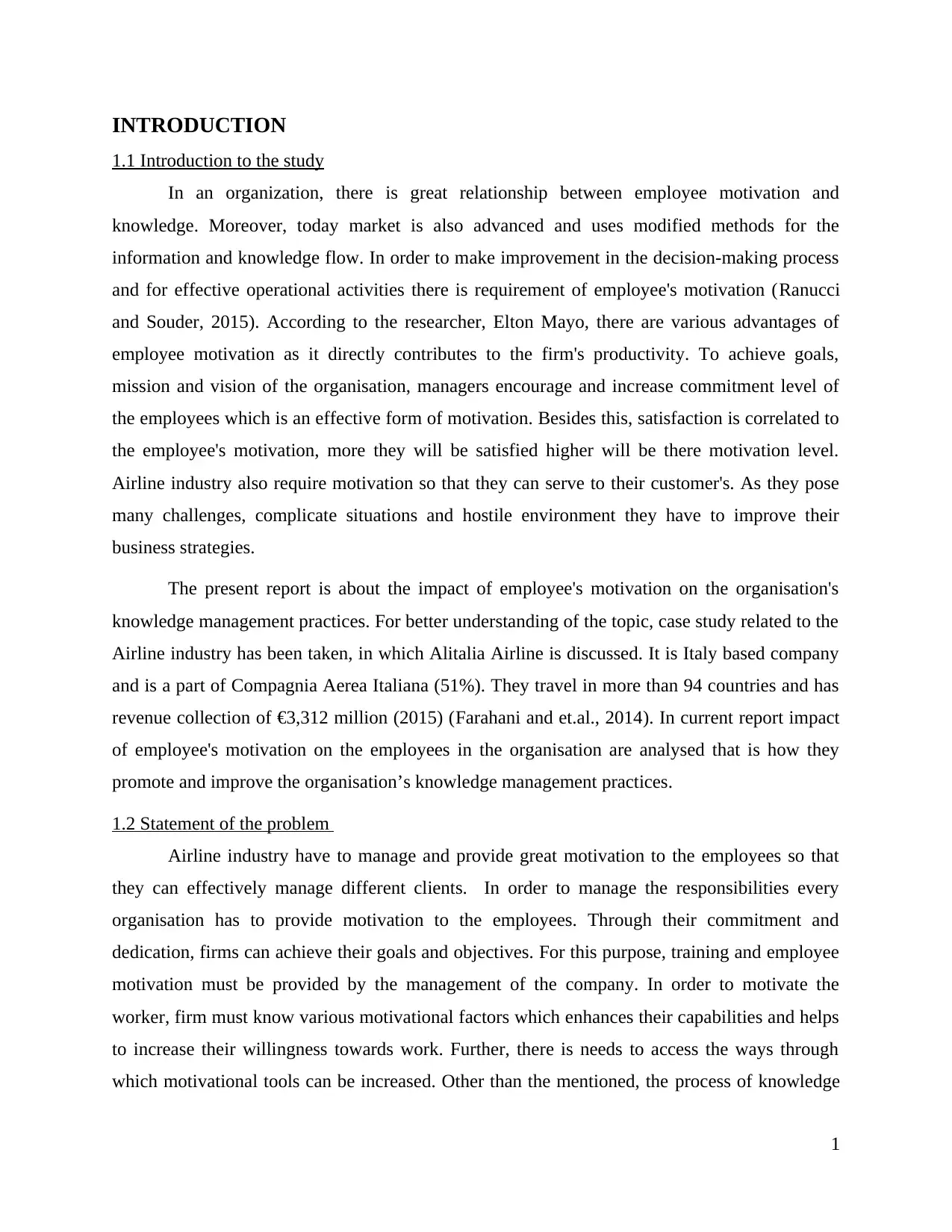
1.1 Introduction to the study
In an organization, there is great relationship between employee motivation and
knowledge. Moreover, today market is also advanced and uses modified methods for the
information and knowledge flow. In order to make improvement in the decision-making process
and for effective operational activities there is requirement of employee's motivation (Ranucci
and Souder, 2015). According to the researcher, Elton Mayo, there are various advantages of
employee motivation as it directly contributes to the firm's productivity. To achieve goals,
mission and vision of the organisation, managers encourage and increase commitment level of
the employees which is an effective form of motivation. Besides this, satisfaction is correlated to
the employee's motivation, more they will be satisfied higher will be there motivation level.
Airline industry also require motivation so that they can serve to their customer's. As they pose
many challenges, complicate situations and hostile environment they have to improve their
business strategies.
The present report is about the impact of employee's motivation on the organisation's
knowledge management practices. For better understanding of the topic, case study related to the
Airline industry has been taken, in which Alitalia Airline is discussed. It is Italy based company
and is a part of Compagnia Aerea Italiana (51%). They travel in more than 94 countries and has
revenue collection of €3,312 million (2015) (Farahani and et.al., 2014). In current report impact
of employee's motivation on the employees in the organisation are analysed that is how they
promote and improve the organisation’s knowledge management practices.
1.2 Statement of the problem
Airline industry have to manage and provide great motivation to the employees so that
they can effectively manage different clients. In order to manage the responsibilities every
organisation has to provide motivation to the employees. Through their commitment and
dedication, firms can achieve their goals and objectives. For this purpose, training and employee
motivation must be provided by the management of the company. In order to motivate the
worker, firm must know various motivational factors which enhances their capabilities and helps
to increase their willingness towards work. Further, there is needs to access the ways through
which motivational tools can be increased. Other than the mentioned, the process of knowledge
1
1.1 Introduction to the study
In an organization, there is great relationship between employee motivation and
knowledge. Moreover, today market is also advanced and uses modified methods for the
information and knowledge flow. In order to make improvement in the decision-making process
and for effective operational activities there is requirement of employee's motivation (Ranucci
and Souder, 2015). According to the researcher, Elton Mayo, there are various advantages of
employee motivation as it directly contributes to the firm's productivity. To achieve goals,
mission and vision of the organisation, managers encourage and increase commitment level of
the employees which is an effective form of motivation. Besides this, satisfaction is correlated to
the employee's motivation, more they will be satisfied higher will be there motivation level.
Airline industry also require motivation so that they can serve to their customer's. As they pose
many challenges, complicate situations and hostile environment they have to improve their
business strategies.
The present report is about the impact of employee's motivation on the organisation's
knowledge management practices. For better understanding of the topic, case study related to the
Airline industry has been taken, in which Alitalia Airline is discussed. It is Italy based company
and is a part of Compagnia Aerea Italiana (51%). They travel in more than 94 countries and has
revenue collection of €3,312 million (2015) (Farahani and et.al., 2014). In current report impact
of employee's motivation on the employees in the organisation are analysed that is how they
promote and improve the organisation’s knowledge management practices.
1.2 Statement of the problem
Airline industry have to manage and provide great motivation to the employees so that
they can effectively manage different clients. In order to manage the responsibilities every
organisation has to provide motivation to the employees. Through their commitment and
dedication, firms can achieve their goals and objectives. For this purpose, training and employee
motivation must be provided by the management of the company. In order to motivate the
worker, firm must know various motivational factors which enhances their capabilities and helps
to increase their willingness towards work. Further, there is needs to access the ways through
which motivational tools can be increased. Other than the mentioned, the process of knowledge
1
Paraphrase This Document
Need a fresh take? Get an instant paraphrase of this document with our AI Paraphraser
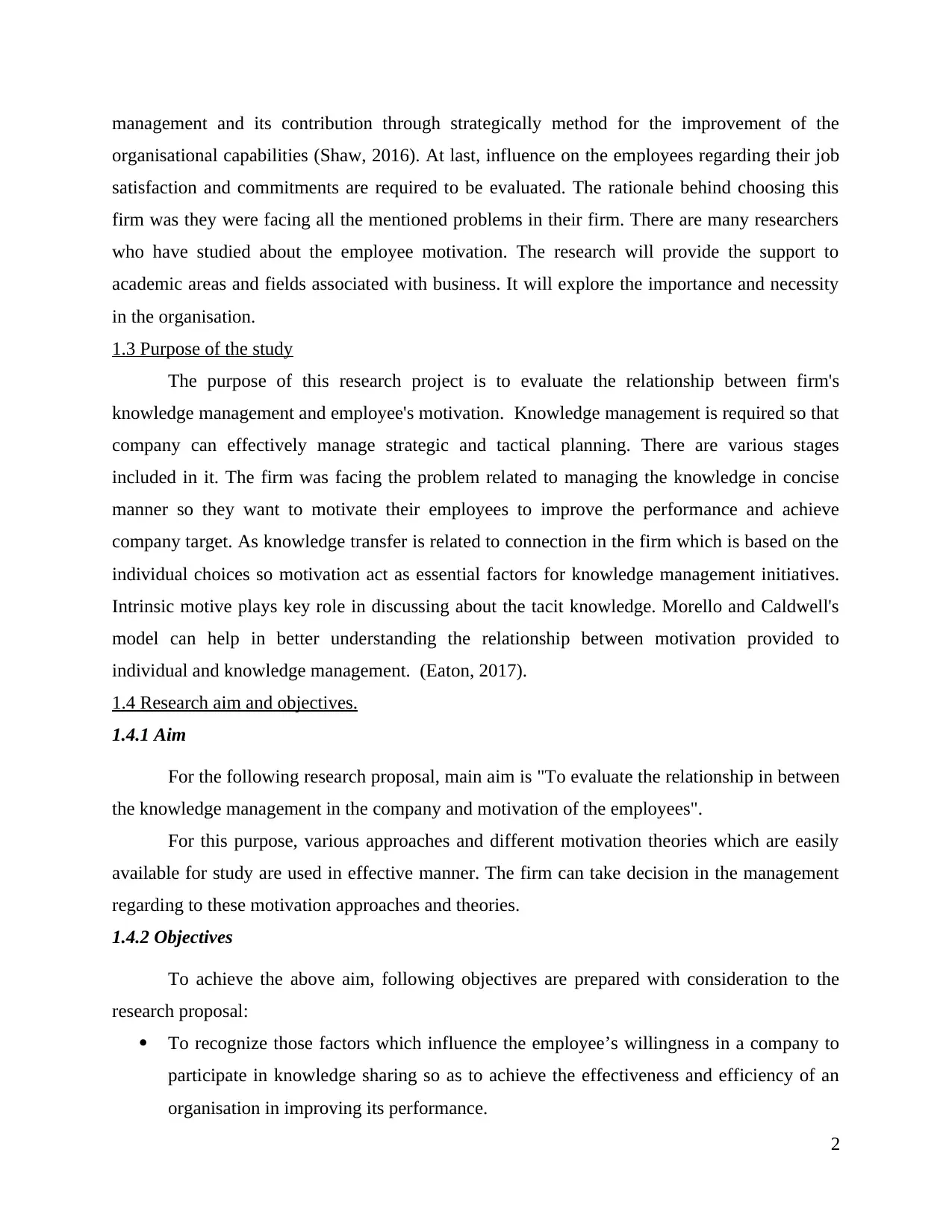
management and its contribution through strategically method for the improvement of the
organisational capabilities (Shaw, 2016). At last, influence on the employees regarding their job
satisfaction and commitments are required to be evaluated. The rationale behind choosing this
firm was they were facing all the mentioned problems in their firm. There are many researchers
who have studied about the employee motivation. The research will provide the support to
academic areas and fields associated with business. It will explore the importance and necessity
in the organisation.
1.3 Purpose of the study
The purpose of this research project is to evaluate the relationship between firm's
knowledge management and employee's motivation. Knowledge management is required so that
company can effectively manage strategic and tactical planning. There are various stages
included in it. The firm was facing the problem related to managing the knowledge in concise
manner so they want to motivate their employees to improve the performance and achieve
company target. As knowledge transfer is related to connection in the firm which is based on the
individual choices so motivation act as essential factors for knowledge management initiatives.
Intrinsic motive plays key role in discussing about the tacit knowledge. Morello and Caldwell's
model can help in better understanding the relationship between motivation provided to
individual and knowledge management. (Eaton, 2017).
1.4 Research aim and objectives.
1.4.1 Aim
For the following research proposal, main aim is "To evaluate the relationship in between
the knowledge management in the company and motivation of the employees".
For this purpose, various approaches and different motivation theories which are easily
available for study are used in effective manner. The firm can take decision in the management
regarding to these motivation approaches and theories.
1.4.2 Objectives
To achieve the above aim, following objectives are prepared with consideration to the
research proposal:
To recognize those factors which influence the employee’s willingness in a company to
participate in knowledge sharing so as to achieve the effectiveness and efficiency of an
organisation in improving its performance.
2
organisational capabilities (Shaw, 2016). At last, influence on the employees regarding their job
satisfaction and commitments are required to be evaluated. The rationale behind choosing this
firm was they were facing all the mentioned problems in their firm. There are many researchers
who have studied about the employee motivation. The research will provide the support to
academic areas and fields associated with business. It will explore the importance and necessity
in the organisation.
1.3 Purpose of the study
The purpose of this research project is to evaluate the relationship between firm's
knowledge management and employee's motivation. Knowledge management is required so that
company can effectively manage strategic and tactical planning. There are various stages
included in it. The firm was facing the problem related to managing the knowledge in concise
manner so they want to motivate their employees to improve the performance and achieve
company target. As knowledge transfer is related to connection in the firm which is based on the
individual choices so motivation act as essential factors for knowledge management initiatives.
Intrinsic motive plays key role in discussing about the tacit knowledge. Morello and Caldwell's
model can help in better understanding the relationship between motivation provided to
individual and knowledge management. (Eaton, 2017).
1.4 Research aim and objectives.
1.4.1 Aim
For the following research proposal, main aim is "To evaluate the relationship in between
the knowledge management in the company and motivation of the employees".
For this purpose, various approaches and different motivation theories which are easily
available for study are used in effective manner. The firm can take decision in the management
regarding to these motivation approaches and theories.
1.4.2 Objectives
To achieve the above aim, following objectives are prepared with consideration to the
research proposal:
To recognize those factors which influence the employee’s willingness in a company to
participate in knowledge sharing so as to achieve the effectiveness and efficiency of an
organisation in improving its performance.
2
To better understand the process of knowledge management and its strategically
contribution in developing organisational capabilities which significantly facilitates in
increasing the firm’s productivity.
To explore the key factor which essentially contributes in motivating the employees for
improving the organisational performance. To gain understanding about what extent the knowledge-sharing can influence the
employee with their job satisfaction and organisational commitments.
1.4.3 Research Question
For the following research proposal, study on how the motivation of the employees in
company’s impact the firm’s ability to manage knowledge is evaluated. For the mentioned
Airline industry following question are made for the research:
1. How and what are the motivational factors which can influence the employee’s
willingness to participate in knowledge sharing for achieving the effectiveness and
efficiency of an organisational productivity?
2. Evaluate and assess the association among the employee’s motivation with the
knowledge management to what extent employees are affected with the increase in
motivational tools?
3. How the process of knowledge management strategically contributed in developing
organisational capabilities?
4. Evaluation of motivation factors which can positively influence the employee with their
job satisfaction and organisational commitments?
1.5 Significant of the study.
There is great significance of the knowledge management and employees’ motivation.
Many companies have recognized it importance for improvement which can be made through
conscious dealing with knowledge. Through the above study the firm can effectively utilize the
methods and can improve their standards and level in the market. Further, knowledge related to
any field in the organisation helps to make better tactics and strategies. Along with this,
employees can learn new things, and can apply it more effectively. Moreover, employees having
higher knowledge level will be considered higher and will have more price. Besides this,
effective knowledge-management is unbound and has changeless principles. Implementing in the
3
contribution in developing organisational capabilities which significantly facilitates in
increasing the firm’s productivity.
To explore the key factor which essentially contributes in motivating the employees for
improving the organisational performance. To gain understanding about what extent the knowledge-sharing can influence the
employee with their job satisfaction and organisational commitments.
1.4.3 Research Question
For the following research proposal, study on how the motivation of the employees in
company’s impact the firm’s ability to manage knowledge is evaluated. For the mentioned
Airline industry following question are made for the research:
1. How and what are the motivational factors which can influence the employee’s
willingness to participate in knowledge sharing for achieving the effectiveness and
efficiency of an organisational productivity?
2. Evaluate and assess the association among the employee’s motivation with the
knowledge management to what extent employees are affected with the increase in
motivational tools?
3. How the process of knowledge management strategically contributed in developing
organisational capabilities?
4. Evaluation of motivation factors which can positively influence the employee with their
job satisfaction and organisational commitments?
1.5 Significant of the study.
There is great significance of the knowledge management and employees’ motivation.
Many companies have recognized it importance for improvement which can be made through
conscious dealing with knowledge. Through the above study the firm can effectively utilize the
methods and can improve their standards and level in the market. Further, knowledge related to
any field in the organisation helps to make better tactics and strategies. Along with this,
employees can learn new things, and can apply it more effectively. Moreover, employees having
higher knowledge level will be considered higher and will have more price. Besides this,
effective knowledge-management is unbound and has changeless principles. Implementing in the
3
⊘ This is a preview!⊘
Do you want full access?
Subscribe today to unlock all pages.
Trusted by 1+ million students worldwide
company they can be more innovative and can complete their task more accurately and at faster
rate.
1.6 Defining the theoretical framework.
Theoretical framework related to the relationship between the knowledge management
and motivation of the employees in the company are discussed. Such things can be implemented
in the organisation if focus on the performance based training is given training part is given.
Further, refinement and validation can also be done on that basis. In order to improve the
performance focus on the communication, coordination and collaboration must be focused. As
per the survey of Alitalia Airline, executive board and management plays important role. They
often fail to provide motivation to rest of employees so that they can adopt these systems.
Employee's fail to perform better as firm has insufficient communication and is unable to
integrate themself. Besides this, they fail to exchange knowledge to each other and utilize it
effectively. Moreover, they are unable to capture tacit knowledge. There are different forces
through which company can improve their performance but they want to use knowledge and
knowledge-sharing by fostering commitment & motivation (Kim, Yun and Lee, 2014, Lawton,
Rajwani and Doh, 2013)). Further, due to motivation there is debate in knowledge-workers about
the incentives. Additionally, cultural norms of company decide to whom rewards must be
provided. The problem in the statement is more regarded as being caused to inexactness in
differentiating between motivation types.
1.7 Assumptions, Limitations and scope.
There are various philosophical assumptions and belief made during the study for
completing the research proposal completely. For the research, mix assumption has been chosen
for the evaluation. Moreover, they are reliable and answer all the question which were asked in
the research proposal. Following are the assumption made while implementing the research:
Participants of the research who will be part of the survey will provide honest answer to
the question asked.
Many organisation has used knowledge-management and motivation to improve firm's
performance.
Every research proposal has certain limitations which researcher has to identify and can
be minimized. For this research, limitation related to qualitative studies, philosophical. As it is
conducted in natural setting so it is very difficult to copy those studies.
4
rate.
1.6 Defining the theoretical framework.
Theoretical framework related to the relationship between the knowledge management
and motivation of the employees in the company are discussed. Such things can be implemented
in the organisation if focus on the performance based training is given training part is given.
Further, refinement and validation can also be done on that basis. In order to improve the
performance focus on the communication, coordination and collaboration must be focused. As
per the survey of Alitalia Airline, executive board and management plays important role. They
often fail to provide motivation to rest of employees so that they can adopt these systems.
Employee's fail to perform better as firm has insufficient communication and is unable to
integrate themself. Besides this, they fail to exchange knowledge to each other and utilize it
effectively. Moreover, they are unable to capture tacit knowledge. There are different forces
through which company can improve their performance but they want to use knowledge and
knowledge-sharing by fostering commitment & motivation (Kim, Yun and Lee, 2014, Lawton,
Rajwani and Doh, 2013)). Further, due to motivation there is debate in knowledge-workers about
the incentives. Additionally, cultural norms of company decide to whom rewards must be
provided. The problem in the statement is more regarded as being caused to inexactness in
differentiating between motivation types.
1.7 Assumptions, Limitations and scope.
There are various philosophical assumptions and belief made during the study for
completing the research proposal completely. For the research, mix assumption has been chosen
for the evaluation. Moreover, they are reliable and answer all the question which were asked in
the research proposal. Following are the assumption made while implementing the research:
Participants of the research who will be part of the survey will provide honest answer to
the question asked.
Many organisation has used knowledge-management and motivation to improve firm's
performance.
Every research proposal has certain limitations which researcher has to identify and can
be minimized. For this research, limitation related to qualitative studies, philosophical. As it is
conducted in natural setting so it is very difficult to copy those studies.
4
Paraphrase This Document
Need a fresh take? Get an instant paraphrase of this document with our AI Paraphraser
The research has great scope in business fields. User can effectively understand the
necessity and relationship between knowledge management, commitment and motivation
provided by the company. All the question asked in the research can be answered through the
research. Moreover, it will be implemented by other companies also.
1.8 Summary
Motivation of managers, professional and knowledge workers, are considered as
important aspect in organization. It is increasing due to critical success factors for the
establishment of the company's knowledge-management systems. It has contributed in success of
many companies. Case of Alitalia Airline has been studied where contribution through all the
employees towards knowledge through motivation is explained. This study seeks to provide
understanding and relationship between knowledge-management and motivation in Alitalia
Airline.
1.9 Chapter Outline
Chapter 1 Introduction- In this details about the Alitalia Airline in mentioned. Details such as
what will be discussed in the unit, objectives, aims, research questions are mentioned. Further,
theoretical framework, limitation, issues and summary are discussed.
Chapter 2 Literature review- Here the topic is evaluated and described. From different sources
details are carried out and reviews are mentioned. Entire research's question and objectives are
achieved in this unit.
Chapter 3 Research methodology- One of the important part of the research project where details
related tools and techniques used in the research are mentioned. These elements are utilised so
that positive approach can be made towards the research. Data collection methods, analysis,
ethical perspective, research's limitation and other similar terms are used to evaluate the research.
5
necessity and relationship between knowledge management, commitment and motivation
provided by the company. All the question asked in the research can be answered through the
research. Moreover, it will be implemented by other companies also.
1.8 Summary
Motivation of managers, professional and knowledge workers, are considered as
important aspect in organization. It is increasing due to critical success factors for the
establishment of the company's knowledge-management systems. It has contributed in success of
many companies. Case of Alitalia Airline has been studied where contribution through all the
employees towards knowledge through motivation is explained. This study seeks to provide
understanding and relationship between knowledge-management and motivation in Alitalia
Airline.
1.9 Chapter Outline
Chapter 1 Introduction- In this details about the Alitalia Airline in mentioned. Details such as
what will be discussed in the unit, objectives, aims, research questions are mentioned. Further,
theoretical framework, limitation, issues and summary are discussed.
Chapter 2 Literature review- Here the topic is evaluated and described. From different sources
details are carried out and reviews are mentioned. Entire research's question and objectives are
achieved in this unit.
Chapter 3 Research methodology- One of the important part of the research project where details
related tools and techniques used in the research are mentioned. These elements are utilised so
that positive approach can be made towards the research. Data collection methods, analysis,
ethical perspective, research's limitation and other similar terms are used to evaluate the research.
5
REFERENCES
Canonico, P. and et.al. (2015). The boundaries of a performance management system between
learning and control. Measuring Business Excellence. 19(3). pp.7-21.
Costantino, F. and et. al. (2016). Evolution of the intellectual structure of research on pricing
strategy of low cost carriers. Research in Transportation Business & Management. 21.
pp.99-116.
Eaton, J. (2017). Globalization and human resource management in the airline industry.
Routledge.
Farahani, R. Z. and et. al. (2014). Competitive supply chain network design: An overview of
classifications, models, solution techniques and applications. Omega. 45. pp.92-118.
Kim, Y., Yun, S. and Lee, J. (2014). Can companies induce sustainable consumption? The
impact of knowledge and social embeddedness on airline sustainability programs in the
us. Sustainability. 6(6). pp.3338-3356.
Lawton, T., Rajwani, T. and Doh, J. (2013). The antecedents of political capabilities: A study of
ownership, cross-border activity and organisation at legacy airlines in a deregulatory
context. International Business Review. 22(1). pp.228-242.
Ranucci, R. A. and Souder, D. (2015). Facilitating tacit knowledge transfer: routine
compatibility, trustworthiness, and integration in M & As. Journal of Knowledge
Management. 19(2). pp.257-276.
Shaw, S., 2016. Airline marketing and management. Routledge.
6
Canonico, P. and et.al. (2015). The boundaries of a performance management system between
learning and control. Measuring Business Excellence. 19(3). pp.7-21.
Costantino, F. and et. al. (2016). Evolution of the intellectual structure of research on pricing
strategy of low cost carriers. Research in Transportation Business & Management. 21.
pp.99-116.
Eaton, J. (2017). Globalization and human resource management in the airline industry.
Routledge.
Farahani, R. Z. and et. al. (2014). Competitive supply chain network design: An overview of
classifications, models, solution techniques and applications. Omega. 45. pp.92-118.
Kim, Y., Yun, S. and Lee, J. (2014). Can companies induce sustainable consumption? The
impact of knowledge and social embeddedness on airline sustainability programs in the
us. Sustainability. 6(6). pp.3338-3356.
Lawton, T., Rajwani, T. and Doh, J. (2013). The antecedents of political capabilities: A study of
ownership, cross-border activity and organisation at legacy airlines in a deregulatory
context. International Business Review. 22(1). pp.228-242.
Ranucci, R. A. and Souder, D. (2015). Facilitating tacit knowledge transfer: routine
compatibility, trustworthiness, and integration in M & As. Journal of Knowledge
Management. 19(2). pp.257-276.
Shaw, S., 2016. Airline marketing and management. Routledge.
6
⊘ This is a preview!⊘
Do you want full access?
Subscribe today to unlock all pages.
Trusted by 1+ million students worldwide

1 out of 9


Related Documents


Your All-in-One AI-Powered Toolkit for Academic Success.
+13062052269
info@desklib.com
Available 24*7 on WhatsApp / Email
![[object Object]](/_next/static/media/star-bottom.7253800d.svg)
Unlock your academic potential
Copyright © 2020–2026 A2Z Services. All Rights Reserved. Developed and managed by ZUCOL.