Strategies for Motivating Employees and Addressing Negative Factors
VerifiedAdded on 2023/06/18
|8
|2152
|64
Report
AI Summary
This report explores the concept of employee motivation within organizations, emphasizing its importance for achieving business goals. It delves into factors affecting motivation, including salary, rewards, development opportunities, work environment, leadership, and work-life balance. The report discusses positive aspects such as fair policies, safety, engagement, flexibility, appreciation, and granted responsibility, while also addressing negative factors like poor working conditions, unfair practices, unjust pay, lack of freedom, negative personal traits, and restrictive company structures. Strategies to cope with these negative factors, such as active listening, fostering a positive workplace, ensuring stability, engaging in healthy conversations, offering health programs, implementing regular reward systems, and providing continuous feedback, are highlighted. The report concludes that a motivated workforce is essential for a positive organizational culture and improved performance.
Understanding why people work

Paraphrase This Document
Need a fresh take? Get an instant paraphrase of this document with our AI Paraphraser
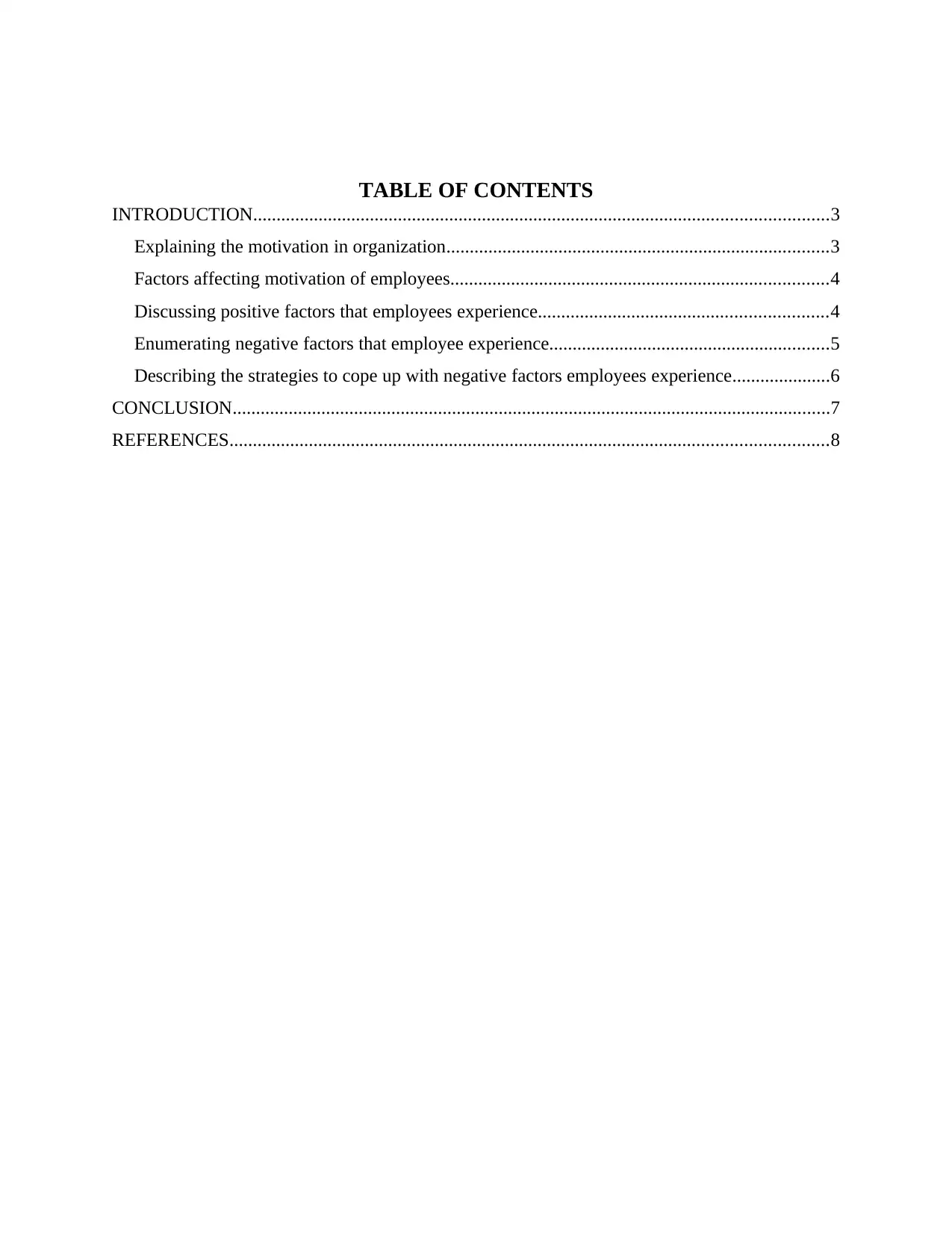
TABLE OF CONTENTS
INTRODUCTION...........................................................................................................................3
Explaining the motivation in organization..................................................................................3
Factors affecting motivation of employees.................................................................................4
Discussing positive factors that employees experience..............................................................4
Enumerating negative factors that employee experience............................................................5
Describing the strategies to cope up with negative factors employees experience.....................6
CONCLUSION................................................................................................................................7
REFERENCES................................................................................................................................8
INTRODUCTION...........................................................................................................................3
Explaining the motivation in organization..................................................................................3
Factors affecting motivation of employees.................................................................................4
Discussing positive factors that employees experience..............................................................4
Enumerating negative factors that employee experience............................................................5
Describing the strategies to cope up with negative factors employees experience.....................6
CONCLUSION................................................................................................................................7
REFERENCES................................................................................................................................8
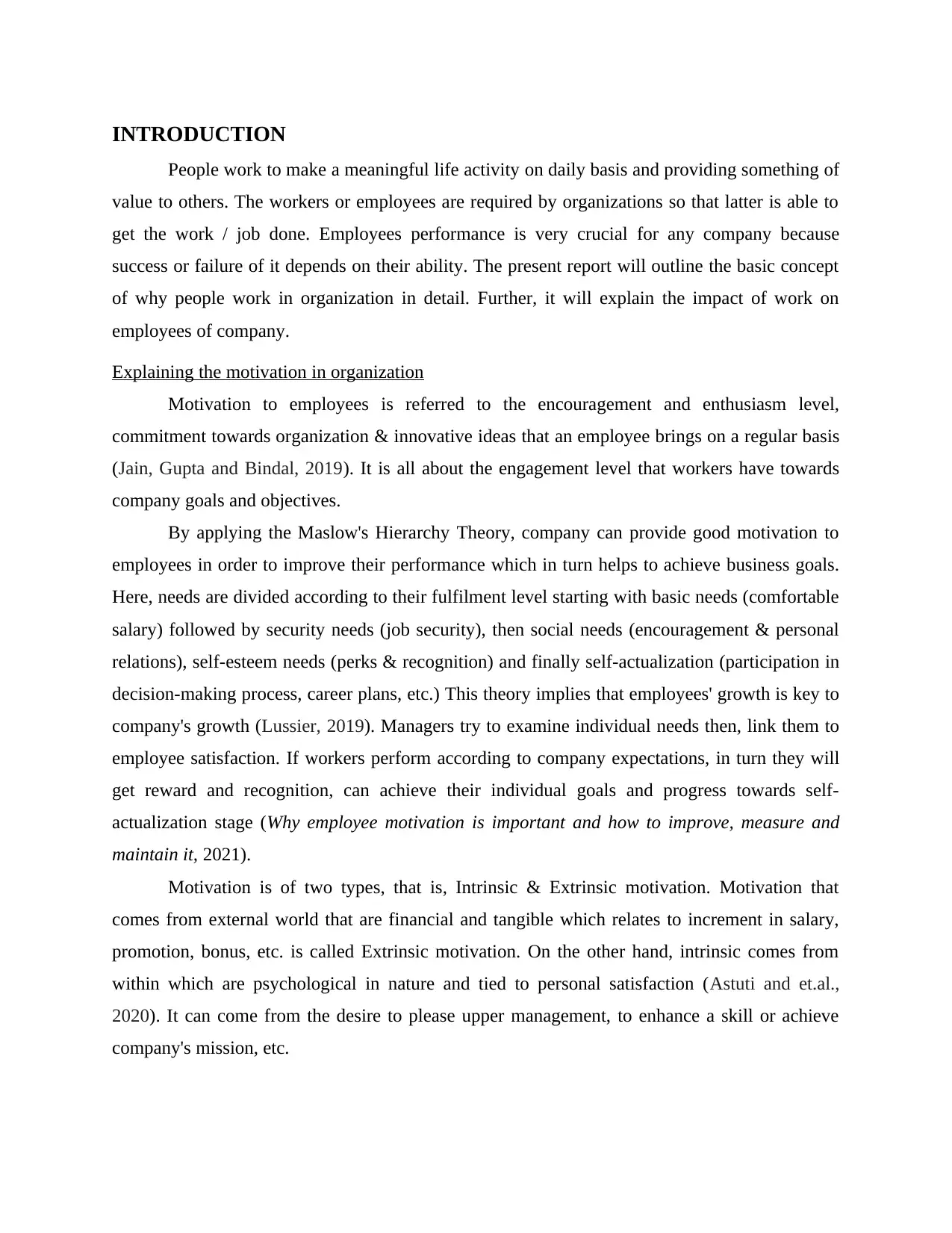
INTRODUCTION
People work to make a meaningful life activity on daily basis and providing something of
value to others. The workers or employees are required by organizations so that latter is able to
get the work / job done. Employees performance is very crucial for any company because
success or failure of it depends on their ability. The present report will outline the basic concept
of why people work in organization in detail. Further, it will explain the impact of work on
employees of company.
Explaining the motivation in organization
Motivation to employees is referred to the encouragement and enthusiasm level,
commitment towards organization & innovative ideas that an employee brings on a regular basis
(Jain, Gupta and Bindal, 2019). It is all about the engagement level that workers have towards
company goals and objectives.
By applying the Maslow's Hierarchy Theory, company can provide good motivation to
employees in order to improve their performance which in turn helps to achieve business goals.
Here, needs are divided according to their fulfilment level starting with basic needs (comfortable
salary) followed by security needs (job security), then social needs (encouragement & personal
relations), self-esteem needs (perks & recognition) and finally self-actualization (participation in
decision-making process, career plans, etc.) This theory implies that employees' growth is key to
company's growth (Lussier, 2019). Managers try to examine individual needs then, link them to
employee satisfaction. If workers perform according to company expectations, in turn they will
get reward and recognition, can achieve their individual goals and progress towards self-
actualization stage (Why employee motivation is important and how to improve, measure and
maintain it, 2021).
Motivation is of two types, that is, Intrinsic & Extrinsic motivation. Motivation that
comes from external world that are financial and tangible which relates to increment in salary,
promotion, bonus, etc. is called Extrinsic motivation. On the other hand, intrinsic comes from
within which are psychological in nature and tied to personal satisfaction (Astuti and et.al.,
2020). It can come from the desire to please upper management, to enhance a skill or achieve
company's mission, etc.
People work to make a meaningful life activity on daily basis and providing something of
value to others. The workers or employees are required by organizations so that latter is able to
get the work / job done. Employees performance is very crucial for any company because
success or failure of it depends on their ability. The present report will outline the basic concept
of why people work in organization in detail. Further, it will explain the impact of work on
employees of company.
Explaining the motivation in organization
Motivation to employees is referred to the encouragement and enthusiasm level,
commitment towards organization & innovative ideas that an employee brings on a regular basis
(Jain, Gupta and Bindal, 2019). It is all about the engagement level that workers have towards
company goals and objectives.
By applying the Maslow's Hierarchy Theory, company can provide good motivation to
employees in order to improve their performance which in turn helps to achieve business goals.
Here, needs are divided according to their fulfilment level starting with basic needs (comfortable
salary) followed by security needs (job security), then social needs (encouragement & personal
relations), self-esteem needs (perks & recognition) and finally self-actualization (participation in
decision-making process, career plans, etc.) This theory implies that employees' growth is key to
company's growth (Lussier, 2019). Managers try to examine individual needs then, link them to
employee satisfaction. If workers perform according to company expectations, in turn they will
get reward and recognition, can achieve their individual goals and progress towards self-
actualization stage (Why employee motivation is important and how to improve, measure and
maintain it, 2021).
Motivation is of two types, that is, Intrinsic & Extrinsic motivation. Motivation that
comes from external world that are financial and tangible which relates to increment in salary,
promotion, bonus, etc. is called Extrinsic motivation. On the other hand, intrinsic comes from
within which are psychological in nature and tied to personal satisfaction (Astuti and et.al.,
2020). It can come from the desire to please upper management, to enhance a skill or achieve
company's mission, etc.
⊘ This is a preview!⊘
Do you want full access?
Subscribe today to unlock all pages.

Trusted by 1+ million students worldwide
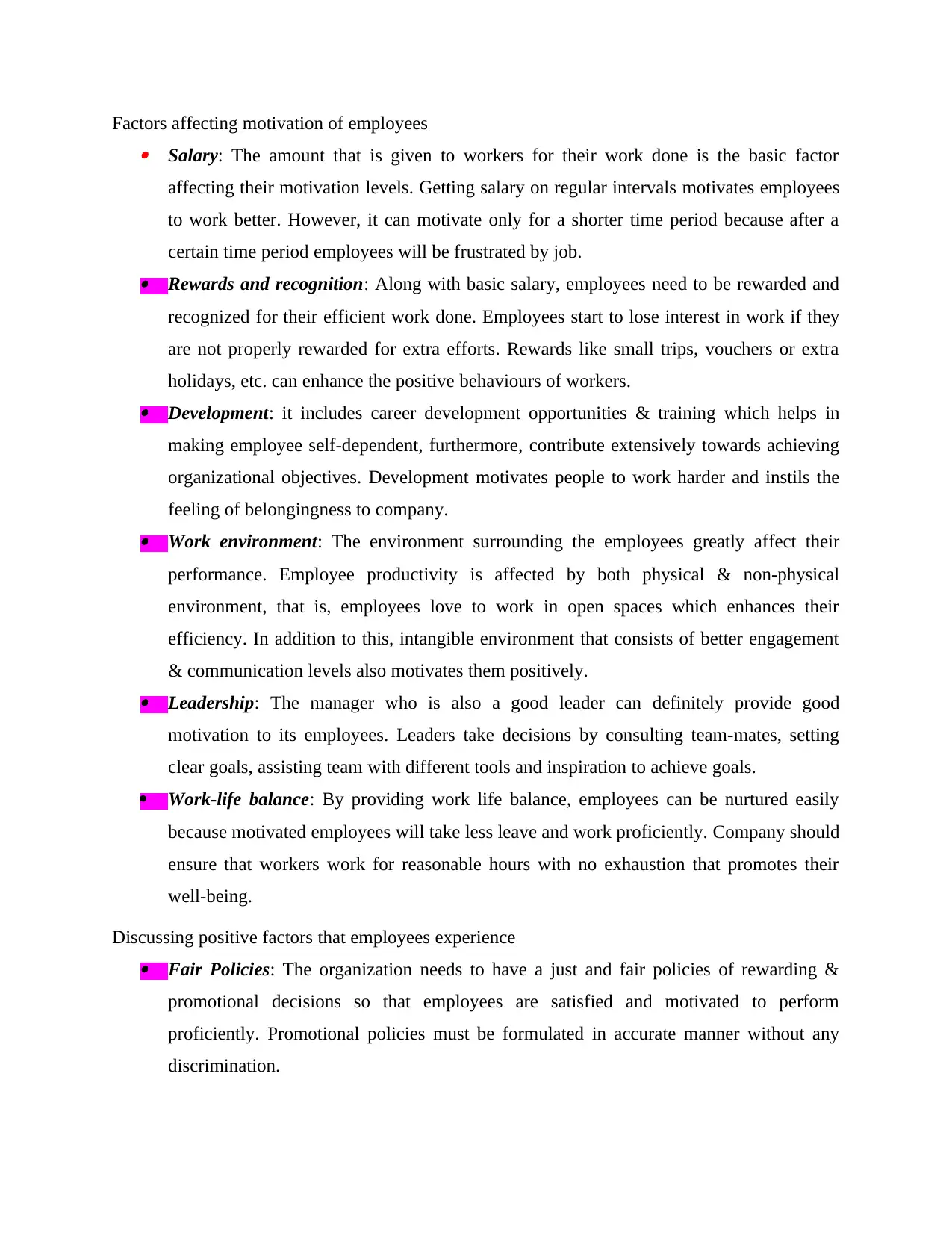
Factors affecting motivation of employees Salary: The amount that is given to workers for their work done is the basic factor
affecting their motivation levels. Getting salary on regular intervals motivates employees
to work better. However, it can motivate only for a shorter time period because after a
certain time period employees will be frustrated by job. Rewards and recognition: Along with basic salary, employees need to be rewarded and
recognized for their efficient work done. Employees start to lose interest in work if they
are not properly rewarded for extra efforts. Rewards like small trips, vouchers or extra
holidays, etc. can enhance the positive behaviours of workers. Development: it includes career development opportunities & training which helps in
making employee self-dependent, furthermore, contribute extensively towards achieving
organizational objectives. Development motivates people to work harder and instils the
feeling of belongingness to company. Work environment: The environment surrounding the employees greatly affect their
performance. Employee productivity is affected by both physical & non-physical
environment, that is, employees love to work in open spaces which enhances their
efficiency. In addition to this, intangible environment that consists of better engagement
& communication levels also motivates them positively. Leadership: The manager who is also a good leader can definitely provide good
motivation to its employees. Leaders take decisions by consulting team-mates, setting
clear goals, assisting team with different tools and inspiration to achieve goals.
Work-life balance: By providing work life balance, employees can be nurtured easily
because motivated employees will take less leave and work proficiently. Company should
ensure that workers work for reasonable hours with no exhaustion that promotes their
well-being.
Discussing positive factors that employees experience Fair Policies: The organization needs to have a just and fair policies of rewarding &
promotional decisions so that employees are satisfied and motivated to perform
proficiently. Promotional policies must be formulated in accurate manner without any
discrimination.
affecting their motivation levels. Getting salary on regular intervals motivates employees
to work better. However, it can motivate only for a shorter time period because after a
certain time period employees will be frustrated by job. Rewards and recognition: Along with basic salary, employees need to be rewarded and
recognized for their efficient work done. Employees start to lose interest in work if they
are not properly rewarded for extra efforts. Rewards like small trips, vouchers or extra
holidays, etc. can enhance the positive behaviours of workers. Development: it includes career development opportunities & training which helps in
making employee self-dependent, furthermore, contribute extensively towards achieving
organizational objectives. Development motivates people to work harder and instils the
feeling of belongingness to company. Work environment: The environment surrounding the employees greatly affect their
performance. Employee productivity is affected by both physical & non-physical
environment, that is, employees love to work in open spaces which enhances their
efficiency. In addition to this, intangible environment that consists of better engagement
& communication levels also motivates them positively. Leadership: The manager who is also a good leader can definitely provide good
motivation to its employees. Leaders take decisions by consulting team-mates, setting
clear goals, assisting team with different tools and inspiration to achieve goals.
Work-life balance: By providing work life balance, employees can be nurtured easily
because motivated employees will take less leave and work proficiently. Company should
ensure that workers work for reasonable hours with no exhaustion that promotes their
well-being.
Discussing positive factors that employees experience Fair Policies: The organization needs to have a just and fair policies of rewarding &
promotional decisions so that employees are satisfied and motivated to perform
proficiently. Promotional policies must be formulated in accurate manner without any
discrimination.
Paraphrase This Document
Need a fresh take? Get an instant paraphrase of this document with our AI Paraphraser
Safety & security: Now-a-days, employees want safety and security in their jobs that
plays a major role in job satisfaction. Companies are taking several measures to provide
security to employees like regular health, medical check ups, insurance policies, etc. Employee engagement: This factor also play an important role to have positive impact on
employee experience (Haldorai and et.al., 2019). A friendly working environment where
each employee respect others and their work affects positively. Managers need to take
responsibility to foster good relations among employees and take steps to reduce
conflicts. Flexibility: Flexible working hours will have positive impact on employee experience
because it will enhance their productivity. Smart people can work effectively according
to their schedules. Appreciation: All employees love to be appreciated and rewarded either, financially or
non-financially. It positively affects the employees by boosting up their morale &
motivation. A small recognition from colleagues, managers or superiors can provide a lot
of encouragement to employees. Caring Company: When employees feel that company cares for them and takes
necessary actions to improve their work & life, it creates a positive impact on them that
motivates them to work wonderfully.
Responsibility granted: Another factor that have positive impact is responsibility that is
given to an employee (Redelinghuys, Rothmann and Botha, 2019). If he is given a bigger
responsibility it makes him think that he is a capable candidate & increases satisfaction
levels.
Enumerating negative factors that employee experience Bad working conditions: If the environment in which employees work is not conducive,
it will definitely have a negative impact on them. An employee cannot focus on work if
working area is hot, noisy, dirty or if systems are unsynchronized. Unfair practices: Employees feel dissatisfied, demotivated and frustrated if company
follows unfair practices. When an organization promotes an employee not on the basis of
performance but on the basis of relations with superior then unfair practices are followed.
It leads to decline in employee performance which is bad for company.
plays a major role in job satisfaction. Companies are taking several measures to provide
security to employees like regular health, medical check ups, insurance policies, etc. Employee engagement: This factor also play an important role to have positive impact on
employee experience (Haldorai and et.al., 2019). A friendly working environment where
each employee respect others and their work affects positively. Managers need to take
responsibility to foster good relations among employees and take steps to reduce
conflicts. Flexibility: Flexible working hours will have positive impact on employee experience
because it will enhance their productivity. Smart people can work effectively according
to their schedules. Appreciation: All employees love to be appreciated and rewarded either, financially or
non-financially. It positively affects the employees by boosting up their morale &
motivation. A small recognition from colleagues, managers or superiors can provide a lot
of encouragement to employees. Caring Company: When employees feel that company cares for them and takes
necessary actions to improve their work & life, it creates a positive impact on them that
motivates them to work wonderfully.
Responsibility granted: Another factor that have positive impact is responsibility that is
given to an employee (Redelinghuys, Rothmann and Botha, 2019). If he is given a bigger
responsibility it makes him think that he is a capable candidate & increases satisfaction
levels.
Enumerating negative factors that employee experience Bad working conditions: If the environment in which employees work is not conducive,
it will definitely have a negative impact on them. An employee cannot focus on work if
working area is hot, noisy, dirty or if systems are unsynchronized. Unfair practices: Employees feel dissatisfied, demotivated and frustrated if company
follows unfair practices. When an organization promotes an employee not on the basis of
performance but on the basis of relations with superior then unfair practices are followed.
It leads to decline in employee performance which is bad for company.
Unjust pay: Workers in organization work for basic salary or wages which is very
significant to motivate them. In case of inadequate salary structure, employees will have
negative impact on their jobs and would like to leave it. Fringe benefits like perks and
bonuses not provided in accordance with the performance will demotivate personnel. Lack of freedom: Satisfaction from work can also be reduced if employees are not given
freedom or autonomy to work accordingly. Workers do not like to be supervised at every
step they take. There is a reduction in morale when employees have to follow strict
procedure and cannot deviate from that. Personal traits: Sometimes, personnel with negative personality, that is, people with
negative and pessimistic attitude will complain about everything in job and can never be
motivated. Such negative traits of people can lead to dissatisfaction and demotivation.
Company structure: Organization following autocratic and authoritative structure will
cause displeasure among employees because they will not be allowed to participate in
any decision-making process (Demsky and et.al., 2019). They just have to follow the
orders of superiors which reduces employee engagement and innovative ideas.
Describing the strategies to cope up with negative factors employees experience Active listening: Company should adopt the strategy of actively listening to the concerns
and complaints of employees and solving them as soon as possible to induce satisfaction.
Such practice will provide encouragement to employees and sometimes they will come
along with suggestions for their problems. Fostering positive workplace: Smart managers can easily bring in good & bright
emotions at work. A positive workplace will have positive personnel that will enhance
the performance of organization, increases morale, reduces stress and retention of
employees. Stability: Business must follow stable policies and practices to develop trust among
employees. Job policies & structure should be formulated and followed for longer time
period so that employees are motivated. Frequent changes in these strategies can break
the trust between employee-employer relations. Healthy conversation with negative employees: Handling handful of negative personnel
can save workplace from becoming toxic. A positive, healthy conversation with such
significant to motivate them. In case of inadequate salary structure, employees will have
negative impact on their jobs and would like to leave it. Fringe benefits like perks and
bonuses not provided in accordance with the performance will demotivate personnel. Lack of freedom: Satisfaction from work can also be reduced if employees are not given
freedom or autonomy to work accordingly. Workers do not like to be supervised at every
step they take. There is a reduction in morale when employees have to follow strict
procedure and cannot deviate from that. Personal traits: Sometimes, personnel with negative personality, that is, people with
negative and pessimistic attitude will complain about everything in job and can never be
motivated. Such negative traits of people can lead to dissatisfaction and demotivation.
Company structure: Organization following autocratic and authoritative structure will
cause displeasure among employees because they will not be allowed to participate in
any decision-making process (Demsky and et.al., 2019). They just have to follow the
orders of superiors which reduces employee engagement and innovative ideas.
Describing the strategies to cope up with negative factors employees experience Active listening: Company should adopt the strategy of actively listening to the concerns
and complaints of employees and solving them as soon as possible to induce satisfaction.
Such practice will provide encouragement to employees and sometimes they will come
along with suggestions for their problems. Fostering positive workplace: Smart managers can easily bring in good & bright
emotions at work. A positive workplace will have positive personnel that will enhance
the performance of organization, increases morale, reduces stress and retention of
employees. Stability: Business must follow stable policies and practices to develop trust among
employees. Job policies & structure should be formulated and followed for longer time
period so that employees are motivated. Frequent changes in these strategies can break
the trust between employee-employer relations. Healthy conversation with negative employees: Handling handful of negative personnel
can save workplace from becoming toxic. A positive, healthy conversation with such
⊘ This is a preview!⊘
Do you want full access?
Subscribe today to unlock all pages.
Trusted by 1+ million students worldwide
people can change their mind and turn them in positive. By encouraging them and
providing right direction to their goals, company can tackle negative people. Health programs: Company can organize regular health check up camps in offices which
will help the individuals to better take care of their health & well-being. Such health
programs benefit corporates because if employee's health is good, he can work hard and
give better results (Zhang and et.al., 2019). Regular Rewarding system: Organization should regularly provide rewards and
recognition to employees who are performing very well. A simple appreciation post or
announcement of achievements can motivate other employees also to perform effectively.
Giving Feedback: Along with rewards, business entity should also provide continuous
feedback to their employees. Positive feedback which are specific, clear & fair enough
will lead to higher employee engagement and motivation.
CONCLUSION
From the above report, it can be concluded that providing good motivation to employees
is must for any organization to foster positive working culture. It can also be said that some
employees require extrinsic motivation while others have intrinsic motivation. Further, the report
also analysed various positive and negative factors that have an impact on the employees'
satisfaction such as promotion practices, working conditions, level of freedom, etc. Lastly, the
report highlighted strategies that can be adopted by company to reduce the negativity, for
instance, giving constructive feedbacks and healthy conversations.
providing right direction to their goals, company can tackle negative people. Health programs: Company can organize regular health check up camps in offices which
will help the individuals to better take care of their health & well-being. Such health
programs benefit corporates because if employee's health is good, he can work hard and
give better results (Zhang and et.al., 2019). Regular Rewarding system: Organization should regularly provide rewards and
recognition to employees who are performing very well. A simple appreciation post or
announcement of achievements can motivate other employees also to perform effectively.
Giving Feedback: Along with rewards, business entity should also provide continuous
feedback to their employees. Positive feedback which are specific, clear & fair enough
will lead to higher employee engagement and motivation.
CONCLUSION
From the above report, it can be concluded that providing good motivation to employees
is must for any organization to foster positive working culture. It can also be said that some
employees require extrinsic motivation while others have intrinsic motivation. Further, the report
also analysed various positive and negative factors that have an impact on the employees'
satisfaction such as promotion practices, working conditions, level of freedom, etc. Lastly, the
report highlighted strategies that can be adopted by company to reduce the negativity, for
instance, giving constructive feedbacks and healthy conversations.
Paraphrase This Document
Need a fresh take? Get an instant paraphrase of this document with our AI Paraphraser
REFERENCES
Books and Journals
Jain, A., Gupta, B. and Bindal, M., 2019. A study of employee motivation in
organization. International Journal of Engineering and Management Research (IJEMR).
9(6). pp.65-68.
Astuti, R. Y. and et.al., 2020. impact of leadership style, work motivation, organization culture
toward Satuan Polisi Pamong Praja work performance. Journal of Industrial Engineering
& Management Research. 1(3). pp.49-64.
Lussier, K., 2019. Of Maslow, motives, and managers: The hierarchy of needs in American
business, 1960–1985. Journal of the History of the Behavioral Sciences. 55(4). pp.319-
341..
Haldorai, K. and et.al., 2019. Factors affecting hotel employees’ attrition and turnover:
Application of pull-push-mooring framework. International Journal of Hospitality
Management. 83. pp.46-55.
Redelinghuys, K., Rothmann, S. and Botha, E., 2019. Flourishing-at-work: The role of positive
organizational practices. Psychological Reports. 122(2). pp.609-631.
Demsky, C. A. and et.al., 2019. Workplace incivility and employee sleep: The role of rumination
and recovery experiences. Journal of occupational health psychology. 24(2). p.228.
Zhang, Y. and et.al., 2019. Promotion-and prevention-focused coping: A meta-analytic
examination of regulatory strategies in the work stress process. Journal of Applied
Psychology. 104(10). p.1296.
Online
Why employee motivation is important and how to improve, measure and maintain it. 2021.
[Online]. Available through: <https://www.perkbox.com/uk/resources/blog/why-
employee-motivation-is-important-and-how-to-improve-measure-and-maintain-it>
Books and Journals
Jain, A., Gupta, B. and Bindal, M., 2019. A study of employee motivation in
organization. International Journal of Engineering and Management Research (IJEMR).
9(6). pp.65-68.
Astuti, R. Y. and et.al., 2020. impact of leadership style, work motivation, organization culture
toward Satuan Polisi Pamong Praja work performance. Journal of Industrial Engineering
& Management Research. 1(3). pp.49-64.
Lussier, K., 2019. Of Maslow, motives, and managers: The hierarchy of needs in American
business, 1960–1985. Journal of the History of the Behavioral Sciences. 55(4). pp.319-
341..
Haldorai, K. and et.al., 2019. Factors affecting hotel employees’ attrition and turnover:
Application of pull-push-mooring framework. International Journal of Hospitality
Management. 83. pp.46-55.
Redelinghuys, K., Rothmann, S. and Botha, E., 2019. Flourishing-at-work: The role of positive
organizational practices. Psychological Reports. 122(2). pp.609-631.
Demsky, C. A. and et.al., 2019. Workplace incivility and employee sleep: The role of rumination
and recovery experiences. Journal of occupational health psychology. 24(2). p.228.
Zhang, Y. and et.al., 2019. Promotion-and prevention-focused coping: A meta-analytic
examination of regulatory strategies in the work stress process. Journal of Applied
Psychology. 104(10). p.1296.
Online
Why employee motivation is important and how to improve, measure and maintain it. 2021.
[Online]. Available through: <https://www.perkbox.com/uk/resources/blog/why-
employee-motivation-is-important-and-how-to-improve-measure-and-maintain-it>

1 out of 8


Related Documents


Your All-in-One AI-Powered Toolkit for Academic Success.
+13062052269
info@desklib.com
Available 24*7 on WhatsApp / Email
![[object Object]](/_next/static/media/star-bottom.7253800d.svg)
Unlock your academic potential
Copyright © 2020–2026 A2Z Services. All Rights Reserved. Developed and managed by ZUCOL.