People Management: Motivating and Engaging Employees in Workplace
VerifiedAdded on 2024/06/10
|25
|5866
|233
Report
AI Summary
This report provides a comprehensive analysis of employee motivation and engagement, highlighting their significance in achieving organizational success. It defines employee motivation and engagement, emphasizing the importance of aligning company interests with employee needs. The report discusses various types of motivation, including intrinsic and extrinsic factors, and explores different levels of employee engagement: actively disengaged, engaged, and not engaged. Furthermore, it delves into appropriate models and theories of employee motivation, such as Maslow's hierarchy of needs and Herzberg's two-factor theory, and engagement, examining their practical applications in the workplace. Finally, the report examines the relationship between the line manager's role and that of the HR representative in effectively managing people, emphasizing the need for collaboration and communication to foster a motivated and engaged workforce. Desklib provides access to similar solved assignments and study resources for students.
MANAGING AND LEADING
PEOPLE
MOTIVATING AND ENGAGING EMPLOYEES
PEOPLE
MOTIVATING AND ENGAGING EMPLOYEES

Paraphrase This Document
Need a fresh take? Get an instant paraphrase of this document with our AI Paraphraser
Table of Contents
INTRODUCTION..........................................................................................................................2
MOTIVATING AND ENGAGING EMPLOYEES...............................................................................3
DISCUSSION ON APPROPRIATE MODELS RELATED TO MOTIVATING AND ENGAGING
EMPLOYEES................................................................................................................................9
MODELS AND THEORIES OF EMPLOYEE MOTIVATION..........................................................9
MODELS AND THEORIES OF EMPLOYEE ENGAGEMENT......................................................14
RELATIONSHIP BETWEEN THE LINE MANAGER/LEADERS ROLE AND THAT OF THE HR
REPRESENTATIVE IN THE MANAGEMENT OF PEOPLE.............................................................19
CONCLUSION............................................................................................................................22
REFERENCES.............................................................................................................................23
1
INTRODUCTION..........................................................................................................................2
MOTIVATING AND ENGAGING EMPLOYEES...............................................................................3
DISCUSSION ON APPROPRIATE MODELS RELATED TO MOTIVATING AND ENGAGING
EMPLOYEES................................................................................................................................9
MODELS AND THEORIES OF EMPLOYEE MOTIVATION..........................................................9
MODELS AND THEORIES OF EMPLOYEE ENGAGEMENT......................................................14
RELATIONSHIP BETWEEN THE LINE MANAGER/LEADERS ROLE AND THAT OF THE HR
REPRESENTATIVE IN THE MANAGEMENT OF PEOPLE.............................................................19
CONCLUSION............................................................................................................................22
REFERENCES.............................................................................................................................23
1
INTRODUCTION
The success of any business highly depends on its tactful management of human resources.
The driving force behind the actions as well as the behaviour of employees is motivation. It
inspires the individuals at work to take required actions in order to achieve the aim along
with fulfilling the need and also any expectation (Zhang and Bartol, 2010). Motivation also
helps in engaging the employees at the workplace and also ensures the knowledge, ability
and skills to perform the job and achieve higher work standard. This report represents the
critical analysis of the role of line managers in the organization as well as the relationship
between the line manager and HR representative for better management of human
resources in the organization.
2
The success of any business highly depends on its tactful management of human resources.
The driving force behind the actions as well as the behaviour of employees is motivation. It
inspires the individuals at work to take required actions in order to achieve the aim along
with fulfilling the need and also any expectation (Zhang and Bartol, 2010). Motivation also
helps in engaging the employees at the workplace and also ensures the knowledge, ability
and skills to perform the job and achieve higher work standard. This report represents the
critical analysis of the role of line managers in the organization as well as the relationship
between the line manager and HR representative for better management of human
resources in the organization.
2
⊘ This is a preview!⊘
Do you want full access?
Subscribe today to unlock all pages.

Trusted by 1+ million students worldwide
MOTIVATING AND ENGAGING EMPLOYEES
DEFINITION
Employee motivation can be defined as the actions and activities to inspire the employee of
the organization to increase their energy level, creativity and commitment to their work or
job. Employee engagement is the extent of enthusiasm, dedication as well as emotional
commitment of the employee towards its organization (Cadwallader, et al. 2010). It also
represents the property of the relationship between the employees with its organization.
The organization has seen a collection of a large number of individuals who strive towards
the attainment of the common objective of the organization.
It is essential for any organization to motivate its employees and manage its people
effectively so that the company is able to reach out to the aims and objectives of the
organization and also succeed and thrive in this fiercely competitive environment (van Beek,
et al. 2011). There are various researches and studies that show the significance of the
motivation and engagement of employees at the workplace. The employees who are
motivated, responsive and engaged in their workplace are substantially productive as
compared to the employees who are unmotivated or apathetic.
If the employee of the organization is motivated to work hard or increase its performance,
the employees may feel engaged and are considered valuable for the company and thus is
more likely to work hard (Temminck, et al. 2015). The efforts of the workers and employees
contribute to the success and high performance of the company or organization in their
respective fields. It is also said by the scholars and peers that employees work for the
people not for the companies. Employee engagement in any organization is highly impacted
by the leadership style or management style of line managers.
Employees are motivated in order to ensure their high engagement and ultimately lead to
increased customer loyalty, enhanced profits, greater productivity and employee retention
(van Beek, et al. 2011). It is the responsibility of the line manager to align the interest of the
company in the interest of its employees. Employee motivation is directly correlated with
the employee satisfaction. The success and growth of the company can only be possible
when the employees are motivated and satisfied with their work.
3
DEFINITION
Employee motivation can be defined as the actions and activities to inspire the employee of
the organization to increase their energy level, creativity and commitment to their work or
job. Employee engagement is the extent of enthusiasm, dedication as well as emotional
commitment of the employee towards its organization (Cadwallader, et al. 2010). It also
represents the property of the relationship between the employees with its organization.
The organization has seen a collection of a large number of individuals who strive towards
the attainment of the common objective of the organization.
It is essential for any organization to motivate its employees and manage its people
effectively so that the company is able to reach out to the aims and objectives of the
organization and also succeed and thrive in this fiercely competitive environment (van Beek,
et al. 2011). There are various researches and studies that show the significance of the
motivation and engagement of employees at the workplace. The employees who are
motivated, responsive and engaged in their workplace are substantially productive as
compared to the employees who are unmotivated or apathetic.
If the employee of the organization is motivated to work hard or increase its performance,
the employees may feel engaged and are considered valuable for the company and thus is
more likely to work hard (Temminck, et al. 2015). The efforts of the workers and employees
contribute to the success and high performance of the company or organization in their
respective fields. It is also said by the scholars and peers that employees work for the
people not for the companies. Employee engagement in any organization is highly impacted
by the leadership style or management style of line managers.
Employees are motivated in order to ensure their high engagement and ultimately lead to
increased customer loyalty, enhanced profits, greater productivity and employee retention
(van Beek, et al. 2011). It is the responsibility of the line manager to align the interest of the
company in the interest of its employees. Employee motivation is directly correlated with
the employee satisfaction. The success and growth of the company can only be possible
when the employees are motivated and satisfied with their work.
3
Paraphrase This Document
Need a fresh take? Get an instant paraphrase of this document with our AI Paraphraser
SIGNIFICANCE OF EMPLOYEE MOTIVATION
It is vital for the business to motivate its employees as the goals and objectives of the
business can be achieved through highly productive staffs that are motivated staff
(Temminck, et al. 2015). The level of motivation decides the level of the attitude of the
employees towards its organization. Motivation also helps in altering the negative attitude
into a positive attitude. The efficiency level of the employees is improved through consistent
motivation to reduce the wastage of time as well as resources.
The line managers at workplace create a supportive work environment through their
motivation which not only improves the relationship between superior and subordinates
but enables the employees to contribute their best efforts to accomplish organisational
goals (Skudiene and Auruskeviciene, 2012). The employees of the organisation who are
motivated stay supportive or cooperative in implementing the changes in the organisation.
As the motivated employees are satisfied due to the fulfilment of their needs and
expectation within the organisation itself, it reduces the employees’ attrition or turnover.
SIGNIFICANCE OF EMPLOYEE ENGAGEMENT
One of the most important variables in the majority of the organization is employee
engagement the employees who are better engaged with their employees make an
additional effort and are a quick learner and creative enough that enables the organization
to deliver the superior performance along with gaining competitive advantage (Robson, et
al. 2016). The customer satisfaction level, profitability and productivity and personnel
retention in any organization are indicated through the level of customer engagement.
The corporations constantly motivate the employees to take part in the activities of the
companies so that they feel a sense of connection with the company and believe their work
to be important for the organization, since the better employee engagement results in
better productivity and performance of the company around the market (Bhuvanaiah and
Raya, 2015). Employee engagement at work helps the organization to develop creativity and
positive attitude of the employees towards the company leading to increased satisfaction
level and less employee attrition. Higher employee engagement denotes higher employee
commitment towards its work and also towards the organization.
RELATIONSHIP BETWEEN EMPLOYEE MOTIVATION AND EMPLOYEE ENGAGEMENT
4
It is vital for the business to motivate its employees as the goals and objectives of the
business can be achieved through highly productive staffs that are motivated staff
(Temminck, et al. 2015). The level of motivation decides the level of the attitude of the
employees towards its organization. Motivation also helps in altering the negative attitude
into a positive attitude. The efficiency level of the employees is improved through consistent
motivation to reduce the wastage of time as well as resources.
The line managers at workplace create a supportive work environment through their
motivation which not only improves the relationship between superior and subordinates
but enables the employees to contribute their best efforts to accomplish organisational
goals (Skudiene and Auruskeviciene, 2012). The employees of the organisation who are
motivated stay supportive or cooperative in implementing the changes in the organisation.
As the motivated employees are satisfied due to the fulfilment of their needs and
expectation within the organisation itself, it reduces the employees’ attrition or turnover.
SIGNIFICANCE OF EMPLOYEE ENGAGEMENT
One of the most important variables in the majority of the organization is employee
engagement the employees who are better engaged with their employees make an
additional effort and are a quick learner and creative enough that enables the organization
to deliver the superior performance along with gaining competitive advantage (Robson, et
al. 2016). The customer satisfaction level, profitability and productivity and personnel
retention in any organization are indicated through the level of customer engagement.
The corporations constantly motivate the employees to take part in the activities of the
companies so that they feel a sense of connection with the company and believe their work
to be important for the organization, since the better employee engagement results in
better productivity and performance of the company around the market (Bhuvanaiah and
Raya, 2015). Employee engagement at work helps the organization to develop creativity and
positive attitude of the employees towards the company leading to increased satisfaction
level and less employee attrition. Higher employee engagement denotes higher employee
commitment towards its work and also towards the organization.
RELATIONSHIP BETWEEN EMPLOYEE MOTIVATION AND EMPLOYEE ENGAGEMENT
4
Employee motivation is related to the inspiration of employees who brings a level of energy
as well as enthusiasm to their work at workplace whereas employee engagement is the
approach that represents the sense of willingness of enthusiasm among the employees
towards their work or job (Njoroge and Yazdanifard, 2014). It is essential to maintain the
balance between employee motivation and employee engagement to get the required
efforts for the success of the organization in the market.
It is observed that the employees that are intrinsically motivated are highly engaged
towards their work and always strive for mastering new skills and enthusiastic about
utilising their talents (Ferri-Reed, 2014). In the contradiction, the employees are extrinsically
motivated then it constantly needs to stimulate them to be productive. This approach
inspires the employee for the limited time period and may not be sustainable for the long
run.
TYPES OF MOTIVATION
Motivation is classified in different ways and on different basis given below.
There are primarily two types of motivation that are intrinsic plus extrinsic motivation. It is
essential to understand the types of motivation as the motivational needs of each
employee’s vary from another (Temminck, et al. 2015). The line manager or HR
5
Types of
motivation
On the basis of
rewards or
punishment
Positive
Negative
On the basis of
self induced
motivation
Internal
External
On the basis of
financial
means
Financial
Non-financial
On the basis of
motivation
focus
Group
motivation
Individual
motivation
as well as enthusiasm to their work at workplace whereas employee engagement is the
approach that represents the sense of willingness of enthusiasm among the employees
towards their work or job (Njoroge and Yazdanifard, 2014). It is essential to maintain the
balance between employee motivation and employee engagement to get the required
efforts for the success of the organization in the market.
It is observed that the employees that are intrinsically motivated are highly engaged
towards their work and always strive for mastering new skills and enthusiastic about
utilising their talents (Ferri-Reed, 2014). In the contradiction, the employees are extrinsically
motivated then it constantly needs to stimulate them to be productive. This approach
inspires the employee for the limited time period and may not be sustainable for the long
run.
TYPES OF MOTIVATION
Motivation is classified in different ways and on different basis given below.
There are primarily two types of motivation that are intrinsic plus extrinsic motivation. It is
essential to understand the types of motivation as the motivational needs of each
employee’s vary from another (Temminck, et al. 2015). The line manager or HR
5
Types of
motivation
On the basis of
rewards or
punishment
Positive
Negative
On the basis of
self induced
motivation
Internal
External
On the basis of
financial
means
Financial
Non-financial
On the basis of
motivation
focus
Group
motivation
Individual
motivation
⊘ This is a preview!⊘
Do you want full access?
Subscribe today to unlock all pages.
Trusted by 1+ million students worldwide
management need to categorise the team members according to their motivational need
and apply appropriate type of motivation.
Extrinsic motivation: extrinsic motivation represents the external motivational factors and
external reinforcer. It can also be said that the desire to accomplish the task is controlled
and managed by the outside sources. It is external in nature and is less effective as it comes
from outside the person (Zhang and Bartol, 2010). The examples of external rewards or
motivational factors are money, awards, bonus incentives and praise in monetary terms.
And some of the external reinforcers are speeding tickets, boundary-setting, disciplinary
actions, policy and procedures and so on.
Intrinsic motivation: the individual is motivated by the motivational stimuli that come from
within. The individual has the desire to perform the particular task as the outcome of the
task is as per its belief system or desire fulfilment. The individual is motivated by the internal
rewards and reinforcers (Zhang and Bartol, 2010). The deep-rooted desires of the
individuals have highest motivational power. Some of the examples of the internal rewards
are an achievement, acceptance, social status, independence, honour, social contact,
enjoyment a sense of competence and the examples of internal reinforcer are toxic shame
and guilt conscience and so on.
TYPE OF EMPLOYEE ENGAGEMENT
When it comes to the accomplishment of objectives of the organization, every employee is
expected to put their full potential efforts in the direction of reputation and common
interest of the company (Mone and London, 2018). However, the majority of organizations
fails to maintain such position due to lack of enthusiasm of the employees in utilising their
full potential. The engagement of the employee in an organization can be classified into
three types on the basis of their level of engagement or commitment that are given below:
6
and apply appropriate type of motivation.
Extrinsic motivation: extrinsic motivation represents the external motivational factors and
external reinforcer. It can also be said that the desire to accomplish the task is controlled
and managed by the outside sources. It is external in nature and is less effective as it comes
from outside the person (Zhang and Bartol, 2010). The examples of external rewards or
motivational factors are money, awards, bonus incentives and praise in monetary terms.
And some of the external reinforcers are speeding tickets, boundary-setting, disciplinary
actions, policy and procedures and so on.
Intrinsic motivation: the individual is motivated by the motivational stimuli that come from
within. The individual has the desire to perform the particular task as the outcome of the
task is as per its belief system or desire fulfilment. The individual is motivated by the internal
rewards and reinforcers (Zhang and Bartol, 2010). The deep-rooted desires of the
individuals have highest motivational power. Some of the examples of the internal rewards
are an achievement, acceptance, social status, independence, honour, social contact,
enjoyment a sense of competence and the examples of internal reinforcer are toxic shame
and guilt conscience and so on.
TYPE OF EMPLOYEE ENGAGEMENT
When it comes to the accomplishment of objectives of the organization, every employee is
expected to put their full potential efforts in the direction of reputation and common
interest of the company (Mone and London, 2018). However, the majority of organizations
fails to maintain such position due to lack of enthusiasm of the employees in utilising their
full potential. The engagement of the employee in an organization can be classified into
three types on the basis of their level of engagement or commitment that are given below:
6
Paraphrase This Document
Need a fresh take? Get an instant paraphrase of this document with our AI Paraphraser
Fig 1 Types of Employee Engagement
[Source: https://businessjargons.com/types-of-employee-engagement.html]
Actively Disengaged: employees who are actively disengaged neither completes their task
timely nor they perform their work properly. This type of the employees is bad for the
organization as they are unhappy and spread the same around the organization by
provoking and convincing an employee to leave their job (Singh, 2016). They negligibly
contribute their efforts in attaining the objectives and goals of the organization and also
attain success or growth of the organization ultimately leading the organization to suffer
from a negative direction. This type of employee last longer and remove potential
candidates that come in their way to reach to a higher position.
Engaged: the base of the development and success of the organization is its engaged
employees. These employees carry the business into the positive direction to achieve the
aims and objectives of the organizations. The role of these employees is very important as
they perform their task by utilising their strengths and talent on daily basis (Mone and
London, 2018). The growth and progress of the organization highly depend on the
performance of these individuals as they perform with the passion, zeal, alignment and
synergy. This type of employee anticipates the future market condition and spread
optimistic outlook among the employees by providing new ideas and innovation to move
the organization forward.
7
[Source: https://businessjargons.com/types-of-employee-engagement.html]
Actively Disengaged: employees who are actively disengaged neither completes their task
timely nor they perform their work properly. This type of the employees is bad for the
organization as they are unhappy and spread the same around the organization by
provoking and convincing an employee to leave their job (Singh, 2016). They negligibly
contribute their efforts in attaining the objectives and goals of the organization and also
attain success or growth of the organization ultimately leading the organization to suffer
from a negative direction. This type of employee last longer and remove potential
candidates that come in their way to reach to a higher position.
Engaged: the base of the development and success of the organization is its engaged
employees. These employees carry the business into the positive direction to achieve the
aims and objectives of the organizations. The role of these employees is very important as
they perform their task by utilising their strengths and talent on daily basis (Mone and
London, 2018). The growth and progress of the organization highly depend on the
performance of these individuals as they perform with the passion, zeal, alignment and
synergy. This type of employee anticipates the future market condition and spread
optimistic outlook among the employees by providing new ideas and innovation to move
the organization forward.
7
Not Engaged: the majority of the organizations fails due to the presence of the employees
who do not engage in the activities of the organizations. These employees perform the work
delegated to them and seek for direction or guidance from their superior. They lack
innovativeness and do not show any passion or energy towards the work (Mone and
London, 2018). They majorly focus on their work and make a meagre contribution in the
success or development of the organisation. They may possess either negative or positives
opinion or outlook about the organization and are not concerned with goals, development
and objectives of the organization.
8
who do not engage in the activities of the organizations. These employees perform the work
delegated to them and seek for direction or guidance from their superior. They lack
innovativeness and do not show any passion or energy towards the work (Mone and
London, 2018). They majorly focus on their work and make a meagre contribution in the
success or development of the organisation. They may possess either negative or positives
opinion or outlook about the organization and are not concerned with goals, development
and objectives of the organization.
8
⊘ This is a preview!⊘
Do you want full access?
Subscribe today to unlock all pages.
Trusted by 1+ million students worldwide
DISCUSSION ON APPROPRIATE MODELS RELATED TO MOTIVATING
AND ENGAGING EMPLOYEES
MODELS AND THEORIES OF EMPLOYEE MOTIVATION
The researchers from a different part of the world have carried out several types of research
regarding the different aspects related to the motivation of employees within a workplace.
The researchers have also proposed an assortment of different motivational theories which
depicts the diverse concepts of the motivation of human resources within an organization
(Albrecht, et al. 2015). These different types of motivational theories lie in two categories,
i.e. content motivational theories and process motivational theories.
There are several small as well as large organizations present in the international market
and the role of Department of Human Resource Management (HRM) and the HR manager of
the company is very vital to sustaining the development rate of an organization in the
market (Bedarkar and Pandita, 2014). The two types of motivational theories that are used
by the Department of Human Resource Management of an organization for motivating the
company's employees are as follows;
CONTENT THEORIES OF MOTIVATION
There is a wide range of factors that motivate employees in an organization, and these
factors are depicted by the content theories of motivation. The major content theories of
motivation are as follows;
Maslow’s Theory of Motivation
It is one of the most used theories of motivation by an HR manager and the Department of
Human Resource Management of an organization in the market. According to the Maslow's
theory of motivation, every individual has several needs and when these needs are fulfilled,
then that individual gets motivated (Miner, 2015). Maslow proposed a hierarchical pyramid
which illustrates the five different categories in which the needs of an individual are divided.
These five stages of Maslow’s need hierarchy include; psychological needs (food, water,
shelter), safety needs (safety and security), needs of love and belongingness (friends, family,
relationships), esteem needs (accomplishment feeling), and self-fulfillment needs (creative
9
AND ENGAGING EMPLOYEES
MODELS AND THEORIES OF EMPLOYEE MOTIVATION
The researchers from a different part of the world have carried out several types of research
regarding the different aspects related to the motivation of employees within a workplace.
The researchers have also proposed an assortment of different motivational theories which
depicts the diverse concepts of the motivation of human resources within an organization
(Albrecht, et al. 2015). These different types of motivational theories lie in two categories,
i.e. content motivational theories and process motivational theories.
There are several small as well as large organizations present in the international market
and the role of Department of Human Resource Management (HRM) and the HR manager of
the company is very vital to sustaining the development rate of an organization in the
market (Bedarkar and Pandita, 2014). The two types of motivational theories that are used
by the Department of Human Resource Management of an organization for motivating the
company's employees are as follows;
CONTENT THEORIES OF MOTIVATION
There is a wide range of factors that motivate employees in an organization, and these
factors are depicted by the content theories of motivation. The major content theories of
motivation are as follows;
Maslow’s Theory of Motivation
It is one of the most used theories of motivation by an HR manager and the Department of
Human Resource Management of an organization in the market. According to the Maslow's
theory of motivation, every individual has several needs and when these needs are fulfilled,
then that individual gets motivated (Miner, 2015). Maslow proposed a hierarchical pyramid
which illustrates the five different categories in which the needs of an individual are divided.
These five stages of Maslow’s need hierarchy include; psychological needs (food, water,
shelter), safety needs (safety and security), needs of love and belongingness (friends, family,
relationships), esteem needs (accomplishment feeling), and self-fulfillment needs (creative
9
Paraphrase This Document
Need a fresh take? Get an instant paraphrase of this document with our AI Paraphraser
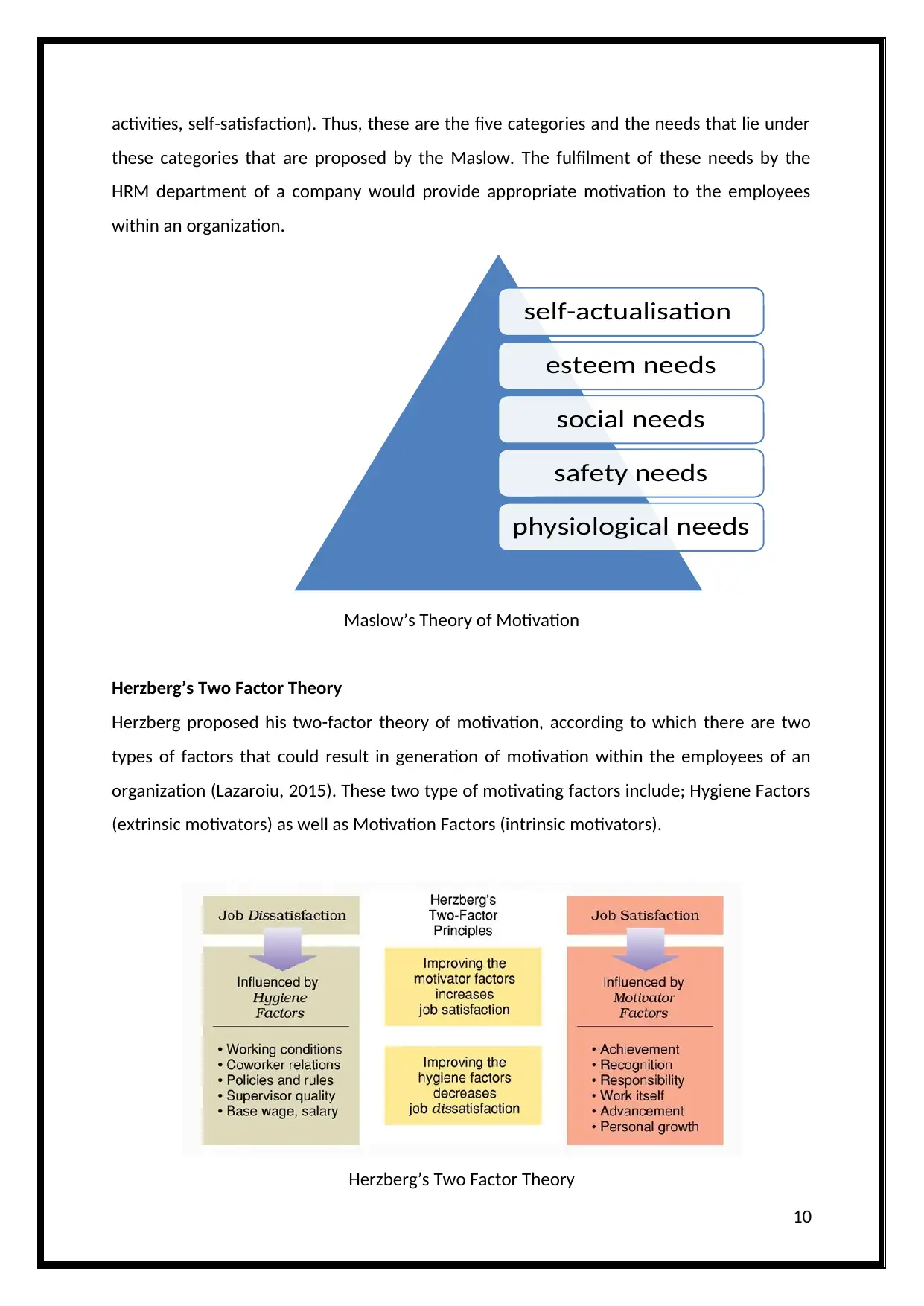
activities, self-satisfaction). Thus, these are the five categories and the needs that lie under
these categories that are proposed by the Maslow. The fulfilment of these needs by the
HRM department of a company would provide appropriate motivation to the employees
within an organization.
Maslow’s Theory of Motivation
Herzberg’s Two Factor Theory
Herzberg proposed his two-factor theory of motivation, according to which there are two
types of factors that could result in generation of motivation within the employees of an
organization (Lazaroiu, 2015). These two type of motivating factors include; Hygiene Factors
(extrinsic motivators) as well as Motivation Factors (intrinsic motivators).
Herzberg’s Two Factor Theory
10
self-actualisation
esteem needs
social needs
safety needs
physiological needs
these categories that are proposed by the Maslow. The fulfilment of these needs by the
HRM department of a company would provide appropriate motivation to the employees
within an organization.
Maslow’s Theory of Motivation
Herzberg’s Two Factor Theory
Herzberg proposed his two-factor theory of motivation, according to which there are two
types of factors that could result in generation of motivation within the employees of an
organization (Lazaroiu, 2015). These two type of motivating factors include; Hygiene Factors
(extrinsic motivators) as well as Motivation Factors (intrinsic motivators).
Herzberg’s Two Factor Theory
10
self-actualisation
esteem needs
social needs
safety needs
physiological needs
[Source: Lazaroiu, 2015]
Alderfer’s Erg Theory
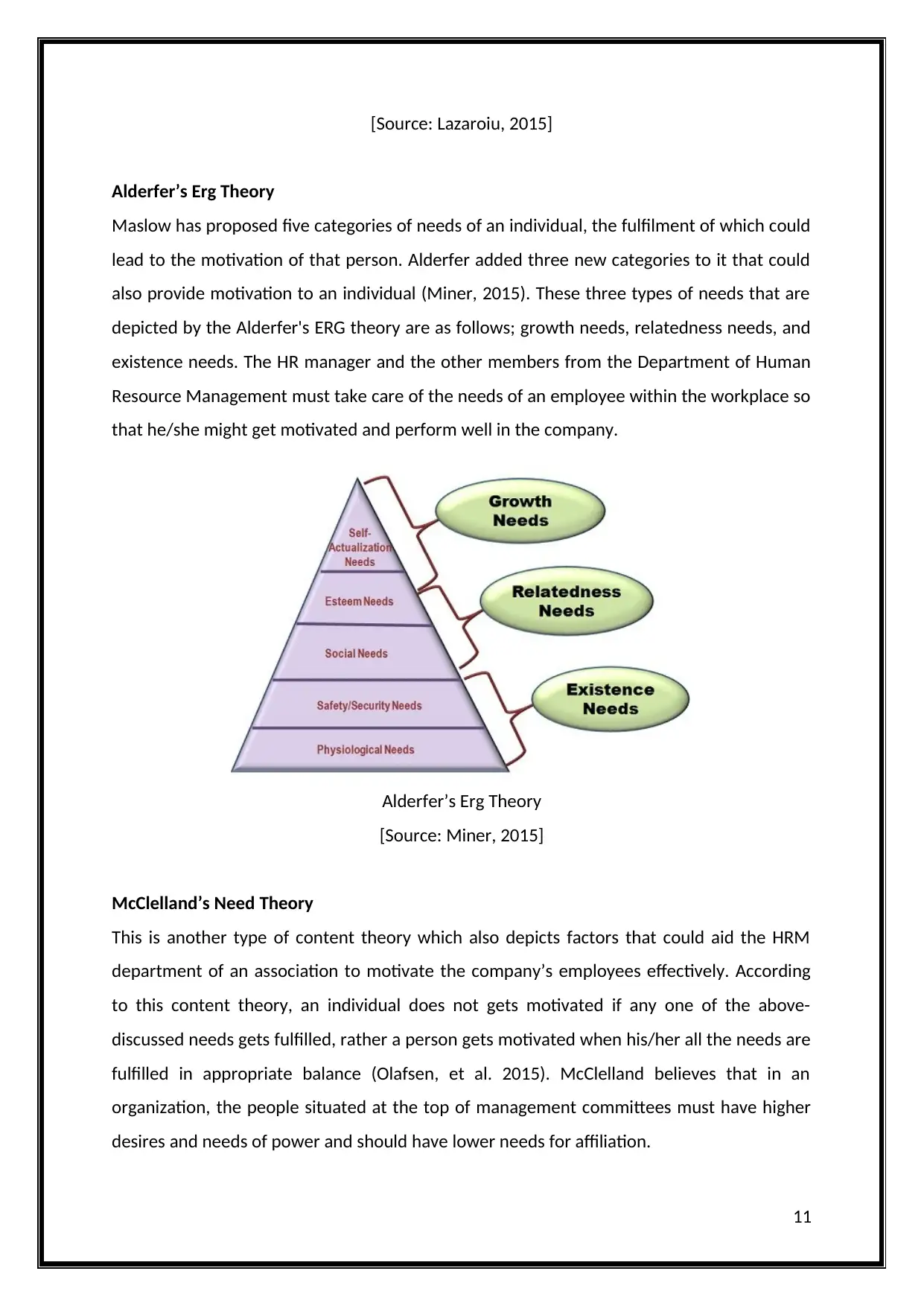
Maslow has proposed five categories of needs of an individual, the fulfilment of which could
lead to the motivation of that person. Alderfer added three new categories to it that could
also provide motivation to an individual (Miner, 2015). These three types of needs that are
depicted by the Alderfer's ERG theory are as follows; growth needs, relatedness needs, and
existence needs. The HR manager and the other members from the Department of Human
Resource Management must take care of the needs of an employee within the workplace so
that he/she might get motivated and perform well in the company.
Alderfer’s Erg Theory
[Source: Miner, 2015]
McClelland’s Need Theory
This is another type of content theory which also depicts factors that could aid the HRM
department of an association to motivate the company’s employees effectively. According
to this content theory, an individual does not gets motivated if any one of the above-
discussed needs gets fulfilled, rather a person gets motivated when his/her all the needs are
fulfilled in appropriate balance (Olafsen, et al. 2015). McClelland believes that in an
organization, the people situated at the top of management committees must have higher
desires and needs of power and should have lower needs for affiliation.
11
Alderfer’s Erg Theory
Maslow has proposed five categories of needs of an individual, the fulfilment of which could
lead to the motivation of that person. Alderfer added three new categories to it that could
also provide motivation to an individual (Miner, 2015). These three types of needs that are
depicted by the Alderfer's ERG theory are as follows; growth needs, relatedness needs, and
existence needs. The HR manager and the other members from the Department of Human
Resource Management must take care of the needs of an employee within the workplace so
that he/she might get motivated and perform well in the company.
Alderfer’s Erg Theory
[Source: Miner, 2015]
McClelland’s Need Theory
This is another type of content theory which also depicts factors that could aid the HRM
department of an association to motivate the company’s employees effectively. According
to this content theory, an individual does not gets motivated if any one of the above-
discussed needs gets fulfilled, rather a person gets motivated when his/her all the needs are
fulfilled in appropriate balance (Olafsen, et al. 2015). McClelland believes that in an
organization, the people situated at the top of management committees must have higher
desires and needs of power and should have lower needs for affiliation.
11
⊘ This is a preview!⊘
Do you want full access?
Subscribe today to unlock all pages.
Trusted by 1+ million students worldwide

1 out of 25


Related Documents


Your All-in-One AI-Powered Toolkit for Academic Success.
+13062052269
info@desklib.com
Available 24*7 on WhatsApp / Email
![[object Object]](/_next/static/media/star-bottom.7253800d.svg)
Unlock your academic potential
Copyright © 2020–2026 A2Z Services. All Rights Reserved. Developed and managed by ZUCOL.