Analyzing Employee Motivation Strategies: Marks & Spencer Report
VerifiedAdded on 2020/01/07
|9
|2573
|434
Report
AI Summary
This report examines employee motivation within Marks & Spencer, a leading clothing retailer. It explores the application of Maslow's Hierarchy of Needs and Herzberg's Two-Factor Theory to enhance employee performance and satisfaction. The report discusses the business issue of intense competition in the retail industry and the importance of employee motivation for customer satisfaction and operational efficiency. It details how Marks & Spencer can utilize Maslow's theory to address employees' physiological, safety, belongingness, esteem, and self-actualization needs, while acknowledging the challenges of diverse employee needs in a global context. Furthermore, the report analyzes Herzberg's theory, emphasizing hygiene factors (e.g., pay, working conditions) and motivators (e.g., recognition, responsibility) to foster a positive work environment and improve employee retention. The conclusion highlights the benefits of applying motivation theories to achieve organizational goals, improve employee morale, and gain a competitive advantage in the market. This report is a valuable resource for students seeking to understand leadership management and employee motivation strategies.

Organization Employee
Motivation
Motivation

Paraphrase This Document
Need a fresh take? Get an instant paraphrase of this document with our AI Paraphraser
Table of Contents
Introduction......................................................................................................................................3
Main body........................................................................................................................................3
Business issue..............................................................................................................................3
Maslow theory of motivation.......................................................................................................3
Herzberg two factor theory of motivation...................................................................................5
Conclusion.......................................................................................................................................7
References........................................................................................................................................9
Introduction......................................................................................................................................3
Main body........................................................................................................................................3
Business issue..............................................................................................................................3
Maslow theory of motivation.......................................................................................................3
Herzberg two factor theory of motivation...................................................................................5
Conclusion.......................................................................................................................................7
References........................................................................................................................................9
INTRODUCTION
In the modern era, management of human resource in organization has become one of the
most crucial aspects of companies. Furthermore, firms are required to take care of areas such as
employee motivation and retention in order to carry out smooth flow of operations and activities
(Maslow, 2013). For this purpose different tools and techniques of motivation are used by
businesses with an objective to carry manage workers and retain them for long run. The present
research report is based on Marks & Spencer which is one of the leading clothing retailers in all
across the globe. This study explains the use of different motivation theories to enhance the
overall performance of Marks & Spencer’s employees.
MAIN BODY
Business issue
It can be stated that over the past few years, the competition among businesses operating
in the clothing retail industry has become so intense that it is no longer easy for companies to
attract new customers and retain the old ones. Nowadays, businesses have started focusing upon
need and demand of employees with an objective to enhance their skill set and make them more
effective. The rationale behind this is that it helps companies to enhance their degree of customer
satisfaction and carry out smooth flow of operations (Nuttin, 2014). Along with this,
organizations are also using different types of motivation theories such as Maslow and Herzberg
to motivate workers and encourage them to give their best.
Maslow theory of motivation
This theory of motivation was developed and presented by Abraham Maslow in the year
1940-50s. The main objective behind development of this theory was to identify key ways which
can be used to encourage people in the organization to give their best towards success and
accomplishment of aim and objectives. Furthermore, this theory developed by Abraham Maslow
is considered as one of the most popular and effective theory in context of employee motivation.
As per this theory employees in organization can be motivated in situations when their need and
demand has been achieved in the best possible manner (Petri and Govern, 2012). This means it is
required by employer to understand the need of employees working at different level of
management and then take corrective measures for the satisfaction of those needs in order to
motivate workers. However, it can be argued that for a business such as Marks & Spencer
In the modern era, management of human resource in organization has become one of the
most crucial aspects of companies. Furthermore, firms are required to take care of areas such as
employee motivation and retention in order to carry out smooth flow of operations and activities
(Maslow, 2013). For this purpose different tools and techniques of motivation are used by
businesses with an objective to carry manage workers and retain them for long run. The present
research report is based on Marks & Spencer which is one of the leading clothing retailers in all
across the globe. This study explains the use of different motivation theories to enhance the
overall performance of Marks & Spencer’s employees.
MAIN BODY
Business issue
It can be stated that over the past few years, the competition among businesses operating
in the clothing retail industry has become so intense that it is no longer easy for companies to
attract new customers and retain the old ones. Nowadays, businesses have started focusing upon
need and demand of employees with an objective to enhance their skill set and make them more
effective. The rationale behind this is that it helps companies to enhance their degree of customer
satisfaction and carry out smooth flow of operations (Nuttin, 2014). Along with this,
organizations are also using different types of motivation theories such as Maslow and Herzberg
to motivate workers and encourage them to give their best.
Maslow theory of motivation
This theory of motivation was developed and presented by Abraham Maslow in the year
1940-50s. The main objective behind development of this theory was to identify key ways which
can be used to encourage people in the organization to give their best towards success and
accomplishment of aim and objectives. Furthermore, this theory developed by Abraham Maslow
is considered as one of the most popular and effective theory in context of employee motivation.
As per this theory employees in organization can be motivated in situations when their need and
demand has been achieved in the best possible manner (Petri and Govern, 2012). This means it is
required by employer to understand the need of employees working at different level of
management and then take corrective measures for the satisfaction of those needs in order to
motivate workers. However, it can be argued that for a business such as Marks & Spencer
⊘ This is a preview!⊘
Do you want full access?
Subscribe today to unlock all pages.

Trusted by 1+ million students worldwide
identification of employee needs is a very challenging task as all workers has different set of
need and demand which needs to be taken care of.
According to this proposed theory of motivation, Marks & Spencer can enhance
performance of its lower level employee by identifying and satisfying their needs such as
physiological and safety. Further, these needs of employee can be of adequate food, air, shelter,
drink, safety, protection and stability. The theory clearly highlights the fact that performance of
people working in organization can be enhanced by satisfaction of all the above mentioned needs
(Maslow, 2015). The rationale behind this is that need satisfaction act as driving force and
encourages staff members to give their best towards success of organization. In his need
hierarchy theory, Maslow presented that after fulfilment of physiological and safety needs, a
person seeks for satisfying needs such as belongingness, love, esteem and at last self
actualization (Latham, 2012). This means for the purpose of enhancing performance of
employees and motivating them to give their best, it is required by Marks & Spencer to develop
effective strategies and work towards accomplishment of needs of employee working at different
managerial level.
This theory is considered as one of the most renowned theories in terms of employee
motivation because of the fact that it directly takes nature of human being into consideration. on
the contrary of this, it can be argued that the main drawback associated with the use of this
theory is that it do not considered the social and cultural difference which exists among people in
the organization (Kanfer and Chen, 2016). At the time of using this theory of motivation, it is
required by Marks & Spencer to take care of the fact that different employees have different set
of demand and needs. It can be also asserted that being a global brand, the selected business is
required to consider the fact that it is not necessary that employee working in Marks & Spencer’s
Singapore as same hierarchy of needs as that of a person working in Marks & Spencer’s UK.
Apart from this, it is also required by the selected business enterprise to focus on different
needs of all its workers. Employee will feel motivated and their morale level will also get
enhanced in situations where their personal and professional needs are being satisfied by their
respective employer (Park and Ryoo, 2013). This will also support in developing a positive
environment at workplace and will encourage high degree of coordination among people
working in Marks & Spencer. Other than this, the use of Maslow needs hierarchy theory will also
need and demand which needs to be taken care of.
According to this proposed theory of motivation, Marks & Spencer can enhance
performance of its lower level employee by identifying and satisfying their needs such as
physiological and safety. Further, these needs of employee can be of adequate food, air, shelter,
drink, safety, protection and stability. The theory clearly highlights the fact that performance of
people working in organization can be enhanced by satisfaction of all the above mentioned needs
(Maslow, 2015). The rationale behind this is that need satisfaction act as driving force and
encourages staff members to give their best towards success of organization. In his need
hierarchy theory, Maslow presented that after fulfilment of physiological and safety needs, a
person seeks for satisfying needs such as belongingness, love, esteem and at last self
actualization (Latham, 2012). This means for the purpose of enhancing performance of
employees and motivating them to give their best, it is required by Marks & Spencer to develop
effective strategies and work towards accomplishment of needs of employee working at different
managerial level.
This theory is considered as one of the most renowned theories in terms of employee
motivation because of the fact that it directly takes nature of human being into consideration. on
the contrary of this, it can be argued that the main drawback associated with the use of this
theory is that it do not considered the social and cultural difference which exists among people in
the organization (Kanfer and Chen, 2016). At the time of using this theory of motivation, it is
required by Marks & Spencer to take care of the fact that different employees have different set
of demand and needs. It can be also asserted that being a global brand, the selected business is
required to consider the fact that it is not necessary that employee working in Marks & Spencer’s
Singapore as same hierarchy of needs as that of a person working in Marks & Spencer’s UK.
Apart from this, it is also required by the selected business enterprise to focus on different
needs of all its workers. Employee will feel motivated and their morale level will also get
enhanced in situations where their personal and professional needs are being satisfied by their
respective employer (Park and Ryoo, 2013). This will also support in developing a positive
environment at workplace and will encourage high degree of coordination among people
working in Marks & Spencer. Other than this, the use of Maslow needs hierarchy theory will also
Paraphrase This Document
Need a fresh take? Get an instant paraphrase of this document with our AI Paraphraser
support the selected business enterprise to gain competitive advantage over other key player in
the market.
Herzberg two factor theory of motivation
On the other side of this, Marks & Spencer’s can also motivate its workers by using
theories such as Herzberg two factor theory. This theory was developed and proposed in the year
1959 by Frederick Herzberg with an objective to make people and organization aware about the
key strategies which can be used to motivate and encourage employees. As per the theory,
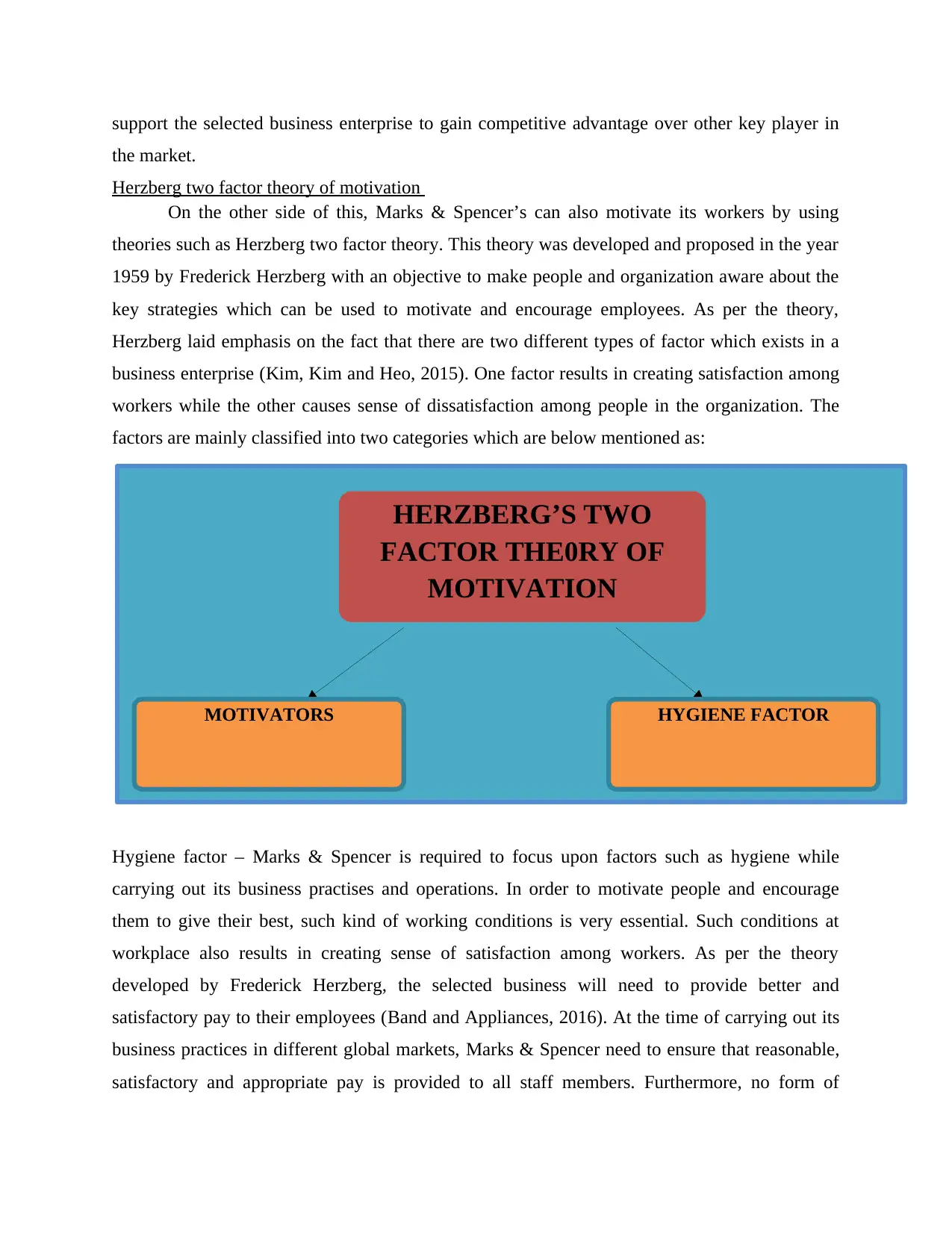
Herzberg laid emphasis on the fact that there are two different types of factor which exists in a
business enterprise (Kim, Kim and Heo, 2015). One factor results in creating satisfaction among
workers while the other causes sense of dissatisfaction among people in the organization. The
factors are mainly classified into two categories which are below mentioned as:
Hygiene factor – Marks & Spencer is required to focus upon factors such as hygiene while
carrying out its business practises and operations. In order to motivate people and encourage
them to give their best, such kind of working conditions is very essential. Such conditions at
workplace also results in creating sense of satisfaction among workers. As per the theory
developed by Frederick Herzberg, the selected business will need to provide better and
satisfactory pay to their employees (Band and Appliances, 2016). At the time of carrying out its
business practices in different global markets, Marks & Spencer need to ensure that reasonable,
satisfactory and appropriate pay is provided to all staff members. Furthermore, no form of
HERZBERG’S TWO
FACTOR THE0RY OF
MOTIVATION
MOTIVATORS HYGIENE FACTOR
the market.
Herzberg two factor theory of motivation
On the other side of this, Marks & Spencer’s can also motivate its workers by using
theories such as Herzberg two factor theory. This theory was developed and proposed in the year
1959 by Frederick Herzberg with an objective to make people and organization aware about the
key strategies which can be used to motivate and encourage employees. As per the theory,
Herzberg laid emphasis on the fact that there are two different types of factor which exists in a
business enterprise (Kim, Kim and Heo, 2015). One factor results in creating satisfaction among
workers while the other causes sense of dissatisfaction among people in the organization. The
factors are mainly classified into two categories which are below mentioned as:
Hygiene factor – Marks & Spencer is required to focus upon factors such as hygiene while
carrying out its business practises and operations. In order to motivate people and encourage
them to give their best, such kind of working conditions is very essential. Such conditions at
workplace also results in creating sense of satisfaction among workers. As per the theory
developed by Frederick Herzberg, the selected business will need to provide better and
satisfactory pay to their employees (Band and Appliances, 2016). At the time of carrying out its
business practices in different global markets, Marks & Spencer need to ensure that reasonable,
satisfactory and appropriate pay is provided to all staff members. Furthermore, no form of
HERZBERG’S TWO
FACTOR THE0RY OF
MOTIVATION
MOTIVATORS HYGIENE FACTOR
discrimination should be carried out among employees at the time of defining and offering them
with the pay.
Apart from this, the salaries, wages and other related benefits provided to workers also
need to be competitive as per the standard of industry. On the other side of this, Marks &
Spencer also required to concentrate upon its overall management procedures and policies. As
per the theory developed by Herzberg, fair and transparent working policies also play a very
important role in the entire process of motivating people in a business enterprise.
Other than this, fringe benefits, physical working conditions, status, interpersonal
relations and job security are the key elements or hygienic factor which results in creating sense
of satisfaction among workers and motivating them towards giving their best. It can be stated
that while carrying out its business operations, it is required by Marks & Spencer to ensure that
working conditions provided to staff members are safe, hygienic and clean in the best possible
manner. It can be also argued that if focus is not laid upon the above mentioned elements the
chances of increasing dissatisfaction among workers directly increases to a great level (Ghazi,
Shahzada and Khan, 2013). The selected business enterprise will also need to make efforts to
retain the status of all its workers and to develop a good interpersonal relationship among them.
Furthermore, lack of trust and coordination among workers may directly results in increasing rate
of turnover and lowering down the morale level of employees. In the modern era, retaining
employees for long run is considered as one of the most complicated task for businesses.
Management of Marks & Spencer need to provide job security to workers and also need to lay
emphasis on their personal and professional growth.
Apart from hygienic factors, it is required by Marks & Spencer to focus upon some key
motivational factors. These factors directly results in developing sense of satisfaction among
staff members and also encourages them to give their best towards accomplishment of
organizational goals. It can be expressed that while carrying out their operations and activities,
the brand needs to ensure that the efforts and hard work of staff members is recognized and
appreciated in the best possible manner (Yusoff, Kian and Idris, 2013). While carrying out the
assigned task and activities employees at Marks & Spencer should actually feel sense of
achievement. This will directly boost up their morale and will also results in enhancing the
overall degree of positivity.
with the pay.
Apart from this, the salaries, wages and other related benefits provided to workers also
need to be competitive as per the standard of industry. On the other side of this, Marks &
Spencer also required to concentrate upon its overall management procedures and policies. As
per the theory developed by Herzberg, fair and transparent working policies also play a very
important role in the entire process of motivating people in a business enterprise.
Other than this, fringe benefits, physical working conditions, status, interpersonal
relations and job security are the key elements or hygienic factor which results in creating sense
of satisfaction among workers and motivating them towards giving their best. It can be stated
that while carrying out its business operations, it is required by Marks & Spencer to ensure that
working conditions provided to staff members are safe, hygienic and clean in the best possible
manner. It can be also argued that if focus is not laid upon the above mentioned elements the
chances of increasing dissatisfaction among workers directly increases to a great level (Ghazi,
Shahzada and Khan, 2013). The selected business enterprise will also need to make efforts to
retain the status of all its workers and to develop a good interpersonal relationship among them.
Furthermore, lack of trust and coordination among workers may directly results in increasing rate
of turnover and lowering down the morale level of employees. In the modern era, retaining
employees for long run is considered as one of the most complicated task for businesses.
Management of Marks & Spencer need to provide job security to workers and also need to lay
emphasis on their personal and professional growth.
Apart from hygienic factors, it is required by Marks & Spencer to focus upon some key
motivational factors. These factors directly results in developing sense of satisfaction among
staff members and also encourages them to give their best towards accomplishment of
organizational goals. It can be expressed that while carrying out their operations and activities,
the brand needs to ensure that the efforts and hard work of staff members is recognized and
appreciated in the best possible manner (Yusoff, Kian and Idris, 2013). While carrying out the
assigned task and activities employees at Marks & Spencer should actually feel sense of
achievement. This will directly boost up their morale and will also results in enhancing the
overall degree of positivity.
⊘ This is a preview!⊘
Do you want full access?
Subscribe today to unlock all pages.
Trusted by 1+ million students worldwide
However, it can be critically argued that management of selected business enterprise also
need to lay emphasis on providing higher responsibilities and authorities to their employees.
Thus, it can be stated that the use of Herzberg two factor theory is beneficial for long term
growth and success of companies such as Marks & Spencer. On the contrary of this, it can be
critically argued that the main drawback associated with the theory is that it assumes that there is
a correlation between productivity and employee satisfaction and this cannot be same. There are
certain situations when workers are able to give their best but they are not satisfied internally.
From the above carried out discussion, it has been observed by the researcher that both
the theories play very important role in enhancing the overall performance of people in a
business enterprise. The use of motivation theories helps in accomplishment of businesses
objectives and also contributes in long term success of a company.
It can be stated that the use of employee motivation will allow Marks & Spencer to
satisfy need of all its workers and encourage them to put more efforts. In terms of staff members,
it can be stated that use of motivational theories will enhance overall productivity as they provide
employees with adequate job satisfied (Maslow, 2013). Furthermore, employees with higher
morale and motivation level are always able to deliver desired and satisfactory performance for
the long term success of businesses such as Marks & Spencer.
The use of Maslow and Herzberg two factor theory will also allow Marks & Spencer to
develop an open and positive working environment. It can be also stated that there is a direct
relations who exist among employee performance and motivation. For example employees with
high motivation and morale level are being able to deliver satisfactory and more effective
performance for the success of organization. It also helps international businesses such as Marks
& Spencer to deal with issues such as high rate of employee turnover and intense competition in
the marketplace (Kanfer. and Chen, 2016). The use of different motivational theories will allow
selected business enterprise to encourage creative ideas and suggestions which can be used to
deliver more satisfactory products and services to clients. However, at the time of rewarding
employees, the business will be required to use a fair and transparent system so that workers can
stay motivated for long run.
CONCLUSION
From the above carried out research report, it can be concluded that the use motivational
theory can play very important role in enhancing the overall performance of people in the
need to lay emphasis on providing higher responsibilities and authorities to their employees.
Thus, it can be stated that the use of Herzberg two factor theory is beneficial for long term
growth and success of companies such as Marks & Spencer. On the contrary of this, it can be
critically argued that the main drawback associated with the theory is that it assumes that there is
a correlation between productivity and employee satisfaction and this cannot be same. There are
certain situations when workers are able to give their best but they are not satisfied internally.
From the above carried out discussion, it has been observed by the researcher that both
the theories play very important role in enhancing the overall performance of people in a
business enterprise. The use of motivation theories helps in accomplishment of businesses
objectives and also contributes in long term success of a company.
It can be stated that the use of employee motivation will allow Marks & Spencer to
satisfy need of all its workers and encourage them to put more efforts. In terms of staff members,
it can be stated that use of motivational theories will enhance overall productivity as they provide
employees with adequate job satisfied (Maslow, 2013). Furthermore, employees with higher
morale and motivation level are always able to deliver desired and satisfactory performance for
the long term success of businesses such as Marks & Spencer.
The use of Maslow and Herzberg two factor theory will also allow Marks & Spencer to
develop an open and positive working environment. It can be also stated that there is a direct
relations who exist among employee performance and motivation. For example employees with
high motivation and morale level are being able to deliver satisfactory and more effective
performance for the success of organization. It also helps international businesses such as Marks
& Spencer to deal with issues such as high rate of employee turnover and intense competition in
the marketplace (Kanfer. and Chen, 2016). The use of different motivational theories will allow
selected business enterprise to encourage creative ideas and suggestions which can be used to
deliver more satisfactory products and services to clients. However, at the time of rewarding
employees, the business will be required to use a fair and transparent system so that workers can
stay motivated for long run.
CONCLUSION
From the above carried out research report, it can be concluded that the use motivational
theory can play very important role in enhancing the overall performance of people in the
Paraphrase This Document
Need a fresh take? Get an instant paraphrase of this document with our AI Paraphraser
organization. Furthermore, it can be also inferred that Maslow need hierarchy theory is
completely different from Herzberg two factor theory. As per Maslow theory, it is required by
companies such as Marks & Spencer to identify the need of employee and take corrective
measures for the satisfaction of the same. On the other side of this, Herzberg two factor theory
encourages the company to focus upon two major factors which are motivators and hygiene.
completely different from Herzberg two factor theory. As per Maslow theory, it is required by
companies such as Marks & Spencer to identify the need of employee and take corrective
measures for the satisfaction of the same. On the other side of this, Herzberg two factor theory
encourages the company to focus upon two major factors which are motivators and hygiene.
REFERENCES
Books and Journals
Maslow, A.H., 2013. A theory of human motivation. Start Publishing LLC.
Nuttin, J., 2014. Future time perspective and motivation: Theory and research method.
Psychology Press.
Petri, H.L. and Govern, J.M., 2012. Motivation: Theory, research, and application. Cengage
Learning.
Maslow, A.H., 2015. A theory of Human Motivation. Classics of Organization Theory, 50,
p.142.
Kanfer, R. and Chen, G., 2016. Motivation in organizational behavior: History, advances and
prospects. Organizational Behavior and Human Decision Processes, 136, pp.6-19.
Latham, G.P., 2012. Work motivation: History, theory, research, and practice. Sage.
Park, S.C. and Ryoo, S.Y., 2013. An empirical investigation of end-users’ switching toward
cloud computing: A two factor theory perspective. Computers in Human Behavior, 29(1),
pp.160-170.
Kim, B.N., Kim, S. and Heo, C.Y., 2015. An application of Herzberg’s two-factor theory on
online hotel reviews.
Band, G., Shah, N.V., Sriram, R. and Appliances, E., 2016. Herzberg Two Factor Theory among
the Management Faculty in Nagpur City. In International Conference on Management
and Information Systems September (Vol. 23, p. 24).
Ghazi, S.R., Shahzada, G. and Khan, M.S., 2013. Resurrecting Herzberg’s two factor theory: An
implication to the university teachers. Journal of Educational and Social Research, 3(2),
p.445.
Yusoff, W.F.W., Kian, T.S. and Idris, M.T.M., 2013. Herzberg’s Two Factors Theory On Work
Motivation: Does Its Work For Todays Environment. Global journal of commerce and
Management, 2(5), pp.18-22.
Books and Journals
Maslow, A.H., 2013. A theory of human motivation. Start Publishing LLC.
Nuttin, J., 2014. Future time perspective and motivation: Theory and research method.
Psychology Press.
Petri, H.L. and Govern, J.M., 2012. Motivation: Theory, research, and application. Cengage
Learning.
Maslow, A.H., 2015. A theory of Human Motivation. Classics of Organization Theory, 50,
p.142.
Kanfer, R. and Chen, G., 2016. Motivation in organizational behavior: History, advances and
prospects. Organizational Behavior and Human Decision Processes, 136, pp.6-19.
Latham, G.P., 2012. Work motivation: History, theory, research, and practice. Sage.
Park, S.C. and Ryoo, S.Y., 2013. An empirical investigation of end-users’ switching toward
cloud computing: A two factor theory perspective. Computers in Human Behavior, 29(1),
pp.160-170.
Kim, B.N., Kim, S. and Heo, C.Y., 2015. An application of Herzberg’s two-factor theory on
online hotel reviews.
Band, G., Shah, N.V., Sriram, R. and Appliances, E., 2016. Herzberg Two Factor Theory among
the Management Faculty in Nagpur City. In International Conference on Management
and Information Systems September (Vol. 23, p. 24).
Ghazi, S.R., Shahzada, G. and Khan, M.S., 2013. Resurrecting Herzberg’s two factor theory: An
implication to the university teachers. Journal of Educational and Social Research, 3(2),
p.445.
Yusoff, W.F.W., Kian, T.S. and Idris, M.T.M., 2013. Herzberg’s Two Factors Theory On Work
Motivation: Does Its Work For Todays Environment. Global journal of commerce and
Management, 2(5), pp.18-22.
⊘ This is a preview!⊘
Do you want full access?
Subscribe today to unlock all pages.
Trusted by 1+ million students worldwide

1 out of 9


Related Documents


Your All-in-One AI-Powered Toolkit for Academic Success.
+13062052269
info@desklib.com
Available 24*7 on WhatsApp / Email
![[object Object]](/_next/static/media/star-bottom.7253800d.svg)
Unlock your academic potential
Copyright © 2020–2026 A2Z Services. All Rights Reserved. Developed and managed by ZUCOL.