Motivating and Rewarding Employees and Cessation of Employment Report
VerifiedAdded on 2020/03/07
|12
|3201
|229
Report
AI Summary
This report delves into the strategies employed by Supermart Plc to motivate and reward its employees. It examines the link between motivational theories, such as Maslow's and Herzberg's, and the implementation of financial and non-financial reward systems. The report evaluates the process of job evaluation, considering factors that determine pay, and assesses the effectiveness of different reward systems within the company's context. Furthermore, it explores the methods used by Supermart Plc to monitor employee performance, including feedback, appraisals, and observation. The report also identifies the reasons for the cessation of employment, such as resignation and termination, and describes the employment exit procedures. Finally, it considers the impact of the legal and regulatory framework on employment cessation arrangements within the company. The report highlights the importance of motivation, reward systems, and effective management practices in fostering a productive and satisfied workforce. This report provides valuable insights into employee management strategies within Supermart Plc.

Motivating and Rewarding Employees and Cessation of Employment
1
1

Paraphrase This Document
Need a fresh take? Get an instant paraphrase of this document with our AI Paraphraser
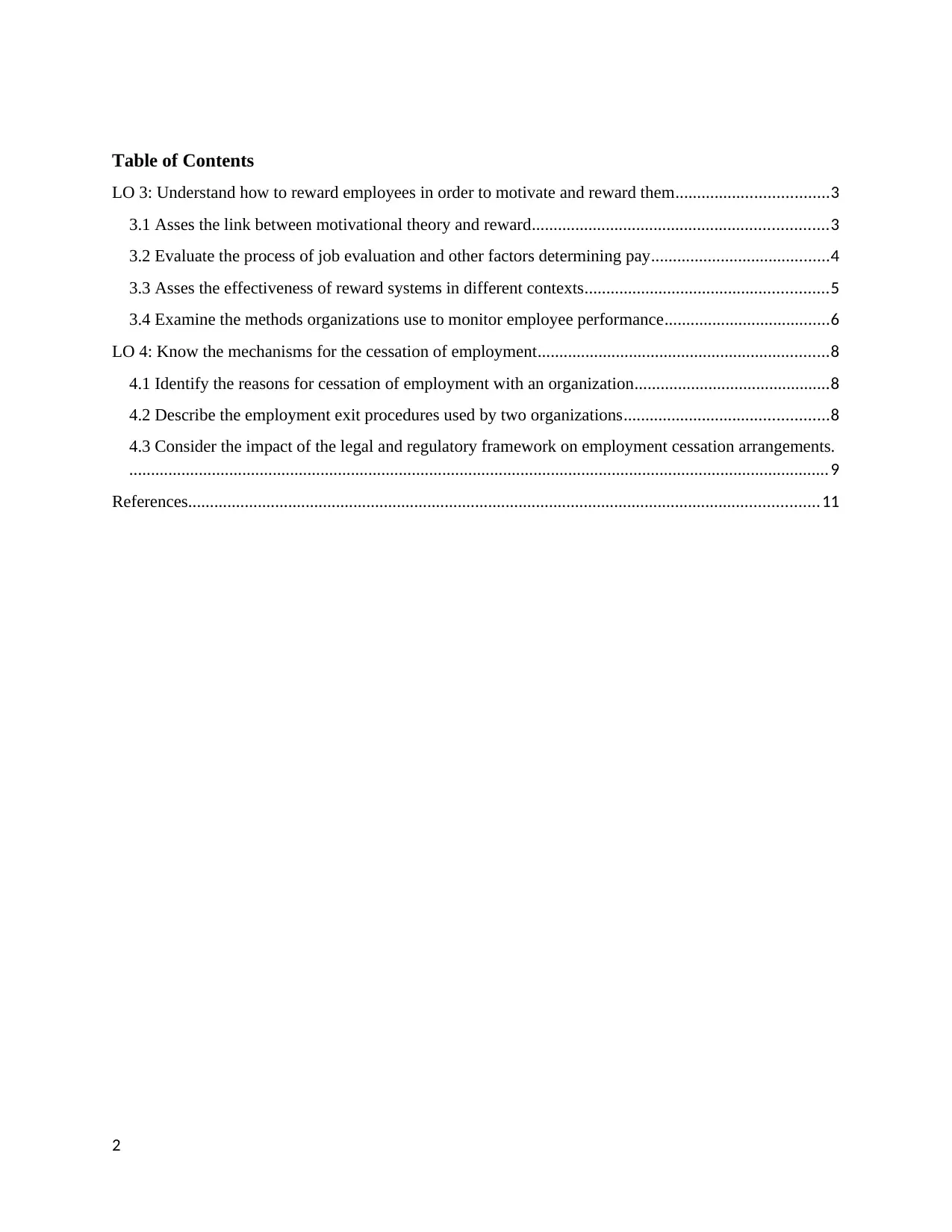
Table of Contents
LO 3: Understand how to reward employees in order to motivate and reward them...................................3
3.1 Asses the link between motivational theory and reward....................................................................3
3.2 Evaluate the process of job evaluation and other factors determining pay.........................................4
3.3 Asses the effectiveness of reward systems in different contexts........................................................5
3.4 Examine the methods organizations use to monitor employee performance......................................6
LO 4: Know the mechanisms for the cessation of employment...................................................................8
4.1 Identify the reasons for cessation of employment with an organization.............................................8
4.2 Describe the employment exit procedures used by two organizations...............................................8
4.3 Consider the impact of the legal and regulatory framework on employment cessation arrangements.
.................................................................................................................................................................9
References.................................................................................................................................................11
2
LO 3: Understand how to reward employees in order to motivate and reward them...................................3
3.1 Asses the link between motivational theory and reward....................................................................3
3.2 Evaluate the process of job evaluation and other factors determining pay.........................................4
3.3 Asses the effectiveness of reward systems in different contexts........................................................5
3.4 Examine the methods organizations use to monitor employee performance......................................6
LO 4: Know the mechanisms for the cessation of employment...................................................................8
4.1 Identify the reasons for cessation of employment with an organization.............................................8
4.2 Describe the employment exit procedures used by two organizations...............................................8
4.3 Consider the impact of the legal and regulatory framework on employment cessation arrangements.
.................................................................................................................................................................9
References.................................................................................................................................................11
2

LO 3: Understand how to reward employees in order to motivate and reward them
3.1 Asses the link between motivational theory and reward
Motivation is the approach through which the behavior of the labor force in Supermart Plc is
encouraged by filling their objectives and needs. The motivational models put importance on the
original procedure of motivation at the working place (Davidson, 2012). Motivation is the only
aim for any certain behavior of a person. It is the optimistic influence of anything that
encourages the person to do something. Motivation is quite significant at the working place. It
also benefitted the workers in order to labor efficiently in the company. It is imperative to
motivate workers as this motivation supports the workers to accomplish their certain objectives
at the working place.
The motivational theories used in Supermart Plc are Maslow’s motivational theory and
Herzberg motivational theory (Björnsson et al., 2015) . These theories signify that the workers
can only be motivated through fulfilling their goals and needs and also by attaining job
satisfaction. The motivational theory and reward are interdependent and interlinked with one
another. Without reward, there is no use of motivational theories in the working place. In
additions this, without motivational theories the reward can’t be able to use as an approach for
motivating purpose. Giving rewards to the workers of the company helps them to be more
productive and also raise their job performance as well.
There are mainly two types of rewards which are provided by Supermart Plc to their
employees, those two rewards are shown in the following:
Financial Rewards- Financial rewards are those rewards that are considered as the monetary
incentives which workers earn due to their excellent performances in their respective field. All
financial rewards are tangible in nature (Gorman, 2007). Tangible rewards are also considered as
an extrinsic motivation. There are various kinds of financial rewards which the company
provides to their employees. Increment in wages and bonuses are the two kinds of financial
rewards provided to their employees.
Non-Financial rewards- Non-financial rewards are the rewards from which employees are
benefitted and get more job satisfaction, but not increase financial well-being. It consists of
3
3.1 Asses the link between motivational theory and reward
Motivation is the approach through which the behavior of the labor force in Supermart Plc is
encouraged by filling their objectives and needs. The motivational models put importance on the
original procedure of motivation at the working place (Davidson, 2012). Motivation is the only
aim for any certain behavior of a person. It is the optimistic influence of anything that
encourages the person to do something. Motivation is quite significant at the working place. It
also benefitted the workers in order to labor efficiently in the company. It is imperative to
motivate workers as this motivation supports the workers to accomplish their certain objectives
at the working place.
The motivational theories used in Supermart Plc are Maslow’s motivational theory and
Herzberg motivational theory (Björnsson et al., 2015) . These theories signify that the workers
can only be motivated through fulfilling their goals and needs and also by attaining job
satisfaction. The motivational theory and reward are interdependent and interlinked with one
another. Without reward, there is no use of motivational theories in the working place. In
additions this, without motivational theories the reward can’t be able to use as an approach for
motivating purpose. Giving rewards to the workers of the company helps them to be more
productive and also raise their job performance as well.
There are mainly two types of rewards which are provided by Supermart Plc to their
employees, those two rewards are shown in the following:
Financial Rewards- Financial rewards are those rewards that are considered as the monetary
incentives which workers earn due to their excellent performances in their respective field. All
financial rewards are tangible in nature (Gorman, 2007). Tangible rewards are also considered as
an extrinsic motivation. There are various kinds of financial rewards which the company
provides to their employees. Increment in wages and bonuses are the two kinds of financial
rewards provided to their employees.
Non-Financial rewards- Non-financial rewards are the rewards from which employees are
benefitted and get more job satisfaction, but not increase financial well-being. It consists of
3
⊘ This is a preview!⊘
Do you want full access?
Subscribe today to unlock all pages.

Trusted by 1+ million students worldwide
achievement, promotion, praise, job cards, demanded work assignment and also impressive job
title (Long, 2012). The management of Supermart Plc uses appraisals, engagement in decisions
making process and also self-rating in order to motivate their labor force to gain improved and
excellent outcome.
The management of Supermart Plc uses both motivational theories to motivate their
employees, as Herzberg theory of motivation helps in providing more job increment to the
employees. Whereas, with the help of Maslow’s motivational theory employees gets chance of
self-achievement which in return motivates them to be more productive.
3.2 Evaluate the process of job evaluation and other factors determining pay
For the purpose of defining the value and position of the job within the company, Supermart Plc
uses job evaluation process that helps to know and determine the actual worth of jobs. Analysis
of the value of jobs helps the company to create the hierarchy system within the firm (O'Neil,
Drillings and O'Neil, 2012). Job evaluation is the procedure of identifying the responsibilities
and roles linked with the job and ranking them based on their value. Ratings can be marked by
the range as well as prominence of roles related to the job. The process of job evaluation has
been segmented according to the job activities:
Procedure of Job evaluation
Job Enquiry- This is the method of conducting appropriate information of the job and
indentifying them for determining the responsibilities and roles related to it (O'Neil,
Drillings and O'Neil, 2012). It is utilized for determining as well as analyzing the job
contents and the events associated with the job specification which is require achieving
during doing that job.
Job Ranking- Job rating is simply the dimension of the job accountabilities and rating
them based on their value (Aguinis and Lengnick-Hall, 2012). It is the step that includes
distribution of the possessions to the activities associated with the job. Resources
distribution to the job actions supports the company for determining the pay ratio of that
specific job.
Other factors determining pay
4
title (Long, 2012). The management of Supermart Plc uses appraisals, engagement in decisions
making process and also self-rating in order to motivate their labor force to gain improved and
excellent outcome.
The management of Supermart Plc uses both motivational theories to motivate their
employees, as Herzberg theory of motivation helps in providing more job increment to the
employees. Whereas, with the help of Maslow’s motivational theory employees gets chance of
self-achievement which in return motivates them to be more productive.
3.2 Evaluate the process of job evaluation and other factors determining pay
For the purpose of defining the value and position of the job within the company, Supermart Plc
uses job evaluation process that helps to know and determine the actual worth of jobs. Analysis
of the value of jobs helps the company to create the hierarchy system within the firm (O'Neil,
Drillings and O'Neil, 2012). Job evaluation is the procedure of identifying the responsibilities
and roles linked with the job and ranking them based on their value. Ratings can be marked by
the range as well as prominence of roles related to the job. The process of job evaluation has
been segmented according to the job activities:
Procedure of Job evaluation
Job Enquiry- This is the method of conducting appropriate information of the job and
indentifying them for determining the responsibilities and roles related to it (O'Neil,
Drillings and O'Neil, 2012). It is utilized for determining as well as analyzing the job
contents and the events associated with the job specification which is require achieving
during doing that job.
Job Ranking- Job rating is simply the dimension of the job accountabilities and rating
them based on their value (Aguinis and Lengnick-Hall, 2012). It is the step that includes
distribution of the possessions to the activities associated with the job. Resources
distribution to the job actions supports the company for determining the pay ratio of that
specific job.
Other factors determining pay
4
Paraphrase This Document
Need a fresh take? Get an instant paraphrase of this document with our AI Paraphraser
Reward system- Supermart Plc uses this factor to determine the job pay within the
company. Reward system is the method of giving rewards to the workers who plays
excellent than others and who ample their targets on given time (Aguinis and Lengnick-
Hall, 2012). Bonus scheme such as ASPIRE has been utilized by the organization to give
gratuity to the workers.
Compensation- Reimbursement is considered as the benefit which has been provided to
the workers by Supermart Plc. This supports in defining the pay of the job within the
company. The firm use this rewards system majorly because it is the most effective factor
to determine the job pay.
3.3 Asses the effectiveness of reward systems in different contexts
Rewards are the most significant factors for motivating the workers to work solely. It forms a
sense of rivalry in the minds of workers to accomplish their higher objectives. It is the human
nature that they work for the satisfaction and achievement which provide benefits (Beardwell
and Thompson, 2017). These benefits are the rewards which can be gained through the employee
in return of their excellent performances. It also considered as a lashing force which drives the
workers to perform more effectively. Rewards are in many forms and it is not essential that every
person get encouraged with the common type of rewards.
The reward at Supermart Plc includes extrinsic and intrinsic rewards given to the workers
working within the company under their employer. The reward system in Supermart Plc includes
administrative procedures, practices and also integrated policies in order to implement the
method in the framework of the human resources planning and the complete organizational
system (Došenović, 2016). The extrinsic rewards are the tangible rewards given to the workers
for their excellent t performances; the tangible rewards are bonuses, gifts, compensations,
promotions, salary increment and commissions. Whereas the intrinsic rewards give personal
gratification to the worker as it contains relationship, appreciation, feedback and trust. In
Supermart Plc, employee bonus system can also be used as a positive approach to motivate the
workers in an accurate path that result in the enhancement in level of productivity and better
enactment in the company. The employee bonus system takes into account the elements like
group performances, customers’ services, individual, quality and attendance to determine
according to the bonus that is given to the workers. This system even helps in enhancing their
5
company. Reward system is the method of giving rewards to the workers who plays
excellent than others and who ample their targets on given time (Aguinis and Lengnick-
Hall, 2012). Bonus scheme such as ASPIRE has been utilized by the organization to give
gratuity to the workers.
Compensation- Reimbursement is considered as the benefit which has been provided to
the workers by Supermart Plc. This supports in defining the pay of the job within the
company. The firm use this rewards system majorly because it is the most effective factor
to determine the job pay.
3.3 Asses the effectiveness of reward systems in different contexts
Rewards are the most significant factors for motivating the workers to work solely. It forms a
sense of rivalry in the minds of workers to accomplish their higher objectives. It is the human
nature that they work for the satisfaction and achievement which provide benefits (Beardwell
and Thompson, 2017). These benefits are the rewards which can be gained through the employee
in return of their excellent performances. It also considered as a lashing force which drives the
workers to perform more effectively. Rewards are in many forms and it is not essential that every
person get encouraged with the common type of rewards.
The reward at Supermart Plc includes extrinsic and intrinsic rewards given to the workers
working within the company under their employer. The reward system in Supermart Plc includes
administrative procedures, practices and also integrated policies in order to implement the
method in the framework of the human resources planning and the complete organizational
system (Došenović, 2016). The extrinsic rewards are the tangible rewards given to the workers
for their excellent t performances; the tangible rewards are bonuses, gifts, compensations,
promotions, salary increment and commissions. Whereas the intrinsic rewards give personal
gratification to the worker as it contains relationship, appreciation, feedback and trust. In
Supermart Plc, employee bonus system can also be used as a positive approach to motivate the
workers in an accurate path that result in the enhancement in level of productivity and better
enactment in the company. The employee bonus system takes into account the elements like
group performances, customers’ services, individual, quality and attendance to determine
according to the bonus that is given to the workers. This system even helps in enhancing their
5
morale and self-esteem. A careful and planned bonus supports the company for preserving their
best and hardworking employees.
The other reward system in Supermart Plc is the promotion. Under this reward system,
the reward is given to the workforces for their excellent enactment through moving them from
their recent position to a top position (Došenović, 2016). This reward also helps in carrying job
gratification between the workers and increase output and brings profitability. Increments in
salary are the main key for motivation and bring improvement in their performance level. All
these reward system in the company is much effective as it improves the performance level of
the employees also brings customers satisfaction benefits to the company.
Many workers get interested with financial factors whereas many other employees get
encouraged with the non- monetary factors. There are various philosophies have been projected
to analyze the motivational factors in the working field. Supermart Plc believes in the theory of
human relation also and observes that many workers get inspired if they get consideration. The
company even chooses attention and recognition as a kind of reward which motivate the
workers. Some of the programs like SHOUT, NPS and Championship have been launched in the
company to give attention to the employees who performs better.
3.4 Examine the methods organizations use to monitor employee performance
Monitoring is the procedure of checking and observing the performances of the employees; this
enables the organizations to evaluating the performances of the employees as well as
be4nerfitted to reward the workers accordingly. Companies require to monitor the employee’s
performances in order to take out the mistakes in the enactment as well as to take helpful
measures where require (Gunderson, 2001). For the purpose of monitoring the employee’s
performances within the company, Supermart Plc has used some of the methods like feedbacks,
appraisals and also proper observation. Under all these methods of monitoring, the company
hires an individual for regular and proper monitoring of the employee’s performances. After a
completing observation, the individual gives straightforward feedback. Feedback from the
executives of the hired department regarding the performance of the employees supports in
determining the position of the workers.
6
best and hardworking employees.
The other reward system in Supermart Plc is the promotion. Under this reward system,
the reward is given to the workforces for their excellent enactment through moving them from
their recent position to a top position (Došenović, 2016). This reward also helps in carrying job
gratification between the workers and increase output and brings profitability. Increments in
salary are the main key for motivation and bring improvement in their performance level. All
these reward system in the company is much effective as it improves the performance level of
the employees also brings customers satisfaction benefits to the company.
Many workers get interested with financial factors whereas many other employees get
encouraged with the non- monetary factors. There are various philosophies have been projected
to analyze the motivational factors in the working field. Supermart Plc believes in the theory of
human relation also and observes that many workers get inspired if they get consideration. The
company even chooses attention and recognition as a kind of reward which motivate the
workers. Some of the programs like SHOUT, NPS and Championship have been launched in the
company to give attention to the employees who performs better.
3.4 Examine the methods organizations use to monitor employee performance
Monitoring is the procedure of checking and observing the performances of the employees; this
enables the organizations to evaluating the performances of the employees as well as
be4nerfitted to reward the workers accordingly. Companies require to monitor the employee’s
performances in order to take out the mistakes in the enactment as well as to take helpful
measures where require (Gunderson, 2001). For the purpose of monitoring the employee’s
performances within the company, Supermart Plc has used some of the methods like feedbacks,
appraisals and also proper observation. Under all these methods of monitoring, the company
hires an individual for regular and proper monitoring of the employee’s performances. After a
completing observation, the individual gives straightforward feedback. Feedback from the
executives of the hired department regarding the performance of the employees supports in
determining the position of the workers.
6
⊘ This is a preview!⊘
Do you want full access?
Subscribe today to unlock all pages.
Trusted by 1+ million students worldwide
Another method that is used by the company is performance observing method, in this
method; the standard is set that workers have to achieve it in any possible way. The employee’s
performances are compared to the criterion which is set. Under this method, the performance
should be measurable and also to be able to express in relation to time, manner, cost and quality
of performance. The quality of the performance of the employees is checked by the hire manager
on a regular basis which gives the perception of entire employee’s performance (Hatton, 2017).
The process of performance evaluation also used to compare the original performance of the
employees with the selected performance quality. Supermart Plc also uses the method of 30-
Degree Appraisals in order to monitor the performance of the workers in the working field.
Under this appraisal, all the shareholders of the company evaluate the employee’s performances
and even give feedbacks regarding it to them. Workers observing software can also be used by
the company to monitor the performance of the workers operating on the computer. Through
using this software, the company can effortlessly monitor and keep observing on the
performance of its workers.
7
method; the standard is set that workers have to achieve it in any possible way. The employee’s
performances are compared to the criterion which is set. Under this method, the performance
should be measurable and also to be able to express in relation to time, manner, cost and quality
of performance. The quality of the performance of the employees is checked by the hire manager
on a regular basis which gives the perception of entire employee’s performance (Hatton, 2017).
The process of performance evaluation also used to compare the original performance of the
employees with the selected performance quality. Supermart Plc also uses the method of 30-
Degree Appraisals in order to monitor the performance of the workers in the working field.
Under this appraisal, all the shareholders of the company evaluate the employee’s performances
and even give feedbacks regarding it to them. Workers observing software can also be used by
the company to monitor the performance of the workers operating on the computer. Through
using this software, the company can effortlessly monitor and keep observing on the
performance of its workers.
7
Paraphrase This Document
Need a fresh take? Get an instant paraphrase of this document with our AI Paraphraser
LO 4: Know the mechanisms for the cessation of employment
4.1 Identify the reasons for cessation of employment with an organization
In the given case scenario of Supermart Plc, the CEO of the company has decided to reorganize
the Personal Department that contains six operations for the growth and development in the
business. The reorganized Personal Department of the company has three staffs, oversee 120
full-time and 60 half-time student staff. So if any of the staff members do something unfortunate
in the company, then the management of the company can terminate any of the employees
(Hearn, 2011). Apart from any unfortunate circumstances, there are several other reasons from
where the cessation of staffs can occurs. Those various reasons are termination of the contract,
resignation and retirement.
Resignation is instigated from the employee relations for leaving the company for
dissatisfaction with the company and also for personal reasons. A better chance in the other
company can be a motive behind the acknowledgment. Retirement is basically based on the
specified age of the staff by the plans and laws of the company. Workers hired to achieve a target
for a specific time that may be retired with the lawful exit procedure. The time period of the
retirement should be demonstrated in the procedures fulfilled at engagement time (Mak and
Justman, 2016). As compare to the retirement and resignation, the contract termination is quite a
tough task. As it may be because of unfortunate situation created by the staffs and for the
behavior of the employees in the working field. The company should have a lawful reason to
terminate the employees from the company. The staffs hired to fulfill specific jobs can also be
terminated because of their low performance, poor participation in the work and policy violation.
Part from all these reasons, the company even has own reasons to break the contract of
employment because of lack of work and finance.
4.2 Describe the employment exit procedures used by two organizations
Exit process is the method of departing from the company because of termination of the
employment. There are various reasons for the cessation. Dissimilar organizations have different
rules for the reasons of cessation of the service and so they use diverse practices and exit
processes (Mak and Justman, 2016). Single procedure cannot be used by the company,
organizations uses various exit procedure on the basis of the reason behind the cessation. In the
8
4.1 Identify the reasons for cessation of employment with an organization
In the given case scenario of Supermart Plc, the CEO of the company has decided to reorganize
the Personal Department that contains six operations for the growth and development in the
business. The reorganized Personal Department of the company has three staffs, oversee 120
full-time and 60 half-time student staff. So if any of the staff members do something unfortunate
in the company, then the management of the company can terminate any of the employees
(Hearn, 2011). Apart from any unfortunate circumstances, there are several other reasons from
where the cessation of staffs can occurs. Those various reasons are termination of the contract,
resignation and retirement.
Resignation is instigated from the employee relations for leaving the company for
dissatisfaction with the company and also for personal reasons. A better chance in the other
company can be a motive behind the acknowledgment. Retirement is basically based on the
specified age of the staff by the plans and laws of the company. Workers hired to achieve a target
for a specific time that may be retired with the lawful exit procedure. The time period of the
retirement should be demonstrated in the procedures fulfilled at engagement time (Mak and
Justman, 2016). As compare to the retirement and resignation, the contract termination is quite a
tough task. As it may be because of unfortunate situation created by the staffs and for the
behavior of the employees in the working field. The company should have a lawful reason to
terminate the employees from the company. The staffs hired to fulfill specific jobs can also be
terminated because of their low performance, poor participation in the work and policy violation.
Part from all these reasons, the company even has own reasons to break the contract of
employment because of lack of work and finance.
4.2 Describe the employment exit procedures used by two organizations
Exit process is the method of departing from the company because of termination of the
employment. There are various reasons for the cessation. Dissimilar organizations have different
rules for the reasons of cessation of the service and so they use diverse practices and exit
processes (Mak and Justman, 2016). Single procedure cannot be used by the company,
organizations uses various exit procedure on the basis of the reason behind the cessation. In the
8
following, there are few reasons of exit procedure have been demonstrated used by Supermart
Plc and also by Tesco Plc.
Retirement- This is the exit procedure used by both Supermart Plc and Tesco Plc which
concentrates on the termination of the service of the worker who has fulfilled their working
period in their life (Perrewé, 2011). The age specified for the retirement has been standard for
every employee in the company.
Resignation- In Supermart Plc as well as Tesco Plc, the employee should give written notice or
letter of resignation at least two weeks before leaving the firm so that exit procedure can be
initiated effectively and also new preparation can be done to fill the position of that position
(Perrewé, 2011). Resignation is a kind of voluntary activity of the employee for leaving the job.
And both companies have a strict rule of submitting the notice before resignation.
Dismissal- it is the non- voluntary activity performed by both the companies to cease the
employment of the staff because of few reasons like criminal records, poor performance,
harassment to other employees and violation of contract (Perrewé, 2011).
Redundancy- Redundancy is also an exit procedure performed by Supermart Plc and also by
Tesco Plc; it has been done when employees are no more required in the company. The reasons
can be rightsizing, merger, acquisition and much more.
4.3 Consider the impact of the legal and regulatory framework on employment cessation
arrangements.
The legal and regulatory framework is described to prevent the unfairness and injustice with
workers in the working place for their rights. Companies execute the legal and regulatory
framework for helping the employees in order to achieve the competitive benefits in private and
public sectors. Laws and policies help workers to stand for their rights as well as to stop injustice
in organizational goals and aims. Advantages like job security have been provided to employees
if any injustice happened to the employees like employer cheating employees (Stillwell and
Tunney, 2012). For managing the execution of rules and laws in the company, Supermart Plc
requires to hire specialist for examine the rules and for guiding the management towards the
9
Plc and also by Tesco Plc.
Retirement- This is the exit procedure used by both Supermart Plc and Tesco Plc which
concentrates on the termination of the service of the worker who has fulfilled their working
period in their life (Perrewé, 2011). The age specified for the retirement has been standard for
every employee in the company.
Resignation- In Supermart Plc as well as Tesco Plc, the employee should give written notice or
letter of resignation at least two weeks before leaving the firm so that exit procedure can be
initiated effectively and also new preparation can be done to fill the position of that position
(Perrewé, 2011). Resignation is a kind of voluntary activity of the employee for leaving the job.
And both companies have a strict rule of submitting the notice before resignation.
Dismissal- it is the non- voluntary activity performed by both the companies to cease the
employment of the staff because of few reasons like criminal records, poor performance,
harassment to other employees and violation of contract (Perrewé, 2011).
Redundancy- Redundancy is also an exit procedure performed by Supermart Plc and also by
Tesco Plc; it has been done when employees are no more required in the company. The reasons
can be rightsizing, merger, acquisition and much more.
4.3 Consider the impact of the legal and regulatory framework on employment cessation
arrangements.
The legal and regulatory framework is described to prevent the unfairness and injustice with
workers in the working place for their rights. Companies execute the legal and regulatory
framework for helping the employees in order to achieve the competitive benefits in private and
public sectors. Laws and policies help workers to stand for their rights as well as to stop injustice
in organizational goals and aims. Advantages like job security have been provided to employees
if any injustice happened to the employees like employer cheating employees (Stillwell and
Tunney, 2012). For managing the execution of rules and laws in the company, Supermart Plc
requires to hire specialist for examine the rules and for guiding the management towards the
9
⊘ This is a preview!⊘
Do you want full access?
Subscribe today to unlock all pages.
Trusted by 1+ million students worldwide

planning free from the policy clashes. The additional amount of the company even declines the
performance of decision- making authority and impacts over the planning towards the
accomplishments of objectives of the firm. Relevant and effective regulations framework has
been followed by Supermart Plc for avoiding the jiggling with lawful and legalized cases.
10
performance of decision- making authority and impacts over the planning towards the
accomplishments of objectives of the firm. Relevant and effective regulations framework has
been followed by Supermart Plc for avoiding the jiggling with lawful and legalized cases.
10
Paraphrase This Document
Need a fresh take? Get an instant paraphrase of this document with our AI Paraphraser
References
Aguinis, H. and Lengnick-Hall, M. (2012). Assessing the value of human resource certification:
A call
for evidence-based human resource management. Human Resource Management Review, 22(4),
pp.281-284.
Beardwell, J. and Thompson, A. (2017). Human resource management. Harlow, England:
Pearson.
Björnsson, G., Björklund, F., Strandberg, C., Eriksson, J. and Olinder, R. (2015). Motivational
internalism. New York: Oxford University Press.
Davidson, J. (2012). Motivation. [Place of publication not identified]: F+W Media.
Došenović, D. (2016). Employee Reward Systems in Organizations. ECONOMICS, 4(1).
Gorman, T. (2007). Motivation. Avon, Mass.: Adams Media.
Gunderson, M. (2001). Economics of personnel and human resource management. Human
Resource
Management Review, 11(4), pp.431-452.
Long, R. (2012). Motivation. Hoboken: Taylor and Francis.
Hatton, E. (2017). Mechanisms of invisibility: rethinking the concept of invisible work. Work,
employment and society, 31(2), pp.336-351.
Hearn, S. (2011). The crucial link between performance and reward. Strategic HR Review,
11(1).
Mak, H. and Justman, Q. (2016). Risk and Reward. Cell Systems, 3(4), p.317.
O'Neil, J., Drillings, M. and O'Neil, H. (2012). Motivation. Hoboken: Taylor and Francis.
11
Aguinis, H. and Lengnick-Hall, M. (2012). Assessing the value of human resource certification:
A call
for evidence-based human resource management. Human Resource Management Review, 22(4),
pp.281-284.
Beardwell, J. and Thompson, A. (2017). Human resource management. Harlow, England:
Pearson.
Björnsson, G., Björklund, F., Strandberg, C., Eriksson, J. and Olinder, R. (2015). Motivational
internalism. New York: Oxford University Press.
Davidson, J. (2012). Motivation. [Place of publication not identified]: F+W Media.
Došenović, D. (2016). Employee Reward Systems in Organizations. ECONOMICS, 4(1).
Gorman, T. (2007). Motivation. Avon, Mass.: Adams Media.
Gunderson, M. (2001). Economics of personnel and human resource management. Human
Resource
Management Review, 11(4), pp.431-452.
Long, R. (2012). Motivation. Hoboken: Taylor and Francis.
Hatton, E. (2017). Mechanisms of invisibility: rethinking the concept of invisible work. Work,
employment and society, 31(2), pp.336-351.
Hearn, S. (2011). The crucial link between performance and reward. Strategic HR Review,
11(1).
Mak, H. and Justman, Q. (2016). Risk and Reward. Cell Systems, 3(4), p.317.
O'Neil, J., Drillings, M. and O'Neil, H. (2012). Motivation. Hoboken: Taylor and Francis.
11

Perrewé, P. (2011). The role of personality in human resource management. Human Resource
Management Review, 21(4), p.257.
Stillwell, D. and Tunney, R. (2012). Effects of measurement methods on the relationship
between smoking and delay reward discounting. Addiction, 107(5), pp.1003-1012.
12
Management Review, 21(4), p.257.
Stillwell, D. and Tunney, R. (2012). Effects of measurement methods on the relationship
between smoking and delay reward discounting. Addiction, 107(5), pp.1003-1012.
12
⊘ This is a preview!⊘
Do you want full access?
Subscribe today to unlock all pages.
Trusted by 1+ million students worldwide

1 out of 12


Related Documents


Your All-in-One AI-Powered Toolkit for Academic Success.
+13062052269
info@desklib.com
Available 24*7 on WhatsApp / Email
![[object Object]](/_next/static/media/star-bottom.7253800d.svg)
Unlock your academic potential
Copyright © 2020–2026 A2Z Services. All Rights Reserved. Developed and managed by ZUCOL.