Impact of Motivation on Sales: Tesco Employee Performance Report
VerifiedAdded on 2020/06/06
|11
|2858
|42
Report
AI Summary
This report investigates the critical role of employee motivation in enhancing sales performance within an organization, using Tesco as a case study. The introduction highlights the importance of motivated employees for achieving organizational goals, emphasizing the use of financial and non-financial tools. The rationale explores the research issue, focusing on the increasing demands of the business world and the need for cost efficiency, particularly within Tesco. The report examines the impact of motivation on sales, the importance of employee well-being, and the current challenges. The literature review delves into various motivational theories and techniques, including Herzberg's two-factor theory, reward systems, and employee feedback. It also explores different research methodologies such as quantitative and qualitative research, and various research approaches and data collection techniques. The aim is to determine the effects of motivation on sales, with objectives focused on assessing the impact of motivation and its role in sales. Research questions are formulated to understand the importance of motivation, its impact on productivity, and its effect on Tesco's sales. The report concludes with a discussion of the findings and recommendations for improving employee motivation and sales performance.

Research Methods

Paraphrase This Document
Need a fresh take? Get an instant paraphrase of this document with our AI Paraphraser
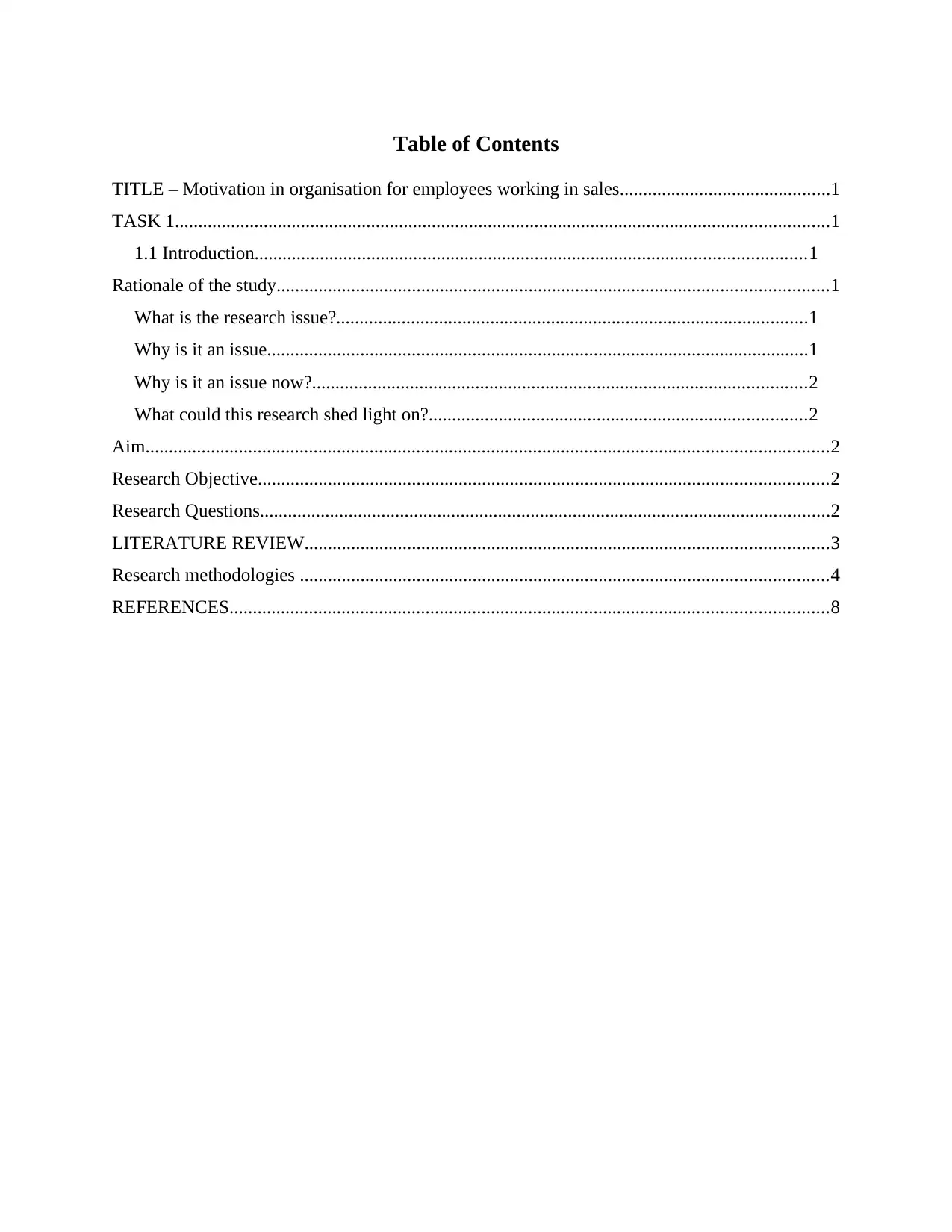
Table of Contents
TITLE – Motivation in organisation for employees working in sales.............................................1
TASK 1............................................................................................................................................1
1.1 Introduction......................................................................................................................1
Rationale of the study......................................................................................................................1
What is the research issue?.....................................................................................................1
Why is it an issue....................................................................................................................1
Why is it an issue now?..........................................................................................................2
What could this research shed light on?.................................................................................2
Aim..................................................................................................................................................2
Research Objective..........................................................................................................................2
Research Questions..........................................................................................................................2
LITERATURE REVIEW................................................................................................................3
Research methodologies .................................................................................................................4
REFERENCES................................................................................................................................8
TITLE – Motivation in organisation for employees working in sales.............................................1
TASK 1............................................................................................................................................1
1.1 Introduction......................................................................................................................1
Rationale of the study......................................................................................................................1
What is the research issue?.....................................................................................................1
Why is it an issue....................................................................................................................1
Why is it an issue now?..........................................................................................................2
What could this research shed light on?.................................................................................2
Aim..................................................................................................................................................2
Research Objective..........................................................................................................................2
Research Questions..........................................................................................................................2
LITERATURE REVIEW................................................................................................................3
Research methodologies .................................................................................................................4
REFERENCES................................................................................................................................8

⊘ This is a preview!⊘
Do you want full access?
Subscribe today to unlock all pages.

Trusted by 1+ million students worldwide
TITLE – Motivation in organisation for employees working in sales
TASK 1
1.1 Introduction
In an organisation employees are the most important asset. Without their contribution the
goals and objectives can not be achieved. They help in carrying out the day to day operations for
which it is very much necessary that employees are provided with good motivation. It can be
done with the help of financial and non financial tools depending upon the nature and
requirement of the candidate (Schunk, Meece and Pintrich, 2012). Tesco is a well known super
market where a group of employees work towards a common goal. The present report is prepared
in order to understand the effectiveness of motivation by comparing its effects on the total sales
as how they can be improved. Different tools will be utilised in order to collect the relevant data
which will be further analysed with distinct statistical tools. Presentation of the collected data
will be done using graphs which will further clear the vision of user.
Rationale of the study
What is the research issue?
With the globalisation the demand in the business world has increased which has to be
supported with quality and effectiveness. It increases the pressure on work to produce more with
cost efficiency so that the competitive advantage can be achieved. TESCO is a UK based public
organisation in which different products are offered to the market under the same roof. It has
given employment to a great number of employees which are assigned duties as per their
designation. It is necessary for the management that the work force is motivated to work with
high degree of excellence for which needs and demands of the employees need to be fulfilled.
Moreover, the companies revenue depends upon the total sales which it does in a particular time
period and therefore to improve that it has to be ensure that the employees are happy with their
working environment and job which they are doing.
Why is it an issue
If the contribution of non motivated working staff is compared with that of the motivated
one than it can be observed that there is a big difference in between both. This is the prime
1
TASK 1
1.1 Introduction
In an organisation employees are the most important asset. Without their contribution the
goals and objectives can not be achieved. They help in carrying out the day to day operations for
which it is very much necessary that employees are provided with good motivation. It can be
done with the help of financial and non financial tools depending upon the nature and
requirement of the candidate (Schunk, Meece and Pintrich, 2012). Tesco is a well known super
market where a group of employees work towards a common goal. The present report is prepared
in order to understand the effectiveness of motivation by comparing its effects on the total sales
as how they can be improved. Different tools will be utilised in order to collect the relevant data
which will be further analysed with distinct statistical tools. Presentation of the collected data
will be done using graphs which will further clear the vision of user.
Rationale of the study
What is the research issue?
With the globalisation the demand in the business world has increased which has to be
supported with quality and effectiveness. It increases the pressure on work to produce more with
cost efficiency so that the competitive advantage can be achieved. TESCO is a UK based public
organisation in which different products are offered to the market under the same roof. It has
given employment to a great number of employees which are assigned duties as per their
designation. It is necessary for the management that the work force is motivated to work with
high degree of excellence for which needs and demands of the employees need to be fulfilled.
Moreover, the companies revenue depends upon the total sales which it does in a particular time
period and therefore to improve that it has to be ensure that the employees are happy with their
working environment and job which they are doing.
Why is it an issue
If the contribution of non motivated working staff is compared with that of the motivated
one than it can be observed that there is a big difference in between both. This is the prime
1
Paraphrase This Document
Need a fresh take? Get an instant paraphrase of this document with our AI Paraphraser
reason why this topic is being selected as it is very important to analyse the importance of
motivation in an organisation specially which is dealing in sales operations. In organisations it is
observed that mostly employees are neglected in order to earn higher profits but they do not
realise that it can lead to further addition in the total cost as a non motived employee do not
continue with the same organisation in the long run.
Why is it an issue now?
It is a big issue now because gradually the morale of employees are decline as they do not
get recognisance in the work place which directly effects the total business. There are different
tools and techniques which are available for the management to encourage the staff but they do
not understand the value of same and ignore the basic requirements of employees.
What could this research shed light on?
Implementation of motivation in TESCO will be discussed in the given study so that the
aim can be achieved. Participation of employees will be done in order to understand the
importance of motivation. Different importance of this technique will be elaborated through
literature review which will show how it can help the given organisation in achieving its desired
targets and establishing a better bran image in the market. If an appropriate attention is given to
the facts that are highlighted in the study regarding the motivation effectiveness the refereed
organisation can experience growth in its total sales.
Aim
To determine the results on sales with the implementation of motivation in the employees
Research Objective
To examine the change with motivation in organisation
To assess the role of motivation in sales
To find how by implementing motivation in organisation employees are affected
Research Questions
1. Why is motivation important?
2. How motivation adds more productivity?
3. How motivation can effect the sales of TESCO?
2
motivation in an organisation specially which is dealing in sales operations. In organisations it is
observed that mostly employees are neglected in order to earn higher profits but they do not
realise that it can lead to further addition in the total cost as a non motived employee do not
continue with the same organisation in the long run.
Why is it an issue now?
It is a big issue now because gradually the morale of employees are decline as they do not
get recognisance in the work place which directly effects the total business. There are different
tools and techniques which are available for the management to encourage the staff but they do
not understand the value of same and ignore the basic requirements of employees.
What could this research shed light on?
Implementation of motivation in TESCO will be discussed in the given study so that the
aim can be achieved. Participation of employees will be done in order to understand the
importance of motivation. Different importance of this technique will be elaborated through
literature review which will show how it can help the given organisation in achieving its desired
targets and establishing a better bran image in the market. If an appropriate attention is given to
the facts that are highlighted in the study regarding the motivation effectiveness the refereed
organisation can experience growth in its total sales.
Aim
To determine the results on sales with the implementation of motivation in the employees
Research Objective
To examine the change with motivation in organisation
To assess the role of motivation in sales
To find how by implementing motivation in organisation employees are affected
Research Questions
1. Why is motivation important?
2. How motivation adds more productivity?
3. How motivation can effect the sales of TESCO?
2
LITERATURE REVIEW
Motivation
Herzberg, Mausner and Snyderman, (2011) says that motivation is a force through which
an individual is influenced to work with his maximum capacity. He further adds that an
employee who is motivated can do better utilisation of resources which are provided to them. He
also says that it in some case act as a decision making process, as through it organisation can
select its desired results by making appropriate motivation moves at the work place. Further in
the perspective of Dörnyei and Ushioda, (2013) motivation if used effectively can help
organisation in reducing its total cost of production and also minimising the total labour turnover
ratio from the work place. There are different methods of influencing work force among which
carrot and stick is the most appropriate one. Here the management can use the rewards schemes
to encourage the work force so that they give more concentration on improving their quality of
work and perform their job with maximum dedication. In the same context stick act as negative
motivation where employee tends to work hard as failure to achieve results can also lead to loss
of job, demotion or transfer. An employee work with the motive of earning to meet certain
personal and family requirements and when punishment is related to financial loss he tends to
give his 100% and reach the sales target Reeve (2014) also suggested several other method of
motivation like Job enlargement and job enrichment. Its is based on Herzbergs two factor theory
that the job itself must provide opportunities to grow and excel. If sales team are given an option
to themselves determine ways to improve sales for the current period, there are chances that they
might use some promotional unique ways to raise sales level. This will help them to think out of
the box and as marketing and sales are dependent on each other a successfully idea may lead to
growth in sales and in turn will improve employees morale by giving them recognition for the
unexpected sales figure. As per the study done by Wlodkowski and Ginsberg (2017) rewards and
awards play a very important role in motivating employee by giving them target based reward
and company awards like employee of the month, best leader, best sales manager and so on. If
the sales team are given targets and each level of target is related to reward there is a chance of
them working harder than before and achieving their best. Example Tupperware gives its
members various sales level and each level is linked to a valuable gift like refrigerator, foreign
trips, air condition and many others. This motivates their members to sale more by targeting new
buyers and also transferring some benefits to new buyers in the form of discounts and small gifts.
3
Motivation
Herzberg, Mausner and Snyderman, (2011) says that motivation is a force through which
an individual is influenced to work with his maximum capacity. He further adds that an
employee who is motivated can do better utilisation of resources which are provided to them. He
also says that it in some case act as a decision making process, as through it organisation can
select its desired results by making appropriate motivation moves at the work place. Further in
the perspective of Dörnyei and Ushioda, (2013) motivation if used effectively can help
organisation in reducing its total cost of production and also minimising the total labour turnover
ratio from the work place. There are different methods of influencing work force among which
carrot and stick is the most appropriate one. Here the management can use the rewards schemes
to encourage the work force so that they give more concentration on improving their quality of
work and perform their job with maximum dedication. In the same context stick act as negative
motivation where employee tends to work hard as failure to achieve results can also lead to loss
of job, demotion or transfer. An employee work with the motive of earning to meet certain
personal and family requirements and when punishment is related to financial loss he tends to
give his 100% and reach the sales target Reeve (2014) also suggested several other method of
motivation like Job enlargement and job enrichment. Its is based on Herzbergs two factor theory
that the job itself must provide opportunities to grow and excel. If sales team are given an option
to themselves determine ways to improve sales for the current period, there are chances that they
might use some promotional unique ways to raise sales level. This will help them to think out of
the box and as marketing and sales are dependent on each other a successfully idea may lead to
growth in sales and in turn will improve employees morale by giving them recognition for the
unexpected sales figure. As per the study done by Wlodkowski and Ginsberg (2017) rewards and
awards play a very important role in motivating employee by giving them target based reward
and company awards like employee of the month, best leader, best sales manager and so on. If
the sales team are given targets and each level of target is related to reward there is a chance of
them working harder than before and achieving their best. Example Tupperware gives its
members various sales level and each level is linked to a valuable gift like refrigerator, foreign
trips, air condition and many others. This motivates their members to sale more by targeting new
buyers and also transferring some benefits to new buyers in the form of discounts and small gifts.
3
⊘ This is a preview!⊘
Do you want full access?
Subscribe today to unlock all pages.
Trusted by 1+ million students worldwide
Apart from these the company can also provide free food for those working overtime, arrange
for a gym or playing room in the office itself to help the employees take some break and restart
work with more energy. Employee feedback plays a very essential role in knowing whether the
steps taken by company to raise their morale are in right direction or not.
Even after taking all the above measures to motivate employee if a employee is still
unmotivated this doesn't meant that he is lazy or there are flaws in motivation programme.
Several other factors are also related to employees motivation like health issues, family
problems, no off from work since long time, working environment etc.
Otmakhova and Lisman (2013)The difference between an motivated employee and
unmotivated employee is that a motivated employee will utilise all the available resources to give
his best while an unmotivated employee may waste some of the resources leading to additional
expenses. There are chances that he may take more breaks during working and distract other
motivated employees also, thus affecting the profits of the company. Hence, its very necessary to
know the reason behind him being demotivated and take immediate action to prevent company
from incurring further loss of money and time.
Research methodologies
It is basically referred as a process of data and information collection used for the
purpose of making business decision. A research is a systematic way to investigate and establish
facts to draw new conclusions. Research is something which is done to expand the knowledge
which is already available to get the useful information about the subject. Research
methodology is systematic and theoretical analysis of the methods associated to the particular
field of study. The various research methodologies are described as below-
Research design : The design is the basic structure of any scientific work. The design we
choose in this report will definitely affect our conclusions and the results drawn from them. The
function of research design is to ensure that conclusions drawn will definitely address the
problem solving (Özerdem and Bowd, 2016). There are two main approaches to research design
which are described as follows- Quantitative research – It is one which is statistical and can be done with the use of
numerical data. Its main function is quantification of data. In other word, we can say if
there is no number involved then it is not quantitative research. For example – change in
customer present needs. There are various tools and techniques involved in analysing
4
for a gym or playing room in the office itself to help the employees take some break and restart
work with more energy. Employee feedback plays a very essential role in knowing whether the
steps taken by company to raise their morale are in right direction or not.
Even after taking all the above measures to motivate employee if a employee is still
unmotivated this doesn't meant that he is lazy or there are flaws in motivation programme.
Several other factors are also related to employees motivation like health issues, family
problems, no off from work since long time, working environment etc.
Otmakhova and Lisman (2013)The difference between an motivated employee and
unmotivated employee is that a motivated employee will utilise all the available resources to give
his best while an unmotivated employee may waste some of the resources leading to additional
expenses. There are chances that he may take more breaks during working and distract other
motivated employees also, thus affecting the profits of the company. Hence, its very necessary to
know the reason behind him being demotivated and take immediate action to prevent company
from incurring further loss of money and time.
Research methodologies
It is basically referred as a process of data and information collection used for the
purpose of making business decision. A research is a systematic way to investigate and establish
facts to draw new conclusions. Research is something which is done to expand the knowledge
which is already available to get the useful information about the subject. Research
methodology is systematic and theoretical analysis of the methods associated to the particular
field of study. The various research methodologies are described as below-
Research design : The design is the basic structure of any scientific work. The design we
choose in this report will definitely affect our conclusions and the results drawn from them. The
function of research design is to ensure that conclusions drawn will definitely address the
problem solving (Özerdem and Bowd, 2016). There are two main approaches to research design
which are described as follows- Quantitative research – It is one which is statistical and can be done with the use of
numerical data. Its main function is quantification of data. In other word, we can say if
there is no number involved then it is not quantitative research. For example – change in
customer present needs. There are various tools and techniques involved in analysing
4
Paraphrase This Document
Need a fresh take? Get an instant paraphrase of this document with our AI Paraphraser
such research from simple graph to show the data in terms of correlation involved
between two or more items. Qualitative research - Something that is not done statistically is known as qualitative
research. It often involves words, languages and sometimes pictures and observations etc.
It particularly explore why and how things have happened. For example – customer taste
and preferences towards products. It is exploratory research method that studies highly
complex phenomenon.
Research approach : The research approach defines which approach will be chosen to
study the particular topic. There are usually two approaches in research are as follows-
Inductive research approach - Inductive research does not involve formulation of
hypothesis. It starts with research aims and objectives that is required to be achieved
during research process.
Deductive research approach - In deductive research approach, hypothesis is formulated
and the same will be tested at the end to draw conclusions.
Research philosophy : It is brief about the way in which data about a particular field is
gathered, analysed and used. The term epistemology (what is known to be true) as opposed to
doxology (what is believed to be true) encompasses the various philosophies of research
approach. Choosing an appropriate research philosophy is an important part of research
methodology (Neuman and Robson, 2012). Philosophical approach enables the researcher to
know which approach should be adopted and why. The important assumptions exist in research
philosophy that explains about the researcher’s view regarding the world. The same will help to
determine research strategy and the methods of that strategy.
Data collection technique : The information that a researcher gathered will come from various
sources. There are various alternatives available to find data in addition to the one that is
collected by you. Data that is collected for the first time is termed as primary data and the one
that is already in existence is secondary source of data. The data collection techniques are listed
below-
Interviews – These conducted face-to-face and over phones. It is the technique of data
collection where a person is being interviewed by one or more than one persons.
5
between two or more items. Qualitative research - Something that is not done statistically is known as qualitative
research. It often involves words, languages and sometimes pictures and observations etc.
It particularly explore why and how things have happened. For example – customer taste
and preferences towards products. It is exploratory research method that studies highly
complex phenomenon.
Research approach : The research approach defines which approach will be chosen to
study the particular topic. There are usually two approaches in research are as follows-
Inductive research approach - Inductive research does not involve formulation of
hypothesis. It starts with research aims and objectives that is required to be achieved
during research process.
Deductive research approach - In deductive research approach, hypothesis is formulated
and the same will be tested at the end to draw conclusions.
Research philosophy : It is brief about the way in which data about a particular field is
gathered, analysed and used. The term epistemology (what is known to be true) as opposed to
doxology (what is believed to be true) encompasses the various philosophies of research
approach. Choosing an appropriate research philosophy is an important part of research
methodology (Neuman and Robson, 2012). Philosophical approach enables the researcher to
know which approach should be adopted and why. The important assumptions exist in research
philosophy that explains about the researcher’s view regarding the world. The same will help to
determine research strategy and the methods of that strategy.
Data collection technique : The information that a researcher gathered will come from various
sources. There are various alternatives available to find data in addition to the one that is
collected by you. Data that is collected for the first time is termed as primary data and the one
that is already in existence is secondary source of data. The data collection techniques are listed
below-
Interviews – These conducted face-to-face and over phones. It is the technique of data
collection where a person is being interviewed by one or more than one persons.
5
Questions are always focused, and encourages open-ended responses. Interviews are
usually qualitative in nature. It can be done formally and informally (Mackey and Gass,
2015).
Questionnaires and surveys – It is one of the instruments of data collected that will be
administered either through mail, phone and online. Research can be analysed usually by
quantitative method by assigning numerical value or likert-type scale. Here , results are
usually easier to be analysed. It gives researcher an opportunity to formulate the data
collection plan with precise.
Observations - Making direct observation is one of the best techniques available.
Making direct observation, when the situations allows for it is an effective way of data
collection. Making the right mechanism for observation is all one need to adopt such
technique. The data collection is reliable on the expert as they only know how to interpret
the data. But the main advantage is this technique is not a time-consuming one as
compare to other. Focus groups - Focus group is the data collection technique done by the set of experts by
the interactive sessions. Discussion will be done on a particular field of study and then
analyses will be done on the basis of information gathered. However finding right
persons for such discussion and arranging such meeting can be difficult. Every person put
their point of views and helps in results generations (Miller, 2012).
Sampling technique – These techniques are the strategies applied by the researchers during the
sampling process. There are two types of sampling techniques-
Probability sampling techniques - it is a technique is adopted as the sample of the total
population and termed as a representative of the population. Probability sampling
techniques include random sampling, systematic sampling, and stratified sampling. Non probability sampling techniques - Non-probability sampling techniques include
convenience sampling, snowball sampling and quota sampling. Here the data are
collected with no structure of total population in mind.
Data analysis: It is is the collection and organising of data based on which researcher can come
to results. Data analysis is the method of converting unstructured data into useful information
and drawing conclusions from them and thus helps in decision making aspect of business. The
main motive of data analysis is to get usable and suitable information. Data collection is one of
6
usually qualitative in nature. It can be done formally and informally (Mackey and Gass,
2015).
Questionnaires and surveys – It is one of the instruments of data collected that will be
administered either through mail, phone and online. Research can be analysed usually by
quantitative method by assigning numerical value or likert-type scale. Here , results are
usually easier to be analysed. It gives researcher an opportunity to formulate the data
collection plan with precise.
Observations - Making direct observation is one of the best techniques available.
Making direct observation, when the situations allows for it is an effective way of data
collection. Making the right mechanism for observation is all one need to adopt such
technique. The data collection is reliable on the expert as they only know how to interpret
the data. But the main advantage is this technique is not a time-consuming one as
compare to other. Focus groups - Focus group is the data collection technique done by the set of experts by
the interactive sessions. Discussion will be done on a particular field of study and then
analyses will be done on the basis of information gathered. However finding right
persons for such discussion and arranging such meeting can be difficult. Every person put
their point of views and helps in results generations (Miller, 2012).
Sampling technique – These techniques are the strategies applied by the researchers during the
sampling process. There are two types of sampling techniques-
Probability sampling techniques - it is a technique is adopted as the sample of the total
population and termed as a representative of the population. Probability sampling
techniques include random sampling, systematic sampling, and stratified sampling. Non probability sampling techniques - Non-probability sampling techniques include
convenience sampling, snowball sampling and quota sampling. Here the data are
collected with no structure of total population in mind.
Data analysis: It is is the collection and organising of data based on which researcher can come
to results. Data analysis is the method of converting unstructured data into useful information
and drawing conclusions from them and thus helps in decision making aspect of business. The
main motive of data analysis is to get usable and suitable information. Data collection is one of
6
⊘ This is a preview!⊘
Do you want full access?
Subscribe today to unlock all pages.
Trusted by 1+ million students worldwide

the difficult task but the collected data is unusable if analyses are not drawn from it. Thus
consideration need to be given for data analysis. It is one of the most time consuming process as
giving meaning to the mass-collected data is not easy.
7
consideration need to be given for data analysis. It is one of the most time consuming process as
giving meaning to the mass-collected data is not easy.
7
Paraphrase This Document
Need a fresh take? Get an instant paraphrase of this document with our AI Paraphraser
REFERENCES
Books and Journals
Schunk, D.H., Meece, J.R. and Pintrich, P.R., 2012. Motivation in education: Theory, research,
and applications. Pearson Higher Ed.
Herzberg, F., Mausner, B. and Snyderman, B.B., 2011. The motivation to work (Vol. 1).
Transaction publishers.
Dörnyei, Z. and Ushioda, E., 2013. Teaching and researching: Motivation. Routledge.
Reeve, J., 2014. Understanding motivation and emotion. John Wiley & Sons.
Wlodkowski, R.J. and Ginsberg, M.B., 2017. Enhancing adult motivation to learn: A
comprehensive guide for teaching all adults. John Wiley & Sons.
Otmakhova, N., Duzel, E., Deutch, A.Y. and Lisman, J., 2013. The hippocampal-VTA loop: the
role of novelty and motivation in controlling the entry of information into long-term
memory. In Intrinsically Motivated Learning in Natural and Artificial Systems (pp. 235-
254). Springer Berlin Heidelberg.
Mackey, A. and Gass, S.M., 2015. Second language research: Methodology and design.
Routledge.
Miller, T., Birch, M., Mauthner, M. and Jessop, J., 2012. Ethics in qualitative research. Sage.
Neuman, W.L. and Robson, K., 2012. Basics of social research: Qualitative and quantitative
approaches.
Özerdem, A. and Bowd, R., 2016. Participatory research methodologies: Development and post-
disaster/conflict reconstruction. Routledge.
8
Books and Journals
Schunk, D.H., Meece, J.R. and Pintrich, P.R., 2012. Motivation in education: Theory, research,
and applications. Pearson Higher Ed.
Herzberg, F., Mausner, B. and Snyderman, B.B., 2011. The motivation to work (Vol. 1).
Transaction publishers.
Dörnyei, Z. and Ushioda, E., 2013. Teaching and researching: Motivation. Routledge.
Reeve, J., 2014. Understanding motivation and emotion. John Wiley & Sons.
Wlodkowski, R.J. and Ginsberg, M.B., 2017. Enhancing adult motivation to learn: A
comprehensive guide for teaching all adults. John Wiley & Sons.
Otmakhova, N., Duzel, E., Deutch, A.Y. and Lisman, J., 2013. The hippocampal-VTA loop: the
role of novelty and motivation in controlling the entry of information into long-term
memory. In Intrinsically Motivated Learning in Natural and Artificial Systems (pp. 235-
254). Springer Berlin Heidelberg.
Mackey, A. and Gass, S.M., 2015. Second language research: Methodology and design.
Routledge.
Miller, T., Birch, M., Mauthner, M. and Jessop, J., 2012. Ethics in qualitative research. Sage.
Neuman, W.L. and Robson, K., 2012. Basics of social research: Qualitative and quantitative
approaches.
Özerdem, A. and Bowd, R., 2016. Participatory research methodologies: Development and post-
disaster/conflict reconstruction. Routledge.
8

1 out of 11


Related Documents


Your All-in-One AI-Powered Toolkit for Academic Success.
+13062052269
info@desklib.com
Available 24*7 on WhatsApp / Email
![[object Object]](/_next/static/media/star-bottom.7253800d.svg)
Unlock your academic potential
Copyright © 2020–2026 A2Z Services. All Rights Reserved. Developed and managed by ZUCOL.