Research on Employee Satisfaction and Performance in SMEs
VerifiedAdded on 2019/12/17
|25
|9097
|59
Project
AI Summary
This project investigates the effects of employee satisfaction and psychological ownership on the performance of Small and Medium Enterprises (SMEs) in Kuala Lumpur, Malaysia. The research employs a quantitative methodology, utilizing a combination of positivism and interpretivism philosophies to analyze the impact of these factors. The research design is exploratory, addressing a research problem that is not clearly defined, and utilizes primary data collected through questionnaires distributed to a sample of 218 employees from a population of 500, selected using a simple random sampling technique. Data analysis is conducted using IBM’s SPSS version 22, employing Cronbach’s Alpha test, Pearson correlation, and linear regression to ensure data reliability and determine the relationships between variables. Ethical considerations, including informed consent, data use restrictions, honesty, objectivity, confidentiality, and privacy, are strictly adhered to throughout the research process. The project aims to provide a comprehensive analysis of employee satisfaction and its influence on SME performance.

Project Name

Paraphrase This Document
Need a fresh take? Get an instant paraphrase of this document with our AI Paraphraser
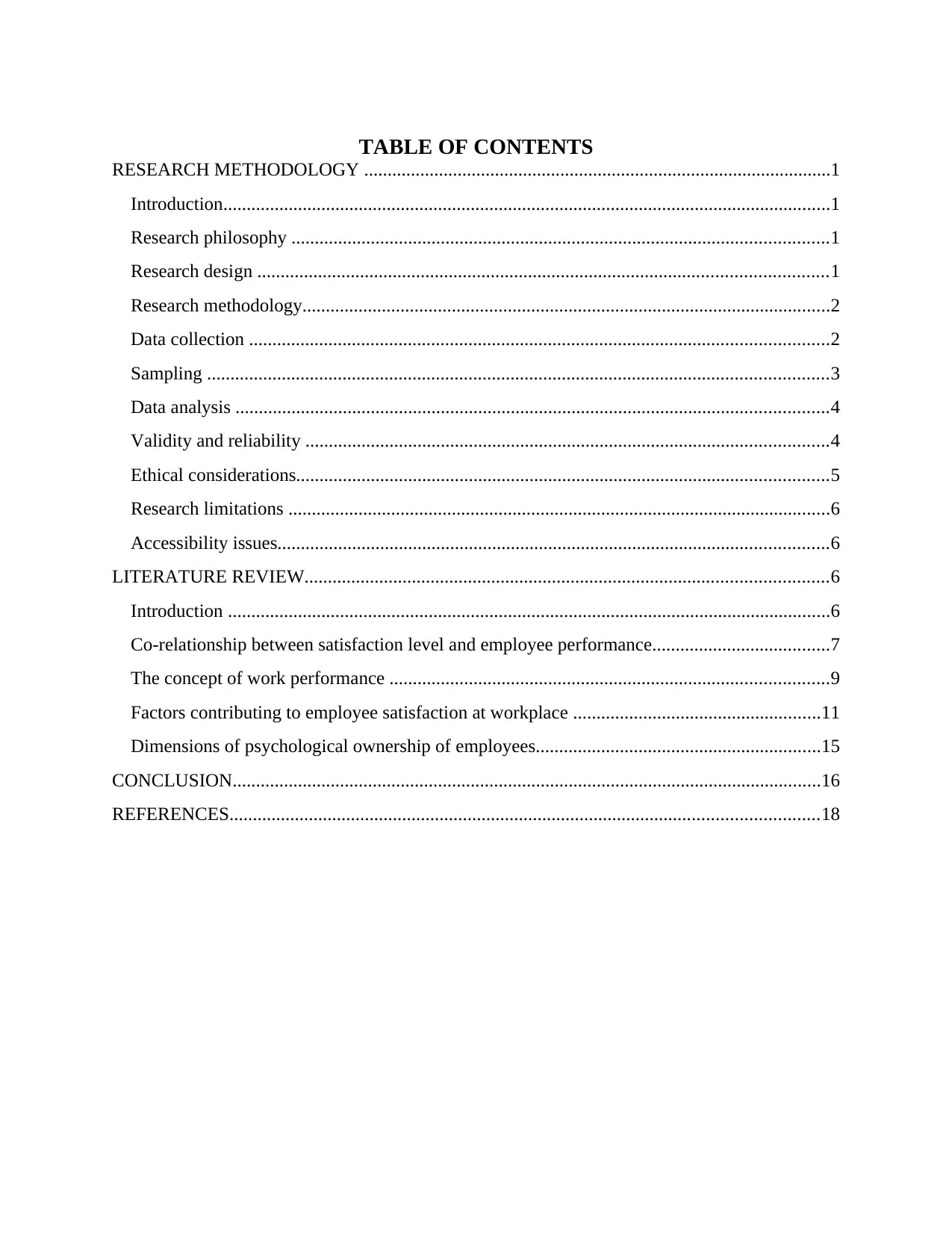
TABLE OF CONTENTS
RESEARCH METHODOLOGY ....................................................................................................1
Introduction..................................................................................................................................1
Research philosophy ...................................................................................................................1
Research design ..........................................................................................................................1
Research methodology.................................................................................................................2
Data collection ............................................................................................................................2
Sampling .....................................................................................................................................3
Data analysis ...............................................................................................................................4
Validity and reliability ................................................................................................................4
Ethical considerations..................................................................................................................5
Research limitations ....................................................................................................................6
Accessibility issues......................................................................................................................6
LITERATURE REVIEW................................................................................................................6
Introduction .................................................................................................................................6
Co-relationship between satisfaction level and employee performance......................................7
The concept of work performance ..............................................................................................9
Factors contributing to employee satisfaction at workplace .....................................................11
Dimensions of psychological ownership of employees.............................................................15
CONCLUSION..............................................................................................................................16
REFERENCES..............................................................................................................................18
RESEARCH METHODOLOGY ....................................................................................................1
Introduction..................................................................................................................................1
Research philosophy ...................................................................................................................1
Research design ..........................................................................................................................1
Research methodology.................................................................................................................2
Data collection ............................................................................................................................2
Sampling .....................................................................................................................................3
Data analysis ...............................................................................................................................4
Validity and reliability ................................................................................................................4
Ethical considerations..................................................................................................................5
Research limitations ....................................................................................................................6
Accessibility issues......................................................................................................................6
LITERATURE REVIEW................................................................................................................6
Introduction .................................................................................................................................6
Co-relationship between satisfaction level and employee performance......................................7
The concept of work performance ..............................................................................................9
Factors contributing to employee satisfaction at workplace .....................................................11
Dimensions of psychological ownership of employees.............................................................15
CONCLUSION..............................................................................................................................16
REFERENCES..............................................................................................................................18
RESEARCH METHODOLOGY
Introduction
Research methodology comprise of the systematic plan that is followed by researcher for
carrying out a study. It involves several important aspects such as research design, approach,
data collection and analysis procedures, sampling, ethical issues etc. (Chenail, 2011) It also takes
into consideration the aspect of validity and reliability of data. After drafting the literature
review, appropriate methodology was adopted by the researcher for conducting the study on
effects of employee satisfaction in SMEs in Kuala Lumpur, Malaysia. The present chapter
provides details of the research techniques that were employed along with justifications. These
techniques provided significant assistance in carrying ot the study to find out the effects of
satisfaction and psychological ownership on t5heir performance in SMEs in Kuala Lumpur
Malaysia.
Research philosophy
This is associated with the development of knowledge and helps in forming the
background to a study. Research philosophy involves the perception of an individual with which
he views the world and his belief towards reality (Christopher, 2014). For the present study on
SMEs in Kuala Lumpur, a combination of positivism and interpretivism philosophies were
utilized. Interpretivism philosophy was used because it helped in adequately justifying the
research problem. With the assistance of this philosophy, the research was able to highlight the
various figures and facts that depicted the research background. Moreover, interpretivism
enabled the researcher to understand the views of the sample in detail so that effects on their
performance can be studied.
Positivism philosophy was also used by the researcher because it assisted in providing his
viewpoint for evaluation of the social world (Ihantola and Kihn, 2011). In the present study on
SMEs in Kuala Lumpur, the researcher was required to collect information from the respondents
about the ways in which their performance was affected by satisfaction. Therefore, use of
positivism philosophy was most suitable as with the researcher could play his role independent
from the study. This made him concentrate better on facts and analyze them efficiently.
Research design
Research design depicts the overall strategy that is used for combining the various
components of the study in a coherent manner. It is therefore, an important concept in research.
1 | P a g e
Introduction
Research methodology comprise of the systematic plan that is followed by researcher for
carrying out a study. It involves several important aspects such as research design, approach,
data collection and analysis procedures, sampling, ethical issues etc. (Chenail, 2011) It also takes
into consideration the aspect of validity and reliability of data. After drafting the literature
review, appropriate methodology was adopted by the researcher for conducting the study on
effects of employee satisfaction in SMEs in Kuala Lumpur, Malaysia. The present chapter
provides details of the research techniques that were employed along with justifications. These
techniques provided significant assistance in carrying ot the study to find out the effects of
satisfaction and psychological ownership on t5heir performance in SMEs in Kuala Lumpur
Malaysia.
Research philosophy
This is associated with the development of knowledge and helps in forming the
background to a study. Research philosophy involves the perception of an individual with which
he views the world and his belief towards reality (Christopher, 2014). For the present study on
SMEs in Kuala Lumpur, a combination of positivism and interpretivism philosophies were
utilized. Interpretivism philosophy was used because it helped in adequately justifying the
research problem. With the assistance of this philosophy, the research was able to highlight the
various figures and facts that depicted the research background. Moreover, interpretivism
enabled the researcher to understand the views of the sample in detail so that effects on their
performance can be studied.
Positivism philosophy was also used by the researcher because it assisted in providing his
viewpoint for evaluation of the social world (Ihantola and Kihn, 2011). In the present study on
SMEs in Kuala Lumpur, the researcher was required to collect information from the respondents
about the ways in which their performance was affected by satisfaction. Therefore, use of
positivism philosophy was most suitable as with the researcher could play his role independent
from the study. This made him concentrate better on facts and analyze them efficiently.
Research design
Research design depicts the overall strategy that is used for combining the various
components of the study in a coherent manner. It is therefore, an important concept in research.
1 | P a g e
⊘ This is a preview!⊘
Do you want full access?
Subscribe today to unlock all pages.

Trusted by 1+ million students worldwide
An appropriate research design is essentially required for ensuring that the researcher will be
able to address the research problem efficiently (Harrison and Reilly, 2011). There are various
research designs such as exploratory, descriptive, analytical etc. For the present study on
employee satisfaction and psychological ownership, exploratory research design was used. There
were various reasons for selecting this design. Firstly, exploratory research is conducted for a
problem that has not been defined in a clear manner. the research had knowledge about employee
satisfaction and psychological ownership and wanted to understand more about their impacts on
performance in SMEs. Hence, it required to explore a new angle of viewing an aspect. Therefore,
exploratory research was suitable for the present study. The present research on SMEs in Kuala
Lumpur had time and money constraints. This also suggested that exploratory research was the
best suited for it. Further, the purpose of the research was to suggest and provide some
recommendation on specific organizational aspects. This necessitated the utilization of
exploratory research design. Moreover, in the present study, the researcher was required to use a
statistical tool for analyzing the data to reach conclusion. Hence, exploratory research was used
as it assisted in successfully implementing the tool.
Research methodology
Basically, a research can be carried out by following two methodologies, namely,
qualitative and quantitative. Qualitative research aims at gaining an understanding of underlying
motivations and reasons thereby providing insights into a particular problem. In contrast to this,
quantitative research comprises of empirical investigation of a phenomenon with the use of
statistical techniques (Franklin, 2012). The aim of the present research to analyse the effects of
employee satisfaction and psychological ownership on employee performance in SMEs in Kuala
Lumpur. In order to achieve the aim, the research required to obtain large volume of data from a
number of respondents. Qualitative research would not have supported this requirement
efficiently. It is for this reason that quantitative methodology was adopted for conducting the
present research on SMEs in Kuala Lumpur. The researcher was required to collect data with the
help of a questionnaire. Hence, Quantitative research was best suited for this.
Data collection
Data collection can be done by utilizing two methods, namely, primary and secondary
data collection. Primary data is the first hand information that a researcher specifically collected
for a particular study. Primary data collection comprises of the various research techniques that
2 | P a g e
able to address the research problem efficiently (Harrison and Reilly, 2011). There are various
research designs such as exploratory, descriptive, analytical etc. For the present study on
employee satisfaction and psychological ownership, exploratory research design was used. There
were various reasons for selecting this design. Firstly, exploratory research is conducted for a
problem that has not been defined in a clear manner. the research had knowledge about employee
satisfaction and psychological ownership and wanted to understand more about their impacts on
performance in SMEs. Hence, it required to explore a new angle of viewing an aspect. Therefore,
exploratory research was suitable for the present study. The present research on SMEs in Kuala
Lumpur had time and money constraints. This also suggested that exploratory research was the
best suited for it. Further, the purpose of the research was to suggest and provide some
recommendation on specific organizational aspects. This necessitated the utilization of
exploratory research design. Moreover, in the present study, the researcher was required to use a
statistical tool for analyzing the data to reach conclusion. Hence, exploratory research was used
as it assisted in successfully implementing the tool.
Research methodology
Basically, a research can be carried out by following two methodologies, namely,
qualitative and quantitative. Qualitative research aims at gaining an understanding of underlying
motivations and reasons thereby providing insights into a particular problem. In contrast to this,
quantitative research comprises of empirical investigation of a phenomenon with the use of
statistical techniques (Franklin, 2012). The aim of the present research to analyse the effects of
employee satisfaction and psychological ownership on employee performance in SMEs in Kuala
Lumpur. In order to achieve the aim, the research required to obtain large volume of data from a
number of respondents. Qualitative research would not have supported this requirement
efficiently. It is for this reason that quantitative methodology was adopted for conducting the
present research on SMEs in Kuala Lumpur. The researcher was required to collect data with the
help of a questionnaire. Hence, Quantitative research was best suited for this.
Data collection
Data collection can be done by utilizing two methods, namely, primary and secondary
data collection. Primary data is the first hand information that a researcher specifically collected
for a particular study. Primary data collection comprises of the various research techniques that
2 | P a g e
Paraphrase This Document
Need a fresh take? Get an instant paraphrase of this document with our AI Paraphraser
are employed for gathering primary data. These include interviews, focus groups, survey
questionnaire etc. (Grafton, Lillis and Mahama, 2011). In contrast to this, secondary data refers
to information that was already published in studies carried out by other researchers. It is readily
available ion other sources such as books, journals, blogs, reports, government factsheets etc. For
the present study, only primary data collection methods were used. This is because the researcher
wanted to explore the effects of employee satisfaction and psychological ownership on their
performance, which could only be done by obtaining information from employees. Hence,
primary data collection was suitable for the present study on SMEs in Kuala Lumpur.
For collecting the data, questionnaire was utilized. This is because large amount of
information could be collected from a large sample. Hence, with it the researcher could collect
data about the effects of employee satisfaction on their performance from a large sample in order
to achieve the aim of the study. Another reason for using questionnaire was that results could be
quickly and easily quantified (McGrath and O'Toole, 2012). As the present research used
quantitative methodology, questionnaire was suitable for it. The development of questionnaire
was done with the help of Google Forms tool. The questionnaire was divided into three sections.
In the first section, general information about the respondents was collected. The second section
comprised of independent variables. The last section of the questionnaire was related to
dependent variables.
Sampling
Sampling refers to the method of selecting a subset of individuals from a population.
Collecting data from each and every unit of the population does not seem to be a feasible task for
the researcher as it requires a lot of time and money. Therefore, sampling is done to select a
sample that is capable of representing the entire population. There are two types of sampling
methods, namely, probability and non- probability sampling (Cox and McDonald, 2013). For the
present study on SMEs in Kuala Lumpur, probability sampling method was used. Sample was
selected by utilizing simple random sampling technique. The reason behind using this technique
was that it was a fair way of sample selection because every member got an equal chance of
being included in the sample. The respondents were selected in a random manner from the
population of employees working in SMEs in Kuala Lumpur region of Malaysia.
Sample size is another important concept because an appropriate size of sample is to be
selected by researcher which is capable of representing the entire population (Ormerod and
3 | P a g e
questionnaire etc. (Grafton, Lillis and Mahama, 2011). In contrast to this, secondary data refers
to information that was already published in studies carried out by other researchers. It is readily
available ion other sources such as books, journals, blogs, reports, government factsheets etc. For
the present study, only primary data collection methods were used. This is because the researcher
wanted to explore the effects of employee satisfaction and psychological ownership on their
performance, which could only be done by obtaining information from employees. Hence,
primary data collection was suitable for the present study on SMEs in Kuala Lumpur.
For collecting the data, questionnaire was utilized. This is because large amount of
information could be collected from a large sample. Hence, with it the researcher could collect
data about the effects of employee satisfaction on their performance from a large sample in order
to achieve the aim of the study. Another reason for using questionnaire was that results could be
quickly and easily quantified (McGrath and O'Toole, 2012). As the present research used
quantitative methodology, questionnaire was suitable for it. The development of questionnaire
was done with the help of Google Forms tool. The questionnaire was divided into three sections.
In the first section, general information about the respondents was collected. The second section
comprised of independent variables. The last section of the questionnaire was related to
dependent variables.
Sampling
Sampling refers to the method of selecting a subset of individuals from a population.
Collecting data from each and every unit of the population does not seem to be a feasible task for
the researcher as it requires a lot of time and money. Therefore, sampling is done to select a
sample that is capable of representing the entire population. There are two types of sampling
methods, namely, probability and non- probability sampling (Cox and McDonald, 2013). For the
present study on SMEs in Kuala Lumpur, probability sampling method was used. Sample was
selected by utilizing simple random sampling technique. The reason behind using this technique
was that it was a fair way of sample selection because every member got an equal chance of
being included in the sample. The respondents were selected in a random manner from the
population of employees working in SMEs in Kuala Lumpur region of Malaysia.
Sample size is another important concept because an appropriate size of sample is to be
selected by researcher which is capable of representing the entire population (Ormerod and
3 | P a g e
Ulrich, 2013). For the present study, sample size was calculated by using Raosoft sample size
calculator. The allowed error margin was of 5 per cent with 95 per cent confidence level. In
Malaysia, 35. 7 percent of all SMEs are in Kuala Lumpur. With the help of Raosoft, the
calculated sample size was 218 from a population of 500. Questionnaire was distributed to 500
respondents and only 218 responses were selected through probability sampling.
Data analysis
Data analysis refers to cleaning and transforming the data by using systematic and logical
techniques. There are two methods of analyzing the data. These include qualitative and
quantitative analysis (Kumar, 2014). For the present research, data was analysed by using
quantitative methods. IBM’s SPSS version 22 software was used for carrying out analysis on the
data collected from the respondents. The data analysis comprised of conducting 3 tests. In order
to ensure the reliability and integrity of data Cronbach’s Alpha test was used. In order to
determine the effects of employee satisfaction on their present, the researcher was required to
identify relationship between dependent and independent variables. For this, Pearson correlation
was employed. Further, linear regression was also performed to identify the independent variable
that has the strongest impact on dependent variable.
Validity and reliability
Validity refers to the extent to which a research measures what it is intended to measure
(Flick, 2011). It is an important concept to be considered while carrying out a research. For the
present research on SMEs in Kuala Lumpur, validity was maintained by utilizing appropriate
tools for collecting and analyzing data. Question used by the researcher was suitable as it assisted
in obtaining the responses of a large sample. This helped the researcher in determining the
effects of employee satisfaction and psychological ownership on their performance. Hence, it
measured the effect that it was intended to measure. This indicates that questionnaire fulfilled the
purpose for which it was used.
Reliability is another vital concept and refers to the degree to which a study is capable of
producing consistent results it is conducted again in future (Fiegen, 2010). The present research
on SMEs in Kuala Lumpur is reliable as authentic sources have been used for collecting the data.
Employees could provide the most useful and relevant information about the effects of
satisfaction on their performance. As the present research collected data from employees, it
4 | P a g e
calculator. The allowed error margin was of 5 per cent with 95 per cent confidence level. In
Malaysia, 35. 7 percent of all SMEs are in Kuala Lumpur. With the help of Raosoft, the
calculated sample size was 218 from a population of 500. Questionnaire was distributed to 500
respondents and only 218 responses were selected through probability sampling.
Data analysis
Data analysis refers to cleaning and transforming the data by using systematic and logical
techniques. There are two methods of analyzing the data. These include qualitative and
quantitative analysis (Kumar, 2014). For the present research, data was analysed by using
quantitative methods. IBM’s SPSS version 22 software was used for carrying out analysis on the
data collected from the respondents. The data analysis comprised of conducting 3 tests. In order
to ensure the reliability and integrity of data Cronbach’s Alpha test was used. In order to
determine the effects of employee satisfaction on their present, the researcher was required to
identify relationship between dependent and independent variables. For this, Pearson correlation
was employed. Further, linear regression was also performed to identify the independent variable
that has the strongest impact on dependent variable.
Validity and reliability
Validity refers to the extent to which a research measures what it is intended to measure
(Flick, 2011). It is an important concept to be considered while carrying out a research. For the
present research on SMEs in Kuala Lumpur, validity was maintained by utilizing appropriate
tools for collecting and analyzing data. Question used by the researcher was suitable as it assisted
in obtaining the responses of a large sample. This helped the researcher in determining the
effects of employee satisfaction and psychological ownership on their performance. Hence, it
measured the effect that it was intended to measure. This indicates that questionnaire fulfilled the
purpose for which it was used.
Reliability is another vital concept and refers to the degree to which a study is capable of
producing consistent results it is conducted again in future (Fiegen, 2010). The present research
on SMEs in Kuala Lumpur is reliable as authentic sources have been used for collecting the data.
Employees could provide the most useful and relevant information about the effects of
satisfaction on their performance. As the present research collected data from employees, it
4 | P a g e
⊘ This is a preview!⊘
Do you want full access?
Subscribe today to unlock all pages.
Trusted by 1+ million students worldwide
ensured that the study is reliable. Further, it also ensured that the chances of biasness have been
reduced to minimum. Also, the data as not manipulated in any form.
Ethical considerations
Researcher needs to take into consideration ethical aspect while carrying out the research.
This is because a study is considered to be complete in all aspect if it has followed the ethical
norms (Cox and McDonald, 2013). In the present research on effects of employee satisfaction,
the following ethical considerations were taken into account by the researcher: Prior approval: It is not necessary that all the participants agree to take part in the study.
It is therefore important for research to take informed consent from the respondents
(Daniel and Sam, 2011). For the present study, the research informed the participants
about the nature and purpose of research. Informed consent was then obtained from them
to ensure that the individuals are taking part in the study in a voluntary manner. This also
ensured that they are aware of the benefits and risks of research. Data use: The data collected for this study was used specifically for academic purposes.
As the participants were ensured that the data will be not be used for any other purpose,
adequate steps were taken for restricting the data use for research purpose. Principle of honesty and objectivity: The principle of honesty was followed by the
researcher while carrying out the present study on SMEs in Kuala Lumpur. Each
respondent was allowed to fill the questionnaire only once. There was no use of any
automated software for submitting multiple responses at once. This helped in maintaining
the objectivity by avoiding bias in data analysis and interpretation. Confidentiality and privacy: In order to follow the ethical principles of confidentiality
and privacy, the researcher ensured that anonymity of the participants is maintained. In
no case, their identifying information was shared with anyone who was not involved in
the research. Further, confidentiality of the data provided by the participants was also
maintained. For this, unauthorized access to data was checked by the researcher.
Proper citation of work: The researcher took appropriate care to ensure that all the
resources have been cited where necessary. It was also ensured that correct citation of
5 | P a g e
reduced to minimum. Also, the data as not manipulated in any form.
Ethical considerations
Researcher needs to take into consideration ethical aspect while carrying out the research.
This is because a study is considered to be complete in all aspect if it has followed the ethical
norms (Cox and McDonald, 2013). In the present research on effects of employee satisfaction,
the following ethical considerations were taken into account by the researcher: Prior approval: It is not necessary that all the participants agree to take part in the study.
It is therefore important for research to take informed consent from the respondents
(Daniel and Sam, 2011). For the present study, the research informed the participants
about the nature and purpose of research. Informed consent was then obtained from them
to ensure that the individuals are taking part in the study in a voluntary manner. This also
ensured that they are aware of the benefits and risks of research. Data use: The data collected for this study was used specifically for academic purposes.
As the participants were ensured that the data will be not be used for any other purpose,
adequate steps were taken for restricting the data use for research purpose. Principle of honesty and objectivity: The principle of honesty was followed by the
researcher while carrying out the present study on SMEs in Kuala Lumpur. Each
respondent was allowed to fill the questionnaire only once. There was no use of any
automated software for submitting multiple responses at once. This helped in maintaining
the objectivity by avoiding bias in data analysis and interpretation. Confidentiality and privacy: In order to follow the ethical principles of confidentiality
and privacy, the researcher ensured that anonymity of the participants is maintained. In
no case, their identifying information was shared with anyone who was not involved in
the research. Further, confidentiality of the data provided by the participants was also
maintained. For this, unauthorized access to data was checked by the researcher.
Proper citation of work: The researcher took appropriate care to ensure that all the
resources have been cited where necessary. It was also ensured that correct citation of
5 | P a g e
Paraphrase This Document
Need a fresh take? Get an instant paraphrase of this document with our AI Paraphraser
work was done. Further, the content was not copy pasted at any part so that plagiarism
could be avoided.
Research limitations
There are various limitations of the present research. As it was primarily focused on
employees working in Kuala Lumpur, the present research cannot be applied on employees who
do not belong to Malaysia. Another limitation of the study was that it was focused on small and
medium sized organizations. Hence, it did not take into account large organizations. Employee
satisfaction and psychological ownership may have different effects on employee performance in
the context of large organizations.
Accessibility issues
Various accessibility issues were also faced by the researcher while carrying out the
present study on SMEs in Kuala Lumpur. The researcher was required to collect data from the
employees of SMEs in Kuala Lumpur. However, a lot of areas were under federal territory of
Kuala Lumpur. Hence, it was a difficult and challenging task for the researcher to collect data
from such a wide spread area in a random manner. As majority of the SMEs were in Klang
Valley, Selangor; it was narrowed down by the researcher to Klang Valley which helped in
overcoming the accessibility issues. Further, accessibility issues were also addressed by
researcher by using various online media such as Whatsapp, Facebook, emails for data
collection. This saved time, money and efforts as the researcher did not have to collect data by
visiting the respondents.
LITERATURE REVIEW
Introduction
The section of literature review is considered as an important chapter of a research which
plays a very vital role in accomplishment of research aim and objectives. This section is crucial
because it is linked with the opinions and views of other scholars regarding the topic which has
been taken for carrying out investigation. Furthermore, it can be stated that the opinions and
views of other researchers supports in getting insight into a particular topic and carry out the
research in desired manner. The present section of literature review lays emphasis on areas such
as relationship between employee satisfaction level and employee performance, the overall
concept of work performance, the impact of psychological ownership on overall performance of
6 | P a g e
could be avoided.
Research limitations
There are various limitations of the present research. As it was primarily focused on
employees working in Kuala Lumpur, the present research cannot be applied on employees who
do not belong to Malaysia. Another limitation of the study was that it was focused on small and
medium sized organizations. Hence, it did not take into account large organizations. Employee
satisfaction and psychological ownership may have different effects on employee performance in
the context of large organizations.
Accessibility issues
Various accessibility issues were also faced by the researcher while carrying out the
present study on SMEs in Kuala Lumpur. The researcher was required to collect data from the
employees of SMEs in Kuala Lumpur. However, a lot of areas were under federal territory of
Kuala Lumpur. Hence, it was a difficult and challenging task for the researcher to collect data
from such a wide spread area in a random manner. As majority of the SMEs were in Klang
Valley, Selangor; it was narrowed down by the researcher to Klang Valley which helped in
overcoming the accessibility issues. Further, accessibility issues were also addressed by
researcher by using various online media such as Whatsapp, Facebook, emails for data
collection. This saved time, money and efforts as the researcher did not have to collect data by
visiting the respondents.
LITERATURE REVIEW
Introduction
The section of literature review is considered as an important chapter of a research which
plays a very vital role in accomplishment of research aim and objectives. This section is crucial
because it is linked with the opinions and views of other scholars regarding the topic which has
been taken for carrying out investigation. Furthermore, it can be stated that the opinions and
views of other researchers supports in getting insight into a particular topic and carry out the
research in desired manner. The present section of literature review lays emphasis on areas such
as relationship between employee satisfaction level and employee performance, the overall
concept of work performance, the impact of psychological ownership on overall performance of
6 | P a g e
people working in a business enterprise, the potential impact of self identity on psychological
ownership of staff member etc. It can be also expressed that the present section of literature
review has played a very important role in making the study successful and accomplishment of
all its objectives developed.
Theoretical gap
It can be stated that the main reason behind carrying out the present research was to
analyse Identifying the Effects of Employee Satisfaction and Employees Psychological
Ownership on Employees Performance in Small and Medium Enterprises (SME's) in Kuala
Lumpur Malaysia. Furthermore, it has been identified by the scholar that earlier researches have
been conducted over areas such as employee satisfaction and employee performance. However,
no such research is carried out which mainly focuses on variable such as employee psychological
ownership, performance and small medium enterprise. This can be termed as a clear gap which
has been identified by the researcher and this is the main rationale behind conducting the
research.
Conceptual Framework
In addition to this, it can be said that design of research is descriptive and it provides in
depth analysis about the subject. This design will be helpful in describing the characteristics of
the population and explore the investigation. Moreover, the inductive approach is being adopted
by the researcher. These reasons can be varied and will require new findings to be added to the
study. It assist in meeting the objectives of the investigation. Along with this, it can be said that
present research is qualitative that helps in identify the co-relationship between satisfaction level
and employee performance.
Co-relationship between satisfaction level and employee performance
In the modern era, employees are considered as one of the most important and crucial
assets of any business enterprise. As per the view of Luthans and et.al., (2008) there was a time
when the main focus of businesses was laid upon achieving higher degree of customer
satisfaction and enhancing the same in the best possible manner. However, Huey Yiing and
Zaman Bin Ahmad, (2009) has argued that at present organizations has also started focusing
upon achieving higher degree of their employee satisfaction. The rationale behind this is that
satisfied and motivated workers are able to deliver more effective performance towards the
7 | P a g e
ownership of staff member etc. It can be also expressed that the present section of literature
review has played a very important role in making the study successful and accomplishment of
all its objectives developed.
Theoretical gap
It can be stated that the main reason behind carrying out the present research was to
analyse Identifying the Effects of Employee Satisfaction and Employees Psychological
Ownership on Employees Performance in Small and Medium Enterprises (SME's) in Kuala
Lumpur Malaysia. Furthermore, it has been identified by the scholar that earlier researches have
been conducted over areas such as employee satisfaction and employee performance. However,
no such research is carried out which mainly focuses on variable such as employee psychological
ownership, performance and small medium enterprise. This can be termed as a clear gap which
has been identified by the researcher and this is the main rationale behind conducting the
research.
Conceptual Framework
In addition to this, it can be said that design of research is descriptive and it provides in
depth analysis about the subject. This design will be helpful in describing the characteristics of
the population and explore the investigation. Moreover, the inductive approach is being adopted
by the researcher. These reasons can be varied and will require new findings to be added to the
study. It assist in meeting the objectives of the investigation. Along with this, it can be said that
present research is qualitative that helps in identify the co-relationship between satisfaction level
and employee performance.
Co-relationship between satisfaction level and employee performance
In the modern era, employees are considered as one of the most important and crucial
assets of any business enterprise. As per the view of Luthans and et.al., (2008) there was a time
when the main focus of businesses was laid upon achieving higher degree of customer
satisfaction and enhancing the same in the best possible manner. However, Huey Yiing and
Zaman Bin Ahmad, (2009) has argued that at present organizations has also started focusing
upon achieving higher degree of their employee satisfaction. The rationale behind this is that
satisfied and motivated workers are able to deliver more effective performance towards the
7 | P a g e
⊘ This is a preview!⊘
Do you want full access?
Subscribe today to unlock all pages.
Trusted by 1+ million students worldwide
success of organization. It can be expressed that attaining higher degree of employee satisfaction
is no longer an easy task for the businesses operating in the market.
There are wide ranges of factors and elements which need to be take care of by
companies while carrying out their business practices. For example appropriate growth and
development opportunities is required to be provided to each and every employees in order to
make them satisfied and feel motivated. Nowadays companies has started using different types
of motivational theories such as Maslow need hierarchy theory and Herzberg two factor theory
with an objective to attain higher degree of employee satisfaction. According to the view point
of Van den Broeck, and et.al. (2008) There is a direct relationship which existing among
variable such as employees satisfaction level and work performance. Furthermore, satisfied
employees are always able to deliver effective and desired performance toward the success of a
business enterprise.
The rationale behind this is that satisfied employees are innovative and they also provide
different types of unique and creative ideas for the success of a particular company. On the other
side of this, it can be asserted that dissatisfaction among people working in an organization can
also create several kinds of obstacles in its overall success. According to the theory presented by
Maslow, it is required by firms to identify the need of people working at different level and the
take corrective measure for the satisfaction of the same. However, Chi. and Gursoy, (2009) has
explained that enhancing degree of employee satisfaction is a very complicated task for
businesses as it is not easy to identify the needs of employees and satisfy them. Nowadays,
companies has also started making use of Herzberg two factor theory of motivation with an
objective to make employee satisfied and enhance their overall performance (Takeuchi, Chen
and Lepak, 2009). According to Herzberg theory, there are two major factors which can either
cause satisfaction or dissatisfaction among workers. The factors are motivators and hygiene
which plays a very vital role in a business enterprise. For example if the workplace is not safe
and hygienic, then workers may not feel satisfied and they also find it very difficult to deliver
required performance.
Apart from this, employee satisfaction is also created with the help of tools such as
reward system and providing responsibilities to workers. In the modern era, lots of time and
energy is invested by employers to examine the overall degree of satisfaction among employees.
8 | P a g e
is no longer an easy task for the businesses operating in the market.
There are wide ranges of factors and elements which need to be take care of by
companies while carrying out their business practices. For example appropriate growth and
development opportunities is required to be provided to each and every employees in order to
make them satisfied and feel motivated. Nowadays companies has started using different types
of motivational theories such as Maslow need hierarchy theory and Herzberg two factor theory
with an objective to attain higher degree of employee satisfaction. According to the view point
of Van den Broeck, and et.al. (2008) There is a direct relationship which existing among
variable such as employees satisfaction level and work performance. Furthermore, satisfied
employees are always able to deliver effective and desired performance toward the success of a
business enterprise.
The rationale behind this is that satisfied employees are innovative and they also provide
different types of unique and creative ideas for the success of a particular company. On the other
side of this, it can be asserted that dissatisfaction among people working in an organization can
also create several kinds of obstacles in its overall success. According to the theory presented by
Maslow, it is required by firms to identify the need of people working at different level and the
take corrective measure for the satisfaction of the same. However, Chi. and Gursoy, (2009) has
explained that enhancing degree of employee satisfaction is a very complicated task for
businesses as it is not easy to identify the needs of employees and satisfy them. Nowadays,
companies has also started making use of Herzberg two factor theory of motivation with an
objective to make employee satisfied and enhance their overall performance (Takeuchi, Chen
and Lepak, 2009). According to Herzberg theory, there are two major factors which can either
cause satisfaction or dissatisfaction among workers. The factors are motivators and hygiene
which plays a very vital role in a business enterprise. For example if the workplace is not safe
and hygienic, then workers may not feel satisfied and they also find it very difficult to deliver
required performance.
Apart from this, employee satisfaction is also created with the help of tools such as
reward system and providing responsibilities to workers. In the modern era, lots of time and
energy is invested by employers to examine the overall degree of satisfaction among employees.
8 | P a g e
Paraphrase This Document
Need a fresh take? Get an instant paraphrase of this document with our AI Paraphraser
Furthermore, corrective measures are also taken in order to increase the level of job satisfaction
as it is directly linked with their overall productivity (Madlock, 2008). Nowadays, many
employers are well aware of the fact that the employee satisfaction and their overall
performance are closely linked with each other. In addition to this, monitoring of employee
satisfaction level has also become very crucial and one of the most important aspect of
companies operating in market place. As per the view of Bakker and Schaufeli, (2008) SMEs in
Kuala Lumpur, Malaysia are carrying out very close monitoring of employees satisfaction level
and they are also taking corrective measures through which the performance can be enhanced.
For companies which are operating at middle and small scale, attracting more and more
customers has never been an easy task. In order to gain competitive advantage over other key
players in the market, it is required by SMEs to focus upon delivering quality products and
services at convenient prices.
Along with this, they are also required to focus on developing and implementing
effective strategies through which they can retain employees in long run. SME in Kuala
Lumpur, Malaysia, needs to take care of the fact that in order to sustain in highly competitive
marketplace, their employee posses high degree of motivation. It can be stated that employees
no longer remains motivated in situations where they are doing same kind of work over and over
again and they have no satisfaction in doing that. At the time of carrying out process such as
recruitment and selection also, it is required by small and medium sized enterprises to ensure
that over qualified candidates are not hired for the vacant position as it may increase the chances
of dissatisfaction. It can be also expressed that having a team of skilled, motivated and satisfied
workers also contributes a lot in overall success and productivity of a company.
However, Ilies, Wilson and Wagner, 2009 has argued that it is not always necessary that
satisfied workers can results in enhancing a company’s overall productivity as there are some
other factors also which can create obstacles in overall success. Sometimes carrying out
constructive or productive work results in developing a sense of satisfaction among workers. It
can be also stated that delivering desired and effective performance may results in achieving
better monetary and non monetary rewards. Takeuchi, Chen and Lepak, (2009) has critically
argued that sometime employees working in small and medium sized businesses can get
dissatisfied even after delivering desired and effective performance. The rationale behind this is
that the main and most common motive of staff members behind delivering quality performance
9 | P a g e
as it is directly linked with their overall productivity (Madlock, 2008). Nowadays, many
employers are well aware of the fact that the employee satisfaction and their overall
performance are closely linked with each other. In addition to this, monitoring of employee
satisfaction level has also become very crucial and one of the most important aspect of
companies operating in market place. As per the view of Bakker and Schaufeli, (2008) SMEs in
Kuala Lumpur, Malaysia are carrying out very close monitoring of employees satisfaction level
and they are also taking corrective measures through which the performance can be enhanced.
For companies which are operating at middle and small scale, attracting more and more
customers has never been an easy task. In order to gain competitive advantage over other key
players in the market, it is required by SMEs to focus upon delivering quality products and
services at convenient prices.
Along with this, they are also required to focus on developing and implementing
effective strategies through which they can retain employees in long run. SME in Kuala
Lumpur, Malaysia, needs to take care of the fact that in order to sustain in highly competitive
marketplace, their employee posses high degree of motivation. It can be stated that employees
no longer remains motivated in situations where they are doing same kind of work over and over
again and they have no satisfaction in doing that. At the time of carrying out process such as
recruitment and selection also, it is required by small and medium sized enterprises to ensure
that over qualified candidates are not hired for the vacant position as it may increase the chances
of dissatisfaction. It can be also expressed that having a team of skilled, motivated and satisfied
workers also contributes a lot in overall success and productivity of a company.
However, Ilies, Wilson and Wagner, 2009 has argued that it is not always necessary that
satisfied workers can results in enhancing a company’s overall productivity as there are some
other factors also which can create obstacles in overall success. Sometimes carrying out
constructive or productive work results in developing a sense of satisfaction among workers. It
can be also stated that delivering desired and effective performance may results in achieving
better monetary and non monetary rewards. Takeuchi, Chen and Lepak, (2009) has critically
argued that sometime employees working in small and medium sized businesses can get
dissatisfied even after delivering desired and effective performance. The rationale behind this is
that the main and most common motive of staff members behind delivering quality performance
9 | P a g e
is to achieve various kinds of monetary and non monetary incentive. Therefore, if these rewards
are not present in a business enterprise, then workers morale and motivational level directly gets
degraded. In addition to this, small and medium sized companies are also required to take care
of the fact that appreciation and satisfactory appraisal is always provided to people in situations
where they are delivering outstanding performances at regular intervals.
The concept of work performance
As per the view of Kim, Murrmann and Lee, (2009) the success or failure of a company
heavily relies on the kind of performance which has been delivered by its staff members. In the
modern era, the market has become highly competitive for small and medium businesses in
Malaysia and therefore it is no longer easy to attract new customers and retain the old ones in
long run. It can be stated that two businesses can have same type of technological and financial
resources but makes a company different from other market players is the level of performance
which has been delivered by its staff members. This is one of the main and most important
reasons behind the fact that work performance has started to play very significant role in success
and failure of an organization. Nishii, Lepak and Schneider, (2008) has explained that in the
present scenario, companies are required to evaluate performance of their employees at regular
intervals. This helps a business enterprise in identification of the fact that whether efforts of staff
members are heading towards right direction or not. Along with this, monitoring of employees
work performance also supports in accomplishment of an organization aim and objectives in the
best possible manner. According to Huey Yiing and Zaman Bin Ahmad, (2009) there are wide
ranges of tools and techniques which can be used by firms in order to define or determine the
level of performance which has been delivered by people or workers. For examples performance
appraisal is a kind of effective tool which has been used by firms with an objective to evaluate
performance which has been delivered by people in and organization.
Other than this, 360 degree feedback system can be also used with an objective to
monitor and deliver the performance of staff members. As per this tool, small and medium sized
businesses needs to gathered information about employees performance through feedbacks and
reviews from their respective colleagues and other members. It can be stated that in order to
operate in long run and delivered high end performance, companies are required to develop and
implement effective methods which can results in enhancing their overall productivity and
performance. Apart from this, evaluation of work performance also plays very important role in
10 | P a g e
are not present in a business enterprise, then workers morale and motivational level directly gets
degraded. In addition to this, small and medium sized companies are also required to take care
of the fact that appreciation and satisfactory appraisal is always provided to people in situations
where they are delivering outstanding performances at regular intervals.
The concept of work performance
As per the view of Kim, Murrmann and Lee, (2009) the success or failure of a company
heavily relies on the kind of performance which has been delivered by its staff members. In the
modern era, the market has become highly competitive for small and medium businesses in
Malaysia and therefore it is no longer easy to attract new customers and retain the old ones in
long run. It can be stated that two businesses can have same type of technological and financial
resources but makes a company different from other market players is the level of performance
which has been delivered by its staff members. This is one of the main and most important
reasons behind the fact that work performance has started to play very significant role in success
and failure of an organization. Nishii, Lepak and Schneider, (2008) has explained that in the
present scenario, companies are required to evaluate performance of their employees at regular
intervals. This helps a business enterprise in identification of the fact that whether efforts of staff
members are heading towards right direction or not. Along with this, monitoring of employees
work performance also supports in accomplishment of an organization aim and objectives in the
best possible manner. According to Huey Yiing and Zaman Bin Ahmad, (2009) there are wide
ranges of tools and techniques which can be used by firms in order to define or determine the
level of performance which has been delivered by people or workers. For examples performance
appraisal is a kind of effective tool which has been used by firms with an objective to evaluate
performance which has been delivered by people in and organization.
Other than this, 360 degree feedback system can be also used with an objective to
monitor and deliver the performance of staff members. As per this tool, small and medium sized
businesses needs to gathered information about employees performance through feedbacks and
reviews from their respective colleagues and other members. It can be stated that in order to
operate in long run and delivered high end performance, companies are required to develop and
implement effective methods which can results in enhancing their overall productivity and
performance. Apart from this, evaluation of work performance also plays very important role in
10 | P a g e
⊘ This is a preview!⊘
Do you want full access?
Subscribe today to unlock all pages.
Trusted by 1+ million students worldwide

1 out of 25


Related Documents


Your All-in-One AI-Powered Toolkit for Academic Success.
+13062052269
info@desklib.com
Available 24*7 on WhatsApp / Email
![[object Object]](/_next/static/media/star-bottom.7253800d.svg)
Unlock your academic potential
Copyright © 2020–2026 A2Z Services. All Rights Reserved. Developed and managed by ZUCOL.