Analyzing Employee Satisfaction through Maslow's Theory Framework
VerifiedAdded on 2021/02/20
|12
|4073
|26
Report
AI Summary
This report delves into the influence of Maslow's Hierarchical Theory on employee satisfaction and psychological phenomena within contemporary business settings. The introduction establishes the significance of employee satisfaction as a critical contemporary issue and introduces Maslow's theory as a framework for understanding employee motivation. The report critically evaluates Maslow's theory, detailing its five-stage hierarchical structure and providing examples of its application in organizational contexts. It also examines various research methodologies, including qualitative approaches, and discusses the research topic and questions. Furthermore, the report includes a critical review of related research articles, comparing and contrasting different perspectives on Maslow's theory, and concludes with a summary of findings and implications for business practice. The report highlights how the theory can be applied to improve employee satisfaction and, consequently, organizational performance. The report uses secondary data sources like online articles to enhance the understanding of the topic.
Introduction to Research in
Contemporary Business
Issues
Contemporary Business
Issues

Paraphrase This Document
Need a fresh take? Get an instant paraphrase of this document with our AI Paraphraser
Table of Contents
INTRODUCTION...........................................................................................................................3
LO 1.................................................................................................................................................3
a) Maslow's hierarchical theory..............................................................................................3
b) Research topic and research questions...............................................................................7
LO 2.................................................................................................................................................8
a) Research Methodology.......................................................................................................8
b) Reflective models.............................................................................................................10
CONCLUSION..............................................................................................................................11
REFERENCES..............................................................................................................................12
INTRODUCTION...........................................................................................................................3
LO 1.................................................................................................................................................3
a) Maslow's hierarchical theory..............................................................................................3
b) Research topic and research questions...............................................................................7
LO 2.................................................................................................................................................8
a) Research Methodology.......................................................................................................8
b) Reflective models.............................................................................................................10
CONCLUSION..............................................................................................................................11
REFERENCES..............................................................................................................................12
INTRODUCTION
Contemporary business issues refers to those issues that belongs to current time period
and affects work of businesses. Employees dissatisfaction is seen as an important contemporary
issue that affects performance of business organisation in negative manner. It is essential for
business associations to take some initiatives so that they can easily improve satisfaction level of
employees so that their devotion towards company can be raised (Alyoubi, 2015). The current
investigation is relies upon psychological phenomenon and employee satisfaction theory that is
helpful for enterprises in developing higher level of satisfaction among employees. The report
will also critically evaluate the chosen theory and its benefits for enterprises. Later, research
topic and questions will going to be identified based on theory. It will also elaborate various
research methodologies along with their comparison and contrast. Furthermore, it will include
discussion of reflective model and its application for explaining research process, different
theoretical perspectives and methodological approaches.
LO 1
a) Maslow's hierarchical theory
Employee satisfaction is termed as an essential motive of every business organisation as
they are an integral part of company. It can be said that if employees of company are not
satisfied then, they will not place their best possible efforts in organisational work. Business
managers are often using different techniques and theories for enhancing satisfaction level of
employees with the motive of raising their productivity (Amankwah-Amoah and Wang, 2019).
This will ultimately lead to increase in profitability of company in effective way. Maslow
hierarchical theory is observed as one of the important theory which is being opted by many
business associations in order to increase influence of employees towards organisational work.
Maslows hierarchical theory is described as below effectively:
Maslow's Hierarchical Theory
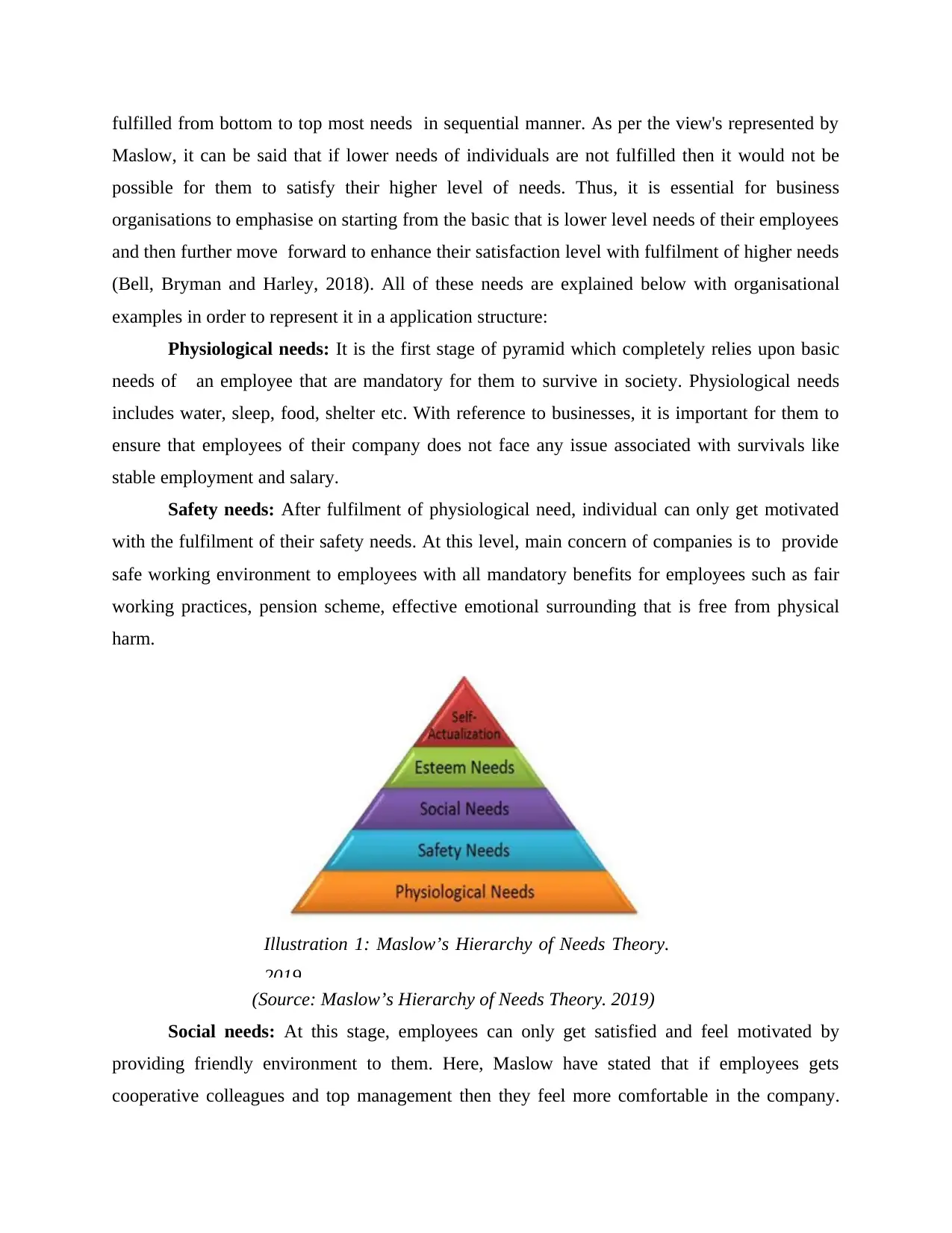
Maslow's Hierarchy of needs theory was developed by Abraham Maslow, a
psychological professor in the year 1943. The theory consist of 5 main stages that showcase how
individual's can get motivated by fulfilment of each level one after another. Categories of these
needs are physiological needs, safety needs, social needs, esteem needs and self actualisation
needs. All of these categories are organized in pyramid structure. These needs of individuals are
Contemporary business issues refers to those issues that belongs to current time period
and affects work of businesses. Employees dissatisfaction is seen as an important contemporary
issue that affects performance of business organisation in negative manner. It is essential for
business associations to take some initiatives so that they can easily improve satisfaction level of
employees so that their devotion towards company can be raised (Alyoubi, 2015). The current
investigation is relies upon psychological phenomenon and employee satisfaction theory that is
helpful for enterprises in developing higher level of satisfaction among employees. The report
will also critically evaluate the chosen theory and its benefits for enterprises. Later, research
topic and questions will going to be identified based on theory. It will also elaborate various
research methodologies along with their comparison and contrast. Furthermore, it will include
discussion of reflective model and its application for explaining research process, different
theoretical perspectives and methodological approaches.
LO 1
a) Maslow's hierarchical theory
Employee satisfaction is termed as an essential motive of every business organisation as
they are an integral part of company. It can be said that if employees of company are not
satisfied then, they will not place their best possible efforts in organisational work. Business
managers are often using different techniques and theories for enhancing satisfaction level of
employees with the motive of raising their productivity (Amankwah-Amoah and Wang, 2019).
This will ultimately lead to increase in profitability of company in effective way. Maslow
hierarchical theory is observed as one of the important theory which is being opted by many
business associations in order to increase influence of employees towards organisational work.
Maslows hierarchical theory is described as below effectively:
Maslow's Hierarchical Theory
Maslow's Hierarchy of needs theory was developed by Abraham Maslow, a
psychological professor in the year 1943. The theory consist of 5 main stages that showcase how
individual's can get motivated by fulfilment of each level one after another. Categories of these
needs are physiological needs, safety needs, social needs, esteem needs and self actualisation
needs. All of these categories are organized in pyramid structure. These needs of individuals are
⊘ This is a preview!⊘
Do you want full access?
Subscribe today to unlock all pages.

Trusted by 1+ million students worldwide
fulfilled from bottom to top most needs in sequential manner. As per the view's represented by
Maslow, it can be said that if lower needs of individuals are not fulfilled then it would not be
possible for them to satisfy their higher level of needs. Thus, it is essential for business
organisations to emphasise on starting from the basic that is lower level needs of their employees
and then further move forward to enhance their satisfaction level with fulfilment of higher needs
(Bell, Bryman and Harley, 2018). All of these needs are explained below with organisational
examples in order to represent it in a application structure:
Physiological needs: It is the first stage of pyramid which completely relies upon basic
needs of an employee that are mandatory for them to survive in society. Physiological needs
includes water, sleep, food, shelter etc. With reference to businesses, it is important for them to
ensure that employees of their company does not face any issue associated with survivals like
stable employment and salary.
Safety needs: After fulfilment of physiological need, individual can only get motivated
with the fulfilment of their safety needs. At this level, main concern of companies is to provide
safe working environment to employees with all mandatory benefits for employees such as fair
working practices, pension scheme, effective emotional surrounding that is free from physical
harm.
(Source: Maslow’s Hierarchy of Needs Theory. 2019)
Social needs: At this stage, employees can only get satisfied and feel motivated by
providing friendly environment to them. Here, Maslow have stated that if employees gets
cooperative colleagues and top management then they feel more comfortable in the company.
Illustration 1: Maslow’s Hierarchy of Needs Theory.
2019
Maslow, it can be said that if lower needs of individuals are not fulfilled then it would not be
possible for them to satisfy their higher level of needs. Thus, it is essential for business
organisations to emphasise on starting from the basic that is lower level needs of their employees
and then further move forward to enhance their satisfaction level with fulfilment of higher needs
(Bell, Bryman and Harley, 2018). All of these needs are explained below with organisational
examples in order to represent it in a application structure:
Physiological needs: It is the first stage of pyramid which completely relies upon basic
needs of an employee that are mandatory for them to survive in society. Physiological needs
includes water, sleep, food, shelter etc. With reference to businesses, it is important for them to
ensure that employees of their company does not face any issue associated with survivals like
stable employment and salary.
Safety needs: After fulfilment of physiological need, individual can only get motivated
with the fulfilment of their safety needs. At this level, main concern of companies is to provide
safe working environment to employees with all mandatory benefits for employees such as fair
working practices, pension scheme, effective emotional surrounding that is free from physical
harm.
(Source: Maslow’s Hierarchy of Needs Theory. 2019)
Social needs: At this stage, employees can only get satisfied and feel motivated by
providing friendly environment to them. Here, Maslow have stated that if employees gets
cooperative colleagues and top management then they feel more comfortable in the company.
Illustration 1: Maslow’s Hierarchy of Needs Theory.
2019
Paraphrase This Document
Need a fresh take? Get an instant paraphrase of this document with our AI Paraphraser
This ultimately improves their satisfaction level and motivates them to remain loyal with the
company for longer period of time
Esteem needs: It is the fourth stage of pyramid which states that individuals here gives
main preference to themselves at this level (Boone and et. al., 2019). The only things which can
satisfy their needs are self respect, working space, promotion or job titles, recognition and self
image.
Self-actualisation needs: It is the last level of Maslow hierarchical pyramid, in which
employees can only be satisfied with challenging work, expert status and workplace autonomy.
This is because, if individual have attained their all needs from last four stages then, they can
only get motivated with those areas where their expertise is valued. It is last stage, here main
expectation of employees to attain that position where their expertise is valued by all. This
simply motivate them at higher extent.
Reviews from different research articles
As per views expressed by Tanner, R., (2019), Maslow's need hierarchical theory in
modern business scenario is termed as an important motivational tool that is helpful for managers
in enhancing satisfaction as well as motivational level of an employee. The author have further
given example of common situation faced by person while starting their career. For example: if
an individual is beginning with their career will surely emphasise on physiological needs. This
means they will be concerned that they are getting appropriate salary or not (Carrión and et. al.,
2016). The main focus of freshers is to attain satisfactory salary so that they fulfil their own as
well as their family's needs.
According to views presented by Hopper, E., (2019), the author have reviewed different
studies conducted on Maslow's hierarchical need theory in order to check efficiency of the
theory whether it is beneficial is modern business scenario or not. In the study, two investigators
named as Tay, L., and Diener, E., have reviewed data gathered from 60000 participants
belonging to 120 countries. Both the researchers have supported maximum needs stated in
Maslow's theory. Their findings can be understood in an effective manner with one example. For
instance: As per Maslows, an individual can not get satisfied at second or third level of pyramid
i.e. social and belongingness if their basic needs (food, water and shelter) are not met. But, these
authors have expressed that even though basic needs of individuals are not fulfilled but, if they
get love and support from their colleagues, they automatically get satisfied. This is because, love
company for longer period of time
Esteem needs: It is the fourth stage of pyramid which states that individuals here gives
main preference to themselves at this level (Boone and et. al., 2019). The only things which can
satisfy their needs are self respect, working space, promotion or job titles, recognition and self
image.
Self-actualisation needs: It is the last level of Maslow hierarchical pyramid, in which
employees can only be satisfied with challenging work, expert status and workplace autonomy.
This is because, if individual have attained their all needs from last four stages then, they can
only get motivated with those areas where their expertise is valued. It is last stage, here main
expectation of employees to attain that position where their expertise is valued by all. This
simply motivate them at higher extent.
Reviews from different research articles
As per views expressed by Tanner, R., (2019), Maslow's need hierarchical theory in
modern business scenario is termed as an important motivational tool that is helpful for managers
in enhancing satisfaction as well as motivational level of an employee. The author have further
given example of common situation faced by person while starting their career. For example: if
an individual is beginning with their career will surely emphasise on physiological needs. This
means they will be concerned that they are getting appropriate salary or not (Carrión and et. al.,
2016). The main focus of freshers is to attain satisfactory salary so that they fulfil their own as
well as their family's needs.
According to views presented by Hopper, E., (2019), the author have reviewed different
studies conducted on Maslow's hierarchical need theory in order to check efficiency of the
theory whether it is beneficial is modern business scenario or not. In the study, two investigators
named as Tay, L., and Diener, E., have reviewed data gathered from 60000 participants
belonging to 120 countries. Both the researchers have supported maximum needs stated in
Maslow's theory. Their findings can be understood in an effective manner with one example. For
instance: As per Maslows, an individual can not get satisfied at second or third level of pyramid
i.e. social and belongingness if their basic needs (food, water and shelter) are not met. But, these
authors have expressed that even though basic needs of individuals are not fulfilled but, if they
get love and support from their colleagues, they automatically get satisfied. This is because, love
and support is always appreciated by all level of people because it provides them soothing
environment which directly motivates them a lot (Testing Maslow’s Theory. 2019). This simply
depicts that views represented by these authors and Maslow contradict at some stakes.
On the basis of another research conducted on the same theory i.e., Maslow hierarchical
theory in order to check its applicability on staff of NHS UK. In this study, it has been reviewed
that Maslow's hierarchical theory has both favourable and non favourable factors that mean it has
both supportive and contradictory evidence. It has been revealed in the study that supportive
evidence of this theory has stated that basic needs of individual directly influences this model as
well as different areas of psychology (Falzon, 2016). On the other hand, it contradicts that it
many a times ignores logical concepts which ultimately influences motivation. For instance:
While linking this framework with ancillary worker's motivation, it has been analysed that this
framework provides high level of motivation and satisfaction to workers as their needs are
fulfilled one after another in a sequential framework (Evaluating the applicability of Maslow's
theory of motivation to ancillary staff. 2019). In this, it has been identified that low level of
workers might not get satisfied if they do not get financially secure information on their job role.
Critical review of articles
As per above described information reviewed from different articles, it has been analysed
that Maslow's hierarchical need theory has different aspects and outcomes after testing them at
different level. In the first reviewed article, it has been observed that reviews presented by this
researcher is quite similar to Maslow hierarchical theory. In this, clear representation has been
made on the situation that whenever any freshers starts job they simply gets satisfied with good
range of salary as their preliminary motive is to fulfil basic requirements of themselves as well as
their family. On the other hand views represented by Tay, L., and Diener, E. and Maslow are
quite different from one another which are simply described in the above stated example. The
outcome of example states that lower level of employees can also get satisfied with the
fulfilment of belongingness and love needs. This satisfaction directly motivates employees as
they are getting better response and support from their colleagues.
For the current investigation, I have reviewed three different articles in order to develop
my own knowledge on employee satisfaction and psychological phenomenon. With the support
of data collection methods, it has been identified by me that Maslow's Hierarchical need theory is
helpful in improving satisfaction of level of employees. According to this theory, it is essential
environment which directly motivates them a lot (Testing Maslow’s Theory. 2019). This simply
depicts that views represented by these authors and Maslow contradict at some stakes.
On the basis of another research conducted on the same theory i.e., Maslow hierarchical
theory in order to check its applicability on staff of NHS UK. In this study, it has been reviewed
that Maslow's hierarchical theory has both favourable and non favourable factors that mean it has
both supportive and contradictory evidence. It has been revealed in the study that supportive
evidence of this theory has stated that basic needs of individual directly influences this model as
well as different areas of psychology (Falzon, 2016). On the other hand, it contradicts that it
many a times ignores logical concepts which ultimately influences motivation. For instance:
While linking this framework with ancillary worker's motivation, it has been analysed that this
framework provides high level of motivation and satisfaction to workers as their needs are
fulfilled one after another in a sequential framework (Evaluating the applicability of Maslow's
theory of motivation to ancillary staff. 2019). In this, it has been identified that low level of
workers might not get satisfied if they do not get financially secure information on their job role.
Critical review of articles
As per above described information reviewed from different articles, it has been analysed
that Maslow's hierarchical need theory has different aspects and outcomes after testing them at
different level. In the first reviewed article, it has been observed that reviews presented by this
researcher is quite similar to Maslow hierarchical theory. In this, clear representation has been
made on the situation that whenever any freshers starts job they simply gets satisfied with good
range of salary as their preliminary motive is to fulfil basic requirements of themselves as well as
their family. On the other hand views represented by Tay, L., and Diener, E. and Maslow are
quite different from one another which are simply described in the above stated example. The
outcome of example states that lower level of employees can also get satisfied with the
fulfilment of belongingness and love needs. This satisfaction directly motivates employees as
they are getting better response and support from their colleagues.
For the current investigation, I have reviewed three different articles in order to develop
my own knowledge on employee satisfaction and psychological phenomenon. With the support
of data collection methods, it has been identified by me that Maslow's Hierarchical need theory is
helpful in improving satisfaction of level of employees. According to this theory, it is essential
⊘ This is a preview!⊘
Do you want full access?
Subscribe today to unlock all pages.
Trusted by 1+ million students worldwide
for business managers to start fulfilling requirement of employees from their basic needs that
ends up at self actualization (Hoque, 2018). Also, usage of secondary sources that is online
articles was highly helpful in grabbing maximum information on this topic. Secondary data was
also helpful in understanding different perspective of researchers on the same topic. This has
supported me in enhancing in depth understanding on Maslow's Hierarchical need theory. Apart
from this, I have also identified that business associations are required to adopt Maslow's
Hierarchical need theory for satisfying core needs of their employees. It directly leads to
improvement in performance of employees in effective manner. This clearly shows that this
theory has major influence over satisfaction level of employees. In addition to this, it can also be
said that this theory guides managers to motivate employees step by step by fulfilling their core
needs and requirements.
b) Research topic and research questions
Research topic
The main research topic for current investigation is “To analyse influence of Maslow's
Hierarchical theory on employees satisfaction level and psychological phenomenon”.
Research Objectives
To understand Maslow's Hierarchical need theory
To determine influence of Maslow's Hierarchical theory on employee's satisfaction level
and psychological phenomenon
Research Questions
What do you understand by Maslow's Hierarchical need theory?
How Maslow's Hierarchical theory influences satisfaction level and psychology of
employees?
The current developed discussion on Maslow's Hierarchical theory will work as the
fundamental base for the further research as it has provided basic knowledge on the core concept
with the point of view of different authors. Usage of various perception for single topic is helpful
in developing in depth knowledge on the core concept. This directly contributes in applying this
theory in organisational context. It supports in the improvement of employees satisfaction level
that ultimately grows organisational performance.
ends up at self actualization (Hoque, 2018). Also, usage of secondary sources that is online
articles was highly helpful in grabbing maximum information on this topic. Secondary data was
also helpful in understanding different perspective of researchers on the same topic. This has
supported me in enhancing in depth understanding on Maslow's Hierarchical need theory. Apart
from this, I have also identified that business associations are required to adopt Maslow's
Hierarchical need theory for satisfying core needs of their employees. It directly leads to
improvement in performance of employees in effective manner. This clearly shows that this
theory has major influence over satisfaction level of employees. In addition to this, it can also be
said that this theory guides managers to motivate employees step by step by fulfilling their core
needs and requirements.
b) Research topic and research questions
Research topic
The main research topic for current investigation is “To analyse influence of Maslow's
Hierarchical theory on employees satisfaction level and psychological phenomenon”.
Research Objectives
To understand Maslow's Hierarchical need theory
To determine influence of Maslow's Hierarchical theory on employee's satisfaction level
and psychological phenomenon
Research Questions
What do you understand by Maslow's Hierarchical need theory?
How Maslow's Hierarchical theory influences satisfaction level and psychology of
employees?
The current developed discussion on Maslow's Hierarchical theory will work as the
fundamental base for the further research as it has provided basic knowledge on the core concept
with the point of view of different authors. Usage of various perception for single topic is helpful
in developing in depth knowledge on the core concept. This directly contributes in applying this
theory in organisational context. It supports in the improvement of employees satisfaction level
that ultimately grows organisational performance.
Paraphrase This Document
Need a fresh take? Get an instant paraphrase of this document with our AI Paraphraser
LO 2
a) Research Methodology
Research methodology section provides complete guidelines to investigator in terms of
various methods that will going to be used by them for conducting effective research. It simply
showcase the pattern in which information is going to be collected, analysed and used so that
appropriate conclusion could be drawn on research problem (Goss, 2015). The current
investigation is going to be developed on the topic “To analyse influence of Maslow's
Hierarchical theory on employees satisfaction level and psychological phenomenon”. This
section has various elements that collaboratively helps in executing an effective research. All of
important elements are described as below in effective manner:
Type of investigation
Investigation is termed as the pattern or technique that is being used by investigator to
analyse overall gathered information. Qualitative and Quantitative research method are two of
the main types of investigation which supports in conducting research in effective way. In
current investigation, researcher has used qualitative method of investigation in order to address
research problem with the help of human perception. Qualitative research method refers analysis
overall gathered information by understanding different perspective individuals on same concept
or topic. It includes observation conducted on the basis of belief of individuals. On the other
hand, quantitative type of investigation is completely based on numerical data and statistical
formulas for gaining outcome with accuracy. If it is talked about, qualitative methodology,
weakness of this section is that it never bring exact results in specified time frame. Along with
this, it's strength is that it helps researcher in conducting the investigation considering thoughts
and perceptions of respondents and other researchers. Away with this, threat of this investigation
type is that less effective results are being pulled out.
Research philosophy
It is termed as the belief of conducting research by including various steps like collection
of information, its evaluation and attainment of feasible solution for research problem.
Interpretivism and Positivism are two kind of research philosophy. Interpretivism philosophy
completely relies qualitative analysis that is supportive in addressing research problems by
analysing various perception of researchers. Positivism is considered as a philosophy that relies
upon natural phenomenon. It simply emphasises on gathering information first then interpreting
a) Research Methodology
Research methodology section provides complete guidelines to investigator in terms of
various methods that will going to be used by them for conducting effective research. It simply
showcase the pattern in which information is going to be collected, analysed and used so that
appropriate conclusion could be drawn on research problem (Goss, 2015). The current
investigation is going to be developed on the topic “To analyse influence of Maslow's
Hierarchical theory on employees satisfaction level and psychological phenomenon”. This
section has various elements that collaboratively helps in executing an effective research. All of
important elements are described as below in effective manner:
Type of investigation
Investigation is termed as the pattern or technique that is being used by investigator to
analyse overall gathered information. Qualitative and Quantitative research method are two of
the main types of investigation which supports in conducting research in effective way. In
current investigation, researcher has used qualitative method of investigation in order to address
research problem with the help of human perception. Qualitative research method refers analysis
overall gathered information by understanding different perspective individuals on same concept
or topic. It includes observation conducted on the basis of belief of individuals. On the other
hand, quantitative type of investigation is completely based on numerical data and statistical
formulas for gaining outcome with accuracy. If it is talked about, qualitative methodology,
weakness of this section is that it never bring exact results in specified time frame. Along with
this, it's strength is that it helps researcher in conducting the investigation considering thoughts
and perceptions of respondents and other researchers. Away with this, threat of this investigation
type is that less effective results are being pulled out.
Research philosophy
It is termed as the belief of conducting research by including various steps like collection
of information, its evaluation and attainment of feasible solution for research problem.
Interpretivism and Positivism are two kind of research philosophy. Interpretivism philosophy
completely relies qualitative analysis that is supportive in addressing research problems by
analysing various perception of researchers. Positivism is considered as a philosophy that relies
upon natural phenomenon. It simply emphasises on gathering information first then interpreting
it effectively. In the current research, investigator has used interpretivism research approach. The
main reason behind choosing this is attainment of research outcome with the inclusion of
different researcher's perspectives. Strength of this approach is that, it is best suitable for
qualitative research, which investigator has taken into consideration for this research. Including
this, weakness of interpretivism is smaller sample size and it is time consuming as well.
Therefore, it is may be possible that right results would not be carried out and this can be
considered here as a threat.
RESEARCH APPROACH
Research approach is next layer in research onion after research philosophy. Research
approach is process of date collection and interpretation according to requirements. Research
approaches are of two types inductive and deductive approach. Inductive approach is based on
qualitative data (Hair Jr and et. al., 2015). Here, information is gathered initially on wider basis
and eventually focus on tiny information. On the other hand, deductive approach is based on
quantitative data and is concerned about specific information rather than going from start to end.
Inductive approach is used in this research as it is flexible and relates to qualitative data
collection. Including this, basic strength of inductive investigation is its use in predicting what
might happen in the future or in establishing the possibility of what researcher will encounter. On
the other hand, weakness of inductive approach is that it is incomplete in nature. Therefore,
threat can be false conclusions even with accurate observations.
DATA COLLECTION
This is a process of collecting data from different sources for specific topic. There are
two types of data collection primary and secondary. Primary data is collected by researcher on
personal level. Therefore, it is known as first-hand data. There are many different ways by which
primary data is collected like door to door surveys, interviews, surveys, observations and
questionnaire. This form of data collection is very hectic and time consuming and sometime
proves to be a very tedious job (Henry, Foss and Ahl, 2016). A lot of money is also used to
gather this type of data but, it is totally authentic in nature as it is collected by researcher on their
own. Information becomes Secondary when it is already collected by others and here researcher
is just sorting that information for their own use accordingly to their topic. Investigator collect
this type of data from different sources like google, books, newspaper articles and journals. In
this report, use of secondary sources is done to assemble information as it is less costly as
main reason behind choosing this is attainment of research outcome with the inclusion of
different researcher's perspectives. Strength of this approach is that, it is best suitable for
qualitative research, which investigator has taken into consideration for this research. Including
this, weakness of interpretivism is smaller sample size and it is time consuming as well.
Therefore, it is may be possible that right results would not be carried out and this can be
considered here as a threat.
RESEARCH APPROACH
Research approach is next layer in research onion after research philosophy. Research
approach is process of date collection and interpretation according to requirements. Research
approaches are of two types inductive and deductive approach. Inductive approach is based on
qualitative data (Hair Jr and et. al., 2015). Here, information is gathered initially on wider basis
and eventually focus on tiny information. On the other hand, deductive approach is based on
quantitative data and is concerned about specific information rather than going from start to end.
Inductive approach is used in this research as it is flexible and relates to qualitative data
collection. Including this, basic strength of inductive investigation is its use in predicting what
might happen in the future or in establishing the possibility of what researcher will encounter. On
the other hand, weakness of inductive approach is that it is incomplete in nature. Therefore,
threat can be false conclusions even with accurate observations.
DATA COLLECTION
This is a process of collecting data from different sources for specific topic. There are
two types of data collection primary and secondary. Primary data is collected by researcher on
personal level. Therefore, it is known as first-hand data. There are many different ways by which
primary data is collected like door to door surveys, interviews, surveys, observations and
questionnaire. This form of data collection is very hectic and time consuming and sometime
proves to be a very tedious job (Henry, Foss and Ahl, 2016). A lot of money is also used to
gather this type of data but, it is totally authentic in nature as it is collected by researcher on their
own. Information becomes Secondary when it is already collected by others and here researcher
is just sorting that information for their own use accordingly to their topic. Investigator collect
this type of data from different sources like google, books, newspaper articles and journals. In
this report, use of secondary sources is done to assemble information as it is less costly as
⊘ This is a preview!⊘
Do you want full access?
Subscribe today to unlock all pages.
Trusted by 1+ million students worldwide

compared to primary data and a very convenient source of information. This major strength of
utilising secondary sources that is online articles, books and journals is that it is less time
consuming in nature. The main drawback of this method is that there are probable chances that
other researchers may have represented wrong perception that could also affect relevance of
present data. This can also be considered as a threat as well at the time of utilising this type of
data collection method.
b) Reflective models
In the current investigation, researcher have used qualitative research method for
ensuring that information gathered with this investigation is highly relevant for addressing
research questions. In this study, secondary source of information has been given main
preferences so that maximum information topic could be identified within the provided time
frame. Adoption of secondary data collection methods is highly effective in the current
investigation as it has helped in gathering maximum information on research question within the
provided time frame.
Gibbs reflective model
This framework was given by Graham Gibbs in the year 1988. In order to express overall
experience from this investigation, researcher has used Gibbs reflective model for sharing their
overall experience with the same. All stages of this reflective cycle are described as below:
Description: I have conducted investigation on the topic “To analyse influence of
Maslow's Hierarchical theory on employees satisfaction level and psychological phenomenon”.
It has included various research methodologies for gathering information in effective manner. In
this secondary sources of data collection has been opted by researcher.
Feeling: At the starting time of this investigation, I was very happy because, I have read
about this topic in past years. But, it it complicated for me later because gathering authentic
information was highly difficult for me. Feelings at the time of investigation were fluctuating
with the changing time as things were not going well.
Evaluation and analysis: Knowledge about of this topic was good for me but delay in
collection of information was highly bad as it has consumed my huge time. And also made it
difficult for me to complete it within provided time frame. From this research I have developed
by communication skills, analytical skills and searching skill.
utilising secondary sources that is online articles, books and journals is that it is less time
consuming in nature. The main drawback of this method is that there are probable chances that
other researchers may have represented wrong perception that could also affect relevance of
present data. This can also be considered as a threat as well at the time of utilising this type of
data collection method.
b) Reflective models
In the current investigation, researcher have used qualitative research method for
ensuring that information gathered with this investigation is highly relevant for addressing
research questions. In this study, secondary source of information has been given main
preferences so that maximum information topic could be identified within the provided time
frame. Adoption of secondary data collection methods is highly effective in the current
investigation as it has helped in gathering maximum information on research question within the
provided time frame.
Gibbs reflective model
This framework was given by Graham Gibbs in the year 1988. In order to express overall
experience from this investigation, researcher has used Gibbs reflective model for sharing their
overall experience with the same. All stages of this reflective cycle are described as below:
Description: I have conducted investigation on the topic “To analyse influence of
Maslow's Hierarchical theory on employees satisfaction level and psychological phenomenon”.
It has included various research methodologies for gathering information in effective manner. In
this secondary sources of data collection has been opted by researcher.
Feeling: At the starting time of this investigation, I was very happy because, I have read
about this topic in past years. But, it it complicated for me later because gathering authentic
information was highly difficult for me. Feelings at the time of investigation were fluctuating
with the changing time as things were not going well.
Evaluation and analysis: Knowledge about of this topic was good for me but delay in
collection of information was highly bad as it has consumed my huge time. And also made it
difficult for me to complete it within provided time frame. From this research I have developed
by communication skills, analytical skills and searching skill.
Paraphrase This Document
Need a fresh take? Get an instant paraphrase of this document with our AI Paraphraser
Conclusion: From this investigation, I have learnt that employee satisfaction is important
part of every organisation and if managers uses Maslow's hierarchical need theory will contribute
in increasing satisfaction level of employees. Apart from this, I have also identified that usage of
this theory is helpful in developing satisfaction level of employees as it is fulfilling their basic
needs in effective manner.
Action Plan: All of the developed knowledge from this investigation will help me in
conducting more effective research in future. I will consider my past experience while making
action plan so that I can avoid all mistakes and develop effective plan for future. This will
support me in conducting effective research.
CONCLUSION
From the above described report, it has been identified that employees satisfaction is
considered as an important part of every organisation as they are main asset of company.
Satisfaction level of employees completely depends upon psychological phenomenon as if
psychology of an employees is not in favour of company then they would not be able to perform
their job responsibilities in effective manner. This might also become reason of non fulfilment of
organisational goals and objectives. Maslow's Hierarchical need theory has been identified as
essential theory that is helpful in enhancing satisfaction level of employees by fulfilling their
psychological needs. In the research methodological section, qualitative type of investigation has
been used by investigator to complete it by referring it with human perception. Also, secondary
method of data collection has been used by investigator in order to gathering maximum
information within less period of time.
part of every organisation and if managers uses Maslow's hierarchical need theory will contribute
in increasing satisfaction level of employees. Apart from this, I have also identified that usage of
this theory is helpful in developing satisfaction level of employees as it is fulfilling their basic
needs in effective manner.
Action Plan: All of the developed knowledge from this investigation will help me in
conducting more effective research in future. I will consider my past experience while making
action plan so that I can avoid all mistakes and develop effective plan for future. This will
support me in conducting effective research.
CONCLUSION
From the above described report, it has been identified that employees satisfaction is
considered as an important part of every organisation as they are main asset of company.
Satisfaction level of employees completely depends upon psychological phenomenon as if
psychology of an employees is not in favour of company then they would not be able to perform
their job responsibilities in effective manner. This might also become reason of non fulfilment of
organisational goals and objectives. Maslow's Hierarchical need theory has been identified as
essential theory that is helpful in enhancing satisfaction level of employees by fulfilling their
psychological needs. In the research methodological section, qualitative type of investigation has
been used by investigator to complete it by referring it with human perception. Also, secondary
method of data collection has been used by investigator in order to gathering maximum
information within less period of time.
REFERENCES
Books and Journals
Alyoubi, A. A., 2015. E-commerce in developing countries and how to develop them during the
introduction of modern systems. Procedia Computer Science. 65. pp.479-483.
Amankwah-Amoah, J. and Wang, X., 2019. Opening editorial: contemporary business risks: an
overview and new research agenda.
Bell, E., Bryman, A. and Harley, B., 2018. Business research methods. Oxford university press.
Boone, L. E. and et. al., 2019. Contemporary business. John Wiley & Sons.
Carrión, G. C. and et. al., 2016. Prediction-oriented modeling in business research by means of
PLS path modeling: Introduction to a JBR special section. Journal of Business
Research. 69(10). pp.4545-4551.
Demil, B. and et. al., 2015. Introduction to the SEJ special issue on business models: business
models within the domain of strategic entrepreneurship. Strategic Entrepreneurship
Journal. 9(1). pp.1-11.
Falzon, M. A., 2016. Introduction: Multi-sited ethnography: Theory, praxis and locality in
contemporary research. In Multi-sited ethnography (pp. 15-38). Routledge.
Goss, D., 2015. Small Business and Society (Routledge Revivals). Routledge.
Hair Jr, J. F. and et. al., 2015. Essentials of business research methods. Routledge.
Henry, C., Foss, L. and Ahl, H., 2016. Gender and entrepreneurship research: A review of
methodological approaches. International Small Business Journal. 34(3). pp.217-241.
Hoque, Z., 2018. Methodological issues in accounting research. Spiramus Press Ltd.
Houlihan, B. and Malcolm, D. eds., 2015. Sport and society: a student introduction. Sage.
Myers, M. D., 2019. Qualitative research in business and management. Sage Publications
Limited.
Patten, M. L. and Newhart, M., 2017. Understanding research methods: An overview of the
essentials. Routledge.
Online
Testing Maslow’s Theory. 2019. [Online]. Available Through:
<https://www.thoughtco.com/maslows-hierarchy-of-needs-4582571>.
Evaluating the applicability of Maslow's theory of motivation to ancillary staff. 2019. [Online].
Available Through:
<https://www.academia.edu/3859292/Evaluating_the_applicability_of_Maslows_theory
_of_motivation_to_ancillary_staff>.
Maslow’s Hierarchy of Needs Theory. 2019. [Online]. Available Through:
<https://www.managementstudyguide.com/maslows-hierarchy-needs-theory.htm>.
Books and Journals
Alyoubi, A. A., 2015. E-commerce in developing countries and how to develop them during the
introduction of modern systems. Procedia Computer Science. 65. pp.479-483.
Amankwah-Amoah, J. and Wang, X., 2019. Opening editorial: contemporary business risks: an
overview and new research agenda.
Bell, E., Bryman, A. and Harley, B., 2018. Business research methods. Oxford university press.
Boone, L. E. and et. al., 2019. Contemporary business. John Wiley & Sons.
Carrión, G. C. and et. al., 2016. Prediction-oriented modeling in business research by means of
PLS path modeling: Introduction to a JBR special section. Journal of Business
Research. 69(10). pp.4545-4551.
Demil, B. and et. al., 2015. Introduction to the SEJ special issue on business models: business
models within the domain of strategic entrepreneurship. Strategic Entrepreneurship
Journal. 9(1). pp.1-11.
Falzon, M. A., 2016. Introduction: Multi-sited ethnography: Theory, praxis and locality in
contemporary research. In Multi-sited ethnography (pp. 15-38). Routledge.
Goss, D., 2015. Small Business and Society (Routledge Revivals). Routledge.
Hair Jr, J. F. and et. al., 2015. Essentials of business research methods. Routledge.
Henry, C., Foss, L. and Ahl, H., 2016. Gender and entrepreneurship research: A review of
methodological approaches. International Small Business Journal. 34(3). pp.217-241.
Hoque, Z., 2018. Methodological issues in accounting research. Spiramus Press Ltd.
Houlihan, B. and Malcolm, D. eds., 2015. Sport and society: a student introduction. Sage.
Myers, M. D., 2019. Qualitative research in business and management. Sage Publications
Limited.
Patten, M. L. and Newhart, M., 2017. Understanding research methods: An overview of the
essentials. Routledge.
Online
Testing Maslow’s Theory. 2019. [Online]. Available Through:
<https://www.thoughtco.com/maslows-hierarchy-of-needs-4582571>.
Evaluating the applicability of Maslow's theory of motivation to ancillary staff. 2019. [Online].
Available Through:
<https://www.academia.edu/3859292/Evaluating_the_applicability_of_Maslows_theory
_of_motivation_to_ancillary_staff>.
Maslow’s Hierarchy of Needs Theory. 2019. [Online]. Available Through:
<https://www.managementstudyguide.com/maslows-hierarchy-needs-theory.htm>.
⊘ This is a preview!⊘
Do you want full access?
Subscribe today to unlock all pages.
Trusted by 1+ million students worldwide

1 out of 12


Related Documents


Your All-in-One AI-Powered Toolkit for Academic Success.
+13062052269
info@desklib.com
Available 24*7 on WhatsApp / Email
![[object Object]](/_next/static/media/star-bottom.7253800d.svg)
Unlock your academic potential
Copyright © 2020–2026 A2Z Services. All Rights Reserved. Developed and managed by ZUCOL.