Employee Talent and People Resources: NHS Labour Market Analysis
VerifiedAdded on 2021/04/21
|12
|2913
|46
Report
AI Summary
This report analyzes employee talent and people resources within the National Health Service (NHS), focusing on labour market dynamics and strategic human resource (HR) planning. The analysis begins with an overview of the importance of labour market analysis for the NHS, highlighting challenges such as disequilibrium in the labour market, shortages of doctors, and the impact of factors like pay and working conditions on employee retention. The report then explores the significance of both short-term and long-term planning in business decision-making within the context of the NHS, emphasizing workforce planning, recruitment, and training strategies. It also addresses the reasons why the NHS needs to adopt effective HR strategies to improve its performance, particularly in retaining nurses and health executives. The report includes a reflective log of an HR executive interview, offering a personal perspective on the challenges and potential solutions for talent management within the NHS. Overall, the report provides a comprehensive examination of the issues and strategies related to employee talent and people resources within the NHS.
Running head: EMPLOYEE TALENT AND PEOPLE RESOURCES
Employee talent and People resources
Student’s name:
Name of the university:
Author’s note:
Employee talent and People resources
Student’s name:
Name of the university:
Author’s note:

Paraphrase This Document
Need a fresh take? Get an instant paraphrase of this document with our AI Paraphraser
1EMPLOYEE TALENT AND PEOPLE RESOURCES
Table of Contents
Task 1...............................................................................................................................................2
1. Explaining the relevance of conducting labour market analysis to organisations relating to
NHS.............................................................................................................................................2
The process of contributing to effective planning.......................................................................3
2. Analysing the importance of short-term and long-term planning in business decision making
.....................................................................................................................................................5
Reasons behind organisations like the NHS adopt these effective HR strategies to improve its
performance.................................................................................................................................6
Task 2: Reflective Log.....................................................................................................................7
Table of Contents
Task 1...............................................................................................................................................2
1. Explaining the relevance of conducting labour market analysis to organisations relating to
NHS.............................................................................................................................................2
The process of contributing to effective planning.......................................................................3
2. Analysing the importance of short-term and long-term planning in business decision making
.....................................................................................................................................................5
Reasons behind organisations like the NHS adopt these effective HR strategies to improve its
performance.................................................................................................................................6
Task 2: Reflective Log.....................................................................................................................7
2EMPLOYEE TALENT AND PEOPLE RESOURCES
Task 1
1. Explaining the relevance of conducting labour market analysis to organisations relating
to NHS
HRM is also known as the Human Capital Resources and it is one of the significant
sections of organisational management that needs properly administration. As stated by De
Boeck et al. (2018), HRM has the close link to the unit performances and policies, especially to
the service based organisation that has a complex structure. HRM focuses mainly business profit
of the organisation and less attention is given to the public service organisations. Consumables
and physical capital are the two other important inputs that are complementary in human
resources. The largest group in the NHS are health visiting staffs, nurses and midwives. Unlike
other employment, the combination of occupational heterogeneity and substantial spatial set the
health service apart. NHS employees face the challenge as the other employees in different
sectors get motivation like reward structure, devising pay and satisfaction. Labour market
information Labour market analysis is needed to NHS as NHS has been facing the issue of
disequilibrium feature in labour market (Kamil et al. 2016). Disequilibrium can assist itself to the
persistent speciality and regional factor to the nursing staffs and pay structure. The employees
are lacking their interests in workplace and they do not perform their job roles well.
Doctors' demands are always higher than the supply in NHS and vacancies have been
fulfilled by the overseas doctors. The shortage of doctors in the labour market of healthcare is
predominant characteristics not only in the UK but also Germany and France. There are more
than 690,700 midwives and nurses are registered in the UK and 5.5% of the nurses are trained in
the EU (England.nhs.uk 2018). The new entrants in the labour market of nurses are higher than
previous two years 2015 and 2016. (Bonoli 2017) However, there is a huge fall of the new
Task 1
1. Explaining the relevance of conducting labour market analysis to organisations relating
to NHS
HRM is also known as the Human Capital Resources and it is one of the significant
sections of organisational management that needs properly administration. As stated by De
Boeck et al. (2018), HRM has the close link to the unit performances and policies, especially to
the service based organisation that has a complex structure. HRM focuses mainly business profit
of the organisation and less attention is given to the public service organisations. Consumables
and physical capital are the two other important inputs that are complementary in human
resources. The largest group in the NHS are health visiting staffs, nurses and midwives. Unlike
other employment, the combination of occupational heterogeneity and substantial spatial set the
health service apart. NHS employees face the challenge as the other employees in different
sectors get motivation like reward structure, devising pay and satisfaction. Labour market
information Labour market analysis is needed to NHS as NHS has been facing the issue of
disequilibrium feature in labour market (Kamil et al. 2016). Disequilibrium can assist itself to the
persistent speciality and regional factor to the nursing staffs and pay structure. The employees
are lacking their interests in workplace and they do not perform their job roles well.
Doctors' demands are always higher than the supply in NHS and vacancies have been
fulfilled by the overseas doctors. The shortage of doctors in the labour market of healthcare is
predominant characteristics not only in the UK but also Germany and France. There are more
than 690,700 midwives and nurses are registered in the UK and 5.5% of the nurses are trained in
the EU (England.nhs.uk 2018). The new entrants in the labour market of nurses are higher than
previous two years 2015 and 2016. (Bonoli 2017) However, there is a huge fall of the new
⊘ This is a preview!⊘
Do you want full access?
Subscribe today to unlock all pages.

Trusted by 1+ million students worldwide
3EMPLOYEE TALENT AND PEOPLE RESOURCES
entrants from EEA (European Economic Area) in the nursing sector. Nurses in this profession in
recent time do not get a pay rise and the jobs are now open to the women that can constitute the
vast majority of new entrants. NHS provides training opportunities to the nurses and NHS has
always been a dominant buyer of the qualified nurses. Now the growth of the private healthcare
centres, the nurses are trying to shift to the private healthcare as the pay package is good. Now,
NHS finds itself running in the competitive labour market. As stated by Burrell (2016), aspects
of the job in nursing are far better than the pay package as the job gives the nurse's job
satisfaction. The labour market of nurses is characteristics of long working hours, working
conditions and short-run supply of labours. The theory of compensating differentials shows that
labours pay more attention to the lower wages that give attractive attributes rather than the good
wages with unattractive attributes (England 2016). There is a gap between pays of doctors and
nurses and the incentives are lower in nurse anaesthetists and substantial nurses. Self-employed
people in the UK in the year 2017 were 15% and it is much lower in case of the nursing and it is
just 2% (England.nhs.uk 2018). NMC Health is leaving the UK because of working condition,
degrading personal circumstances, poor pay and benefits and disillusioned with Equality Act
(Atkinson and Storey 2016). The UK government has increased £ 900 million in the present year
of 2018 in order to solve the pay scale issue of health executives.
The process of contributing to effective planning
The HR department of healthcare needs to plan workforce planning in order to solve the
nurses and health executive issues. As opined by Adisa et al. (2017), workforce planning can
ensure the labours are rightly allocated to projects in order to achieve service users’ delivery
schedule. Strategic workforce planning takes a long-term forecast what the organisation might
need in future. The HR department can proactively scan the external environment as well as the
entrants from EEA (European Economic Area) in the nursing sector. Nurses in this profession in
recent time do not get a pay rise and the jobs are now open to the women that can constitute the
vast majority of new entrants. NHS provides training opportunities to the nurses and NHS has
always been a dominant buyer of the qualified nurses. Now the growth of the private healthcare
centres, the nurses are trying to shift to the private healthcare as the pay package is good. Now,
NHS finds itself running in the competitive labour market. As stated by Burrell (2016), aspects
of the job in nursing are far better than the pay package as the job gives the nurse's job
satisfaction. The labour market of nurses is characteristics of long working hours, working
conditions and short-run supply of labours. The theory of compensating differentials shows that
labours pay more attention to the lower wages that give attractive attributes rather than the good
wages with unattractive attributes (England 2016). There is a gap between pays of doctors and
nurses and the incentives are lower in nurse anaesthetists and substantial nurses. Self-employed
people in the UK in the year 2017 were 15% and it is much lower in case of the nursing and it is
just 2% (England.nhs.uk 2018). NMC Health is leaving the UK because of working condition,
degrading personal circumstances, poor pay and benefits and disillusioned with Equality Act
(Atkinson and Storey 2016). The UK government has increased £ 900 million in the present year
of 2018 in order to solve the pay scale issue of health executives.
The process of contributing to effective planning
The HR department of healthcare needs to plan workforce planning in order to solve the
nurses and health executive issues. As opined by Adisa et al. (2017), workforce planning can
ensure the labours are rightly allocated to projects in order to achieve service users’ delivery
schedule. Strategic workforce planning takes a long-term forecast what the organisation might
need in future. The HR department can proactively scan the external environment as well as the
Paraphrase This Document
Need a fresh take? Get an instant paraphrase of this document with our AI Paraphraser
4EMPLOYEE TALENT AND PEOPLE RESOURCES
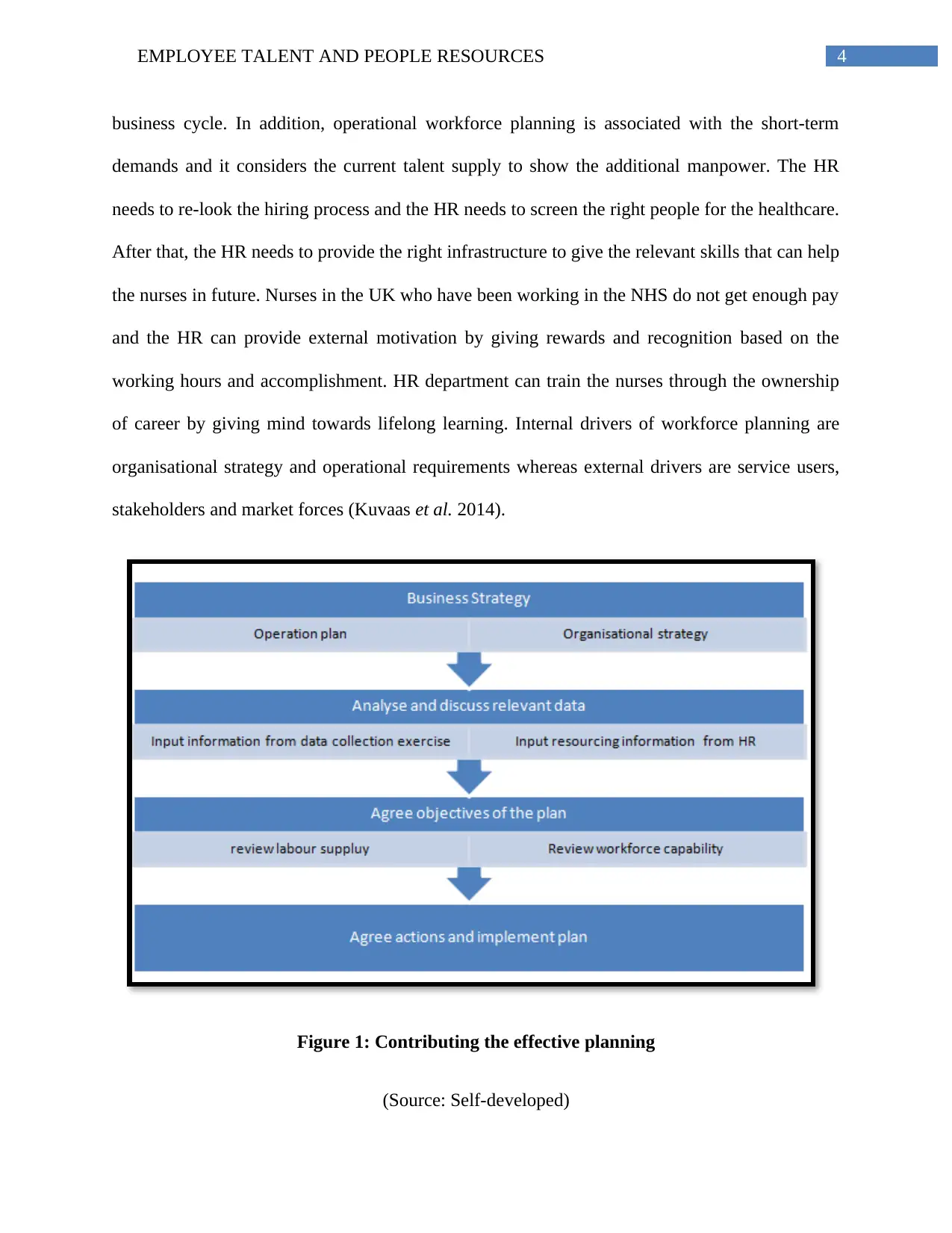
business cycle. In addition, operational workforce planning is associated with the short-term
demands and it considers the current talent supply to show the additional manpower. The HR
needs to re-look the hiring process and the HR needs to screen the right people for the healthcare.
After that, the HR needs to provide the right infrastructure to give the relevant skills that can help
the nurses in future. Nurses in the UK who have been working in the NHS do not get enough pay
and the HR can provide external motivation by giving rewards and recognition based on the
working hours and accomplishment. HR department can train the nurses through the ownership
of career by giving mind towards lifelong learning. Internal drivers of workforce planning are
organisational strategy and operational requirements whereas external drivers are service users,
stakeholders and market forces (Kuvaas et al. 2014).
Figure 1: Contributing the effective planning
(Source: Self-developed)
business cycle. In addition, operational workforce planning is associated with the short-term
demands and it considers the current talent supply to show the additional manpower. The HR
needs to re-look the hiring process and the HR needs to screen the right people for the healthcare.
After that, the HR needs to provide the right infrastructure to give the relevant skills that can help
the nurses in future. Nurses in the UK who have been working in the NHS do not get enough pay
and the HR can provide external motivation by giving rewards and recognition based on the
working hours and accomplishment. HR department can train the nurses through the ownership
of career by giving mind towards lifelong learning. Internal drivers of workforce planning are
organisational strategy and operational requirements whereas external drivers are service users,
stakeholders and market forces (Kuvaas et al. 2014).
Figure 1: Contributing the effective planning
(Source: Self-developed)
5EMPLOYEE TALENT AND PEOPLE RESOURCES
2. Analysing the importance of short-term and long-term planning in business decision
making
Making HR plan for the betterment of employees takes time. Making business plan is
important to grow and expand the business. Short-term planning strives to address goal that can
be taken within a short period of time. Short-term planning generally refers to the work that can
be done within a month or a few weeks (Kooji et al. 2014). Short-term planning is also
associated with the expanding the base of the customers to a certain percentage. In healthcare,
HR department needs to work harder to meet the service users' need. In case of a short-term plan,
the HR needs to hire the nurses and staffs and they can also train the employees. In the short-
term plan, the HR managers of the health care can anticipate the workforce requirement and they
must not get surprised by the change of events. In addition, HR department plans how to survive
the healthcare organisation not to fall into a trap during the shifting workforce market.
In case of the long-term plan of the HR is done almost for the five years. In a meeting,
the employees and manager cannot decide the future as it is unrealistic. In case of the healthcare
systems, the HR department adjusts the long-term plan where they decide about improving the
organisation’s stakeholders as well as liabilities (Donate et al. 2016). The HR department tries to
make a conjunction with the requirement and the professional experience of the organisation,
skills and talent needs of the healthcare. The HR can decide the strategy of the organisation in a
growth phase. The nurses of NHS have been facing the issue of pay and the management cannot
commit towards resource funding. The HR needs to consider the organisational objectives and
HR planning allows identifying and selecting the development needed to acquire the new talent
and retain the existing talents.
2. Analysing the importance of short-term and long-term planning in business decision
making
Making HR plan for the betterment of employees takes time. Making business plan is
important to grow and expand the business. Short-term planning strives to address goal that can
be taken within a short period of time. Short-term planning generally refers to the work that can
be done within a month or a few weeks (Kooji et al. 2014). Short-term planning is also
associated with the expanding the base of the customers to a certain percentage. In healthcare,
HR department needs to work harder to meet the service users' need. In case of a short-term plan,
the HR needs to hire the nurses and staffs and they can also train the employees. In the short-
term plan, the HR managers of the health care can anticipate the workforce requirement and they
must not get surprised by the change of events. In addition, HR department plans how to survive
the healthcare organisation not to fall into a trap during the shifting workforce market.
In case of the long-term plan of the HR is done almost for the five years. In a meeting,
the employees and manager cannot decide the future as it is unrealistic. In case of the healthcare
systems, the HR department adjusts the long-term plan where they decide about improving the
organisation’s stakeholders as well as liabilities (Donate et al. 2016). The HR department tries to
make a conjunction with the requirement and the professional experience of the organisation,
skills and talent needs of the healthcare. The HR can decide the strategy of the organisation in a
growth phase. The nurses of NHS have been facing the issue of pay and the management cannot
commit towards resource funding. The HR needs to consider the organisational objectives and
HR planning allows identifying and selecting the development needed to acquire the new talent
and retain the existing talents.
⊘ This is a preview!⊘
Do you want full access?
Subscribe today to unlock all pages.
Trusted by 1+ million students worldwide
6EMPLOYEE TALENT AND PEOPLE RESOURCES
Reasons behind organisations like the NHS adopt these effective HR strategies to improve
its performance
NHS needs to adopt the HR strategies to retain nurses and health executives by giving
them motivation. The HR department can recruit and retain top talent as maximum nurses at this
time are going to private healthcare. Finding and keeping talent is necessary from the side of HR
in NHS organisation. The HR departments need to master in attracting and keeping the great
people who stand still to continue to shine in healthcare. In addition, HR departments can move
faster to make the great hires as potential candidates move faster in streamlines hiring process. In
addition, as stated by England (2016), NHS organisation needs to establish and communicate
career path to the nurses so that they can improve in long-term career objectives. Lastly, in order
to improve the performance of the nurses, the HR department can invest in training and
motivation. Working in patient-centred homes is not an easy task for the nurses and management
re-invest in training so that the decision-making of the nurses must be fulfilled.
Reasons behind organisations like the NHS adopt these effective HR strategies to improve
its performance
NHS needs to adopt the HR strategies to retain nurses and health executives by giving
them motivation. The HR department can recruit and retain top talent as maximum nurses at this
time are going to private healthcare. Finding and keeping talent is necessary from the side of HR
in NHS organisation. The HR departments need to master in attracting and keeping the great
people who stand still to continue to shine in healthcare. In addition, HR departments can move
faster to make the great hires as potential candidates move faster in streamlines hiring process. In
addition, as stated by England (2016), NHS organisation needs to establish and communicate
career path to the nurses so that they can improve in long-term career objectives. Lastly, in order
to improve the performance of the nurses, the HR department can invest in training and
motivation. Working in patient-centred homes is not an easy task for the nurses and management
re-invest in training so that the decision-making of the nurses must be fulfilled.
Paraphrase This Document
Need a fresh take? Get an instant paraphrase of this document with our AI Paraphraser
7EMPLOYEE TALENT AND PEOPLE RESOURCES
Task 2: Reflective Log
I went for a job interview for the post of HR executive and I was asked to sit in the
interview room. There were two persons inside the interview room who would take my
interview. I was trying to be calm and I was focusing on the concentration of mine. Of late, NHS
has been facing the issue of talent management and people resources as the most of the health
executives are leaving NHS and joining the private sector. The interviewers asked about myself
first and then they talked about the NHS issues and what kind of development can NHS need to
make to solve the issue.
Strategic goals of NHS are associated with the safe, compassionate and effective care to
the service users and attract, support and retain the finest workforce. NHS wants to have
financial stability and work with the partners. These goals of NHS are tried to make up for the
HR strategies of recruiting and retaining the nurses and providing motivation to the nurses. The
HR departments masters in keeping and attracting the people. I believe, they can establish and
communicate career path through training to the nurses. HR department can segregate the plan in
long-term and short-term wise so that the management can invest in improving the health
executives to make the finest workforce.
In NHS current issues are related to the nurses' lack of a hike in pay and nurses do not
observe any growth in the NHS based workplaces. The nurses are trying to shift their career in
private healthcare so that they can improve their career growth. Therefore, the issues of the
nurses in NHS are associated with the recruiting the current talent as the private sector are taking
potential nurses. NHS does not give training to the nurses and retaining talent is an issue in
healthcare. NHS is facing issue to develop an ethical culture in nursing. My strategies of HR can
Task 2: Reflective Log
I went for a job interview for the post of HR executive and I was asked to sit in the
interview room. There were two persons inside the interview room who would take my
interview. I was trying to be calm and I was focusing on the concentration of mine. Of late, NHS
has been facing the issue of talent management and people resources as the most of the health
executives are leaving NHS and joining the private sector. The interviewers asked about myself
first and then they talked about the NHS issues and what kind of development can NHS need to
make to solve the issue.
Strategic goals of NHS are associated with the safe, compassionate and effective care to
the service users and attract, support and retain the finest workforce. NHS wants to have
financial stability and work with the partners. These goals of NHS are tried to make up for the
HR strategies of recruiting and retaining the nurses and providing motivation to the nurses. The
HR departments masters in keeping and attracting the people. I believe, they can establish and
communicate career path through training to the nurses. HR department can segregate the plan in
long-term and short-term wise so that the management can invest in improving the health
executives to make the finest workforce.
In NHS current issues are related to the nurses' lack of a hike in pay and nurses do not
observe any growth in the NHS based workplaces. The nurses are trying to shift their career in
private healthcare so that they can improve their career growth. Therefore, the issues of the
nurses in NHS are associated with the recruiting the current talent as the private sector are taking
potential nurses. NHS does not give training to the nurses and retaining talent is an issue in
healthcare. NHS is facing issue to develop an ethical culture in nursing. My strategies of HR can
8EMPLOYEE TALENT AND PEOPLE RESOURCES
solve the current issue as giving external motivation can retain the existing employees. In
addition, the recruiting potential nurses can reduce the re-invest in the training process.
Moreover, training to the nurses can solve the issue of retaining talent and developing ethical
culture. I think, communicating and establishing the career path for the health executives will
solve the issue of not meeting the goals of NHS.
First two minutes of the interview was challenging for me as I was a bit nervous. After
that, I started to feel comfortable. They asked me the issue of NHS that it has been facing in
recent time regarding the talent management. NHS has been facing the issue of staffing as many
of the nurses have been coming to the UK from the EU countries. This figure may touch 55,000
in adult social care workers. In addition, in the year 2017, this shortfall touched to almost 5%
from the previous year. After the Brexit incident, numbers of nurses in the NHS have drastically
fallen as the UK has not made a treaty with the EU member countries. The UK based NHS needs
to recruit staffs in order to solve the staffing issue. After hearing all my analysis of the NHS's
significant issue, the interviewers gave their viewpoint regarding the accessing the treatment in
the UK and abroad. I felt confident as I could answer all the questions asked by the interviewers.
NHS has to follow the regulation set by the UK government and working-time directive is
important and procurement and competition law should be followed.
Sometimes, my viewpoint was not supported by interviewers regarding the HR strategies.
I took up the concept of the lower external motivation of the nurses. The nurses may have the
intrinsic motivation that keeps them within the organisation. I took up with another concept of
cross-border cooperation in the public health and the interviewers did not familiar with the
concept. I have been facing the issue of asking the wrong questions. The whole interview was for
the purpose of HR strategies and issues, however, nursing based questions and strategies must
solve the current issue as giving external motivation can retain the existing employees. In
addition, the recruiting potential nurses can reduce the re-invest in the training process.
Moreover, training to the nurses can solve the issue of retaining talent and developing ethical
culture. I think, communicating and establishing the career path for the health executives will
solve the issue of not meeting the goals of NHS.
First two minutes of the interview was challenging for me as I was a bit nervous. After
that, I started to feel comfortable. They asked me the issue of NHS that it has been facing in
recent time regarding the talent management. NHS has been facing the issue of staffing as many
of the nurses have been coming to the UK from the EU countries. This figure may touch 55,000
in adult social care workers. In addition, in the year 2017, this shortfall touched to almost 5%
from the previous year. After the Brexit incident, numbers of nurses in the NHS have drastically
fallen as the UK has not made a treaty with the EU member countries. The UK based NHS needs
to recruit staffs in order to solve the staffing issue. After hearing all my analysis of the NHS's
significant issue, the interviewers gave their viewpoint regarding the accessing the treatment in
the UK and abroad. I felt confident as I could answer all the questions asked by the interviewers.
NHS has to follow the regulation set by the UK government and working-time directive is
important and procurement and competition law should be followed.
Sometimes, my viewpoint was not supported by interviewers regarding the HR strategies.
I took up the concept of the lower external motivation of the nurses. The nurses may have the
intrinsic motivation that keeps them within the organisation. I took up with another concept of
cross-border cooperation in the public health and the interviewers did not familiar with the
concept. I have been facing the issue of asking the wrong questions. The whole interview was for
the purpose of HR strategies and issues, however, nursing based questions and strategies must
⊘ This is a preview!⊘
Do you want full access?
Subscribe today to unlock all pages.
Trusted by 1+ million students worldwide
9EMPLOYEE TALENT AND PEOPLE RESOURCES
not be asked here. Interviewers sometimes were making the bias comments. I had to handle this
by making diplomatic answers. I was facing the issue of a communication problem and lack of
confident some of the times. In addition, the inconsistency of the answers was another challenge
for me as I was making a different point of view what I had made earlier.
After the job interview, I have realised that I could have answered the questions in the
more diplomatic way with more data. I could have listened to the questions properly and narrate
my answers keeping the eyes to the interviewers. I could have highlighted my past experiences to
show my knowledge in-depth way. I could have shown up my knowledge assets to give specific
past examples of NHS. I had not researched properly about NHS what I should have done earlier.
One should focus on the key issues experienced during the job interview meeting rather
than just outlining what happened. I was always trying to participate the interview process;
however, because of my lack of confidence, I could not make eye-contact properly.
not be asked here. Interviewers sometimes were making the bias comments. I had to handle this
by making diplomatic answers. I was facing the issue of a communication problem and lack of
confident some of the times. In addition, the inconsistency of the answers was another challenge
for me as I was making a different point of view what I had made earlier.
After the job interview, I have realised that I could have answered the questions in the
more diplomatic way with more data. I could have listened to the questions properly and narrate
my answers keeping the eyes to the interviewers. I could have highlighted my past experiences to
show my knowledge in-depth way. I could have shown up my knowledge assets to give specific
past examples of NHS. I had not researched properly about NHS what I should have done earlier.
One should focus on the key issues experienced during the job interview meeting rather
than just outlining what happened. I was always trying to participate the interview process;
however, because of my lack of confidence, I could not make eye-contact properly.
Paraphrase This Document
Need a fresh take? Get an instant paraphrase of this document with our AI Paraphraser
10EMPLOYEE TALENT AND PEOPLE RESOURCES
Reference List
Adisa, T.A., Osabutey, E.L., Gbadamosi, G. and Mordi, C., 2017. The challenges of employee
resourcing: the perceptions of managers in Nigeria. Career Development International, 22(6),
pp.703-723.
Atkinson, J. and Storey, D.J. eds., 2016. Employment, the small firm and the labour market.
Abingdon: Routledge.
Bonoli, G., 2017. Labour market and social protection reforms in international perspective:
parallel or converging tracks?. London: Taylor & Francis.
Burrell, K. ed., 2016. Polish Migration to the UK in the'new 'European Union: After 2004.
Abingdon: Routledge.
De Boeck, G., Meyers, M.C. and Dries, N., 2018. Employee reactions to talent management:
Assumptions versus evidence. Journal of Organizational Behavior, 39(2), pp.199-213.
Donate, M.J., Peña, I. and Sanchez de Pablo, J.D., 2016. HRM practices for human and social
capital development: effects on innovation capabilities. The International Journal of Human
Resource Management, 27(9), pp.928-953.
England, N. 2018. NHS England » What are our priorities and how we are doing. [online]
England.nhs.uk. Available at: https://www.england.nhs.uk/contact-us/pub-scheme/priorities/
[Accessed 9 Mar. 2018].
England, N.H.S., 2016. Implementing the five years forward view of mental health. London:
NHS England.
Reference List
Adisa, T.A., Osabutey, E.L., Gbadamosi, G. and Mordi, C., 2017. The challenges of employee
resourcing: the perceptions of managers in Nigeria. Career Development International, 22(6),
pp.703-723.
Atkinson, J. and Storey, D.J. eds., 2016. Employment, the small firm and the labour market.
Abingdon: Routledge.
Bonoli, G., 2017. Labour market and social protection reforms in international perspective:
parallel or converging tracks?. London: Taylor & Francis.
Burrell, K. ed., 2016. Polish Migration to the UK in the'new 'European Union: After 2004.
Abingdon: Routledge.
De Boeck, G., Meyers, M.C. and Dries, N., 2018. Employee reactions to talent management:
Assumptions versus evidence. Journal of Organizational Behavior, 39(2), pp.199-213.
Donate, M.J., Peña, I. and Sanchez de Pablo, J.D., 2016. HRM practices for human and social
capital development: effects on innovation capabilities. The International Journal of Human
Resource Management, 27(9), pp.928-953.
England, N. 2018. NHS England » What are our priorities and how we are doing. [online]
England.nhs.uk. Available at: https://www.england.nhs.uk/contact-us/pub-scheme/priorities/
[Accessed 9 Mar. 2018].
England, N.H.S., 2016. Implementing the five years forward view of mental health. London:
NHS England.
11EMPLOYEE TALENT AND PEOPLE RESOURCES
Kamil, B.A.M., Hamid, S.N.A. and Rani, S.H.A., 2016. Framework for Managing Employee
Talent in Malaysian Islamic Banks. Journal of Business and Social Review in Emerging
Economies, 2(2), pp.109-116.
Kavanagh, M.J. and Johnson, R.D. eds., 2017. Human resource information systems: Basics,
applications, and future directions. Sage Publications.
Kooij, D.T., Jansen, P.G., Dikkers, J.S. and de Lange, A.H., 2014. Managing ageing workers: A
mixed methods study on bundles of HR practices for ageing workers. The International Journal
of Human Resource Management, 25(15), pp.2192-2212.
Kuvaas, B., Dysvik, A. and Buch, R., 2014. Antecedents and employee outcomes of line
managers' perceptions of enabling HR practices. Journal of Management Studies, 51(6), pp.845-
868.
Kamil, B.A.M., Hamid, S.N.A. and Rani, S.H.A., 2016. Framework for Managing Employee
Talent in Malaysian Islamic Banks. Journal of Business and Social Review in Emerging
Economies, 2(2), pp.109-116.
Kavanagh, M.J. and Johnson, R.D. eds., 2017. Human resource information systems: Basics,
applications, and future directions. Sage Publications.
Kooij, D.T., Jansen, P.G., Dikkers, J.S. and de Lange, A.H., 2014. Managing ageing workers: A
mixed methods study on bundles of HR practices for ageing workers. The International Journal
of Human Resource Management, 25(15), pp.2192-2212.
Kuvaas, B., Dysvik, A. and Buch, R., 2014. Antecedents and employee outcomes of line
managers' perceptions of enabling HR practices. Journal of Management Studies, 51(6), pp.845-
868.
⊘ This is a preview!⊘
Do you want full access?
Subscribe today to unlock all pages.
Trusted by 1+ million students worldwide

1 out of 12


Related Documents


Your All-in-One AI-Powered Toolkit for Academic Success.
+13062052269
info@desklib.com
Available 24*7 on WhatsApp / Email
![[object Object]](/_next/static/media/star-bottom.7253800d.svg)
Unlock your academic potential
Copyright © 2020–2026 A2Z Services. All Rights Reserved. Developed and managed by ZUCOL.