Addressing Employee Turnover in Hospitality: Imperial Hotel HR Report
VerifiedAdded on 2023/01/10
|8
|2940
|64
Report
AI Summary
This report examines the issue of high employee turnover within the hospitality sector, using the Imperial Hotel in London as a case study. It identifies key problems contributing to this issue, including unclear job expectations, poor communication with managers, lack of flexibility, unhealthy working environments, inefficient communication, lack of recognition, limited growth opportunities, and a mismatch between employees and jobs. The report then proposes a range of solutions, such as clarifying job roles, implementing proper training and development programs, establishing effective scheduling systems, creating a positive work environment, encouraging open communication, recognizing employee contributions, providing clear growth plans, and matching employees with suitable roles. The analysis draws upon relevant management theories to support the proposed solutions, aiming to reduce turnover and improve employee retention. The hotel can improve its HR practices and employee satisfaction to reduce costs associated with recruitment and selection.
INTRODUCTION TO
MANAGEMENT
MANAGEMENT

Paraphrase This Document
Need a fresh take? Get an instant paraphrase of this document with our AI Paraphraser
Contents
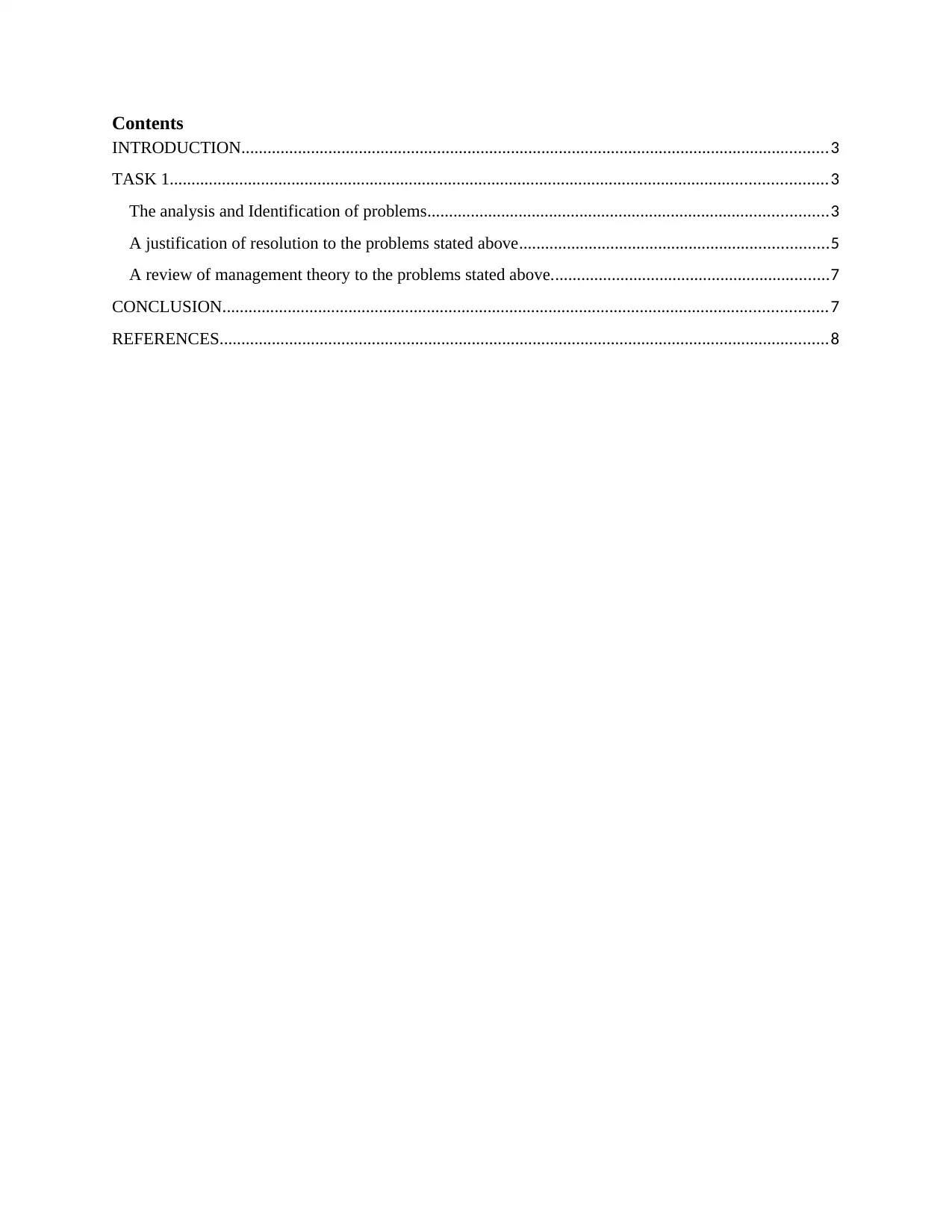
INTRODUCTION.......................................................................................................................................3
TASK 1.......................................................................................................................................................3
The analysis and Identification of problems............................................................................................3
A justification of resolution to the problems stated above.......................................................................5
A review of management theory to the problems stated above................................................................7
CONCLUSION...........................................................................................................................................7
REFERENCES............................................................................................................................................8
INTRODUCTION.......................................................................................................................................3
TASK 1.......................................................................................................................................................3
The analysis and Identification of problems............................................................................................3
A justification of resolution to the problems stated above.......................................................................5
A review of management theory to the problems stated above................................................................7
CONCLUSION...........................................................................................................................................7
REFERENCES............................................................................................................................................8
INTRODUCTION
Human resource department is concern with maintaining a required number of workers in
the organization. They are responsible for recruiting, selecting, motivating, providing of required
training and development programs and etc. In these responsibility there is one more
responsibility which the HR department is concern for is to solve all the problems which are
related with human resource. Hospitality business is such an industry where it huge percentage
of employee turnover is found. For reference purpose this report has taken an example of a hotel,
the Imperial Hotel, London. The Imperial Hotel is a hotel which is situated in London. The hotel
has a total of 500 rooms. This hotel has a total number of 25 hotel chains in UK itself. The hotel
also provides the leisure centre with swimming pool, bars and restaurants, 12 conferences rooms
and a staff of 450 members.
This report discuss about the problem behind the high turnover ratio in the hotel. The real factors
through which such problem arises and the solution which can be adopted by the organization to
reduce this problem.
TASK 1
The analysis and Identification of problems
The following are the problems which can be identified as a factors through which the
organization faces turn over,
Unclear job expectations: Not recognizing what they will or ought to accomplish at work can
be a genuine wellspring of worry for some representatives. On the off chance that activity desires
aren't plainly conveyed, laborers may choose it's an ideal opportunity to get a new line of work
that is all the more satisfying. Representatives may likewise get despondent in the event that they
feel like the activity they're doing doesn't line up with what they think they've been recruited for.
This distinction could push friendliness representatives to get a new line of work elsewhere (Al
Ariss, Cascio and Paauwe, 2014). During the enlistment procedure, it very well may be enticing
to just show the positives of work or attempt and tidy up the portrayal to sound all the more
engaging. While this may persuade a couple of individuals to come ready, they presumably won't
stay long.
Improper communication with manager: In certain ventures, a fruitful chief just needs to
manage procedures or frameworks. It doesn't make a difference on the off chance that they're
ready to associate with the workers under them. Be that as it may, most accommodation
positions are individuals centered – including administrative positions. At the point when chiefs
can't appropriately speak with their staff, it can push representatives to stop. Tragically, one
terrible director can have genuine results hands on fulfillment of your best workers and can be
one of the reasons for representative turnover in accommodation. Administrators of inn staff,
food servers, and other assistance representatives should have the option to oversee the two
Human resource department is concern with maintaining a required number of workers in
the organization. They are responsible for recruiting, selecting, motivating, providing of required
training and development programs and etc. In these responsibility there is one more
responsibility which the HR department is concern for is to solve all the problems which are
related with human resource. Hospitality business is such an industry where it huge percentage
of employee turnover is found. For reference purpose this report has taken an example of a hotel,
the Imperial Hotel, London. The Imperial Hotel is a hotel which is situated in London. The hotel
has a total of 500 rooms. This hotel has a total number of 25 hotel chains in UK itself. The hotel
also provides the leisure centre with swimming pool, bars and restaurants, 12 conferences rooms
and a staff of 450 members.
This report discuss about the problem behind the high turnover ratio in the hotel. The real factors
through which such problem arises and the solution which can be adopted by the organization to
reduce this problem.
TASK 1
The analysis and Identification of problems
The following are the problems which can be identified as a factors through which the
organization faces turn over,
Unclear job expectations: Not recognizing what they will or ought to accomplish at work can
be a genuine wellspring of worry for some representatives. On the off chance that activity desires
aren't plainly conveyed, laborers may choose it's an ideal opportunity to get a new line of work
that is all the more satisfying. Representatives may likewise get despondent in the event that they
feel like the activity they're doing doesn't line up with what they think they've been recruited for.
This distinction could push friendliness representatives to get a new line of work elsewhere (Al
Ariss, Cascio and Paauwe, 2014). During the enlistment procedure, it very well may be enticing
to just show the positives of work or attempt and tidy up the portrayal to sound all the more
engaging. While this may persuade a couple of individuals to come ready, they presumably won't
stay long.
Improper communication with manager: In certain ventures, a fruitful chief just needs to
manage procedures or frameworks. It doesn't make a difference on the off chance that they're
ready to associate with the workers under them. Be that as it may, most accommodation
positions are individuals centered – including administrative positions. At the point when chiefs
can't appropriately speak with their staff, it can push representatives to stop. Tragically, one
terrible director can have genuine results hands on fulfillment of your best workers and can be
one of the reasons for representative turnover in accommodation. Administrators of inn staff,
food servers, and other assistance representatives should have the option to oversee the two
⊘ This is a preview!⊘
Do you want full access?
Subscribe today to unlock all pages.

Trusted by 1+ million students worldwide
procedures and people. They have to realize how to deal with strife, delegate arranges, and
discuss straightforwardly with both their group and clients.
Lack of flexibility: Representatives in the cordiality business once in a while work a set
timetable, and that is a major advantage for a considerable lot of them. The adaptability that
accompanies the activity is a major drawing point for some individuals who need some squirm
room in their timetable (Barnes and Liao, 2012). Lamentably, this adaptability can likewise now
and again mean workers don't have the foggiest idea what's in store every week. On the off
chance that they're uncertain what their hours may be, the activity may really wind up causing
extra pressure. Representatives would prefer not to hold up until the last moment to get their
timetables. They additionally need to have something to do with days they have off, times they're
not able to work, and on the off chance that they're required to work long or extra time hours.
Unhealthy working environment: The hospitality industry regularly calls for high-pressure
workplaces that can leave even quiet and gathered representatives learning about focused. Not
every person can deal with this sort of condition, causing significant levels of turnover. Be that
as it may, this isn't the main explanation the workplace may get harmful or unfortunate. Indeed,
63% of hospitality laborers said they've encountered inappropriate behavior at work. This is
reason enough to make anybody need to leave. Moreover, 9% of representatives report that they
are at present tormented at their working environment. It's critical to make a workplace that your
representatives will really need to be a piece of. Set up clear approaches that workers can follow
if something occurs, and guarantee they're sheltered and ensured on the off chance that they
decide to make some noise.
Inefficient communication: Openness is of the utmost importance, paying little heed to
industry. In any case, in the hospitality industry, it's particularly urgent that requirements and
desires are plainly imparted between higher administration and their staff. At the point when
officials and group pioneers don't appropriately fill in workers on new guidelines or procedures,
they can feel withdrew and unmotivated (Della Torre and Solari, 2013). In the event that these
client confronting representatives aren't putting forth a strong effort, it can consider severely the
association all in all. You generally need to have an away from of correspondence over all levels.
It's additionally critical to guarantee that the correspondence pathway is a two-way road. Staff
ought to likewise be allowed to give criticism or voice worries to upper administration.
Lack of recognition: The hospitality industry requests difficult work and frequently long,
unpredictable hours, paying little heed to your position. Tragically, numerous workers don't feel
like their venture is seen by upper administration and officials. At the point when representatives
are continually giving a vocation their everything and feeling like their difficult work is
disregarded, it can prompt burnout. They may likewise begin to accept that it doesn't make a
difference how hard they work and as opposed to attempting to give more, they'll begin giving
less. On the off chance that workers cut corners, it is regularly the clients who endure. At the
point when clients' needs and desires aren't met, they may decide to go to a contender.
discuss straightforwardly with both their group and clients.
Lack of flexibility: Representatives in the cordiality business once in a while work a set
timetable, and that is a major advantage for a considerable lot of them. The adaptability that
accompanies the activity is a major drawing point for some individuals who need some squirm
room in their timetable (Barnes and Liao, 2012). Lamentably, this adaptability can likewise now
and again mean workers don't have the foggiest idea what's in store every week. On the off
chance that they're uncertain what their hours may be, the activity may really wind up causing
extra pressure. Representatives would prefer not to hold up until the last moment to get their
timetables. They additionally need to have something to do with days they have off, times they're
not able to work, and on the off chance that they're required to work long or extra time hours.
Unhealthy working environment: The hospitality industry regularly calls for high-pressure
workplaces that can leave even quiet and gathered representatives learning about focused. Not
every person can deal with this sort of condition, causing significant levels of turnover. Be that
as it may, this isn't the main explanation the workplace may get harmful or unfortunate. Indeed,
63% of hospitality laborers said they've encountered inappropriate behavior at work. This is
reason enough to make anybody need to leave. Moreover, 9% of representatives report that they
are at present tormented at their working environment. It's critical to make a workplace that your
representatives will really need to be a piece of. Set up clear approaches that workers can follow
if something occurs, and guarantee they're sheltered and ensured on the off chance that they
decide to make some noise.
Inefficient communication: Openness is of the utmost importance, paying little heed to
industry. In any case, in the hospitality industry, it's particularly urgent that requirements and
desires are plainly imparted between higher administration and their staff. At the point when
officials and group pioneers don't appropriately fill in workers on new guidelines or procedures,
they can feel withdrew and unmotivated (Della Torre and Solari, 2013). In the event that these
client confronting representatives aren't putting forth a strong effort, it can consider severely the
association all in all. You generally need to have an away from of correspondence over all levels.
It's additionally critical to guarantee that the correspondence pathway is a two-way road. Staff
ought to likewise be allowed to give criticism or voice worries to upper administration.
Lack of recognition: The hospitality industry requests difficult work and frequently long,
unpredictable hours, paying little heed to your position. Tragically, numerous workers don't feel
like their venture is seen by upper administration and officials. At the point when representatives
are continually giving a vocation their everything and feeling like their difficult work is
disregarded, it can prompt burnout. They may likewise begin to accept that it doesn't make a
difference how hard they work and as opposed to attempting to give more, they'll begin giving
less. On the off chance that workers cut corners, it is regularly the clients who endure. At the
point when clients' needs and desires aren't met, they may decide to go to a contender.
Paraphrase This Document
Need a fresh take? Get an instant paraphrase of this document with our AI Paraphraser
Restricted growth opportunity: Perhaps the greatest reason for representative turnover in the
hospitality industry is the appearing absence of development openings. While numerous people
begin in hospitality when they're youthful, relatively few of them decide to remain in the
industry all through their vocation (Flamholtz, 2012). At whatever point somebody enters a new
position, progression will be at the forefront of their thoughts – and hospitality is no special case.
Shockingly, numerous hospitality associations just gander at their representatives as low
maintenance or part time employees. At the point when workers feel as though they're seen as a
momentary representative by the board, they won't have any desire to stay. On the off chance
that they don't feel like the association is put resources into their development, they won't be put
resources into the organization either.
No matching of employees and jobs: Hospitality is a typical activity for youngsters to go into.
Shockingly, it isn't an ideal choice for everybody – and they may find that after they've been
recruited (Sparrow, Brewster and Chung, 2016). Not every person is well-outfitted to manage the
client confronting requests that regularly accompany hospitality occupations. On the off chance
that a recently recruited employee's position doesn't coordinate their character, they may find that
they're discontent with the job and at last leave. In certain cases, you can prepare individuals to
build up the aptitudes they should be fruitful at their specific employment. Notwithstanding, it is
increasingly significant that you search for the correct character qualities during the recruiting
procedure.
All the above stated factors cause the high turnover percentage into the Imperial Hotel. All the
stated problems are been faced by the staff members and they prefers to leave the organization
when they believe they have acquired the minimum money to find for another job. Due to this
the Hotel has to spend 35% of its sales upon the recruitment and selection process to cover up the
slack (Jayasingam and Yong, 2013). This is a loss for both the parties, the employees as they
don’t get the jib which they have thought for and for the organization as they have to incur much
of their cost in employee recruitment and retention processes.
A justification of resolution to the problems stated above
To solve this issue, following solutions can be adopted by the Imperial hotel:
Make job role clear at initial stage only: Be forthright about both the positives and the
negatives of the activity, and ensure workers know precisely what they ought to do during each
move. Check in with workers regularly to check whether they have any inquiries or if any desires
are muddled. Be certain every representative knows who they ought to associate with on the off
chance that they have concerns or need assistance with their duties.
Proper training and development programs: Be forthright about both the positives and the
negatives of the activity, and ensure workers know precisely what they ought to do during each
move. Check in with representatives regularly to check whether they have any inquiries or if any
hospitality industry is the appearing absence of development openings. While numerous people
begin in hospitality when they're youthful, relatively few of them decide to remain in the
industry all through their vocation (Flamholtz, 2012). At whatever point somebody enters a new
position, progression will be at the forefront of their thoughts – and hospitality is no special case.
Shockingly, numerous hospitality associations just gander at their representatives as low
maintenance or part time employees. At the point when workers feel as though they're seen as a
momentary representative by the board, they won't have any desire to stay. On the off chance
that they don't feel like the association is put resources into their development, they won't be put
resources into the organization either.
No matching of employees and jobs: Hospitality is a typical activity for youngsters to go into.
Shockingly, it isn't an ideal choice for everybody – and they may find that after they've been
recruited (Sparrow, Brewster and Chung, 2016). Not every person is well-outfitted to manage the
client confronting requests that regularly accompany hospitality occupations. On the off chance
that a recently recruited employee's position doesn't coordinate their character, they may find that
they're discontent with the job and at last leave. In certain cases, you can prepare individuals to
build up the aptitudes they should be fruitful at their specific employment. Notwithstanding, it is
increasingly significant that you search for the correct character qualities during the recruiting
procedure.
All the above stated factors cause the high turnover percentage into the Imperial Hotel. All the
stated problems are been faced by the staff members and they prefers to leave the organization
when they believe they have acquired the minimum money to find for another job. Due to this
the Hotel has to spend 35% of its sales upon the recruitment and selection process to cover up the
slack (Jayasingam and Yong, 2013). This is a loss for both the parties, the employees as they
don’t get the jib which they have thought for and for the organization as they have to incur much
of their cost in employee recruitment and retention processes.
A justification of resolution to the problems stated above
To solve this issue, following solutions can be adopted by the Imperial hotel:
Make job role clear at initial stage only: Be forthright about both the positives and the
negatives of the activity, and ensure workers know precisely what they ought to do during each
move. Check in with workers regularly to check whether they have any inquiries or if any desires
are muddled. Be certain every representative knows who they ought to associate with on the off
chance that they have concerns or need assistance with their duties.
Proper training and development programs: Be forthright about both the positives and the
negatives of the activity, and ensure workers know precisely what they ought to do during each
move. Check in with representatives regularly to check whether they have any inquiries or if any
desires are hazy. Be certain every representative knows who they ought to interface with on the
off chance that they have concerns or need assistance with their duties (Potgieter, 2012).
Scheduling system: Be frank about both the positives and the negatives of the action, and
guarantee laborers know correctly what they should do during each move. Check in with agents
normally to check whether they have any requests or if any wants are dim. Be sure every agent
knows who they should interface with in case they have concerns or need help with their
obligations.
Positive environment: Try not to quit building up a solid culture since representatives are
cheerful and sound. Continuously search for better approaches to improve the work environment
for your representatives (Schiuma, Andreeva and Kianto, 2012). Every now and again check in
with representatives at all levels to perceive how they feel about your present workplace.
Request criticism or thoughts on how you can improve and search for practical ways you can
actualize them into your everyday tasks.
Opportunity to listen: Energize representatives of all levels to make some noise when they feel
like there is something to examine, yet additionally to tune in to others when they have
something to contribute. This can be trying for bigger associations that might not have a simple
method to encourage correspondence between all workers. In this occasion, go to an application
for inside correspondence that can assist workers with imparting contemplations and thoughts to
other people.
Reorganization of employees: At times, even little affirmations can go far. A straightforward
thank you or acknowledgment during a gathering can leave a representative liking the work
they've done. For bigger achievements, fiscal prizes or additional time off can urge
representatives to keep doing awesome. Build up an acknowledgment framework that inspires
representatives to keep on working harder.
Growth plan: Have a make way to higher positions and ensure workers comprehend what they
have to achieve so as to get there. You ought to likewise hope to enlist inside when you have
open positions (Shields and et. al., 2015). While you will likewise need to select outside of your
interior base of representatives, let qualified up-and-comers as of now inside your association
realize that you have a vacant position they may be keen on.
Clear personality traits: Search for specific qualities while you're recruiting, including
performing multiple tasks and stress resilience. On the off chance that an up-and-comer doesn't
have the qualities should have been fruitful at the specific employment, they're likely not the
ideal individual to enlist. Exploit character polls and occupation recreations during the meeting
procedure. Joining these extra tests before causing a recruit to can assist you with guaranteeing
you're placing the correct applicants in your open positions (Smith, 2016).
off chance that they have concerns or need assistance with their duties (Potgieter, 2012).
Scheduling system: Be frank about both the positives and the negatives of the action, and
guarantee laborers know correctly what they should do during each move. Check in with agents
normally to check whether they have any requests or if any wants are dim. Be sure every agent
knows who they should interface with in case they have concerns or need help with their
obligations.
Positive environment: Try not to quit building up a solid culture since representatives are
cheerful and sound. Continuously search for better approaches to improve the work environment
for your representatives (Schiuma, Andreeva and Kianto, 2012). Every now and again check in
with representatives at all levels to perceive how they feel about your present workplace.
Request criticism or thoughts on how you can improve and search for practical ways you can
actualize them into your everyday tasks.
Opportunity to listen: Energize representatives of all levels to make some noise when they feel
like there is something to examine, yet additionally to tune in to others when they have
something to contribute. This can be trying for bigger associations that might not have a simple
method to encourage correspondence between all workers. In this occasion, go to an application
for inside correspondence that can assist workers with imparting contemplations and thoughts to
other people.
Reorganization of employees: At times, even little affirmations can go far. A straightforward
thank you or acknowledgment during a gathering can leave a representative liking the work
they've done. For bigger achievements, fiscal prizes or additional time off can urge
representatives to keep doing awesome. Build up an acknowledgment framework that inspires
representatives to keep on working harder.
Growth plan: Have a make way to higher positions and ensure workers comprehend what they
have to achieve so as to get there. You ought to likewise hope to enlist inside when you have
open positions (Shields and et. al., 2015). While you will likewise need to select outside of your
interior base of representatives, let qualified up-and-comers as of now inside your association
realize that you have a vacant position they may be keen on.
Clear personality traits: Search for specific qualities while you're recruiting, including
performing multiple tasks and stress resilience. On the off chance that an up-and-comer doesn't
have the qualities should have been fruitful at the specific employment, they're likely not the
ideal individual to enlist. Exploit character polls and occupation recreations during the meeting
procedure. Joining these extra tests before causing a recruit to can assist you with guaranteeing
you're placing the correct applicants in your open positions (Smith, 2016).
⊘ This is a preview!⊘
Do you want full access?
Subscribe today to unlock all pages.
Trusted by 1+ million students worldwide
A review of management theory to the problems stated above.
The recommended arrangements that are of preparing and creating positive work culture
in association for expanding worker efficiencies and inspiration is bolstered by Scientific
Management Theory. This is a customary and an old methodology of management which isn't
regularly utilized by administrators in business today however fitting for The Imperial Hotel and
its workers for improvement.
The Scientific management theory was first settled by Fredrick Tylor, first researcher who
considered work exhibitions and management scientifically. This management theory is known
as Tylor rule and expresses that work ought to be performed through scientific strategies and
procedures at the working environment. Pioneers or troughs ought to create and dole out work
scientifically instead of on their own decisions of colleagues.
As indicated by Tylor guideline of management, constraining individuals work without their will
expand execution however for a particular timeframe, rather supervisors of The Imperial Hotel
ought to improve undertakings for representatives and groups so as to prompt their exhibitions. It
is significant that Peter Farnsworth the new General Manager ought to distinguish ranges of
abilities of staff in front office and different divisions, likewise train them and altogether
administer them for guaranteeing their efficiencies and successful presentation norms
CONCLUSION
From the report presented above, the hotel Imperial faced the problem of high turnover
which forces them to put approx 35% of their sales in recruitment and selection process. Some of
the problems are, Unclear job expectations, Improper communication with manager, Lack of
flexibility, Unhealthy working environment, Inefficient communication and so on. To solve
such, the hotel can adopt the solution which includes Make job role clear at initial stage only,
Proper training and development programs, Scheduling system, Positive environment,
Opportunity to listen and etc which can help the Hotel in retaining the employees and decrease in
turn over percentage.
The recommended arrangements that are of preparing and creating positive work culture
in association for expanding worker efficiencies and inspiration is bolstered by Scientific
Management Theory. This is a customary and an old methodology of management which isn't
regularly utilized by administrators in business today however fitting for The Imperial Hotel and
its workers for improvement.
The Scientific management theory was first settled by Fredrick Tylor, first researcher who
considered work exhibitions and management scientifically. This management theory is known
as Tylor rule and expresses that work ought to be performed through scientific strategies and
procedures at the working environment. Pioneers or troughs ought to create and dole out work
scientifically instead of on their own decisions of colleagues.
As indicated by Tylor guideline of management, constraining individuals work without their will
expand execution however for a particular timeframe, rather supervisors of The Imperial Hotel
ought to improve undertakings for representatives and groups so as to prompt their exhibitions. It
is significant that Peter Farnsworth the new General Manager ought to distinguish ranges of
abilities of staff in front office and different divisions, likewise train them and altogether
administer them for guaranteeing their efficiencies and successful presentation norms
CONCLUSION
From the report presented above, the hotel Imperial faced the problem of high turnover
which forces them to put approx 35% of their sales in recruitment and selection process. Some of
the problems are, Unclear job expectations, Improper communication with manager, Lack of
flexibility, Unhealthy working environment, Inefficient communication and so on. To solve
such, the hotel can adopt the solution which includes Make job role clear at initial stage only,
Proper training and development programs, Scheduling system, Positive environment,
Opportunity to listen and etc which can help the Hotel in retaining the employees and decrease in
turn over percentage.
Paraphrase This Document
Need a fresh take? Get an instant paraphrase of this document with our AI Paraphraser
REFERENCES
Books and Journals
Al Ariss, A., Cascio, W. F. and Paauwe, J., 2014. Talent management: Current theories and
future research directions.Journal of World Business. 49(2). pp.173-179.
Barnes, J. and Liao, Y., 2012. The effect of individual, network, and collaborative competencies
on the supply chain management system. International Journal of Production
Economics. 140(2). pp.888-899.
Della Torre, E. and Solari, L., 2013. High-performance work systems and the change
management process in medium-sized firms. The International Journal of Human
Resource Management. 24(13). pp.2583-2607.
Flamholtz, E. G., 2012. Human resource accounting: Advances in concepts, methods and
applications. Springer Science & Business Media.
Jayasingam, S. and Yong, J. R., 2013. Affective commitment among knowledge workers: The
role of pay satisfaction and organization career management. The International Journal
of Human Resource Management. 24(20). pp.3903-3920.
Potgieter, I., 2012. The relationship between the self-esteem and employability attributes of
postgraduate business management students. SA Journal of Human Resource
Management. 10(2). pp.1-15.
Schiuma, G., Andreeva, T. and Kianto, A., 2012. Does knowledge management really matter?
Linking knowledge management practices, competitiveness and economic
performance. Journal of knowledge management.
Shields, J.,and et. al., 2015. Managing employee performance & reward: Concepts, practices,
strategies. Cambridge University Press.
Smith, A., 2016. Experiential learning. Edward Elgar Publishing Limited.
Sparrow, P., Brewster, C. and Chung, C., 2016. Globalizing human resource management.
Routledge.
Books and Journals
Al Ariss, A., Cascio, W. F. and Paauwe, J., 2014. Talent management: Current theories and
future research directions.Journal of World Business. 49(2). pp.173-179.
Barnes, J. and Liao, Y., 2012. The effect of individual, network, and collaborative competencies
on the supply chain management system. International Journal of Production
Economics. 140(2). pp.888-899.
Della Torre, E. and Solari, L., 2013. High-performance work systems and the change
management process in medium-sized firms. The International Journal of Human
Resource Management. 24(13). pp.2583-2607.
Flamholtz, E. G., 2012. Human resource accounting: Advances in concepts, methods and
applications. Springer Science & Business Media.
Jayasingam, S. and Yong, J. R., 2013. Affective commitment among knowledge workers: The
role of pay satisfaction and organization career management. The International Journal
of Human Resource Management. 24(20). pp.3903-3920.
Potgieter, I., 2012. The relationship between the self-esteem and employability attributes of
postgraduate business management students. SA Journal of Human Resource
Management. 10(2). pp.1-15.
Schiuma, G., Andreeva, T. and Kianto, A., 2012. Does knowledge management really matter?
Linking knowledge management practices, competitiveness and economic
performance. Journal of knowledge management.
Shields, J.,and et. al., 2015. Managing employee performance & reward: Concepts, practices,
strategies. Cambridge University Press.
Smith, A., 2016. Experiential learning. Edward Elgar Publishing Limited.
Sparrow, P., Brewster, C. and Chung, C., 2016. Globalizing human resource management.
Routledge.

1 out of 8


Related Documents


Your All-in-One AI-Powered Toolkit for Academic Success.
+13062052269
info@desklib.com
Available 24*7 on WhatsApp / Email
![[object Object]](/_next/static/media/star-bottom.7253800d.svg)
Unlock your academic potential
Copyright © 2020–2026 A2Z Services. All Rights Reserved. Developed and managed by ZUCOL.