Assessing Employee Turnover's Impact on Tesco's Profitability
VerifiedAdded on 2021/02/20
|11
|2804
|66
Report
AI Summary
This research proposal investigates the causes and impact of employee turnover on Tesco's profitability. The study aims to identify the factors contributing to employee turnover, assess the challenges faced, and recommend strategies to improve employee retention. The research employs a qualitative approach, utilizing both primary data collected through surveys and secondary data from books and journals. The methodology includes an inductive research approach and interpretivism philosophy, with a thematic data analysis planned. The study acknowledges limitations such as time constraints and resource limitations. The research questions focus on the importance of employee retention, the causes of turnover, the challenges faced, and the best ways to improve retention within Tesco. The proposal outlines the research process, from topic identification to data analysis, and includes a timeline for completing the research. The findings are expected to provide valuable insights for Tesco to address employee turnover and enhance organizational profitability.

RESEARCH PROPOSAL

Paraphrase This Document
Need a fresh take? Get an instant paraphrase of this document with our AI Paraphraser
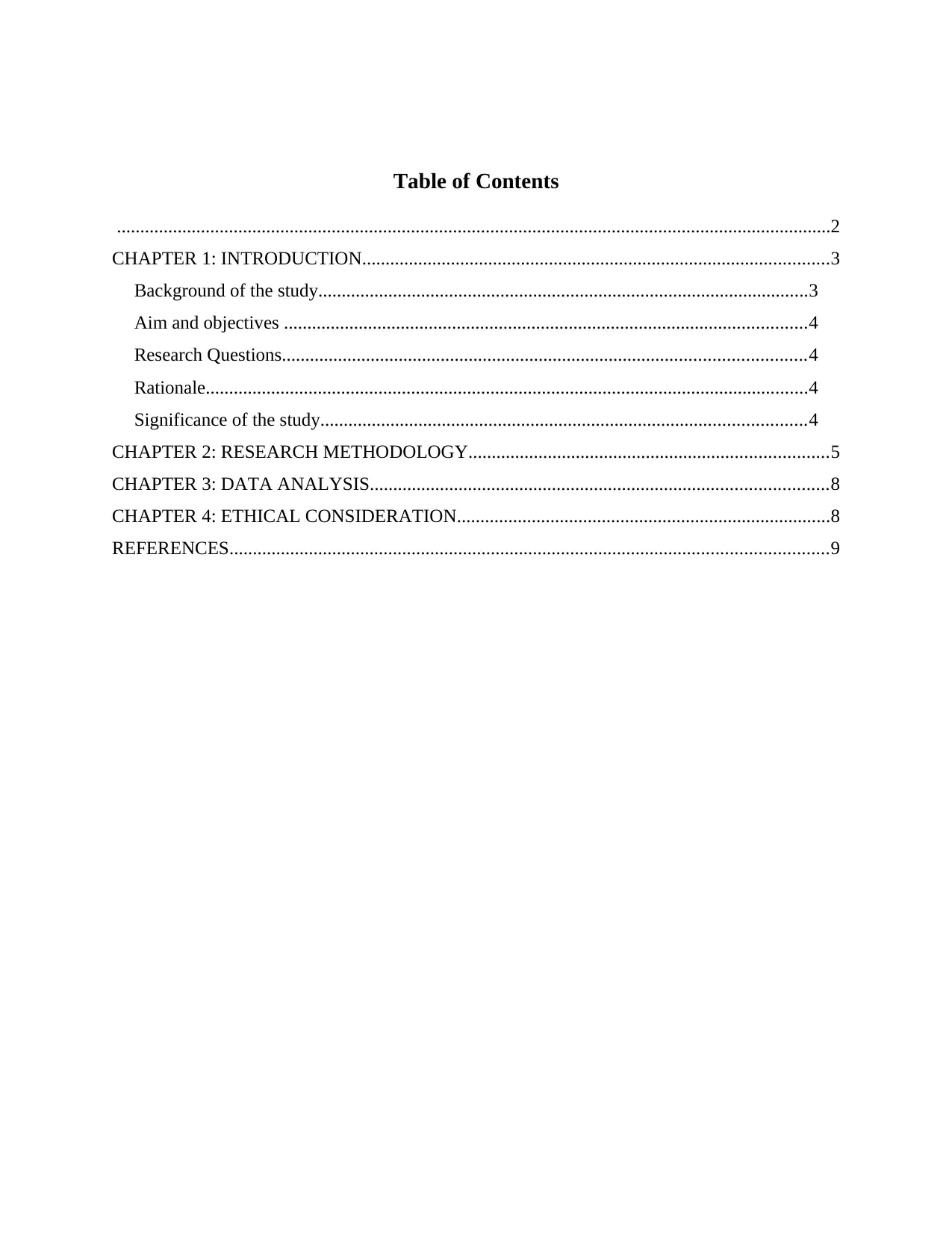
Table of Contents
.........................................................................................................................................................2
CHAPTER 1: INTRODUCTION....................................................................................................3
Background of the study.........................................................................................................3
Aim and objectives ................................................................................................................4
Research Questions................................................................................................................4
Rationale.................................................................................................................................4
Significance of the study........................................................................................................4
CHAPTER 2: RESEARCH METHODOLOGY.............................................................................5
CHAPTER 3: DATA ANALYSIS..................................................................................................8
CHAPTER 4: ETHICAL CONSIDERATION................................................................................8
REFERENCES................................................................................................................................9
.........................................................................................................................................................2
CHAPTER 1: INTRODUCTION....................................................................................................3
Background of the study.........................................................................................................3
Aim and objectives ................................................................................................................4
Research Questions................................................................................................................4
Rationale.................................................................................................................................4
Significance of the study........................................................................................................4
CHAPTER 2: RESEARCH METHODOLOGY.............................................................................5
CHAPTER 3: DATA ANALYSIS..................................................................................................8
CHAPTER 4: ETHICAL CONSIDERATION................................................................................8
REFERENCES................................................................................................................................9
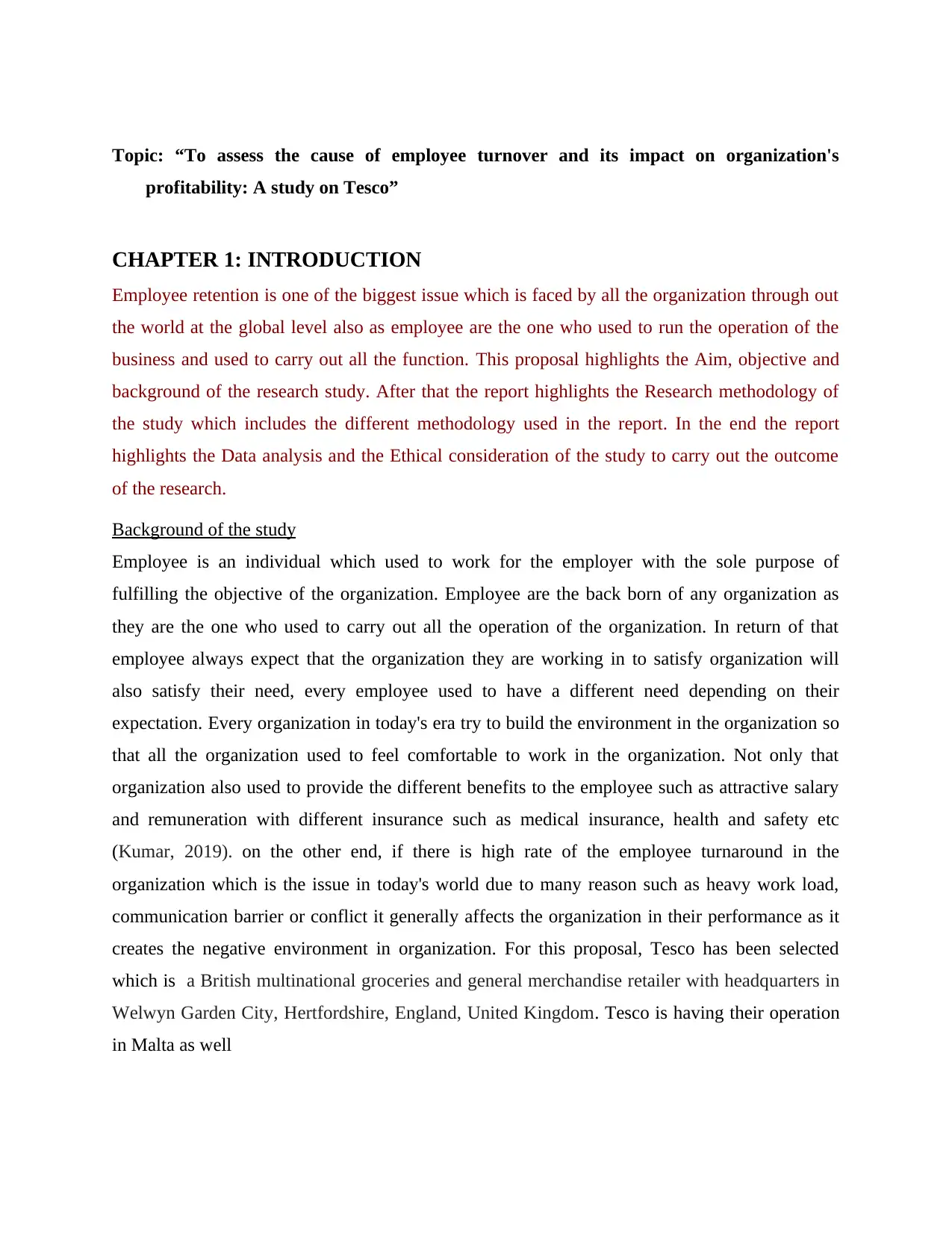
Topic: “To assess the cause of employee turnover and its impact on organization's
profitability: A study on Tesco”
CHAPTER 1: INTRODUCTION
Employee retention is one of the biggest issue which is faced by all the organization through out
the world at the global level also as employee are the one who used to run the operation of the
business and used to carry out all the function. This proposal highlights the Aim, objective and
background of the research study. After that the report highlights the Research methodology of
the study which includes the different methodology used in the report. In the end the report
highlights the Data analysis and the Ethical consideration of the study to carry out the outcome
of the research.
Background of the study
Employee is an individual which used to work for the employer with the sole purpose of
fulfilling the objective of the organization. Employee are the back born of any organization as
they are the one who used to carry out all the operation of the organization. In return of that
employee always expect that the organization they are working in to satisfy organization will
also satisfy their need, every employee used to have a different need depending on their
expectation. Every organization in today's era try to build the environment in the organization so
that all the organization used to feel comfortable to work in the organization. Not only that
organization also used to provide the different benefits to the employee such as attractive salary
and remuneration with different insurance such as medical insurance, health and safety etc
(Kumar, 2019). on the other end, if there is high rate of the employee turnaround in the
organization which is the issue in today's world due to many reason such as heavy work load,
communication barrier or conflict it generally affects the organization in their performance as it
creates the negative environment in organization. For this proposal, Tesco has been selected
which is a British multinational groceries and general merchandise retailer with headquarters in
Welwyn Garden City, Hertfordshire, England, United Kingdom. Tesco is having their operation
in Malta as well
profitability: A study on Tesco”
CHAPTER 1: INTRODUCTION
Employee retention is one of the biggest issue which is faced by all the organization through out
the world at the global level also as employee are the one who used to run the operation of the
business and used to carry out all the function. This proposal highlights the Aim, objective and
background of the research study. After that the report highlights the Research methodology of
the study which includes the different methodology used in the report. In the end the report
highlights the Data analysis and the Ethical consideration of the study to carry out the outcome
of the research.
Background of the study
Employee is an individual which used to work for the employer with the sole purpose of
fulfilling the objective of the organization. Employee are the back born of any organization as
they are the one who used to carry out all the operation of the organization. In return of that
employee always expect that the organization they are working in to satisfy organization will
also satisfy their need, every employee used to have a different need depending on their
expectation. Every organization in today's era try to build the environment in the organization so
that all the organization used to feel comfortable to work in the organization. Not only that
organization also used to provide the different benefits to the employee such as attractive salary
and remuneration with different insurance such as medical insurance, health and safety etc
(Kumar, 2019). on the other end, if there is high rate of the employee turnaround in the
organization which is the issue in today's world due to many reason such as heavy work load,
communication barrier or conflict it generally affects the organization in their performance as it
creates the negative environment in organization. For this proposal, Tesco has been selected
which is a British multinational groceries and general merchandise retailer with headquarters in
Welwyn Garden City, Hertfordshire, England, United Kingdom. Tesco is having their operation
in Malta as well
⊘ This is a preview!⊘
Do you want full access?
Subscribe today to unlock all pages.

Trusted by 1+ million students worldwide
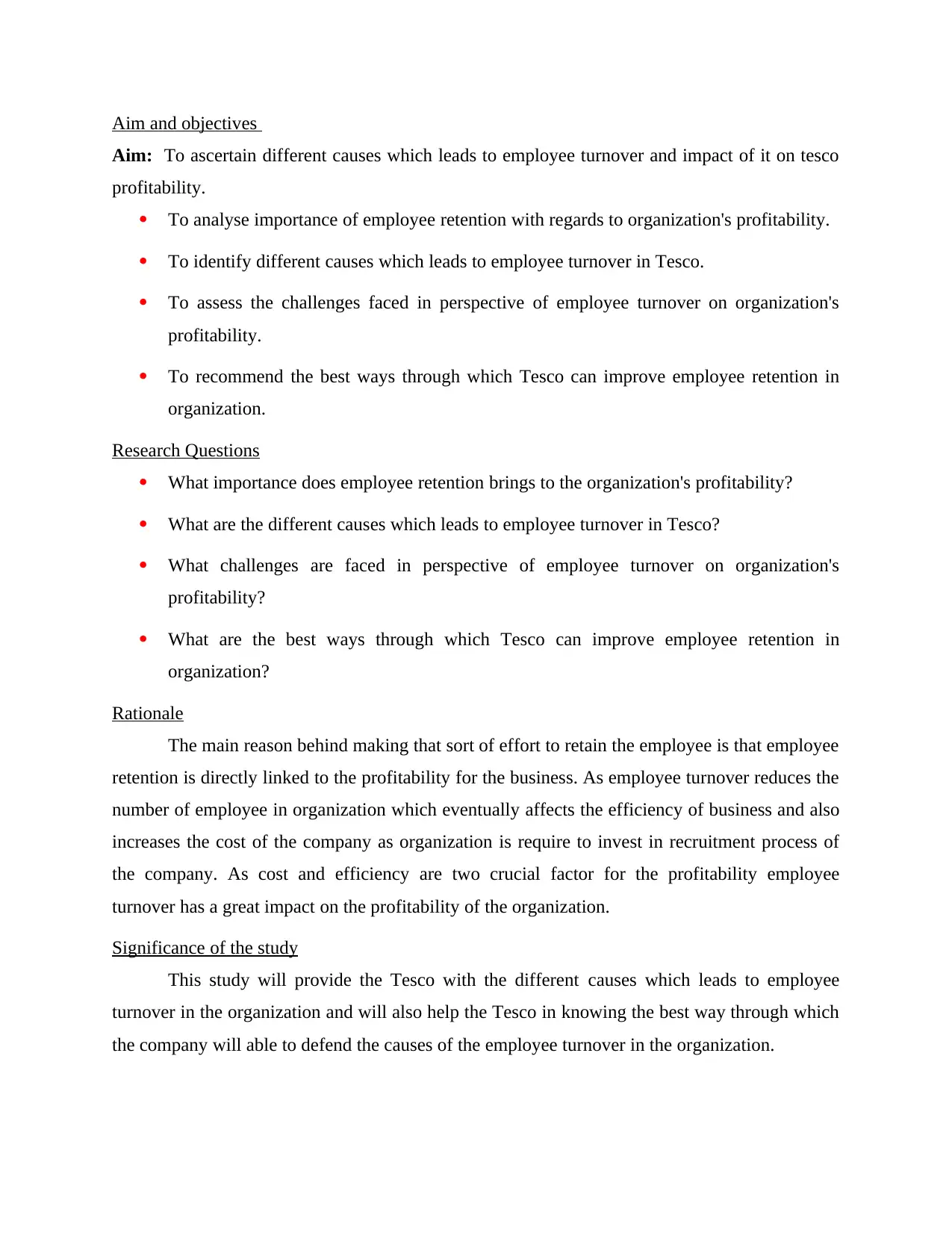
Aim and objectives
Aim: To ascertain different causes which leads to employee turnover and impact of it on tesco
profitability.
To analyse importance of employee retention with regards to organization's profitability.
To identify different causes which leads to employee turnover in Tesco.
To assess the challenges faced in perspective of employee turnover on organization's
profitability.
To recommend the best ways through which Tesco can improve employee retention in
organization.
Research Questions
What importance does employee retention brings to the organization's profitability?
What are the different causes which leads to employee turnover in Tesco?
What challenges are faced in perspective of employee turnover on organization's
profitability?
What are the best ways through which Tesco can improve employee retention in
organization?
Rationale
The main reason behind making that sort of effort to retain the employee is that employee
retention is directly linked to the profitability for the business. As employee turnover reduces the
number of employee in organization which eventually affects the efficiency of business and also
increases the cost of the company as organization is require to invest in recruitment process of
the company. As cost and efficiency are two crucial factor for the profitability employee
turnover has a great impact on the profitability of the organization.
Significance of the study
This study will provide the Tesco with the different causes which leads to employee
turnover in the organization and will also help the Tesco in knowing the best way through which
the company will able to defend the causes of the employee turnover in the organization.
Aim: To ascertain different causes which leads to employee turnover and impact of it on tesco
profitability.
To analyse importance of employee retention with regards to organization's profitability.
To identify different causes which leads to employee turnover in Tesco.
To assess the challenges faced in perspective of employee turnover on organization's
profitability.
To recommend the best ways through which Tesco can improve employee retention in
organization.
Research Questions
What importance does employee retention brings to the organization's profitability?
What are the different causes which leads to employee turnover in Tesco?
What challenges are faced in perspective of employee turnover on organization's
profitability?
What are the best ways through which Tesco can improve employee retention in
organization?
Rationale
The main reason behind making that sort of effort to retain the employee is that employee
retention is directly linked to the profitability for the business. As employee turnover reduces the
number of employee in organization which eventually affects the efficiency of business and also
increases the cost of the company as organization is require to invest in recruitment process of
the company. As cost and efficiency are two crucial factor for the profitability employee
turnover has a great impact on the profitability of the organization.
Significance of the study
This study will provide the Tesco with the different causes which leads to employee
turnover in the organization and will also help the Tesco in knowing the best way through which
the company will able to defend the causes of the employee turnover in the organization.
Paraphrase This Document
Need a fresh take? Get an instant paraphrase of this document with our AI Paraphraser
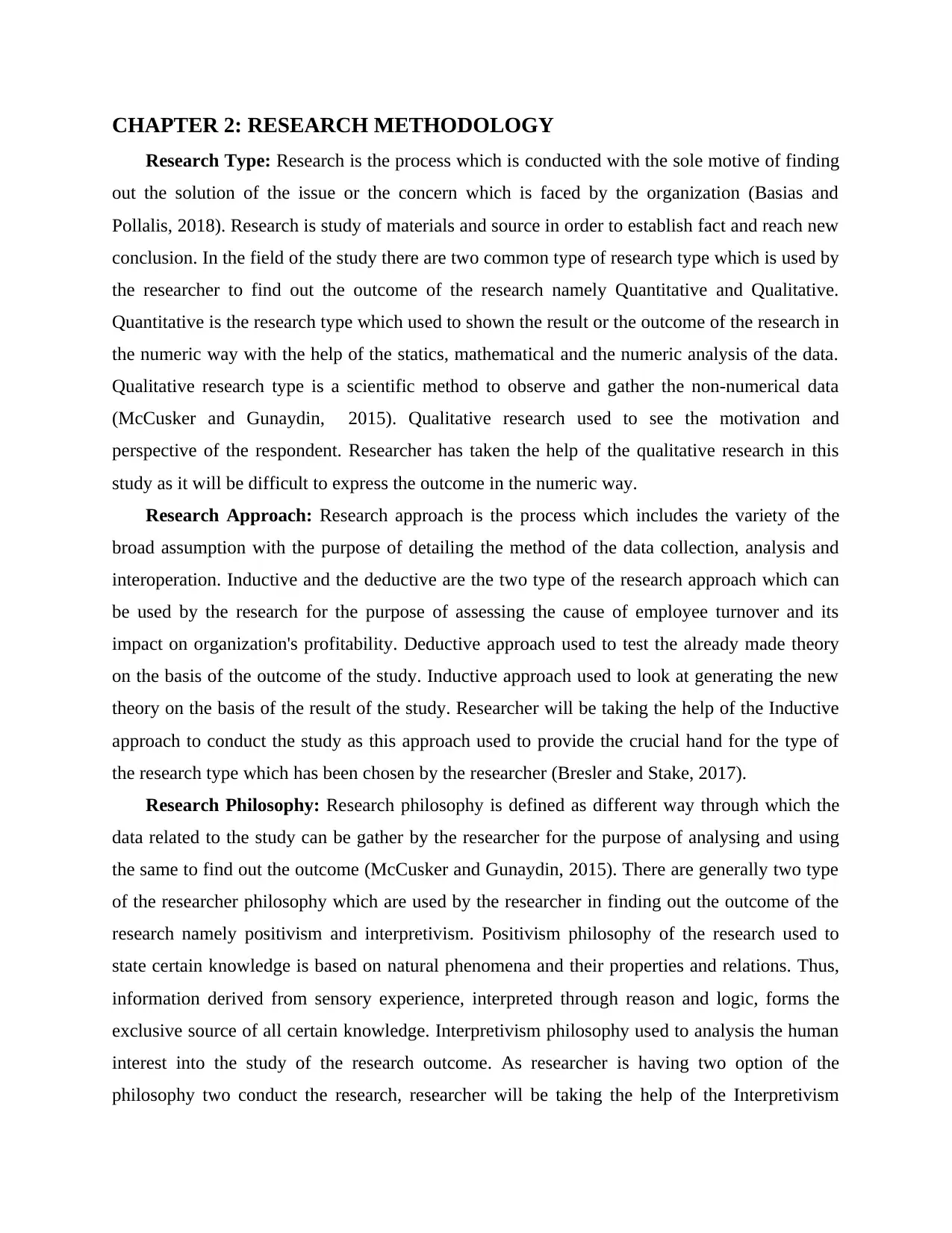
CHAPTER 2: RESEARCH METHODOLOGY
Research Type: Research is the process which is conducted with the sole motive of finding
out the solution of the issue or the concern which is faced by the organization (Basias and
Pollalis, 2018). Research is study of materials and source in order to establish fact and reach new
conclusion. In the field of the study there are two common type of research type which is used by
the researcher to find out the outcome of the research namely Quantitative and Qualitative.
Quantitative is the research type which used to shown the result or the outcome of the research in
the numeric way with the help of the statics, mathematical and the numeric analysis of the data.
Qualitative research type is a scientific method to observe and gather the non-numerical data
(McCusker and Gunaydin, 2015). Qualitative research used to see the motivation and
perspective of the respondent. Researcher has taken the help of the qualitative research in this
study as it will be difficult to express the outcome in the numeric way.
Research Approach: Research approach is the process which includes the variety of the
broad assumption with the purpose of detailing the method of the data collection, analysis and
interoperation. Inductive and the deductive are the two type of the research approach which can
be used by the research for the purpose of assessing the cause of employee turnover and its
impact on organization's profitability. Deductive approach used to test the already made theory
on the basis of the outcome of the study. Inductive approach used to look at generating the new
theory on the basis of the result of the study. Researcher will be taking the help of the Inductive
approach to conduct the study as this approach used to provide the crucial hand for the type of
the research type which has been chosen by the researcher (Bresler and Stake, 2017).
Research Philosophy: Research philosophy is defined as different way through which the
data related to the study can be gather by the researcher for the purpose of analysing and using
the same to find out the outcome (McCusker and Gunaydin, 2015). There are generally two type
of the researcher philosophy which are used by the researcher in finding out the outcome of the
research namely positivism and interpretivism. Positivism philosophy of the research used to
state certain knowledge is based on natural phenomena and their properties and relations. Thus,
information derived from sensory experience, interpreted through reason and logic, forms the
exclusive source of all certain knowledge. Interpretivism philosophy used to analysis the human
interest into the study of the research outcome. As researcher is having two option of the
philosophy two conduct the research, researcher will be taking the help of the Interpretivism
Research Type: Research is the process which is conducted with the sole motive of finding
out the solution of the issue or the concern which is faced by the organization (Basias and
Pollalis, 2018). Research is study of materials and source in order to establish fact and reach new
conclusion. In the field of the study there are two common type of research type which is used by
the researcher to find out the outcome of the research namely Quantitative and Qualitative.
Quantitative is the research type which used to shown the result or the outcome of the research in
the numeric way with the help of the statics, mathematical and the numeric analysis of the data.
Qualitative research type is a scientific method to observe and gather the non-numerical data
(McCusker and Gunaydin, 2015). Qualitative research used to see the motivation and
perspective of the respondent. Researcher has taken the help of the qualitative research in this
study as it will be difficult to express the outcome in the numeric way.
Research Approach: Research approach is the process which includes the variety of the
broad assumption with the purpose of detailing the method of the data collection, analysis and
interoperation. Inductive and the deductive are the two type of the research approach which can
be used by the research for the purpose of assessing the cause of employee turnover and its
impact on organization's profitability. Deductive approach used to test the already made theory
on the basis of the outcome of the study. Inductive approach used to look at generating the new
theory on the basis of the result of the study. Researcher will be taking the help of the Inductive
approach to conduct the study as this approach used to provide the crucial hand for the type of
the research type which has been chosen by the researcher (Bresler and Stake, 2017).
Research Philosophy: Research philosophy is defined as different way through which the
data related to the study can be gather by the researcher for the purpose of analysing and using
the same to find out the outcome (McCusker and Gunaydin, 2015). There are generally two type
of the researcher philosophy which are used by the researcher in finding out the outcome of the
research namely positivism and interpretivism. Positivism philosophy of the research used to
state certain knowledge is based on natural phenomena and their properties and relations. Thus,
information derived from sensory experience, interpreted through reason and logic, forms the
exclusive source of all certain knowledge. Interpretivism philosophy used to analysis the human
interest into the study of the research outcome. As researcher is having two option of the
philosophy two conduct the research, researcher will be taking the help of the Interpretivism
philosophy to conduct the research as it will help the researcher in understanding the human
interest also as it is important from the view point of the study which is conducted. Another
reason of choosing this philosophy was that it suits the type of the research which is selected by
the researcher.
Data Collection: Data collection is the process in which the researcher try to gather and
measure the information which has been gathered by the targeted variables in an established
system, which then enables one to answer relevant questions and evaluate outcomes (Skinner,
2015). Primary data collection and secondary data collection are the two type of the data
collection tool which is generally used by the researcher to gather the information related to the
study of the research. Primary data collection is the tool which used to gather the information
from the source of the occurrence itself. Generally researcher used to conduct the different
survey or the interview to gather the primary data (Flick, U., 2015). Secondary data is the data
collection tool in which the data is collected from the different source other that than the primary
source. Generally researcher take the help of different books and journal to collect the secondary
data. In conducting the following research researcher will be taking the help of both primary and
secondary data collection tool in which for collecting the secondary data researcher will be going
through the different books and journal related to the topic. Primary data will be collected with
the help of the survey which will be conducted on the basis of the questionnaire which will
include both the open ended and close ended question so that the best available information can
be gather from the responded.
Sampling: Sampling is the process which is used by the researcher in statistical analysis in
which predetermine number of observation are taken from the large number of the population
(Sessler and Imrey, 2015). Generally this is done to find out the responded on which the research
need to be conducted. Probability and non-probabilistic are the two type of the sampling method
which can be used by the researcher in this research. Probabilistic sampling used to give the
equal chance for all the responded to get selected in the sample of the respondent. Non
probabilistic is the other type of the sampling method in which researcher just used to select a
range of the respondent from the large population without giving the equal chance for all the
employee to get selected in the sample. Researcher will be taking the help of the probabilistic
sample in the organization as it will give equal chance for all the responded to get selected.
interest also as it is important from the view point of the study which is conducted. Another
reason of choosing this philosophy was that it suits the type of the research which is selected by
the researcher.
Data Collection: Data collection is the process in which the researcher try to gather and
measure the information which has been gathered by the targeted variables in an established
system, which then enables one to answer relevant questions and evaluate outcomes (Skinner,
2015). Primary data collection and secondary data collection are the two type of the data
collection tool which is generally used by the researcher to gather the information related to the
study of the research. Primary data collection is the tool which used to gather the information
from the source of the occurrence itself. Generally researcher used to conduct the different
survey or the interview to gather the primary data (Flick, U., 2015). Secondary data is the data
collection tool in which the data is collected from the different source other that than the primary
source. Generally researcher take the help of different books and journal to collect the secondary
data. In conducting the following research researcher will be taking the help of both primary and
secondary data collection tool in which for collecting the secondary data researcher will be going
through the different books and journal related to the topic. Primary data will be collected with
the help of the survey which will be conducted on the basis of the questionnaire which will
include both the open ended and close ended question so that the best available information can
be gather from the responded.
Sampling: Sampling is the process which is used by the researcher in statistical analysis in
which predetermine number of observation are taken from the large number of the population
(Sessler and Imrey, 2015). Generally this is done to find out the responded on which the research
need to be conducted. Probability and non-probabilistic are the two type of the sampling method
which can be used by the researcher in this research. Probabilistic sampling used to give the
equal chance for all the responded to get selected in the sample of the respondent. Non
probabilistic is the other type of the sampling method in which researcher just used to select a
range of the respondent from the large population without giving the equal chance for all the
employee to get selected in the sample. Researcher will be taking the help of the probabilistic
sample in the organization as it will give equal chance for all the responded to get selected.
⊘ This is a preview!⊘
Do you want full access?
Subscribe today to unlock all pages.
Trusted by 1+ million students worldwide
Sample size for this research will be 20 employee of HR department of Tesco (Kotlar, and et.al.,
2019).
Data Analysis: Data analysis is the process in which data is evaluated on the basis of the
analytical and statistical tools to discover useful information and aid in business decision making
(Cuervo‐Cazurra and et.al., 2017). Researcher will be taking the help of the thematic data
analysis tool to analysis the data. Researcher will be showing the data with the help of the
different theme and making different maps and the graph to shown the data so that the data can
be presented in more attractive way. It has also helped the researcher in interpreting the data in
better way to find out the outcome of the study in more efficient way. Reason for choosing this
method was that researcher has collected the numeric data also with the help of the survey,
thematic data analysis tool used to provide the good support for the data collected with the help
of the primary data collection tool (Kotlar, and et.al., 2019).
Limitations: Limitation is the study of the different characteristic which used to have the
negative impact on the outcome of the research (Walliman, 2017). The biggest limitation of the
proposal was that the time allotted for completing the proposal was not that good to complete the
proposal but due to help of my colleague in the organization and the team member I was able to
complete the same on time. Another limitation was the resource which was allotted for gathering
the information was also very limited but we have tried to gather the best information available
to conduct the research on the topic.
Time Line
Activities/
Weeks
1 2 3 4 5 6 7 8 9 10 11 12 13 14
Identification of Research Topic
Identification of Research Aim and
Objectives
Drafting Proposal
Writing LR using books and journals
2019).
Data Analysis: Data analysis is the process in which data is evaluated on the basis of the
analytical and statistical tools to discover useful information and aid in business decision making
(Cuervo‐Cazurra and et.al., 2017). Researcher will be taking the help of the thematic data
analysis tool to analysis the data. Researcher will be showing the data with the help of the
different theme and making different maps and the graph to shown the data so that the data can
be presented in more attractive way. It has also helped the researcher in interpreting the data in
better way to find out the outcome of the study in more efficient way. Reason for choosing this
method was that researcher has collected the numeric data also with the help of the survey,
thematic data analysis tool used to provide the good support for the data collected with the help
of the primary data collection tool (Kotlar, and et.al., 2019).
Limitations: Limitation is the study of the different characteristic which used to have the
negative impact on the outcome of the research (Walliman, 2017). The biggest limitation of the
proposal was that the time allotted for completing the proposal was not that good to complete the
proposal but due to help of my colleague in the organization and the team member I was able to
complete the same on time. Another limitation was the resource which was allotted for gathering
the information was also very limited but we have tried to gather the best information available
to conduct the research on the topic.
Time Line
Activities/
Weeks
1 2 3 4 5 6 7 8 9 10 11 12 13 14
Identification of Research Topic
Identification of Research Aim and
Objectives
Drafting Proposal
Writing LR using books and journals
Paraphrase This Document
Need a fresh take? Get an instant paraphrase of this document with our AI Paraphraser
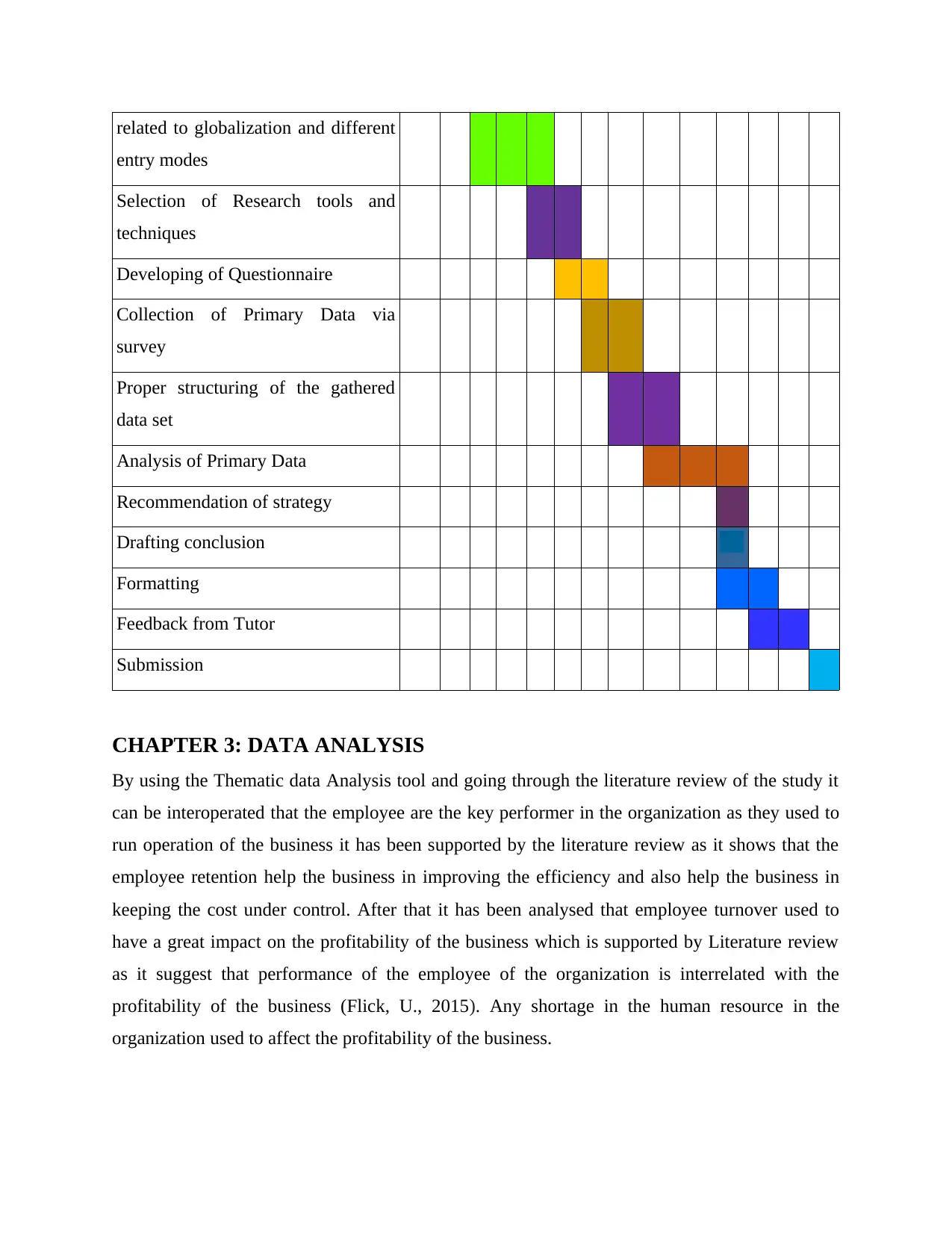
related to globalization and different
entry modes
Selection of Research tools and
techniques
Developing of Questionnaire
Collection of Primary Data via
survey
Proper structuring of the gathered
data set
Analysis of Primary Data
Recommendation of strategy
Drafting conclusion
Formatting
Feedback from Tutor
Submission
CHAPTER 3: DATA ANALYSIS
By using the Thematic data Analysis tool and going through the literature review of the study it
can be interoperated that the employee are the key performer in the organization as they used to
run operation of the business it has been supported by the literature review as it shows that the
employee retention help the business in improving the efficiency and also help the business in
keeping the cost under control. After that it has been analysed that employee turnover used to
have a great impact on the profitability of the business which is supported by Literature review
as it suggest that performance of the employee of the organization is interrelated with the
profitability of the business (Flick, U., 2015). Any shortage in the human resource in the
organization used to affect the profitability of the business.
entry modes
Selection of Research tools and
techniques
Developing of Questionnaire
Collection of Primary Data via
survey
Proper structuring of the gathered
data set
Analysis of Primary Data
Recommendation of strategy
Drafting conclusion
Formatting
Feedback from Tutor
Submission
CHAPTER 3: DATA ANALYSIS
By using the Thematic data Analysis tool and going through the literature review of the study it
can be interoperated that the employee are the key performer in the organization as they used to
run operation of the business it has been supported by the literature review as it shows that the
employee retention help the business in improving the efficiency and also help the business in
keeping the cost under control. After that it has been analysed that employee turnover used to
have a great impact on the profitability of the business which is supported by Literature review
as it suggest that performance of the employee of the organization is interrelated with the
profitability of the business (Flick, U., 2015). Any shortage in the human resource in the
organization used to affect the profitability of the business.
CHAPTER 4: ETHICAL CONSIDERATION
For conducting the research researcher has make sure that the research is conducted under
total ethics such as researcher has respected the dignity of the research participant. All the
information which was gathered was kept with the heigh level of confidentially throughout the
research. Also researcher has not forced or tried to do any wrong activity to change the data
which was collected from the respondent and also while making qualitative research the
interaction of researcher and participant is ethical (Bresler and Stake, 2017).
REFERENCES
Books and Journals
Kumar, R., 2019. Research methodology: A step-by-step guide for beginners. Sage Publications
Limited.
Mackey, A. and Gass, S. M., 2015. Second language research: Methodology and design.
Routledge.
Bresler, L. and Stake, R. E., 2017. Qualitative research methodology in music education. In
Critical Essays in Music Education (pp. 113-128). Routledge.
Flick, U., 2015. Introducing research methodology: A beginner's guide to doing a research
project. Sage.
Kotlar, J., and et.al., 2019. Corporate Governance in large UK family firms.
Cuervo‐Cazurra, A. and et.al., 2017. Research methodology in global strategy research. Global
Strategy Journal. 7(3). pp.233-240.
Walliman, N., 2017. Research methods: The basics. Routledge.
McCusker, K. and Gunaydin, S., 2015. Research using qualitative, quantitative or mixed
methods and choice based on the research. Perfusion. 30(7). pp.537-542.
Skinner, D., 2015. Qualitative methodology: an introduction.
Sessler, D. I. and Imrey, P. B., 2015. Clinical research methodology 2: observational clinical
research. Anesthesia & Analgesia. 121(4). pp.1043-1051.
Basias, N. and Pollalis, Y., 2018. Quantitative and qualitative research in business & technology:
Justifying a suitable research methodology. Review of Integrative Business and
Economics Research. 7. pp.91-105.
For conducting the research researcher has make sure that the research is conducted under
total ethics such as researcher has respected the dignity of the research participant. All the
information which was gathered was kept with the heigh level of confidentially throughout the
research. Also researcher has not forced or tried to do any wrong activity to change the data
which was collected from the respondent and also while making qualitative research the
interaction of researcher and participant is ethical (Bresler and Stake, 2017).
REFERENCES
Books and Journals
Kumar, R., 2019. Research methodology: A step-by-step guide for beginners. Sage Publications
Limited.
Mackey, A. and Gass, S. M., 2015. Second language research: Methodology and design.
Routledge.
Bresler, L. and Stake, R. E., 2017. Qualitative research methodology in music education. In
Critical Essays in Music Education (pp. 113-128). Routledge.
Flick, U., 2015. Introducing research methodology: A beginner's guide to doing a research
project. Sage.
Kotlar, J., and et.al., 2019. Corporate Governance in large UK family firms.
Cuervo‐Cazurra, A. and et.al., 2017. Research methodology in global strategy research. Global
Strategy Journal. 7(3). pp.233-240.
Walliman, N., 2017. Research methods: The basics. Routledge.
McCusker, K. and Gunaydin, S., 2015. Research using qualitative, quantitative or mixed
methods and choice based on the research. Perfusion. 30(7). pp.537-542.
Skinner, D., 2015. Qualitative methodology: an introduction.
Sessler, D. I. and Imrey, P. B., 2015. Clinical research methodology 2: observational clinical
research. Anesthesia & Analgesia. 121(4). pp.1043-1051.
Basias, N. and Pollalis, Y., 2018. Quantitative and qualitative research in business & technology:
Justifying a suitable research methodology. Review of Integrative Business and
Economics Research. 7. pp.91-105.
⊘ This is a preview!⊘
Do you want full access?
Subscribe today to unlock all pages.
Trusted by 1+ million students worldwide

Paraphrase This Document
Need a fresh take? Get an instant paraphrase of this document with our AI Paraphraser


1 out of 11


Related Documents


Your All-in-One AI-Powered Toolkit for Academic Success.
+13062052269
info@desklib.com
Available 24*7 on WhatsApp / Email
![[object Object]](/_next/static/media/star-bottom.7253800d.svg)
Unlock your academic potential
Copyright © 2020–2026 A2Z Services. All Rights Reserved. Developed and managed by ZUCOL.