Employee Relations: Comparing Employer Associations and Trade Unions
VerifiedAdded on 2022/12/12
|10
|2693
|429
Report
AI Summary
This research essay delves into the complexities of employee relations, focusing on the comparison between employer associations and trade unions. It explores the roles and objectives of both entities, highlighting their similarities and differences in representing employee interests and engaging in collective bargaining. The essay examines the functions of trade unions in protecting worker rights, advocating for fair wages and working conditions, and fostering a healthy workplace environment. It also analyzes employer associations and their strategies in responding to labor unions and maintaining a balanced work environment. Furthermore, the paper considers the concept of functional equivalents in employee relations, evaluating how employer associations employ various techniques to improve worker performance and achieve organizational goals. Finally, the essay reviews the decisions of the Fair Work Commission in Australia and its impact on employee rights, workplace standards, and the overall dynamics of employee relations.
Management Employee
Relations project 2
RESEARCH ESSAY
Relations project 2
RESEARCH ESSAY

Paraphrase This Document
Need a fresh take? Get an instant paraphrase of this document with our AI Paraphraser
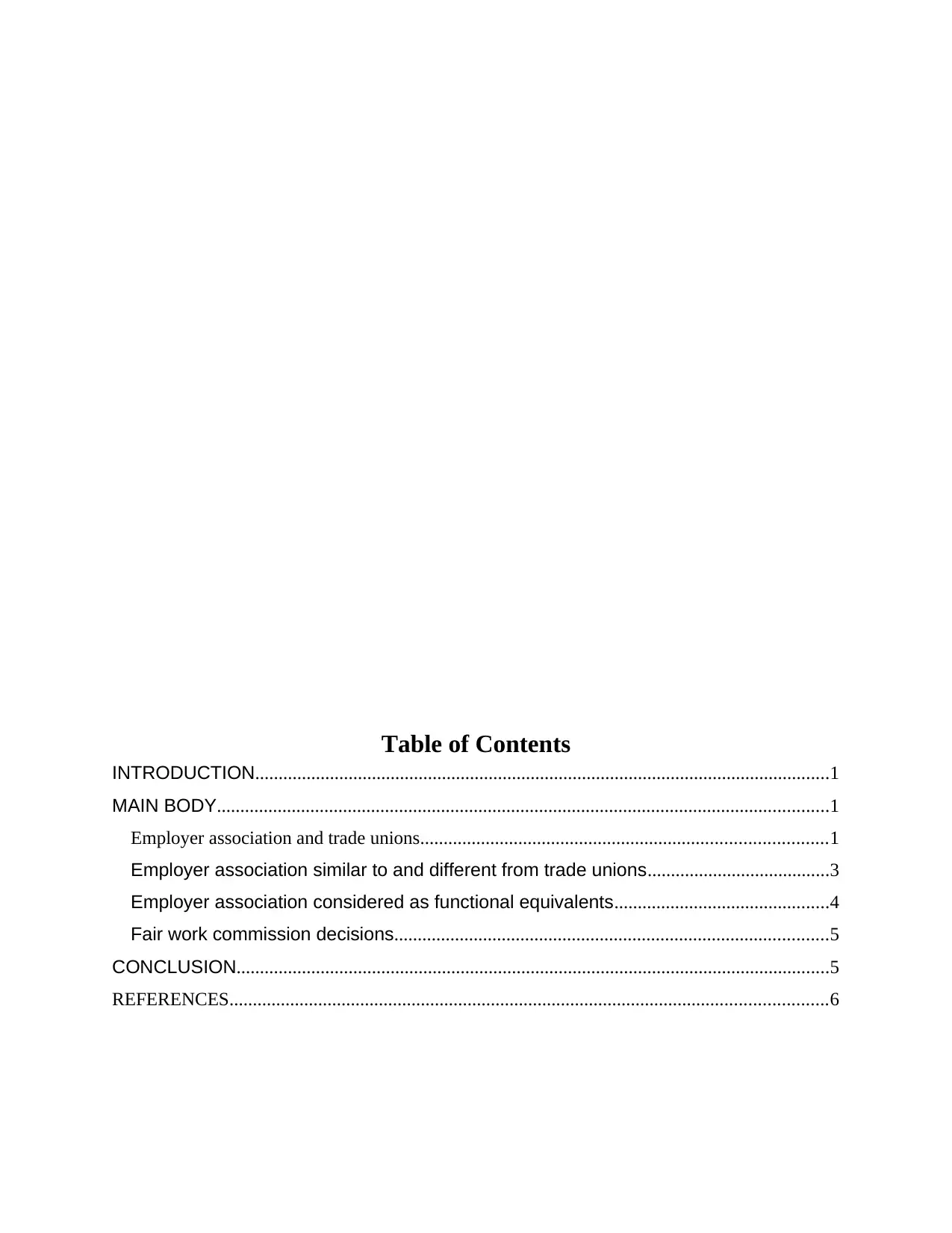
Table of Contents
INTRODUCTION...........................................................................................................................1
MAIN BODY...................................................................................................................................1
Employer association and trade unions.......................................................................................1
Employer association similar to and different from trade unions.......................................3
Employer association considered as functional equivalents..............................................4
Fair work commission decisions.............................................................................................5
CONCLUSION...............................................................................................................................5
REFERENCES................................................................................................................................6
INTRODUCTION...........................................................................................................................1
MAIN BODY...................................................................................................................................1
Employer association and trade unions.......................................................................................1
Employer association similar to and different from trade unions.......................................3
Employer association considered as functional equivalents..............................................4
Fair work commission decisions.............................................................................................5
CONCLUSION...............................................................................................................................5
REFERENCES................................................................................................................................6
INTRODUCTION
Trade union is also termed as a labor union, where the association of the workers
came under for the collective bargaining in a trade, company or the industry for the
specific purpose of improvement in securing the pay, working conditions, benefits or
social and the political status. Employer association is a union of the employee’s that
are the representative of the voluntary organization that is managed by the leaders who
are professional and led by the elected leaders with the permanent staff that are
specialized in the collective bargaining in the arena of the politic of the same collective
interests and the goals of the business class (Allern & Bale (2017)). Employer
association is often known as a part of the trade unions.
The aim of the report is to discuss the employer association similarity and the
difference from the trade unions with the help of the primary and the secondary data
decide whether the employer association is to be considered the part of the functional
equivalents to the unions with the major issues, the research differences and the
sources of the evidence and their long term and the short-term trends.
MAIN BODY
Employer association and trade unions
Employer associations are the counterpart to trade unions because in an
organisation it will help members in solving issues. Trade union can be defined as a
group of members which is made by employees so that their needs can be fulfilled.
Employees are fighting for their rights and they make groups because it has positive
impact on employer. When workers want that their needs should be fulfilled and they
form a group. The main aim of trade union is to protect interest of workers at the
workplace. Employers make groups and they fight for their rights like, they want that
their salary should be increased, flexible working hours should be provided, healthy
environment must be provided to employees so that they can complete their work
(Barton (2021)). If employees want holidays or bonuses, they make groups and with the
help of this they can tell their problems to employer.
If individual employee will go and share their problem then may be employer will not
listen. So, they make groups and share their issues, it has a impact on management
because if their demands are not fulfilled then they will not work and it will create bad
1
Trade union is also termed as a labor union, where the association of the workers
came under for the collective bargaining in a trade, company or the industry for the
specific purpose of improvement in securing the pay, working conditions, benefits or
social and the political status. Employer association is a union of the employee’s that
are the representative of the voluntary organization that is managed by the leaders who
are professional and led by the elected leaders with the permanent staff that are
specialized in the collective bargaining in the arena of the politic of the same collective
interests and the goals of the business class (Allern & Bale (2017)). Employer
association is often known as a part of the trade unions.
The aim of the report is to discuss the employer association similarity and the
difference from the trade unions with the help of the primary and the secondary data
decide whether the employer association is to be considered the part of the functional
equivalents to the unions with the major issues, the research differences and the
sources of the evidence and their long term and the short-term trends.
MAIN BODY
Employer association and trade unions
Employer associations are the counterpart to trade unions because in an
organisation it will help members in solving issues. Trade union can be defined as a
group of members which is made by employees so that their needs can be fulfilled.
Employees are fighting for their rights and they make groups because it has positive
impact on employer. When workers want that their needs should be fulfilled and they
form a group. The main aim of trade union is to protect interest of workers at the
workplace. Employers make groups and they fight for their rights like, they want that
their salary should be increased, flexible working hours should be provided, healthy
environment must be provided to employees so that they can complete their work
(Barton (2021)). If employees want holidays or bonuses, they make groups and with the
help of this they can tell their problems to employer.
If individual employee will go and share their problem then may be employer will not
listen. So, they make groups and share their issues, it has a impact on management
because if their demands are not fulfilled then they will not work and it will create bad
1
⊘ This is a preview!⊘
Do you want full access?
Subscribe today to unlock all pages.

Trusted by 1+ million students worldwide
impact on organisation. A trade union is group of members and it is made for benefit of
employees and their rights can be protected. Trade unions fight for workers equal rights
and equal pay. There should be no discrimination among workers on the basis of age,
gender, race, caste, religion, income or any other basis. All the employees should be
treated equally and everyone should receive respect and proper working environment
should be provided so that workers can complete their work on time. Trade unions
promote following rights like, maternity rights, paternity pay so that employees can work
properly. Trade unions are formed by workers to find solution of their common problems
and they tell employer to solve their issues. If they are working extra then they should
get extra amount for that (Cole & Limb (2017)).
They help workers in problems such as, fairness of pay, hours of work and other
benefits that an employee should get for performing well. Sometimes, workers are not
getting good working environment so they should tell this to management because it is
the responsibility of managers to provide safe and healthy culture within the workplace.
All workers should get clean desk and there must be no misunderstanding. Trade
unions are made because it protects economic interest of employees who are working
in the organisation (Schofield-Georgeson & Rawling (2020)). It helps in building good
reputation in market because if employer will provide all the necessary facilities to
members, then they will enjoy working in the company and this will reduce absenteeism.
So, it is for the benefit of workers as well as for organisation because if some of the
demands are fulfilled the employees will perform their work efficiently (Cooper & Ellem
(2019)). This helps in motivating employees and boost morale of employees; they will
give their best in achieving goals and objectives of company.
Employer association refers to voluntary organisations which is made by leaders
that are selected or elected. It is managed by managers who are professionals and
having permanent staff. Employer association refers to a group of people of
manufacturers, retailers or other employers. They make a team and make plans that
they will implement. It is made so that workers cannot make demand for anything and if
all employers will not listen to workers, then they have to work according to terms and
conditions of management. The main objective of employer association is to improve
conditions of work with the help of collective bargaining methods, better conditions can
2
employees and their rights can be protected. Trade unions fight for workers equal rights
and equal pay. There should be no discrimination among workers on the basis of age,
gender, race, caste, religion, income or any other basis. All the employees should be
treated equally and everyone should receive respect and proper working environment
should be provided so that workers can complete their work on time. Trade unions
promote following rights like, maternity rights, paternity pay so that employees can work
properly. Trade unions are formed by workers to find solution of their common problems
and they tell employer to solve their issues. If they are working extra then they should
get extra amount for that (Cole & Limb (2017)).
They help workers in problems such as, fairness of pay, hours of work and other
benefits that an employee should get for performing well. Sometimes, workers are not
getting good working environment so they should tell this to management because it is
the responsibility of managers to provide safe and healthy culture within the workplace.
All workers should get clean desk and there must be no misunderstanding. Trade
unions are made because it protects economic interest of employees who are working
in the organisation (Schofield-Georgeson & Rawling (2020)). It helps in building good
reputation in market because if employer will provide all the necessary facilities to
members, then they will enjoy working in the company and this will reduce absenteeism.
So, it is for the benefit of workers as well as for organisation because if some of the
demands are fulfilled the employees will perform their work efficiently (Cooper & Ellem
(2019)). This helps in motivating employees and boost morale of employees; they will
give their best in achieving goals and objectives of company.
Employer association refers to voluntary organisations which is made by leaders
that are selected or elected. It is managed by managers who are professionals and
having permanent staff. Employer association refers to a group of people of
manufacturers, retailers or other employers. They make a team and make plans that
they will implement. It is made so that workers cannot make demand for anything and if
all employers will not listen to workers, then they have to work according to terms and
conditions of management. The main objective of employer association is to improve
conditions of work with the help of collective bargaining methods, better conditions can
2
Paraphrase This Document
Need a fresh take? Get an instant paraphrase of this document with our AI Paraphraser
be finding out. Employer association works like trade unions and it also promote
economic interest of members. It helps managers in maintaining healthy environment in
company and this will help in giving response to threats or difficulties from labour unions
(Curtin (2018)). This is a way to fight against unions which is made by employees so
that their demand can be fulfilled.
Employer association similar to and different from trade unions
Employer association and trade unions are different from each other but objective
of both is similar because unions are made to protect rights of employees and they can
benefit whereas association is made to fight against unions. Sometimes, when
management is not ready to fulfil demand of labour so they do strike and stop working.
To avoid these situations or to be prepare for such kind of conditions employers make
an organisation. This helps in maintaining safe and healthy environment in the company
and there will be no discrimination among employees on any basis. In Australia, it is
compulsory to apply laws which are for the safety of employees. This will help in
protecting rights of workers (Dobbie, Nahm & MacMillan (2017)).
Difference between union and association is that trade unions are having legal
right so they can engage in collective bargaining whereas in association employer is not
having such right. Workers are joining trade unions due to some reasons like, to satisfy
their social needs, psychological needs, safety and security needs. They also want
protection from economic needs such as, illness, any accident occurs in organisation or
any employee is injured while working at workplace. Some labour join unions because
they want to increase their salaries and want additional benefits. Some characteristics
of trade unions are, they are related to economic benefits of members (McAlpine &
Roberts (2017)). It is permanent combination of labour because everyday there is
something that employees have to fight for their rights.
Sometimes, they want holidays, clean and safe environment. It is essential that
workers must get good working conditions because if there will be no cleanliness then
may be employees get ill and it will have bad impact on organisation. Character of union
keeps on changing because every time it will have different purpose and members also
change because may be demand of few employees are fulfilled. It has been influenced
by a number of ideologies and protect rights of employees (Flood (2018)). Functions
3
economic interest of members. It helps managers in maintaining healthy environment in
company and this will help in giving response to threats or difficulties from labour unions
(Curtin (2018)). This is a way to fight against unions which is made by employees so
that their demand can be fulfilled.
Employer association similar to and different from trade unions
Employer association and trade unions are different from each other but objective
of both is similar because unions are made to protect rights of employees and they can
benefit whereas association is made to fight against unions. Sometimes, when
management is not ready to fulfil demand of labour so they do strike and stop working.
To avoid these situations or to be prepare for such kind of conditions employers make
an organisation. This helps in maintaining safe and healthy environment in the company
and there will be no discrimination among employees on any basis. In Australia, it is
compulsory to apply laws which are for the safety of employees. This will help in
protecting rights of workers (Dobbie, Nahm & MacMillan (2017)).
Difference between union and association is that trade unions are having legal
right so they can engage in collective bargaining whereas in association employer is not
having such right. Workers are joining trade unions due to some reasons like, to satisfy
their social needs, psychological needs, safety and security needs. They also want
protection from economic needs such as, illness, any accident occurs in organisation or
any employee is injured while working at workplace. Some labour join unions because
they want to increase their salaries and want additional benefits. Some characteristics
of trade unions are, they are related to economic benefits of members (McAlpine &
Roberts (2017)). It is permanent combination of labour because everyday there is
something that employees have to fight for their rights.
Sometimes, they want holidays, clean and safe environment. It is essential that
workers must get good working conditions because if there will be no cleanliness then
may be employees get ill and it will have bad impact on organisation. Character of union
keeps on changing because every time it will have different purpose and members also
change because may be demand of few employees are fulfilled. It has been influenced
by a number of ideologies and protect rights of employees (Flood (2018)). Functions
3
and roles of trade unions are, it helps in achieving goals such as, higher wages or
salary is being increased and good working conditions should be provided. It helps in
acquiring control of industry by workers. It helps in protecting rights in matter of
employee’s interest. It provides self confidence to workers and take necessary steps for
welfare of employees and it helps in increasing morale of workers.
Trade union is a part of association but they are different from each other. It is
essential to make groups as labour will fight for their rights and they will demand for
high salary, provide good working conditions to employees so that they can work
efficiently and they will not face any problem. Both are different and are made for
various purpose. It is necessary that steps should be taken for welfare of employees
and they should make policies and procedures according to need of workers.
Employers should make rules and regulations which is beneficial for labours. It is
essential that proper plans must be made by managers so that workers can get good
culture and in Australia all organisations are providing good working conditions to
employees (Gahan, Pekarek & Nicholson (2018)).
Trade union is made because sometimes employees are not getting proper
treatment and they will take steps for their rights. Managers of company should listen to
issues which is faced by employees at the workplace and try to solve their problem as
soon as possible because it creates negative impact in organisation. Other workers are
not able to focus on their work and due to this reason goals and objectives of company
are not achieved. It is essential that employees must get good working conditions and
premises must be clean so that workers will not face any problem. Employee
association is different from trade union as it is made by manufacturers so that they do
not have to fulfil demand of employees (Humphrys (2018)).
Employer association considered as functional equivalents
Employee association is considered as functional equivalent because it includes
various techniques and approaches which is beneficial for employees. They are taking
necessary steps which help in improving performance of workers so that they can
achieve goals and objectives of organisation. Functional equivalent means alternative
behaviours or replacement behaviour which will help in increasing productivity of
employees as well as of company. Functional equivalent refers to method, practice,
4
salary is being increased and good working conditions should be provided. It helps in
acquiring control of industry by workers. It helps in protecting rights in matter of
employee’s interest. It provides self confidence to workers and take necessary steps for
welfare of employees and it helps in increasing morale of workers.
Trade union is a part of association but they are different from each other. It is
essential to make groups as labour will fight for their rights and they will demand for
high salary, provide good working conditions to employees so that they can work
efficiently and they will not face any problem. Both are different and are made for
various purpose. It is necessary that steps should be taken for welfare of employees
and they should make policies and procedures according to need of workers.
Employers should make rules and regulations which is beneficial for labours. It is
essential that proper plans must be made by managers so that workers can get good
culture and in Australia all organisations are providing good working conditions to
employees (Gahan, Pekarek & Nicholson (2018)).
Trade union is made because sometimes employees are not getting proper
treatment and they will take steps for their rights. Managers of company should listen to
issues which is faced by employees at the workplace and try to solve their problem as
soon as possible because it creates negative impact in organisation. Other workers are
not able to focus on their work and due to this reason goals and objectives of company
are not achieved. It is essential that employees must get good working conditions and
premises must be clean so that workers will not face any problem. Employee
association is different from trade union as it is made by manufacturers so that they do
not have to fulfil demand of employees (Humphrys (2018)).
Employer association considered as functional equivalents
Employee association is considered as functional equivalent because it includes
various techniques and approaches which is beneficial for employees. They are taking
necessary steps which help in improving performance of workers so that they can
achieve goals and objectives of organisation. Functional equivalent means alternative
behaviours or replacement behaviour which will help in increasing productivity of
employees as well as of company. Functional equivalent refers to method, practice,
4
⊘ This is a preview!⊘
Do you want full access?
Subscribe today to unlock all pages.
Trusted by 1+ million students worldwide
technique, procedure or other elements that will help in accomplishing targets of
company (Ibsen & Tapia (2017)). It is important to make policies and procedures for
beneficial of workers and rules should be made which will help in motivating employees
and they will work efficiently. It will also help in making good plans or strategies so that
labours can work properly and they will not face any problem. It is important to take
necessary steps for welfare of workers so that no such situation will arise in which
labour do strike or stop work. They should make proper rules and regulations and
clearly define policies for beneficial of employees.
Fair work commission decisions
Fair work commission decision in Australia means that it is an independent body
having powers to carry some functions such as, minimum wages, providing a safety and
security conditions, make rules which is beneficial for employees. Fair work commission
is important as it helps in assisting employees and employers which maintain equality in
the organisation. In Australia, managers of all company apply laws and there is no
discrimination among employees on the basis of income, gender or any other point.
Every employee should get fair and equal income so that there will be no confusion. it
helps in managing all activities and equal treatment must be given to all workers. Some
act must be applied by companies so that employees will work accordingly (Markey &
McIvor (2018)). While making rules and regulations, managers of company must think
about benefit of employees and they should provide all necessary facilities to workers.
Fair work commission will help managers in taking decisions which is beneficial for
labour.
CONCLUSION
From the above discussion it can be concluded that, trade unions are made for the
benefit of employees and they can fight for their rights such as, if they want more salary,
flexible working hours, maternity leave, paternity leave or any other issue that they are
facing. With the help of trade union workers can share their views and it will help them
in solving problem. Employer association refers to organisation which is made for
benefit of management and they can give response to unions. Further, difference
5
company (Ibsen & Tapia (2017)). It is important to make policies and procedures for
beneficial of workers and rules should be made which will help in motivating employees
and they will work efficiently. It will also help in making good plans or strategies so that
labours can work properly and they will not face any problem. It is important to take
necessary steps for welfare of workers so that no such situation will arise in which
labour do strike or stop work. They should make proper rules and regulations and
clearly define policies for beneficial of employees.
Fair work commission decisions
Fair work commission decision in Australia means that it is an independent body
having powers to carry some functions such as, minimum wages, providing a safety and
security conditions, make rules which is beneficial for employees. Fair work commission
is important as it helps in assisting employees and employers which maintain equality in
the organisation. In Australia, managers of all company apply laws and there is no
discrimination among employees on the basis of income, gender or any other point.
Every employee should get fair and equal income so that there will be no confusion. it
helps in managing all activities and equal treatment must be given to all workers. Some
act must be applied by companies so that employees will work accordingly (Markey &
McIvor (2018)). While making rules and regulations, managers of company must think
about benefit of employees and they should provide all necessary facilities to workers.
Fair work commission will help managers in taking decisions which is beneficial for
labour.
CONCLUSION
From the above discussion it can be concluded that, trade unions are made for the
benefit of employees and they can fight for their rights such as, if they want more salary,
flexible working hours, maternity leave, paternity leave or any other issue that they are
facing. With the help of trade union workers can share their views and it will help them
in solving problem. Employer association refers to organisation which is made for
benefit of management and they can give response to unions. Further, difference
5
Paraphrase This Document
Need a fresh take? Get an instant paraphrase of this document with our AI Paraphraser

between employer association and trade union has been described. Fair work
commission has been discussed.
6
commission has been discussed.
6
REFERENCES
Books and Journals
Allern, E. H., & Bale, T. (Eds.). (2017). Left-of-centre Parties and Trade Unions in the
Twenty-first Century. Oxford University Press.
Barton, R. (2021). Trade unions and industrial regeneration in North West Tasmania:
Moving beyond lock-in?. Environment and Planning A: Economy and
Space. 53(2). 332-348.
Cole, P., & Limb, P. (2017). Hooks down! Anti-apartheid activism and solidarity among
maritime unions in Australia and the United States. Labor History. 58(3). 303-
326.
Cooper, R., & Ellem, B. (2019). Australian unions: Crisis, strategy, survival. In Trade
Unions and Labour Movements in the Asia-Pacific Region (pp. 33-54).
Routledge.
Curtin, J. (2018). Women and trade unions: A comparative perspective. Routledge.
Dobbie, M., Nahm, D., & MacMillan, C. (2017). The Impact of trade unions on work
related training in Australia. Australian Journal of Labour Economics. 20(1).
263-290.
Flood, N. (2018). Focus: Why unions in Australia are looking to tax justice
campaigns. International Union Rights. 25(1). 17-25.
Gahan, P., Pekarek, A., & Nicholson, D. (2018). Unions and collective bargaining in
Australia in 2017. Journal of Industrial Relations. 60(3). 337-357.
Humphrys, E. (2018). Simultaneously deepening corporatism and advancing
neoliberalism: Australia under the Accord. Journal of Sociology. 54(1). 49-63.
Ibsen, C. L., & Tapia, M. (2017). Trade union revitalisation: Where are we now? Where
to next?. Journal of Industrial Relations. 59(2). 170-191.
Markey, R., & McIvor, J. (2018). Regulating casual employment in Australia. Journal of
Industrial Relations. 60(5). 593-618.
McAlpine, K., & Roberts, S. (2017). The future of trade unions in Australia. Chris White
Online.
Schofield-Georgeson, E., & Rawling, M. (2020). Industrial legislation in Australia in
2019. Journal of Industrial Relations. 62(3). 425-445.
7
Books and Journals
Allern, E. H., & Bale, T. (Eds.). (2017). Left-of-centre Parties and Trade Unions in the
Twenty-first Century. Oxford University Press.
Barton, R. (2021). Trade unions and industrial regeneration in North West Tasmania:
Moving beyond lock-in?. Environment and Planning A: Economy and
Space. 53(2). 332-348.
Cole, P., & Limb, P. (2017). Hooks down! Anti-apartheid activism and solidarity among
maritime unions in Australia and the United States. Labor History. 58(3). 303-
326.
Cooper, R., & Ellem, B. (2019). Australian unions: Crisis, strategy, survival. In Trade
Unions and Labour Movements in the Asia-Pacific Region (pp. 33-54).
Routledge.
Curtin, J. (2018). Women and trade unions: A comparative perspective. Routledge.
Dobbie, M., Nahm, D., & MacMillan, C. (2017). The Impact of trade unions on work
related training in Australia. Australian Journal of Labour Economics. 20(1).
263-290.
Flood, N. (2018). Focus: Why unions in Australia are looking to tax justice
campaigns. International Union Rights. 25(1). 17-25.
Gahan, P., Pekarek, A., & Nicholson, D. (2018). Unions and collective bargaining in
Australia in 2017. Journal of Industrial Relations. 60(3). 337-357.
Humphrys, E. (2018). Simultaneously deepening corporatism and advancing
neoliberalism: Australia under the Accord. Journal of Sociology. 54(1). 49-63.
Ibsen, C. L., & Tapia, M. (2017). Trade union revitalisation: Where are we now? Where
to next?. Journal of Industrial Relations. 59(2). 170-191.
Markey, R., & McIvor, J. (2018). Regulating casual employment in Australia. Journal of
Industrial Relations. 60(5). 593-618.
McAlpine, K., & Roberts, S. (2017). The future of trade unions in Australia. Chris White
Online.
Schofield-Georgeson, E., & Rawling, M. (2020). Industrial legislation in Australia in
2019. Journal of Industrial Relations. 62(3). 425-445.
7
⊘ This is a preview!⊘
Do you want full access?
Subscribe today to unlock all pages.
Trusted by 1+ million students worldwide

8

1 out of 10


Related Documents


Your All-in-One AI-Powered Toolkit for Academic Success.
+13062052269
info@desklib.com
Available 24*7 on WhatsApp / Email
![[object Object]](/_next/static/media/star-bottom.7253800d.svg)
Unlock your academic potential
Copyright © 2020–2026 A2Z Services. All Rights Reserved. Developed and managed by ZUCOL.