Individual Report: Employment Law, Ethics and Constructive Dismissal

Verified

Added on  2022/12/27

|7
|2006
|59
Report
AI Summary
This report delves into the intricacies of employment law, exploring the legal framework governing the relationship between employers and employees. It examines various aspects, including employment contracts, employee rights, and the implications of constructive dismissal, where an employee is forced to leave a job due to the employer's misconduct. The report analyzes a case study involving an employee, Linda, who discovers fraud within her company and the subsequent ethical dilemmas she faces. It discusses the concept of ethical perspectives, such as utilitarian ethics, and how these principles should guide decision-making in the workplace. The report provides a comprehensive overview of ethical considerations and practical advice for employees navigating challenging situations. The report offers an in-depth analysis of employment law, ethical considerations, and constructive dismissal scenarios, drawing on relevant legal principles and ethical frameworks.
Document Page
INDIVIDUAL REPORT
tabler-icon-diamond-filled.svg

Paraphrase This Document

Need a fresh take? Get an instant paraphrase of this document with our AI Paraphraser
Document Page
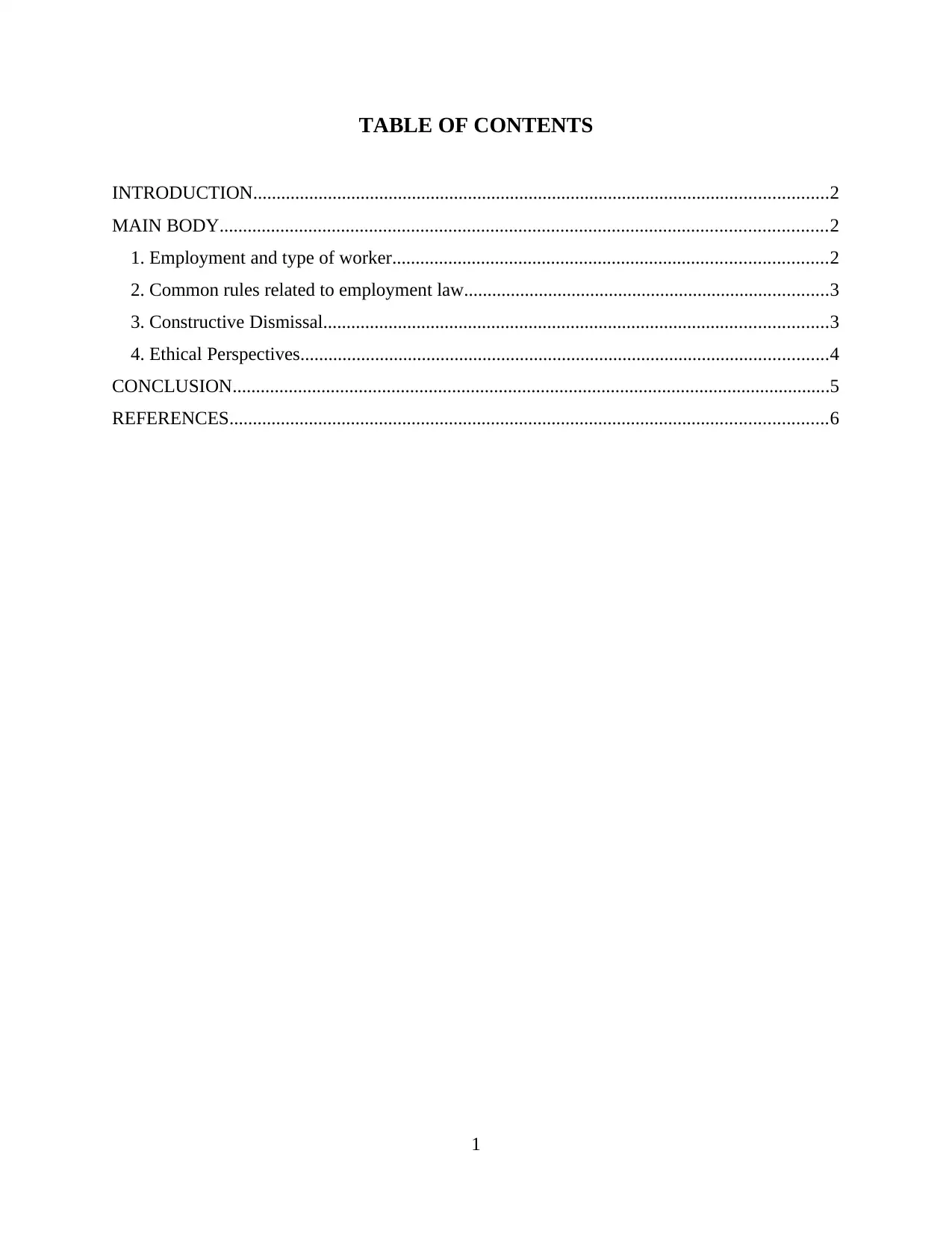
TABLE OF CONTENTS
INTRODUCTION...........................................................................................................................2
MAIN BODY..................................................................................................................................2
1. Employment and type of worker.............................................................................................2
2. Common rules related to employment law..............................................................................3
3. Constructive Dismissal............................................................................................................3
4. Ethical Perspectives.................................................................................................................4
CONCLUSION................................................................................................................................5
REFERENCES................................................................................................................................6
1
Document Page
INTRODUCTION
Laws are legal legislation that are made by government of country related to the way
company needs to operate its business so that no harm can be caused to individual. It has also
make several employment laws that helps in defining relationship between employee’s and
employer of the company. This report has covered necessary information related to the case of
Linda that has recently joined the company has found fraud conducted by Charles and done
various unethical practices.
MAIN BODY
1. Employment and type of worker
As per the Employment and Labour Laws and Regulations, 2020; the term employment
can be legally defined as the one where there is a clear distinction of roles and responsibilities
between the employer and employees having separate legal duties, roles and responsibilities.
Any individual can be categorised as employee if the employers have all rights related to their
control on the work. Further, both the parties i.e. employer and employee are mutually obligated
to each other regarding their work obligations.
This particular law clearly distinguishes between employees, workers and self- employed
people who have different work related rules that are to be fulfilled1. Further, the Employment
Rights Act, 2002 recognises four major types of employment contract types mainly in UK. These
can be identified as full time and part time employees, casual and fixed term workers, shift
workers, daily hired and weekly hired workers, probation period workers, apprentices and
trainees working in the organisation and outworkers. In the present case of Linda, since she was
on a probation period of six months, it can be easily identified that she can be categorised as an
apprentice or trainee in that particular retail company operating at the local level.
As per the act, apprentice acts as employee of an organisation because they have
equivalent rights and duties towards the organisation and their job role as well2. They are entitled
to claim leaves and paid holidays apart from other benefits such as PF, Gratuity etc. However,
they are also implicated with multiple duties that they have to fulfil towards their work practices,
culture and organisational objectives.
1 De Groen, and et.al., (2018)
2 Chung, Heejung. (2018)
2
Document Page
2. Common rules related to employment law
The employment law considers the act of employment as a binding contract between the
employer and the employee. They are both obligated towards each other and have certain duties
and responsibilities that they are required to comply with and follow.
Contractual obligation: Both the employer and employee are bound with a contract towards
each other and they have to fulfil the requirements of that contract3. Breaking such contracts, or
even not fulfilling the obligations that have been pre- determined by both the parties can
ultimately lead to serious legal consequences which gives the either party right to sue each other
if need arises.
Salaries and other benefits: There are a variety of aspects associated with the salaries that are
required to be given to the employees working in the organisation4. It needs to conform with the
finalised figure as per the contract and further, the amount should also be according to the
minimum wages act that is implemented in UK.
Dismissal: It is the one of the law that employer of the company cannot be dismissal any
individual without fair and true reason from the company. There should be valid reason that can
be justify the act of dismissing the employee for the organisation. So, employer of company
needs to take sufficient steps before dismissing employees for the firm.
These are just some of the aspects and there are various other aspects that are included in the
employment law such as time period, terms of employment etc. that are included in the
employment law.
3. Constructive Dismissal
Constructive dismissal is process when an individual is forced to leave its job without its
willingness to do the same and the reason behind is misconduct of employer. Moreover, the
constructive dismissal reason should be much stronger like force an individual to accept
unreasonable changes in work place, or provide right to other employees to harass or bully. So, it
can be stated that any breach of contract has enforced employee’s to leave the job then it can
easily claim for constructive dismissal5. So, in the above case study, it has been learnt that Linda
3 Pesole, Annarosa, and et.al., (2018)
4 Hessels, and et.al., (2018)
5 Zhang, Guangxi, Jianan Zhong, and Muammer Ozer, (2020)
3
tabler-icon-diamond-filled.svg

Paraphrase This Document

Need a fresh take? Get an instant paraphrase of this document with our AI Paraphraser
Document Page
despite knowing the fact that Chief accountant, Charles has involved in the fraud has reported to
its superior Heather. Such as
But it does not take any action or ignored the same, moreover after few days Linda has
observed Charles and heather being socializing. At the same time, it was identified that
Charles has given company cheque of 20K to Linda so that it can buy a car and come at
work on time. So, it the activity that has been conducted by employer against the contract
so in this situation Linda rather than accepting the same should reject.
While in case of tickets given by Charles to visit holiday in resort of Spain in fortnight
time, she should not accept the same and reject the ticket. As the Charles has not behaved
in proper manner as it has suddenly came its residences and gift a car and ticket that was
not professional behaviour as per the contract6.
So, it can be stated that the Linda must have to make use of the options of constructive
dismissal as it was forcefully given the tickets and cars. Thereby rather than accepting them all
Linda must have resigned from the company. Thus, Linda has an option of constructive dismissal
but it has not make use of it in the given case which lead it names for conducting fraud as per
administration.
4. Ethical Perspectives
Ethics are moral values, principles that are considered by specific individual while
dealing with particular situation or circumstance. It is pertaining to things that are right and
wrong in conduct as per set standard or rules and regulation. Ethical perspective is the way a
particular individual overview a problem to situation, as every individual has its own values,
perspective to think and analysis situation or circumstance. Thereby take correct decision that
can be good for all individual that are effect specific decision7. Likewise, that are various
perspective that are directly related to the above case study which can also be advised to Linda.
Utilitarian ethics is perspective which states that person while taking any decision must think
about the greatest goodness to maximum number of people. So, in the above case Linda despite
knowing the trust that Charles has been conducting fraud as just approached to Heather, who is
her line supervisor. Therefore, as per utilitarian ethics perspective it needs to inform higher
authority about the fraud which is beneficial for every individual that are working in the
6 Minhua, Li, (2017)
7 Palíšková, PhDr Marcela, and JUDr Věra Hrouzková
4
Document Page
organisation. It should take decision that are beneficial for majority of people rather than few
individual so that fraud conducted by Charles is harmful for all employees that are working in
the organization.
There is various thing that were not considered ethical such as Linda even knowing the
relationship between Charles and Heather that have different spouses does not aware other
individual in the office. She has taken the cheque even the tickets in order to enjoy the holiday
resort in Spain in fortnight time8. So, there are various advices that Linda needs to adhere so that
she have not been involved in case of fraud conducted by Charles. Such as:
It must have informed about the fraud that is conducted by Charles to another superior or
top management so that fraud can be avoided to some extent.
Furthermore, she has joined their socials or started joining then in wine bar which it
should have avoided as it resulted in adding her name also in the fraud9.
Thirdly, Linda has taken company cheque of 20 K so that it can buy a car and come
earlier to office so as per ethical perspective, she must have rejected to accept the same.
Fourthly the Charles has suddenly come to residence of Linda on its birthday so she and
gave him ticket to enjoy the holiday so as per ethic it should reject it.
Therefore, all these are various advices that need to be implemented by Linda.
CONCLUSION
It can be concluded from above report that employment is relationship between two
parties related to work in specific manner so that company can enjoy higher profit and market
share. The employment laws have described some legislation the way both employee and
employer needs to react or behave with each other while working in the organization. At last, it
can be concluded that the case was related to ethical perspective that has not been considered by
Linda and Charles while completing their respective task in the company.
8 Guerrero-Dib, Jean Gabriel, Luis Portales, and Yolanda Heredia-Escorza, (2020)
9 Zhang, Guangxi, Jianan Zhong, and Muammer Ozer, (2020)
5
Document Page
REFERENCES
Books and Journal
Chung, Heejung. "Gender, flexibility stigma and the perceived negative consequences of flexible
working in the UK." Social Indicators Research (2018): 1-25.
De Groen, and et.al. "Employment and working conditions of selected types of platform work."
(2018).
Guerrero-Dib, Jean Gabriel, Luis Portales, and Yolanda Heredia-Escorza. "Impact of academic
integrity on workplace ethical behaviour." International Journal for Educational
Integrity 16, no. 1 (2020): 1-18.
Hessels, and et.al. "Life satisfaction and self-employment in different types of
occupations." Applied Economics Letters 25, no. 11 (2018): 734-740.
Minhua, Li. "Reason of Labor Legislation on Employment Goal and Economic Target." Law
Science Magazine (2017): 06.
Palíšková, PhDr Marcela, and JUDr Věra Hrouzková. "Regulation of new employment forms in
the legislation on labor relations and in collective agreements."
Pesole, Annarosa, and et.al. "Platform workers in Europe." Luxembourg: Publications Office of
the European Union (2018).
Zeev, Nadav Ben, and Tomer Ifergane. "Employment Protection Legislation and Economic
Resilience." (2018).
Zhang, Guangxi, Jianan Zhong, and Muammer Ozer. "Status threat and ethical leadership: A
power-dependence perspective." Journal of business ethics 161, no. 3 (2020): 665-
685.
6
chevron_up_icon
1 out of 7
circle_padding
hide_on_mobile
zoom_out_icon
[object Object]