Employment Stewardship Report: Analysis of Leadership Principles

Verified

Added on  2021/04/21

|5
|717
|34
Report
AI Summary
This report examines the concept of employment stewardship, exploring the critical elements of effective leadership and employee engagement. It delves into the 'carrot principle' and its application in fostering a positive organizational culture. The report analyzes various leadership styles, differentiating between 'expectors' and 'altruists' and their impact on employee motivation. It highlights the importance of clear communication, trust, and accountability in achieving company goals, emphasizing the need for purpose-based recognition. Furthermore, the report discusses the creation of a 'carrot culture' where employees are valued and appreciated, leading to increased performance and engagement. It also addresses potential challenges and fears associated with implementing such a culture, offering insights into building a workplace where employees feel motivated, valued, and committed to the organization's success. The report references key literature on leadership and employee engagement.
Document Page
Running head: EMPLOYMENT STEWARDSHIP
Employment stewardship
Name of the Student
Name of the University
Author note
tabler-icon-diamond-filled.svg

Paraphrase This Document

Need a fresh take? Get an instant paraphrase of this document with our AI Paraphraser
Document Page
1EMPLOYMENT STEWARDSHIP
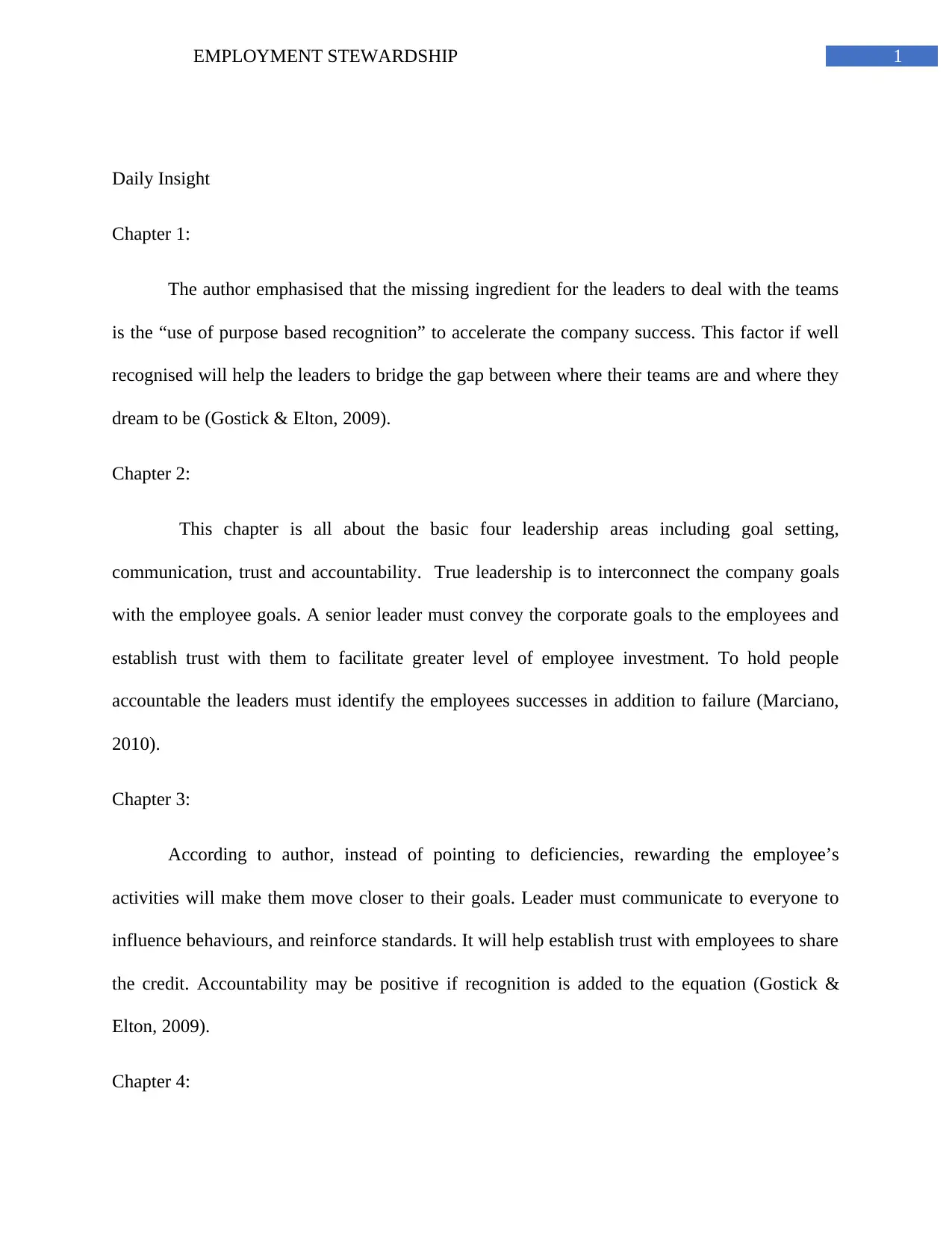
Daily Insight
Chapter 1:
The author emphasised that the missing ingredient for the leaders to deal with the teams
is the “use of purpose based recognition” to accelerate the company success. This factor if well
recognised will help the leaders to bridge the gap between where their teams are and where they
dream to be (Gostick & Elton, 2009).
Chapter 2:
This chapter is all about the basic four leadership areas including goal setting,
communication, trust and accountability. True leadership is to interconnect the company goals
with the employee goals. A senior leader must convey the corporate goals to the employees and
establish trust with them to facilitate greater level of employee investment. To hold people
accountable the leaders must identify the employees successes in addition to failure (Marciano,
2010).
Chapter 3:
According to author, instead of pointing to deficiencies, rewarding the employee’s
activities will make them move closer to their goals. Leader must communicate to everyone to
influence behaviours, and reinforce standards. It will help establish trust with employees to share
the credit. Accountability may be positive if recognition is added to the equation (Gostick &
Elton, 2009).
Chapter 4:
Document Page
2EMPLOYMENT STEWARDSHIP
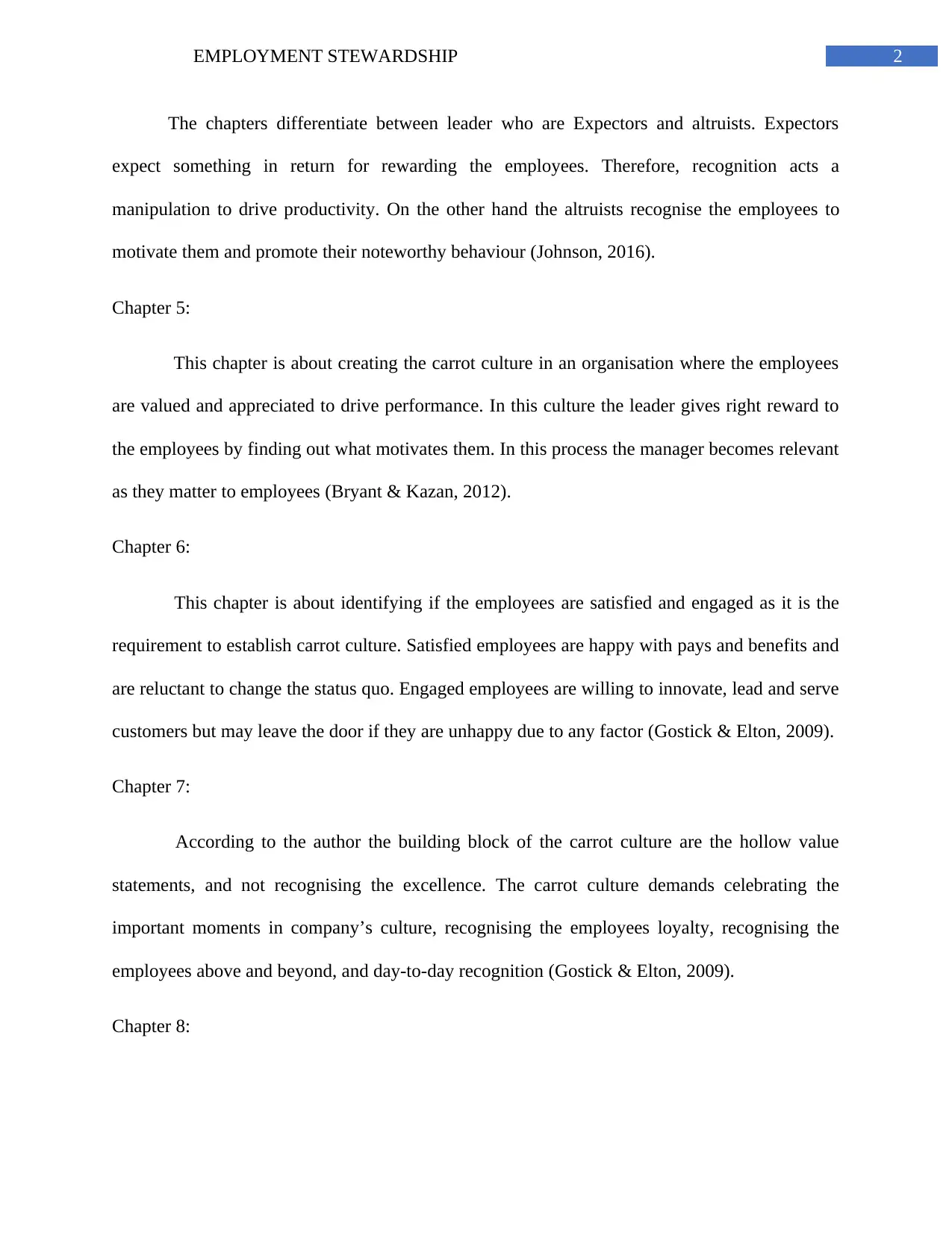
The chapters differentiate between leader who are Expectors and altruists. Expectors
expect something in return for rewarding the employees. Therefore, recognition acts a
manipulation to drive productivity. On the other hand the altruists recognise the employees to
motivate them and promote their noteworthy behaviour (Johnson, 2016).
Chapter 5:
This chapter is about creating the carrot culture in an organisation where the employees
are valued and appreciated to drive performance. In this culture the leader gives right reward to
the employees by finding out what motivates them. In this process the manager becomes relevant
as they matter to employees (Bryant & Kazan, 2012).
Chapter 6:
This chapter is about identifying if the employees are satisfied and engaged as it is the
requirement to establish carrot culture. Satisfied employees are happy with pays and benefits and
are reluctant to change the status quo. Engaged employees are willing to innovate, lead and serve
customers but may leave the door if they are unhappy due to any factor (Gostick & Elton, 2009).
Chapter 7:
According to the author the building block of the carrot culture are the hollow value
statements, and not recognising the excellence. The carrot culture demands celebrating the
important moments in company’s culture, recognising the employees loyalty, recognising the
employees above and beyond, and day-to-day recognition (Gostick & Elton, 2009).
Chapter 8:
Document Page
3EMPLOYMENT STEWARDSHIP
The fear of carrot culture as per author is due to fear of jealousy, difficulty observing
everything, loss of value due to too much recognition, fear of cash benefits, or only intention to
drive benefits within the job scope, which limits the above and beyond recognition behaviour
(Gostick & Elton, 2009).
tabler-icon-diamond-filled.svg

Paraphrase This Document

Need a fresh take? Get an instant paraphrase of this document with our AI Paraphraser
Document Page
4EMPLOYMENT STEWARDSHIP
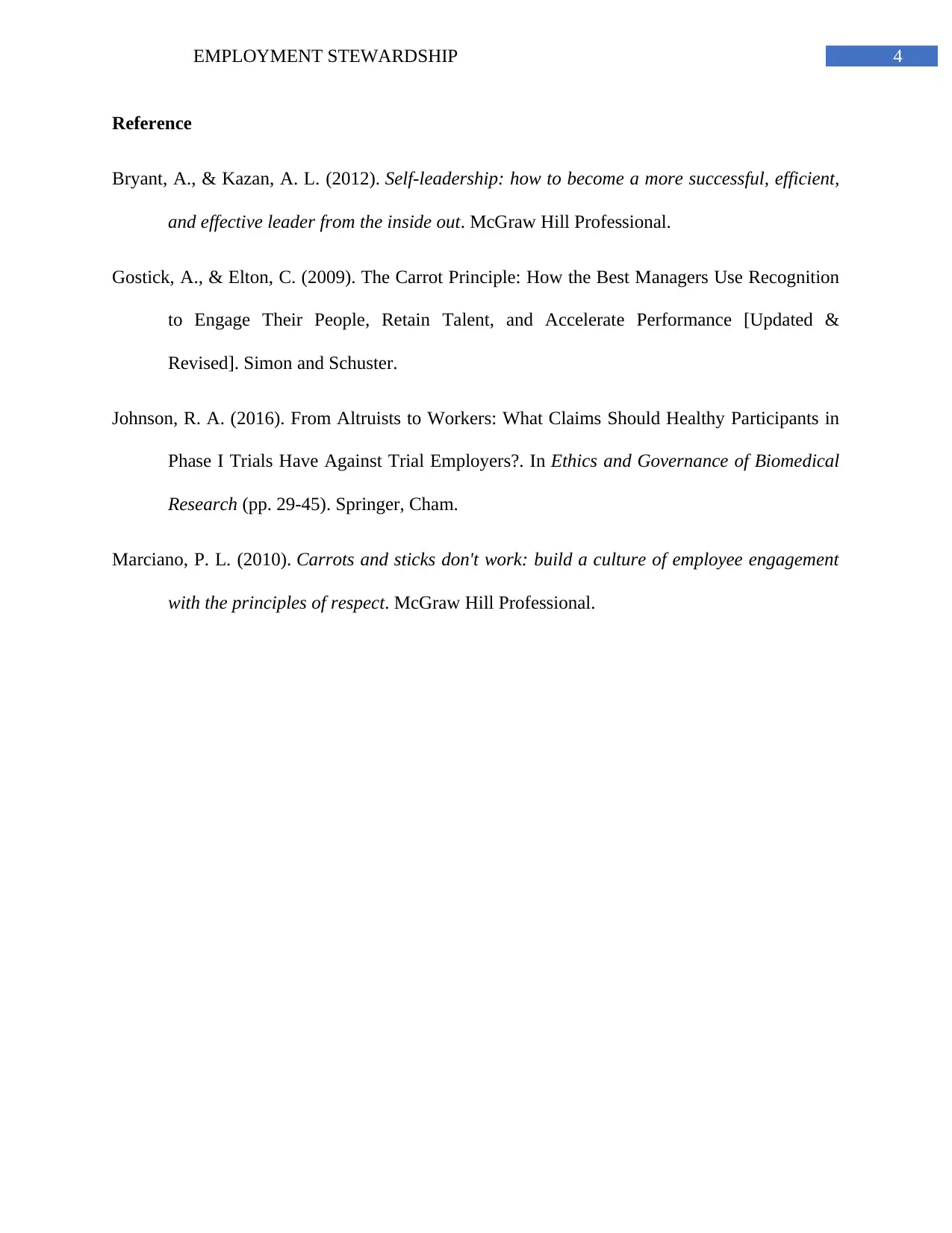
Reference
Bryant, A., & Kazan, A. L. (2012). Self-leadership: how to become a more successful, efficient,
and effective leader from the inside out. McGraw Hill Professional.
Gostick, A., & Elton, C. (2009). The Carrot Principle: How the Best Managers Use Recognition
to Engage Their People, Retain Talent, and Accelerate Performance [Updated &
Revised]. Simon and Schuster.
Johnson, R. A. (2016). From Altruists to Workers: What Claims Should Healthy Participants in
Phase I Trials Have Against Trial Employers?. In Ethics and Governance of Biomedical
Research (pp. 29-45). Springer, Cham.
Marciano, P. L. (2010). Carrots and sticks don't work: build a culture of employee engagement
with the principles of respect. McGraw Hill Professional.
chevron_up_icon
1 out of 5
circle_padding
hide_on_mobile
zoom_out_icon
[object Object]