Comprehensive Report: Employment Relations Legislation and Unions
VerifiedAdded on 2020/02/03
|18
|5548
|30
Report
AI Summary
This report delves into employment relations legislation, beginning with an introduction to the subject and its impact on employer-employee relationships. It differentiates between formal and psychological contracts, outlining their definitions, documentation requirements, and relevant legislation. The report then identifies and explains two key sources of employment relations legislation: statutory bodies and UK/EU institutions, emphasizing their roles and influence. It also reviews recent developments in individual rights, such as those related to smoking in public places and national minimum wages and flexible working hours. The study further explains the statutory trade union recognition and de-recognition processes, considering the reasons why an employer might or might not want to recognize a trade union, detailing the roles of the employee, union, and employer. Appendices provide further details on the contracts, legislation, and developments discussed, making it a comprehensive overview of employment relations.

EMPLOYMENT RELATIONS LEGISLATION

Paraphrase This Document
Need a fresh take? Get an instant paraphrase of this document with our AI Paraphraser
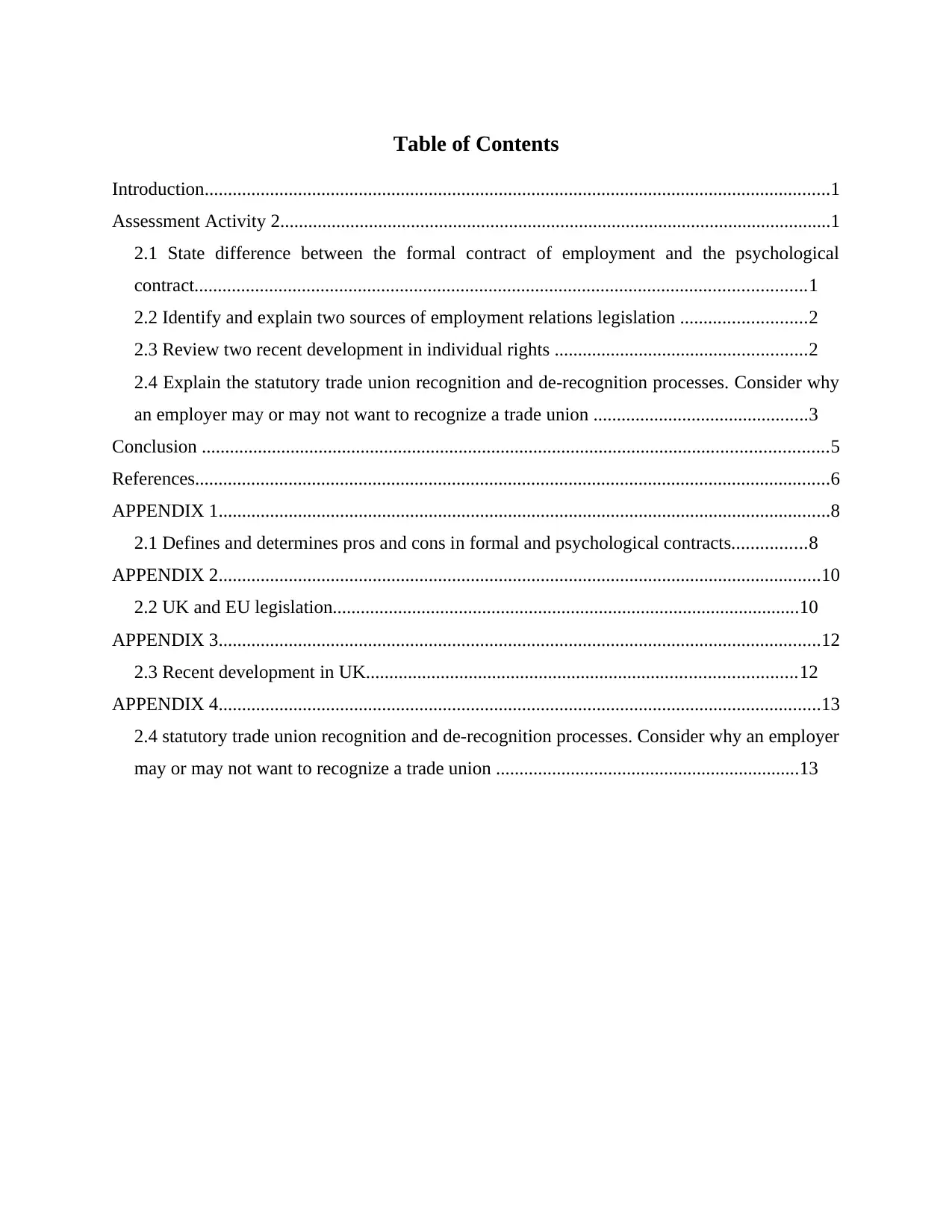
Table of Contents
Introduction......................................................................................................................................1
Assessment Activity 2......................................................................................................................1
2.1 State difference between the formal contract of employment and the psychological
contract...................................................................................................................................1
2.2 Identify and explain two sources of employment relations legislation ...........................2
2.3 Review two recent development in individual rights ......................................................2
2.4 Explain the statutory trade union recognition and de-recognition processes. Consider why
an employer may or may not want to recognize a trade union ..............................................3
Conclusion ......................................................................................................................................5
References........................................................................................................................................6
APPENDIX 1...................................................................................................................................8
2.1 Defines and determines pros and cons in formal and psychological contracts................8
APPENDIX 2.................................................................................................................................10
2.2 UK and EU legislation....................................................................................................10
APPENDIX 3.................................................................................................................................12
2.3 Recent development in UK............................................................................................12
APPENDIX 4.................................................................................................................................13
2.4 statutory trade union recognition and de-recognition processes. Consider why an employer
may or may not want to recognize a trade union .................................................................13
Introduction......................................................................................................................................1
Assessment Activity 2......................................................................................................................1
2.1 State difference between the formal contract of employment and the psychological
contract...................................................................................................................................1
2.2 Identify and explain two sources of employment relations legislation ...........................2
2.3 Review two recent development in individual rights ......................................................2
2.4 Explain the statutory trade union recognition and de-recognition processes. Consider why
an employer may or may not want to recognize a trade union ..............................................3
Conclusion ......................................................................................................................................5
References........................................................................................................................................6
APPENDIX 1...................................................................................................................................8
2.1 Defines and determines pros and cons in formal and psychological contracts................8
APPENDIX 2.................................................................................................................................10
2.2 UK and EU legislation....................................................................................................10
APPENDIX 3.................................................................................................................................12
2.3 Recent development in UK............................................................................................12
APPENDIX 4.................................................................................................................................13
2.4 statutory trade union recognition and de-recognition processes. Consider why an employer
may or may not want to recognize a trade union .................................................................13
Introduction
Employment relations legislation has several reforms and norms which aids in
developing suitable relationships among employer and employees. In this context, the present
study has been emphasizing on formal and psychological contract along with this impact on
organizational performance (Giuliano, Kampelmann and Rycx, 2017). Furthermore, discussion is
also included regarding sources of employment legislation development of individual. Moreover,
two recent development also discussed that are related to individual rights. In addition to this, it
is also made on recognition and de-recognition for a trade union.
Assessment Activity 2
2.1 State difference between the formal contract of employment and the psychological contract
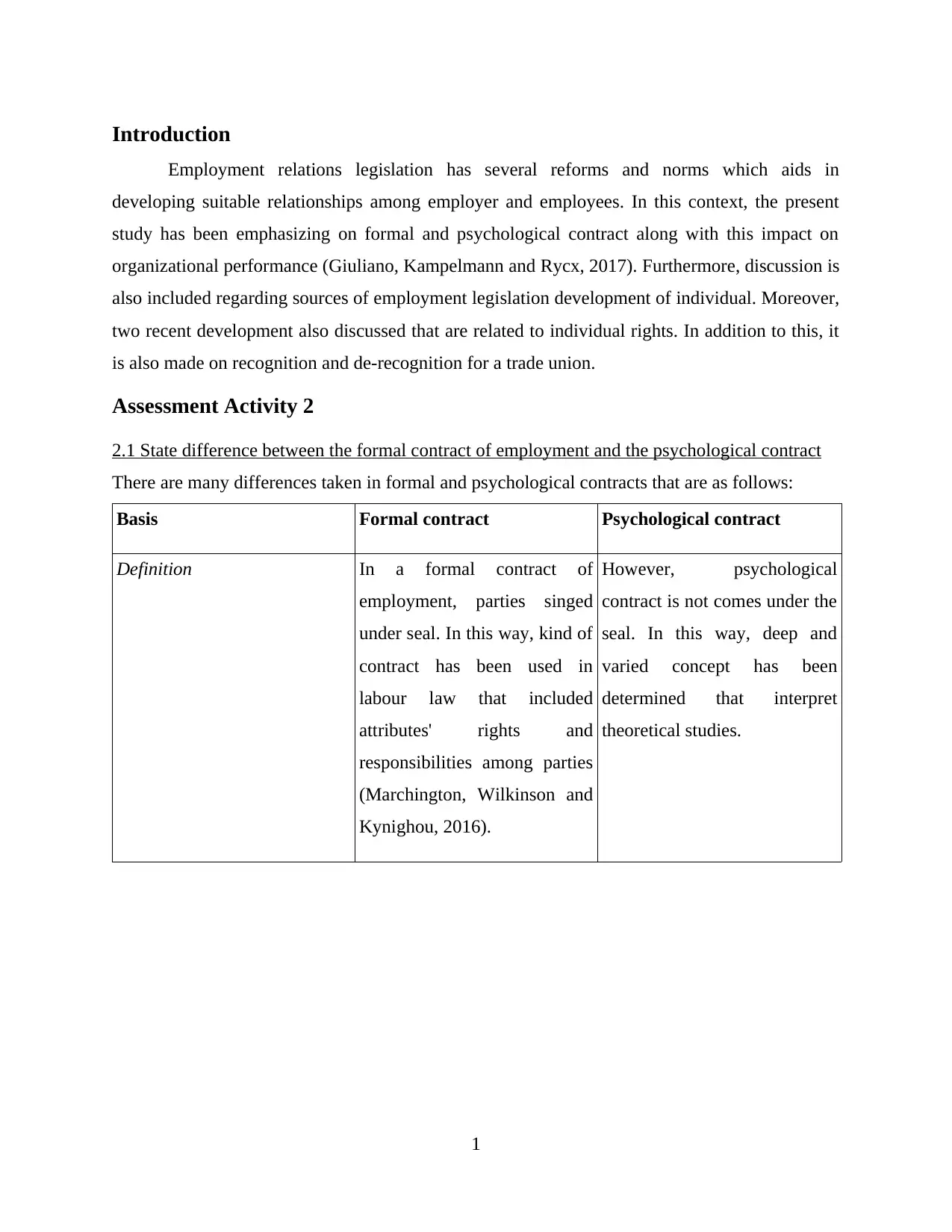
There are many differences taken in formal and psychological contracts that are as follows:
Basis Formal contract Psychological contract
Definition In a formal contract of
employment, parties singed
under seal. In this way, kind of
contract has been used in
labour law that included
attributes' rights and
responsibilities among parties
(Marchington, Wilkinson and
Kynighou, 2016).
However, psychological
contract is not comes under the
seal. In this way, deep and
varied concept has been
determined that interpret
theoretical studies.
1
Employment relations legislation has several reforms and norms which aids in
developing suitable relationships among employer and employees. In this context, the present
study has been emphasizing on formal and psychological contract along with this impact on
organizational performance (Giuliano, Kampelmann and Rycx, 2017). Furthermore, discussion is
also included regarding sources of employment legislation development of individual. Moreover,
two recent development also discussed that are related to individual rights. In addition to this, it
is also made on recognition and de-recognition for a trade union.
Assessment Activity 2
2.1 State difference between the formal contract of employment and the psychological contract
There are many differences taken in formal and psychological contracts that are as follows:
Basis Formal contract Psychological contract
Definition In a formal contract of
employment, parties singed
under seal. In this way, kind of
contract has been used in
labour law that included
attributes' rights and
responsibilities among parties
(Marchington, Wilkinson and
Kynighou, 2016).
However, psychological
contract is not comes under the
seal. In this way, deep and
varied concept has been
determined that interpret
theoretical studies.
1
⊘ This is a preview!⊘
Do you want full access?
Subscribe today to unlock all pages.

Trusted by 1+ million students worldwide
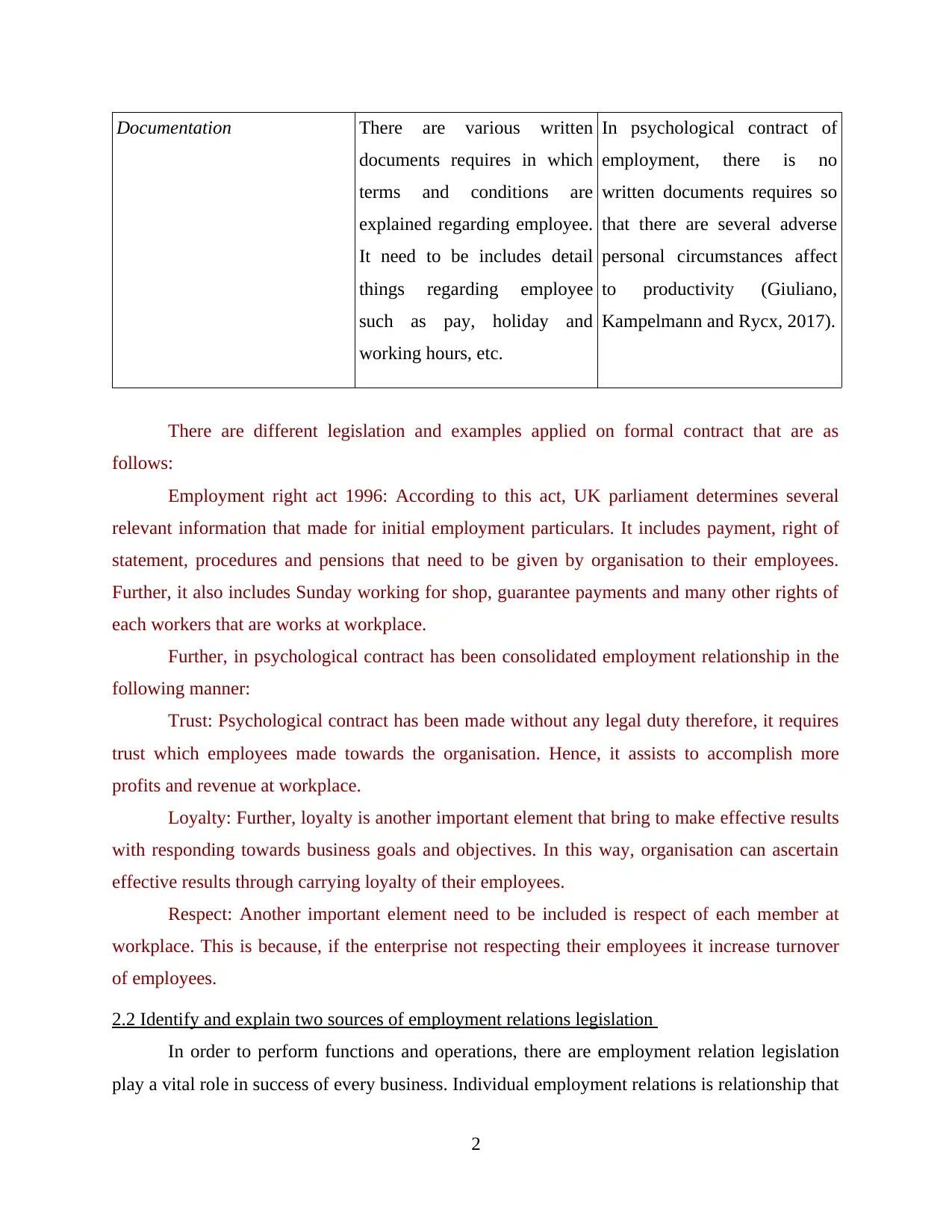
Documentation There are various written
documents requires in which
terms and conditions are
explained regarding employee.
It need to be includes detail
things regarding employee
such as pay, holiday and
working hours, etc.
In psychological contract of
employment, there is no
written documents requires so
that there are several adverse
personal circumstances affect
to productivity (Giuliano,
Kampelmann and Rycx, 2017).
There are different legislation and examples applied on formal contract that are as
follows:
Employment right act 1996: According to this act, UK parliament determines several
relevant information that made for initial employment particulars. It includes payment, right of
statement, procedures and pensions that need to be given by organisation to their employees.
Further, it also includes Sunday working for shop, guarantee payments and many other rights of
each workers that are works at workplace.
Further, in psychological contract has been consolidated employment relationship in the
following manner:
Trust: Psychological contract has been made without any legal duty therefore, it requires
trust which employees made towards the organisation. Hence, it assists to accomplish more
profits and revenue at workplace.
Loyalty: Further, loyalty is another important element that bring to make effective results
with responding towards business goals and objectives. In this way, organisation can ascertain
effective results through carrying loyalty of their employees.
Respect: Another important element need to be included is respect of each member at
workplace. This is because, if the enterprise not respecting their employees it increase turnover
of employees.
2.2 Identify and explain two sources of employment relations legislation
In order to perform functions and operations, there are employment relation legislation
play a vital role in success of every business. Individual employment relations is relationship that
2
documents requires in which
terms and conditions are
explained regarding employee.
It need to be includes detail
things regarding employee
such as pay, holiday and
working hours, etc.
In psychological contract of
employment, there is no
written documents requires so
that there are several adverse
personal circumstances affect
to productivity (Giuliano,
Kampelmann and Rycx, 2017).
There are different legislation and examples applied on formal contract that are as
follows:
Employment right act 1996: According to this act, UK parliament determines several
relevant information that made for initial employment particulars. It includes payment, right of
statement, procedures and pensions that need to be given by organisation to their employees.
Further, it also includes Sunday working for shop, guarantee payments and many other rights of
each workers that are works at workplace.
Further, in psychological contract has been consolidated employment relationship in the
following manner:
Trust: Psychological contract has been made without any legal duty therefore, it requires
trust which employees made towards the organisation. Hence, it assists to accomplish more
profits and revenue at workplace.
Loyalty: Further, loyalty is another important element that bring to make effective results
with responding towards business goals and objectives. In this way, organisation can ascertain
effective results through carrying loyalty of their employees.
Respect: Another important element need to be included is respect of each member at
workplace. This is because, if the enterprise not respecting their employees it increase turnover
of employees.
2.2 Identify and explain two sources of employment relations legislation
In order to perform functions and operations, there are employment relation legislation
play a vital role in success of every business. Individual employment relations is relationship that
2
Paraphrase This Document
Need a fresh take? Get an instant paraphrase of this document with our AI Paraphraser
exist among employee and its employer. With the help of legal regulation, relationship has been
shaped that create outcomes of social partner negotiations with terms and conditions. Further,
individual employment relations is demonstrates as core interest of EU with inception to create
labour market for all employees such as self-employed (Marchington, Wilkinson and Kynighou,
2016). In this way, rights to free movement and social security has been given that assist to
maintain employee relations.
Employment relations are very important aspect which need to be focus on work and also
covered extensively within European Working conditions survey with taking other research on
particular topic (Klyver, Nielsen and Evald, 2013). Following are two different sources assist to
identified employment relation legislation:
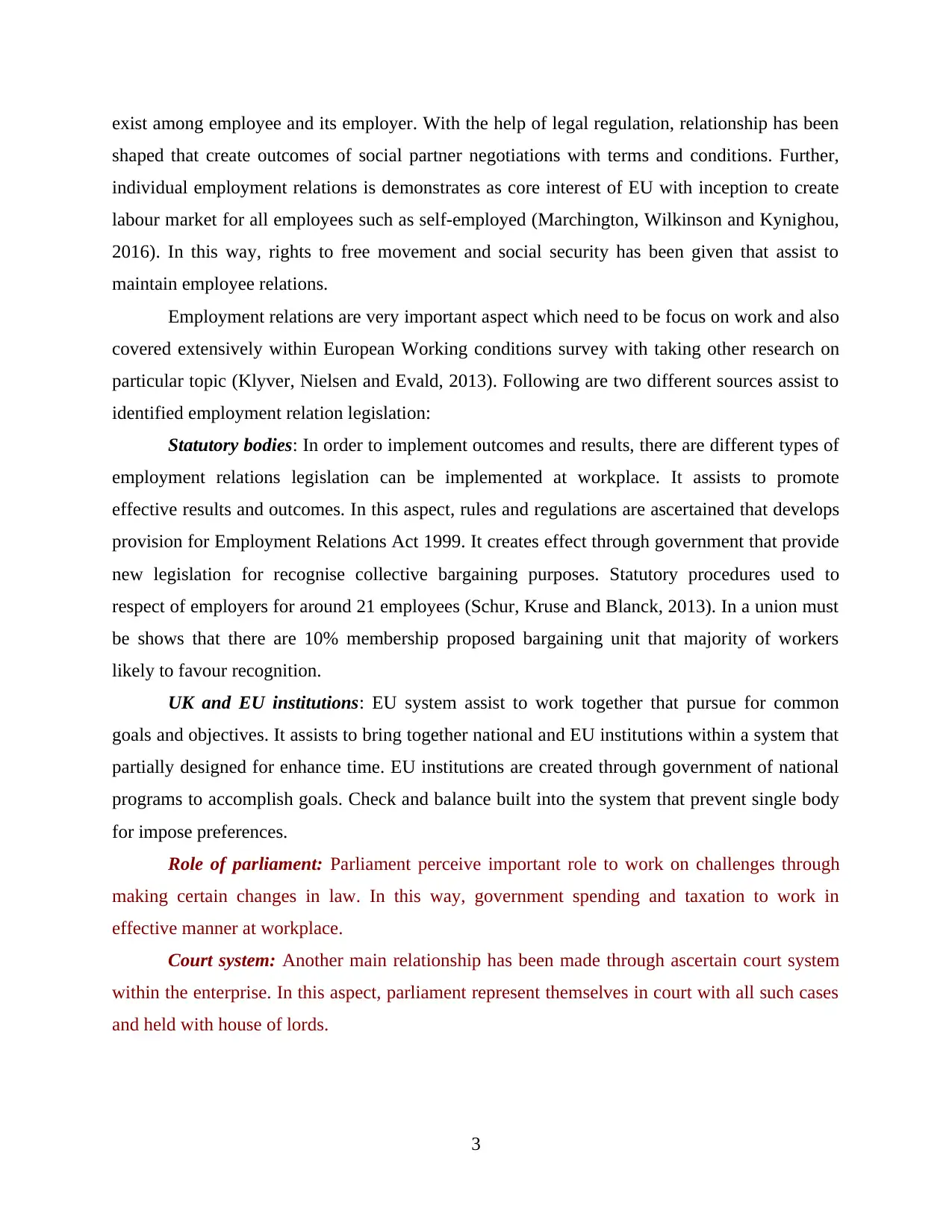
Statutory bodies: In order to implement outcomes and results, there are different types of
employment relations legislation can be implemented at workplace. It assists to promote
effective results and outcomes. In this aspect, rules and regulations are ascertained that develops
provision for Employment Relations Act 1999. It creates effect through government that provide
new legislation for recognise collective bargaining purposes. Statutory procedures used to
respect of employers for around 21 employees (Schur, Kruse and Blanck, 2013). In a union must
be shows that there are 10% membership proposed bargaining unit that majority of workers
likely to favour recognition.
UK and EU institutions: EU system assist to work together that pursue for common
goals and objectives. It assists to bring together national and EU institutions within a system that
partially designed for enhance time. EU institutions are created through government of national
programs to accomplish goals. Check and balance built into the system that prevent single body
for impose preferences.
Role of parliament: Parliament perceive important role to work on challenges through
making certain changes in law. In this way, government spending and taxation to work in
effective manner at workplace.
Court system: Another main relationship has been made through ascertain court system
within the enterprise. In this aspect, parliament represent themselves in court with all such cases
and held with house of lords.
3
shaped that create outcomes of social partner negotiations with terms and conditions. Further,
individual employment relations is demonstrates as core interest of EU with inception to create
labour market for all employees such as self-employed (Marchington, Wilkinson and Kynighou,
2016). In this way, rights to free movement and social security has been given that assist to
maintain employee relations.
Employment relations are very important aspect which need to be focus on work and also
covered extensively within European Working conditions survey with taking other research on
particular topic (Klyver, Nielsen and Evald, 2013). Following are two different sources assist to
identified employment relation legislation:
Statutory bodies: In order to implement outcomes and results, there are different types of
employment relations legislation can be implemented at workplace. It assists to promote
effective results and outcomes. In this aspect, rules and regulations are ascertained that develops
provision for Employment Relations Act 1999. It creates effect through government that provide
new legislation for recognise collective bargaining purposes. Statutory procedures used to
respect of employers for around 21 employees (Schur, Kruse and Blanck, 2013). In a union must
be shows that there are 10% membership proposed bargaining unit that majority of workers
likely to favour recognition.
UK and EU institutions: EU system assist to work together that pursue for common
goals and objectives. It assists to bring together national and EU institutions within a system that
partially designed for enhance time. EU institutions are created through government of national
programs to accomplish goals. Check and balance built into the system that prevent single body
for impose preferences.
Role of parliament: Parliament perceive important role to work on challenges through
making certain changes in law. In this way, government spending and taxation to work in
effective manner at workplace.
Court system: Another main relationship has been made through ascertain court system
within the enterprise. In this aspect, parliament represent themselves in court with all such cases
and held with house of lords.
3
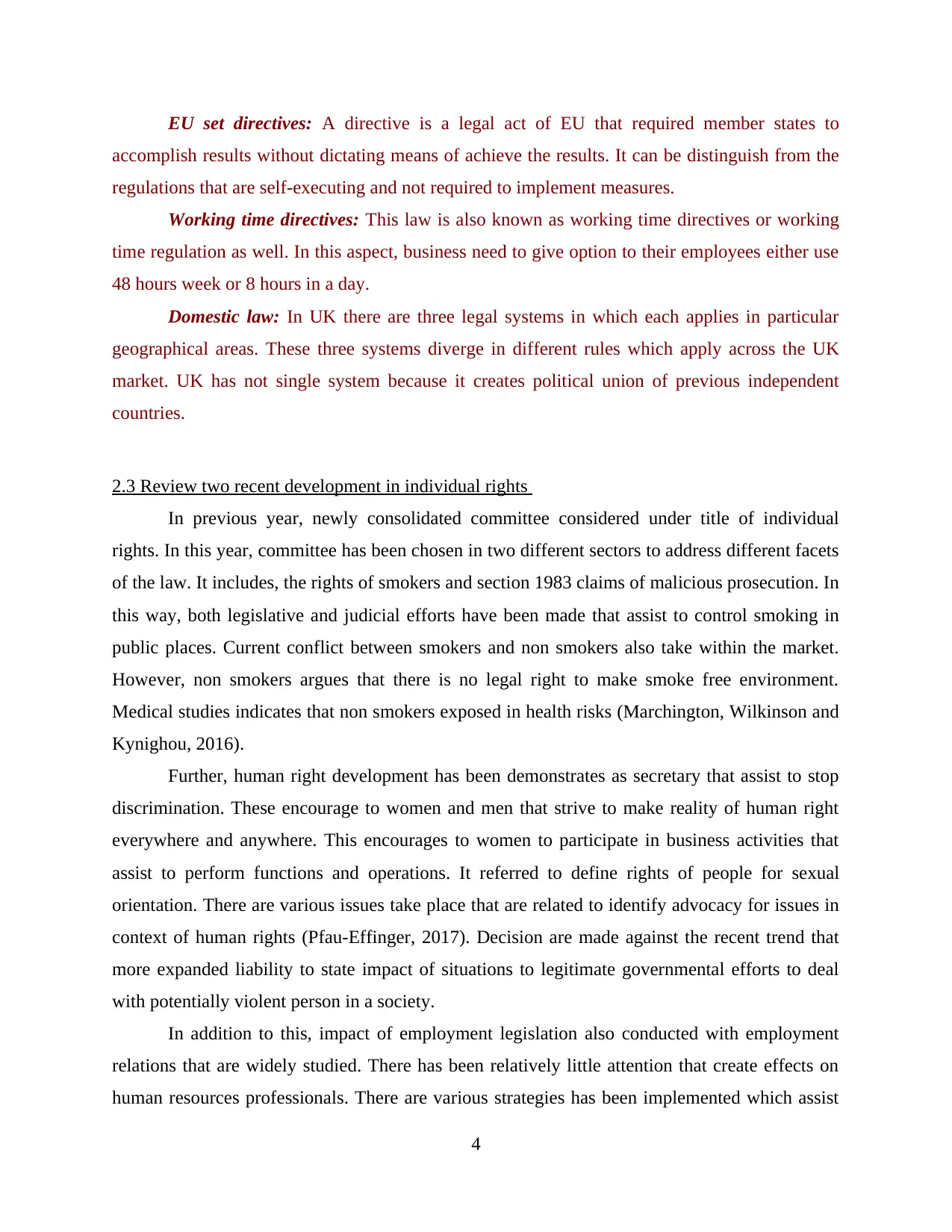
EU set directives: A directive is a legal act of EU that required member states to
accomplish results without dictating means of achieve the results. It can be distinguish from the
regulations that are self-executing and not required to implement measures.
Working time directives: This law is also known as working time directives or working
time regulation as well. In this aspect, business need to give option to their employees either use
48 hours week or 8 hours in a day.
Domestic law: In UK there are three legal systems in which each applies in particular
geographical areas. These three systems diverge in different rules which apply across the UK
market. UK has not single system because it creates political union of previous independent
countries.
2.3 Review two recent development in individual rights
In previous year, newly consolidated committee considered under title of individual
rights. In this year, committee has been chosen in two different sectors to address different facets
of the law. It includes, the rights of smokers and section 1983 claims of malicious prosecution. In
this way, both legislative and judicial efforts have been made that assist to control smoking in
public places. Current conflict between smokers and non smokers also take within the market.
However, non smokers argues that there is no legal right to make smoke free environment.
Medical studies indicates that non smokers exposed in health risks (Marchington, Wilkinson and
Kynighou, 2016).
Further, human right development has been demonstrates as secretary that assist to stop
discrimination. These encourage to women and men that strive to make reality of human right
everywhere and anywhere. This encourages to women to participate in business activities that
assist to perform functions and operations. It referred to define rights of people for sexual
orientation. There are various issues take place that are related to identify advocacy for issues in
context of human rights (Pfau-Effinger, 2017). Decision are made against the recent trend that
more expanded liability to state impact of situations to legitimate governmental efforts to deal
with potentially violent person in a society.
In addition to this, impact of employment legislation also conducted with employment
relations that are widely studied. There has been relatively little attention that create effects on
human resources professionals. There are various strategies has been implemented which assist
4
accomplish results without dictating means of achieve the results. It can be distinguish from the
regulations that are self-executing and not required to implement measures.
Working time directives: This law is also known as working time directives or working
time regulation as well. In this aspect, business need to give option to their employees either use
48 hours week or 8 hours in a day.
Domestic law: In UK there are three legal systems in which each applies in particular
geographical areas. These three systems diverge in different rules which apply across the UK
market. UK has not single system because it creates political union of previous independent
countries.
2.3 Review two recent development in individual rights
In previous year, newly consolidated committee considered under title of individual
rights. In this year, committee has been chosen in two different sectors to address different facets
of the law. It includes, the rights of smokers and section 1983 claims of malicious prosecution. In
this way, both legislative and judicial efforts have been made that assist to control smoking in
public places. Current conflict between smokers and non smokers also take within the market.
However, non smokers argues that there is no legal right to make smoke free environment.
Medical studies indicates that non smokers exposed in health risks (Marchington, Wilkinson and
Kynighou, 2016).
Further, human right development has been demonstrates as secretary that assist to stop
discrimination. These encourage to women and men that strive to make reality of human right
everywhere and anywhere. This encourages to women to participate in business activities that
assist to perform functions and operations. It referred to define rights of people for sexual
orientation. There are various issues take place that are related to identify advocacy for issues in
context of human rights (Pfau-Effinger, 2017). Decision are made against the recent trend that
more expanded liability to state impact of situations to legitimate governmental efforts to deal
with potentially violent person in a society.
In addition to this, impact of employment legislation also conducted with employment
relations that are widely studied. There has been relatively little attention that create effects on
human resources professionals. There are various strategies has been implemented which assist
4
⊘ This is a preview!⊘
Do you want full access?
Subscribe today to unlock all pages.
Trusted by 1+ million students worldwide
to promote professional status that impact on human resource (Klyver, Nielsen and Evald, 2013).
In this way human rights are also working with practices that found in mitigating the risk
element as professional manner. On the second aspect, strategic decision has been found
automatically to unknown and known strengthening.
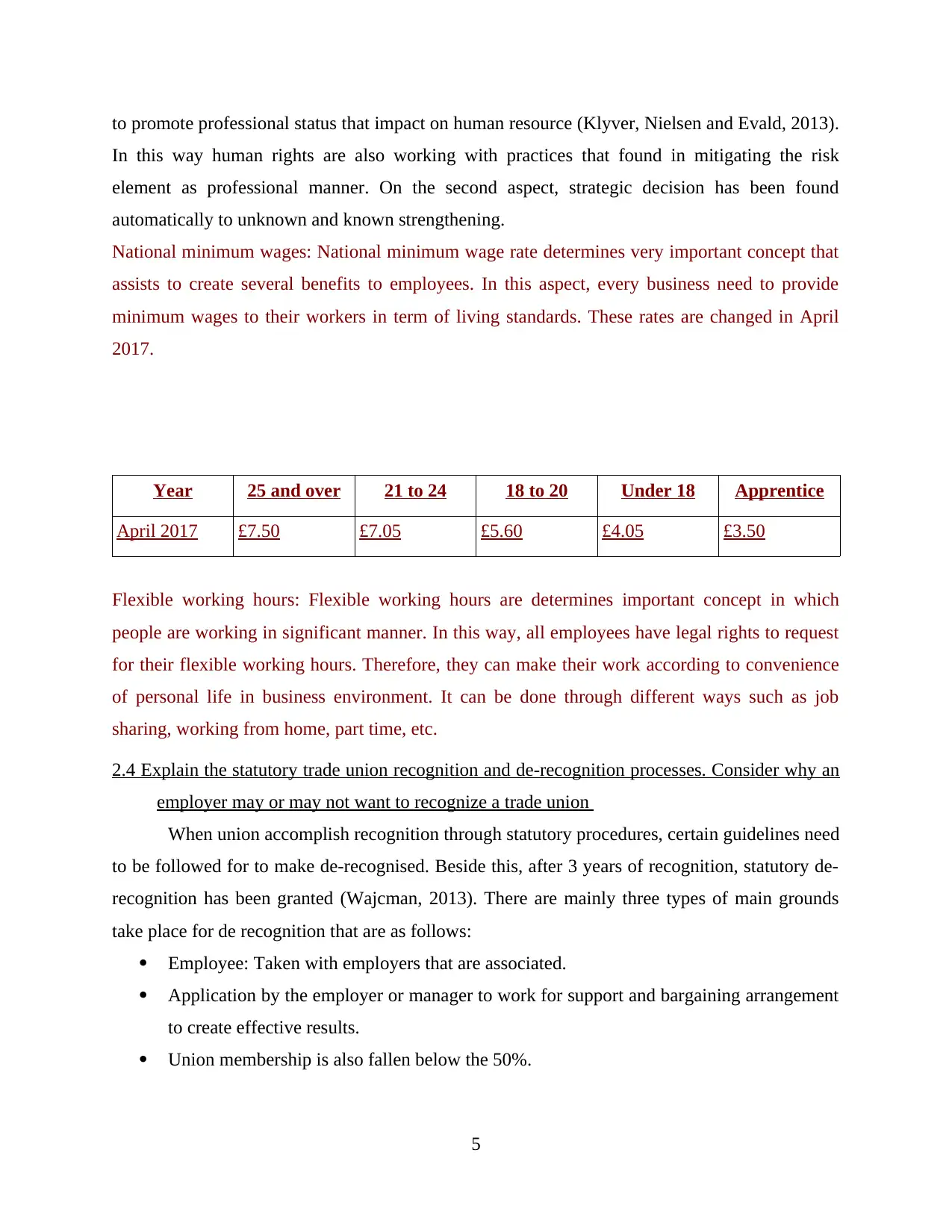
National minimum wages: National minimum wage rate determines very important concept that
assists to create several benefits to employees. In this aspect, every business need to provide
minimum wages to their workers in term of living standards. These rates are changed in April
2017.
Year 25 and over 21 to 24 18 to 20 Under 18 Apprentice
April 2017 £7.50 £7.05 £5.60 £4.05 £3.50
Flexible working hours: Flexible working hours are determines important concept in which
people are working in significant manner. In this way, all employees have legal rights to request
for their flexible working hours. Therefore, they can make their work according to convenience
of personal life in business environment. It can be done through different ways such as job
sharing, working from home, part time, etc.
2.4 Explain the statutory trade union recognition and de-recognition processes. Consider why an
employer may or may not want to recognize a trade union
When union accomplish recognition through statutory procedures, certain guidelines need
to be followed for to make de-recognised. Beside this, after 3 years of recognition, statutory de-
recognition has been granted (Wajcman, 2013). There are mainly three types of main grounds
take place for de recognition that are as follows:
Employee: Taken with employers that are associated.
Application by the employer or manager to work for support and bargaining arrangement
to create effective results.
Union membership is also fallen below the 50%.
5
In this way human rights are also working with practices that found in mitigating the risk
element as professional manner. On the second aspect, strategic decision has been found
automatically to unknown and known strengthening.
National minimum wages: National minimum wage rate determines very important concept that
assists to create several benefits to employees. In this aspect, every business need to provide
minimum wages to their workers in term of living standards. These rates are changed in April
2017.
Year 25 and over 21 to 24 18 to 20 Under 18 Apprentice
April 2017 £7.50 £7.05 £5.60 £4.05 £3.50
Flexible working hours: Flexible working hours are determines important concept in which
people are working in significant manner. In this way, all employees have legal rights to request
for their flexible working hours. Therefore, they can make their work according to convenience
of personal life in business environment. It can be done through different ways such as job
sharing, working from home, part time, etc.
2.4 Explain the statutory trade union recognition and de-recognition processes. Consider why an
employer may or may not want to recognize a trade union
When union accomplish recognition through statutory procedures, certain guidelines need
to be followed for to make de-recognised. Beside this, after 3 years of recognition, statutory de-
recognition has been granted (Wajcman, 2013). There are mainly three types of main grounds
take place for de recognition that are as follows:
Employee: Taken with employers that are associated.
Application by the employer or manager to work for support and bargaining arrangement
to create effective results.
Union membership is also fallen below the 50%.
5
Paraphrase This Document
Need a fresh take? Get an instant paraphrase of this document with our AI Paraphraser
New statutory procedure come up in 6 June 2000 that effect in the UK from which trade
unions can seek to recognise from employers and collective bargaining purposes. This features
outline main elements of legislations that discussed and impact as well (Giuliano, Kampelmann
and Rycx, 2017). Statutory trade union recognised for provision that made for employment
relations Act 1999. It could be brought with effect of government in June, 6th 2000. New
legislation provides recognition that claim for recognition and collective bargaining purposes.
The union also refers to develop and resolves bilaterally with the employer concerned in CAC
for determination. CAC statutory body organised tripartite basis which develop with judge of
high court and number of deputy chairs academics or lawyers. In this aspect, two groups of
members has been shown with experience as employer and workers representatives (Kirton and
Greene, 2015).
Role of CAC is determines scope that are included in bargaining unit and it is also
declared union that could be recognised on the basis of majority of worker that are concerned
with members of the union that qualified to make support and concerned to each category that
convened to deal with application (De Cuyper and Isaksson, 2017).
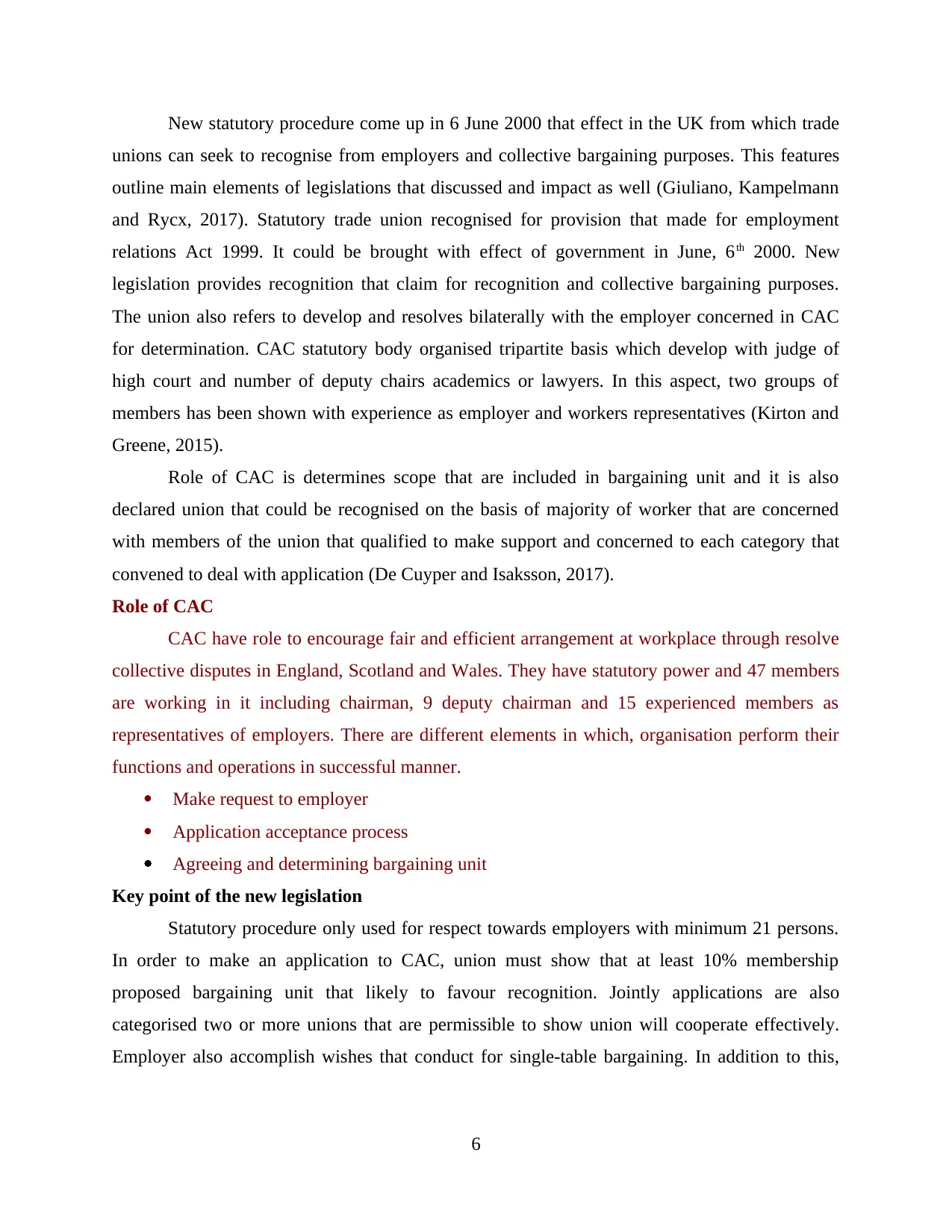
Role of CAC
CAC have role to encourage fair and efficient arrangement at workplace through resolve
collective disputes in England, Scotland and Wales. They have statutory power and 47 members
are working in it including chairman, 9 deputy chairman and 15 experienced members as
representatives of employers. There are different elements in which, organisation perform their
functions and operations in successful manner.
Make request to employer
Application acceptance process
Agreeing and determining bargaining unit
Key point of the new legislation
Statutory procedure only used for respect towards employers with minimum 21 persons.
In order to make an application to CAC, union must show that at least 10% membership
proposed bargaining unit that likely to favour recognition. Jointly applications are also
categorised two or more unions that are permissible to show union will cooperate effectively.
Employer also accomplish wishes that conduct for single-table bargaining. In addition to this,
6
unions can seek to recognise from employers and collective bargaining purposes. This features
outline main elements of legislations that discussed and impact as well (Giuliano, Kampelmann
and Rycx, 2017). Statutory trade union recognised for provision that made for employment
relations Act 1999. It could be brought with effect of government in June, 6th 2000. New
legislation provides recognition that claim for recognition and collective bargaining purposes.
The union also refers to develop and resolves bilaterally with the employer concerned in CAC
for determination. CAC statutory body organised tripartite basis which develop with judge of
high court and number of deputy chairs academics or lawyers. In this aspect, two groups of
members has been shown with experience as employer and workers representatives (Kirton and
Greene, 2015).
Role of CAC is determines scope that are included in bargaining unit and it is also
declared union that could be recognised on the basis of majority of worker that are concerned
with members of the union that qualified to make support and concerned to each category that
convened to deal with application (De Cuyper and Isaksson, 2017).
Role of CAC
CAC have role to encourage fair and efficient arrangement at workplace through resolve
collective disputes in England, Scotland and Wales. They have statutory power and 47 members
are working in it including chairman, 9 deputy chairman and 15 experienced members as
representatives of employers. There are different elements in which, organisation perform their
functions and operations in successful manner.
Make request to employer
Application acceptance process
Agreeing and determining bargaining unit
Key point of the new legislation
Statutory procedure only used for respect towards employers with minimum 21 persons.
In order to make an application to CAC, union must show that at least 10% membership
proposed bargaining unit that likely to favour recognition. Jointly applications are also
categorised two or more unions that are permissible to show union will cooperate effectively.
Employer also accomplish wishes that conduct for single-table bargaining. In addition to this,
6
CAC is also considered from process that completing the applications (Schur, Kruse and Blanck,
2013).
Disagreement among employers and union determines scope that proposed bargaining
unit for covers CAC. It taking range of factors in account which subject to overriding need and
also compatible with effective management. After this, CAC also decide that whether ballot is
needed. When it is satisfied, majority of workers belongs to bargaining that make effective union
with application. It also includes issue of a declaration of recognition without any ballot unless.
It considered holding of ballot that would be interests of good industrial relations that make
significant number of union members (Larsen and Navrbjerg, 2015).
If the majority of workers are voting around 40% of those eligible to vote and support,
union is considered issue that declare recognised as entitled to conduct collective bargaining on
the behalf of bargaining unit.
However, trade union can firstly seek voluntary recognition with employers. In respect to
accomplish it, union must demonstrate request in order to find out union and bargaining unit.
Employers must be employ around 21 workers (Manfredi, 2016). They are not want to recognize
trade union due to following reasons:
Accept the request.
Rejection of request and advise not willing to negotiate.
Reject the request but advise to willingly negotiate.
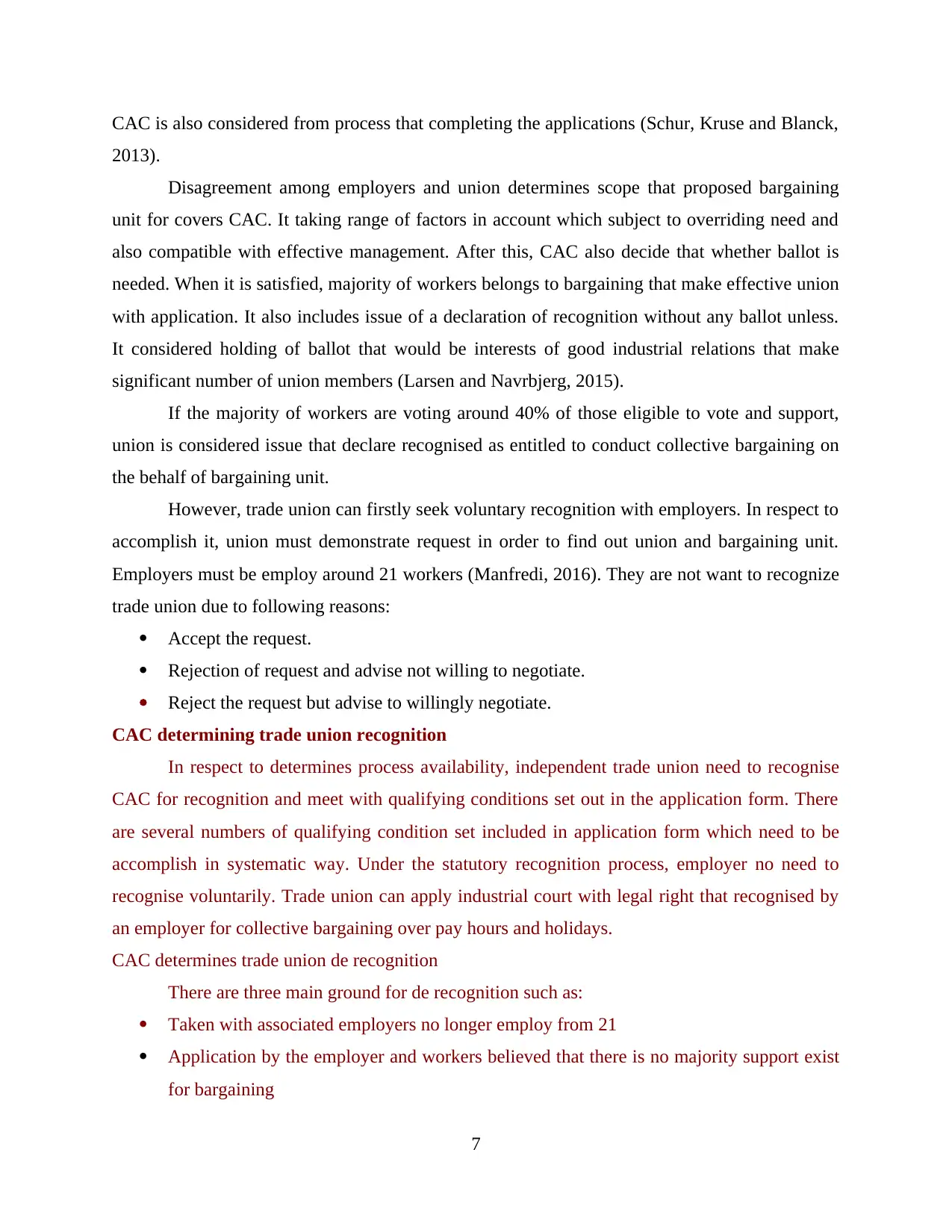
CAC determining trade union recognition
In respect to determines process availability, independent trade union need to recognise
CAC for recognition and meet with qualifying conditions set out in the application form. There
are several numbers of qualifying condition set included in application form which need to be
accomplish in systematic way. Under the statutory recognition process, employer no need to
recognise voluntarily. Trade union can apply industrial court with legal right that recognised by
an employer for collective bargaining over pay hours and holidays.
CAC determines trade union de recognition
There are three main ground for de recognition such as:
Taken with associated employers no longer employ from 21
Application by the employer and workers believed that there is no majority support exist
for bargaining
7
2013).
Disagreement among employers and union determines scope that proposed bargaining
unit for covers CAC. It taking range of factors in account which subject to overriding need and
also compatible with effective management. After this, CAC also decide that whether ballot is
needed. When it is satisfied, majority of workers belongs to bargaining that make effective union
with application. It also includes issue of a declaration of recognition without any ballot unless.
It considered holding of ballot that would be interests of good industrial relations that make
significant number of union members (Larsen and Navrbjerg, 2015).
If the majority of workers are voting around 40% of those eligible to vote and support,
union is considered issue that declare recognised as entitled to conduct collective bargaining on
the behalf of bargaining unit.
However, trade union can firstly seek voluntary recognition with employers. In respect to
accomplish it, union must demonstrate request in order to find out union and bargaining unit.
Employers must be employ around 21 workers (Manfredi, 2016). They are not want to recognize
trade union due to following reasons:
Accept the request.
Rejection of request and advise not willing to negotiate.
Reject the request but advise to willingly negotiate.
CAC determining trade union recognition
In respect to determines process availability, independent trade union need to recognise
CAC for recognition and meet with qualifying conditions set out in the application form. There
are several numbers of qualifying condition set included in application form which need to be
accomplish in systematic way. Under the statutory recognition process, employer no need to
recognise voluntarily. Trade union can apply industrial court with legal right that recognised by
an employer for collective bargaining over pay hours and holidays.
CAC determines trade union de recognition
There are three main ground for de recognition such as:
Taken with associated employers no longer employ from 21
Application by the employer and workers believed that there is no majority support exist
for bargaining
7
⊘ This is a preview!⊘
Do you want full access?
Subscribe today to unlock all pages.
Trusted by 1+ million students worldwide
Conclusion
From the above report, it can be articulated that employment relation legislation play a
vital role in success of businesses. In this context, report summarized about differences in formal
and psychological employment contracts because they both are playing vital role in success of
every business. Furthermore, it is concluded about impact of contracts on organisational
performances. Therefore, it has been stated that it is very important to develop effective results
and performances to enhance productivity, maintain loyalty, opportunities to enhance business
and many more.
8
From the above report, it can be articulated that employment relation legislation play a
vital role in success of businesses. In this context, report summarized about differences in formal
and psychological employment contracts because they both are playing vital role in success of
every business. Furthermore, it is concluded about impact of contracts on organisational
performances. Therefore, it has been stated that it is very important to develop effective results
and performances to enhance productivity, maintain loyalty, opportunities to enhance business
and many more.
8
Paraphrase This Document
Need a fresh take? Get an instant paraphrase of this document with our AI Paraphraser
References
Books and Journals
Benach, J., Vives, A. and Muntaner, C., 2014. Precarious employment: understanding an
emerging social determinant of health. Annual review of public health. 35. pp.229-253.
Benassi, C. and Dorigatti, L., 2015. Straight to the core—Explaining union responses to the
casualization of work: The IG Metall campaign for agency workers. British Journal of
Industrial Relations. 53(3). pp.533-555.
De Cuyper, N. and Isaksson, K., 2017. Employment contracts and well-being among European
workers. Routledge.
Giuliano, R., Kampelmann, S. and Rycx, F., 2017. Short notice, big difference? The effect of
temporary employment on firm competitiveness across sectors. British Journal of
Industrial Relations. 55(2). pp.421-449.
Kirton, G. and Greene, A. M., 2015. The dynamics of managing diversity: A critical approach.
Routledge.
Klyver, K., Nielsen, S. L. and Evald, M. R., 2013. Women's self-employment: An act of
institutional (dis) integration? A multilevel, cross-country study. Journal of Business
Venturing. 28(4). pp.474-488.
Larsen, T. P. and Navrbjerg, S. E., 2015. The economic crisis: Testing employee relations.
Economic and Industrial Democracy. 36(2). pp.331-353.
Manfredi, S., 2016. 6W Equality and Diversity at Work under the Coalition. Employment
Relations Under Coalition Government: The UK Experience. 2010-2015. p.108.
Marchington, M., Wilkinson, A. and Kynighou, A., 2016. Human resource management at work.
Kogan Page Publishers.
Pfau-Effinger, B., 2017. Development of culture, welfare states and women's employment in
Europe. Routledge.
Schur, L., Kruse, D. and Blanck, P., 2013. People with disabilities: Sidelined or mainstreamed?.
Cambridge University Press.
9
Books and Journals
Benach, J., Vives, A. and Muntaner, C., 2014. Precarious employment: understanding an
emerging social determinant of health. Annual review of public health. 35. pp.229-253.
Benassi, C. and Dorigatti, L., 2015. Straight to the core—Explaining union responses to the
casualization of work: The IG Metall campaign for agency workers. British Journal of
Industrial Relations. 53(3). pp.533-555.
De Cuyper, N. and Isaksson, K., 2017. Employment contracts and well-being among European
workers. Routledge.
Giuliano, R., Kampelmann, S. and Rycx, F., 2017. Short notice, big difference? The effect of
temporary employment on firm competitiveness across sectors. British Journal of
Industrial Relations. 55(2). pp.421-449.
Kirton, G. and Greene, A. M., 2015. The dynamics of managing diversity: A critical approach.
Routledge.
Klyver, K., Nielsen, S. L. and Evald, M. R., 2013. Women's self-employment: An act of
institutional (dis) integration? A multilevel, cross-country study. Journal of Business
Venturing. 28(4). pp.474-488.
Larsen, T. P. and Navrbjerg, S. E., 2015. The economic crisis: Testing employee relations.
Economic and Industrial Democracy. 36(2). pp.331-353.
Manfredi, S., 2016. 6W Equality and Diversity at Work under the Coalition. Employment
Relations Under Coalition Government: The UK Experience. 2010-2015. p.108.
Marchington, M., Wilkinson, A. and Kynighou, A., 2016. Human resource management at work.
Kogan Page Publishers.
Pfau-Effinger, B., 2017. Development of culture, welfare states and women's employment in
Europe. Routledge.
Schur, L., Kruse, D. and Blanck, P., 2013. People with disabilities: Sidelined or mainstreamed?.
Cambridge University Press.
9

Silvia, S. J., 2013. Holding the shop together: German industrial relations in the postwar era.
Cornell University Press.
Wajcman, J., 2013. Managing like a man: Women and men in corporate management. John
Wiley & Sons.
10
Cornell University Press.
Wajcman, J., 2013. Managing like a man: Women and men in corporate management. John
Wiley & Sons.
10
⊘ This is a preview!⊘
Do you want full access?
Subscribe today to unlock all pages.
Trusted by 1+ million students worldwide

1 out of 18


Related Documents


Your All-in-One AI-Powered Toolkit for Academic Success.
+13062052269
info@desklib.com
Available 24*7 on WhatsApp / Email
![[object Object]](/_next/static/media/star-bottom.7253800d.svg)
Unlock your academic potential
Copyright © 2020–2026 A2Z Services. All Rights Reserved. Developed and managed by ZUCOL.