Empowering Patients in Healthcare: Patient-Centric Services Report

Verified

Added on  2022/10/02

|9
|1913
|13
Report
AI Summary
This report delves into the multifaceted realm of patient-centric healthcare, exploring critical aspects such as relevant coding systems, the integration of technology, and the pivotal role of Health Information Management Systems (HIMS) in enhancing patient satisfaction. The analysis begins with an examination of the ICD-10 codes pertinent to superbug management, contrasting them with the older ICD-9 system to highlight the advantages of the new system. The report then explores the application of technology in patient-centric practices, showcasing examples like digital inhalers and decision support software. Furthermore, it investigates how HIMS contributes to patient satisfaction by ensuring data integration, security, and the implementation of Systems Development Life Cycle (SDLC) methods. Finally, the report outlines the practical application of patient-centric principles, emphasizing transparency, education, and co-creation between patients, families, and healthcare providers. The report concludes by highlighting how organizations can leverage technology and patient engagement strategies to improve healthcare outcomes.
Document Page
0Running Head: Empowering patients in healthcare: Patient-centric healthcare services
Empowering patients in healthcare:
Patient-centric healthcare services
tabler-icon-diamond-filled.svg

Paraphrase This Document

Need a fresh take? Get an instant paraphrase of this document with our AI Paraphraser
Document Page
1Running Head: Empowering patients in healthcare: Patient-centric healthcare services
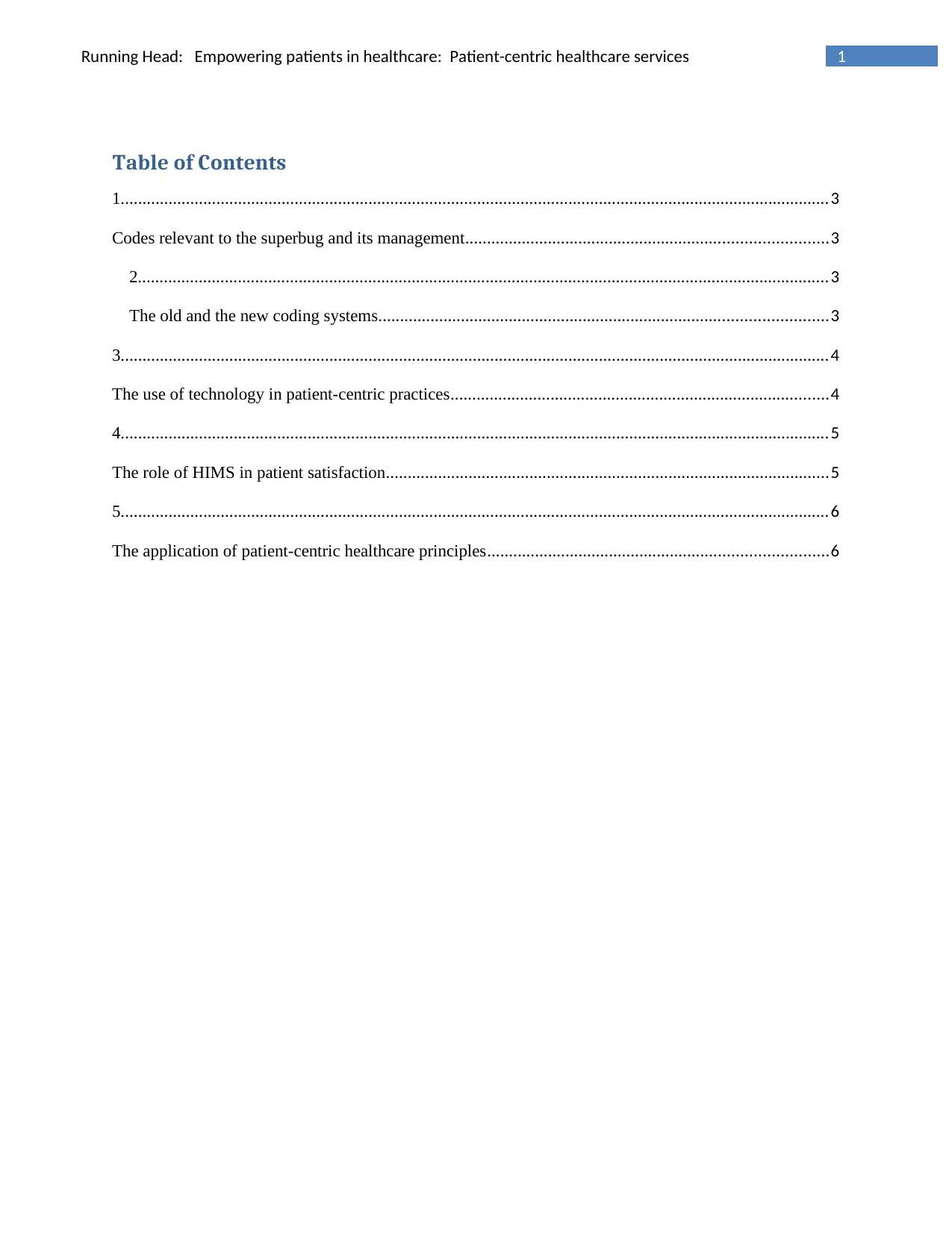
Table of Contents
1...................................................................................................................................................................3
Codes relevant to the superbug and its management...................................................................................3
2...............................................................................................................................................................3
The old and the new coding systems.......................................................................................................3
3...................................................................................................................................................................4
The use of technology in patient-centric practices.......................................................................................4
4...................................................................................................................................................................5
The role of HIMS in patient satisfaction......................................................................................................5
5...................................................................................................................................................................6
The application of patient-centric healthcare principles..............................................................................6
Document Page
2Running Head: Empowering patients in healthcare: Patient-centric healthcare services
1. Codes relevant to the superbug and its management
The research conducted on the superbug has revealed that it exhibits symptoms similar to
infections caused by the MRSA (Methicillin resistant staphylococcus aureus).
Patients who tested negative for the superbug upon admission often acquired the infection during
their stay in the hospital. In this context, the code Z22 of the ICD 10 manual, which deals with
carriers of infections, becomes relevant. Under the specific code Z22.322, the state of MRSA
colonization during admission is noted. It has to be mentioned whether the patient is a suspected
carrier of the superbug. This step is significant from the reimbursement perspective as well.
The superbug infection manifests itself in the form of urinary tract infections and wound or
suture abscesses. Hence, such medical conditions should be recorded along with the code B95
which mentions the causal microbe. The specific code for the MRSA bacterium is B95.62 ("2019
ICD-10-CM Diagnosis Code B95.62: Methicillin resistant Staphylococcus aureus infection as
the cause of diseases classified elsewhere", 2019).
The patients who were infected with the superbug often developed sepsis and pneumonia. When
these conditions are caused by the MRSA superbug, combination codes such as A41.02 and
J15.212 can be used to indicate MRSA-related sepsis and pneumonia respectively.
The superbug infections have exhibited high resistance to antibiotic drugs. Hence, it might be
necessary to include information about the resistance to antibiotics under the Z16 code ("How to
Code MRSA, Methicillin-Resistant Staphylococcus Aureus | PPS Plus", 2019).
The records of past superbug infections aid the diagnosis process and are essential for
reimbursement issues. The personal MRSA infection history can be recorded under the code
Z86.14.
Document Page
3Running Head: Empowering patients in healthcare: Patient-centric healthcare services
2. The old and the new coding systems
The announcement for the transition from the ICD-9 coding system to the ICD-10 coding system
made by the federal government was motivated by the numerous advantages of the new coding
system.
a. The greatest problem posed by the ICD-9 classification was the lack of condition-specific
information. There was no scope to mention the laterality of a medical condition. An
injury in the left leg could not be distinguished from an injury in the right leg. The new
ICD-10 system includes detailed information about a medical condition, its causes as
well as its laterality. Initial visits can now be distinguished from subsequent encounters.
Hence, the new coding system can solve reimbursement issues more effectively than the
previous one ("Transitioning to ICD-10 (Updated) | Health Affairs", 2014).
b. In the old ICD-9 system, codes were 3-5 characters long. The chapters were completely
filled with no space for new codes. Codes were added to completely new chapters which
led to widespread confusion. The new ICD-10 system was designed to include codes up
to seven characters in length. Hence, there was ample room for the introduction of new
codes. The new system has 68,000 codes while the old ICD-9 system had only 13,000
codes.
c. The ICD-10 coding system has been designed to include the latest advancements in
medical research and technology while the previous system had no room for the
evolution of medical sciences ("Transitioning to ICD-10 (Updated) | Health Affairs",
2014).
3. The use of technology in patient-centric practices
Patient-centric healthcare empowers patients to play an active role in the healthcare
services provided to them. Through the use of technology, the patients monitor their symptoms
tabler-icon-diamond-filled.svg

Paraphrase This Document

Need a fresh take? Get an instant paraphrase of this document with our AI Paraphraser
Document Page
4Running Head: Empowering patients in healthcare: Patient-centric healthcare services
and seek assistance selectively. With the advent of the digital age, there has been a steady rise in
the number of patient-centric healthcare practices.
Teva Pharmaceuticals is known for its patient-centric approach. It recently introduced a
product called the ProAirDigihaler which is a special inhaler provided with digital
sensors and a user-friendly app which records the vital details of the patient. The patients
are empowered to monitor their health and call for assistance according to their discretion
(Tai-Seale et al., 2019).
The Empowered Patient Coalition has introduced a decision support software
application in which patients are asked a number of questions. The questions address
those areas where the patient might require support for making decisions. The app
generates a detailed report of the patient’s confidence level in various aspects of the
decision making process.
John Hopkins Medicine in Baltimore and Rush University Medical Centre have
introduced Apple’s health record application that provides patients with access to all
the data about their health that is available with the healthcare providers ("View health
records on your iPhone or iPod touch (beta)", 2018).
The adoption of the latest technological advancements is essential for a healthcare service
provider to engage effectively with the patients and collaborate successfully in the decision
making process.
Patients can be spared the trouble of having to regularly visit the hospital for routine
check-ups by the employment of wearable devices. These devices can measure the levels
of hemoglobin, blood glucose and other vital parameters. The information is then
integrated with the data collected during hospital visits to obtain a complete picture of the
patient’s condition.
A decision support application can empower patients to make their own decisions while
ensuring that the healthcare provider is able to reach out to them for support when they
lack the ability to make a particular decision. These apps could be used to generate a
detailed analysis of a patient’s confidence in his/her decision making ability. Those areas
Document Page
5Running Head: Empowering patients in healthcare: Patient-centric healthcare services
where a patient feels less confident can be marked in red so that the service providers can
provide direct assistance.
An innovative application of technology to patient-centric healthcare is the method of
gamification (Sardi, Idri & Fernández-Alemán, 2017). Applications with game-like
features could be introduced. These provide patients with badges for correctly answering
questions related to self-care or for meeting certain health goals.
4. The role of HIMS in patient satisfaction
HIMS is responsible for the acquisition, protection and analysis of electronic health records
(EHRs). There are several ways in which HIMS can function smoothly and ensure patient
satisfaction.
Patients usually visit a number of doctors and healthcare service providers and the
greatest challenge to effective healthcare is the integration of data from multiple
proprietary systems. Hence, the proprietary system that is selected by a healthcare
provider should be an integrated healthcare information system right from the beginning.
Moreover, the service provider should select certain important HIS modules such as
admission, transfer and discharge for its proprietary system to ensure effective healthcare.
A Systems Development Life Cycle (SDLC) method should be applied for the
improvement of health information management systems. This method consists of a
number of time tested iterations that convert ideas into concrete projects for improved
patient satisfaction.
HIMS also needs to secure the information gathered against external agents. For this the
HIMS can adopt security measures such as access control tokens and cryptographic
devices. These steps assure the patient of the privacy of his/her data ("HIM Careers -
Health Information 101", 2019).
Document Page
6Running Head: Empowering patients in healthcare: Patient-centric healthcare services
5. The application of patient-centric healthcare principles
The principles of patient centric healthcare can be put to effective use by the organization in the
following ways:
The principle of transparency and access can be used to improve patient satisfaction by
developing software applications which allow patients to view their electronic health
records (EHRs) as well as their payment details (Kaplan, 2018).
The organization could exploit mobile and internet facilities to remind the customers of
the ways in which they can manage their medical condition. The healthcare applications
introduced by the healthcare provider could include interactive quizzes that educate the
patients about their medical condition and its treatment or management. In this manner,
the organization adheres to the principle of education (Eric Sullivan, 2019).
The principle of co-creation suggests that the patients, their families and the health-care
providers should come together to make decisions regarding the kind of healthcare the
patient is to be provided with. The decision support applications and monitoring of the
patient through the Internet of Things (IoT) can empower the patient to manage his/her
condition while ensuring that the healthcare organization can provide direct assistance
during a crisis (Keeffe, 2019).
tabler-icon-diamond-filled.svg

Paraphrase This Document

Need a fresh take? Get an instant paraphrase of this document with our AI Paraphraser
Document Page
7Running Head: Empowering patients in healthcare: Patient-centric healthcare services
References
2019 ICD-10-CM Diagnosis Code B95.62: Methicillin resistant Staphylococcus aureus infection
as the cause of diseases classified elsewhere. (2019). Retrieved 13 August 2019, from
https://www.icd10data.com/ICD10CM/Codes/A00-B99/B95-B97/B95-/B95.62
Eric Sullivan, I. (2019). How data – driven insights are powering patient-centric healthcare: In
response to patients’ increasing demand for more information about their health, Apple
has launched Health Records, a personal health record (PHR) feature that aims to
combine a patient’s existing healthcare-related data found on their personal Apple device
with data from an electronic. Retrieved 13 August 2019, from
https://www.beckershospitalreview.com/healthcare-information-technology/how-data-
driven-insights-are-powering-patient-centric-healthcare.html
HIM Careers - Health Information 101. (2019). Retrieved 13 August 2019, from
https://www.ahima.org/careers/healthinfo
How to Code MRSA, Methicillin-Resistant Staphylococcus Aureus | PPS Plus. (2019). Retrieved
13 August 2019, from http://ppsplus.com/blog/how-to-code-mrsa
Kaplan, G. (2018). Building a Culture of Transparency in Health Care. Retrieved 13 August
2019, from https://hbr.org/2018/11/building-a-culture-of-transparency-in-health-care
Keeffe, M. (2019). What are the three principles of co-creation?. Retrieved 13 August 2019,
from https://www.trainingzone.co.uk/lead/culture/what-are-the-three-principles-of-co-
creation
Sardi, L., Idri, A., & Fernández-Alemán, J. (2017). A systematic review of gamification in e-
Health. Journal Of Biomedical Informatics, 71, 31-48. doi: 10.1016/j.jbi.2017.05.011
Tai-Seale, M., Downing, N., Jones, V., Milani, R., Zhao, B., & Clay, B. et al. (2019).
Technology-Enabled Consumer Engagement: Promising Practices At Four Health Care
Delivery Organizations. Health Affairs, 38(3), 383-390. doi: 10.1377/hlthaff.2018.05027
Transitioning to ICD-10 (Updated) | Health Affairs. (2014). Retrieved 13 August 2019, from
https://www.healthaffairs.org/do/10.1377/hpb20140403.830190/full/
Document Page
8Running Head: Empowering patients in healthcare: Patient-centric healthcare services
View health records on your iPhone or iPod touch (beta). (2018). Retrieved 13 August 2019,
from https://support.apple.com/en-us/HT208680
chevron_up_icon
1 out of 9
circle_padding
hide_on_mobile
zoom_out_icon
[object Object]