EMRM5103 - Risk Management for Yemen Cholera Emergency Response
VerifiedAdded on 2023/06/13
|21
|3880
|486
Report
AI Summary
This report details a risk management plan developed for an emergency response project addressing the cholera outbreak in Yemen between May and October 2017. The project focused on providing immediate medical assistance by setting up health camps and deploying medical staff to affected regions. Key risks identified include health risks to medical personnel, supply chain challenges for food and medicine, budget constraints due to medicine import costs, inaccessibility of remote areas, improper disposal of bodies, and potential hostility from local populations. The risk evaluation employs a what-if analysis, and mitigation strategies are outlined using a risk register matrix, addressing contagion, contamination, budget limitations, accessibility issues, dead body disposal, and hostile behavior. Contingency plans involve backup medical staff, strict delivery protocols, requests for additional funding, drone-based supply delivery, community awareness programs, and provision of essential resources to affected populations. The report concludes with monitoring and control plans to ensure project success. Desklib provides access to this and other solved assignments for students.
Running Head: RISK MANAGEMENT
Risk Management
Name of the Student
Name of the University
Risk Management
Name of the Student
Name of the University

Paraphrase This Document
Need a fresh take? Get an instant paraphrase of this document with our AI Paraphraser
1RISK MANAGEMENT
Table of Contents
1.0 Introduction................................................................................................................................2
2.0 Risk Management......................................................................................................................2
2.1 Background of the Chosen Project........................................................................................2
2.2 Identification of Associated Risks.........................................................................................4
2.3 Risk Evaluation and Risk Ranking........................................................................................6
2.4 Mitigation Strategies and Contingency Plans........................................................................7
2.5 Risk Monitoring and Control Plans.......................................................................................9
3.0 Conclusion...............................................................................................................................18
Bibliography..................................................................................................................................20
Table of Contents
1.0 Introduction................................................................................................................................2
2.0 Risk Management......................................................................................................................2
2.1 Background of the Chosen Project........................................................................................2
2.2 Identification of Associated Risks.........................................................................................4
2.3 Risk Evaluation and Risk Ranking........................................................................................6
2.4 Mitigation Strategies and Contingency Plans........................................................................7
2.5 Risk Monitoring and Control Plans.......................................................................................9
3.0 Conclusion...............................................................................................................................18
Bibliography..................................................................................................................................20
2RISK MANAGEMENT
1.0 Introduction
In recent times, Yemen has faced one of the most severe cholera epidemics in the world.
After coming into control in some time, the outbreak again resurged claiming the lives of a huge
number of people and affect the health of few million people of the country. As a result, a project
was authorized to provide emergency medical response to the cholera affected areas. The project
based on setting up health camps, sending medical staff delegates in the regions to treat the
patients and others. In addition to the appointment of medical stuffs, the project required a
constant supply of medicines and medical equipments so that the medical staffs and nurses could
be able to treat the patients and provide them with sufficient dosage of vaccination and
medicines. Due to the large scale of the outbreak, the medicine supplies in the country was
completely exhausted and hence, the medicines and vaccines were needed to be imported from
other countries that resulted in the increase of the project costs and overall time.
In this report, a risk management plan has been developed based on the risks associated
with the emergency response project.
2.0 Risk Management
2.1 Background of the Chosen Project
The chosen project is based on emergency response for Cholera outbreak in Yemen that
took place within the period of May to October 2017. In the last quarter of 2016, a massive
cholera outbreak took place in Yemen that reached an alarming level during April-May. As per
an overall WHO estimated, nearly 900,000 people were affected with cholera with further rise in
the value was projected for the next few weeks. The huge outbreak also claimed a large number
1.0 Introduction
In recent times, Yemen has faced one of the most severe cholera epidemics in the world.
After coming into control in some time, the outbreak again resurged claiming the lives of a huge
number of people and affect the health of few million people of the country. As a result, a project
was authorized to provide emergency medical response to the cholera affected areas. The project
based on setting up health camps, sending medical staff delegates in the regions to treat the
patients and others. In addition to the appointment of medical stuffs, the project required a
constant supply of medicines and medical equipments so that the medical staffs and nurses could
be able to treat the patients and provide them with sufficient dosage of vaccination and
medicines. Due to the large scale of the outbreak, the medicine supplies in the country was
completely exhausted and hence, the medicines and vaccines were needed to be imported from
other countries that resulted in the increase of the project costs and overall time.
In this report, a risk management plan has been developed based on the risks associated
with the emergency response project.
2.0 Risk Management
2.1 Background of the Chosen Project
The chosen project is based on emergency response for Cholera outbreak in Yemen that
took place within the period of May to October 2017. In the last quarter of 2016, a massive
cholera outbreak took place in Yemen that reached an alarming level during April-May. As per
an overall WHO estimated, nearly 900,000 people were affected with cholera with further rise in
the value was projected for the next few weeks. The huge outbreak also claimed a large number
⊘ This is a preview!⊘
Do you want full access?
Subscribe today to unlock all pages.

Trusted by 1+ million students worldwide
3RISK MANAGEMENT
of lives with almost 1% of the affected people reached fatality due to lack of timely and proper
treatment of cholera. The outbreak was not limited to a single area – it spread over more than
150 districts of the country that were included in 16 Governorates of the country. While the
cholera slowly came under control during March-April 2017, a resurgence of the cholera
occurred in late April 2017 that claimed even more lives than the previous outbreak. The fatality
rate also increased significantly to 1.6% of all the affected people and the cholera spread over an
even bigger area – 180 districts in 18 Governorates.
In order to bring the cholera under control and treat the infected people, an emergency
response project was initiated by appointing a large number of human resources including
helpers, physicians, nurses, logistics assistants and others. The main objective of the project was
to move from place to place and provide immediate medications to the affected people in the
area. In addition to the healthcare support staffs, the medications and medical equipments were
also needed to be carried from place to place in the areas of the outbreak. However, when the
healthcare staffs were carried from place to place, it was needed to be ensured that the staffs are
healthy and do not catch cholera during the treatment processes. Hence, sufficient amount of
medical protection was to be provided to the patients as well as the healthcare staffs sent there
for treatment of cholera. The project also required regular supply of medicines and medical
equipments so that the physicians could be able to treat the patients and provide them with
sufficient dosage of vaccination and medicines. Due to the large scale of the outbreak, the
medicine supplies in the country was completely exhausted and hence, the medicines and
vaccines were to be imported from other countries that resulted in the increase of the project
costs and overall time. The project also required setting up field hospitals and health camps
where the cholera struck most severely. The staffs in these camps did not need to move from
of lives with almost 1% of the affected people reached fatality due to lack of timely and proper
treatment of cholera. The outbreak was not limited to a single area – it spread over more than
150 districts of the country that were included in 16 Governorates of the country. While the
cholera slowly came under control during March-April 2017, a resurgence of the cholera
occurred in late April 2017 that claimed even more lives than the previous outbreak. The fatality
rate also increased significantly to 1.6% of all the affected people and the cholera spread over an
even bigger area – 180 districts in 18 Governorates.
In order to bring the cholera under control and treat the infected people, an emergency
response project was initiated by appointing a large number of human resources including
helpers, physicians, nurses, logistics assistants and others. The main objective of the project was
to move from place to place and provide immediate medications to the affected people in the
area. In addition to the healthcare support staffs, the medications and medical equipments were
also needed to be carried from place to place in the areas of the outbreak. However, when the
healthcare staffs were carried from place to place, it was needed to be ensured that the staffs are
healthy and do not catch cholera during the treatment processes. Hence, sufficient amount of
medical protection was to be provided to the patients as well as the healthcare staffs sent there
for treatment of cholera. The project also required regular supply of medicines and medical
equipments so that the physicians could be able to treat the patients and provide them with
sufficient dosage of vaccination and medicines. Due to the large scale of the outbreak, the
medicine supplies in the country was completely exhausted and hence, the medicines and
vaccines were to be imported from other countries that resulted in the increase of the project
costs and overall time. The project also required setting up field hospitals and health camps
where the cholera struck most severely. The staffs in these camps did not need to move from
Paraphrase This Document
Need a fresh take? Get an instant paraphrase of this document with our AI Paraphraser
4RISK MANAGEMENT
place to place for providing services. Medicines, food and water had to be supplied from outside
as the existing water sources were contaminated with cholera bacteria. The emergency response
drive was continued till October 2017 when the outbreak slowly came within control and there
were ample supply of cholera vaccine in the country.
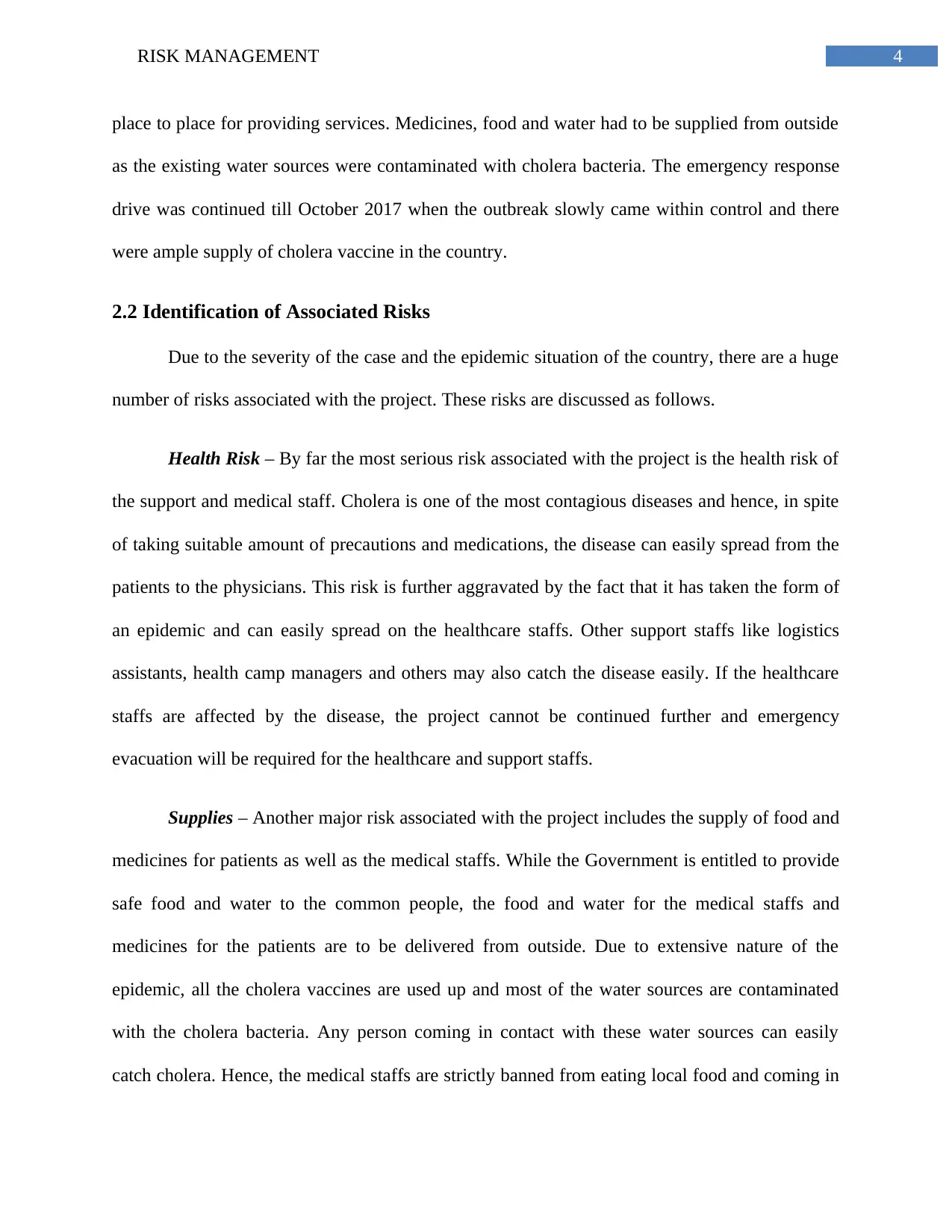
2.2 Identification of Associated Risks
Due to the severity of the case and the epidemic situation of the country, there are a huge
number of risks associated with the project. These risks are discussed as follows.
Health Risk – By far the most serious risk associated with the project is the health risk of
the support and medical staff. Cholera is one of the most contagious diseases and hence, in spite
of taking suitable amount of precautions and medications, the disease can easily spread from the
patients to the physicians. This risk is further aggravated by the fact that it has taken the form of
an epidemic and can easily spread on the healthcare staffs. Other support staffs like logistics
assistants, health camp managers and others may also catch the disease easily. If the healthcare
staffs are affected by the disease, the project cannot be continued further and emergency
evacuation will be required for the healthcare and support staffs.
Supplies – Another major risk associated with the project includes the supply of food and
medicines for patients as well as the medical staffs. While the Government is entitled to provide
safe food and water to the common people, the food and water for the medical staffs and
medicines for the patients are to be delivered from outside. Due to extensive nature of the
epidemic, all the cholera vaccines are used up and most of the water sources are contaminated
with the cholera bacteria. Any person coming in contact with these water sources can easily
catch cholera. Hence, the medical staffs are strictly banned from eating local food and coming in
place to place for providing services. Medicines, food and water had to be supplied from outside
as the existing water sources were contaminated with cholera bacteria. The emergency response
drive was continued till October 2017 when the outbreak slowly came within control and there
were ample supply of cholera vaccine in the country.
2.2 Identification of Associated Risks
Due to the severity of the case and the epidemic situation of the country, there are a huge
number of risks associated with the project. These risks are discussed as follows.
Health Risk – By far the most serious risk associated with the project is the health risk of
the support and medical staff. Cholera is one of the most contagious diseases and hence, in spite
of taking suitable amount of precautions and medications, the disease can easily spread from the
patients to the physicians. This risk is further aggravated by the fact that it has taken the form of
an epidemic and can easily spread on the healthcare staffs. Other support staffs like logistics
assistants, health camp managers and others may also catch the disease easily. If the healthcare
staffs are affected by the disease, the project cannot be continued further and emergency
evacuation will be required for the healthcare and support staffs.
Supplies – Another major risk associated with the project includes the supply of food and
medicines for patients as well as the medical staffs. While the Government is entitled to provide
safe food and water to the common people, the food and water for the medical staffs and
medicines for the patients are to be delivered from outside. Due to extensive nature of the
epidemic, all the cholera vaccines are used up and most of the water sources are contaminated
with the cholera bacteria. Any person coming in contact with these water sources can easily
catch cholera. Hence, the medical staffs are strictly banned from eating local food and coming in
5RISK MANAGEMENT
contact with the local water. Their food and water are to be delivered through supply vans that
travel from place to place for delivery in the health camps. During the delivery as well, the food,
water and medicines can get contaminated and hence, extra-precautions like anti-germ delivery
vaults, disinfectants and hand sanitizers are to be used to prevent contamination during delivery.
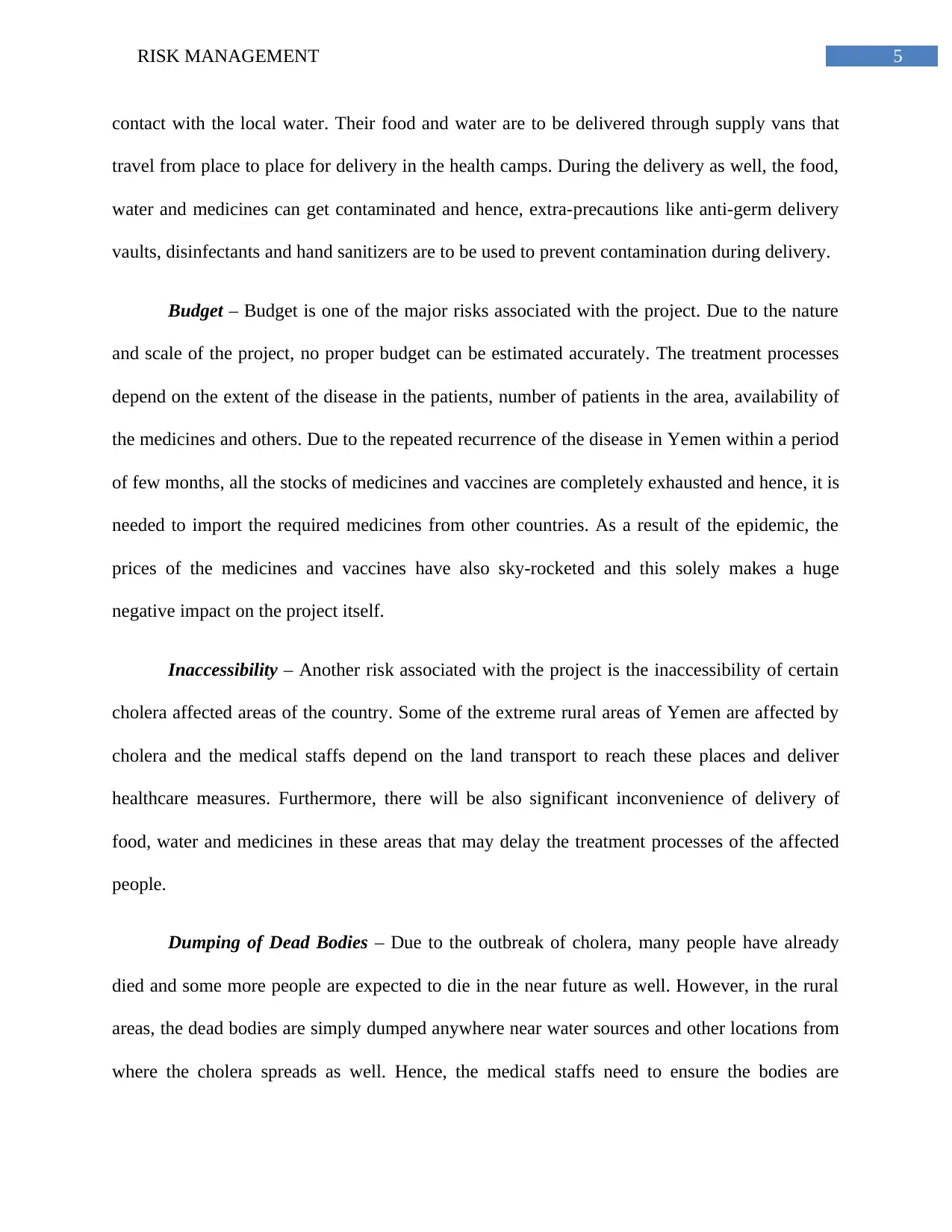
Budget – Budget is one of the major risks associated with the project. Due to the nature
and scale of the project, no proper budget can be estimated accurately. The treatment processes
depend on the extent of the disease in the patients, number of patients in the area, availability of
the medicines and others. Due to the repeated recurrence of the disease in Yemen within a period
of few months, all the stocks of medicines and vaccines are completely exhausted and hence, it is
needed to import the required medicines from other countries. As a result of the epidemic, the
prices of the medicines and vaccines have also sky-rocketed and this solely makes a huge
negative impact on the project itself.
Inaccessibility – Another risk associated with the project is the inaccessibility of certain
cholera affected areas of the country. Some of the extreme rural areas of Yemen are affected by
cholera and the medical staffs depend on the land transport to reach these places and deliver
healthcare measures. Furthermore, there will be also significant inconvenience of delivery of
food, water and medicines in these areas that may delay the treatment processes of the affected
people.
Dumping of Dead Bodies – Due to the outbreak of cholera, many people have already
died and some more people are expected to die in the near future as well. However, in the rural
areas, the dead bodies are simply dumped anywhere near water sources and other locations from
where the cholera spreads as well. Hence, the medical staffs need to ensure the bodies are
contact with the local water. Their food and water are to be delivered through supply vans that
travel from place to place for delivery in the health camps. During the delivery as well, the food,
water and medicines can get contaminated and hence, extra-precautions like anti-germ delivery
vaults, disinfectants and hand sanitizers are to be used to prevent contamination during delivery.
Budget – Budget is one of the major risks associated with the project. Due to the nature
and scale of the project, no proper budget can be estimated accurately. The treatment processes
depend on the extent of the disease in the patients, number of patients in the area, availability of
the medicines and others. Due to the repeated recurrence of the disease in Yemen within a period
of few months, all the stocks of medicines and vaccines are completely exhausted and hence, it is
needed to import the required medicines from other countries. As a result of the epidemic, the
prices of the medicines and vaccines have also sky-rocketed and this solely makes a huge
negative impact on the project itself.
Inaccessibility – Another risk associated with the project is the inaccessibility of certain
cholera affected areas of the country. Some of the extreme rural areas of Yemen are affected by
cholera and the medical staffs depend on the land transport to reach these places and deliver
healthcare measures. Furthermore, there will be also significant inconvenience of delivery of
food, water and medicines in these areas that may delay the treatment processes of the affected
people.
Dumping of Dead Bodies – Due to the outbreak of cholera, many people have already
died and some more people are expected to die in the near future as well. However, in the rural
areas, the dead bodies are simply dumped anywhere near water sources and other locations from
where the cholera spreads as well. Hence, the medical staffs need to ensure the bodies are
⊘ This is a preview!⊘
Do you want full access?
Subscribe today to unlock all pages.
Trusted by 1+ million students worldwide
6RISK MANAGEMENT
dumped at a suitable place that is far from water or food sources in order to avoid further
contamination.
Outrage from Local People – This is a possible risk that might be faced from the medical
and healthcare staffs especially in the rural areas. Due to continuous infections of cholera
without sufficient treatment and prompt healthcare services provided by the governments
resulting in deaths of the patients, the local people may turn hostile against the healthcare staffs
when they arrive at the sites for providing treatment. It is needed ensure that the local people are
calmed down and treatment is provided to the patients as fast as possible.
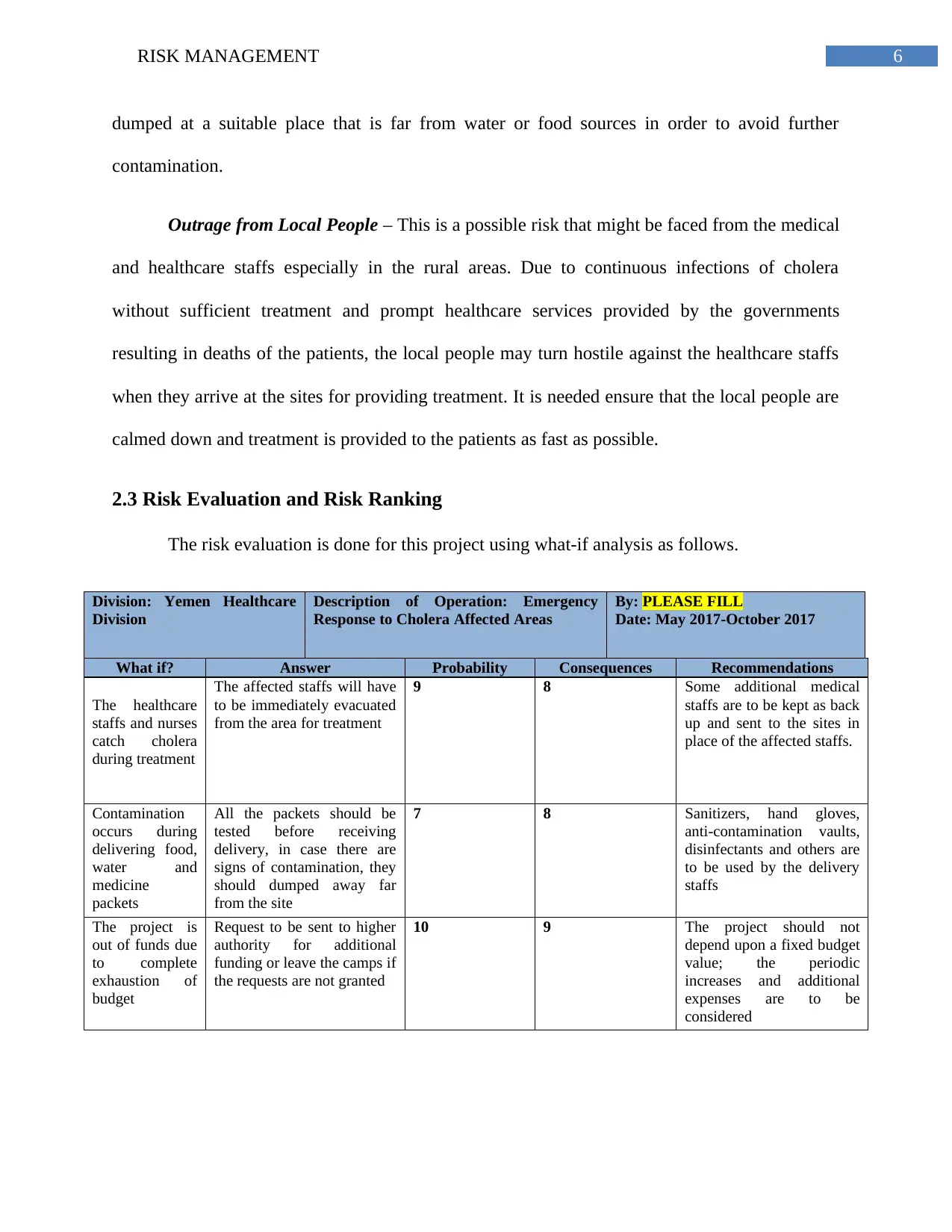
2.3 Risk Evaluation and Risk Ranking
The risk evaluation is done for this project using what-if analysis as follows.
Division: Yemen Healthcare
Division
Description of Operation: Emergency
Response to Cholera Affected Areas
By: PLEASE FILL
Date: May 2017-October 2017
What if? Answer Probability Consequences Recommendations
The healthcare
staffs and nurses
catch cholera
during treatment
The affected staffs will have
to be immediately evacuated
from the area for treatment
9 8 Some additional medical
staffs are to be kept as back
up and sent to the sites in
place of the affected staffs.
Contamination
occurs during
delivering food,
water and
medicine
packets
All the packets should be
tested before receiving
delivery, in case there are
signs of contamination, they
should dumped away far
from the site
7 8 Sanitizers, hand gloves,
anti-contamination vaults,
disinfectants and others are
to be used by the delivery
staffs
The project is
out of funds due
to complete
exhaustion of
budget
Request to be sent to higher
authority for additional
funding or leave the camps if
the requests are not granted
10 9 The project should not
depend upon a fixed budget
value; the periodic
increases and additional
expenses are to be
considered
dumped at a suitable place that is far from water or food sources in order to avoid further
contamination.
Outrage from Local People – This is a possible risk that might be faced from the medical
and healthcare staffs especially in the rural areas. Due to continuous infections of cholera
without sufficient treatment and prompt healthcare services provided by the governments
resulting in deaths of the patients, the local people may turn hostile against the healthcare staffs
when they arrive at the sites for providing treatment. It is needed ensure that the local people are
calmed down and treatment is provided to the patients as fast as possible.
2.3 Risk Evaluation and Risk Ranking
The risk evaluation is done for this project using what-if analysis as follows.
Division: Yemen Healthcare
Division
Description of Operation: Emergency
Response to Cholera Affected Areas
By: PLEASE FILL
Date: May 2017-October 2017
What if? Answer Probability Consequences Recommendations
The healthcare
staffs and nurses
catch cholera
during treatment
The affected staffs will have
to be immediately evacuated
from the area for treatment
9 8 Some additional medical
staffs are to be kept as back
up and sent to the sites in
place of the affected staffs.
Contamination
occurs during
delivering food,
water and
medicine
packets
All the packets should be
tested before receiving
delivery, in case there are
signs of contamination, they
should dumped away far
from the site
7 8 Sanitizers, hand gloves,
anti-contamination vaults,
disinfectants and others are
to be used by the delivery
staffs
The project is
out of funds due
to complete
exhaustion of
budget
Request to be sent to higher
authority for additional
funding or leave the camps if
the requests are not granted
10 9 The project should not
depend upon a fixed budget
value; the periodic
increases and additional
expenses are to be
considered
Paraphrase This Document
Need a fresh take? Get an instant paraphrase of this document with our AI Paraphraser
7RISK MANAGEMENT
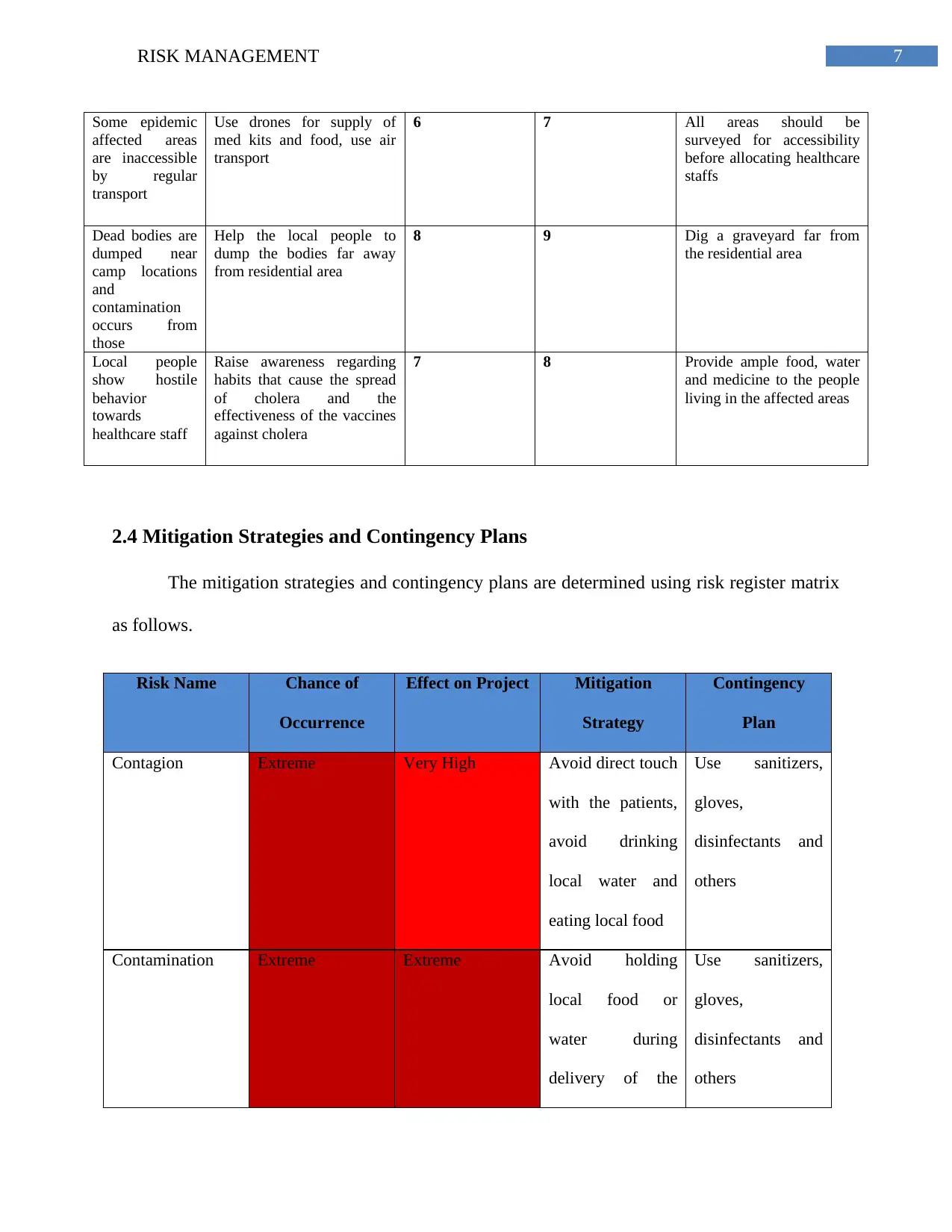
Some epidemic
affected areas
are inaccessible
by regular
transport
Use drones for supply of
med kits and food, use air
transport
6 7 All areas should be
surveyed for accessibility
before allocating healthcare
staffs
Dead bodies are
dumped near
camp locations
and
contamination
occurs from
those
Help the local people to
dump the bodies far away
from residential area
8 9 Dig a graveyard far from
the residential area
Local people
show hostile
behavior
towards
healthcare staff
Raise awareness regarding
habits that cause the spread
of cholera and the
effectiveness of the vaccines
against cholera
7 8 Provide ample food, water
and medicine to the people
living in the affected areas
2.4 Mitigation Strategies and Contingency Plans
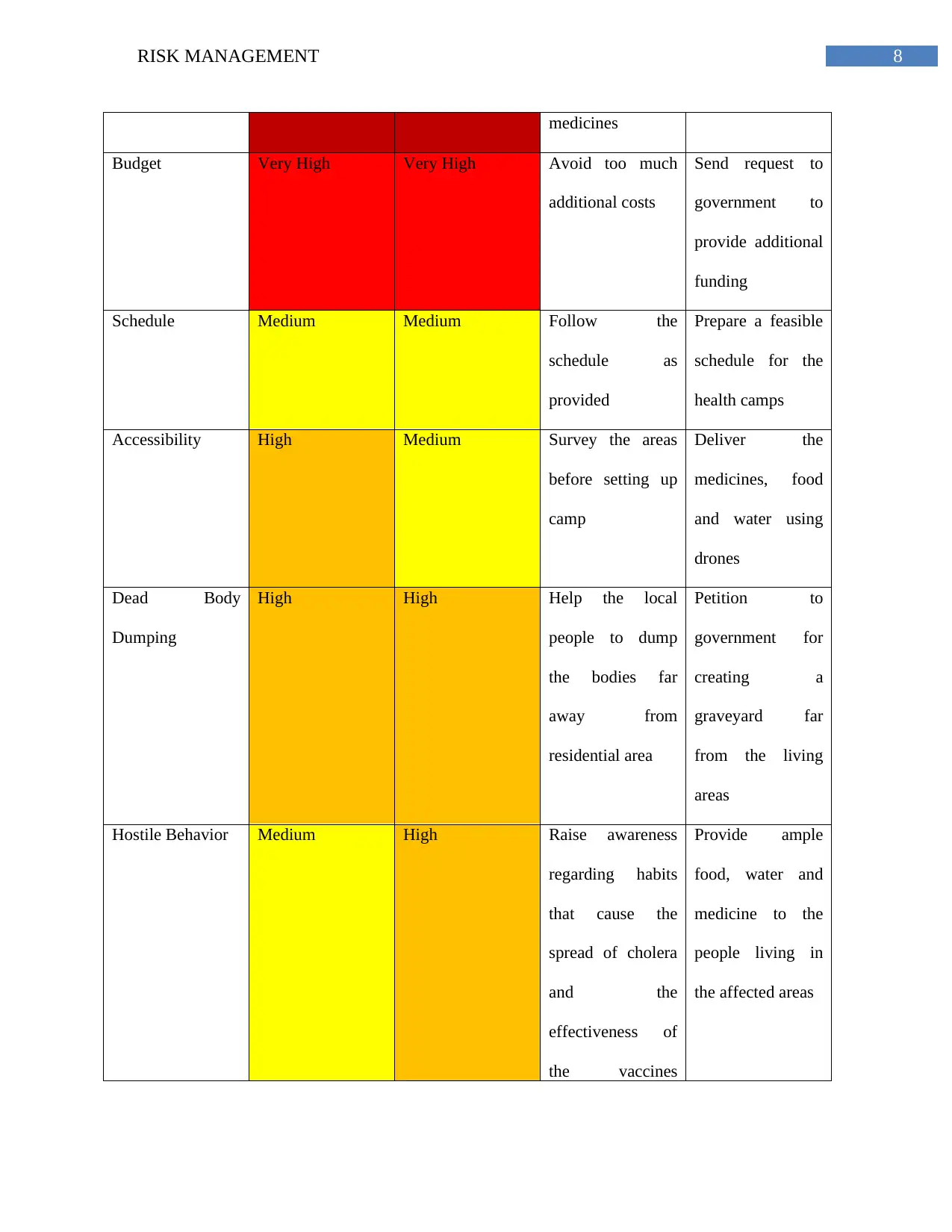
The mitigation strategies and contingency plans are determined using risk register matrix
as follows.
Risk Name Chance of
Occurrence
Effect on Project Mitigation
Strategy
Contingency
Plan
Contagion Extreme Very High Avoid direct touch
with the patients,
avoid drinking
local water and
eating local food
Use sanitizers,
gloves,
disinfectants and
others
Contamination Extreme Extreme Avoid holding
local food or
water during
delivery of the
Use sanitizers,
gloves,
disinfectants and
others
Some epidemic
affected areas
are inaccessible
by regular
transport
Use drones for supply of
med kits and food, use air
transport
6 7 All areas should be
surveyed for accessibility
before allocating healthcare
staffs
Dead bodies are
dumped near
camp locations
and
contamination
occurs from
those
Help the local people to
dump the bodies far away
from residential area
8 9 Dig a graveyard far from
the residential area
Local people
show hostile
behavior
towards
healthcare staff
Raise awareness regarding
habits that cause the spread
of cholera and the
effectiveness of the vaccines
against cholera
7 8 Provide ample food, water
and medicine to the people
living in the affected areas
2.4 Mitigation Strategies and Contingency Plans
The mitigation strategies and contingency plans are determined using risk register matrix
as follows.
Risk Name Chance of
Occurrence
Effect on Project Mitigation
Strategy
Contingency
Plan
Contagion Extreme Very High Avoid direct touch
with the patients,
avoid drinking
local water and
eating local food
Use sanitizers,
gloves,
disinfectants and
others
Contamination Extreme Extreme Avoid holding
local food or
water during
delivery of the
Use sanitizers,
gloves,
disinfectants and
others
8RISK MANAGEMENT
medicines
Budget Very High Very High Avoid too much
additional costs
Send request to
government to
provide additional
funding
Schedule Medium Medium Follow the
schedule as
provided
Prepare a feasible
schedule for the
health camps
Accessibility High Medium Survey the areas
before setting up
camp
Deliver the
medicines, food
and water using
drones
Dead Body
Dumping
High High Help the local
people to dump
the bodies far
away from
residential area
Petition to
government for
creating a
graveyard far
from the living
areas
Hostile Behavior Medium High Raise awareness
regarding habits
that cause the
spread of cholera
and the
effectiveness of
the vaccines
Provide ample
food, water and
medicine to the
people living in
the affected areas
medicines
Budget Very High Very High Avoid too much
additional costs
Send request to
government to
provide additional
funding
Schedule Medium Medium Follow the
schedule as
provided
Prepare a feasible
schedule for the
health camps
Accessibility High Medium Survey the areas
before setting up
camp
Deliver the
medicines, food
and water using
drones
Dead Body
Dumping
High High Help the local
people to dump
the bodies far
away from
residential area
Petition to
government for
creating a
graveyard far
from the living
areas
Hostile Behavior Medium High Raise awareness
regarding habits
that cause the
spread of cholera
and the
effectiveness of
the vaccines
Provide ample
food, water and
medicine to the
people living in
the affected areas
⊘ This is a preview!⊘
Do you want full access?
Subscribe today to unlock all pages.
Trusted by 1+ million students worldwide
9RISK MANAGEMENT
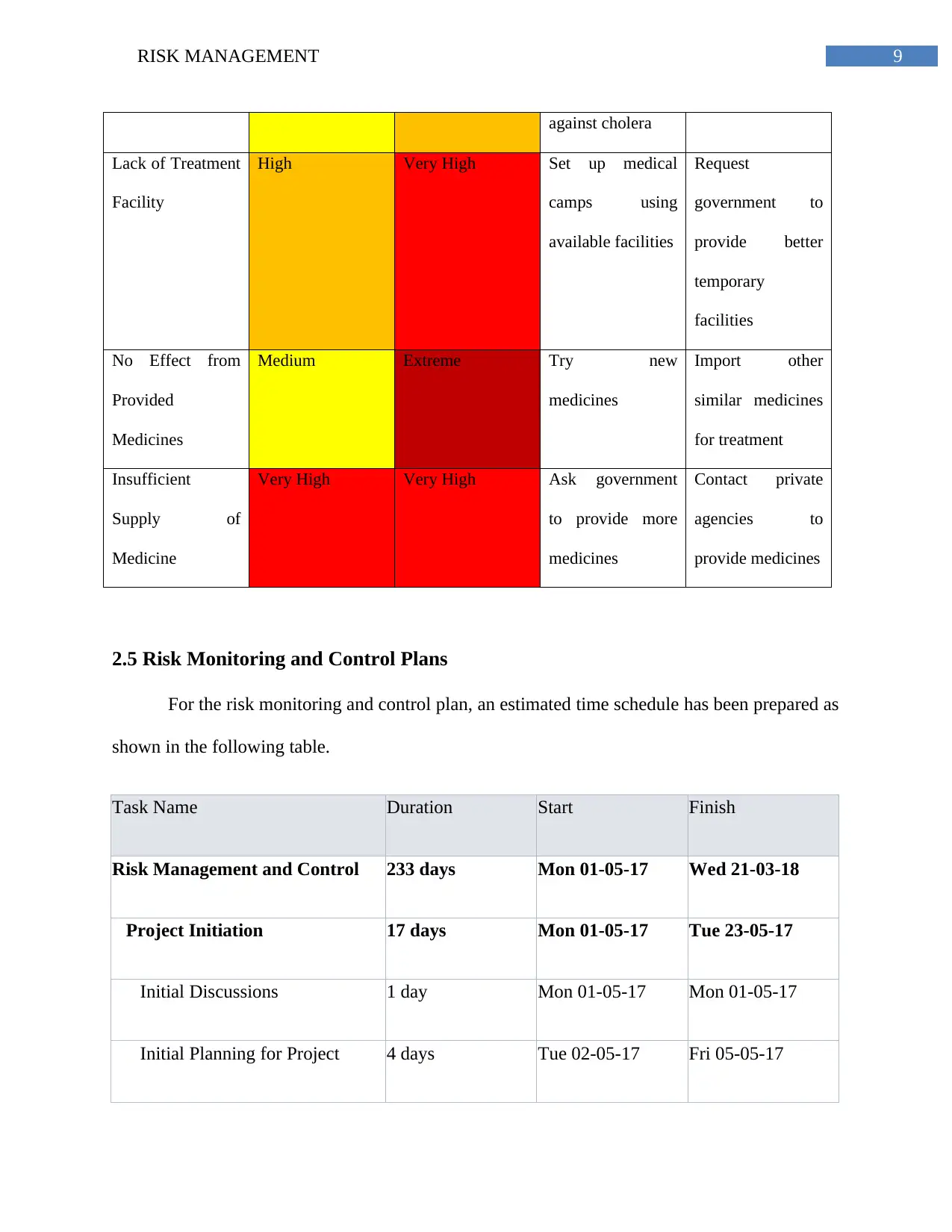
against cholera
Lack of Treatment
Facility
High Very High Set up medical
camps using
available facilities
Request
government to
provide better
temporary
facilities
No Effect from
Provided
Medicines
Medium Extreme Try new
medicines
Import other
similar medicines
for treatment
Insufficient
Supply of
Medicine
Very High Very High Ask government
to provide more
medicines
Contact private
agencies to
provide medicines
2.5 Risk Monitoring and Control Plans
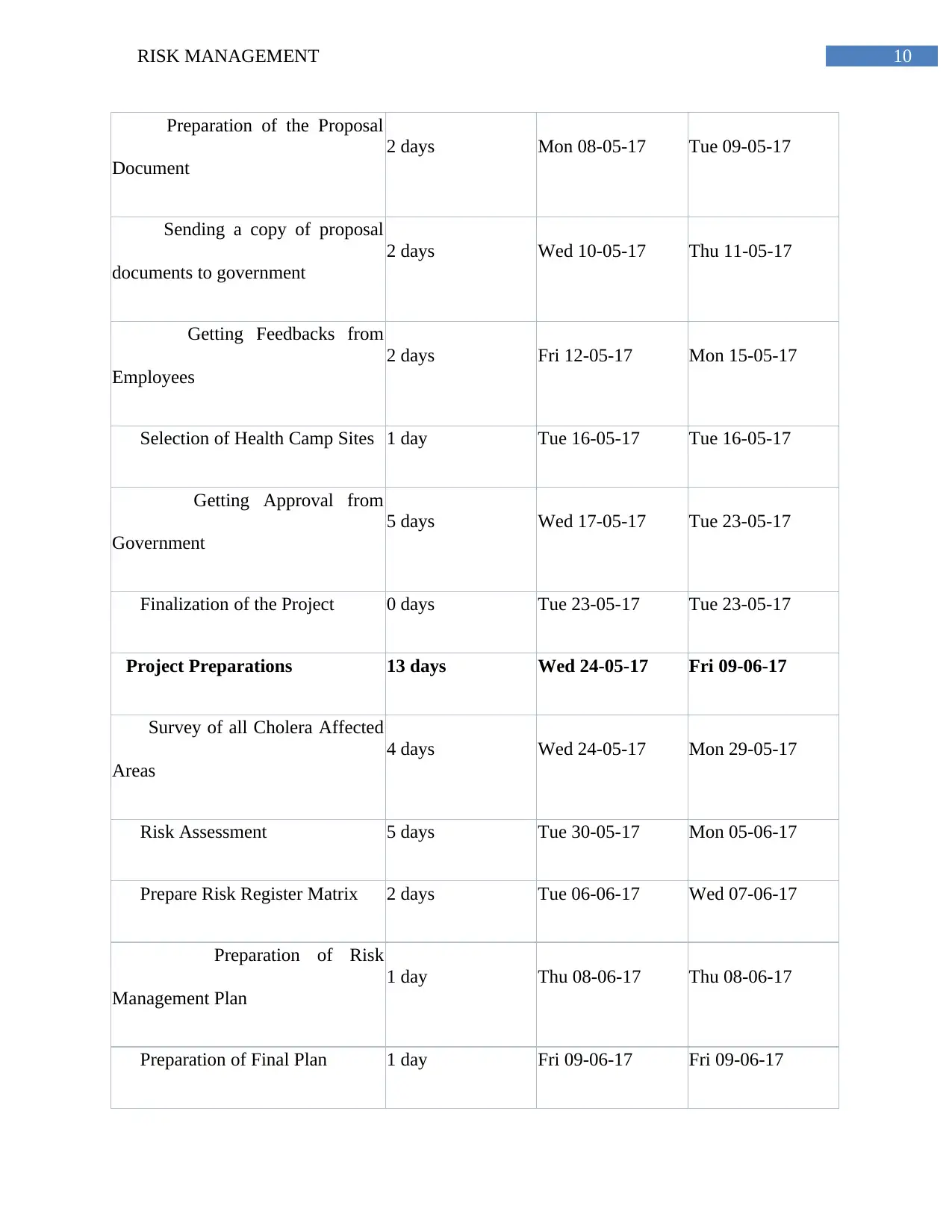
For the risk monitoring and control plan, an estimated time schedule has been prepared as
shown in the following table.
Task Name Duration Start Finish
Risk Management and Control 233 days Mon 01-05-17 Wed 21-03-18
Project Initiation 17 days Mon 01-05-17 Tue 23-05-17
Initial Discussions 1 day Mon 01-05-17 Mon 01-05-17
Initial Planning for Project 4 days Tue 02-05-17 Fri 05-05-17
against cholera
Lack of Treatment
Facility
High Very High Set up medical
camps using
available facilities
Request
government to
provide better
temporary
facilities
No Effect from
Provided
Medicines
Medium Extreme Try new
medicines
Import other
similar medicines
for treatment
Insufficient
Supply of
Medicine
Very High Very High Ask government
to provide more
medicines
Contact private
agencies to
provide medicines
2.5 Risk Monitoring and Control Plans
For the risk monitoring and control plan, an estimated time schedule has been prepared as
shown in the following table.
Task Name Duration Start Finish
Risk Management and Control 233 days Mon 01-05-17 Wed 21-03-18
Project Initiation 17 days Mon 01-05-17 Tue 23-05-17
Initial Discussions 1 day Mon 01-05-17 Mon 01-05-17
Initial Planning for Project 4 days Tue 02-05-17 Fri 05-05-17
Paraphrase This Document
Need a fresh take? Get an instant paraphrase of this document with our AI Paraphraser
10RISK MANAGEMENT
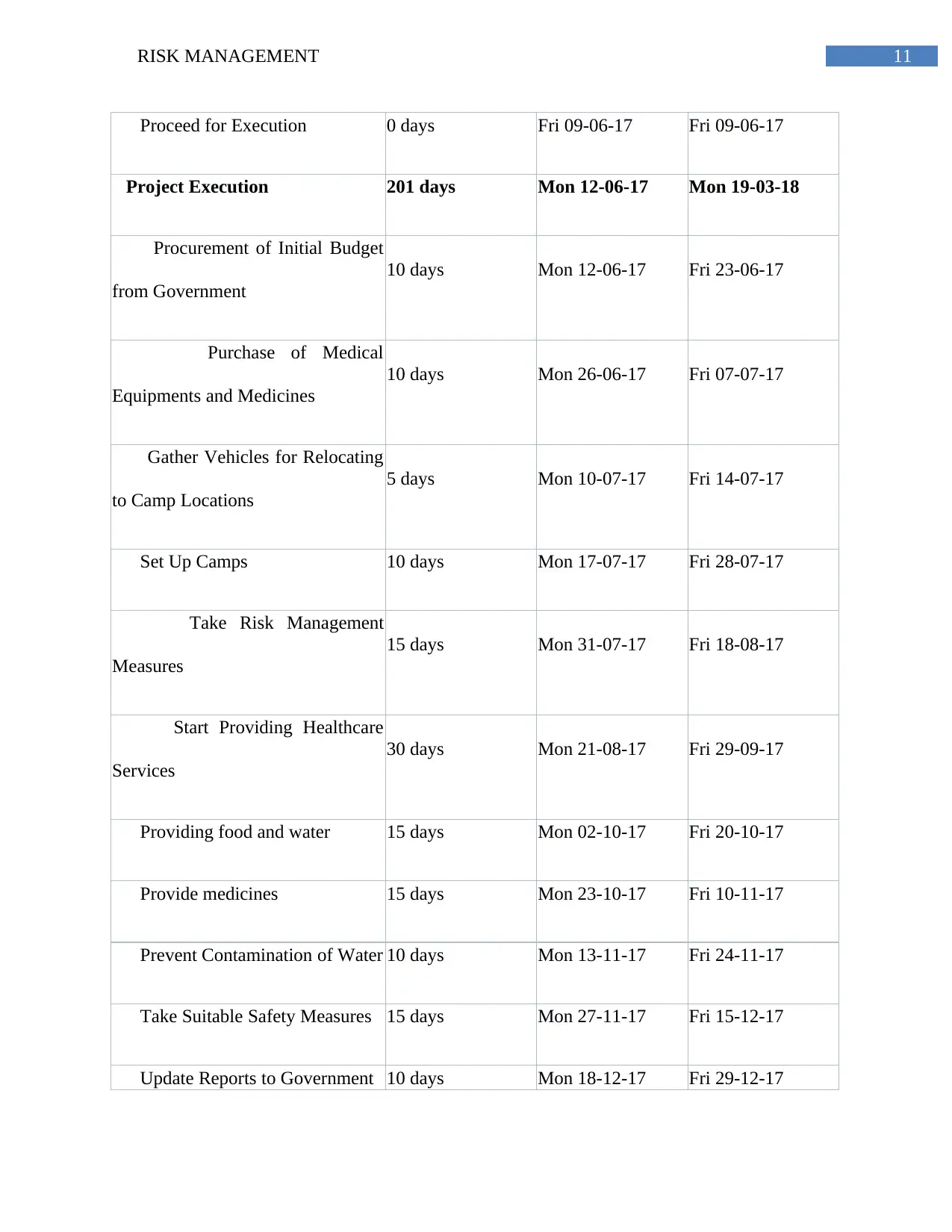
Preparation of the Proposal
Document
2 days Mon 08-05-17 Tue 09-05-17
Sending a copy of proposal
documents to government
2 days Wed 10-05-17 Thu 11-05-17
Getting Feedbacks from
Employees
2 days Fri 12-05-17 Mon 15-05-17
Selection of Health Camp Sites 1 day Tue 16-05-17 Tue 16-05-17
Getting Approval from
Government
5 days Wed 17-05-17 Tue 23-05-17
Finalization of the Project 0 days Tue 23-05-17 Tue 23-05-17
Project Preparations 13 days Wed 24-05-17 Fri 09-06-17
Survey of all Cholera Affected
Areas
4 days Wed 24-05-17 Mon 29-05-17
Risk Assessment 5 days Tue 30-05-17 Mon 05-06-17
Prepare Risk Register Matrix 2 days Tue 06-06-17 Wed 07-06-17
Preparation of Risk
Management Plan
1 day Thu 08-06-17 Thu 08-06-17
Preparation of Final Plan 1 day Fri 09-06-17 Fri 09-06-17
Preparation of the Proposal
Document
2 days Mon 08-05-17 Tue 09-05-17
Sending a copy of proposal
documents to government
2 days Wed 10-05-17 Thu 11-05-17
Getting Feedbacks from
Employees
2 days Fri 12-05-17 Mon 15-05-17
Selection of Health Camp Sites 1 day Tue 16-05-17 Tue 16-05-17
Getting Approval from
Government
5 days Wed 17-05-17 Tue 23-05-17
Finalization of the Project 0 days Tue 23-05-17 Tue 23-05-17
Project Preparations 13 days Wed 24-05-17 Fri 09-06-17
Survey of all Cholera Affected
Areas
4 days Wed 24-05-17 Mon 29-05-17
Risk Assessment 5 days Tue 30-05-17 Mon 05-06-17
Prepare Risk Register Matrix 2 days Tue 06-06-17 Wed 07-06-17
Preparation of Risk
Management Plan
1 day Thu 08-06-17 Thu 08-06-17
Preparation of Final Plan 1 day Fri 09-06-17 Fri 09-06-17
11RISK MANAGEMENT
Proceed for Execution 0 days Fri 09-06-17 Fri 09-06-17
Project Execution 201 days Mon 12-06-17 Mon 19-03-18
Procurement of Initial Budget
from Government
10 days Mon 12-06-17 Fri 23-06-17
Purchase of Medical
Equipments and Medicines
10 days Mon 26-06-17 Fri 07-07-17
Gather Vehicles for Relocating
to Camp Locations
5 days Mon 10-07-17 Fri 14-07-17
Set Up Camps 10 days Mon 17-07-17 Fri 28-07-17
Take Risk Management
Measures
15 days Mon 31-07-17 Fri 18-08-17
Start Providing Healthcare
Services
30 days Mon 21-08-17 Fri 29-09-17
Providing food and water 15 days Mon 02-10-17 Fri 20-10-17
Provide medicines 15 days Mon 23-10-17 Fri 10-11-17
Prevent Contamination of Water 10 days Mon 13-11-17 Fri 24-11-17
Take Suitable Safety Measures 15 days Mon 27-11-17 Fri 15-12-17
Update Reports to Government 10 days Mon 18-12-17 Fri 29-12-17
Proceed for Execution 0 days Fri 09-06-17 Fri 09-06-17
Project Execution 201 days Mon 12-06-17 Mon 19-03-18
Procurement of Initial Budget
from Government
10 days Mon 12-06-17 Fri 23-06-17
Purchase of Medical
Equipments and Medicines
10 days Mon 26-06-17 Fri 07-07-17
Gather Vehicles for Relocating
to Camp Locations
5 days Mon 10-07-17 Fri 14-07-17
Set Up Camps 10 days Mon 17-07-17 Fri 28-07-17
Take Risk Management
Measures
15 days Mon 31-07-17 Fri 18-08-17
Start Providing Healthcare
Services
30 days Mon 21-08-17 Fri 29-09-17
Providing food and water 15 days Mon 02-10-17 Fri 20-10-17
Provide medicines 15 days Mon 23-10-17 Fri 10-11-17
Prevent Contamination of Water 10 days Mon 13-11-17 Fri 24-11-17
Take Suitable Safety Measures 15 days Mon 27-11-17 Fri 15-12-17
Update Reports to Government 10 days Mon 18-12-17 Fri 29-12-17
⊘ This is a preview!⊘
Do you want full access?
Subscribe today to unlock all pages.
Trusted by 1+ million students worldwide

1 out of 21


Your All-in-One AI-Powered Toolkit for Academic Success.
+13062052269
info@desklib.com
Available 24*7 on WhatsApp / Email
![[object Object]](/_next/static/media/star-bottom.7253800d.svg)
Unlock your academic potential
Copyright © 2020–2026 A2Z Services. All Rights Reserved. Developed and managed by ZUCOL.